
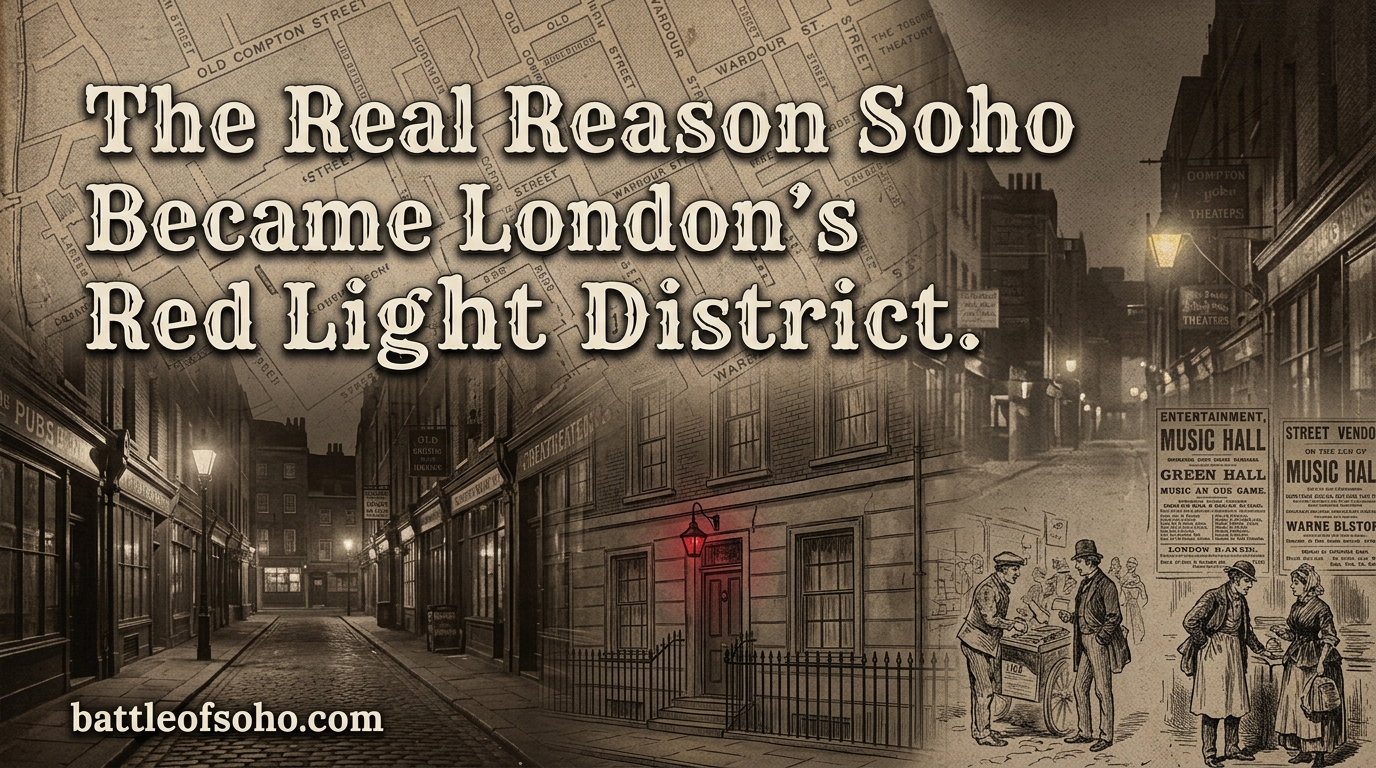
If you walk through Soho today, you will see craft cocktail bars, boutique coffee shops, and media offices. But for over a century, this same patch of central London was the most infamous red light district in Britain. The story of how that happened is not simple or accidental. It is a tale of immigration, poverty, geography, and opportunism that stretches back hundreds of years.
Understanding the Soho London red light district history means tracing a thread that runs from Tudor-era Southwark through the Victorian slums and into the swinging sixties. The sex trade did not start in Soho. It migrated there for very specific reasons that no other London neighborhood could match at the time.
In this article, we will walk through the full timeline, explain what a “walk-up” actually is, and reveal the combination of economic and social forces that made this small grid of streets the center of London’s sex industry. We will also look at what remains today after decades of aggressive gentrification.
Table of Contents
What Is a Red Light District?
A red light district is a neighborhood where prostitution, sex work, and adult entertainment businesses are concentrated. These areas typically host a mix of brothels, strip clubs, peep shows, sex shops, and related venues that operate with varying degrees of official tolerance.
The term itself does not refer to a legally designated zone in most cities. Instead, it describes an area where the sex industry has become visibly established through a combination of demand, lax enforcement, and economic conditions. Amsterdam’s De Wallen is the most famous example globally, with its window displays and regulated brothels drawing millions of curious tourists each year.
London never had a legally sanctioned red light district in the Amsterdam style. What it had instead was a series of neighborhoods where the trade flourished semi-openly, moving across the city over centuries as one area was cleaned up and another was discovered by sex workers and their clients.
Where Does the Term “Red Light District” Come From?
The phrase “red light district” has its origins in the United States during the late 1800s. Railroad workers carried red lanterns as part of their safety equipment, and when they visited brothels during layovers, they would leave these lanterns burning outside the doors or in windows so their crewmates could find them.
Over time, the red glow became associated with the presence of sex work. Brothel owners realized that a red light in a window served as a signal to potential customers, and the color became shorthand for commercial sex across the Western world.
Another theory traces the term even further back to the practice of placing red lights outside Roman brothels. Some historians also point to early Christian symbolism where red lamps hung outside certain establishments to indicate services available within. Regardless of the exact origin, the association between red lighting and the sex trade was firmly established by the early twentieth century.
The term first appeared in print in an 1894 article in the Sandusky Register, an Ohio newspaper, referring to the red-light district of a small American town. From there it spread into common English usage and eventually became the global label for areas where the sex industry concentrates.
London’s Red Light Districts: A Timeline of Movement
The sex trade in London is older than the city itself. But where it operated has shifted dramatically over the centuries, and Soho was simply the final destination in a long chain of displacement. Each time authorities cracked down on one area, the trade simply relocated to the next neighborhood with the right conditions.
Roman London and the City (Pre-13th Century)
In Roman and early medieval London, prostitution was concentrated around the docks and taverns near the Thames. The City of London, the original square mile, had brothels operating near Cheap Street and Smithfield as early as the 1200s. Southwark’s trade was already known by this period, as it lay just across the river from the City’s strict jurisdiction.
Southwark and the Winchester Geese (Tudor Era)
Southwark became London’s first truly organized red light district during the medieval and Tudor periods. The area sat outside the City of London’s legal boundaries in an area called the Liberty of the Clink, which meant City authorities had no power to enforce their strict morality laws there.
The Bishop of Winchester owned much of the land in Southwark and licensed the brothels that operated there. The sex workers in these establishments became known as “Winchester Geese,” a nickname that stuck for centuries. They were legally registered and required to pay fees to the bishop’s estate.
This arrangement was extraordinarily profitable. The brothels of Southwark attracted men from across London who wanted entertainment the City would not permit. Famous publications like Harris’s List of Covent Garden Ladies would later document similar trade, but Southwark was where institutionalized prostitution in London truly began.
Covent Garden (18th Century)
By the 1700s, the center of London’s sex trade had shifted north to Covent Garden. The area around the market and the theaters of the West End attracted large numbers of wealthy men looking for entertainment after shows. Prostitutes worked the piazzas, the coffee houses, and the alleys surrounding the market.
The publication of Harris’s List of Covent Garden Ladies from 1757 to 1795 was essentially a guidebook to the area’s sex workers. It listed names, addresses, physical descriptions, and specialties. The guide was hugely popular and showed how openly the trade operated in this era.
Covent Garden remained the heart of London’s sex trade through the Georgian period. But as the area became more respectable and property values rose, the trade was pushed westward into a neighborhood that was still cheap, still central, and still largely unpoliced: Soho.
The Real Reason Soho Became London’s Red Light District
Soho became London’s red light district because it possessed a unique combination of factors that no other London neighborhood could match at the time. Its central location put it within walking distance of wealthy West End clients. Its cheap rents made it affordable for sex workers and small operators. Its mixed-use street layout provided anonymity. And its history as an immigrant quarter meant it had an established culture of tolerance for outsiders and unconventional lifestyles.
To understand why Soho specifically, you have to start with how the neighborhood developed in the first place.
Why Do They Call It Soho?
The name “Soho” comes from a hunting cry used by falconers and hunters in the Tudor period. Before the area was developed, it was open farmland and hunting ground attached to Westminster. The cry “So Ho!” was used to drive game, similar to “Tally Ho!” The name stuck even as the fields disappeared under buildings.
Huguenot Immigration and the Making of Little France
In the late 1600s, French Huguenot Protestants fled religious persecution in France and settled in Soho in large numbers. The area became known as “Little France” and developed a reputation as a neighborhood of immigrants, artisans, and outsiders. This set the cultural template for everything that followed.
Immigrant communities brought their own social norms and a willingness to tolerate activities that more established English neighborhoods would not accept. Soho became home to French restaurants, foreign newspapers, and a bohemian atmosphere that attracted people living outside mainstream society.
Cheap Rents and Central Location
Throughout the 1700s and 1800s, Soho remained poorer and less developed than its neighbors. While Mayfair to the west was building grand townhouses for aristocrats, Soho was filling up with cramped tenements, workshops, and small dwellings. This made rents cheap.
Cheap rents mattered enormously. Sex workers needed affordable housing. Brothel keepers needed space they could rent profitably. And the trade needed to operate in small, easily concealed units rather than large visible establishments. Soho’s warren of narrow streets and multi-occupancy buildings was perfect.
The neighborhood was also walking distance from the theaters of the West End, the gentlemen’s clubs of St James’s, and the political power of Westminster. Clients did not need to travel far. This geographic advantage cannot be overstated.
The Victorian Explosion
The Victorian era was when Soho’s sex industry truly exploded. London’s population quadrupled between 1800 and 1900, and the vast majority of new arrivals were poor. Women who could not find other work turned to prostitution out of sheer economic desperation. A domestic servant might earn 10 pounds a year. A Soho sex worker could earn that in a week.
Victorian Soho was also notorious for its gin palaces, its disease, and its overcrowding. The 1854 cholera outbreak centered on Broad Street (now Broadwick Street) killed over 600 people in the area. Dr. John Snow famously traced the outbreak to a contaminated water pump, proving cholera was waterborne. The poverty and squalor that enabled the disease also enabled the sex trade to flourish unchecked.
The Five Key Factors
Here is a summary of why Soho specifically became the center of London’s sex industry:
1. Geographic convenience – Walking distance from wealthy clients in Mayfair, the West End, and Westminster.
2. Affordable housing stock – Cheap multi-occupancy buildings perfect for discrete operations.
3. Immigrant culture of tolerance – A neighborhood of outsiders that accepted unconventional lifestyles.
4. Weak policing – Largely outside the City of London’s strict enforcement, with Westminster authorities stretched thin.
5. Economic desperation – Surrounding poverty provided a steady supply of women with few other options.
World War II and the Post-War Boom
World War II transformed Soho’s sex industry yet again. The Blitz destroyed large parts of the area, but the neighborhood that survived became a hub for off-duty soldiers, American GIs, and black marketeers. Soho was where you went for drink, women, and entertainment that the rest of bomb-damaged London could not provide.
American servicemen stationed in Britain brought money, demand, and a tolerance for commercial sex that was more open than British norms. Soho’s bars and clubs catered to them directly. The neighborhood’s reputation as a place where anything could be bought was cemented during the war years.
After the war, Soho became the center of London’s emerging music scene. Jazz clubs like the Bag O’Nails and the Marquee Club opened on and around Soho’s streets. By the late 1950s and early 1960s, skiffle and rock and roll were drawing young crowds to the area. The sex industry and the music industry existed side by side, each feeding the other’s foot traffic.
The “Swinging Sixties” made Soho globally famous. Carnaby Street, just south of Soho proper, became the fashion capital of youth culture. The crowds that came for music and fashion also found the strip clubs, peep shows, and sex shops that lined Old Compton Street and the surrounding alleys.
The Walk-Up System: How Soho’s Sex Trade Actually Worked
The defining feature of Soho’s sex industry was the walk-up flat. A Soho walk-up is a small studio flat, usually on the first or second floor of a narrow building, accessed by climbing a staircase from the street. A sex worker would rent the flat and operate from it, seeing clients who walked in from the street.
The system was brilliantly designed for discretion and efficiency. A typical walk-up consisted of a tiny bedroom and an even smaller bathroom. A woman known as a “maid” would sit in the hallway or at the door to greet clients, take payment, and manage security. The sex worker herself never had to open the door to strangers.
Specific streets in Soho became known for walk-ups. Greys Yard, Green’s Court, Peter Street, and Walker’s Court all had multiple walk-up flats operating simultaneously. A client could walk down these streets and see open doorways with cards indicating that a flat was “in service.” If a card was removed, the worker was busy.
Police tolerance was a key element. For decades, the Metropolitan Police operated a semi-official policy of containment rather than elimination. As long as the trade stayed indoors and out of public view, raids were infrequent. This changed periodically when political pressure mounted, but the walk-ups invariably reopened.
The Street Offences Act 1959
The Street Offences Act of 1959 was a turning point. It criminalized loitering and soliciting for the purposes of prostitution, effectively making street prostitution illegal in a way it had not been before. The act did not criminalize prostitution itself, but it forced the trade almost entirely indoors.
This is exactly what drove more of the trade into Soho’s walk-up flats. Women who had previously worked the streets of Piccadilly Circus and the Strand now needed indoor locations. Soho, with its cheap studio flats and established infrastructure, was the obvious destination. The law intended to clean up London’s streets actually concentrated the sex industry more heavily in Soho.
Telephone Box Cards
Before the internet, Soho’s sex workers advertised using cards pinned to the walls of public telephone boxes. Walking through central London in the 1970s, 80s, and 90s, you would find telephone kiosks plastered with small cards offering “massage,” “French lessons,” or “modeling.” Each card listed a phone number and sometimes a street in Soho.
The cards were technically illegal, and workers risked fines for posting them. But the system was so effective that it persisted for decades. Telephone box cards became a visual symbol of Soho’s sex trade, recognized by Londoners and tourists alike.
The Internet Changes Everything
The rise of the internet in the late 1990s and 2000s disrupted the walk-up model fundamentally. Sex workers could now advertise online, screen clients digitally, and arrange appointments without relying on street visibility or telephone box cards. The physical infrastructure of Soho became less necessary.
At the same time, property prices in Soho were skyrocketing. Studio flats that once served as walk-ups were being converted into offices for media companies, tech startups, and advertising agencies. The economics that had made Soho the center of London’s sex trade for over a century were dissolving.
The Raymond Revuebar: Soho’s Most Famous Adult Venue
No account of Soho’s red light district history would be complete without the Raymond Revuebar. Opened in 1958 by Paul Raymond on Walker’s Court, the Revuebar became the most famous strip club and adult entertainment venue in Britain. It featured burlesque shows, striptease, and performances that pushed the boundaries of what was legally permitted.
The Raymond Revuebar was central to Soho’s identity for over fifty years. Its neon sign was one of the most photographed landmarks in the neighborhood. Raymond himself became one of Britain’s wealthiest men through his Soho property empire, owning much of the real estate that housed the sex industry.
The venue eventually closed in 2004, and the building was converted into a mainstream arts venue called The Box. The closure of the Revuebar was a symbolic moment in Soho’s transformation from red light district to entertainment quarter.
Modern Soho: Gentrification and Transformation
The Soho of 2026 is almost unrecognizable from the Soho of even thirty years ago. Gentrification has transformed the neighborhood at a pace that shocks long-time residents. Property prices in Soho are now among the highest in London, and the cheap studio flats that once housed walk-ups have been renovated into luxury apartments or knocked through into office spaces.
Walk-ups still exist in small numbers, but nothing like the density of the 1970s and 80s. The telephone box cards have disappeared entirely, killed by both the internet and the removal of most public telephone kiosks. Strip clubs and peep shows have closed one by one as landlords find more profitable tenants.
What has replaced the old sex trade is a mix of corporate chains, high-end restaurants, and media offices. Old Compton Street remains the heart of London’s LGBTQ+ scene, with gay bars and clubs that trace their own history through the neighborhood. The music and entertainment tradition continues in venues like Ronnie Scott’s Jazz Club, which has been on Frith Street since 1959.
Many Londoners feel a deep nostalgia for the “old Soho.” The artist and writer Sebastian Horsley, who lived and worked in Soho until his death in 2010, captured this feeling perfectly when he described the neighborhood as a place where “everyone was a loser and everyone was a star.” That Soho is largely gone.
What remains is a neighborhood that is cleaner, safer, and more expensive than it has ever been. Whether that is an improvement or a tragedy depends on who you ask. The sex workers who once operated here have been displaced to other parts of London or have moved entirely online.
Is It Safe to Visit Soho Today?
Soho is one of the safest neighborhoods in central London. The streets are busy well into the early hours of the morning, thanks to the density of bars, restaurants, clubs, and theaters. CCTV coverage is extensive, and police presence is visible, particularly around Soho Square and Old Compton Street.
Visitors walking through Soho at night will find crowds of people enjoying the nightlife rather than anything resembling the old red light district. The neighborhood has become a mainstream entertainment destination rather than a center of vice. You are more likely to encounter a queue for a cocktail bar than a walk-up flat.
If you are interested in Soho’s history, there are several walking tour companies that offer guided explorations of the neighborhood’s past. These tours point out the locations of former brothels, music venues, and famous incidents. They are a good way to understand the layers of history beneath the modern surface.
A few words of advice for visitors: stick to well-lit main streets late at night, be aware that pickpockets can target busy nightlife areas, and remember that Soho is a living neighborhood, not just a tourist attraction. The businesses that remain there are part of an ongoing story.
FAQs
Why was Soho a red light district?
Soho became London’s red light district due to five key factors: its central location within walking distance of wealthy West End clients, cheap rents in multi-occupancy buildings, an immigrant culture that tolerated unconventional lifestyles, historically weak policing compared to the City of London, and surrounding poverty that supplied a steady stream of women with few economic alternatives. These conditions converged in the Victorian era and persisted through the 20th century.
Is Soho still seedy?
Soho in the present day is far less seedy than it was even twenty years ago. Decades of gentrification have replaced most sex industry venues with cocktail bars, restaurants, media offices, and luxury apartments. A small number of adult entertainment venues remain, but the neighborhood is now primarily a mainstream entertainment and nightlife district that attracts tourists, professionals, and partygoers rather than anything resembling a traditional red light district.
Why is Soho famous in London?
Soho is famous as the heart of London’s West End entertainment scene, known historically for its sex industry, music venues, jazz clubs, and bohemian culture. Since the 17th century it has been a neighborhood of immigrants, artists, and outsiders. Today it is celebrated for its nightlife, LGBTQ+ scene centered on Old Compton Street, independent restaurants, media companies, and deep cultural history.
Why do they call it Soho in London?
The name Soho comes from a hunting cry called ‘So Ho!’ used by falconers and hunters during the Tudor period, when the area was open countryside used for hunting. The name persisted even after the land was developed into streets and buildings in the 17th century. It has no connection to the SoHo district in New York City, which stands for South of Houston Street.
What is a Soho walk-up?
A Soho walk-up is a small studio flat, typically on the first or second floor of a narrow building, used by a sex worker to see clients. Customers walk in from the street and climb a staircase to reach the flat. A woman called a ‘maid’ would manage the door and take payment. Walk-ups were concentrated on streets like Greys Yard, Green’s Court, and Walker’s Court, and operated for decades with semi-official police tolerance.
Conclusion
The real reason Soho became London’s red light district was never a single event or decision. It was the convergence of geography, economics, immigration, and poverty over hundreds of years. Soho London red light district history is ultimately the story of a neighborhood that was always a little different from the rest of London, and how that difference was exploited, celebrated, and eventually priced out of existence.
The sex workers, immigrants, musicians, and outsiders who built Soho’s unique character are mostly gone now. But their imprint on the streets remains visible if you know where to look. Walker’s Court still has its narrow passageways. Broadwick Street still has the John Snow pub next to the site of the famous pump. And Old Compton Street still pulses with energy after dark.
If you want to understand London’s social history, spend an afternoon walking through Soho. The layers of the past are all still there, hiding beneath the cocktail menus and office facades. You just have to know what you are looking at.