
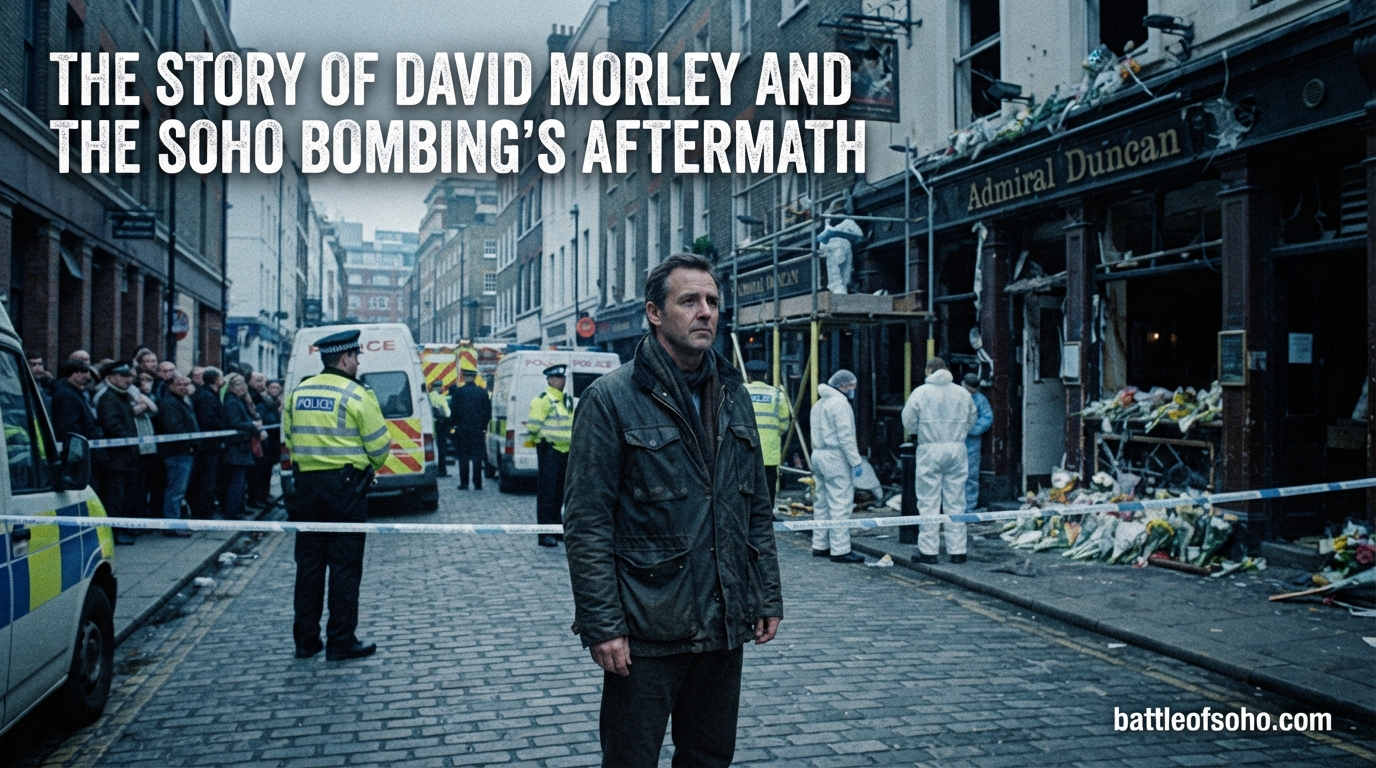
Some stories refuse to fade because they carry a weight that transcends headlines. The story of David Morley and the Soho bombing’s aftermath is one of those. A man who survived one of the most notorious hate-driven attacks in modern London history only to lose his life five years later, Morley’s experience forces us to confront uncomfortable truths about violence, resilience, and the communities we build.
I first encountered David Morley’s story through archival research on LGBTQ+ history in London. What struck me was not just the tragedy, but the way people who knew him spoke about him. They described warmth, humor, and an unshakable presence behind the bar of one of Soho’s most beloved pubs. His nickname was Cinders, and the name fit him perfectly.
In this article, we trace the full arc of David Morley’s story: who he was, what happened on the night of the Soho nail bombing, how the Soho bombing’s aftermath shaped a community, and the devastating circumstances of his death in 2004. This is a story about survival, about a neighborhood that rallied together, and about the work that remains unfinished.
Table of Contents
Who Was David Morley (Cinders)?
David Roger Morley was a barman and assistant manager at the Admiral Duncan pub in Soho, one of London’s most iconic gay venues. Friends and regulars knew him as “Cinders,” a nickname that captured both his warmth and his slightly mischievous sense of humor. He was, by every account, the kind of person who made a room feel more alive just by being in it.
Those who frequented the Admiral Duncan during the late 1990s remember Morley as more than staff. He was a fixture of the community. He greeted newcomers, kept the energy light, and created a space where people felt safe at a time when feeling safe was never guaranteed for LGBTQ+ people in Britain.
He was openly gay, charismatic, and deeply embedded in the social fabric of Soho. His role at the Admiral Duncan placed him at the center of a community that had fought for decades simply to exist openly. That context matters, because the attack that would define the next chapter of his story was not random. It was aimed squarely at the community he served.
Understanding who David Morley was as a person, not just a victim, is the foundation for understanding the full weight of the David Morley Soho bombing aftermath.
The Admiral Duncan Pub: A Soho Institution
The Admiral Duncan, located on Old Compton Street in the heart of Soho, has long been one of London’s most recognizable gay pubs. For decades, it served as a gathering place, a refuge, and a symbol of visible, unapologetic LGBTQ+ life in a city where that visibility had been hard-won.
Old Compton Street itself became a kind of anchor for London’s gay community through the 1980s and 1990s. The Admiral Duncan stood out for its openness, its theatrical atmosphere, and the loyal clientele who treated it like a second home. Morley, as assistant manager, was part of what made the space feel welcoming rather than merely commercial.
This is why the pub became a target. The bomber chose it precisely because of what it represented: a visible, thriving gay community. The attack was designed to instill terror in people who had fought to claim a small piece of public space as their own.
The 1999 Soho Nail Bomb Attack
On the evening of April 30, 1999, a nail bomb detonated inside the Admiral Duncan pub. The device had been planted by David Copeland, a 22-year-old man motivated by far-right ideology and a desire to stir fear and division across London. The Soho bombing was the third in a series of attacks Copeland carried out that month, following explosions in Brixton and Brick Lane that targeted Black and South Asian communities.
The bomb in the Admiral Duncan was packed with nails and designed to cause maximum injury. It went off at approximately 6:37 PM on a Friday evening, when the pub was busy with people beginning their weekend. The blast tore through the small interior, shattering glass and embedding shrapnel in walls, furniture, and bodies.
Three people were killed in the attack: Andrea Dykes, John Light, and Nick Moore. Andrea Dykes was four months pregnant. More than 70 others were injured, many severely. David Morley was behind the bar at the time and took the full force of the blast.
Copeland was arrested the following day after an extensive manhunt. He was later convicted of three counts of murder and sentenced to six life sentences. His stated intent had been to ignite racial and social conflict. Instead, his attacks drew widespread condemnation and an outpouring of solidarity across affected communities.
Surviving the Bombing: Injuries and Recovery
David Morley survived the Admiral Duncan bombing, but his survival came at a steep physical cost. He suffered 44 separate injuries in the blast. His spleen was ruptured and had to be removed. He endured burns, lacerations, and the psychological toll that comes with surviving an event designed to kill everyone in the room.
Recovery was not just about healing wounds. Morley had to rebuild his life after an attack that destroyed the pub he worked in and killed people he knew. The psychological impact of surviving a targeted bombing is profound and long-lasting. Survivors often describe a complex mix of gratitude, guilt, and fear that lingers well after physical injuries have closed.
Friends noted that Morley carried the experience with him but did not let it define him entirely. He returned to work, re-engaged with his community, and tried to move forward. But the scars, both visible and invisible, remained.
The David Morley Soho bombing aftermath was not a clean line from trauma to recovery. It was an ongoing negotiation with what had happened and what it meant for his place in the world.
The Soho Bombing’s Aftermath and Community Response
The response to the Admiral Duncan bombing was immediate and powerful. Within hours, crowds gathered near the pub in shock and grief. A vigil was held at St. Anne’s Church in Soho, drawing hundreds of people from across London. Politicians, community leaders, and ordinary citizens condemned the attack as an act of terrorism aimed at the LGBTQ+ community.
A Disaster Appeal was established to support the victims and their families. Funds poured in from across the country. The appeal helped cover medical costs, counseling, and ongoing support for those whose lives had been upended in a single evening.
The bombing also prompted a broader conversation about hate crimes in Britain. LGBTQ+ organizations pointed out that violence against gay and transgender people was underreported, under-investigated, and frequently dismissed. The Admiral Duncan attack forced a level of public attention that had been absent in earlier, smaller incidents.
For Morley, the aftermath meant becoming, in some sense, a symbol. He had survived. He was a face people could attach to the story. But symbols are heavy, and the burden of representing an entire community’s trauma is not something anyone chooses.
The 2004 Murder Near Waterloo Station
On the morning of October 30, 2004, David Morley was attacked near Waterloo Station in London. He was beaten by a group of teenagers in what authorities later determined was part of a violent spree the group had been conducting that night. The attack was savage and unprovoked. Morley was kicked and punched until he collapsed on the pavement.
He died from his injuries shortly after. The cause of death was consistent with the cumulative trauma of the assault. He was 37 years old.
The group that killed Morley was associated with a phenomenon known as “happy slapping,” a trend at the time in which young people recorded assaults on strangers using early camera phones. The gang had attacked several people that night, but Morley was the only one who did not survive.
Whether the attack on Morley was motivated by homophobia has been a subject of discussion. Some reports suggested the gang did not know his identity or his history as a bombing survivor. Others noted that the violence reflected a broader culture of contempt that made people like Morley vulnerable. What is certain is that a man who had survived a terrorist attack designed to kill him died in an act of senseless street violence five years later.
The Perpetrators and Sentencing
The gang responsible for David Morley’s death was identified through CCTV footage and mobile phone records. Chelsea O’Mahoney, who was 15 at the time, was among those convicted. Several other teenagers were also charged in connection with the attack and the broader spree of violence that night.
In 2005, O’Mahoney and others were convicted of manslaughter. The court heard that the group had been recording their attacks and treating the violence as entertainment. The sentencing drew significant media attention, both because of Morley’s history as a Soho bombing survivor and because of the youth of the perpetrators.
The convictions brought a measure of legal closure, but they could not undo what had been lost. A community that had already grieved the Admiral Duncan bombing was now grieving again, this time for someone who had become a living link to that earlier trauma.
Legacy, Memorial, and the Fight Against Hate
David Morley’s story has been kept alive by those who knew him and by the broader community that recognized itself in his experience. Memorial events have referenced both his survival of the bombing and his death in 2004, framing his life as a reminder of both resilience and vulnerability.
The Admiral Duncan itself was rebuilt and reopened, and it remains a functioning pub on Old Compton Street today. A memorial plaque near the site honors the three people killed in the 1999 attack. Morley’s name is part of the story that the plaque and the building continue to tell.
For the LGBTQ+ community in London, the David Morley Soho bombing aftermath represents a chapter in a longer struggle against hate-motivated violence. The story of a man who survived a neo-Nazi bombing only to be killed by a gang of teenagers underscores the fact that hate takes many forms, and that survival does not guarantee safety.
That reality continues to shape activism, policy discussions, and community organizing in 2026. The work that Morley’s story highlights is unfinished, and acknowledging that is part of honoring his memory honestly.
FAQs
Who was David Morley and what happened to him?
David Morley, known as Cinders, was a barman and assistant manager at the Admiral Duncan pub in Soho. He survived the 1999 Soho nail bombing that killed three people but was murdered in October 2004 near Waterloo Station by a gang of teenagers.
What is the Admiral Duncan pub known for?
The Admiral Duncan is a historic gay pub on Old Compton Street in Soho. It is known as a community landmark and as the site of the April 1999 nail bomb attack carried out by David Copeland, which killed three people and injured over 70.
Who was convicted for David Morley’s murder?
Chelsea O’Mahoney and several other teenagers were convicted of manslaughter in 2005 for the attack on David Morley near Waterloo Station. The group had been conducting a spree of assaults that night, some of which they recorded on mobile phones.
What was happy slapping?
Happy slapping was a trend in the early 2000s in which attackers assaulted strangers and recorded the violence on early camera phones. The gang that killed David Morley was associated with this phenomenon, treating the assaults as entertainment.
Conclusion
The story of David Morley and the Soho bombing’s aftermath is not a simple narrative of tragedy and recovery. It is a layered account of a man who embodied a community’s resilience, survived an attack designed to destroy that community, and then lost his life to a different kind of violence that the same community has long worked to confront.
What stays with me is the testimony of people who knew him. They do not describe a victim. They describe a friend, a colleague, and a presence that made a difficult world a little easier to inhabit. That is the legacy that matters, and it is worth holding onto.
If there is a takeaway from the David Morley Soho bombing aftermath, it is that the fight against hate does not end with a single conviction or a single memorial. It continues in the daily work of creating spaces where people can exist openly and safely. That work is unfinished, and stories like Morley’s are why it must continue.