
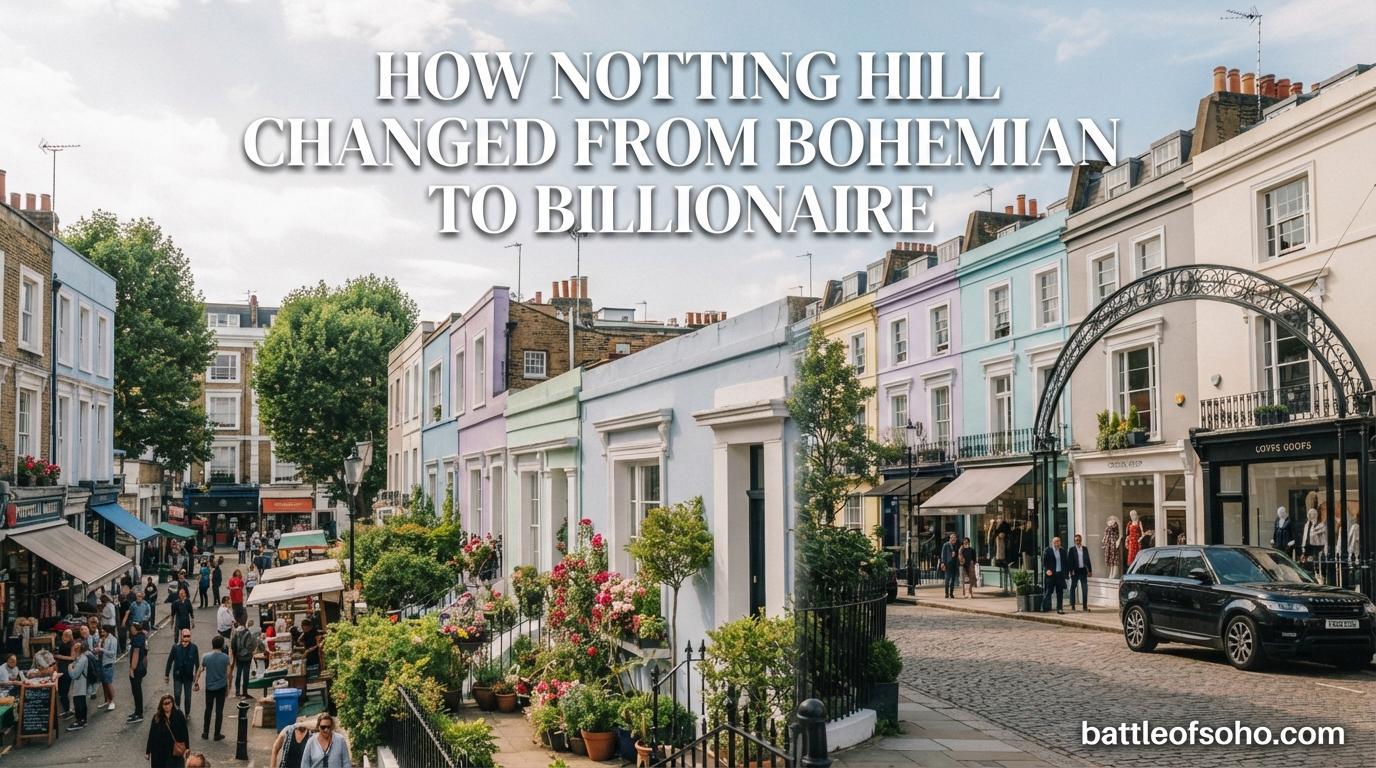
Notting Hill is one of London’s most striking contradictions. Walk down Portland Road today and you will find homes worth tens of millions of pounds. Walk a few streets north and you reach the base of Grenfell Tower, where 72 people died in 2017 in one of Britain’s worst modern tragedies. This is the story of how Notting Hill changed from bohemian to billionaire, a transformation that took roughly six decades and was accelerated by a single romantic comedy that grossed $360 million at the box office.
The area we now associate with pastel-colored Georgian townhouses, celebrity residents, and boutique shopping was once defined by its Caribbean community, working-class families, and thriving artistic scene. Our team has spent months researching historical records, local resident accounts, and property data to piece together how this West London neighborhood became one of the most expensive postcodes in the United Kingdom.
What makes Notting Hill’s story different from other gentrified London areas is the role that popular culture played. The 1999 film “Notting Hill,” starring Hugh Grant and Julia Roberts, turned a neighborhood into a global brand almost overnight. But the real transformation began long before cameras rolled, and the consequences are still unfolding today.
In this article, we trace the full arc of Notting Hill’s evolution. We cover the 1958 race riots that are largely absent from competing coverage, the Caribbean community that gave the area its cultural soul, the property price explosion that displaced thousands of families, and the current reality where one neighborhood contains both extreme wealth and deep inequality. Whether you study urban development, love London history, or simply wonder why your favorite market stall has vanished, this is the complete picture.
Table of Contents
How Notting Hill Changed From Bohemian to Billionaire: The Short Answer
Notting Hill transformed from a diverse, working-class, and bohemian neighborhood into one of London’s wealthiest districts through a process that unfolded in several distinct stages. Understanding these stages is the key to grasping how gentrification reshaped this corner of West London.
The transformation happened in roughly five phases:
- Mid-19th century: The area was developed from brick fields and pig farms into housing, much of it poorly built and quickly deteriorated into slum conditions.
- 1940s-1950s: Caribbean immigrants arriving on the Empire Windrush and subsequent ships settled in Notting Hill’s cheap rental housing, establishing a vibrant West Indian community.
- 1958: Race riots targeting Caribbean residents shocked the nation and led directly to the creation of the Notting Hill Carnival as an act of cultural defiance.
- 1960s-1980s: Artists, musicians, and bohemian residents moved in attracted by low rents, creating a counter-cultural scene alongside the Caribbean community.
- 1999-2000s: The film “Notting Hill” triggered explosive property price growth, cinematic tourism, and rapid gentrification that displaced long-term residents and businesses.
By 2026, Notting Hill ranks among the most expensive residential areas in London. Properties that once housed factory workers and recent immigrants now sell for between £500,000 for a modest flat to over £6 million for a restored Georgian townhouse. The area that once embodied multicultural London has become a symbol of wealth, exclusivity, and the sharp end of gentrification.
The Bohemian Origins: Notting Hill Before the Money
To understand how Notting Hill changed from bohemian to billionaire, you have to start at the beginning. The neighborhood’s character was shaped by poverty, immigration, and artistic rebellion long before estate agents discovered its charm.
From Brick Fields to Slum Housing: The Early Years
In the early 19th century, the land that became Notting Hill was largely rural. It was known for its brick fields and pig farms, supplying materials and food to the growing city of London. The area was part of the Kensington Potteries, a zone of kilns and clay pits that few would have predicted would become one of the most desirable addresses in Britain.
Development began in earnest in the 1840s when a developer named John Ladbroke began laying out streets and building houses on the elevated ground. The architecture was intended to be grand. Elegant stucco terraces and large garden squares were designed to attract the upper middle class. But the reality of the development was far messier.
Many of the houses were poorly constructed. Some were left unfinished when funding ran dry. Larger properties were subdivided into cramped rental rooms. By the late 19th and early 20th centuries, parts of Notting Hill had deteriorated into some of London’s worst slum housing. The area around Portland Road, now one of the most expensive streets in the UK, was described in historical accounts as a notorious rookery of overcrowded, unsanitary dwellings.
This pattern of grand intentions collapsing into poverty defined Notting Hill for over a century. The large Victorian and Georgian houses, built for single wealthy families, instead housed dozens of working-class tenants. This is the physical and social foundation upon which the later bohemian and Caribbean communities were built.
The 1958 Race Riots and the Birth of a Community
The story of how Notting Hill changed from bohemian to billionaire cannot be told without confronting the 1958 race riots. This is one of the most significant events in the neighborhood’s history, yet it is largely missing from competing articles about the area’s transformation.
After World War II, Britain faced severe labor shortages and actively recruited workers from its Caribbean colonies. The arrival of the Empire Windrush in 1948 marked the beginning of large-scale Caribbean immigration to Britain. Many of these new arrivals settled in Notting Hill, where cheap rooming houses and multi-occupied buildings offered affordable rents that mainstream landlords in other areas would not provide to Black immigrants.
By the late 1950s, tensions were simmering. Working-class white residents in the area faced their own housing pressures, and far-right groups like the White Defence League actively stoked racial hatred. In August 1958, these tensions exploded into violence.
Mobs of white men, some reportedly numbering in the hundreds, attacked Caribbean residents on the streets of Notting Hill over several nights. Homes were vandalized. People were beaten. The violence was fueled by racist rhetoric and economic anxiety, a combination that would be recognized in gentrification debates for decades to come. The Metropolitan Police was widely criticized for its slow and inadequate response.
The riots had a profound effect on the Caribbean community. Rather than driving them out, the violence galvanized a sense of solidarity and determination to claim Notting Hill as home. In January 1959, Claudia Jones, a Trinidadian-born activist and journalist, organized an indoor Caribbean Carnival at St Pancras Town Hall. It was broadcast to the nation and is widely regarded as the spiritual birth of the Notting Hill Carnival.
This is the historical context that most stories about Notting Hill’s gentrification skip. The area’s bohemian character was not just about artists and cheap rents. It was forged in the aftermath of racial violence, in the resilience of a community that refused to be driven away, and in the cultural traditions that would eventually attract millions of visitors every year.
The Caribbean Community and Cultural Roots
Throughout the 1960s and 1970s, Notting Hill’s Caribbean community grew and deepened its roots. Ladbroke Grove became the heart of West Indian life in London. Grocers sold plantains and scotch bonnet peppers. Record shops blasted reggae and calypso. Barbershops and beauty salons served as community hubs where news and gossip flowed freely.
The first outdoor Notting Hill Carnival took place in 1964, organized by Rhaune Laslett, a local community worker. It was a small street fair designed to bring the neighborhood together. By the 1970s, the Carnival had evolved into a specifically Caribbean celebration, growing larger each year and drawing performers from across the diaspora.
Alongside the Caribbean community, Notting Hill attracted a bohemian crowd of artists, writers, and musicians drawn by the cheap rents and counter-cultural atmosphere. Actresses worked market stalls between roles. Musicians rehearsed in basements. The area had an energy that money could not buy, precisely because money had not yet arrived in any significant quantity.
A local greengrocer who has worked in the area for decades recalled the era vividly: “Notting Hill was more fun in the Sixties, when everyone was on LSD, and I don’t doubt it. Actresses manned stalls when they were resting.” This was the neighborhood that existed before the cameras arrived. It was messy, vibrant, and genuinely diverse in a way that the polished boutique version of Notting Hill can only approximate.
Notting Hill Carnival: The Cultural Anchor That Survived
The Notting Hill Carnival is arguably the single most important cultural institution that connects today’s Notting Hill to its bohemian and Caribbean past. Understanding how the Carnival started, how it survived, and the tensions it faces today is essential to understanding the neighborhood’s full story.
The Carnival began as a direct response to the 1958 race riots. Claudia Jones’s indoor event in 1959 was conceived as a way to celebrate Caribbean culture and bridge racial divides. When the event moved outdoors in the mid-1960s under the guidance of community leaders, it grew into a massive street celebration featuring steel bands, calypso music, and traditional Caribbean food.
By the 1970s, the Carnival was drawing tens of thousands of people and had become Europe’s largest street festival. It was not always a peaceful event. Clashes between Carnival-goers and police in 1976 resulted in arrests and negative media coverage. But the Carnival persisted, and each year it reaffirmed the Caribbean community’s right to occupy public space in a neighborhood that was beginning to attract wealthier, whiter residents.
The Carnival’s survival through decades of gentrification is remarkable, but it has not been without friction. Long-term market trader John from Portobello Camera captured the irony perfectly: “So-called people don’t want nothing to do with the carnival. The very thing they love about the area they don’t want to participate in. They board up their property, lock it down, and fly away.”
This dynamic captures the core tension of how Notting Hill changed from bohemian to billionaire. New residents are attracted to the area’s cultural cachet, its diversity, and its artistic legacy. But many of those same residents treat the living expression of that culture as a nuisance to be endured rather than a tradition to be celebrated. The Carnival draws over two million visitors annually, making it the largest street festival in Europe. It pumps an estimated £93 million into the local economy each year. Yet it still faces ongoing battles over policing costs, noise complaints, and route restrictions pushed by residents who would prefer a quieter August bank holiday.
The Carnival remains the strongest thread of cultural continuity between the Notting Hill of the 1960s and the Notting Hill of 2026. It is the one institution that refuses to be priced out, even as the community that created it has largely been displaced to other parts of London.
The 1999 Film That Changed Everything
If the Caribbean community gave Notting Hill its soul and the bohemian scene gave it its edge, the 1999 film gave it its brand. “Notting Hill,” directed by Roger Michell and written by Richard Curtis, was not the first cultural work to feature the neighborhood. But it was the most consequential by a wide margin.
The Blue Door Effect: Cinematic Tourism
The film told the story of a humble travel bookshop owner, played by Hugh Grant, who falls in love with the world’s most famous actress, played by Julia Roberts. The setting was a romanticized, idealized version of Notting Hill: charming streets, quirky independent shops, friendly neighbors, and a famous blue door that served as the entrance to Grant’s character’s flat.
The film was a massive commercial success, grossing $360 million worldwide on a budget of approximately $42 million. But its real impact was not at the box office. It was on the streets of Notting Hill itself.
Almost immediately after the film’s release, tourists began arriving in Notting Hill in search of the blue door, the travel bookshop, and the Portobello Road Market scenes they had seen on screen. The blue door, located at 280 Westbourne Park Road, became one of the most photographed doors in the world. Residents reported daily groups of tourists posing outside, sometimes in the hundreds during peak season.
Frank Akinsete, who has run a vintage shop in the area for 35 years, shared a memorable anecdote about the tourist influx: “When I was young and naughty, when people came asking for the blue door I used to send them to Trellick Tower, because it was really rough up there. Now it’s a heritage site.” His joke captures how the area’s reputation shifted so dramatically that even a notorious housing estate became a tourist attraction.
Property Values Jumped 25 Percent in 18 Months
The film’s most measurable impact was on property prices. Howard Malin, owner of the Notting Hill Bookshop and a 40-year resident of the area, described the effect in stark terms: “The influence of the film was dramatic and the area became very rapidly gentrified, within about 18 months. I think property values jumped by a quarter, it was insane.”
A 25 percent increase in property values in just 18 months is extraordinary by any standard. To put that in perspective, average UK house price growth in a typical year runs between 2 and 8 percent. What happened in Notting Hill after the film was not normal market appreciation. It was a cultural event translated directly into property value.
The mechanism is not mysterious. The film showcased Notting Hill’s architecture, its market, and its charming streets to a global audience of hundreds of millions of people. Estate agents reported a surge of interest from international buyers, particularly from the United States and continental Europe. People who had never set foot in London were suddenly inquiring about properties in a neighborhood they had seen on screen.
This influx of demand collided with a limited housing supply. Notting Hill’s housing stock is largely fixed because it consists of period properties in conservation areas where new development is heavily restricted. When demand surges against a fixed supply, prices spike. And when the demand comes from global wealth rather than local wages, the gap between prices and local affordability becomes unbridgeable.
The Notting Hill Bookshop and the Travel Bookshop Legacy
The Travel Bookshop that inspired the film’s bookshop setting became a pilgrimage site for fans. It drew visitors from around the world who wanted to recreate the meet-cute moment from the movie. The real Travel Bookshop, located on Portobello Road, operated for decades before closing in 2011, a victim of rising rents and the shift to online book retail.
The Notting Hill Bookshop, a separate but related institution on Blenheim Crescent, has continued to operate. Howard Malin, its owner, has been one of the most vocal witnesses to the neighborhood’s transformation. His bookshop represents one of the surviving independent businesses that give the area some of its remaining character.
But the survival of a few beloved shops does not offset the broader pattern. The film created a tourist economy that rewarded businesses catering to visitors over businesses serving local residents. Souvenir shops, overpriced cafes, and boutique chains replaced the greengrocers, hardware stores, and community-oriented businesses that had served the neighborhood for generations.
Portobello Road Market: From Working-Class Hub to Tourist Attraction
Portobello Road Market is one of the world’s most famous street markets. It runs through the heart of Notting Hill and has been a commercial center for the area since the 19th century. But the market of 2026 bears little resemblance to the market that served the working-class and Caribbean communities of the 1960s and 1970s.
Originally, Portobello Market was a genuine working-class market. It sold food, household goods, and secondhand items at prices local residents could afford. The famous antiques section developed over time as dealers recognized the market’s growing reputation, but even the antiques trade was grounded in genuine local commerce rather than tourism.
As Notting Hill’s reputation grew in the 1980s and 1990s, the market began to shift. Stallholders noticed that an increasing percentage of their customers were tourists rather than locals. The products on sale changed to match. Fresh produce and household goods gave way to antiques aimed at collectors, then to souvenirs aimed at day-trippers, and finally to the generic merchandise that fills many stalls today.
This transformation has not been passive or organic. It has been driven by policy decisions, rent structures, and development plans that favor tourism revenue over community commerce. The most recent flashpoint is a proposed council revamp of the market that has drawn fierce opposition from long-term traders.
Ellis Jenkins, a fifth-generation market trader, expressed the fears of many stallholders: “The council are looking to revamp this market and gentrify it, remove all the character from it.” His family has traded on Portobello Road for generations. The proposed changes include restrictions on van parking for stallholders, which traders argue would make it impossible for them to transport their goods.
Marion Gettleson, who has run an antiques shop on Portobello Road for 50 years, was even more blunt. She called the council’s plans “an absolute shortcut to destroying this market” and added: “The council wants a sea of tranquility where everyone is paying 40 percent income tax because they don’t need public services.”
Her accusation cuts to the heart of how Notting Hill changed from bohemian to billionaire. The market was built by working-class traders. It became famous because of its character. And now the very success of that character is being used as justification for changes that would destroy it. The market that gave Notting Hill its identity is being treated as an obstacle to the area’s continued upmarket development.
The Property Price Explosion: A Timeline
Understanding how Notting Hill changed from bohemian to billionaire requires hard numbers. The story of this transformation is written in property prices, and the data tells a story of exponential growth that far outpaced the rest of London.
Here is how property prices in Notting Hill evolved over the decades:
- 1970s: Notting Hill remained one of the cheaper areas of central West London. Multi-occupied Victorian houses could be purchased for the equivalent of tens of thousands of pounds. Many properties were in poor condition, having been subdivided into bedsits and rooming houses.
- 1980s: The first wave of gentrification began. Young professionals started buying and renovating period properties. Prices rose steadily but remained within reach of middle-class buyers.
- 1990s (pre-film): Property prices in Notting Hill were rising in line with the broader London market. A typical two-bedroom flat could be purchased for around £150,000 to £200,000.
- 1999-2001: The film effect hit. Property values jumped approximately 25 percent within 18 months of the film’s release. By 2001, the same two-bedroom flat that cost £200,000 in 1998 was selling for £300,000 or more.
- 2000s: The boom continued. International buyers entered the market in force. Prices for prime properties in Notting Hill reached £1 million and above. The average price per square foot approached £1,000 in the most desirable streets.
- 2010s: Post-financial-crisis recovery pushed prices higher. By 2015, Forbes reported that average prices in prime Notting Hill reached approximately £1,500 per square foot. A two-bedroom flat typically cost between £500,000 and £800,000. Restored Georgian townhouses sold for £3 million to £6 million and above.
- 2026: Notting Hill remains one of the most expensive areas in London. The most desirable properties on streets like Portland Road and Stanley Crescent command prices well into eight figures. Even modest apartments in the area are priced beyond the reach of average London earners.
To contextualize this growth, consider that a property purchased for £200,000 in 1998 could reasonably be worth £1.5 million or more today. That represents roughly a seven-fold increase in 28 years. Over the same period, average UK wages increased by approximately 100 to 120 percent. The gap between property prices and earnings in Notting Hill is now so wide that the area is functionally inaccessible to anyone relying on a normal salary.
This is not just about individual wealth. It is about the systematic displacement of entire communities. When property values increase seven times faster than wages, the people who gave an area its character are inevitably priced out. The Caribbean families, the artists, and the working-class residents who made Notting Hill interesting in the first place cannot afford to live there. Their departure is not a coincidence of the market. It is a direct consequence of the price explosion.
The Architecture: Pastel Houses and Hidden Gardens
The visual identity of Notting Hill is inseparable from its architecture. Those pastel-colored Georgian townhouses, photographed millions of times for Instagram and travel guides, are not just a pretty backdrop. They are physical artifacts of the neighborhood’s complex history.
The distinctive architecture of Notting Hill was created in the mid-19th century during the Ladbroke Estate development. The layout was designed with a series of communal garden squares, a feature that was relatively innovative for its time. These gardens were intended to provide shared green space for residents of the surrounding terraces.
The pastel colors that make Notting Hill so photographable are largely a later addition. Many of the houses were originally painted in more conventional colors or left as bare stucco. The vibrant pinks, blues, yellows, and greens that define the area’s aesthetic today became popular as the neighborhood gentrified. Property owners discovered that distinctive colors increased the visual appeal and, consequently, the value of their homes.
The communal gardens are one of Notting Hill’s most exclusive features. These private squares are accessible only to residents of the surrounding houses who hold keys. In an area where public green space is limited, these gardens represent a significant amenity. Forbes highlighted them as a key selling point, noting that access to a communal garden can add substantial value to a property.
There is an irony in the architecture of Notting Hill that encapsulates the neighborhood’s transformation. These grand houses were built for wealthy Victorian families, then deteriorated into slum housing for the working class and immigrants, and have now been restored to their original grandeur at prices that exceed anything their original builders could have imagined. The architecture has come full circle, but the community has not.
Charlie Cunningham-Reid, an estate agent with Chestertons who specializes in the area, explained that many large properties have been split into flats for young professionals who cannot afford whole townhouses. This creates a demographic that is wealthy by national standards but priced out of the most exclusive properties. Even within Notting Hill’s wealth, there are tiers of affordability.
The Coronet Theatre and the Gate Theatre, both fringe venues in Notting Hill, represent the cultural infrastructure that remains from the area’s more bohemian era. They continue to program adventurous work, but their audiences have changed alongside the neighborhood. The days when struggling artists could live around the corner and pop in for a rehearsal are long gone.
Two Cities: Grenfell Tower and the Billionaire Next Door
No discussion of how Notting Hill changed from bohemian to billionaire is complete without addressing the stark inequality within the same borough. Notting Hill sits within the Royal Borough of Kensington and Chelsea, the wealthiest local authority in England. But that headline statistic masks a reality of extreme disparity.
Journalist Tanya Gold, a former resident of the area, captured this duality in Unherd: “Notting Hill is two cities with two kinds of stories, the dreamlike and the deadly.” Her observation refers to the jarring contrast between the polished streets of million-pound homes and the reality of social housing within the same borough.
The most devastating expression of this contrast is Grenfell Tower. On June 14, 2017, a fire tore through the 24-story residential tower in North Kensington, just a short distance from the expensive streets of Notting Hill. Seventy-two people died. The fire was caused by cheap, flammable cladding installed during a refurbishment of the building. An official inquiry found systemic failures across the council, the tenant management organization, and the firms involved in the refurbishment.
Grenfell Tower exposed the human cost of inequality in one of Britain’s richest boroughs. While millions were being spent on aesthetic improvements to private properties nearby, residents of a social housing tower were living with dangerous materials that should never have been approved. The inquiry revealed that residents’ warnings about fire safety had been repeatedly dismissed by the authorities.
The economic contrast is quantifiable. According to data cited in the Unherd investigation, residents of one part of Notting Hill paid more in capital gains tax in 2020 than the residents of three major British cities combined. This is not a metaphor or an exaggeration. A single London neighborhood generated more capital gains tax revenue than entire cities elsewhere in the country.
The BBC documented this phenomenon on Portland Road, which went from being described as a slum to ranking as one of the most expensive streets in the UK. The BBC report called Portland Road “a microcosm of super-gentrification,” a street where every house tells a story of dramatic transformation.
Reddit discussions about Notting Hill and gentrification frequently highlight this anger. One commenter wrote: “Gentrification isn’t passive because it requires an active decision to underfund and devalue an area so it can be carved up for profit interests.” This perspective frames gentrification not as an inevitable market process but as a policy choice that benefits some communities at the direct expense of others.
A working-class resident quoted in local media expressed the identity struggle that comes with Notting Hill’s transformation: “Being a resident from a working-class background we say Ladbroke Grove. Calling it Notting Hill does bother me. Because of everything that comes with Notting Hill. The working class will be moved out, and the history will be rewritten in a heartbeat.” The distinction between Ladbroke Grove and Notting Hill is not just geographic. It is a refusal to let the area’s working-class history be erased by its billionaire present.
Then vs. Now: Notting Hill Compared
The transformation of Notting Hill is most clearly understood through direct comparison. Here is how the neighborhood has changed across key dimensions.
Demographics: In the 1960s, Notting Hill was home to a large Caribbean community, working-class families, and a bohemian artistic scene. The area was genuinely diverse in terms of race, class, and occupation. By 2026, the demographic profile has shifted dramatically. The area is predominantly affluent, with a high concentration of professionals in finance, media, and technology. The Caribbean community has largely been displaced to areas further out in West and Northwest London.
Property prices: In the 1970s, properties in Notting Hill were among the cheapest in West London due to their condition and the area’s reputation. Multi-occupied houses sold for the equivalent of tens of thousands of pounds. Today, the same properties sell for between £500,000 for a flat to over £6 million for a restored townhouse. Price per square foot in prime locations approaches or exceeds £1,500.
Business landscape: In the bohemian era, Portobello Road and the surrounding streets were lined with greengrocers, hardware stores, cheap eateries, and community-oriented shops. The market served local residents with affordable food and goods. Today, the business landscape is dominated by boutique shops, high-end restaurants, estate agents, and souvenir stalls catering to tourists.
Cultural character: The Notting Hill of the 1960s and 1970s was raw, creative, and unpredictable. Live music spilled out of pubs, artists occupied cheap studio space, and the streets had a genuine energy born of diversity and struggle. The Notting Hill of 2026 is polished, curated, and safe. It is beautiful, but many long-term residents describe it as sterile and soulless by comparison.
The Carnival: The one institution that bridges then and now is the Notting Hill Carnival. It remains Europe’s largest street festival and the most visible expression of the Caribbean culture that shaped the area. But even the Carnival is contested, with wealthy residents regularly complaining about noise, disruption, and policing costs.
This comparison reveals a pattern that extends beyond Notting Hill. When an area becomes desirable, the very qualities that made it attractive to new residents, diversity, character, and cultural energy, are gradually eroded by the economic forces that follow desirability. The result is a neighborhood that looks the part but has lost the substance.
How Notting Hill Compares to Other Gentrified London Areas
Notting Hill’s gentrification is dramatic, but it is not unique. London has seen similar transformations across multiple neighborhoods in recent decades. Comparing Notting Hill to other areas helps contextualize what happened and what might happen next.
Brixton: Brixton, in South London, shares Notting Hill’s strong Caribbean heritage. Like Notting Hill, Brixton experienced waves of gentrification that displaced long-term residents and changed the commercial landscape. But Brixton’s gentrification happened later and more gradually. The area still retains a visible Caribbean presence, though rising rents continue to pressure the community. Brixton’s market, Brixton Village, has been at the center of debates about whether food-focused redevelopment preserves or destroys local culture.
Hackney: Hackney, particularly areas like Dalston and London Fields, underwent rapid gentrification in the 2000s and 2010s. The trajectory is similar to Notting Hill’s: artists moved in for cheap rents, their presence made the area fashionable, property prices rose, and working-class residents were displaced. Hackney’s transformation happened faster than Notting Hill’s in some respects, driven by its proximity to Shoreditch and the tech industry cluster around Old Street.
Shoreditch: Shoreditch represents perhaps the most rapid gentrification in modern London. What was a gritty, industrial area in the 1990s became a hub for tech companies, luxury apartments, and high-end restaurants within roughly two decades. Shoreditch’s transformation was driven more by commercial development than by a single cultural event, unlike Notting Hill’s film-driven boost.
What sets Notting Hill apart from these other areas is the speed and specificity of its transformation trigger. The 1999 film acted as an accelerant on a gentrification process that was already underway but had not yet reached full velocity. No other London neighborhood has experienced a comparable single-event catalyst. This makes Notting Hill’s story particularly instructive for understanding how popular culture can reshape urban economics.
Another distinguishing factor is Notting Hill’s location within Kensington and Chelsea, the wealthiest borough in England. While Brixton sits in Lambeth and Hackney remains its own borough with pockets of deprivation, Notting Hill is surrounded by extreme wealth. Its gentrification was not an island of affluence in a sea of working-class neighborhoods. It was an extension of existing wealth into an area that had resisted it for decades.
Frequently Asked Questions
When did Notting Hill become posh?
Notting Hill began its transformation into an affluent area in the 1980s with the first wave of professional buyers renovating period properties. The process accelerated dramatically after the 1999 film ‘Notting Hill,’ which caused property values to jump approximately 25 percent within 18 months. By the mid-2000s, the area was firmly established as one of London’s most expensive neighborhoods.
How did the Notting Hill film affect property prices?
The 1999 film ‘Notting Hill’ starring Hugh Grant and Julia Roberts triggered a surge of international interest in the area. According to local business owner Howard Malin, property values jumped by approximately a quarter within 18 months of the film’s release. The global exposure attracted wealthy international buyers to a market with limited housing supply, driving rapid and sustained price growth.
What happened to the Caribbean community in Notting Hill?
The Caribbean community that gave Notting Hill much of its cultural identity has been largely displaced by rising property prices and rents. Many families moved to more affordable areas of West and Northwest London. The Notting Hill Carnival, which originated as a response to the 1958 race riots, remains the most visible surviving expression of the area’s Caribbean heritage, though the community that created it no longer lives there in significant numbers.
Is Portobello Market losing its character?
Many long-term traders and residents believe Portobello Market is losing its authentic character. The market has shifted from serving local working-class residents with affordable goods to catering primarily to tourists with souvenirs and antiques. A proposed council revamp has drawn fierce opposition from traders like Ellis Jenkins and Marion Gettleson, who fear the changes will further erode the market’s traditional identity.
How did Notting Hill Carnival start?
Notting Hill Carnival originated from the 1958 race riots, when attacks on Caribbean residents galvanized the community. In 1959, activist Claudia Jones organized an indoor Caribbean Carnival in response. The first outdoor event was held in 1964, organized by community worker Rhaune Laslett. It grew into Europe’s largest street festival, now attracting over two million visitors annually and generating an estimated 93 million pounds for the local economy.
What is the most expensive street in Notting Hill?
Portland Road is widely regarded as one of the most expensive streets in Notting Hill and among the priciest in the UK. The BBC documented its transformation from a Victorian slum to a street of multi-million-pound homes, calling it a microcosm of super-gentrification. Stanley Crescent and other streets overlooking communal gardens also command some of the highest prices in the area.
What Notting Hill’s Transformation Teaches Us About London
The story of how Notting Hill changed from bohemian to billionaire is ultimately a story about what London values and what it is willing to sacrifice. A neighborhood that was forged in the aftermath of racial violence, built by Caribbean immigrants and working-class families, and enlivened by artists and musicians has been transformed into a curated postcard of its former self.
The film that catalyzed this transformation presented a fantasy. It showed a charming, diverse, and bohemian neighborhood without engaging with the struggles that made it that way. The irony is that the film’s success helped destroy the very qualities it celebrated. Rising prices drove out the Caribbean community, the artists, and the working-class families. What remains is beautiful, wealthy, and in the words of many long-term locals, something essential has been lost.
Notting Hill’s transformation is not an isolated case. It is a pattern visible across London, from Brixton to Hackney to Shoreditch. But Notting Hill remains the most dramatic example because of the speed of its change, the role of a single film in accelerating it, and the starkness of the inequality that persists within its borders. The neighborhood where residents paid more capital gains tax than three British cities combined is the same borough where Grenfell Tower stood.
As we look at London in 2026, the question is not whether gentrification will continue. It will. The question is whether the city can find ways to preserve the cultural communities and working-class residents that give neighborhoods their character before that character becomes nothing more than an aesthetic preserved for the wealthy. The story of Notting Hill shows what happens when it cannot.