
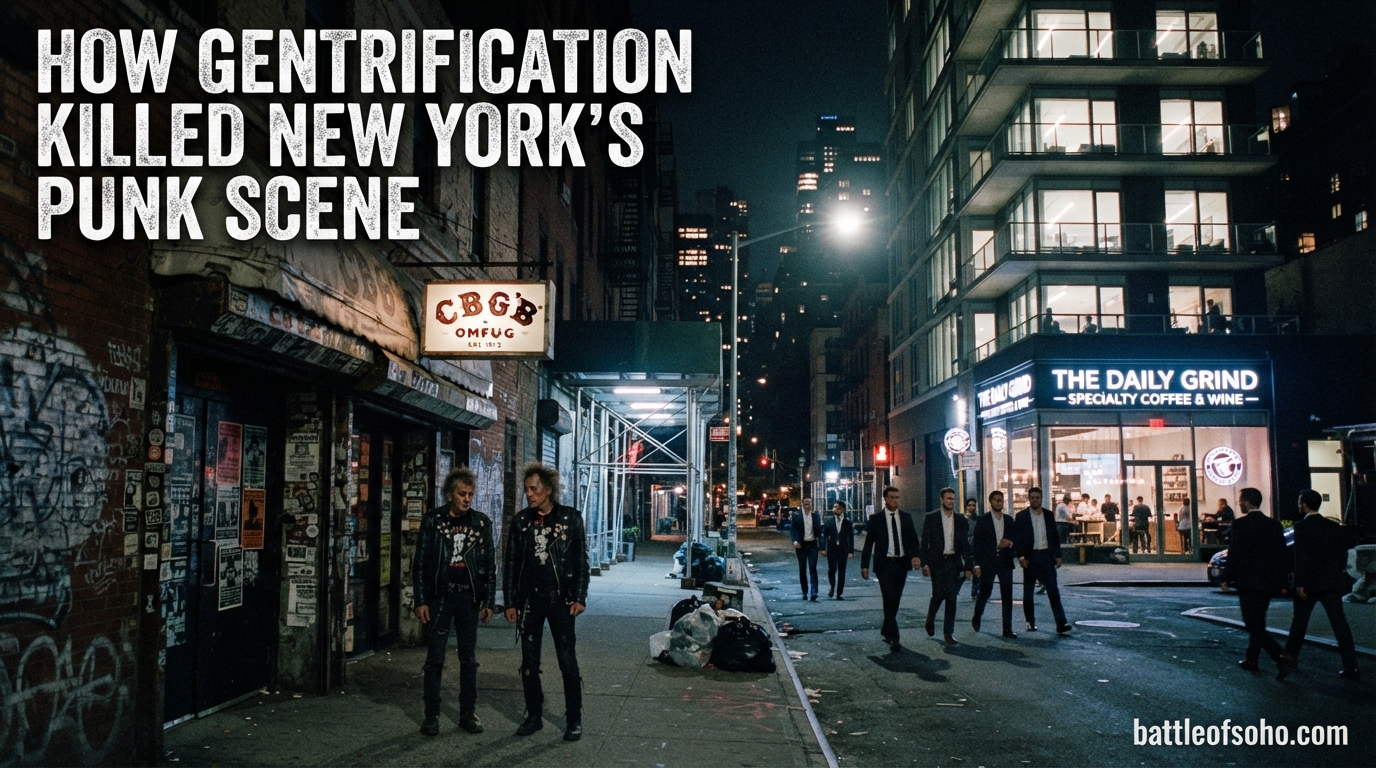
Walk down the Bowery today and you will find a John Varvatos boutique where CBGB once stood. The club that launched the Ramones, Patti Smith, and Talking Heads is now a luxury clothing store. That single transformation captures how gentrification killed New York’s punk scene more powerfully than any statistic could.
The story of how gentrification killed New York’s punk scene is not just about one club closing. It is about an entire ecosystem of cheap rent, abandoned buildings, working-class communities, and creative desperation being systematically dismantled by real estate speculation over five decades.
Punk was born from urban decay. It died from urban renewal. And the neighborhoods that nurtured it, from the Lower East Side to Williamsburg, were transformed beyond recognition by the same economic forces that made the music possible in the first place.
In this article, I will walk you through the complete history of how NYC’s punk scene rose from the rubble of the 1970s fiscal crisis and was extinguished by the luxury condo boom that followed. You will learn about the venues that were lost, the neighborhoods that were transformed, the economic forces behind the displacement, and what remains of the scene today in 2026.
Table of Contents
The Birth of Punk in 1970s New York
New York City in the 1970s was bankrupt, dangerous, and falling apart. Buildings stood empty across the Bronx, the Lower East Side, and Brooklyn. Landlords burned their own properties for insurance money because they were worth more as rubble than as rentals.
This devastation created the exact conditions punk needed to thrive. Cheap or abandoned spaces meant artists could live, rehearse, and perform for almost nothing. A musician working a part-time job could afford a roach-infested apartment on Avenue B and still have time to practice, write, and play shows.
The city’s fiscal crisis of 1975 gutted municipal services. Garbage piled up. Subway cars were covered in graffiti and barely functioned. Times Square was a haven for sex workers and drug dealers. For middle-class families, this was a nightmare. For young artists with no money and big ideas, it was an opportunity.
The working-class and immigrant communities that populated these neighborhoods provided the social fabric that punk grew from. The Lower East Side was home to Puerto Rican, Ukrainian, and Polish communities. The East Village had a mix of artists, drag queens, and counterculture figures who had been there since the beatnik era.
These were not trendy neighborhoods. They were affordable because nobody with money wanted to live there. That is the paradox at the heart of this story. The conditions that made punk possible were conditions of poverty, abandonment, and municipal neglect.
The Velvet Underground Template
Before the Ramones or the Dolls, there was the Velvet Underground. Lou Reed’s band established the template for New York punk in the late 1960s by combining noise, drugs, and avant-garde art with raw rock and roll. Andy Warhol’s Exploding Plastic Inevitable multimedia shows at the Dom on St. Mark’s Place set the cultural stage.
The Velvet Underground proved that you could make confrontational, anti-commercial music in Manhattan and find an audience. That building on St. Mark’s Place where the Exploding Plastic Inevitable happened? It sold for $35 million in 2007. That sale price tells you everything about what happened to the neighborhood.
Max’s Kansas City and the NY Dolls Era
Max’s Kansas City on Park Avenue South was the nexus where art world money met proto-punk attitude starting in 1965. Andy Warhol held court in the back room. The Velvet Underground played there regularly. By the early 1970s, the New York Dolls brought their gender-bending, amp-cranking rock and roll to the stage.
The Dolls were critical because they proved that punk’s visual aesthetic, the ripped clothes, the attitude, the deliberate provocation, could come from working-class kids and not just art school graduates. They opened the door for the Ramones, who walked through it in 1974.
The Ramones, Patti Smith, and the CBGB Class of 1976
When the Ramones played their first show at CBGB on August 16, 1974, they played a twenty-minute set of songs that barely lasted two minutes each. Joey, Johnny, Dee Dee, and Tommy Ramone created a blueprint that would influence every punk band that followed. Fast, loud, short, and stripped of anything unnecessary.
Patti Smith brought poetry and punk together. Her Horses album, recorded in 1975, proved that the scene could produce art of lasting significance. Talking Heads brought art-school intellectualism. Blondie, fronted by Debbie Harry, proved that downtown bands could cross over to mainstream success while maintaining their punk credentials.
Richard Hell, Tom Verlaine, and the Television crew added literary ambition and jagged guitar interplay. The scene was small enough that everyone knew each other but diverse enough to produce a staggering range of sounds. By 1976, Rolling Stone and the British music press were making pilgrimages to the Bowery to see what was happening.
Working-Class Roots and Diverse Voices
The myth of NYC punk as an exclusively white, art-school phenomenon erases the diverse communities that shaped it. The Lower East Side’s Puerto Rican punk scene produced bands like the Cramps, who drew heavily from rockabilly and Latino garage rock traditions. Bad Brains, though originally from Washington D.C., became deeply embedded in the NYC hardcore scene and brought Black musicianship into a genre that increasingly whitewashed itself.
The death of these neighborhoods did not just kill venues. It erased the multicultural, working-class communities that gave punk its raw material. When the Puerto Rican families on Avenue B were priced out, the cultural exchange that produced bands like the Cramps disappeared with them.
The Venues That Defined the Scene
To understand how gentrification killed New York’s punk scene, you have to understand the venues. These were not just places to see bands. They were community centers, rehearsal spaces, networking hubs, and second homes for thousands of musicians and fans.
Each venue that closed removed a node from the network. When enough nodes were destroyed, the network collapsed. Here are the venues that mattered most and what happened to them.
CBGB (315 Bowery, 1973 to 2006)
CBGB was the most famous punk venue in the world. Hilly Kristal opened it in 1973 as a country, bluegrass, and blues bar (hence the acronym). What he got instead was the Ramones, Blondie, Patti Smith, Talking Heads, and virtually every important punk and hardcore band of the next three decades.
The club operated on a simple model that no longer exists in Manhattan. Bands kept the door money. The venue kept the bar money. No pay-to-play. No booking agents taking cuts. You could be a terrible band from New Jersey and still get a weeknight slot if you were willing to play for whatever came through the door.
The end came when the Bowery Resident Council, which owned the building, wanted CBGB out. A rent dispute over approximately $90,000 in back rent spiraled into a legal battle. The neighborhood was already gentrifying. The Bowery was transforming from skid row to a corridor of luxury hotels and high-end restaurants.
CBGB played its final show on October 15, 2006. Patti Smith headlined the last night. The space is now a John Varvatos luxury clothing boutique. The property was valued at approximately $3 million. A pair of boots in that store costs more than what many punk bands earned in a month of shows at CBGB.
Max’s Kansas City (213 Park Avenue South, 1965 to 1981)
Max’s Kansas City preceded CBGB by nearly a decade. It was the bridge between the Warhol art scene of the 1960s and the punk explosion of the 1970s. The Velvet Underground played their final shows there. Iggy Pop, Lou Reed, and David Bowie all hung out in the back room.
Max’s closed in 1981 as the neighborhood around Park Avenue South began its long climb toward corporate respectability. The building now houses office space. The rent that Mick Jagger once paid for a round of drinks would not cover a single square foot of that property today.
The Mudd Club (77 White Street, 1978 to 1983)
The Mudd Club was the art-punk and no-wave venue that defined downtown cool from 1978 to 1983. Located in Tribeca, it hosted bands like Sonic Youth, DNA, and the Lounge Lizards alongside performance art and film screenings. Debbie Harry and Jean-Michel Basquiat were regulars.
Tribeca’s transformation is one of the most dramatic gentrification stories in Manhattan. What was an industrial wasteland of empty warehouses in 1978 is now one of the most expensive residential neighborhoods in the United States. The Mudd Club closed in 1983, unable to compete with rising costs and changing neighborhood dynamics.
The building at 77 White Street now houses luxury apartments. A one-bedroom there rents for more per month than the Mudd Club probably grossed in a good week.
The Electric Circus and Mercer Arts Center
Before CBGB, there was the Mercer Arts Center. Located in the old Mercer Hotel on the Bowery, it was a complex of small rooms that hosted the early New York Dolls scene starting in 1971. The building partially collapsed in 1973, killing the venue and scattering the scene that would regroup at CBGB.
The Electric Circus on St. Mark’s Place was another early precursor. Running from 1967 to 1971, it hosted the Velvet Underground, the Doors, and early performance art. It closed after a combination of financial trouble, drug raids, and a biker gang incident that turned violent.
These venues represent the prehistory of NYC punk. They established the pattern. Artists colonize cheap, abandoned spaces in undesirable neighborhoods. The neighborhoods become interesting because of the artists. Property values rise. The artists are priced out. The cycle repeats.
St. Mark’s Place: The Street That Was a Scene
St. Mark’s Place between Second and Third Avenues was not a single venue. It was an entire street that functioned as a punk ecosystem. There were record stores like Bleecker Bob’s (which later moved), clothing shops, tattoo parlors, and bars that hosted shows. It was the daytime and nighttime hub of the East Village punk world.
As one Reddit user on r/eastvillage put it: “St. Mark’s was the place to go to punk and rock shows before it turned into Japanese and Korean restaurants. It used to be one of the coolest streets in the city.”
That comment captures the transformation perfectly. St. Mark’s Place is now dominated by restaurants, bubble tea shops, and chain stores. The punk infrastructure, the record stores, the head shops, the dive bars, are almost entirely gone. The street where the Exploding Plastic Inevitable happened is now indistinguishable from any commercial strip in Manhattan.
The building where the Velvet Underground and Warhol staged their revolutionary multimedia shows sold for $35 million. The cultural value created in that building was incalculable. The real estate value consumed it entirely.
How Gentrification Reshaped the Neighborhoods
The venues did not close in a vacuum. They closed because the neighborhoods around them changed. Understanding how gentrification killed New York’s punk scene means understanding how each neighborhood was transformed from affordable creative haven to luxury destination.
The Lower East Side and East Village
The Lower East Side was the cradle of NYC punk. In the 1970s and 1980s, Avenue A and Avenue B were lined with tenements where a musician could rent a room for under $200 a month. Tompkins Square Park was a tent city of homeless people and punks. It was rough, cheap, and full of creative energy.
The gentrification of the Lower East Side followed a now-familiar pattern. Artists moved in because rents were cheap. Galleries, bars, and venues followed. The neighborhood became known as cool and edgy. Media coverage attracted wealthier residents. Rents started climbing.
By the late 1990s, the Tompkins Square Park riots were a distant memory and luxury condos were rising on streets that had been open-air drug markets. A neighborhood where working-class immigrant families and struggling artists had coexisted for decades became unaffordable for both groups.
The process can be tracked in rent numbers. A one-bedroom apartment on the Lower East Side that rented for approximately $300 to $500 per month in the late 1980s now commands $3,000 to $4,500 or more. That is a tenfold increase that vastly outpaced inflation and musician incomes.
As one DIY venue operator told Forbes in a 2017 interview about the gentrification cycle: “You can bring the hip upper-middle class kids because it’s cool and artsy. Then once property value went up: Get the f*ck out.”
Williamsburg: The Brooklyn Renaissance and Its Collapse
When Manhattan became too expensive for artists in the 1990s, they crossed the East River into Williamsburg. North Brooklyn’s industrial landscape offered exactly what Manhattan no longer could: massive, cheap loft spaces in abandoned factories and warehouses.
Williamsburg became the epicenter of Brooklyn’s punk and DIY scene from the late 1990s through the 2010s. Venues like Warsaw, Glasslands Gallery, Death by Audio, and 285 Kent hosted legendary shows. The neighborhood felt like what the East Village must have felt like in 1976: raw, exciting, and overflowing with bands.
Then the rezoning happened. In 2005, the Bloomberg administration approved a massive rezoning of the Williamsburg waterfront that greenlit luxury high-rise development. Property values exploded. The artists who had made Williamsburg desirable were the first to be pushed out.
Death by Audio, one of the most beloved DIY venues in the country, was forced to close in 2014 when Vice Media bought the building for its corporate headquarters. Glasslands followed. 285 Kent shuttered. The same pattern that had destroyed the East Village played out in fast-forward across Williamsburg.
What makes the Williamsburg story particularly painful is that it happened in full view. Everyone could see the gentrification coming. Artists organized, protested, and tried to save their spaces. The economic forces were simply too powerful. A factory loft that cost $800 a month in 2000 now rents for $3,500 to $5,000 or more.
Bushwick: The Last Stand
As Williamsburg gentrified, the DIY scene pushed deeper into Brooklyn. Bushwick became the next frontier. Venues like Shea Stadium (the DIY venue, not the stadium), House of Yes, and numerous unmarked warehouse spaces kept the punk tradition alive through the 2010s.
Bushwick’s scene was always precarious. These were largely unlicensed warehouse venues operating in legal gray areas. Fire code violations were common. One fire, one noise complaint, one landlord decision could shut everything down.
Then COVID-19 hit. The pandemic was devastating for DIY venues that operated on razor-thin margins. A Reddit user on r/punk summarized the aftermath: “Pre-COVID I was living in Brooklyn and we had a pretty sweet scene with lots of great bands, DIY venues, etc. Post pandemic, it never really came back.”
Many Bushwick venues never reopened after the lockdown. Some warehouse spaces were reclaimed by landlords who saw an opportunity to renovate and raise rents. Others simply lost their community, the regulars, the booking agents, and the word-of-mouth that kept them alive.
Bushwick now sits at the same crossroads Williamsburg faced fifteen years ago. Gentrification is in full swing. Coffee shops and cocktail bars line Morgan Avenue. The remaining DIY spaces operate quietly, knowing that visibility brings both audiences and code enforcement.
The Economics of Displacement: Why Venues Die
The pattern is clear. But the question of why gentrification killed New York’s punk scene deserves a deeper economic answer. It comes down to four interconnected forces: commercial rent escalation, residential displacement, streaming economics, and regulatory crackdowns.
Commercial Rent: The Numbers Behind the Closures
Commercial rent is the most direct killer of music venues. A punk club operates on narrow margins. Door money covers the bands. Bar sales cover the rent, staff, and overhead. When commercial rent doubles or triples, the math stops working.
Consider CBGB. In the early 2000s, the annual rent was reportedly around $100,000 for a raw, unrenovated space on the Bowery. The dispute that led to the club’s closure involved approximately $90,000 in allegedly owed back rent. By the time CBGB closed, the neighborhood was already transforming into a destination for high-end dining and boutique hotels.
After CBGB closed, the landlord renovated the space for John Varvatos. The retail rent for that location today would be exponentially higher than what Hilly Kristal paid. No punk club in existence could afford that Bowery address in 2026.
This pattern repeated across every neighborhood. Commercial landlords discovered that restaurants, bars, and retail stores would pay significantly more than music venues. Why rent to a noisy punk club that draws a rough crowd when you can rent to a craft cocktail bar that attracts affluent professionals?
Residential Displacement: When Musicians Cannot Afford to Live
Venues are only half the equation. You cannot have a punk scene without punk musicians. And you cannot have punk musicians if they cannot afford to live anywhere near the venues.
The residential displacement of artists from New York City has been catastrophic. A musician who could rent a Lower East Side apartment for $300 a month in 1980 would need to pay $3,000 or more for the same apartment today. If they were lucky enough to find one.
Even bands that achieve moderate success cannot make rent in NYC. Touring punk bands now routinely stay with fans rather than hotels to cut costs. This was common in the underground touring circuit for decades, but it has become a survival necessity rather than a lifestyle choice.
The result is a brain drain of talent. Young musicians who might have moved to New York to join the punk scene in the 1970s or 1990s now go to Philadelphia, Baltimore, Providence, or cities in the South where rent is still affordable. The creative pipeline that fed NYC punk has been severed.
Streaming Economics: The Final Blow
The destruction of physical music revenue through streaming compounded the damage done by gentrification. In the 1970s and 1980s, a punk band could press a record, sell it at shows and independent record stores, and generate enough income to subsidize rent and rehearsal space.
Today, streaming pays fractions of a cent per play. A punk band might earn $20 from 10,000 Spotify streams. That does not cover a month of rehearsal space rental, let alone rent on an apartment. The income streams that once allowed musicians to survive in New York have evaporated.
This means live shows are more important than ever as a revenue source. But live shows require venues. And venues require affordable commercial space. The economic foundation of the entire ecosystem has been pulled out from underneath it.
Punk show prices reflect this pressure. As one forum commenter noted, shows that used to cost $5 to $10 now regularly run $10 to $15 or higher. For a scene built on accessibility and working-class participation, even small price increases push out the very people who created it.
Fire Codes and Regulatory Crackdowns
When DIY venues cannot survive in legal commercial spaces, they move underground. Warehouse shows, house shows, and basement venues become the alternative. These spaces are essential to the punk ecosystem because they are the only ones cheap enough to operate.
But unlicensed venues are vulnerable. The 2016 Ghost Ship fire in Oakland, which killed 36 people, triggered a nationwide crackdown on DIY spaces. Cities that had tacitly tolerated warehouse venues suddenly felt pressure to enforce fire codes and occupancy limits.
NYC was already aggressive about this. The city’s Multi-Agency Response to Community Hotspots (MARCH) initiative conducted coordinated inspections of nightlife venues, often resulting in immediate closures. For a DIY venue operating on the margins, a single MARCH inspection could mean the end.
The combination of fire code enforcement and gentrification created an impossible bind. Legal venues cannot afford commercial rent. Illegal venues cannot survive regulatory scrutiny. The space for punk to exist in New York shrinks from both sides.
What the Punk Scene Looks Like Today
Despite everything, reports of punk’s death in New York have been exaggerated. The scene did not vanish. It adapted, shrank, and went further underground. To say gentrification killed New York’s punk scene is accurate in one sense and incomplete in another.
What gentrification killed was the scale and visibility of the scene. There will never again be a CBGB, a venue that operates for thirty years in the heart of Manhattan and becomes globally iconic while remaining accessible to unknown bands. That type of venue requires cheap Manhattan rent, and cheap Manhattan rent is never coming back.
But punk persists. It persists because the impulse to make loud, confrontational music outside the mainstream is not dependent on real estate. It persists because young people will always find ways to make art in the cracks of a city, even as those cracks get smaller.
Punk Island NYC and Outdoor Alternatives
One of the most vibrant expressions of contemporary NYC punk is Punk Island, an annual free festival that takes place on Governors Island. Organized by the nonprofit Educated Advocates, it features dozens of punk bands across multiple stages for a single day each summer.
Punk Island represents a clever adaptation to the gentrification crisis. By moving the scene to a public outdoor space, organizers bypass the commercial rent problem entirely. The event draws thousands of attendees and proves that the appetite for punk in New York remains enormous.
Outdoor and public-space punk events have become increasingly important as indoor venues disappear. Tompkins Square Park still hosts occasional shows and gatherings. Community gardens on the Lower East Side sometimes host small performances. These spaces cannot replace CBGB, but they keep the music alive.
Modern Artists and Collectives
A new generation of NYC punk artists is navigating the gentrified landscape through collective action and digital strategy. Artists like Amber Ryann are building sustainable careers through direct-to-fan relationships, crowdfunded recording, and strategic touring that does not depend on NYC venue infrastructure.
Collectives like Damag3 represent the intersectional future of NYC punk, bringing together trans, queer, and BIPOC voices that were historically marginalized even within the original punk scene. These artists are not just surviving gentrification. They are actively building alternatives to the venue-dependent model that gentrification destroyed.
The queercore and trans punk scenes deserve particular attention here. While the original CBGB era was progressive for its time, it was still dominated by white male voices. The displacement caused by gentrification paradoxically opened space for a more diverse punk community, one that organizes through mutual aid networks rather than physical venues.
The DIY Spider Web: Punk Without Venues
The most promising concept for the future of NYC punk is what some organizers call the “DIY spider web.” Instead of relying on a fixed set of venues, the scene operates as a decentralized network of house shows, pop-up events, online communities, and touring circuits.
In this model, no single closure is fatal because the scene is not concentrated in one place. A basement show in Bed-Stuy connects to a warehouse event in Ridgewood connects to a livestream from someone’s apartment in Crown Heights. The spider web is harder for gentrification to destroy because there is no single node to eliminate.
This model has limitations. House shows are inherently exclusive because most people do not want strangers in their living rooms. Pop-up events require massive organizing effort. And the lack of permanent venues means the scene lacks the cultural continuity that CBGB provided for thirty years.
Where to Find the Scene Now
If you are looking for punk in New York in 2026, you will not find it on the Bowery. Here is where the scene actually lives:
Niagara on Avenue A still books punk-adjacent acts and maintains an East Village attitude. Saint Vitus in Greenpoint, Brooklyn, is one of the best small rock venues in the city and regularly hosts hardcore and punk shows. The Broadway in Bushwick, Union Pool in Williamsburg, and Gold Sounds in Bushwick also serve the underground community.
For DIY shows, the going is harder. Word spreads through Instagram, Bandcamp, and tight-knit group chats. Following local booking collectives and individual bands on social media is the most reliable way to find underground shows. Punk Island remains the most accessible entry point for anyone wanting to experience the scene in full force.
The scene exists. It is smaller, more fragmented, and more difficult to find than it was in the era of CBGB. But it exists because the people who make it refuse to let gentrification have the final word.
Can Punk Survive in a Gentrified City?
The short answer is yes, but it will never look the way it did in the 1970s. The conditions that created the original NYC punk scene, wholesale urban abandonment, dangerously cheap rent, and a critical mass of desperate artists, will not return to Manhattan.
But the longer answer involves policy choices. New York City could protect music venues and artists through zoning reforms, affordable housing set-asides for cultural workers, and commercial rent regulation. Other cities have experimented with these approaches with varying degrees of success.
The Policy Question
Austin, Texas, passed the Red River Cultural District ordinance to protect its music corridor from displacement. London has the Agent of Change principle, which makes new residential developments responsible for soundproofing existing music venues. Seattle established the Cultural Space Agency to preserve affordable space for artists.
New York has taken steps. The city’s CREATE initiative provides some grants for cultural spaces. The Mayor’s Office of Media and Entertainment has studied nightlife preservation. But these efforts are drops in the ocean compared to the scale of the problem. Without commercial rent regulation, any venue that succeeds will eventually face a rent hike it cannot survive.
The question of whether New York values its cultural infrastructure enough to protect it through policy is ultimately a political question. The same real estate industry that drove gentrification is one of the most powerful political forces in the city. Challenging it requires organizing, advocacy, and political will that has not yet materialized at the necessary scale.
What the DIY Community Is Doing
While waiting for policy solutions that may never come, the punk community is taking matters into its own hands. The DIY spider web model is the most resilient response. Collective spaces that share resources, rotating locations that avoid detection, and digital-first distribution that reduces dependence on physical venues are all part of the strategy.
The chant “Put a Landlord in a Landfill,” popularized in NYC punk circles, captures the rage that fuels this organizing. It is dark humor, but it reflects a genuine analysis. The enemy is not just rising rents. It is the system that treats cultural spaces as disposable when they become more valuable as luxury housing.
Punk has always been about creating something from nothing. The original scene built itself in abandoned buildings because the city had given up on those neighborhoods. The current scene is building itself in the interstices of a city that has been bought and sold by developers. The conditions are different. The impulse is the same.
FAQs
Why was CBGB so important to the New York punk scene in the 1970s?
CBGB was the foundational venue of NYC punk because it gave unknown bands a stage with no pay-to-play requirement. Bands kept door money while the venue kept bar sales, which meant any band could get a show. The Ramones, Patti Smith, Blondie, and Talking Heads all played their earliest and most important shows there between 1974 and 1976. Over its 33-year run, CBGB hosted tens of thousands of bands and became the global symbol of punk’s DIY ethos.
What is the most gentrified neighborhood in NYC?
The Lower East Side, Williamsburg, and Bushwick are among the most dramatically gentrified neighborhoods in NYC. Williamsburg saw property values increase by over 300% after the 2005 waterfront rezoning. The Lower East Side transformed from a working-class immigrant neighborhood with rents under $500 per month in the 1980s to a luxury district where the same apartment costs $3,000 to $4,500 or more today.
Is there a punk scene in NYC?
Yes, there is still a punk scene in NYC, but it is smaller and more fragmented than it was in the CBGB era. Venues like Saint Vitus in Greenpoint, Niagara on Avenue A, and Union Pool in Williamsburg host punk and hardcore shows. The annual Punk Island festival on Governors Island draws thousands. DIY shows operate through decentralized networks, house shows, and social media. The scene persists, but at a fraction of its former scale.
What is the CBGB club now?
CBGB’s former location at 315 Bowery is now a John Varvatos luxury clothing boutique. The club closed on October 15, 2006, after a rent dispute with the Bowery Resident Council. The property was valued at approximately $3 million at the time. The space was renovated extensively for retail use, erasing most of the original club’s interior.
How has gentrification affected music venues in New York?
Gentrification has devastated NYC music venues by driving commercial rents to levels that punk and DIY venues cannot sustain. Venues lose their spaces when landlords can earn more from restaurants, retail, or residential conversion. Residential gentrification also displaces the musicians and fans who make up the scene. Major venues lost to these pressures include CBGB, Death by Audio, Glasslands Gallery, 285 Kent, and the Mudd Club.
Where can you find DIY punk shows in NYC today?
DIY punk shows in NYC are found through Instagram, Bandcamp, and community networks rather than fixed venues. Saint Vitus in Greenpoint, The Broadway in Bushwick, and Gold Sounds host regular punk and hardcore shows. The annual Punk Island festival on Governors Island is the largest accessible entry point. House shows and warehouse events circulate through word of mouth and group chats, making social media the most reliable tool for finding the underground scene.
Conclusion
The story of how gentrification killed New York’s punk scene is ultimately a story about what cities choose to value. Punk thrived in 1970s New York because abandoned buildings and cheap rent existed. It declined because those conditions were eliminated by real estate speculation, luxury development, and policies that prioritized property values over cultural preservation.
CBGB became a boutique. St. Mark’s Place became a restaurant row. Williamsburg’s warehouses became luxury lofts. The Lower East Side’s tenements became $4,000 apartments. Each transformation removed a piece of the infrastructure that made NYC punk possible.
But the scene is not dead. It is smaller, more underground, and harder to find than it has ever been. It survives through collective action, digital networks, outdoor festivals, and the stubborn refusal of a new generation of artists to let gentrification have the last word on what New York culture looks like.
If you want to support the surviving punk scene, go to shows. Buy directly from bands on Bandcamp. Follow DIY collectives on social media. Attend Punk Island. Donate to organizations fighting for affordable cultural space. The scene that gentrification could not fully kill is still out there, waiting to be found by anyone willing to look past the luxury storefronts.