
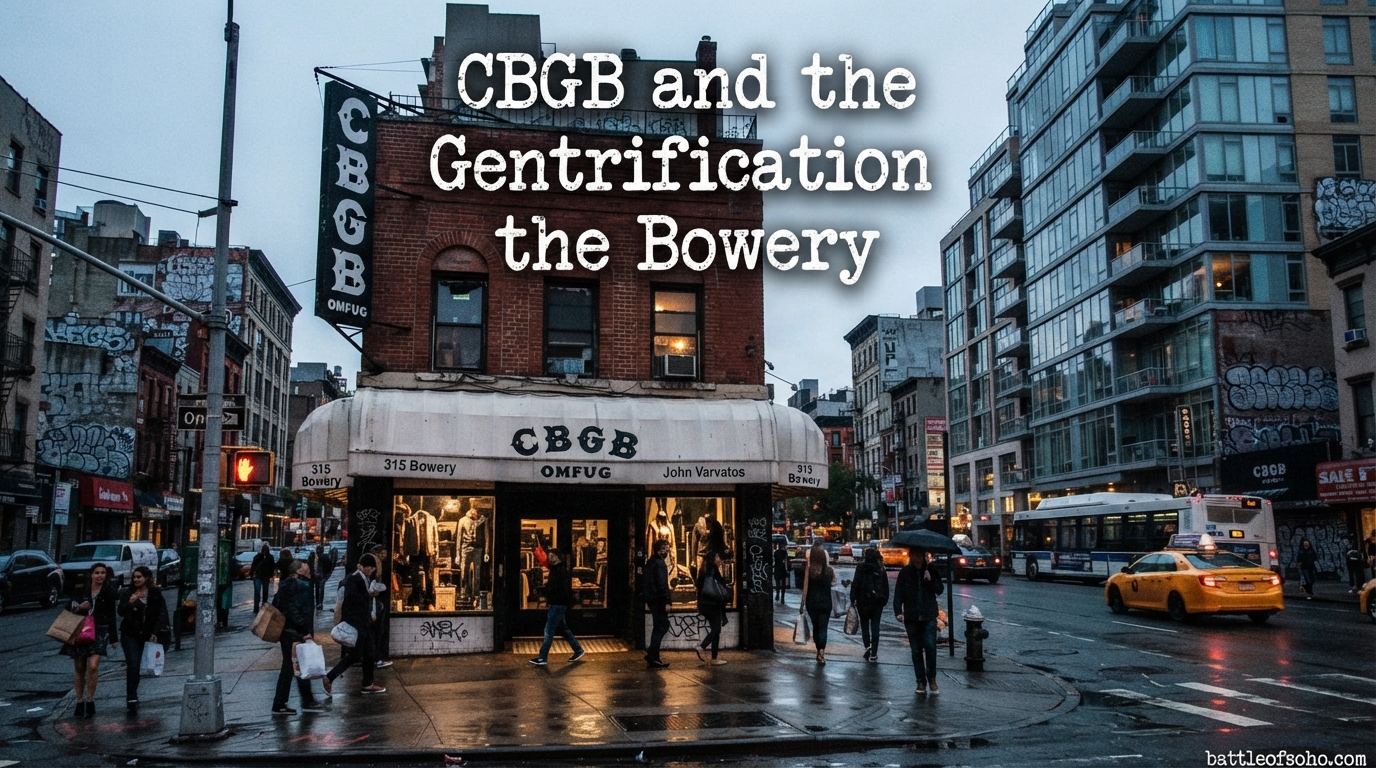
Walk down the Bowery in Manhattan today and you will find luxury boutiques, upscale restaurants, and multi-million dollar lofts. Forty years ago, those same blocks smelled of stale beer, cheap wine, and cigarette smoke billowing from a tiny club at 315 Bowery. That club was CBGB, and its story is inseparable from the story of the Bowery gentrification that ultimately consumed it.
In this article, we trace the full arc of CBGB & OMFUG, from its unlikely founding by Hilly Kristal in 1973 to its heartbreaking closure in 2006. We also examine how the surrounding Bowery neighborhood transformed from one of America’s most notorious skid rows into one of its most expensive addresses. The story of CBGB and the gentrification of the Bowery is really two stories braided together: the rise and fall of an iconic music venue, and the slow erasure of a counterculture by the very urban forces it helped spark.
Whether you are a punk rock historian, a New York City enthusiast, or someone trying to understand how neighborhoods change, this history matters. CBGB was not just a bar with a stage. It was the birthplace of American punk rock, the launching pad for dozens of legendary careers, and a cultural incubator whose influence still ripples through music today. Its fate at the hands of rising rents and real estate pressure tells us something profound about what cities gain and what they lose when they “improve.”
Table of Contents
The Bowery’s Dark History: From Saloons to Skid Row
Long before CBGB existed, the Bowery was already famous, though not for anything glamorous. The Bowery is one of Manhattan’s oldest streets, originally a farm road (bouwerij in Dutch) connecting lower Manhattan to the rural estates of Peter Stuyvesant and other Dutch settlers in the 1600s. It was, in fact, one of the original roads laid out by the Dutch colonists of New Amsterdam.
By the mid-1800s, the Bowery had become an entertainment district packed with theaters, beer gardens, and dance halls. It was rowdy, working-class, and alive with energy. The Bowery Theatre, opened in 1826, was one of the most popular playhouses in America, drawing huge crowds with sensational melodramas and variety acts. The street was a destination for immigrants, laborers, and anyone looking for cheap entertainment.
But the neighborhood began a long decline after the Civil War. Cheap lodging houses, saloons, and brothels multiplied along its length. The street became associated with criminal gangs, opium dens, and general lawlessness. Respectable New Yorkers avoided it. The very things that had made it exciting as an entertainment district, its accessibility to the masses, also made it a magnet for vice and poverty.
By the early 20th century, the Bowery had become synonymous with despair. It was America’s most infamous skid row. During its peak in the mid-1900s, between 25,000 and 75,000 homeless men slept on the Bowery each night in flophouses, on benches, or directly on the sidewalk. The street was lined with missions, cheap bars, and pawnshops. It was a place where men went when they had nowhere else to go.
The flophouses, which charged as little as fifty cents a night for a thin mattress in a shared room, became defining features of the street. Rescue missions like the Bowery Mission, founded in 1879, offered meals, sermons, and temporary shelter. The relationship between charity and desperation defined the Bowery for nearly a century. It was the last stop for men who had fallen through every crack in the social fabric.
This is the Bowery that existed when a man named Hilly Kristal started looking for cheap real estate in the early 1970s. The neighborhood was dangerous, blighted, and largely abandoned by anyone with options. Landlords were desperate. Rents were almost nothing by Manhattan standards. It was the perfect place to open a music club that nobody expected to succeed.
What Was CBGB? The Origins of a Legend
CBGB & OMFUG was a music club that opened on December 10, 1973, at 315 Bowery in the East Village neighborhood of Manhattan. It was founded by Hilly Kristal, a former Marine and music industry veteran who had previously run Hilly’s on Bleecker Street in the West Village. That earlier venue had struggled, and Kristal was looking for a fresh start in a cheaper location.
Hilly Kristal was born in 1931 and had a deep love of folk, country, and blues music. Before opening his own venues, he worked as the manager of the legendary Village Vanguard jazz club. He understood the business side of running a room, even if his taste in music was more traditional than what his club would eventually become famous for. He was, by all accounts, a patient and tolerant man who let the scene develop around him rather than trying to control it.
The full name stood for “Country, Bluegrass, Blues and Other Music For Uplifting Gourmandizers.” Kristal’s original vision was to feature the kinds of roots music he loved: country, bluegrass, and blues. The “OMFUG” portion was a playful, somewhat nonsensical addition that essentially meant “other original music.” That second clause would prove far more important than the first.
Kristal had one rule that defined everything about the club. Bands had to play original material. No covers allowed. This single requirement, born partly from Kristal’s taste and partly from licensing practicalities, became the filter that shaped an entire generation of music. If you wanted to play CBGB, you had to write your own songs. You could not hide behind someone else’s hit.
The club itself was famously unglamorous. The interior was covered floor to ceiling in band posters, stickers, and graffiti that accumulated over decades. The plumbing was questionable. The greenrooms had no doors. The bathrooms were notoriously disgusting, a fact that became part of the club’s legend. The capacity was roughly 350 people packed shoulder to shoulder. The famous awning, with its white letters on a black background, became one of the most photographed signs in music history.
The physical layout of CBGB contributed to its mythology. The stage was small and low, barely raised above the audience floor. There was no barrier between the band and the crowd. You could literally reach out and touch the performers. The sound system was adequate but never pristine. Everything about the space communicated that this was not about spectacle or production values. It was about the songs and the performance, raw and unmediated.
In the early months, few people came. Kristal booked whatever acts he could find, still hoping to attract country and blues audiences. But the East Village in 1973 was not full of country music fans. It was full of young, broke, creative people who wanted to make noise. One of those people would change everything.
The Punk Revolution: How CBGB Changed Music Forever
In early 1974, a band called Television asked Kristal for a gig. Television was led by Tom Verlaine and Richard Hell, two poets-turned-guitarists who played jagged, literate, aggressively unconventional rock music. They were not country. They were not blues. They were not anything Kristal had originally envisioned. But they played original songs, so they met the only requirement that mattered.
Kristal gave them a Sunday night residency because nobody else wanted the slot. Sundays were dead nights in the bar business. Giving a residency to an unknown band that played strange, noisy music on the slowest night of the week seemed like a low-risk gamble. It turned out to be the most important booking decision in the history of live music.
That residency became the spark. Word spread through downtown Manhattan that something was happening at 315 Bowery. Other bands started showing up, asking to play. What happened next was not a single moment but a rapid chain reaction that produced an entire scene within roughly eighteen months. The CBGB scene did not have a manifesto or a plan. It grew organically from a community of musicians who recognized each other as kindred spirits.
The Ramones played their first CBGB show on August 16, 1974. They were four guys from Forest Hills, Queens, who played two-minute songs at blistering volume with bubblegum-pop melodies cranked through distortion. They wore matching leather jackets and shared a last name despite not being related. They were fast, funny, and completely unlike anything the music industry was producing at the time.
Patti Smith started performing at CBGB around the same period. She was a poet who had begun performing her work with a backing band, fusing Beat-generation lyricism with raw rock energy. Her performances were intense, theatrical, and deeply literary. Her Horses album, recorded after her CBGB breakthrough, became one of the most influential debuts in rock history and established her as the godmother of punk poetry.
Blondie, led by Debbie Harry and Chris Stein, evolved from the CBGB scene into one of the biggest new wave bands of the era. They started as a gritty downtown band playing for door money and ended up selling millions of records worldwide. Debbie Harry became one of the most iconic frontwomen in rock history, and the band’s fusion of punk energy with pop, disco, and reggae influences showed that the CBGB aesthetic could reach a mass audience.
Talking Heads, three art-school graduates from Rhode Island, played their first New York shows at CBGB in 1975 and brought an angular, intellectual approach that expanded what punk could sound like. David Byrne’s nervous, twitchy stage presence and the band’s polyrhythmic arrangements proved that the CBGB scene was not monolithic. It was a umbrella large enough to cover an extraordinary range of sounds.
What united all these bands was not a single musical style. It was an attitude. The CBGB scene rejected the bloated, overproduced rock of the mid-1970s in favor of something rawer, faster, and more direct. These bands could not play stadiums. They could barely afford equipment. But they could write songs that felt real, and they could play them with an urgency that stadium bands had lost.
The press eventually noticed. In 1975, a writer named Legs McNeil co-founded a fanzine called Punk, which helped name the movement. Magazines and critics began referring to the CBGB scene as the birthplace of punk rock, and the label stuck. By 1976, bands from London and Los Angeles were citing the Ramones and Patti Smith as proof that you did not need a record deal or studio polish to start a revolution. The Sex Pistols, The Clash, and the entire British punk explosion traced their lineage directly back to what happened at 315 Bowery.
CBGB became a pilgrimage site. Music fans from around the world traveled to 315 Bowery to stand in that dirty room and watch bands that might be terrible or might be genius. You never knew. That unpredictability was the point. The club operated as a laboratory where hundreds of bands could experiment, fail, and occasionally create something that changed everything. On any given night, you might see a future legend or you might see an unforgettable disaster. Both were valuable.
The Hardcore Era: Sunday Matinees and Underground Brotherhood
By the early 1980s, the original punk wave had largely moved on. The Ramones were signed to a major label and touring the world. Patti Smith retired from performing for nearly a decade after her marriage to Fred Sonic Smith. Blondie and Talking Heads had become MTV stars. But CBGB did not close. It evolved.
A new generation of musicians discovered the club, and they played even faster, louder, and more aggressively than their predecessors. This was the hardcore punk era, and CBGB became its East Coast headquarters through a simple innovation: the Sunday matinee. The matinees were the brainchild of a promoter named David Surgick, who convinced Kristal to let him book all-ages afternoon shows on the one day of the week the club was otherwise dead.
Sunday hardcore matinees at CBGB started around 1983 and ran for years. These were afternoon shows, typically starting around 1 or 2 PM, that featured four or five hardcore bands for a low door price. They drew teenagers from across the tri-state area who otherwise could not get into bars. The demographic shifted from arty downtown adults to suburban and outer-borough kids, many of whom were too young to drink.
The bands that defined this era included Bad Brains, a Washington D.C. group widely considered the pioneers of hardcore. They played at a speed and intensity that most bands could not match, led by the extraordinary guitarist Dr. Know and the charismatic frontman H.R. Their ability to shift between blistering hardcore and slow, reggae-influenced passages set them apart from every other band in the scene.
Agnostic Front brought a working-class, street-level aggression that defined New York hardcore specifically. Their lyrics dealt with urban survival, loyalty, and the harsh realities of growing up in a decaying city. The Cro-Mags fused hardcore with metal and apocalyptic lyrics, creating a heavier, more muscular sound that influenced countless bands in both scenes. Gorilla Biscuits, Youth of Today, and Sick of It All carried the sound into the late 1980s and early 1990s, with Youth of Today helping define the straight-edge movement within hardcore.
The Sunday matinees were not for everyone. They were loud, physical, and sometimes violent. Stage diving and slam dancing were constants. Fights broke out, occasionally serious ones. There were incidents of crowd violence that drew negative attention to the club and made Kristal consider ending the matinees more than once. But they were also a genuine community. Kids who felt like outcasts in their schools and neighborhoods found a place at CBGB where they belonged. For many, those Sunday afternoons were the most important hours of their week.
The hardcore era at CBGB demonstrated something important about the club’s DNA. It was not tied to one genre or one generation. As long as bands played original music and Kristal could pay the rent, the door stayed open. This flexibility allowed the club to survive the departure of its founding generation and remain relevant for another two decades.
The End of an Era: Why CBGB Closed
CBGB closed on October 15, 2006, after losing a protracted legal battle over unpaid rent with its landlord, the Bowery Residents’ Committee (BRC). The closure was the result of a rent dispute that had been building for years, combined with the broader economic pressures transforming the neighborhood.
The BRC was a nonprofit organization that provided services to homeless people, the very population that the Bowery had been associated with for a century. It owned the building at 315 Bowery and had been CBGB’s landlord since the club opened. The relationship between Kristal and the BRC had always been somewhat awkward: a punk rock club operating in a building owned by a homeless services organization on what had been skid row. But for decades, the arrangement worked because neither party had better options.
The dispute centered on approximately $75,000 in allegedly unpaid back rent. Kristal disputed the amount and argued that the BRC had failed to maintain the building properly, leaving the club to deal with leaks, structural issues, and code violations that were the landlord’s responsibility. The conflict went to court, and in 2005 a judge ruled that the BRC could legally terminate CBGB’s lease when it expired in August 2006. A separate ruling found that Kristal did owe the back rent, though the amount was disputed.
There was a massive public campaign to save the club. Musicians, fans, and even some politicians argued that CBGB was a cultural landmark worth preserving. Patti Smith, Debbie Harry, and other legends spoke publicly about the club’s importance. A rally was held outside the club. Petitions circulated. The argument was that CBGB was not just a business but a piece of New York City’s cultural heritage that deserved protection. But the legal reality was clear. The lease was ending, and the landlord did not want to renew.
The broader context made the dispute inevitable. By 2006, the Bowery was no longer a cheap neighborhood. Property values had soared, and the BRC, which relied on revenue from its real estate holdings to fund its homeless services, was under pressure to maximize income from its properties. A punk club paying 1970s-era rent in a building that could command vastly more on the open market was a luxury the organization could no longer afford. In a bitter twist, the very neighborhood CBGB had helped make culturally attractive was now too expensive for CBGB to survive in.
Patti Smith played the final show at CBGB on October 15, 2006. She played for over three hours, covering songs by the Ramones, Blondie, and other CBGB veterans who had already passed on or could not attend. Near the end of the set, she told the crowd that the club’s spirit would survive, even if the building did not. Whether that turned out to be true depends on who you ask. Many fans left that final show feeling that something irreplaceable had been lost.
Hilly Kristal died less than a year later, in August 2007, at the age of 75. Many people saw his death and the club’s closure as two halves of the same ending. The man and the institution had been inseparable for 33 years, and they disappeared within months of each other. Kristal had reportedly been planning to open a new CBGB in Las Vegas, but the project never materialized before his death.
What Replaced CBGB: The John Varvatos Era and Beyond
After CBGB closed, the space at 315 Bowery did not stay empty for long. In 2008, the fashion designer John Varvatos opened a high-end boutique in the former club location. The store sold luxury clothing and accessories, with some items priced at several hundred dollars or more. For the fashion brand, the address was not just retail space. It was cultural capital. Being at 315 Bowery meant something, even if what it meant had been hollowed out.
Varvatos made a point of preserving certain elements of the original club. The famous awning was partially retained. Some of the original interior walls, still covered in decades of band stickers and graffiti, were left in place as design features. The store even kept a small stage area where occasional live performances were held. Varvatos, who was a music fan, framed the store as a tribute to CBGB’s legacy rather than a desecration of it.
For many in the punk community, the conversion was a painful symbol. The building that had incubated a do-it-yourself movement built on anti-commercial values was now selling three-hundred-dollar t-shirts. The irony was not lost on anyone. A club that existed because rents were cheap had been replaced by a business that could only survive because rents were high. The punk ethos of accessibility, of shows that cost a few dollars at the door, had been replaced by an ethos of exclusivity.
Reddit users and music fans frequently describe visiting the Varvatos store (and its later iterations) as a kind of reluctant pilgrimage. They go to see the walls, to touch the surviving stickers, and to stand in a room that once held something extraordinary. Almost everyone who writes about the experience says the same thing: it is not the same, and it never will be. The walls are behind glass. The energy is gone. What remains is a museum of something that was once alive.
The Varvatos store eventually closed, and the space has since been occupied by other commercial tenants. The physical building remains, but its identity has been completely transformed. What was once the beating heart of underground music is now just another retail address on a gentrified street. The awning, the most iconic element of the original club, has been altered or removed. 315 Bowery looks like any other storefront now.
The Gentrification of the Bowery: From Skid Row to Luxury Lofts
The Bowery has been gentrified to a degree that would have been unimaginable in the 1970s. What was once America’s most notorious skid row is now one of Manhattan’s most expensive corridors, lined with boutique hotels, upscale restaurants, and luxury residential developments. The transformation is so complete that a person who knew the Bowery in 1973 would barely recognize it today.
The transformation did not happen overnight. It was a gradual process that began in the 1980s and accelerated dramatically in the 1990s and 2000s. Several factors drove the change. New York City’s overall crime drop in the 1990s made previously dangerous neighborhoods feel safer. The dot-com boom and Wall Street expansion created enormous wealth that pushed outward from traditional luxury areas. And the city’s zoning and development policies encouraged large-scale construction along the Bowery corridor, rezoning blocks that had been protected from high-rise development for decades.
The flophouses that once housed tens of thousands of homeless men were gradually demolished or converted. The White House Hotel, one of the last surviving flophouses on the Bowery, was transformed into a trendy micro-hotel called The Marcel at Gramercy. The Sunshine Hotel, another famous flophouse documented in films, fought a long battle against redevelopment. The Bowery Residents’ Committee and other service organizations faced increasing pressure as the neighborhood around them became wealthier and less tolerant of visible poverty. Many missions and shelters relocated or scaled back.
In their place rose buildings like the New Museum, which opened its striking SANAA-designed headquarters on the Bowery in 2007. The seven-story building, clad in shimmering aluminum, was a deliberate statement that the Bowery had arrived as a cultural destination. Boutique hotels like the Bowery Hotel and citizenM moved in. Luxury condo developments replaced parking lots and abandoned buildings. A street that once symbolized urban decay became a showcase for contemporary architecture and high-end dining.
The connection between CBGB and the gentrification of the Bowery is more than coincidental. Some urban researchers argue that art and music scenes actually accelerate gentrification. When artists move into a cheap, gritty neighborhood because they cannot afford anywhere else, they make that neighborhood culturally interesting. They open galleries, host shows, and create the kind of authentic, edgy atmosphere that appeals to young professionals. That cultural cachet attracts wealthier residents, who drive up rents until the original artists can no longer afford to stay. CBGB and the broader East Village punk scene may have been early participants in exactly this cycle.
This theory, sometimes called the “arts-led gentrification” model, does not blame artists for displacement. Rather, it describes a structural pattern in which cultural activity becomes a leading indicator of real estate speculation. The very qualities that made the Bowery attractive to punks, its grittiness, its cheapness, its distance from mainstream respectability, were the same qualities that made it appealing to developers and investors once those qualities had been reframed as “authentic” and “edgy.” The punk scene gave the Bowery a cultural identity that the real estate market could commodify.
The irony is stark. The punk ethos was fundamentally anti-establishment, anti-corporate, and anti-materialist. Yet the cultural energy that punk generated in the Bowery area helped make the neighborhood attractive to the exact forces that punk opposed. The club that helped put the Bowery on the cultural map was ultimately priced out by the real estate market that followed. The anti-capitalist movement created cultural value that capitalism consumed.
Today, visitors to the Bowery will find almost no trace of its skid row past. The men who once slept on its sidewalks are gone, relocated to shelters in other boroughs or pushed out of the city entirely. The punk kids who came for Sunday matinees have grown up and moved on. What remains is a clean, expensive, and culturally homogeneous street that looks like any other upscale Manhattan corridor. The only reminders of the past are a few historical plaques and the memories of those who were there.
Music fans on forums like Reddit frequently ask the same question: is there a modern equivalent of CBGB? The consensus is that the current NYC punk and underground scene has largely migrated to Brooklyn, particularly to Williamsburg and Bushwick. Venues like Market Hotel, Pet Rescue, and various DIY basement spaces have attempted to carry the torch. But everyone agrees that nothing has fully replaced what CBGB was. The combination of cheap rent, an open-door booking policy, and a critical mass of creative people in one neighborhood may be impossible to reproduce in New York City today. The economics simply do not allow it.
The loss of CBGB is not just about one club closing. It is about a whole ecosystem of cheap space that allowed underground culture to flourish. When a city eliminates its cheap spaces, it eliminates the conditions under which new art forms can emerge. Every scene needs a laboratory, and the laboratories are disappearing. The Bowery’s gentrification is a case study in what happens when real estate values eclipse every other form of value a neighborhood can produce.
FAQs
What was CBGB?
CBGB was a legendary New York City music club opened in 1973 by Hilly Kristal at 315 Bowery in the East Village. It is widely known as the birthplace of American punk rock and launched the careers of the Ramones, Patti Smith, Television, Blondie, and Talking Heads. The full name was CBGB & OMFUG, standing for Country, Bluegrass, Blues and Other Music For Uplifting Gourmandizers.
Why did CBGB shut down?
CBGB closed on October 15, 2006, after losing a rent dispute with its landlord, the Bowery Residents’ Committee, a nonprofit homeless services organization. The conflict involved approximately $75,000 in allegedly unpaid back rent. A judge ruled that the BRC could terminate the lease, and despite a public campaign to save the club, the lease was not renewed.
Has the Bowery been gentrified?
Yes, the Bowery has been heavily gentrified. What was once America’s most notorious skid row, where 25,000 to 75,000 homeless men slept nightly, is now one of Manhattan’s most expensive corridors lined with luxury condos, boutique hotels, and upscale restaurants. The transformation accelerated in the 1990s and 2000s.
What neighborhood was CBGB in?
CBGB was located at 315 Bowery in the East Village neighborhood of Manhattan, New York City. The East Village was a hub for counterculture and underground music in the 1970s, with cheap rents that allowed artists and musicians to live and work there.
What replaced CBGB?
The space at 315 Bowery was converted into a John Varvatos luxury boutique in 2008, which preserved some original elements like the iconic awning and graffiti-covered walls as design features. The Varvatos store later closed and the space has been occupied by other commercial tenants since.
What does CBGB stand for?
CBGB stands for Country, Bluegrass, Blues. The full club name was CBGB & OMFUG, with OMFUG standing for Other Music For Uplifting Gourmandizers. Despite the country and bluegrass origins implied by the name, the club became famous for punk rock and new wave music.
What is the history of the Bowery?
The Bowery is one of Manhattan’s oldest streets, originally a Dutch farm road in the 1600s. By the 1800s it was an entertainment district, then declined into America’s most notorious skid row in the early 20th century, with 25,000 to 75,000 homeless men sleeping there nightly. Beginning in the 1980s and accelerating in the 1990s and 2000s, the Bowery underwent massive gentrification into a luxury corridor.
Is the Bowery still skid row?
No, the Bowery is no longer skid row. The flophouses, missions, and homeless populations that defined the area for nearly a century have been almost entirely displaced by gentrification. The street is now lined with luxury condos, boutique hotels, upscale restaurants, and cultural institutions like the New Museum.
Conclusion: The Story of CBGB and the Gentrification of the Bowery
The story of CBGB and the gentrification of the Bowery is a story about what cities give up when they grow. CBGB gave the world punk rock, hardcore, and a model for how a small room with cheap rent and an open-door policy can change culture forever. The gentrification that surrounded and ultimately consumed it traded that cultural ferment for clean streets and luxury condos. The two stories cannot be separated, because they are the same story told from two sides.
Every city has its own version of this story. A cheap neighborhood attracts artists. The artists make it interesting. The interest attracts money. The money drives out the artists. The question that lingers after CBGB is whether we will ever learn to protect the spaces that make culture possible, or whether the cycle is unstoppable. Either way, 315 Bowery will always be sacred ground to anyone who believes that three chords and an original song can change the world.