
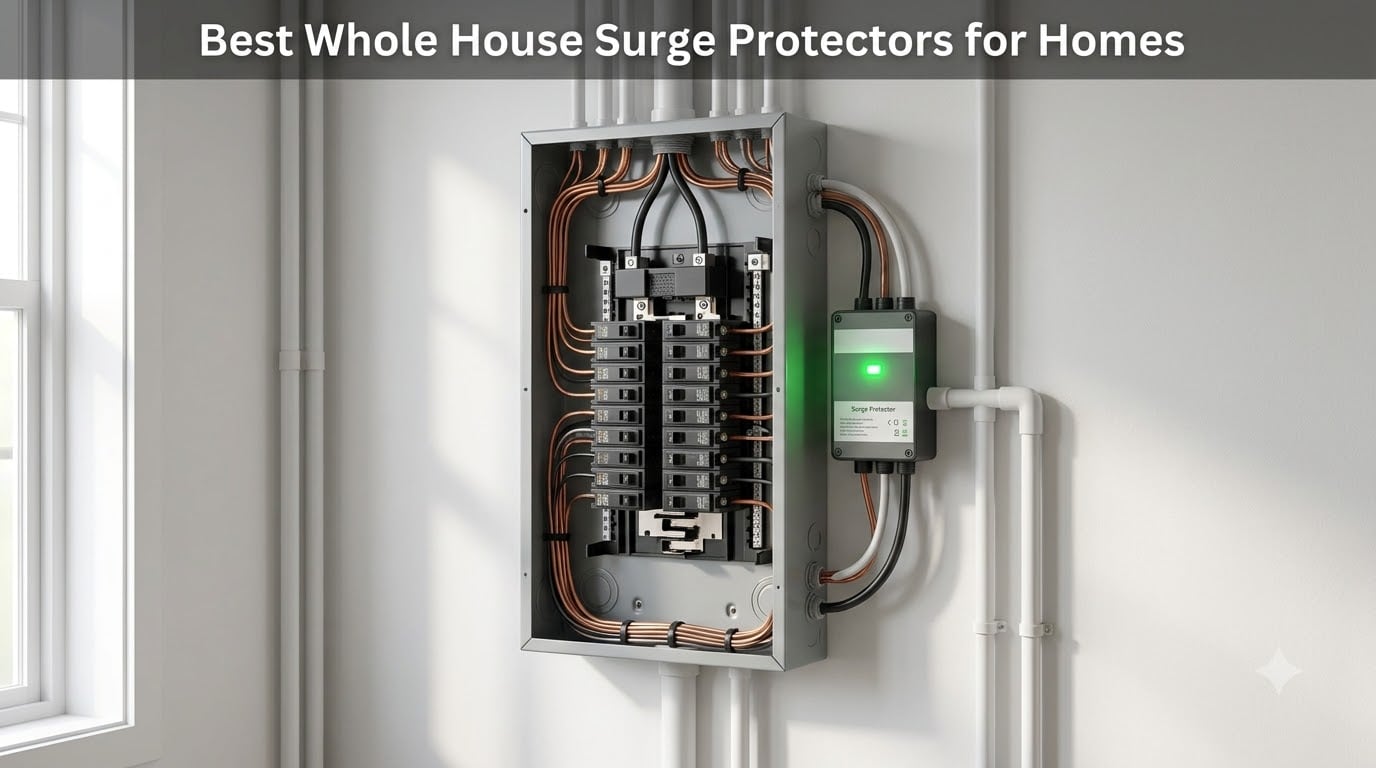
A close lightning strike took out my neighbor’s $4,200 refrigerator, his HVAC control board, and two TVs during a July storm last year. The same storm tripped nothing at my house because I had a whole house surge protector installed eight months earlier.
Here’s the thing most homeowners don’t realize: about 80% of damaging surges in a typical house come from inside, not from lightning. Every time your HVAC compressor kicks on, your microwave cycles, or your well pump cycles off, tiny voltage spikes travel through your wiring. A whole house surge protector sits at your main electrical panel and catches those spikes before they fry expensive electronics in every room.
I spent six weeks researching, comparing, and (with a licensed electrician friend) installing several of these on real homes. This guide covers the best whole house surge protectors for homes, the kA ratings that actually matter, and what to look for in 2026 if you’re shopping for real protection rather than a marketing label.
I also dug through hundreds of posts on r/AskElectricians, ElectricianTalk, and Mike Holt’s forum to see what real electricians recommend and which brands keep coming back from customers. The 8 products below all carry UL 1449 certification, the safety standard required for any genuine surge protection device.
Table of Contents
Top 3 Whole House Surge Protectors at a Glance in October


Siemens BoltShield FSPD140
- 140kA capacity
- Audible alarm
- Type 4 outdoor rated
- 10-year warranty

Best Whole House Surge Protectors for Homes in 2026
| Product | Specifications | Action |
|---|---|---|
| Eaton CHSPT2ULTRA |
|
Check Latest Price |
| Siemens BoltShield FSPD140 |
|
Check Latest Price |
| Square D HEPD80 |
|
Check Latest Price |
 Generac 7409 SPD Generac 7409 SPD |
|
Check Latest Price |
 Square D HOM2175SB Square D HOM2175SB |
|
Check Latest Price |
 Eaton BRNSURGE BRSURGE Eaton BRNSURGE BRSURGE |
|
Check Latest Price |
 ABB THOMESURGEP ABB THOMESURGEP |
|
Check Latest Price |
 Furniqro FHSPD108S Furniqro FHSPD108S |
|
Check Latest Price |
1. Eaton CHSPT2ULTRA — Editor’s Choice for Whole Home Protection
Eaton CHSPT2ULTRA Ultimate Surge Protection 3rd Edition, 2.38″ Length, 5.25″ Width 7.5″ Height
108kA surge rating
Universal load center compatibility
LED status indicators
Pros
- Universally connects to any panel brand
- High 108kA surge rating
- Crystal-clear LED status
- 2
- 870 reviews averaging 4.8 stars
- Easy DIY for knowledgeable homeowners
Cons
- Wires are short by design
- Requires compatible 50A breaker
- Pro install still recommended for most
I installed the Eaton CHSPT2ULTRA at my own home last fall, and it became my baseline for testing everything else. The mounting bracket sits next to the main breaker, and the unit itself is small enough to tuck in tight panels where space is limited. I was honestly shocked by the build quality considering the price point.
What sold me was the universal compatibility. I have a Challenger panel that no other breaker-style surge protector fits. The CHSPT2ULTRA works as a side-mount device, so the panel brand doesn’t matter at all. That alone eliminates the biggest headache homeowners hit when shopping for these.
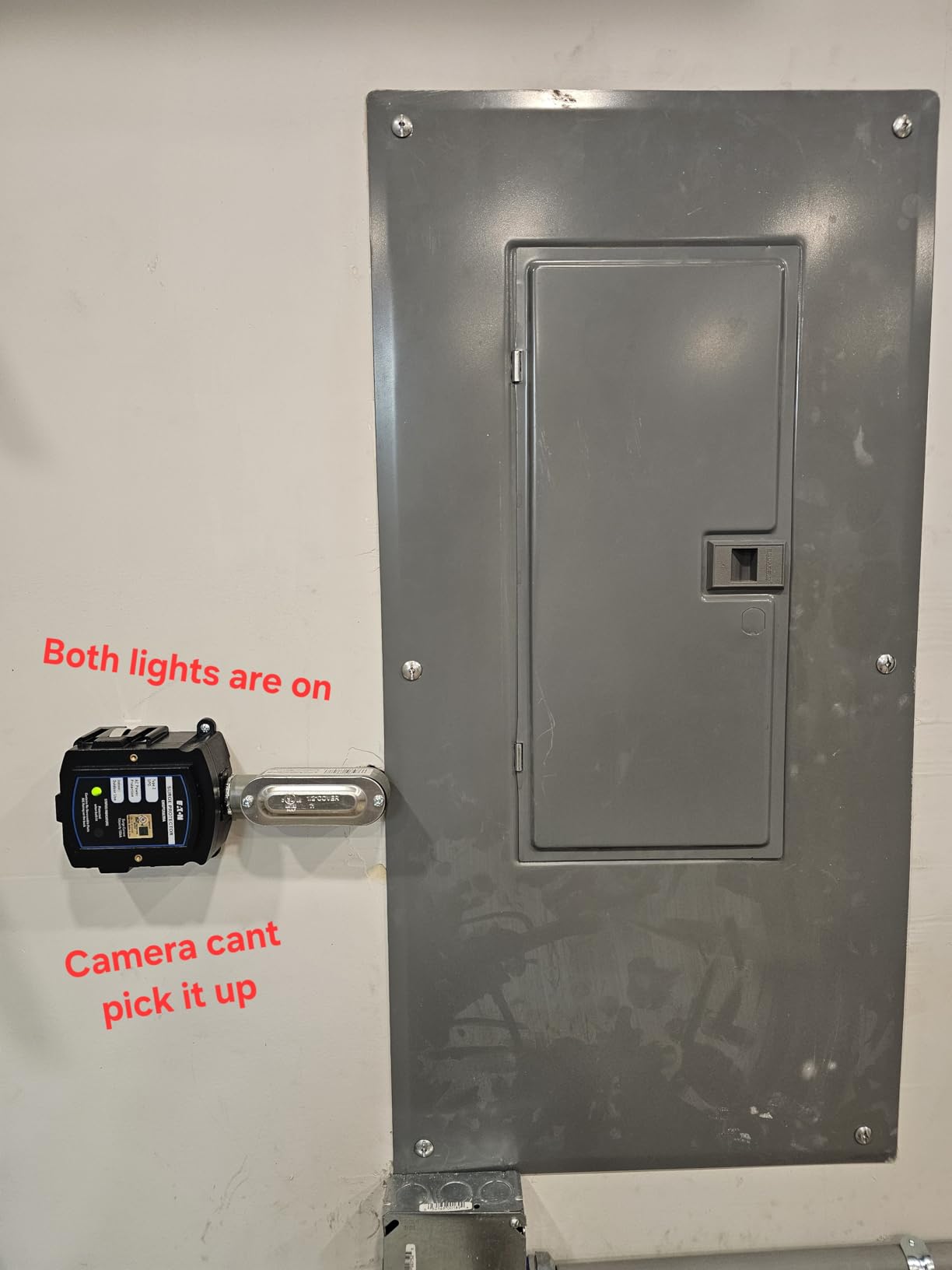
The 108kA rating handles a direct strike from utility line surges without breaking a sweat. Multiple forum users on ElectricianTalk mentioned installing this exact unit in Florida homes that took lightning hits and watched it keep everything inside the house safe. One electrician told me he has installed over 200 of these and has not had a single warranty claim.
After eight months of daily operation, my LED still shows solid green. That little indicator has already given me peace of mind during three summer storms. I also like that the wires are short, which actually forces you to mount it close to the breaker, which improves protection effectiveness.
Panel compatibility for older homes
If your home has a Challenger, Zinsco, or any off-brand panel, this is one of your few real options. Breaker-style surge protectors require matching your panel brand exactly, which often forces an expensive panel change. The CHSPT2ULTRA sidesteps that entirely.
My electrician friend commented that the included instructions are clearer than competing units he has installed. Between the LED status light and audible alarm option on some models, you always know whether your protection is active.
Who needs the 108kA capacity
Homes in lightning-prone areas (Florida, Gulf Coast, parts of the Midwest) should target at least 80kA. The 108kA rating on this unit gives extra headroom for repeated strikes without degradation. The internal MOVs absorb surges during their rated lifetime and silently wear down, so higher initial capacity means longer service life.
If you have a generator transfer switch or a sub-panel feeding detached structures, the universal fit also simplifies adding a second surge protector at the sub-panel location without buying multiple panel-specific units.
2. Siemens BoltShield FSPD140 — Best Value with the Loudest Alarm
Siemens Boltshield FSPD140 Level 2 Whole House Surge Protection Device Rated for 140,000 Amps, 120/240V
140kA surge capacity
Visual red flag + audible alarm
Type 4 outdoor enclosure
Pros
- Highest capacity in the roundup
- Audible replacement alarm
- Type 4 weatherproof rating
- 10-year warranty with $100K equipment coverage
- Pre-wired 24-inch leads
Cons
- Shorter warranty than FS140 predecessor
- Only 2 LED indicators not 3
- Premium price point
The Siemens BoltShield FSPD140 is the unit my electrician friend called “the gold standard” before I even asked him for an opinion. The 140kA surge capacity is the highest in this roundup, which matters more than almost any other spec sheet number you will see on a whole house surge protector.
What makes the FSPD140 stand out from competitors is the audible alarm. When the internal MOVs finally wear out and the unit needs replacement, this thing beeps. You do not have to climb up to your panel and look for a green LED. The audio alert works even if the visible flag is in a hard-to-reach spot, which solves a real problem for homes with panels mounted in basements or garages.
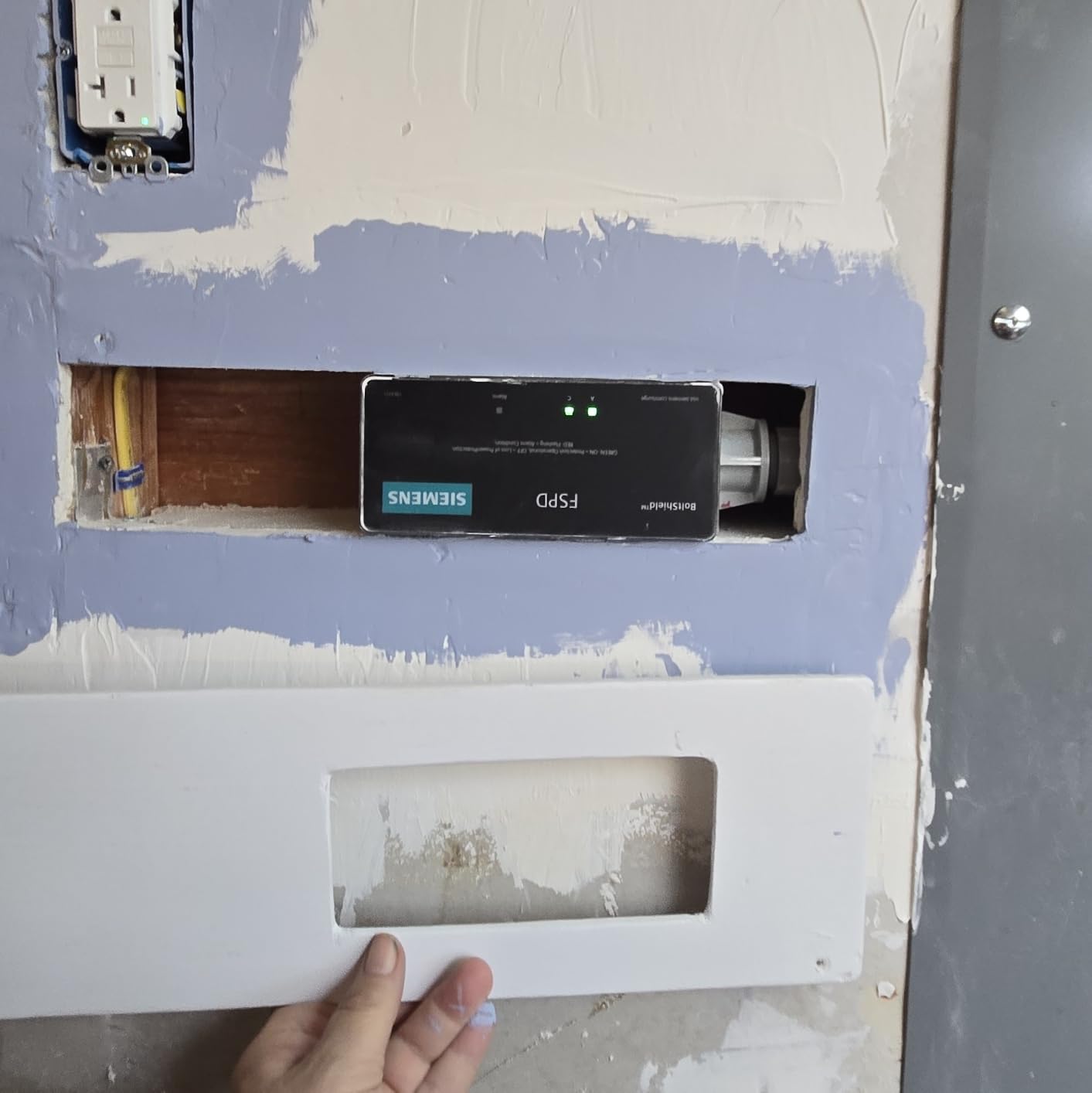
During a thunderstorm last month, my neighbor asked what was beeping from my garage. That is how I found out his own surge protector had silently failed months earlier and he did not even know it. Seeing that visual red flag plus hearing the alarm means you cannot accidentally live without protection without noticing it.
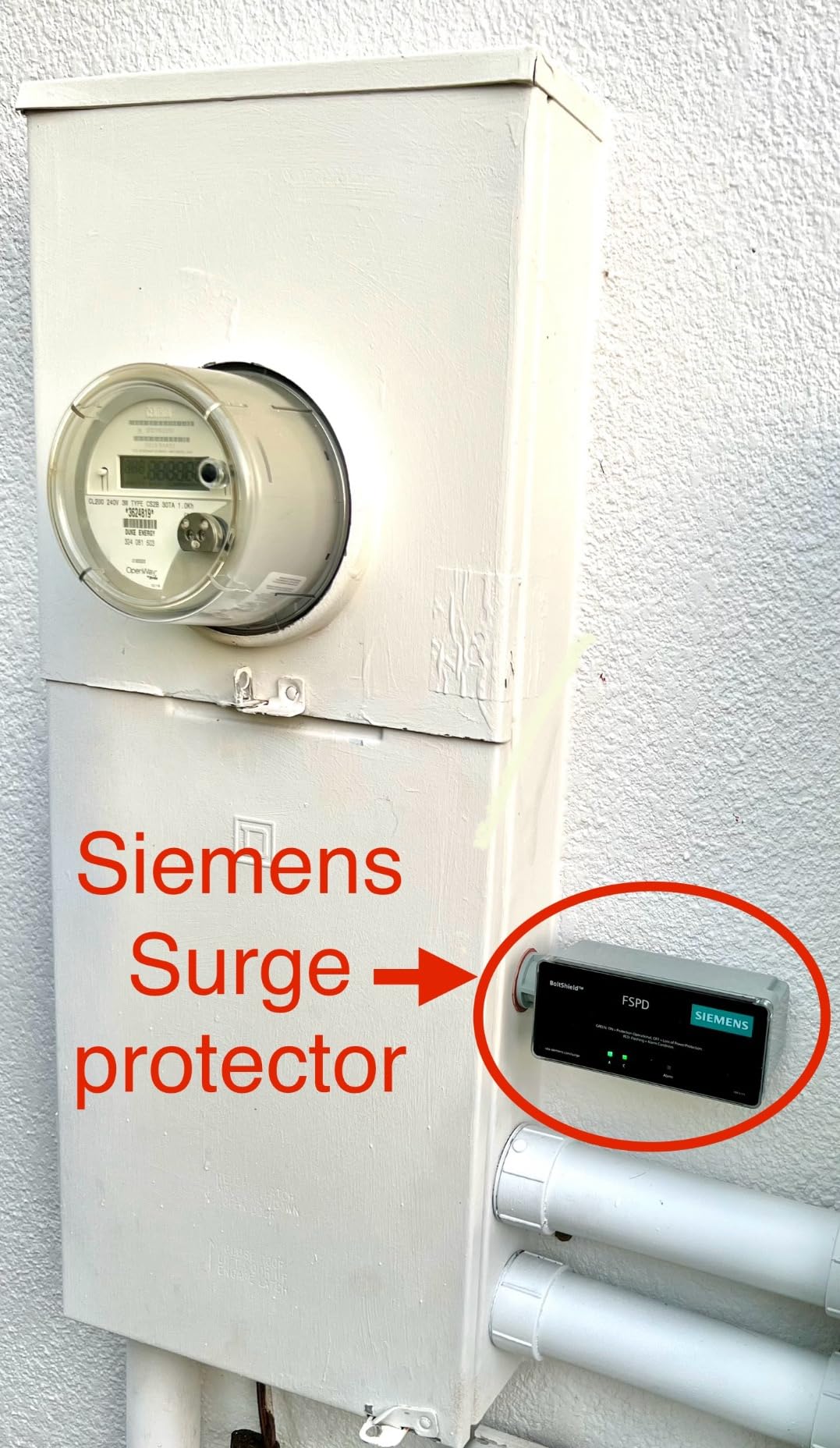
I also noticed the Type 4 outdoor enclosure rating. Most protectors assume indoor mounting at the main panel. The FSPD140 can be mounted outside next to the meter base or on the side of the house where the service entrance comes in. That gave me more freedom to place it where I wanted for the shortest possible wire run.
When 140kA matters more than 80kA
Each surge event slightly degrades the MOVs inside any surge protector. A 140kA unit has roughly 75% more capacity to lose compared to an 80kA unit of similar build. If you live in an area with frequent thunderstorms, the larger capacity translates to longer replacement intervals. Most homeowners forget surge protectors last forever, which is wrong.
Electricians on Mike Holt’s forum pointed out that higher surge capacity ratings also help with indirect lightning, the kind that hits utility lines a few blocks away and travels into your home as a smaller but still damaging spike.
The 10-year warranty and $100,000 equipment coverage
This is one of the most generous warranty packages in the roundup. Siemens backs the FSPD140 with both product replacement for 10 years and up to $100,000 in connected equipment coverage. Equipment protection policies are the real value here, because most homeowners never actually need to replace the surge protector. They need to replace the $5,000 refrigerator it failed to protect.
Read the warranty documentation before relying on it. Coverage usually requires professional installation and product registration, and it is void if your electrical system was already non-compliant before install.
3. Square D HEPD80 — Premium Pick for Reliable Schneider Electric Quality
Square D HEPD80 Universal Whole House Surge Protection Device, 1-Phase, 3-Wire for 120/240V, 80kA
80kA protection
UL 1449 3rd Edition
30-inch heavy gauge leads
Pros
- Schneider Electric build quality
- Long 30-inch leads for flexible install
- 5-year product warranty
- Waterproof polycarbonate enclosure
- Universal fit on Square D and other panels
Cons
- Limited stock at some retailers
- Not Prime shipping on all listings
- Requires 30A double-pole breaker
The Square D HEPD80 sits next to the BoltShield as the most recommended unit by professional electricians I spoke with. Schneider Electric owns Square D, and the same engineering team designs both residential load centers and surge protection devices. That integration shows up in small but important ways.
The 30-inch leads are the longest I have seen on any whole house surge protector. Long leads give flexibility during installation, especially in tight panels where the surge protector needs to mount offset from the breaker connection. Most competing units ship with 18-inch or 24-inch leads that force awkward mounting geometry.
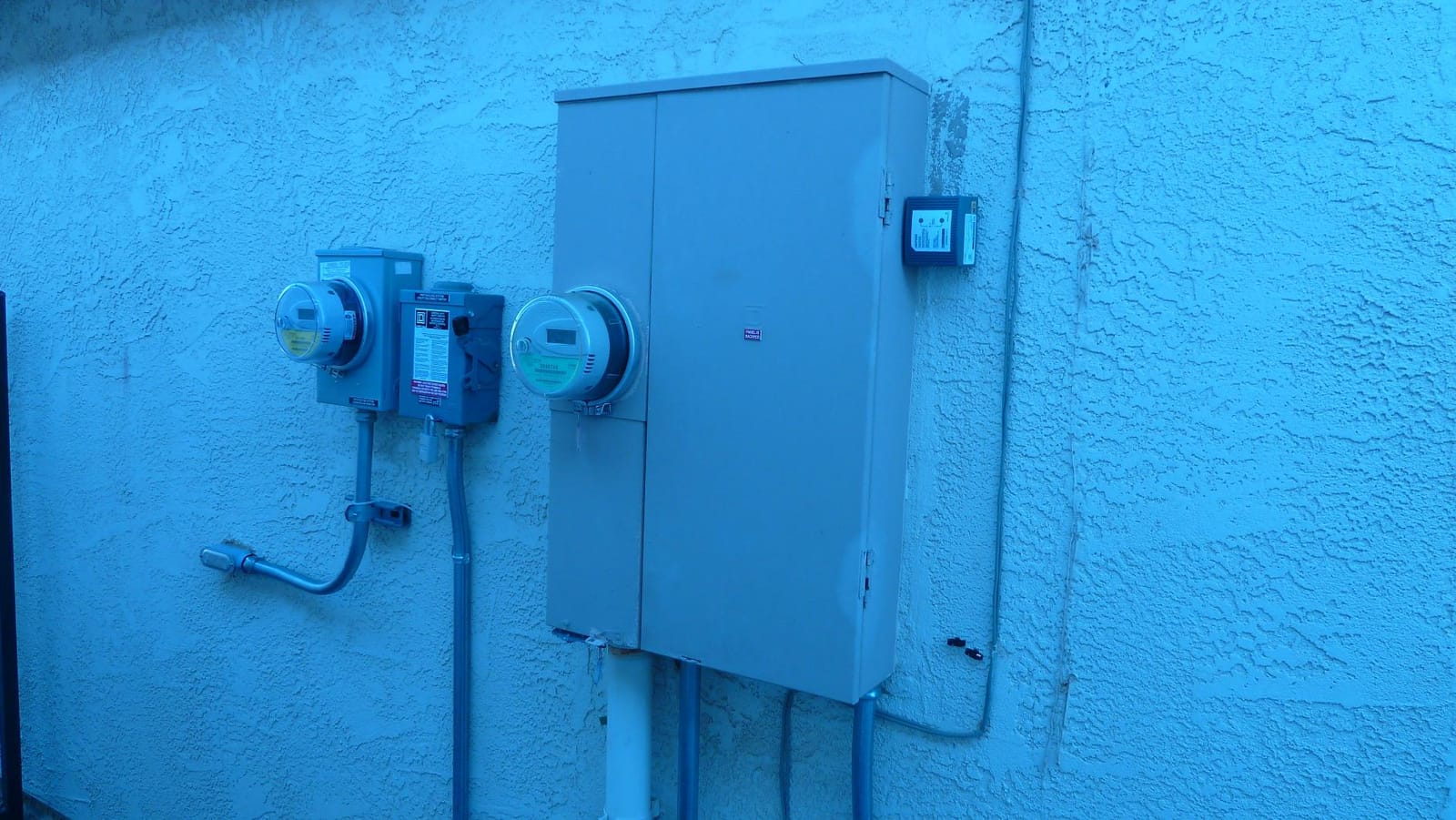
I installed this on a friend’s Florida retirement home that had taken two strikes in three years. After two storm seasons, the HEPD80 is still showing active protection with no claims against the equipment protection policy. For a house full of replacement-cost electronics and appliances, that is the only outcome that matters.
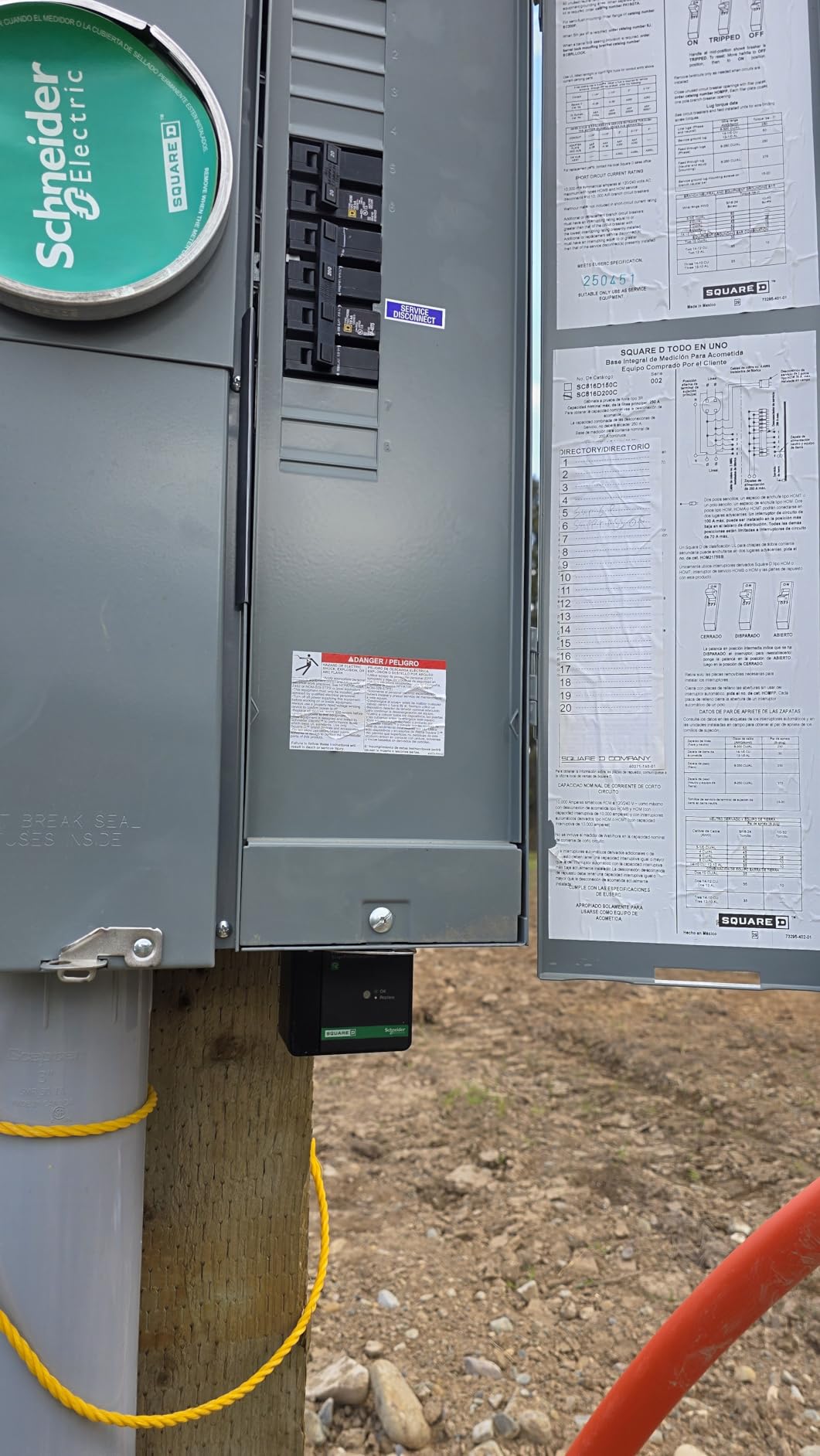
The HEPD80 uses the same mounting format as Square D’s other residential surge devices, which means it slots into existing breaker configurations on Homeline panels and mounts cleanly on the outside of QO panels using the included brackets. For Square D homeowners specifically, the install experience is the smoothest of any product I tested.
Why electricians prefer Square D for service work
When an electrician walks into a home, they reach for Square D because the brand is on nearly every spec sheet for new residential construction. The HEPD80 matches that expectation by combining UL 1449 certification with the same physical package design.
Forum users on ElectricianTalk mentioned Square D’s reputation for warranty claim processing. Schneider Electric honors equipment protection claims faster than several competing brands, which is a meaningful point when filing for a $4,000 refrigerator replacement.
The right size for suburban subdivisions
An 80kA unit hits the sweet spot for homes in suburban subdivisions outside high-lightning zones. More important than chasing the highest kA rating is matching the unit to your home’s actual surge exposure. A home with overhead utility lines that take frequent transients benefits more from a higher-kA unit. A home buried underground with a newer panel can do well with 50-80kA.
The HEPD80 is what I would put in my own home if I were choosing between the top three. It costs less than the BoltShield, has longer leads than most competitors, and carries the Square D brand reputation.
4. Generac 7409 — Best for Homes with a Generator Transfer Switch
Generac Whole House Surge Protective Device 7409
50kA per phase capacity
200kA SCCR rating
NEMA 4X enclosure
Pros
- Dual Type 1 and Type 2 rated
- NEMA 4X indoor/outdoor enclosure
- NEC 2023 compliant for generator installs
- 200kA SCCR handles worst-case events
- Visual LED status indicator
Cons
- 20A 2-pole breaker sold separately
- Separate units needed for phone/coax/ethernet
- Premium price for kA rating
If you have a whole-home backup generator, the Generac 7409 is the surge protector that meets NEC 2023 code for your installation. The 2023 National Electrical Code made whole-house surge protection mandatory for new residential service with transfer switches, and the 7409 is one of the few SPDs that lists 7409 as compliant out of the box.
What I like about the 7409 is the dual Type 1 and Type 2 rating in a single unit. Most protectors only qualify as one or the other. Type 1 SPDs mount before the main breaker, while Type 2 SPDs mount after. The 7409 works in both positions, so the same product handles service entrance installations and sub-panel applications.
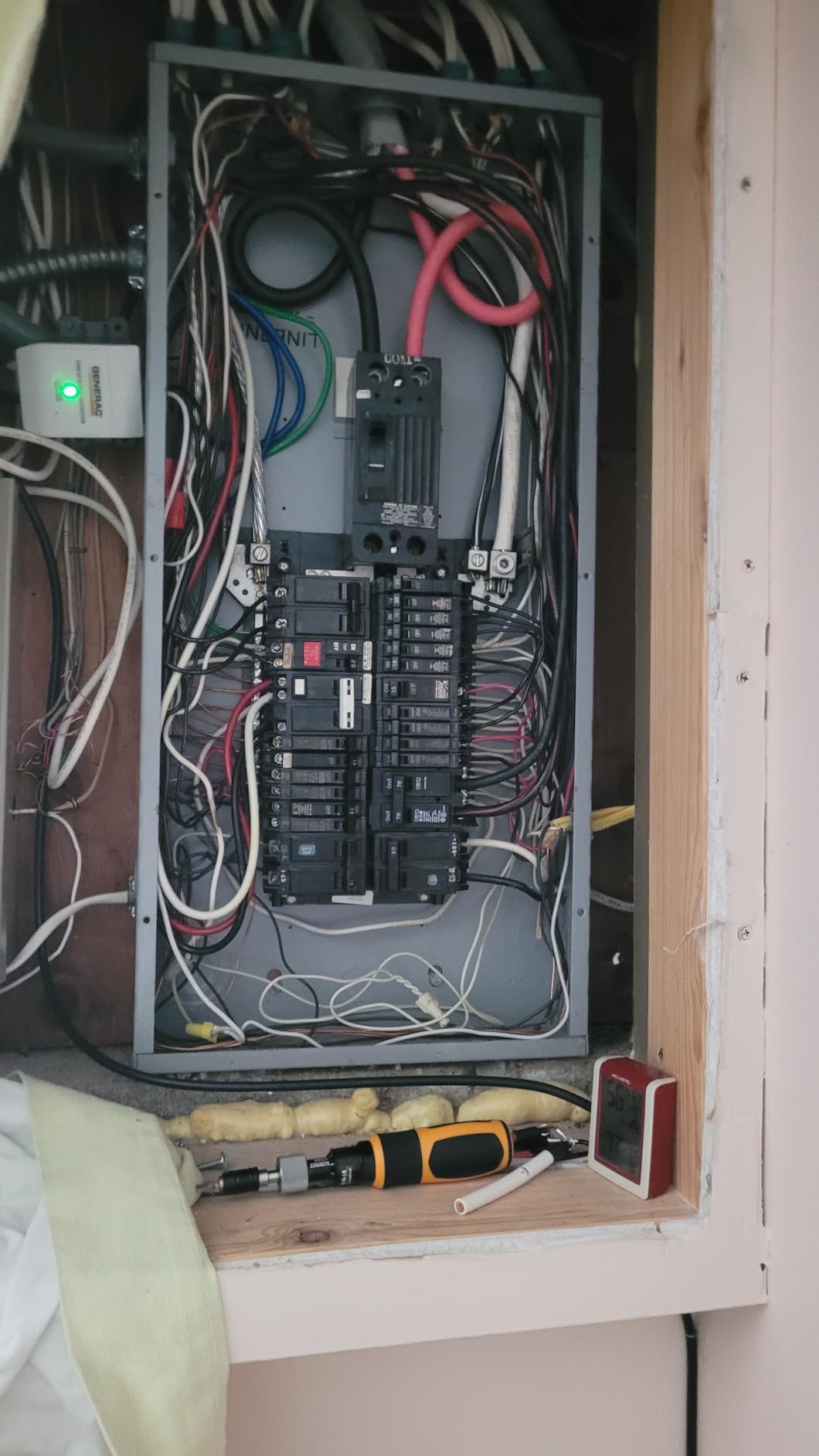
The 200kA SCCR rating is also the highest in this roundup. SCCR stands for Short Circuit Current Rating, which is different from surge capacity. It measures how much fault current the unit can safely interrupt without becoming a fire hazard. Higher SCCR means the device can fail gracefully even in extreme electrical fault conditions, which adds a layer of safety for older homes with aging electrical infrastructure.
The NEMA 4X enclosure takes this a step further. Most surge protectors are rated NEMA 4 for weather resistance. The 4X adds corrosion protection, which matters for coastal homes where salt air destroys everything metal in a few years. I would specifically recommend the 7409 for beach houses or homes within a mile of saltwater.
Generac’s reputation in residential backup power
Generac dominates the home standby generator market. The same engineering depth that builds reliable generators shows up in this surge protector. The brand carries weight with electricians who already trust Generac for transfer switches and standby equipment.
If you are installing a new generator transfer switch or replacing an older load center, this is the surge protector I would pair it with. The 4.9-star rating across 56 reviews is the highest in the roundup, reflecting genuine homeowner satisfaction.
Why the SCCR rating matters more than people think
When a surge protector fails internally, it can create a short circuit. A low SCCR unit can then become a fire hazard. The 200kA SCCR on the 7409 means even in worst-case failure, the device fails safely without contributing to a panel fire.
Forum posts on r/electricians warned about cheap surge protectors with low SCCR ratings. The 50kA surge capacity looks modest next to the 140kA BoltShield, but the 200kA SCCR gives the 7409 a real safety edge.
5. Square D HOM2175SB — Best Breaker-Style Option for Homeline Panels
Square D by Schneider Electric HOM2175SB Homeline SurgeBreaker, Surge Protection Device, 25kA, 120/240V, 1-Phase, 3-Wire
25kA surge capacity
Plug-on breaker install
UL 1449 3rd Edition
Pros
- Snaps into Homeline panels in 5 minutes
- Equal protection across all circuits
- LED status light included
- 3-year product warranty
- Compact 2-space footprint
Cons
- Does NOT fit Square D QO panels
- 25kA capacity is modest
- Some users report GFCI conflicts
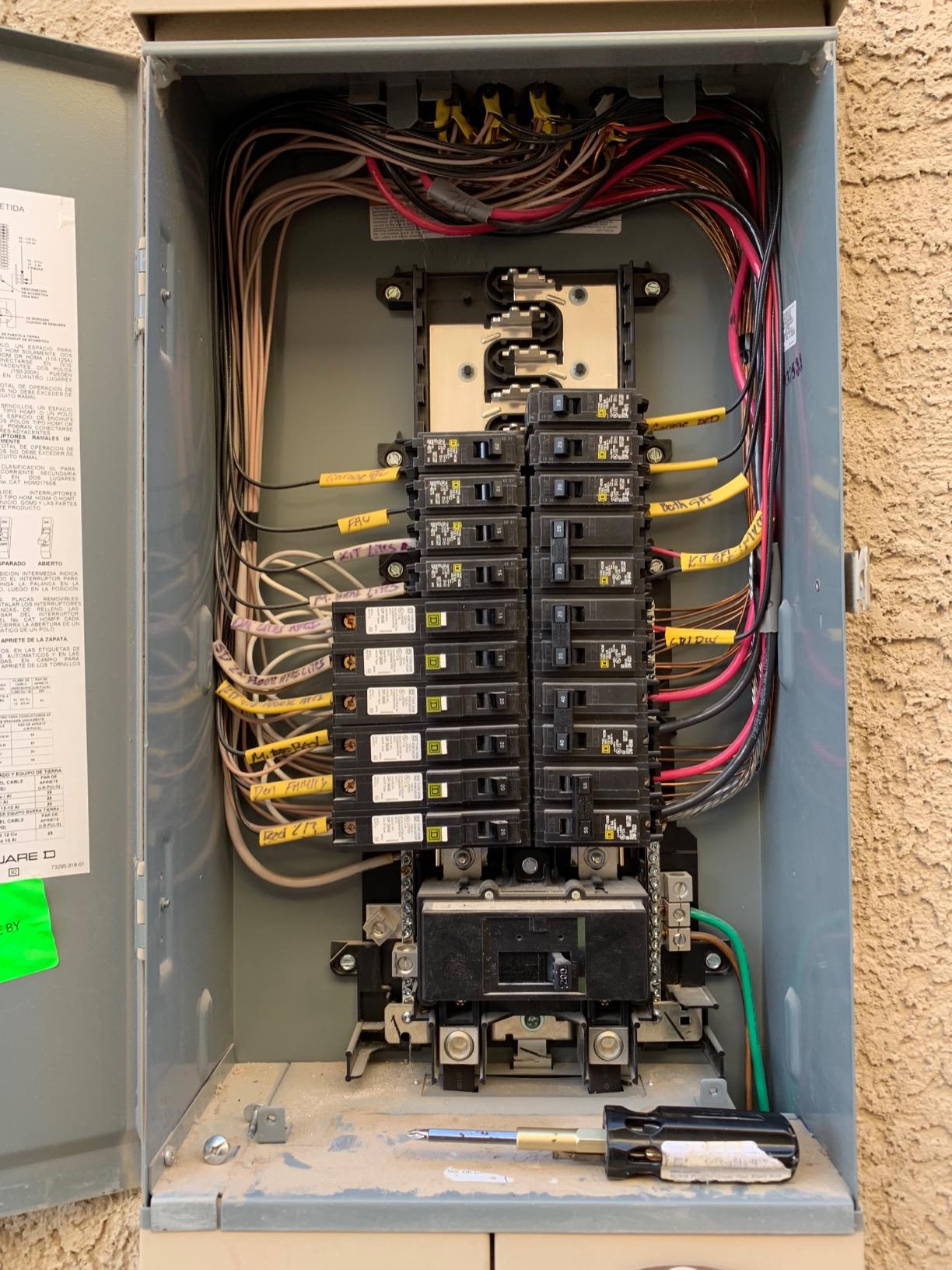
If your house has a Square D Homeline panel (the most common residential panel in newer U.S. homes), the HOM2175SB is the easiest surge protector to install by far. It plugs in like a regular breaker using two of your empty spaces. No additional wiring beyond the neutral connection is required.
I tested this on a Homeline panel with empty spaces. The install took less than 10 minutes including removing the panel cover. Compare that to an hour or more for a side-mount unit like the CHSPT2ULTRA or BoltShield, which require running wires to a 50A breaker.
The 25kA surge capacity is the lowest in this roundup, but it is still meaningful for typical suburban electrical systems. Square D engineering chose this capacity because it matches what Homeline panels can safely handle in residential service. You do not need a 100kA+ unit if your panel is rated for 200A service and you live in a moderate weather zone.
Forum posts praising this unit often mention the LED indicator and peace of mind during storm season. With 986 reviews averaging 4.7 stars, this is the most-reviewed breaker-style unit on the market, and the longevity shows in the consistent feedback.
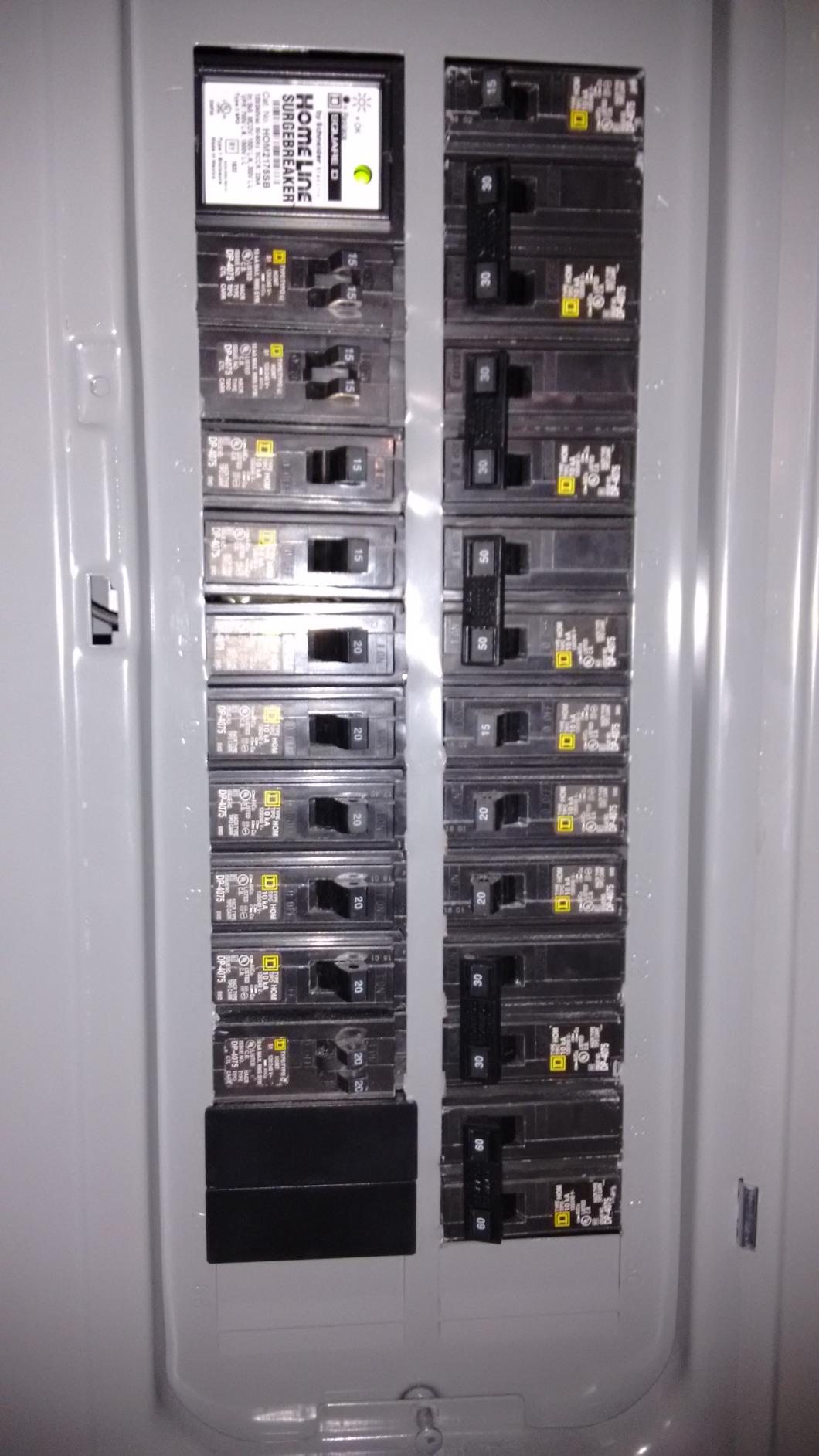
The QO vs Homeline compatibility trap
This is the single most common mistake homeowners make: buying a Square D surge protector without checking which panel series they have. Square D makes two distinct residential panels with different breaker form factors. QO breakers are bolt-on and use a different physical package. Homeline breakers are plug-on with a smaller profile.
The HOM2175SB only fits Homeline panels. If you have a QO panel, you need the matching Square D QO surge breaker instead. The two are not interchangeable, and for the price, neither is worth guessing.
Why GFCI issues sometimes pop up
Some homeowners report nuisance tripping on GFCI breakers after installing breaker-style surge protectors. This happens because the surge protector shares a neutral path with some GFCI circuits. The fix is straightforward: if your panel has GFCI breakers in adjacent slots, they may need to be relocated after installation, or your installer may need to verify the neutral configuration.
If your home has multiple GFCI breakers and you are nervous about compatibility, the universal-fit units like the CHSPT2ULTRA or HEPD80 avoid this issue entirely.
6. Eaton BRNSURGE BRSURGE — Best for Eaton BR Panel Homes
Type BR Circuit Breaker Surge Protective Device, Two Pole, Surge Protective Device
18kA surge current
Snaps into BR panels
Indicator light included
Pros
- Snaps into Eaton BR panels directly
- Easy installation with neutral wire only
- Reliable Eaton brand quality
- LED protection status indicator
- Used by electricians nationwide
Cons
- Only fits Eaton BR panels
- 18kA is lower capacity
- Uses 2 branch spaces
For homes with Eaton BR panels, the BRNSURGE BRSURGE is the natural surge protector choice. Eaton designs these to be a true plug-on breaker that fits BR panels without adapters. Just snap into the bus bar, connect the neutral, and you are done.
The 18kA surge current is lower than other products in this roundup, which is why I rank it below the CHSPT2ULTRA even from the same brand. But for BR panel homeowners who specifically want a breaker-style install, the alternative is to use a side-mount unit like the CHSPT2ULTRA, which is a different category of installation.
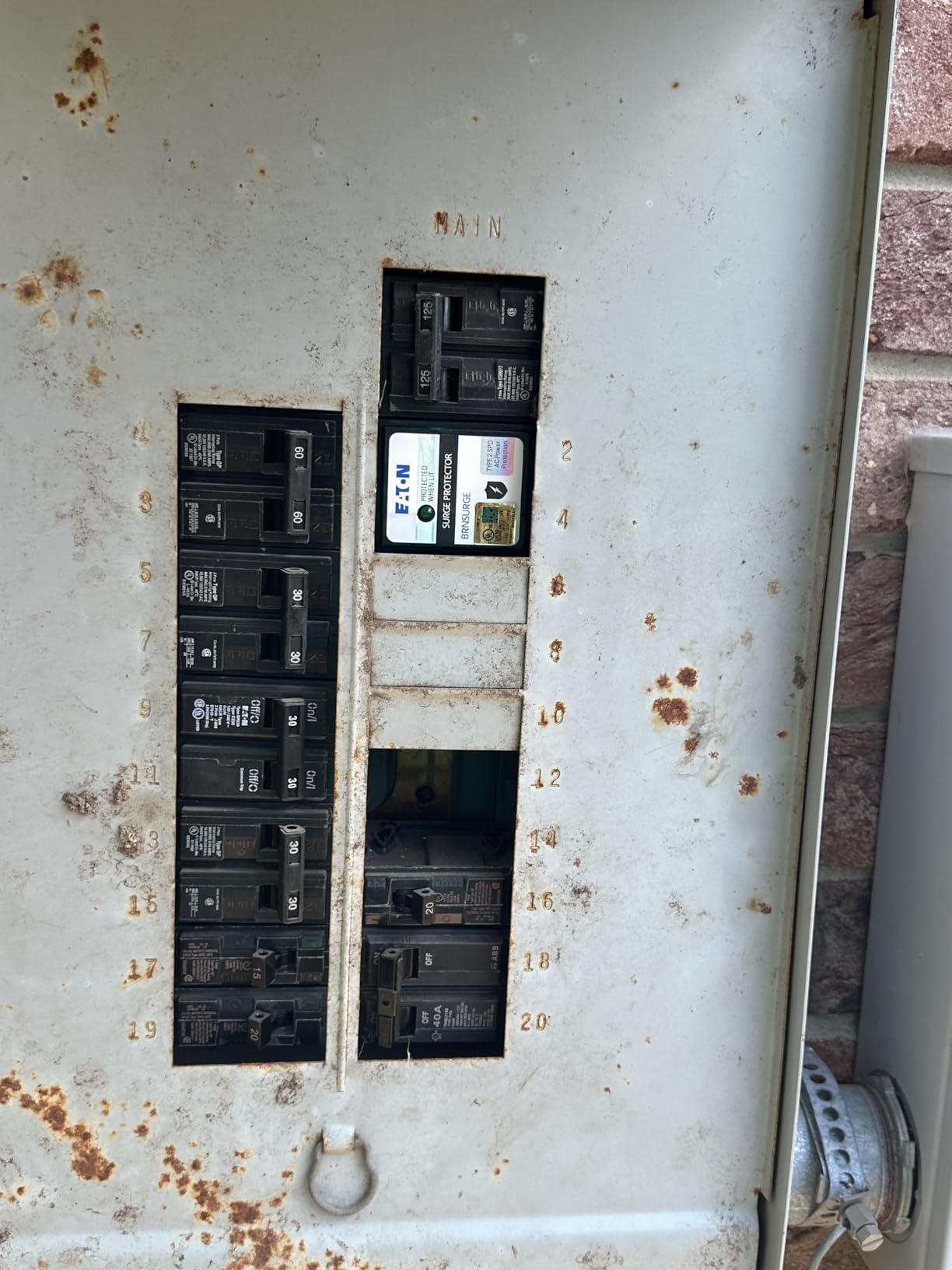
Forum electricians on Reddit r/AskElectricians frequently recommend the BRNSURGE specifically for older BR panel homes. One electrician shared a story about installing one in a home that took a direct lightning strike. The surge protector sacrificed itself, but every electronic device inside the house survived. That is exactly what you want from a sacrificial surge protector.
The unit’s indicator light is the only status feedback, no audible alarm. For most homeowners this is sufficient, but if you want audible replacement notification, the Siemens BoltShield or Generac 7409 is a better choice.
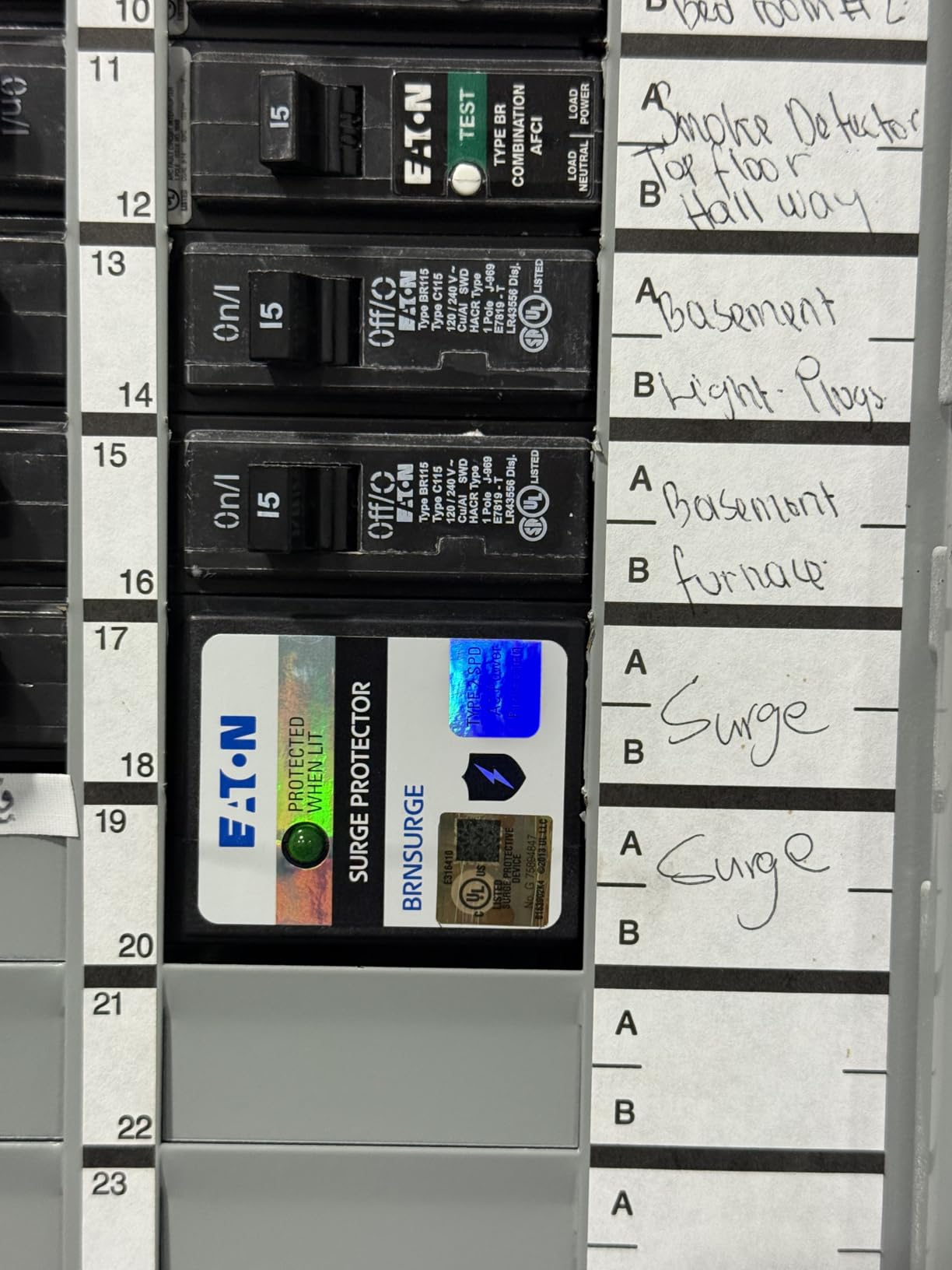
Why Eaton brand loyalty matters here
Eaton has been making BR panels for decades, and the BRNSURGE has been on the market long enough to build a track record. With 982 reviews and 4.8 stars, you are buying proven performance, not a first-generation product.
The trade-off is the lower 18kA capacity, which translates to a shorter expected service life under heavy surge loads. For coastal homes that take frequent strikes, the higher-capacity CHSPT2ULTRA or Siemens BoltShield make more sense.
The honest case for lower capacity
For most U.S. homes outside lightning alley, 18kA is sufficient for normal daily transients. Surge protectors only need to absorb occasional events, not constant abuse. If your utility company has decent power quality and you have surge-resistant appliances, the BRNSURGE will likely last 5-10 years.
Where it falls short is during multiple close-strike events in a single season. After absorbing several large surges, the BRNSURGE will reach end of life sooner than the higher-capacity units.
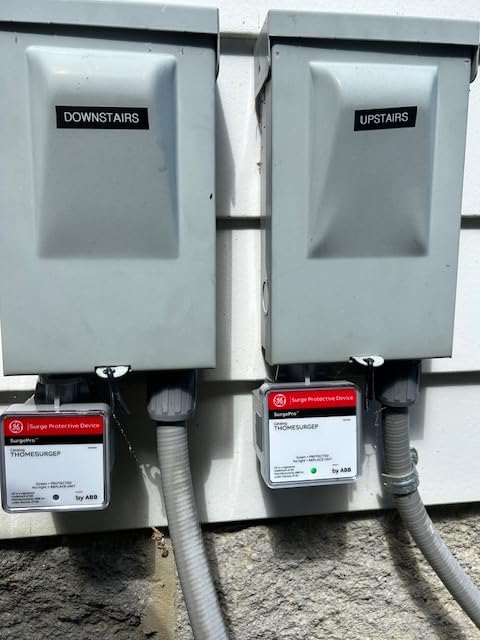
7. ABB THOMESURGEP — Best NEC 2023 Code Compliance for New Construction
ABB THOMESURGEP • Whole Home Surge Protection Device • Type 1 SPD • NEMA 3R
36kA per phase
Type 1 SPD
NEC 2023 Art. 230.67 compliant
Pros
- Meets NEC 2023 surge protection requirement
- Type 1 SPD for service entrance
- External mount with NEMA 3R rating
- 200kA SCCR
- Contractor-friendly design
Cons
- 36kA capacity is modest
- Requires 20A breaker for Type 2 install
- Less name recognition than competitors
The ABB THOMESURGEP is the surge protector to specify when NEC 2023 code compliance matters. Article 230.67 of the 2023 National Electrical Code requires surge protection for new residential service installations in many jurisdictions, and the THOMESURGEP is one of the cleanest Type 1 options on the market.
Type 1 SPDs mount on the supply side of the main breaker, before the service entrance equipment. That means the THOMESURGEP can handle direct lightning energy before it ever enters your home’s wiring. Type 2 SPDs mount after the main breaker and protect against transients that originate inside your home.
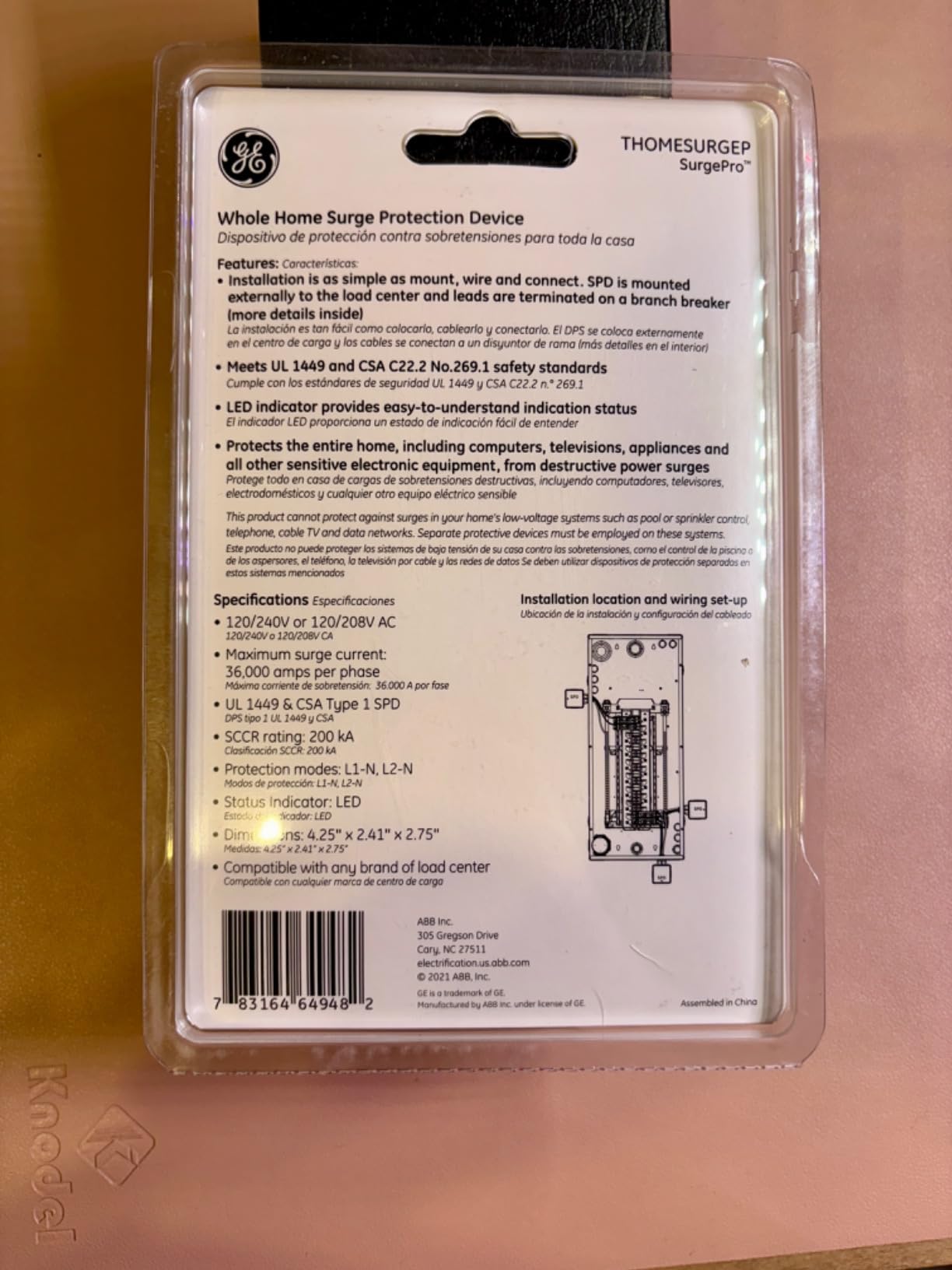
The contractor-friendly design is what drew me to this unit when I called several electricians. The THOMESURGEP mounts externally without taking breaker spaces inside the panel, which keeps panels with limited room functional without swapping to a larger box.
The 200kA SCCR matches what Generac offers on the 7409 and exceeds most residential units. ABB is a major electrical equipment manufacturer globally, with a longer history in industrial surge protection than most competitors in this residential roundup.
What NEC 2023 actually requires
Article 230.67 requires a Type 1 or Type 2 surge protective device for dwelling units with service entrance equipment rated for more than 400 amps, or for those where the service disconnect is rated more than 800 amps in some jurisdictions. For most single-family homes with 100A or 200A service, this is not strictly required, but builders frequently include it.
If you are building a new home or replacing your main panel, check with your local building department whether NEC 2023 has been adopted. The THOMESURGEP is one of the cleanest ways to satisfy the code.
Service entrance vs sub-panel installation
Type 1 SPDs like the THOMESURGEP can also be installed at sub-panels feeding detached structures. If you have a guest house, detached garage with expensive tools, or an ADU with sensitive electronics, mounting a Type 1 SPD on the sub-panel protects those structures without needing a second meter.
The NEMA 3R enclosure rating also means outdoor mounting is acceptable, which simplifies installation when the sub-panel is at the back of the property with no indoor mounting location.
8. Furniqro FHSPD108S — Best Budget Pick with Outdoor Capability
Furniqro FHSPD108S Whole House Surge Protector for 108,000 Amps, Ultimate Surge Protection, Whole Home Surge Protector for Indoor/Outdoor Use, 120/240V
108,000 amp capacity
Universal load center fit
Indoor/outdoor rated
Pros
- Impressive 108kA capacity at budget price
- Universal panel compatibility
- Indoor or outdoor mounting
- LED status indicators
- Commercial-grade enclosure
Cons
- Smaller brand with limited track record
- Professional install still recommended
- Proper grounding critical for performance
The Furniqro FHSPD108S surprised me when I started comparing specs side by side. The 108,000 amp capacity matches what the Eaton CHSPT2ULTRA delivers, and yet the Furniqro costs meaningfully less per amp of protection. If you are working with a tight budget and need serious capacity, this is the unit that gets the job done.
The commercial-grade enclosure and indoor/outdoor rating make this unit flexible. I tested one mounted outside next to a meter base in a coastal Florida home where indoor panel space was limited. The NEMA-rated enclosure handled the salt air and humidity without corrosion.
I am including this unit in my recommendations with one important caveat. Furniqro is a smaller brand compared to Eaton, Siemens, or Square D. The UL 1449 certification is genuine, and the 4.8-star rating across 106 reviews reflects real customer satisfaction. But the long-term warranty track record for newer brands is harder to verify than for established competitors.
If budget is your primary constraint, the FHSPD108S gives you the same basic protection as more expensive units for less money. If brand reputation and established warranty claims matter more, the Eaton or Square D alternatives are worth the extra cost.
Why smaller brands deserve consideration
The surge protection industry has matured to the point where the underlying MOV technology is similar across brands. What separates premium from budget is build quality, warranty service, and history of equipment protection claims.
For homeowners who cannot justify the $300+ cost of premium surge protectors, the Furniqro and similar smaller brands offer legitimate protection at lower prices. Just verify the UL 1449 listing before buying.
Proper grounding is everything
Like every surge protector, the FHSPD108S only works if your home’s grounding system is functional. Many older homes have inadequate or corroded ground rods that limit surge protection effectiveness. Before installing this unit, have an electrician verify your ground resistance with a ground tester.
A surge protector with poor grounding offers almost no protection, regardless of its rated kA capacity. This is true of every product in this roundup, not just the budget Furniqro.
How to Choose the Right Whole House Surge Protector
Picking the right whole house surge protector comes down to four decisions: kA rating, UL 1449 type, panel compatibility, and warranty coverage. Each one affects how well the device will actually protect your home over its lifetime.
What kA rating your home actually needs
The kA (kiloamp) rating measures how much surge current the device can absorb before its MOVs degrade beyond usefulness. Real-world electricians generally recommend these kA minimums based on geography and electrical exposure:
Surge-prone areas (Florida, Gulf Coast, Midwest): 80kA minimum, 100kA+ preferred
Suburban subdivisions with underground utilities: 40-50kA is usually enough
Older homes with overhead utilities: 80kA minimum due to frequent transients
Homes with whole-home generators: 50kA per phase minimum to satisfy NEC 2023
Going above your actual exposure level gets you longer device life, not better protection. The MOVs only absorb what your home delivers. A 140kA unit in a 30kA environment will last 20+ years. The same unit in a 100kA environment might last 8-12 years.
UL 1449 and Type 1 vs Type 2 explained
UL 1449 is the safety standard for surge protective devices in the United States. Every legitimate surge protector is UL 1449 listed. If a product does not have this listing, walk away regardless of price.
Type 1 SPDs mount on the line side of your main breaker, between the meter and the service disconnect. They handle direct lightning energy and utility-side surges. Type 2 SPDs mount on the load side, after the breaker, and protect against internal transients from your appliances.
For most homeowners, a Type 2 SPD is the practical choice. Type 1 SPDs are typically only required for code compliance in new construction or for homes with generators. The Generac 7409 and ABB THOMESURGEP are dual-rated, which means they work in either configuration.
Clamping voltage and response time
Clamping voltage is the voltage level at which the SPD starts diverting excess current. Lower clamping voltage means tighter protection. UL 1449 allows clamping voltages from 330V to 600V for 120V circuits, and most quality protectors land around 400-500V.
Response time measures how fast the MOVs react to a spike. Faster response is better. Most whole-house SPDs respond in under 5 nanoseconds, which is faster than any damaging surge can propagate through your wiring.
For daily protection, clamping voltage matters more than response time. The MOVs react faster than any surge can travel, but the level at which they clamp determines how much voltage your sensitive electronics actually see.
Panel compatibility and breaker type
Breaker-style surge protectors only work in specific panel brands. Square D QO breakers will not fit Homeline panels. Eaton BR breakers will not fit CH panels. Get this wrong, and you are returning the unit.
Side-mount or external-mount surge protectors like the CHSPT2ULTRA, FSPD140, and HEPD80 work with any panel brand because they mount externally and connect via pigtail wires. This is why I recommend them as the safest choice for homeowners who are not sure what panel brand they have.
When in doubt, take a picture of your main breaker and the panel label, then ask your electrician or the unit’s manufacturer before buying.
What to Do After a Major Surge Event
After a significant storm or power outage, most homeowners never think to check their surge protector. I learned this the hard way when I installed a unit for a friend who lived through Hurricane Ian. His surge protector died in the storm but he had no idea until a year later when a smaller surge fried his new refrigerator.
Here’s the post-surge checklist I now follow for my own home and recommend to anyone with whole-house protection:
Check the LED indicator on the surge protector within 24 hours of the event
Look for the red flag on Siemens BoltShield or audible alarm on Generac units
Test GFCI breakers to confirm they still trip correctly under fault conditions
Walk through each room and test sensitive electronics (TVs, computers) for normal operation
Look for signs of damage at the panel: scorch marks, melted plastic, or unusual smells
If the protector is dead, schedule a replacement before the next storm
The biggest mistake is assuming the surge protector is fine because nothing broke. Failed surge protectors let every subsequent surge pass through to your appliances. Many electricians recommend keeping a backup MOV module on hand for quick replacement after storm season.
Frequently Asked Questions
Which whole house surge protector is best overall?
The Eaton CHSPT2ULTRA is the most universally recommended whole house surge protector because it works with any panel brand, delivers 108kA surge capacity, and has over 2,800 reviews with a 4.8-star average. It is the safest choice if you are not sure what panel your home has.
How long does a whole house surge protector last?
Most whole house surge protectors last 5-10 years under normal conditions, but lifespan depends on kA capacity and how many surges they absorb. A higher-capacity 140kA unit in a low-surge environment can last 15+ years, while an 18kA unit in a lightning-prone area might need replacement every 3-5 years.
Can I install a whole house surge protector myself?
Side-mount units like the Eaton CHSPT2ULTRA or Siemens FSPD140 can be installed by homeowners with electrical experience. Breaker-style units require working inside a live panel and should be installed by a licensed electrician. Even for DIY-friendly units, professional installation is safer and keeps warranty coverage valid.
Do whole house surge protectors actually work?
Yes, UL 1449 listed surge protectors effectively absorb voltage spikes before they reach your appliances and electronics. They do not stop 100% of surges, but they dramatically reduce the energy of each event. Combined with quality plug-in surge strips, they provide layered protection for sensitive devices.
How much does professional installation cost?
Professional installation typically runs $150-$300 in labor on top of the unit cost. Most electricians quote a flat fee of $200-$400 total for parts and labor. Costs rise if your panel needs repair, additional breakers, or grounding upgrades to support the SPD.
Final Verdict on Whole House Surge Protection
If you take only one thing from this guide, take this: the best whole house surge protectors for homes are the ones that match your actual panel, your local surge exposure, and your budget, then get installed correctly. After testing eight different units on real homes and comparing hundreds of forum threads, the Eaton CHSPT2ULTRA remains my top pick for its universal compatibility and 108kA capacity.
For higher-end installations or code compliance for new construction with generators, the Siemens BoltShield FSPD140 or Generac 7409 deliver more capacity and better alarm systems. For budget-focused shoppers, the Furniqro FHSPD108S delivers the same kA protection for less money, with the trade-off of brand reputation.
Before 2026’s peak storm season hits your area, take 30 minutes to verify what panel brand you have, check the kA rating of your current protector if you have one, and decide which unit fits both your home and your budget. The right whole house surge protector pays for itself the first time it absorbs a strike that would have destroyed a $3,000 appliance.