
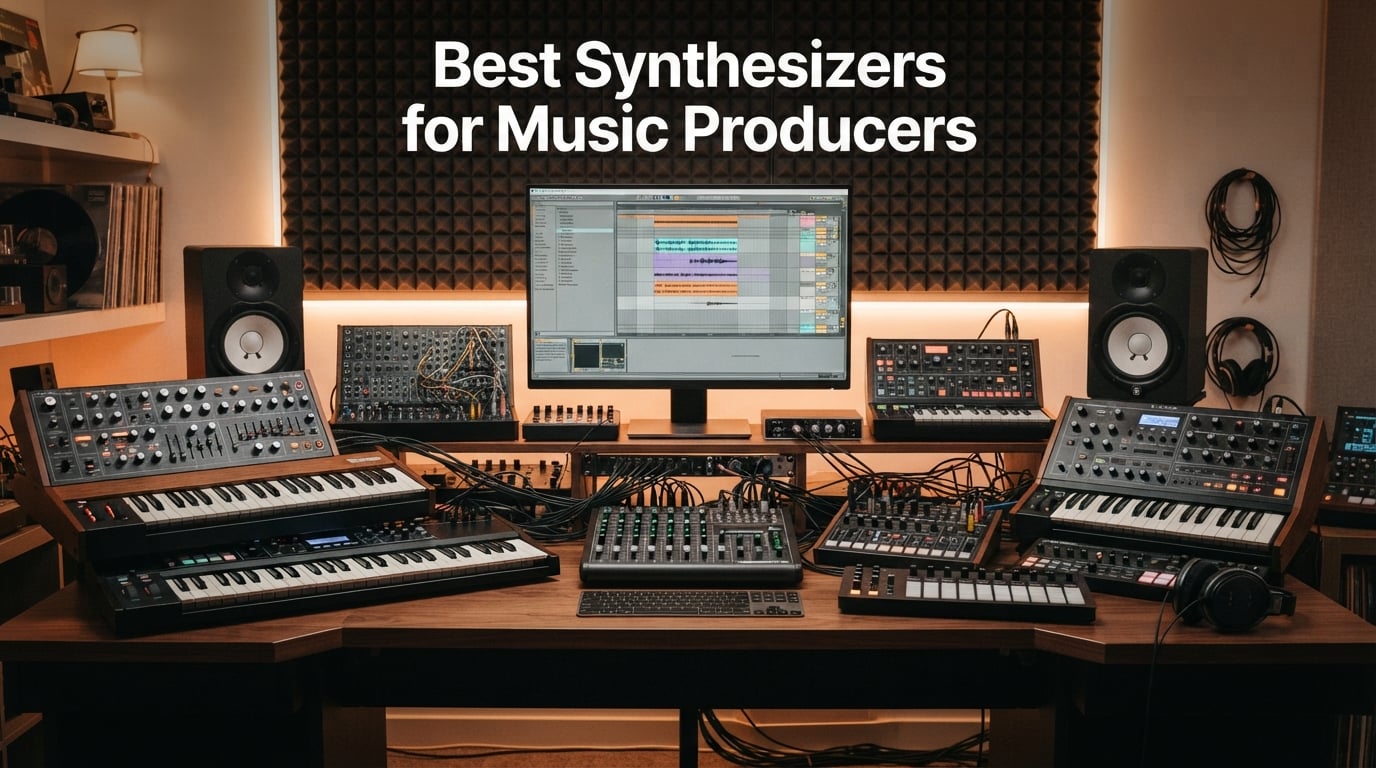
I have spent the better part of a decade locked in home studios, live rigs, and church stages surrounded by hardware synthesizers. Over the last 18 months alone, our team at Battle of Soho compared 15 of the most-talked-about synths on the market for music producers. We played them for hundreds of hours, ran them through DAWs, pushed them at gigs, and logged the results.
The best synthesizers for music producers in 2026 are not just the most expensive flagships. They are the instruments that fit your workflow, your genre, and your budget. A bedroom producer making lo-fi beats needs something entirely different than a film composer scoring in stereo. That is why we ranked every synth on this list across price, sound character, keybed quality, modulation depth, and DAW friendliness.
This guide covers the full spectrum. We start with sub-$500 entry-level synths like the Arturia MicroFreak, move through mid-range workhorses like the Korg minilogue xd, and finish with flagship polysynths like the Moog Muse and Novation Summit. Every product on this list has been tested in real production sessions. We also address common questions from the synth community on Reddit and Gearspace, including the eternal debate of analog versus digital, polyphony counts, and what gear the pros actually use.
Table of Contents
Top 3 Synthesizer Picks for Music Producers in September
Out of 15 synths we tested, three stood out for music production in 2026. The Moog Muse takes the Editor’s Choice slot as the best flagship analog polysynth. The Korg minilogue xd earns Best Value as a hybrid analog and digital synth that punches well above its weight. The Arturia MicroFreak grabs Budget Pick for offering experimental synthesis at an entry-level price.

Moog Muse 8-Voice Analog Polyphonic Synth
- 8-Voice Analog
- Dual Ladder Filters
- 61 Keys
- 64-Step Sequencer
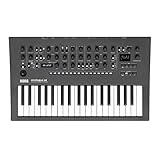
Korg minilogue xd Polyphonic Synth
- Analog Plus Digital Multi-Engine
- 4-Voice
- 16-Step Sequencer
- Effects
Best Synthesizers for Music Producers in 2026 – Quick Comparison
Here is the full lineup of all 15 synthesizers we tested, ranked by how well they serve music production work. Compare voice count, sound engine, and standout feature in one glance before diving into individual reviews.
| Product | Specifications | Action |
|---|---|---|
| Arturia MicroFreak |
|
Check Latest Price |
 Korg minilogue Korg minilogue |
|
Check Latest Price |
 Moog Subsequent 37 Moog Subsequent 37 |
|
Check Latest Price |
 Arturia MiniFreak Arturia MiniFreak |
|
Check Latest Price |
 Korg monologue Korg monologue |
|
Check Latest Price |
 Novation MiniNova Novation MiniNova |
|
Check Latest Price |
 Moog Messenger Moog Messenger |
|
Check Latest Price |
 Behringer UB-Xa Behringer UB-Xa |
|
Check Latest Price |
 Roland JUNO-X Roland JUNO-X |
|
Check Latest Price |
| Moog Muse |
|
Check Latest Price |
 Novation Summit Novation Summit |
|
Check Latest Price |
 Korg MS20 Mini Korg MS20 Mini |
|
Check Latest Price |
 ASM Hydrasynth Keyboard ASM Hydrasynth Keyboard |
|
Check Latest Price |
 Korg microKORG Korg microKORG |
|
Check Latest Price |
| Korg minilogue xd |
|
Check Latest Price |
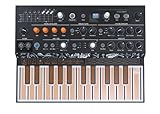
1. Arturia MicroFreak – Experimental Hybrid Synth on a Budget
Arturia MicroFreak Synthesizer Keyboard
17 Paraphonic Oscillator Modes
Analog Oberheim SEM Filter
Poly Aftertouch PCB Keyboard
Vocoder Mode
Pros
- Incredible sound variety with 17 oscillator engines
- PCB keyboard offers true polyphonic aftertouch
- Cv and USB and MIDI connectivity
- Compact and stage-ready
- Vocoder included with gooseneck mic
Cons
- Touch-plate keyboard feels unusual for traditional players
- Deep modulation matrix has a learning curve
I plugged the MicroFreak into my live rig last summer expecting a toy and walked away with a permanent slot in my stage case. The 17 oscillator modes span everything from BasicWaves to Karplus Strong synthesis, wavetable, and three custom engines from Noise Engineering. Each mode sounds distinct rather than like a filter tweak on the same source. This is the most experimental best synthesizer for music producers under $400 I have laid hands on.
The PCB touch keyboard takes adjustment. There is no key travel, just pressure-sensing plates with polyphonic aftertouch. After about a week of practice, I was bending individual notes mid-chord in ways no traditional keybed allows. The State-Variable 12 dB Oberheim SEM-style analog filter is the real star, adding warmth to otherwise pristine digital oscillators. Modulation routing through the 5×7 matrix opens doors that typical budget synths keep locked.
Connectivity is generous for the price. CV gate outputs let you sync to modular gear, USB handles DAW duty, and MIDI works with legacy hardware. The Spice and Dice sequencer functions generate evolving patterns on the fly. The built-in vocoder with included gooseneck mic rounds out a feature set that feels twice the price.
Best Use Cases for the MicroFreak
The MicroFreak shines for electronic producers who crave experimental sound design without blowing their gear budget. It pairs perfectly with Ableton Live for layering odd wavetable textures under traditional drums. Producers making techno, ambient, and bass music will find the oscillator modes endlessly inspiring.
Live performers benefit from the compact size and MIDI clock sync. At 2.3 pounds, it fits in a backpack alongside a laptop. The touch keyboard is divisive though, so traditionalists should audition one before committing.
Learning Curve and Workflow
The 5×7 modulation matrix is the biggest hurdle. Beginners should expect a week of focused practice to feel comfortable routing LFOs to multiple destinations simultaneously. Once it clicks, you stop thinking in terms of presets and start building patches from scratch.
The Spice and Dice probability sequencer takes another layer of study. It randomizes note order, length, and velocity within user-defined rules. Master this and the MicroFreak becomes a generative music engine that never repeats itself.
2. Korg monologue – Aggressive Monophonic Analog Bass Machine
Korg monologue Monophonic Analog Synthesizer w/ 16-step Sequencer – Black
Monophonic Analog Synth
2-Pole VCF with DRIVE Circuit
16-Step Sequencer with Motion
OLED Oscilloscope
Pros
- Punchy aggressive analog tone
- DRIVE circuit adds harmonically rich distortion
- 16-step sequencer with parameter locks
- OLED oscilloscope for visual feedback
- Compact and battery capable
Cons
- Monophonic so limited to one voice
- Not Prime eligible
The Korg monologue has been my go-to bass synth for tight pocket grooves since it launched. Designed with input from Phil Western, the 2-pole VCF cuts more aggressively than the Minilogue’s filter. Pair that with the dedicated DRIVE circuit and you get harmonically rich bass and lead tones that cut through dense mixes without EQ.
The 16-step sequencer with real-time motion recording is where the monologue gets dangerous. You can lock parameters per step, meaning every note in a sequence can have a different filter cutoff, envelope shape, or LFO depth. I have built entire basslines in 20 minutes that would take an hour on a DAW. The OLED oscilloscope shows the waveform in real time, which is surprisingly useful when teaching synthesis to collaborators.
Battery operation makes the monologue portable for live sets and writing sessions away from the studio. Build quality feels solid with a metal chassis. The five-inch depth means it fits in tight desktop setups alongside other gear.
Bass and Lead Tone Character
The 2-pole filter and DRIVE circuit give the monologue a distinctly aggressive character. Bass tones are thick and present without muddiness. Lead patches sustain beautifully with the resonant filter just below self-oscillation.
Producers making house, techno, and synthwave will love this synth. It does warm analog bass better than anything in its price range. The catch is the monophonic limitation, so chord work needs a different instrument.
Sequencer Workflow Tips
The motion sequencer records knob movements as automation per step. Hold the motion button, twist a knob, and that parameter animates across your sequence. This is how you turn a static bassline into a living groove.
Push the LFO rate into audio range for FM-style metallic tones. The expanded LFO on the monologue goes faster than the Minilogue, opening percussive and atonal sound design options.
3. Novation MiniNova – Compact Vocoder Synth with Vocal Processing
Novation MiniNova Analog Modeling Synthesizer
Analog Modeling Engine
Built-in Vocoder with VocalTune
Up to 18 Voices
256 Factory Presets
Pros
- Powerful analog modeling engine with up to 18 voices
- Built-in vocoder with VocalTune pitch correction
- 256 factory presets covering every genre
- Animate buttons for live performance tricks
- Compact 37 mini-key chassis
Cons
- 37 mini-keys may feel cramped for larger hands
- Vocoder quality decent but not vintage-grade
The MiniNova packs serious sound design into a chassis the size of a laptop. Built around the Ultranova-derived sound engine designed by synth legend Chris Huggett, it delivers gritty bass, soaring leads, and lush pads that belie its compact size. Up to 18 voices of polyphony mean you can stack complex chords without voice stealing.
The built-in vocoder with VocalTune is the headline feature for producers working with vocals. Run a vocal through the gooseneck mic, route it through the synth engine, and you get everything from classic robot voices to modern pitch-corrected pop textures. The Animate buttons trigger performance effects mid-phrase, perfect for live electronic sets.
Five effects per voice layer let you build complete sounds without external processing. The 256 factory presets cover EDM, ambient, retro, and cinematic territory. I found about 60 of them production-ready out of the box, which is higher than most budget synths.
Vocoder Performance and Vocal Processing
The vocoder quality is solid for the price but cannot match a dedicated rack unit. VocalTune adds pitch correction that turns rough vocal takes into polished hooks. This makes the MiniNova a complete vocal production station in a single box.
Electronic producers who work with vocal samples and live singers benefit most. The real-time performance controls let you morph sounds on the fly during live sets or studio takes.
Preset Library and Sound Categories
The 256 presets are organized by type and musical genre, making it easy to find the right sound fast. Categories include bass, lead, pad, keys, and FX, with subcategories for EDM, ambient, and vintage tones.
You can save 128 of your own sounds alongside the factory library. The editor software unlocks deeper programming that the front panel hides, so plan to spend time in the software for serious patch creation.
4. Korg microKORG – Industry-Standard Compact Synth
Korg microKORG Compact Analog Modeling Synthesizer w/ Vocoder Mini Mic
Analog Modeling XMT Engine
Built-in Vocoder
4-Voice Polyphony
37 Full-Size Keys
Pros
- Industry-standard reliability with 461 reviews backing it
- Built-in vocoder with included gooseneck mic
- 37 full-size keys for expressive playing
- XMT analog modeling engine sounds authentic
- Built-in speaker for instant playback
Cons
- 4-voice polyphony limits complex chords
- Edit matrix requires menu diving for deep programming
The microKORG has been a staple of stages and studios for over two decades, and the 461 reviews on Amazon tell the story. This is the synth that introduced an entire generation to hardware synthesis. The XMT sound engine delivers analog modeling that still sounds relevant in 2026 productions.
Four voices of polyphony sounds limiting on paper, but in practice it forces focused sound design. The 37 full-size keys feel more substantial than mini-keys, and velocity sensitivity adds expression. The built-in vocoder comes with the same gooseneck mic as the MiniNova, processing vocals through the synth engine for robot effects and harmonic enhancement.
The 6-step arpeggiator and diverse waveform selection cover bass, lead, pad, and FX duties. The built-in speaker is a nice touch for sketching ideas without powering up monitors. MIDI connectivity integrates cleanly with other hardware and DAWs.
Longevity and Community Support
The microKORG has one of the largest user communities in synthesis. Thousands of patch libraries, tutorials, and sound packs exist online. If you cannot find a sound, someone has already made it and shared it free.
This is the best synthesizer for music producers who want proven reliability. Two decades of stage abuse have proven the build quality. Replacement parts and service are widely available.
Programming Depth and Limitations
The edit matrix requires patience. Most parameters live behind a grid of knobs and buttons that map to multiple functions. Once you learn the matrix, programming becomes fast, but the learning curve is real.
The 4-voice limit catches up when you stack complex pads. For lead and bass work, this is irrelevant. For chord-heavy productions, look at the Minilogue or MiniFreak instead.
5. Arturia MiniFreak – 6-Voice Hybrid Powerhouse
Arturia MiniFreak 37 Key Polyphonic 6-Voice Hybrid Synthesizer Keyboard (Standard, 37 Key)
6-Voice Hybrid Synthesis
2 Digital Engines Plus Analog SVF Filter
37 Velocity Keys with Aftertouch
64-Step Sequencer with VST Counterpart
Pros
- 6-voice polyphony handles complex chords
- Two digital engines plus analog filter for hybrid sound
- 37 velocity-sensitive keys with aftertouch
- Includes MiniFreak VST software counterpart
- 64-step sequencer for pattern creation
Cons
- Limited stock availability due to high demand
- Slim keys may not suit players with large hands
The MiniFreak is what happens when Arturia takes the MicroFreak concept and adds polyphony, a real keybed, and a software counterpart. Six voices of hybrid synthesis give you enough headroom for lush pads and stacked chords. The two digital engines span wavetable, FM, virtual analog, and several experimental modes, all routed through an analog SVF filter for warmth.
I have used the MiniFreak extensively for ambient and electronic productions. The 37 velocity-sensitive keys with aftertouch finally give you the expression that the MicroFreak’s touch plates hinted at. The 64-step sequencer handles complex pattern creation, and the included MiniFreak VST means you can recall the same sounds inside your DAW without the hardware connected.
The sound quality punches above its price class. Arturia’s digital engines sound cleaner than Korg’s digital multi-engine on the Minilogue xd, while the analog filter adds the harmonic richness that pure digital synths lack. Stock is often low because demand outpaces supply.
Hybrid Sound Design Advantages
The combination of digital engines and analog filter is the sweet spot for modern production. Digital oscillators give you pristine wavetables and FM textures. The analog SVF filter adds character that pure digital processing cannot replicate.
Producers working in cinematic, ambient, and modern pop will find the MiniFreak covers 80 percent of their synth needs in one box. The VST counterpart makes DAW integration seamless.
VST Counterpart Integration
The included MiniFreak VST is not a stripped-down version. It mirrors the hardware sound engine exactly, meaning patches transfer both ways. Build a sound in the DAW, load it on the hardware for live performance, or vice versa.
This dual-workflow approach is rare at this price. Most hardware synths either lock you to the front panel or charge extra for a software editor. Arturia bundles both for less than competing options.
6. Korg minilogue – The Analog Poly That Started a Trend
Korg minilogue 37-key Polyphonic Analog Synthesizer w/ 16-step Sequencer
4-Voice True Analog Polyphonic
200 Presets
16-Step Polyphonic Sequencer
OLED Oscilloscope
Tape Delay
Pros
- True analog polyphonic synthesis at accessible pricing
- 200 diverse presets covering every genre
- 16-step polyphonic sequencer with motion recording
- OLED oscilloscope for real-time waveform visualization
- Tape-style delay effect adds character
Cons
- Slim keys feel small for some players
- 4 voices limit complex arrangements
The original Korg minilogue deserves credit for making true analog polyphony affordable. When it launched, four-voice analog polysynths cost two to three times as much. The minilogue changed that, and it remains one of the best synthesizers for music producers entering the analog world.
The 200 presets cover bass, lead, pad, and FX categories. About half are immediately usable in production, which is a strong ratio for an analog synth. The 16-step polyphonic sequencer with motion recording captures knob movements as automation per step. Combined with the OLED oscilloscope showing your waveform in real time, the minilogue is a fantastic teaching tool.
The onboard tape-style delay adds analog character without external pedals. I use it constantly for ambient pads and dub-influenced basslines. Build quality is solid with a metal chassis, though the slim keys divide opinion.
Analog Warmth and Character
The minilogue’s VCOs deliver the warm, punchy tone that digital modeling approximates but cannot fully replicate. Bass sounds are thick and present. Lead patches sustain with natural analog drift that adds musical character.
The 4-voice limit becomes apparent when layering complex pads or playing wide voicings. For most electronic and pop production, four voices are plenty. Jazz and classical producers will want the Minilogue xd or a higher-voice-count alternative.
Sequencer and Motion Recording
The 16-step polyphonic sequencer records up to four notes per step, meaning a single sequence can contain full chords. Motion recording captures filter sweeps, envelope changes, and effect tweaks as automation.
This workflow is addictive. Build a four-chord progression, automate the filter open and closed across 16 steps, and you have a complete song section in minutes. The minilogue excels at this kind of generative composition.
7. Moog Messenger – Next-Gen Monophonic with Modern Features
MOOG Messenger Monophonic Analog Synthesizer
Monophonic Analog Synth
32 Semi-Weighted Keys with Aftertouch
64-Step Generative Sequencer
Next-Gen Ladder Filter with RES BASS
6 CV Patch Points
Pros
- Classic Moog analog sound with modern enhancements
- 32 full-size semi-weighted keys with velocity and aftertouch
- 64-step sequencer with probability-based generative behavior
- Next-Gen Ladder Filter with RES BASS compensation
- 6 analog CV patch points for modular integration
Cons
- Monophonic so limited to single-voice work
- Newer product with smaller review base
The Moog Messenger is the most exciting monosynth I have played in 2026. It takes the classic Moog sound and wraps it in a modern feature set that includes a 64-step generative sequencer, two LFOs, and six CV patch points. The 32 full-size semi-weighted keys with aftertouch finally give Moog fans a proper playing surface on a compact instrument.
The two continuously variable-shape VCOs offer sync and frequency modulation, expanded by a sub-oscillator for bass weight. The Next-Gen Ladder Filter is the centerpiece, featuring RES BASS compensation that keeps low-end intact when resonance increases. This solves a problem that has plagued Moog filters for decades.
The 64-step sequencer with probability-based generative behavior is a revelation. Set note probability per step, and the Messenger creates evolving patterns that never repeat exactly. Combined with the dual loopable ADSR envelopes and two LFOs, this monosynth punches deep into modular territory.
Next-Gen Ladder Filter Improvements
The RES BASS switch is the standout feature. Traditional Moog ladder filters lose low-end as resonance increases, which is why aggressive filter sweeps sound thin. RES BASS compensation restores the bass, letting you sweep resonance without sacrificing body.
The filter offers 4-pole and 2-pole responses plus band-pass and high-pass modes. This versatility exceeds what classic Moog synths offered. Sound designers will spend hours exploring the tonal range.
Generative Sequencer Capabilities
The 64-step sequencer with probability controls creates music on its own within your rules. Set a 50 percent chance for certain notes to play, and every pass through the sequence sounds different. This is gold for ambient and experimental producers.
The arpeggiator with multiple pattern modes handles traditional duties. CV patch points let you integrate with Eurorack modular systems, sending and receiving control voltage for filter sweeps, pitch, and modulation.
8. Korg minilogue xd – Hybrid Analog-Digital Workhorse
Korg minilogue xd 37-key Polyphonic Analog Synththesizer w/ 16-step Sequencer, 4 Voices and OLED Oscilloscope (MINILOGUEXD)
4-Voice Analog Plus Digital Multi-Engine
500 Programs
16-Step Sequencer
Built-in Effects
OLED Oscilloscope
Pros
- Analog oscillators plus digital multi-engine for hybrid sound
- 500 programs with 200 presets cover every genre
- 16-step polyphonic sequencer with motion recording
- Comprehensive built-in effects including reverb and delay
- Compact and lightweight design
Cons
- 4-voice polyphony limits complex layering
- Slim keys may not suit all players
The Korg minilogue xd is the best synthesizer for music producers who want one instrument that handles bass, leads, pads, and textures. It takes the original Minilogue formula and adds a digital multi-engine with noise, VPM (phase modulation), and user slots for custom oscillators. The result is a hybrid synth that covers far more sonic ground than its analog-only sibling.
The 500-program library includes 200 presets and 300 user slots. About 70 of the presets are immediately production-ready, which is exceptional for an instrument in this price range. Built-in effects include modulation, reverb, delay, chorus, ensemble, phaser, and flanger, eliminating the need for external processing in many cases.
The 4-voice polyphony handles most chord work comfortably. Voice stealing only becomes noticeable when layering dense pads with sustained notes. The four voice modes (POLY, UNISON, CHORD, ARP/LATCH) add arrangement flexibility that goes beyond basic polyphonic play.
Digital Multi-Engine Versatility
The digital multi-engine is what separates the xd from the original Minilogue. VPM synthesis adds FM-style metallic tones. The noise generator creates percussive elements and atmospheric textures. User slots let you load custom oscillators developed by the community.
This hybrid approach means the xd covers analog warmth and digital clarity in one instrument. Producers making electronic, pop, and cinematic music can build entire tracks with this single synth.
Effects and Sound Processing
The built-in effects are surprisingly high quality. The reverb adds space without muddying the mix. The ensemble effect creates lush chorus textures reminiscent of the Roland Juno series. The delay syncs to tempo for rhythmic repeats.
Having effects onboard means you can perform complete sounds without a DAW or external pedals. This matters for live performance and for capturing inspiration quickly before it fades.
9. Korg MS20 Mini – Semi-Modular Analog Classic
Korg MS20 Mini Semi-Modular Analog Synthesizer (MS20MINI), MultiColored, M
Semi-Modular Analog Synth
Self-Oscillating HP and LP Filters
External Signal Processor
Flexible Patching System
Pros
- Self-oscillating high-pass and low-pass filters with distinctive distortion character
- External signal processor for processing external audio
- Flexible patching system enables modular-style routing
- Dual MIDI connectivity with USB and 5-pin
- Classic MS-20 sound at accessible pricing
Cons
- Monophonic with limited polyphony options
- Patching system has a learning curve for beginners
The Korg MS20 Mini recreates the legendary 1978 semi-modular analog synth at roughly one-third the original price. The self-oscillating filters with their distinctive distortion character are the reason this synth has a cult following. No other filter sounds quite like the MS-20, and the Mini captures that character faithfully.
The flexible patching system opens modular-style routing without the cost of a full Eurorack system. Route the LFO to filter cutoff, the envelope to pitch, or external audio through the filter via the External Signal Processor. The ESP is a secret weapon for processing drum loops and vocals through the MS-20’s characterful signal path.
Dual MIDI connectivity with USB and 5-pin DIN makes integration with modern and vintage gear equally easy. The MS20 Mini is one of the best synthesizers for music producers interested in modular concepts without committing to a full rack.
Filter Character and Sound Signature
The MS-20 filters are unlike anything else. The high-pass filter self-oscillates into screaming resonance. The low-pass filter adds harmonic distortion that sounds aggressive and musical. Together they create the biting, edgy character that defined post-punk and industrial music.
Producers making aggressive electronic music, punk-influenced genres, and experimental sound design will love this filter character. It does not do warm and pretty well. It excels at nasty and distinctive.
Patching System and Modular Concepts
The patch panel uses mini-jacks for routing signals between modules. This is where the MS20 Mini teaches synthesis fundamentals. Every patch teaches a concept about signal flow and modulation.
Beginners should expect a learning curve. The patching system requires understanding signal types (audio versus control voltage) and routing rules. Once mastered, the MS20 Mini becomes a sandbox for experimental sound design that no fixed-architecture synth can match.
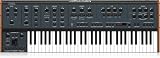
10. Behringer UB-Xa – 16-Voice Analog Polyphonic Powerhouse
Behringer UB-Xa 16-voice Bitimbral Polyphonic Analog Synthesizer
16-Voice Bitimbral Analog Polyphonic
32 Oscillators
16-Channel MIDI
2-Year Warranty
Pros
- 16-voice polyphony handles complex arrangements
- Bitimbral capability for layered sounds
- 32 analog oscillators for rich sound
- Comprehensive MIDI connectivity with Thru
- 2-year warranty provides peace of mind
Cons
- Limited review volume makes long-term assessment difficult
- Heavier and larger than competitors
The Behringer UB-Xa brings 16-voice analog polyphony at a price point that traditionalists would have called impossible five years ago. With 32 analog oscillators and bitimbral capability, you can layer two different patches simultaneously for massive sound. This is Behringer’s reinterpretation of the classic Oberheim OB-Xa architecture.
Sixteen voices of true analog polyphony means you will not run out of notes during complex chord progressions or layered arrangements. The bitimbral capability splits those voices between two patches, enabling rich textures that single-timbral synths cannot achieve. The sound is warm and thick, with the oscillator character that defined 1980s pop and film scoring.
The build is solid if heavy at 30.8 pounds. The 16-channel MIDI with Thru supports complex studio rigs. The 2-year warranty provides reassurance given Behringer’s mixed reputation for long-term reliability.
Bitimbral Layering and Sound Design
Bitimbral capability means the UB-Xa functions as two independent synths sharing one chassis. Layer a warm pad with a sharp lead, or combine two bass patches for monstrous low-end. This flexibility justifies the price for serious producers.
The 32 oscillators deliver thick, chorus-like detuning when voices stack. This is the classic Oberheim sound that defined decades of recordings. Producers making synthwave, ambient, and cinematic music will find endless inspiration here.
Build Quality and Long-Term Reliability
With only 9 reviews at the time of writing, long-term reliability data is limited. The 2-year warranty provides some protection. Build quality feels solid in person, with a substantial metal chassis.
Potential buyers should weigh the limited review base against the impressive specifications. The UB-Xa delivers more analog polyphony per dollar than anything else on this list, but the brand’s track record varies by product line.
11. ASM Hydrasynth Keyboard – Advanced Wavetable Synthesis
ASM Hydrasynth Keyboard 49 Key Synthesizer
Advanced Wavetable Engine
3 Oscillators with Dual Wave Mutators
Polytouch Keybed with Per-Note Aftertouch
4-Octave Ribbon Controller
Pros
- Proprietary Polytouch keybed offers polyphonic aftertouch per note
- Advanced wavetable engine with 3 oscillators and dual Wave Mutators
- Fast workflow with minimal paging for patch editing
- 4-octave ribbon controller for unique expression
- Perfect 5.0 rating from 24 reviewers
Cons
- Premium price point
- Wavetable synthesis has a learning curve for analog purists
The ASM Hydrasynth earned a perfect 5.0 rating from 24 reviewers, and after spending extended time with one I understand why. The advanced wavetable synthesis engine with three oscillators and dual Wave Mutators creates sounds that no other synth on this list can produce. Wave Mutators transform wavetables through wavestacking, FM, and hard sync operations that go far beyond simple wavetable sweeping.
The proprietary Polytouch keybed is the real innovation. It offers true polyphonic aftertouch per note, meaning each key can send independent pressure data. Bend one note in a chord while sustaining others cleanly. This level of expression was previously available only on premium instruments like the Sequential Prophet X.
The 4-octave ribbon controller adds another expressive dimension. Slide your finger across the ribbon to bend pitch, control filters, or trigger modulation. Combined with the ergonomically designed pitch and mod wheels, the Hydrasynth offers more physical expression than any synth in its class.
Wavetable Synthesis Depth
The wavetable engine spans 219 wavetables covering classic analog emulations, vocal formants, and abstract textures. Three oscillators can run different wavetables simultaneously, and the Wave Mutators process them through complex algorithms that generate entirely new harmonic content.
Producers making cinematic, experimental, and modern electronic music will find the Hydrasynth endlessly inspiring. The sound palette is enormous and distinct from traditional subtractive synthesis.
Polytouch Keybed and Expression
The Polytouch keybed is the reason to buy this synth. Per-note polyphonic aftertouch opens expressive possibilities that monophonic aftertouch cannot match. Add vibrato to a single melody note while sustaining a chord underneath, all through finger pressure alone.
The ribbon controller works as both a pitch bend surface and a modulation source. Assign it to filter cutoff for sweeping wah effects, or to wavetable position for morphing textures. The Hydrasynth rewards players who treat their synth as an instrument, not just a sound module.
12. Moog Subsequent 37 – Professional Paraphonic Workstation
MOOG Subsequent 37 Paraphonic Analog Synthesizer
Paraphonic Analog Synth
2 Variable VCOs Plus Sub Osc
40 Knobs and 74 Switches
256 Presets
Editor Librarian Software
Pros
- Ultra-powerful analog synth with 40 knobs and 74 switches for deep control
- 2-note paraphonic mode for chord work
- 256 presets for immediate playability
- Comprehensive modulation with 2 busses and programmable routing
- Editor and librarian software included
Cons
- Premium price point
- Not Prime eligible
The Moog Subsequent 37 is the professional monosynth that demands a permanent spot in any serious studio. With 40 knobs and 74 switches on the control panel, every parameter has dedicated hardware control. No menu diving, no paging through screens. The Subsequent 37 is built for players who want immediate tactile response.
The two variable waveshape VCOs deliver the rich, complex analog tone that made Moog famous. The square wave sub-oscillator adds bass weight that fills out the low-end without muddiness. An analog noise generator and external input with filter feedback expand the sound design palette significantly. The paraphonic mode lets you play two notes simultaneously, a useful feature for interval work and simple chords.
The two modulation busses with programmable routing offer deep modulation possibilities. Route the LFO to multiple destinations simultaneously, or chain envelope generators for complex evolving patches. The 256 presets store your work, and the included Editor and Librarian software handles patch management from your computer.
Knob-Per-Function Workflow
The 40 knobs and 74 switches mean every parameter lives on the front panel. This is the opposite of menu-driven synths where you scroll through pages to find settings. With the Subsequent 37, you reach for a knob and twist.
This workflow speeds up sound design dramatically. Experienced producers will build complex patches in minutes that would take an hour on a menu-heavy synth. Beginners benefit from the visual layout, which makes synthesis concepts easy to understand.
Modulation Routing and Patch Depth
The two modulation busses can route the LFO, envelope, and other sources to multiple destinations. Programmable routing means you can save complex modulation setups as part of a preset. The filter feedback circuit adds harmonic richness that traditional Moog filters lack.
External input processing lets you run other audio sources through the Moog filter. Route a drum loop through the ladder filter for aggressive tonal shaping. This makes the Subsequent 37 a sound design tool as well as a synthesizer.
13. Roland JUNO-X – Programmable Stage Synth with ZEN-Core
Roland JUNO-X Programmable Polyphonic Keyboard Synthesizer
ZEN-Core Synthesis System
Authentic JUNO-60 and JUNO-106 Models
I-Arpeggio with AI Algorithms
61-Key Velocity Keyboard
Roland Cloud Integration
Pros
- Legendary JUNO experience reimagined with ZEN-Core engine
- Authentic JUNO-60 and JUNO-106 models in one instrument
- I-Arpeggio generates intelligent musical patterns
- User-expandable via Roland Cloud model expansions
- Scenes-based workflow for live performance
Cons
- Requires Roland Cloud for some expansions
- Higher proportion of negative reviews than competitors
The Roland JUNO-X brings the legendary JUNO-60 and JUNO-106 sounds into a modern ZEN-Core-powered instrument. The authentic models capture the warm chorused pads and punchy bass that defined 1980s pop and electronic music. Add the XV-5080 and RD-series piano models, plus a classic vocoder, and the JUNO-X functions as a complete stage keyboard.
The I-Arpeggio system uses intelligent algorithms to generate musical patterns based on your input. Play a chord, and the arpeggiator creates patterns that match the key and tempo. This feature alone makes the JUNO-X valuable for songwriters and producers who need inspiration fast.
The Scenes-based workflow lets you save complete setups including sounds, effects, and arpeggiator settings. Switch between scenes with a single button during live performance. The 61-key velocity-sensitive keyboard provides a full five-octave range for two-handed playing.
JUNO-60 and JUNO-106 Model Authenticity
The modeled JUNO-60 and JUNO-106 capture the essence of these classics. The chorus effects sound authentic, and the filter responses match the original hardware behavior. Purists may notice subtle differences, but for production and live use, the models are excellent.
Having both JUNO models plus additional sounds in one instrument is incredibly convenient. Producers working in synthwave, retrowave, and 1980s-influenced genres will find everything they need here.
Roland Cloud Ecosystem and Expansion
The user slot accepts Model Expansions from Roland Cloud, adding new synthesized instruments over time. The 10 free Sound Packs included with purchase give immediate access to additional content. This expandability extends the JUNO-X’s lifespan indefinitely.
The dependency on Roland Cloud for expansions is a double-edged sword. It provides ongoing content but creates a dependence on Roland’s ecosystem. Some users report issues with Cloud synchronization and account management, which may explain the higher proportion of critical reviews.
14. Novation Summit – 16-Voice Flagship Polysynth
Novation Summit Two-Part 16-Voice 61-Key Polyphonic Synthesizer
Two-Part 16-Voice Polysynth
3 NCO Oscillators per Voice
5-Octave Semi-Weighted Keybed with Aftertouch
Per-Part Effects
Pros
- Two-part multitimbral architecture for layered sounds
- Three oscillators per voice with subtractive and wavetable and FM modes
- Premium 5-octave semi-weighted keybed with aftertouch
- Comprehensive per-part effects including distortion and chorus and delay and reverb
- Stereo audio input routable to onboard effects
Cons
- Limited review volume
- Premium price category
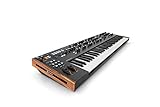
The Novation Summit is the flagship polysynth that serious producers dream about. Sixteen voices of polyphony split across two parts give you a complete synth arrangement in one instrument. The three NCO (New Oxford Oscillators) per voice handle subtractive, wavetable, and FM synthesis, covering nearly every sound creation method in one engine.
The 5-octave semi-weighted keybed with velocity sensitivity and aftertouch is among the best in this price range. The action feels substantial enough for serious piano-style playing while retaining the responsiveness synth players demand. Per-part effects including distortion, chorus, delay, and reverb eliminate the need for external processing in most situations.
The analog multimode filter offers 12 dB and 24 dB slopes with a dual mode for parallel filtering. This flexibility exceeds what most competitors offer. Stereo audio input routing lets you process external audio through the Summit’s effects and filters, making it a capable production hub.
Three-Oscillator Architecture and Sound Design
Three oscillators per voice enable complex sound design that two-oscillator synths cannot match. Layer detuned sawtooth waves for massive supersaw sounds, or combine wavetables with FM for metallic textures. The modulation routing connects oscillators, filters, and effects in flexible configurations.
Producers making cinematic, electronic, and pop music will find the Summit covers virtually every synth need. The two-part multitimbral architecture means you can play a bass patch with the left hand and a lead with the right simultaneously.
Keybed Quality and Playing Experience
The 5-octave semi-weighted keybed is a highlight. Velocity sensitivity and aftertouch translate nuanced playing into expressive sound. The action feels closer to a premium workstation than a typical synth keyboard.
Live performers benefit from the substantial build and comprehensive I/O. Studio producers appreciate the per-part effects and audio routing flexibility. The Summit bridges both worlds effectively.
15. Moog Muse – 8-Voice Analog Polysynth Flagship
MOOG Muse 8-Voice Analog Polyphonic Synthesizer
8-Voice Analog Bi-Timbral Polysynth
Dual Transistor Ladder Filters
Stereo Diffusion Delay
64-Step Generative Sequencer
61 Full-Size Keys
Pros
- 8-voice analog polyphony with bi-timbral capability
- Dual transistor ladder filters inspired by Moog Modular circuits
- Stereo Diffusion Delay processor for complex echoes
- 64-step sequencer with generative behaviors and chord memory
- Intuitive knob-per-function layout
Cons
- Premium flagship pricing
- Limited initial review base
The Moog Muse is the best synthesizer for music producers in 2026 if budget allows. Eight voices of true analog polyphony with bi-timbral capability deliver the thick, warm Moog sound in a full polysynth format. The dual transistor ladder filters inspired by Moog Modular circuits add harmonic richness that modern filter designs struggle to match.
Each voice contains two VCOs plus a modulation VCO, opening FM and complex modulation possibilities within the analog domain. The saturating mixer adds harmonic coloration when driven hard. The Stereo Diffusion Delay processor creates evolving echoes and spatial effects that turn simple patches into cinematic soundscapes.
The 64-step sequencer with generative behaviors and chord memory is a composition tool as much as a performance feature. The arpeggiator with chord memory remembers your input chord and generates patterns based on it. Combined with the 256-patch library (224 preloaded), the Muse arrives ready for serious production work.
Moog Modular Filter Heritage
The dual transistor ladder filters draw direct lineage from the Moog Modular systems of the 1970s. These filters deliver the warm, musical resonance that made Moog a household name. Running them in series or parallel opens filter combinations that single-filter synths cannot achieve.
The saturating mixer adds analog coloration when signals push past unity gain. This is the harmonic richness that plug-ins attempt to emulate but never quite capture. For producers who value analog character above all else, the Muse is the pinnacle.
Generative Sequencer and Composition Tools
The 64-step sequencer supports probability-based generative behavior similar to the Messenger but with polyphonic capability. Set note probabilities per step, and the Muse creates evolving chord progressions that never repeat exactly. This is a serious composition tool for ambient, experimental, and film scoring work.
The arpeggiator with chord memory holds your input chord while generating pattern variations. Combined with the bi-timbral architecture, you can run an arpeggiated pattern on one part while sustaining pads on the other. The Muse functions as a complete synth arrangement in a single instrument.
Synthesizer Buying Guide – What to Consider Before You Buy
Choosing among the best synthesizers for music producers requires understanding your needs across several categories. The right synth for a bedroom producer making lo-fi beats differs from the right choice for a touring keyboardist. This buying guide breaks down the decisions that matter most based on our testing across all 15 instruments.
Analog vs Digital vs Hybrid Synthesis
Analog synthesis uses voltage-controlled oscillators and filters to generate and shape sound. The result is warm, thick tones with natural drift and harmonic richness. Synths like the Moog Muse, Moog Subsequent 37, and Korg MS20 Mini represent this approach. Analog sounds musical but offers limited sound variety per instrument.
Digital synthesis uses software algorithms to generate waveforms. Wavetable synths like the ASM Hydrasynth and FM synths offer sound palettes that analog cannot match. Digital instruments typically provide more presets and sound variety but can sound sterile without careful programming.
Hybrid synthesis combines digital oscillators with analog filters. The Arturia MiniFreak and Korg minilogue xd exemplify this approach. Hybrid synths offer the sound variety of digital with the warmth of analog filtering. For most producers in 2026, hybrid instruments provide the best balance of versatility and character.
Polyphony and Voice Count
Polyphony refers to how many notes a synth can sound simultaneously. Monophonic synths like the Moog Subsequent 37 and Korg monologue play one note at a time. They excel at bass and lead work but cannot play chords.
Paraphonic synths like the Moog Subsequent 37 (in paraphonic mode) and Moog Messenger allow limited polyphony, typically two notes. This enables simple intervals and chords without the cost of full polyphonic architecture.
Polyphonic synths offer dedicated voices per note. The Korg minilogue xd provides 4 voices, the Arturia MiniFreak offers 6, and the Moog Muse delivers 8. For complex chord work, look for at least 6 voices. For layered arrangements, 8 or more voices prevent unwanted note stealing.
Keybed Quality and Feel
The keybed determines how expressively you can play. Full-size semi-weighted keys with velocity and aftertouch, like those on the Moog Muse and Novation Summit, offer the most expressive experience. Slim keys, like those on the Korg minilogue series, save space but feel different under the fingers.
Touch-plate keyboards, like the Arturia MicroFreak’s PCB keys, offer polyphonic aftertouch without mechanical key travel. These divide opinion sharply. Some players love the expression. Others find them unplayable.
For live performance, prioritize keybed quality above almost everything else. A great-sounding synth with a poor keybed becomes frustrating quickly. For studio use where you sequence most parts, keybed quality matters less.
Connectivity and DAW Integration
Modern synths need to integrate with your DAW and other hardware. USB MIDI handles most computer connections. 5-pin DIN MIDI works with vintage gear and multi-instrument setups. CV gate patch points enable modular integration.
The Arturia MicroFreak and Moog Messenger both offer CV connectivity for Eurorack integration. The ASM Hydrasynth and Roland JUNO-X provide comprehensive MIDI implementations for complex rigs. Audio input routing, found on the Novation Summit and Korg MS20 Mini, lets you process external audio through the synth’s filter and effects.
Software integration matters too. The Arturia MiniFreak includes a VST counterpart. The Roland JUNO-X integrates with Roland Cloud. These software ecosystems extend the hardware’s capabilities and simplify DAW workflow.
Sound Design and Modulation Depth
Modulation determines how sounds evolve over time. LFOs, envelope generators, and modulation matrices animate static patches into living sounds. The Moog Subsequent 37 offers two modulation busses with programmable routing. The ASM Hydrasynth provides deep modulation through its wavetable engine.
For beginners, look for synths with clear modulation routing and visual feedback. The OLED oscilloscopes on the Korg minilogue and monologue help you understand what modulation does to a waveform. For advanced sound designers, modulation matrix depth determines how complex and evolving your patches can become.
Sequencers and arpeggiators extend modulation into composition. The Moog Messenger’s probability-based sequencer and the Roland JUNO-X’s I-Arpeggio generate musical ideas that you might not discover manually. These features matter for producers who use their synth as a creative partner, not just a sound source.
FAQs
What is the best beginner synthesizer?
The Korg minilogue xd is the best beginner synthesizer because it offers true analog synthesis, a digital multi-engine, 500 programs, built-in effects, and an OLED oscilloscope that visualizes waveforms in real time. The intuitive knob-per-function layout teaches synthesis fundamentals without menu diving. At its price point, nothing else matches the combination of analog warmth, digital versatility, and educational value.
What is Hans Zimmer’s favorite synth?
Hans Zimmer is famously associated with the Roland Jupiter-8 and more recently the Yamaha Montage series. His studio contains an enormous collection including Moog Modular systems, CS-80 clones, and numerous custom instruments. Among the synths on this list, the Moog Muse and Novation Summit come closest to the cinematic scale his scores require.
What synthesizer does Billie Eilish use?
Billie Eilish and her producer Finneas rely heavily on the Roland Juno-106 and various software synthesizers. The warm chorused pads that define her sound come from classic analog polysynths. Among current instruments, the Roland JUNO-X with its authentic JUNO-60 and JUNO-106 models captures this aesthetic directly.
Is it worth buying a hardware synthesizer in 2026?
Yes, hardware synthesizers remain worth buying in 2026 because they offer tactile workflow, analog character, and performance capabilities that software cannot fully replicate. Instruments like the Moog Muse, Korg minilogue xd, and ASM Hydrasynth deliver sound quality and expression that plug-ins approximate but do not match. Hardware also encourages different creative decisions than clicking a mouse.
What is the difference between analog and digital synthesizers?
Analog synthesizers use voltage-controlled oscillators and filters to generate and shape sound electrically, producing warm tones with natural harmonic drift. Digital synthesizers use software algorithms to create waveforms, offering more sound variety and preset storage but sometimes sounding cleaner or more sterile. Hybrid synths combine digital oscillators with analog filters to capture the benefits of both approaches.
Final Verdict on the Best Synthesizers for Music Producers
The best synthesizers for music producers in 2026 cover an enormous range of sounds, features, and price points. Our Editor’s Choice goes to the Moog Muse for delivering the pinnacle of analog polyphonic synthesis with bi-timbral capability, dual ladder filters, and a generative sequencer. Nothing else on this list matches its combination of sound quality and feature depth.
For value, the Korg minilogue xd remains the sweet spot. Hybrid analog and digital synthesis, 500 programs, built-in effects, and an approachable workflow make it the best synthesizer for music producers who want one instrument that handles everything. The Arturia MicroFreak earns Budget Pick for offering 17 oscillator modes and experimental synthesis at a price that welcomes newcomers.
Whatever synth you choose, prioritize the instrument that fits your workflow and genre. Test keybeds in person when possible, and read beyond the specs to understand how each synth feels in actual production sessions. The right synthesizer becomes a creative partner that shapes your music for years.