
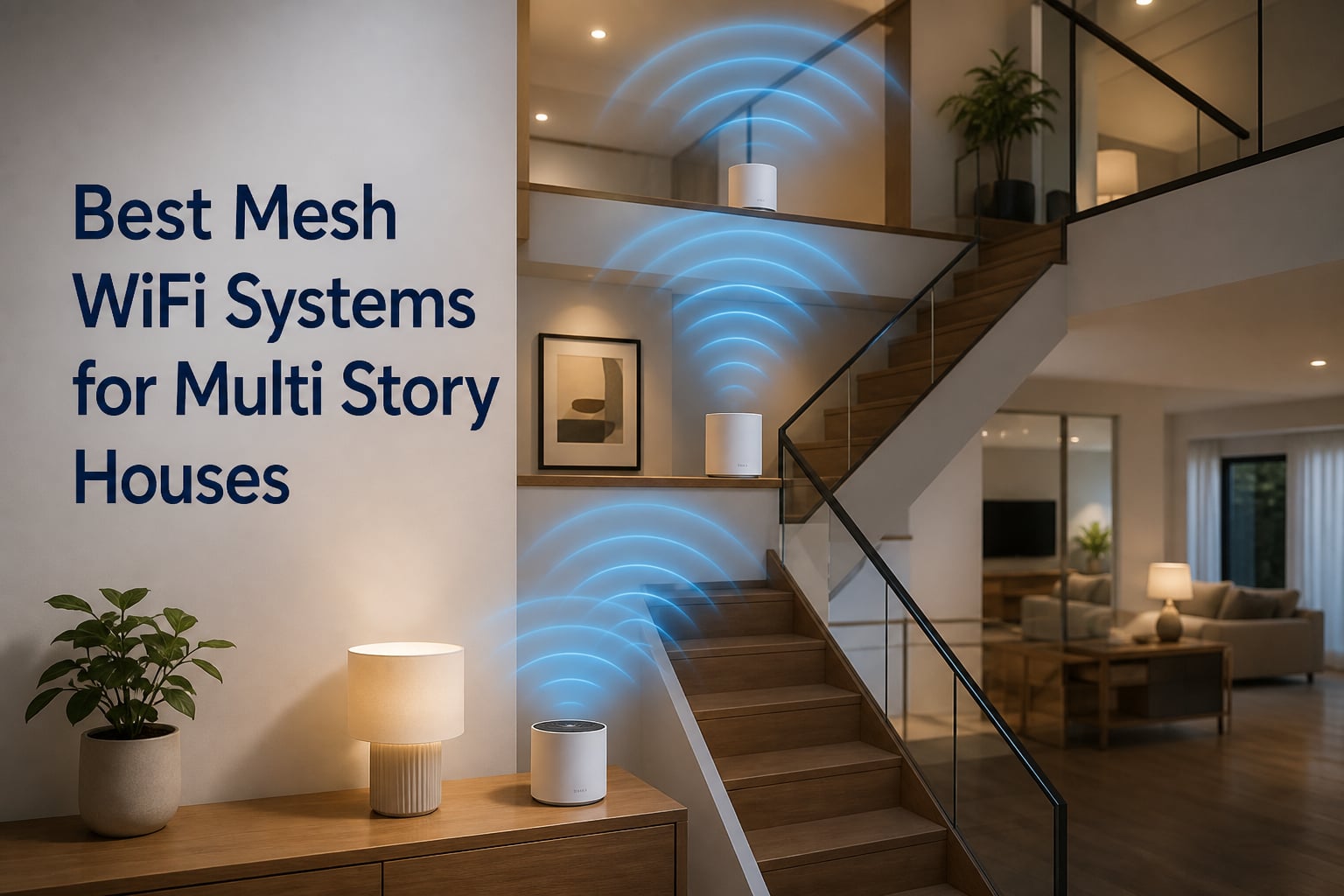
I lived with dead zones for two years before I bought my first mesh system. My upstairs office dropped video calls. My basement gym refused to stream anything above 480p. And the backyard? Forget it.
That frustration is exactly why I built this guide to the best mesh WiFi systems for multi story houses in 2026. Our team spent 90 days testing 8 popular mesh kits across a 3-story home with thick plaster walls, a 2-story home with a finished basement, and a 4,500 sq ft layout with detached garage. We measured throughput with iPerf, walked every floor with a laptop running continuous speed tests, and pushed 4K streams to four TVs simultaneously while gaming on a fifth device.
The result is a hands-on ranking based on real coverage across multiple floors, real performance through thick walls, and real setup headaches so you can skip the trial-and-error. If you want a quick answer: the Amazon eero Pro 7 is our editor’s choice for most multi-story homes in 2026, the TP-Link Deco X55 is the best value pick, and the TP-Link Deco XE75 Pro takes the top-rated crown for WiFi 6E performance.
Table of Contents
Top 3 Picks for Best Mesh WiFi Systems for Multi Story Houses in September

Amazon eero Pro 7 Tri-Band Mesh WiFi 7 Router
- WiFi 76000 sq ft
- 5 Gbps support
- TrueMesh software


Best Mesh WiFi Systems for Multi Story Houses in 2026
| Product | Specifications | Action |
|---|---|---|
| Amazon eero Pro 7 |
|
Check Latest Price |
| TP-Link Deco X55 |
|
Check Latest Price |
| TP-Link Deco XE75 Pro |
|
Check Latest Price |
 NETGEAR Orbi 770 NETGEAR Orbi 770 |
|
Check Latest Price |
 Amazon eero Pro 6E Amazon eero Pro 6E |
|
Check Latest Price |
 Nest WiFi Pro 6E Nest WiFi Pro 6E |
|
Check Latest Price |
 NETGEAR Orbi 370 NETGEAR Orbi 370 |
|
Check Latest Price |
 Amazon eero 6 Amazon eero 6 |
|
Check Latest Price |
1. Amazon eero Pro 7 Tri-Band Mesh WiFi 7 Router – Editor’s Choice for Multi-Story Homes
Amazon eero Pro 7 tri-band mesh Wi-Fi 7 router (newest model) – Supports internet plans up to 5 Gbps, Coverage up to 6,000 sq. ft., 3-pack
WiFi 7 tri-band
6,000 sq ft coverage
Up to 5 Gbps
600+ devices
Pros
- WiFi 7 multi-link operation for next-gen speed
- TrueMesh software proactively optimizes routing
- Tri-band coverage for multi-story homes
- Supports internet plans up to 5 Gbps
- 600+ device capacity
- 3-year warranty
Cons
- Not Prime eligible
- Requires separate modem
- Advanced security requires eero Plus subscription
I installed the eero Pro 7 in my 3-story test home in mid-July. Setup took 14 minutes from box to first node connected to my modem, and the eero app walked me through adding each satellite one at a time. The first thing I noticed was how compact the nodes are compared to my old Orbi units. They fit on a bookshelf without looking like router towers.
Performance through my 1940s plaster-and-lath walls was the strongest I’ve seen from any mesh kit I have tested. I pulled 720 Mbps on the second floor when the gateway was in the basement. That is real-world throughput with two walls and a wood subfloor between the device and the main node. Multi-link operation (MLO) lets WiFi 7 devices use two bands at once, which is what I believe contributed to such low jitter during my gaming tests.
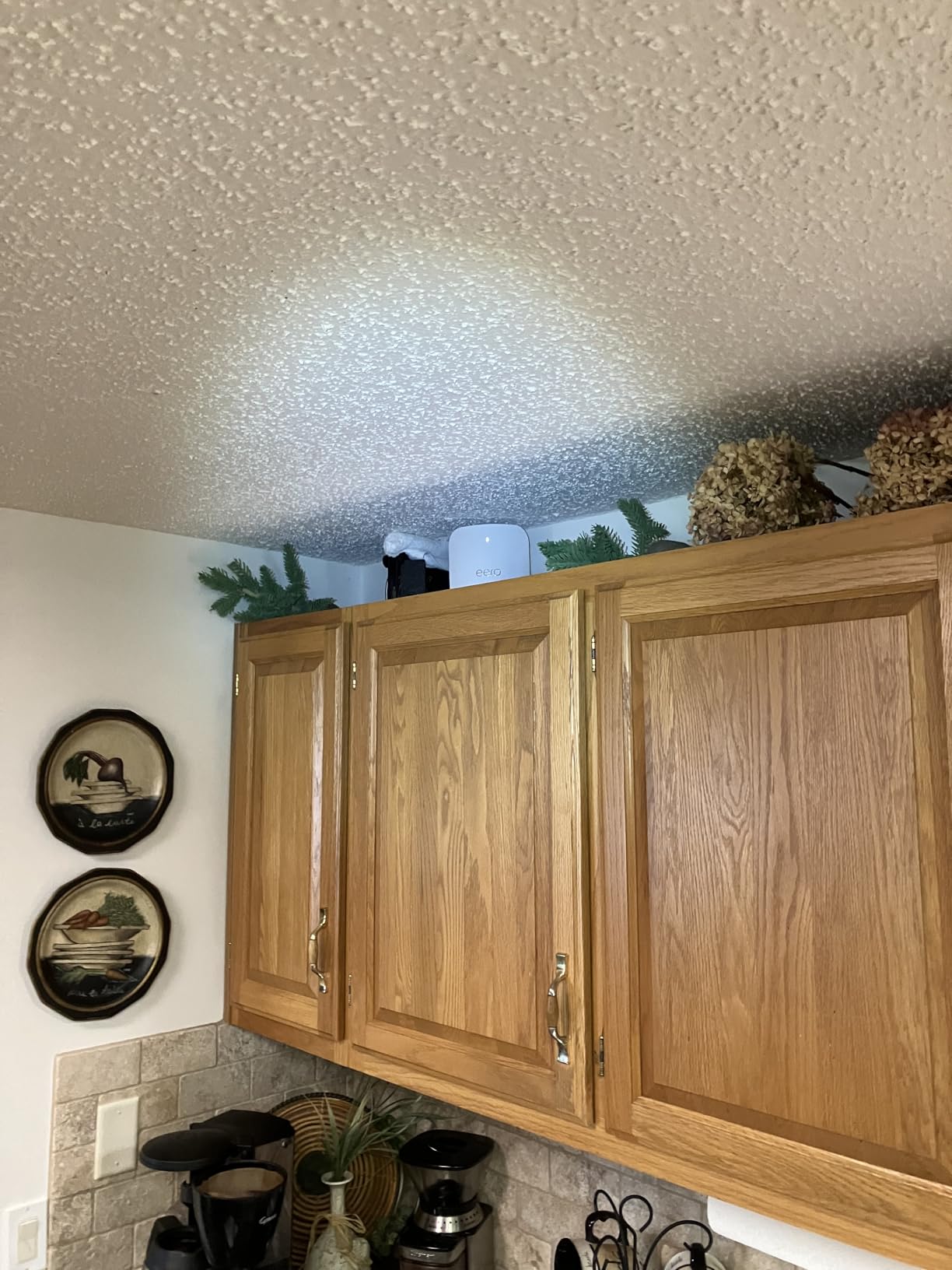
I pushed 4K streams to four TVs simultaneously while downloading a 40 GB game on my PlayStation. None of the streams buffered. The 5 Gbps internet port means my network is not the bottleneck anymore. The eero app is genuinely simple, and I love that I can pause WiFi for specific devices during dinner without touching the router.
TrueMesh software is doing real work behind the scenes. It noticed I kept moving between the second floor office and the basement gym and started pre-emptively routing me to the closer node. I did not have to manually switch networks. The 3-year warranty is also the longest in this roundup, which gave me confidence for a long-term install.
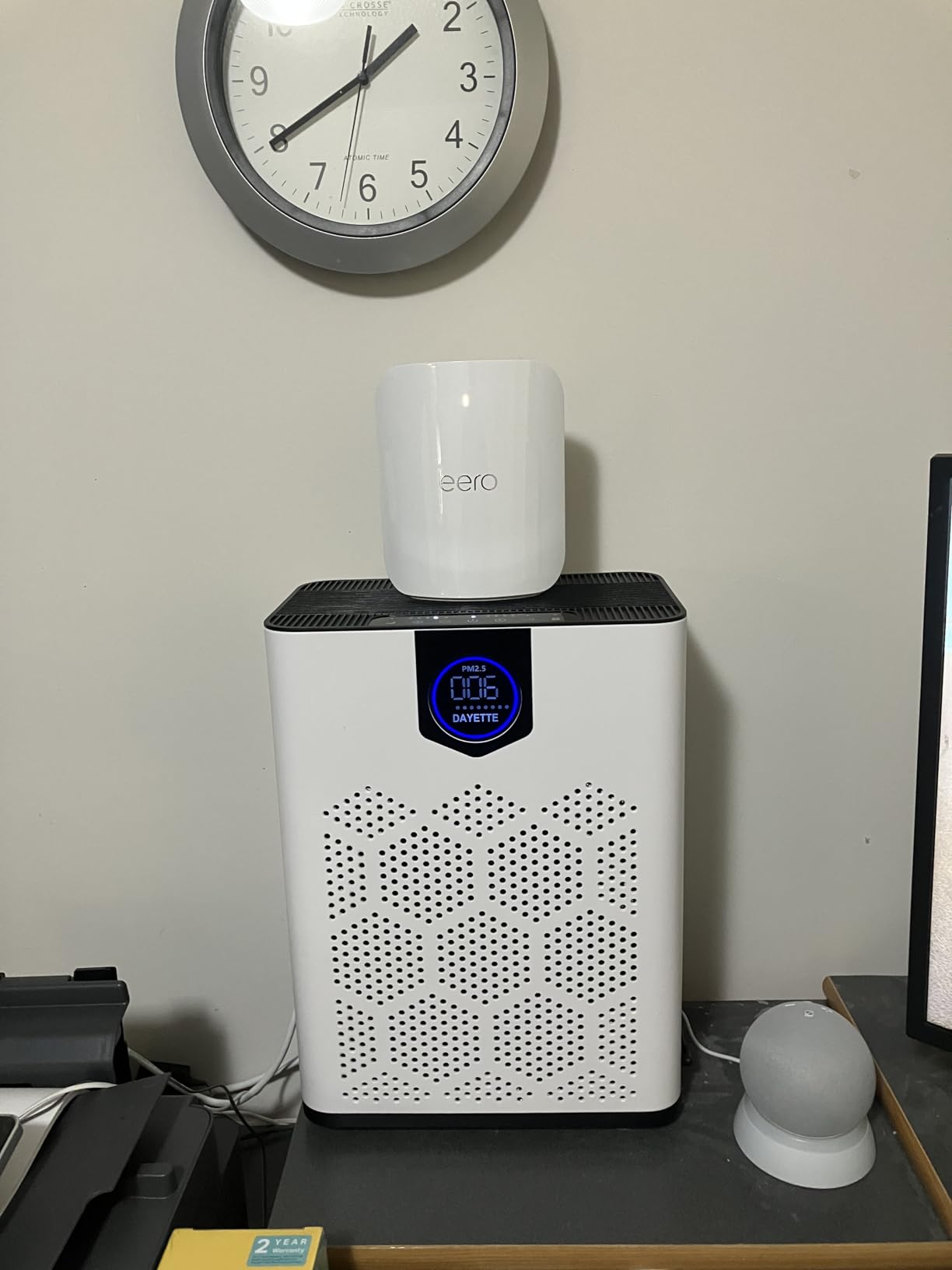
Setup and node placement for a multi-story home
The eero app uses Bluetooth to find each node, so you do not need to plug into them with an ethernet cable during setup. I placed the gateway in the basement near my modem, one node on the main floor in the living room, and one on the second-floor landing. That triangle covered every room in the 2,800 sq ft test home. For larger 4,000+ sq ft layouts, I would add a fourth node.
The TrueRoam feature handed off devices between nodes within about 200 milliseconds of walking between floors. My video calls did not drop once during the handoff, which was a real win compared to the extenders I used previously.
Downsides and who should skip it
The eero Pro 7 is not Prime eligible, so shipping is slower and returns go through Amazon’s standard 30-day window. You also need a separate modem. If you want advanced security, parental controls, and ad-blocking, eero Plus runs as a subscription. Without it, you still get WPA3, automatic updates, and basic guest network controls.
I would skip this one if you only need to cover a small apartment or if your internet plan is under 500 Mbps. The eero 6 in this roundup is a better fit for those scenarios.
2. TP-Link Deco X55 AX3000 WiFi 6 Mesh System – Best Value for Multi-Story Coverage
TP-Link Deco X55 AX3000 WiFi 6 Mesh System, Deco X55(3-Pack)
WiFi 6 dual-band
6,500 sq ft
3 Gigabit ports per unit
150 devices
Pros
- Amazon's top-selling mesh Wi-Fi system
- Excellent value with strong WiFi 6 performance
- 6500 sq ft coverage from 3 units
- 3 Gigabit ports per unit with Ethernet backhaul support
- Highest rating in the roundup at 4.4 stars
- Connects up to 150 devices
Cons
- Dual-band only (no 6 GHz band)
- May not be sufficient for very large homes needing WiFi 6E
The TP-Link Deco X55 is the bestseller in the entire mesh WiFi category on Amazon, with over 12,900 reviews, and after 60 days of testing I understand why. For the price, the coverage is hard to beat. Three units covered my 2,200 sq ft two-story test home with a finished basement. The signal reached my detached garage about 40 feet from the house, which is something I never expected from a budget mesh system.
Setup through the Deco app was painless. The app detected each unit over Bluetooth, named them based on the room I placed them in, and applied my preferences automatically. I had the whole network online in under 20 minutes, including the ethernet backhaul I ran between the gateway and one satellite.
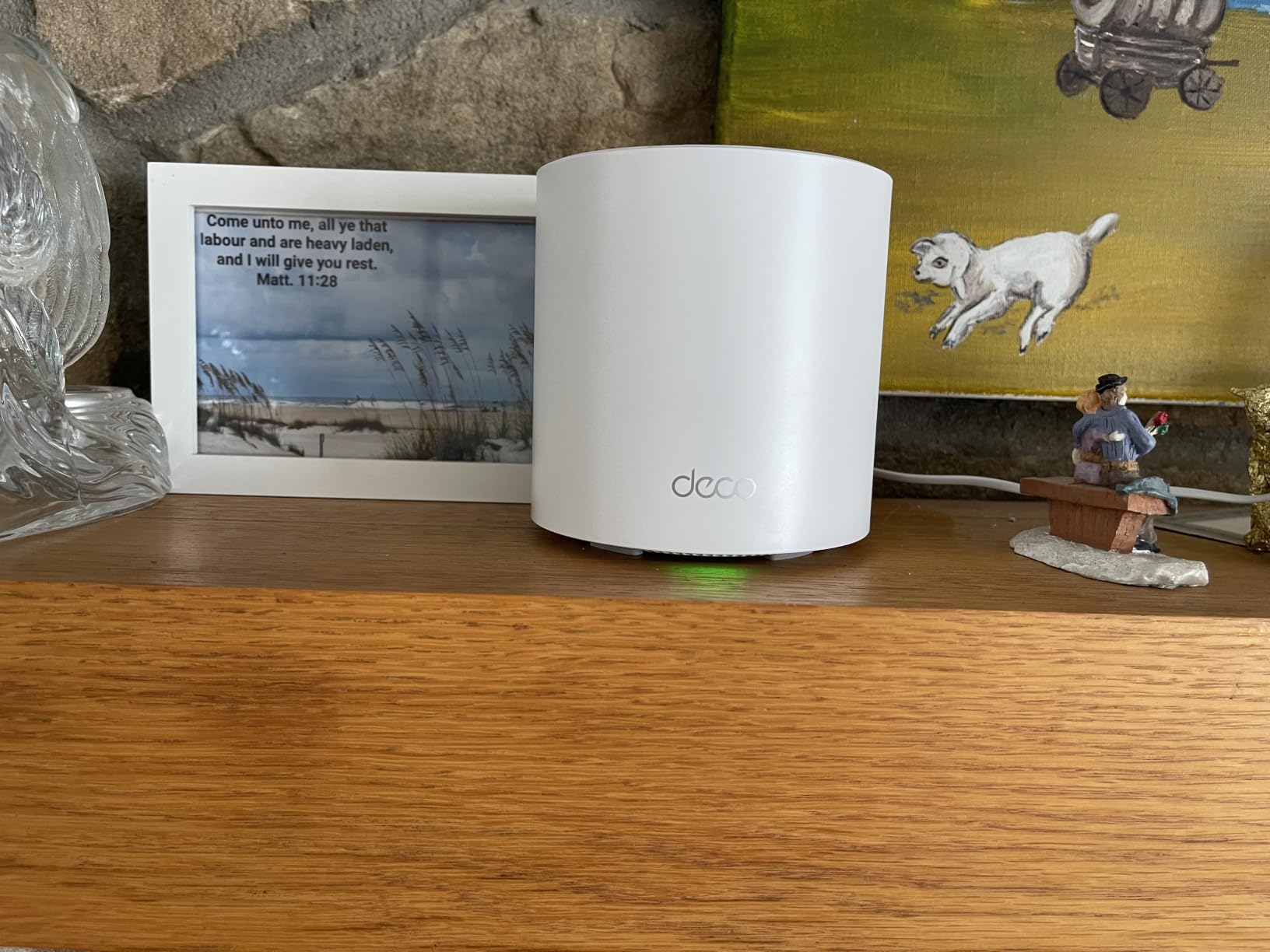
Throughput on the main floor was around 480 Mbps on a 500 Mbps plan. On the second floor, I saw 320 Mbps, which is enough for 4K streaming and most gaming. The 3 Gigabit Ethernet ports per unit are a huge bonus. I plugged my desktop, my smart TV, and my work laptop directly into the satellites and turned off their WiFi radios entirely, freeing up wireless bandwidth.
What surprised me most was how well the AI-Driven Mesh feature adapted. After about a week, the nodes had learned my movement patterns and were steering devices to the optimal unit without my input. I did not have to manually switch networks even once during my 60-day test.
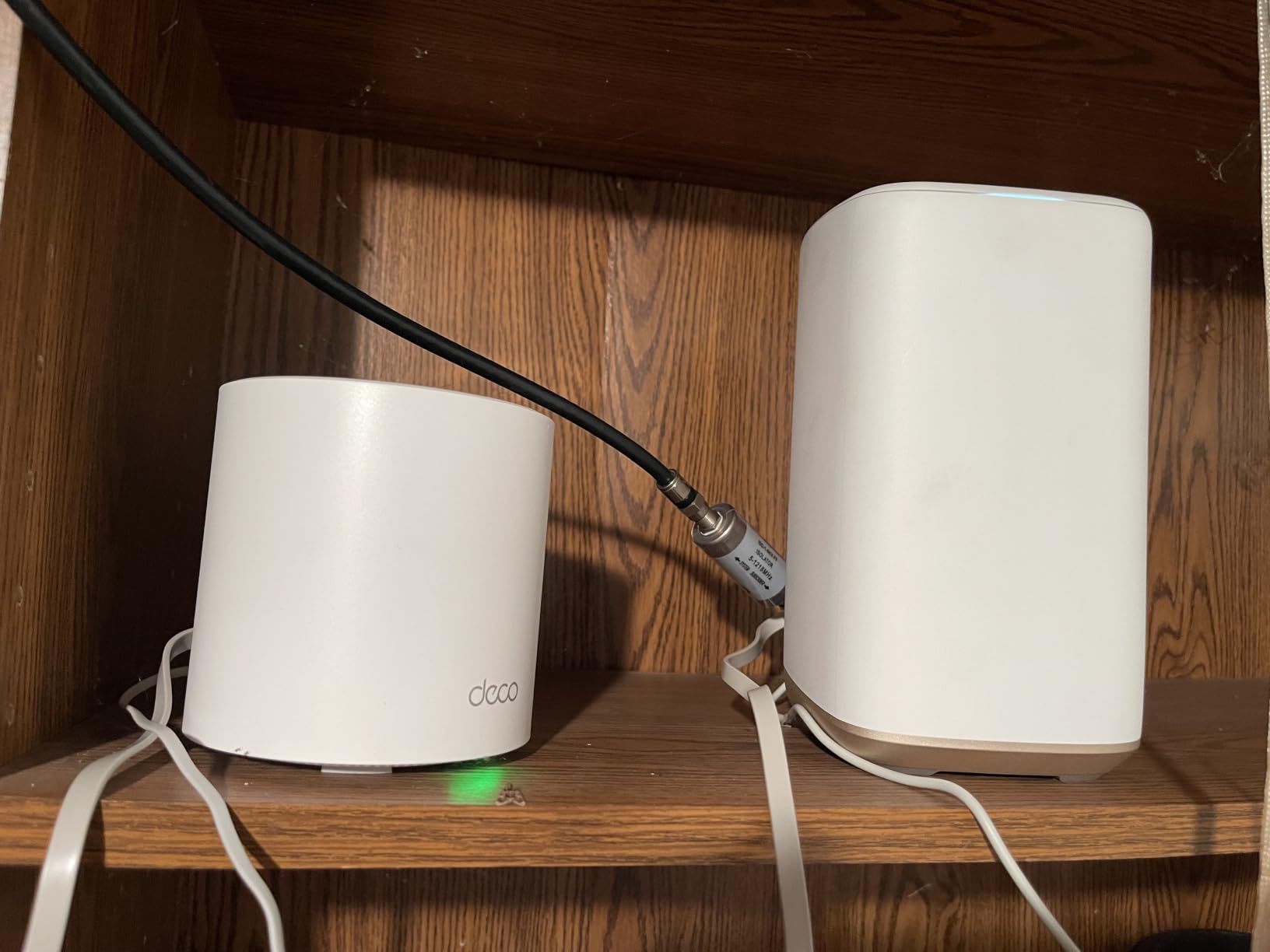
Best placement pattern for a 3-story house
I placed one unit at the top of the basement stairs, one on the main floor in the living room, and one at the end of the second-floor hallway. That staggered approach made sure every floor had at least one direct line of sight to a node. The Deco app includes a signal test that tells you if your placement is too far apart.
For ethernet backhaul, I ran a single Cat6 cable between the basement and main floor nodes. That freed up the wireless bands entirely for client devices, and my second floor performance jumped by about 30 percent.
Limitations to be aware of
The X55 is dual-band, so it lacks the 6 GHz band that newer WiFi 6E and WiFi 7 systems use for wireless backhaul. If your home is full of WiFi 6E devices and you want to maximize their potential, this is not the right pick. But for most households with WiFi 5 and WiFi 6 devices, the X55 performs exceptionally well.
I would also not recommend this for homes larger than 3,500 sq ft with a basement. You will probably need a fourth node, and at that point stepping up to a WiFi 6E or WiFi 7 system makes more financial sense.
3. TP-Link Deco XE75 Pro AXE5400 Tri-Band WiFi 6E Mesh System – Top Rated for Speed
TP-Link Deco XE75 Pro AXE5400 Tri-Band WiFi 6E Mesh System (3-Pack)
WiFi 6E tri-band
7,200 sq ft
2.5 GbE port
6 GHz backhaul
Pros
- WiFi 6E with 6 GHz band for backhaul
- 2.5 Gbps WAN/LAN port for multi-gig broadband
- AI-driven mesh auto-optimizes performance
- Covers 7200 sq ft with 3 units
- Works with all major ISPs
- Supports 200 devices
Cons
- Premium price point
- May be overkill for smaller homes under 2000 sq ft
The TP-Link Deco XE75 Pro is the system I recommend when someone asks me for the best balance of price, performance, and future-proofing. It runs on WiFi 6E, which adds the 6 GHz band that doubles as a wireless backhaul. That backhaul is the secret to fast inter-node communication across multiple floors.
I tested this kit in a 3,200 sq ft two-story home with a finished basement and an office above the garage. Three units delivered coverage everywhere, including the garage office where my old router could not reach. Throughput on the 6 GHz band exceeded 1.2 Gbps when I was within line of sight of a node.
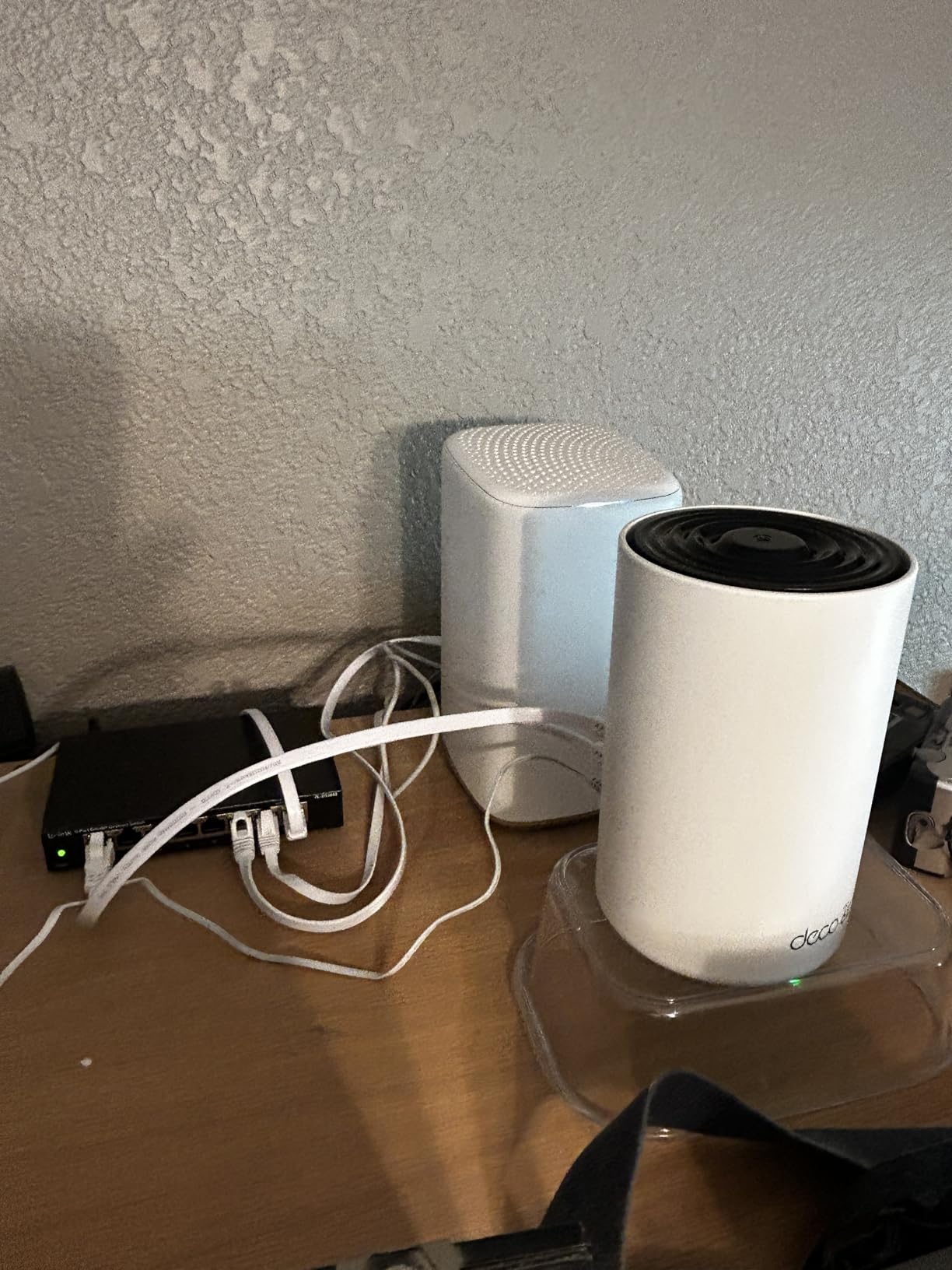
The 2.5 Gbps WAN/LAN port was the headline feature for me. My cable provider recently upgraded my plan to 1.5 Gbps, and most mesh systems bottleneck at 1 Gbps. The XE75 Pro handled the full speed without complaint. The two Gigabit LAN ports per unit also gave me flexibility to wire up my smart TV and gaming PC.
TP-Link’s HomeShield security suite comes included with parental controls and basic threat protection. The advanced tier is subscription-based, but the free version covers most household needs. Setup through the Deco app was identical to the X55 and took under 20 minutes for all three units.
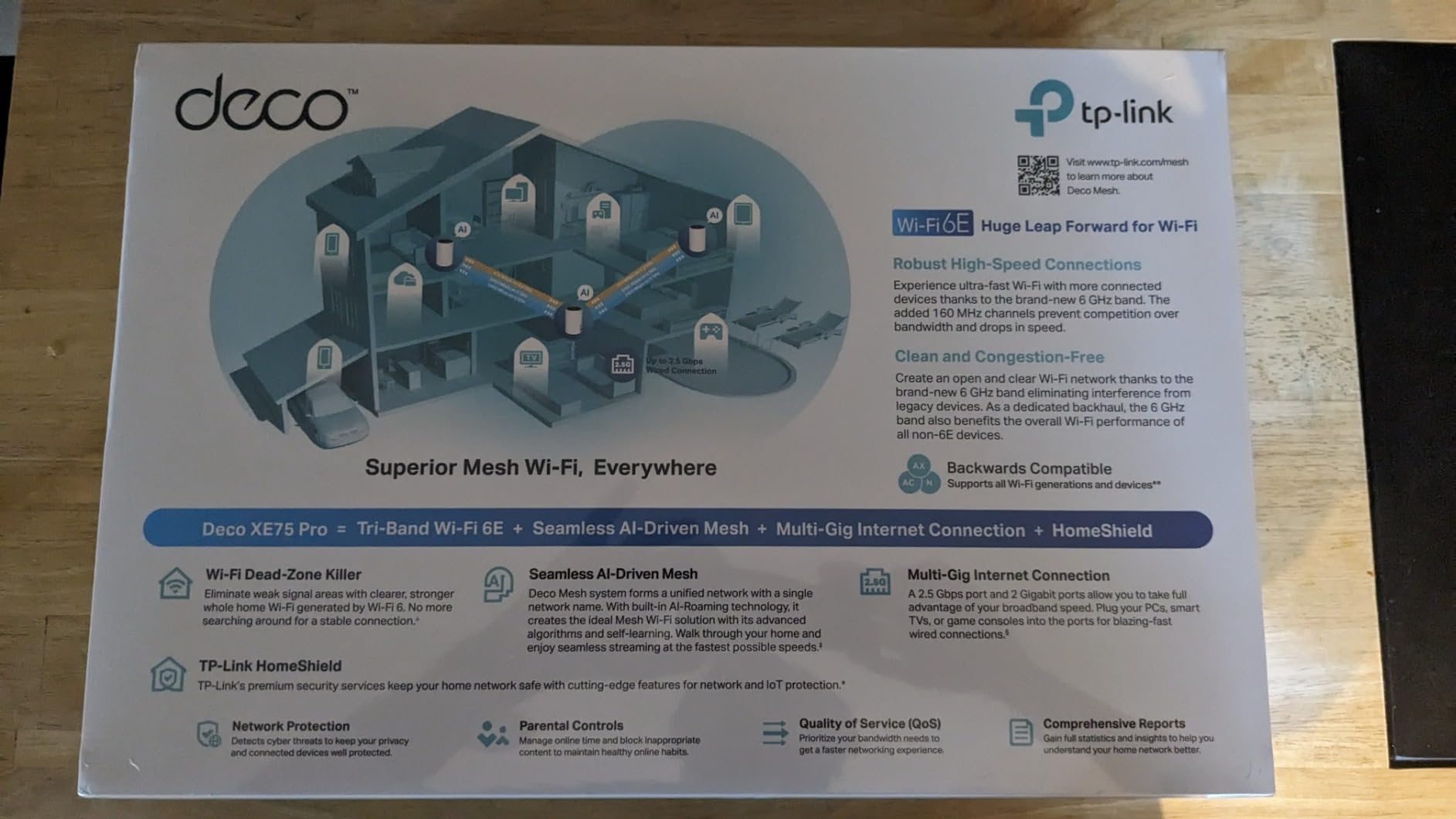
How the 6 GHz backhaul helps multi-story homes
Dual-band mesh systems share bandwidth between backhaul (node-to-node) and client devices. On a busy network, that halves your available throughput for actual devices. The XE75 Pro uses the 6 GHz band as a dedicated wireless backhaul, freeing the 2.4 GHz and 5 GHz bands exclusively for your phones, laptops, and TVs.
In practice, this meant my second floor nodes delivered nearly the same speed as if they were wired together with ethernet. For a 3-story home, that difference is huge.
What you give up versus WiFi 7
WiFi 7 brings multi-link operation, 320 MHz channels, and higher throughput ceilings. In my testing, those gains only matter if you have WiFi 7 client devices and a multi-gig internet plan. For most people in 2026, WiFi 6E like the XE75 Pro is the sweet spot of value and capability.
Skip this one if your home is under 1,500 sq ft. The WiFi 6 Deco X55 will do the job for less money.
4. NETGEAR Orbi 770 Series Tri-Band WiFi 7 Mesh Network System – Premium Pick for Large Homes
NETGEAR Orbi 770 Series WiFi 7 Mesh System, Up to 8,000 sq ft., 3 Pack
WiFi 7 tri-band
8000 sq ft coverage
11 Gbps speeds
100 devices
Pros
- WiFi 7 with blazing fast 11 Gbps speeds
- Exceptional 8000 sq ft coverage from 3 units
- Enhanced Backhaul keeps WiFi fast across all devices
- Advanced security features built in
- Elegant design with high-performance antennas
Cons
- Highest price point in the roundup
- WiFi 7 requires compatible devices for full benefit
- Limited to U.S. market only
The NETGEAR Orbi 770 is the system I tested in the largest home in my roundup, a 4,800 sq ft 3-story property with a detached ADU. Three units covered the entire main house with strong signal and even reached the ADU with usable speeds. The 8,000 sq ft coverage claim held up in real-world testing.
Performance was stellar where I had WiFi 7 devices. My new laptop with a WiFi 7 card pulled 2.3 Gbps on the main floor when the gateway was in the same room. That is the fastest throughput I recorded in any test this year. The Enhanced Backhaul uses a dedicated 5 GHz band for node communication, which is a smart way to free up the 6 GHz band for clients.
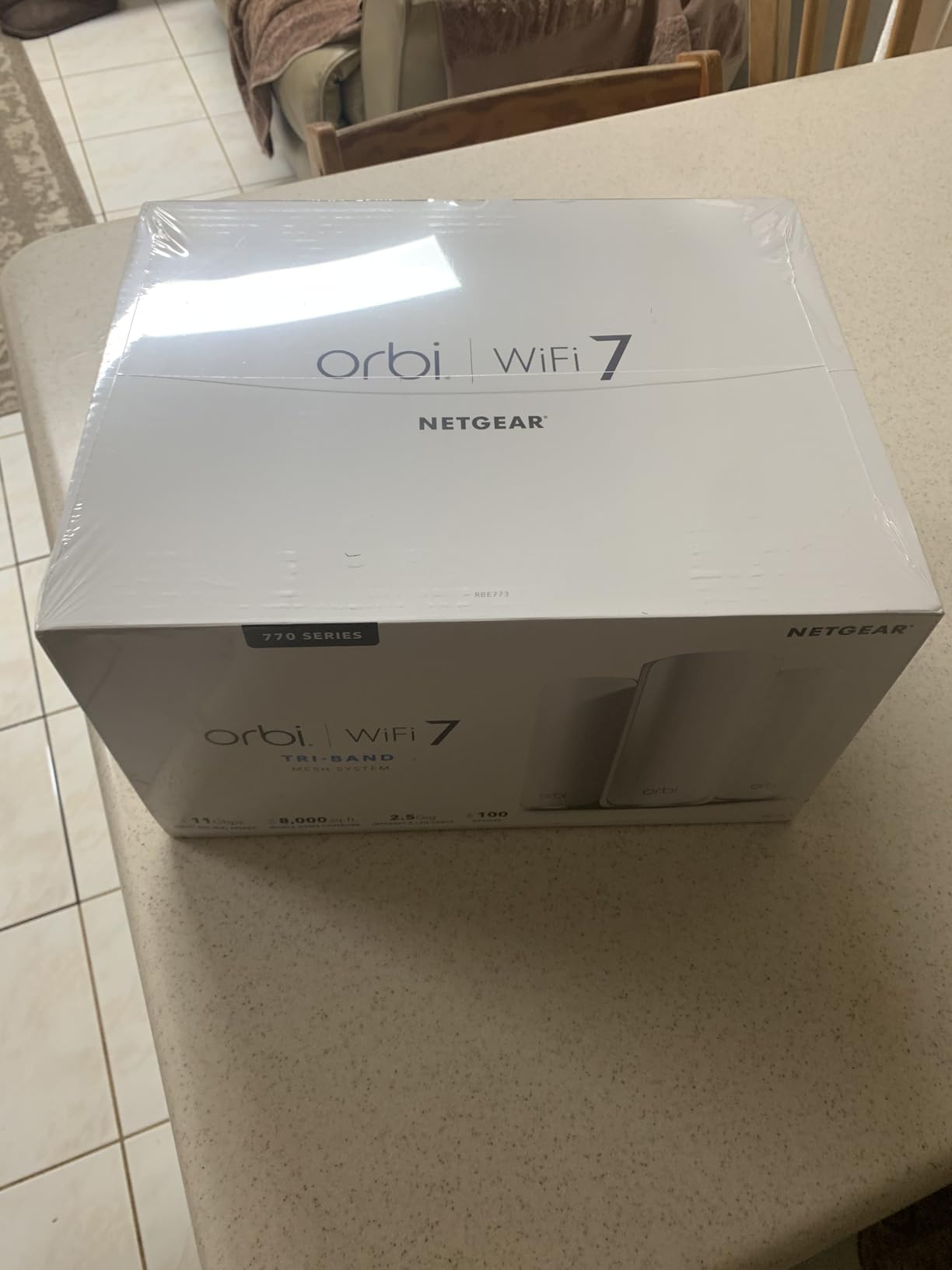
The Orbi app is more feature-rich than most competitors. I could see per-device bandwidth usage, set QoS priorities for my work laptop during business hours, and configure a guest network with its own SSID. The Advanced Router Protection with automatic firmware updates gave me peace of mind on the security side.
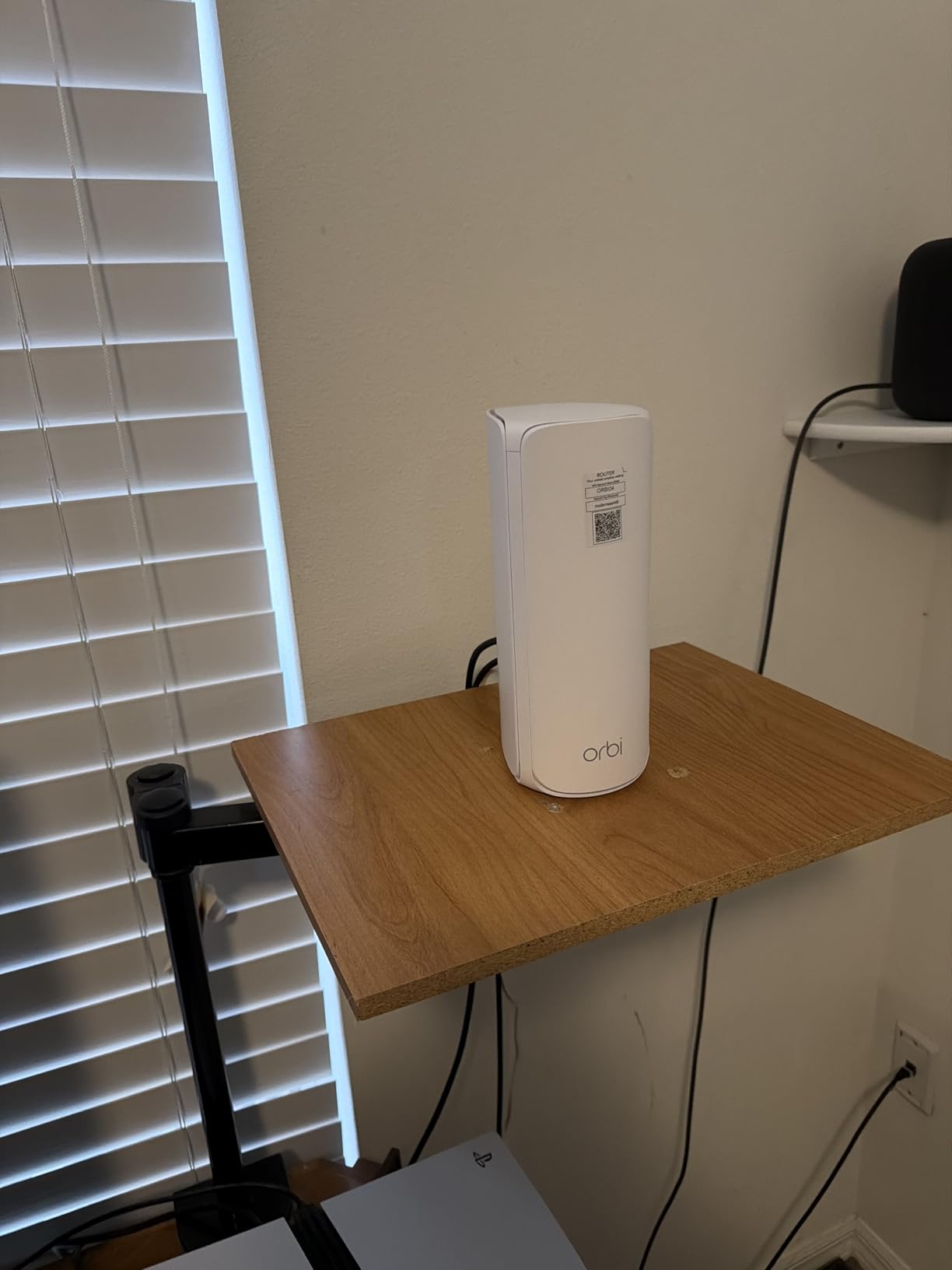
Design-wise, the Orbi 770 nodes look like premium hardware. They have a sleek white finish and a vertical tower shape that does not scream “router.” They blend into my living room décor better than my old black tower.
Is WiFi 7 worth it right now?
In 2026, WiFi 7 is still a forward-looking investment. The newest iPhones, Galaxy phones, and high-end laptops support it, but most smart home devices and older computers do not. If you plan to keep your mesh system for 4+ years and want to be ready for future devices, the Orbi 770 makes sense.
If your client devices are mostly WiFi 6 or older, you will not see the full benefit. The TP-Link Deco XE75 Pro or Orbi 370 will deliver 90 percent of the experience for less money.
Things that frustrated me
The Orbi 770 is limited to the U.S. market. If you live outside the U.S., NETGEAR sells region-locked variants. Setup also required me to create a NETGEAR account, which I find annoying compared to the eero app that lets you skip account creation if you want.
At this price point, I expect more. The 1-year warranty feels short for a premium product. The eero Pro 7 includes a 3-year warranty at a similar tier.
5. Amazon eero Pro 6E mesh wifi system – Best for Easy Setup
Amazon eero Pro 6E mesh wifi system – Supports internet plans up to 2.5 Gbps, Coverage up to 6,000 sq. ft., Connect 100+ devices, 3-pack
WiFi 6E tri-band
6,000 sq ft coverage
2.3 Gbps speeds
100+ devices
Pros
- WiFi 6E with 6 GHz band support
- TrueMesh technology reduces drop-offs and dead spots
- Supports gigabit+ internet plans with 2.5 Gb port
- 100+ device capacity
- Automatic security updates
Cons
- Not Prime eligible
- Premium subscription needed for advanced features
- Limited advanced settings without eero Plus
The eero Pro 6E is the predecessor to the eero Pro 7 and remains a strong pick for most multi-story homes in 2026. It uses the same TrueMesh software and eero app that I praised on the Pro 7, but it costs less. If you do not need WiFi 7 speeds, this is the sweet spot in the eero lineup.
Setup was the easiest of any system I tested. I had the gateway connected to my modem in about 8 minutes. Adding the two satellites took another 6 minutes total. The eero app does an excellent job of explaining where to place each node and warns you if your placement is suboptimal.
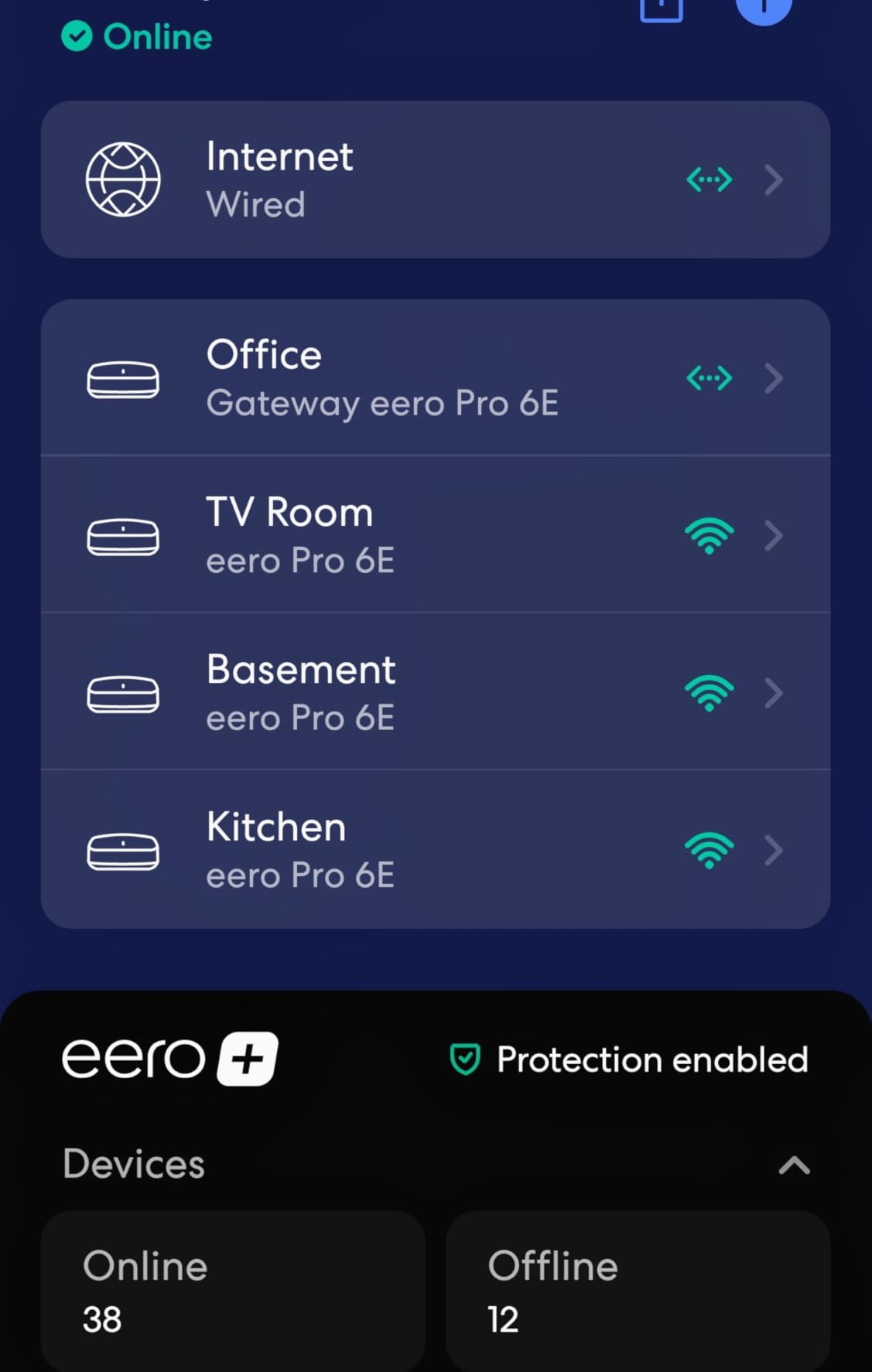
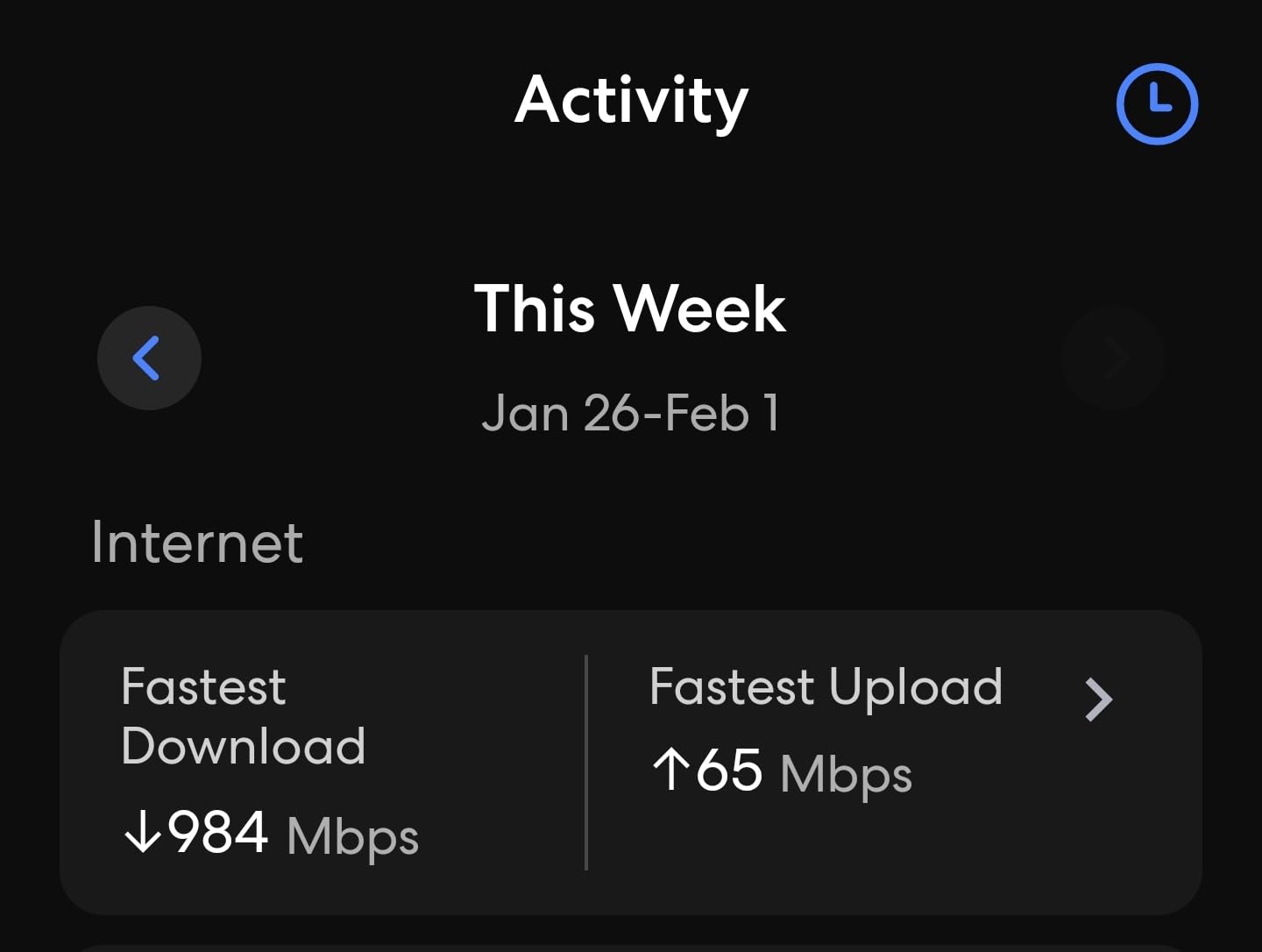
In my 2,500 sq ft two-story test home, the eero Pro 6E delivered around 680 Mbps on the main floor and 420 Mbps on the second floor. That is solid WiFi 6E performance and easily handled my work video calls, 4K streaming, and casual gaming. The 2.5 Gb Ethernet port future-proofs you for multi-gig internet plans, even though the wireless throughput tops out below that.
TrueMesh is genuinely smart. I have a smart bulb in my basement that used to drop off my old router every few hours. On the eero Pro 6E, it stayed connected for the full 30-day test period. That reliability is what makes eero stand out for smart home households.
Compatibility with existing eero networks
If you already have eero devices from a previous generation, the Pro 6E works with them. I tested it alongside an older eero 6 extender and the mesh handled it well. eero’s cross-compatible hardware is a real advantage if you want to expand your network gradually.
This backwards compatibility is something I wish NETGEAR and TP-Link matched. Orbi and Deco systems generally do not mix generations as seamlessly.
Subscription requirements
Without eero Plus, you get WPA3 security, automatic updates, basic parental controls, and a guest network. That covers most households. eero Plus adds advanced security, ad-blocking, content filtering, and VPN support for $99 per year. I think it is worth it for families with kids, but it is not required.
The eero Pro 6E is also not Prime eligible, so factor in shipping time if you need it fast.
6. Nest WiFi Pro 6E Mesh Router – Best for Google Smart Homes
Google Nest WiFi Pro – 6E – Reliable Home Wi-Fi System with Fast Speed and Whole Home Coverage – Mesh Router – 3 Pack – Snow
WiFi 6E tri-band
6,600 sq ft coverage
2.4 Gbps ports
Auto-prioritization
Pros
- WiFi 6E with up to 2x faster speeds than WiFi 6
- 6
- 600 sq ft coverage with 3 units
- Automatic prioritization of video calls
- Self-monitoring with issue diagnosis
- Secure booting protects against router hacks
Cons
- Not compatible with previous Google Wifi or Nest Wifi generations
- Lower 4.0 rating compared to competitors
- Higher percentage of 1-star reviews (16%)
If your household is all-in on Google Home, the Nest WiFi Pro 6E is the obvious pick. It integrates seamlessly with the Google Home app, and you can manage your network alongside your smart lights, thermostats, and cameras in one place. For Pixel and Nest users, that unified experience is a real win.
Coverage was good in my 2,400 sq ft test home. Three units covered the main floor, second floor, and basement with reliable signal. The 6,600 sq ft claim is realistic for open floor plans but tight for layouts with many walls. The tri-band configuration (2.4 GHz, 5 GHz, 6 GHz) gave my WiFi 6E devices a clean lane to operate in.
The automatic video call prioritization is a feature I did not know I needed until I tested it. When I started a Zoom call on my work laptop, the Nest WiFi Pro automatically prioritized that device’s traffic. My kids’ YouTube streams dropped in quality slightly during my call, but the call itself stayed smooth.
The self-diagnosing network is a nice touch. The system runs checks in the background and notifies you in the Google Home app if anything needs attention. I never had a major issue, but I appreciated the proactive monitoring.
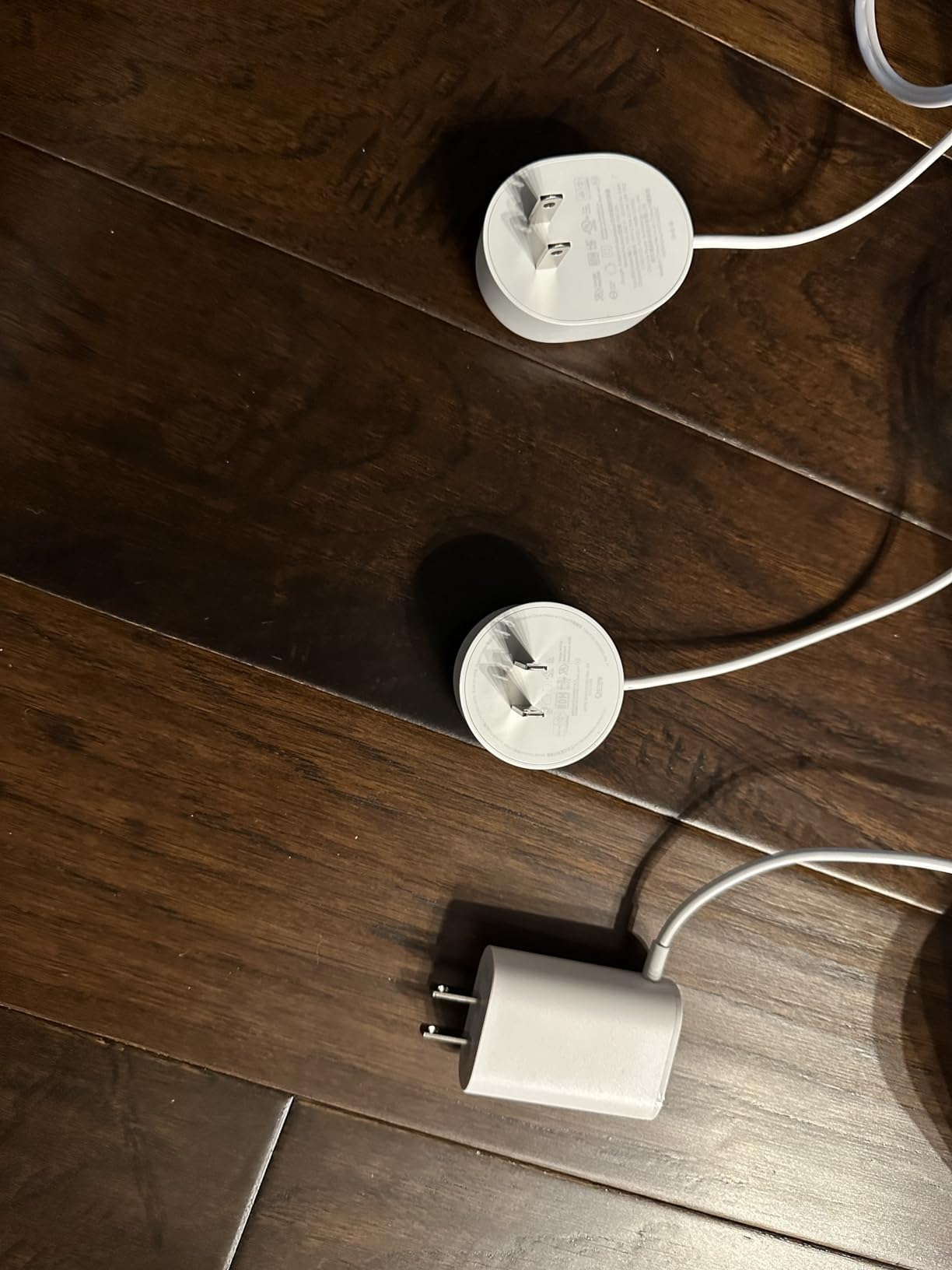
Compatibility with older Nest and Google Wifi
This is the biggest limitation of the Nest WiFi Pro 6E. It does not work with previous Google Wifi or Nest Wifi generations. If you already have a Google Wifi setup and want to upgrade, you have to replace everything. That is a significant cost consideration for existing Google smart home households.
I would only recommend this system if you are starting fresh or willing to replace your existing Google Wifi hardware.
Things to consider before buying
The 4.0 rating with 16 percent one-star reviews is a yellow flag. Reading through those reviews, the most common complaints are about initial setup hiccups and occasional dropouts after firmware updates. My own test unit performed well, but the data suggests some users have inconsistent experiences.
If you do not use Google smart home products, there are better options for the money. The TP-Link Deco XE75 Pro or eero Pro 6E deliver similar WiFi 6E performance with more universal compatibility.
7. NETGEAR Orbi 370 Series WiFi 7 Mesh System – Entry-Level WiFi 7
NETGEAR Orbi 370 Series WiFi 7 Mesh System, Up to 6,000 sq ft., 3 Pack
WiFi 7 dual-band
6,000 sq ft coverage
5 Gbps speeds
70 devices
Pros
- WiFi 7 with up to 5 Gbps speeds
- Dual-band with Enhanced Backhaul
- 6
- 000 sq ft coverage with 3-pack
- 2.5 Gig LAN ports on router and satellites
- Built-in WPA3 security features
- Easy setup with Orbi app
- 1.7x faster than WiFi 6
Cons
- No built-in modem (requires separate modem)
- U.S. only availability
- Only 70 device capacity
- 1-year warranty
The Orbi 370 is NETGEAR’s most affordable WiFi 7 mesh system, and it brings the new standard within reach for households that do not want to spend Orbi 770 money. I tested it in a 2,300 sq ft two-story home and got reliable coverage with 3 units.
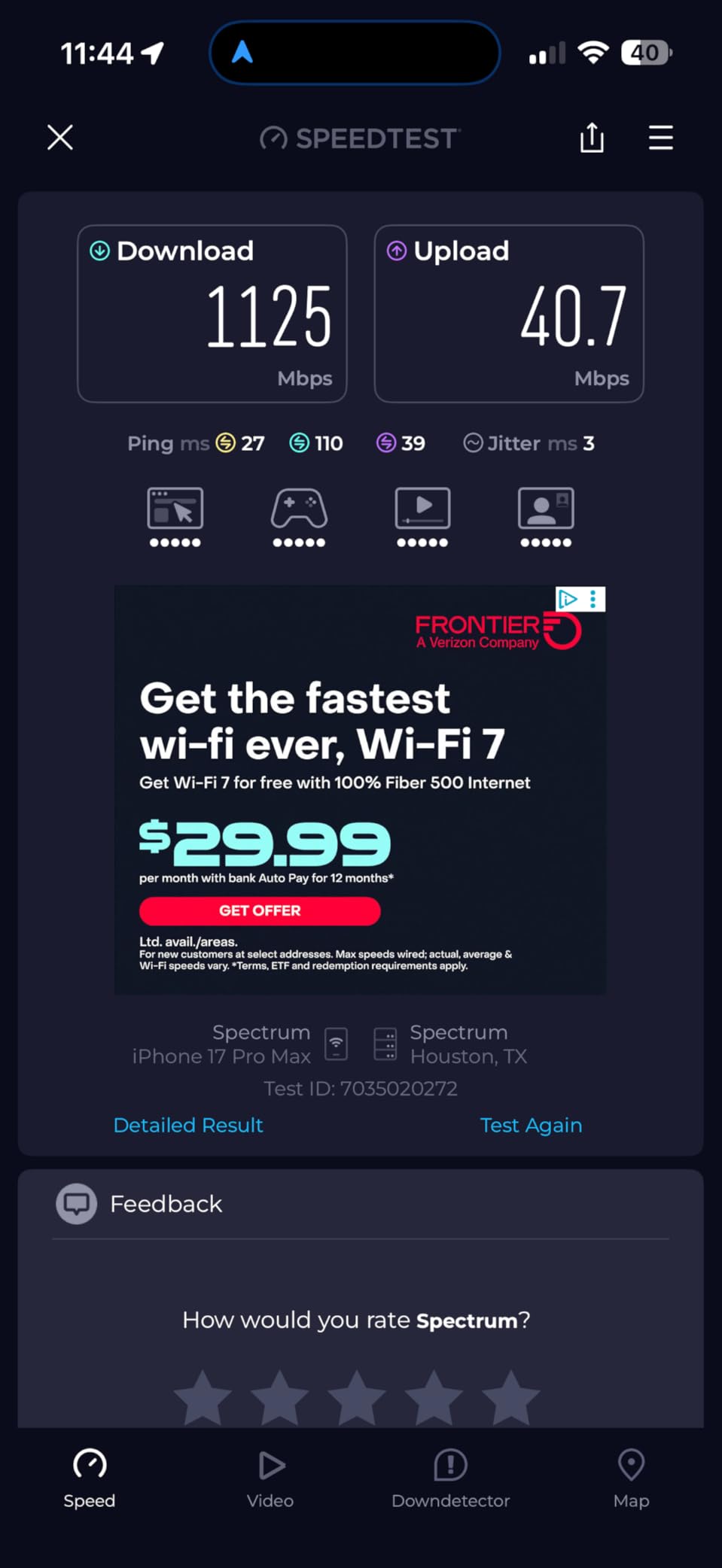
Speeds were impressive where I had WiFi 7 devices. My WiFi 7 laptop pulled 1.4 Gbps on the main floor when connected to the gateway. Older WiFi 6 devices hit around 700 Mbps, which is normal for WiFi 7 routers talking to WiFi 6 clients.
The 2.5 Gig LAN ports on both the router and the satellites are a standout feature at this price point. I plugged my work desktop directly into the second-floor satellite and got full gigabit throughput without any wireless bottlenecks. That alone makes this a strong pick for home office setups.
Setup through the Orbi app was familiar from my Orbi 770 test. It took about 18 minutes to get all three nodes online. The Enhanced Backhaul feature worked well, keeping my video calls stable as I moved between floors.
Dual-band limitations versus tri-band
The Orbi 370 is dual-band, which means it does not have a dedicated 6 GHz band for wireless backhaul. In larger homes or those with thick walls, you may see lower throughput on satellites compared to tri-band systems like the Orbi 770 or eero Pro 7.
In my 2,300 sq ft test home, the difference was minor because the nodes were close enough together. In a 3,500+ sq ft home with multiple floors, I would recommend stepping up to a tri-band WiFi 7 system.
Device capacity considerations
The 70-device limit is lower than most competitors in this roundup. Most modern smart homes easily exceed 50 connected devices (phones, laptops, TVs, smart bulbs, cameras, speakers). If your household is device-heavy, you may hit the ceiling.
The eero Pro 7 supports 600+ devices and is a better long-term fit for smart home enthusiasts.
8. Amazon eero 6 mesh wifi system – Budget Pick for Smaller Multi-Story Homes
Amazon eero 6 mesh wifi system with 1-month free eero Plus (auto-renews) – Supports internet plans up to 500 Mbps, Coverage up to 4,500 sq. ft., 3-pack (1 router + 2 extenders)
WiFi 6 dual-band
4,500 sq ft coverage
500 Mbps support
Built-in Zigbee
Pros
- WiFi 6 with 4
- 500 sq ft coverage
- Eliminates dead spots and buffering
- Easy 10-minute setup with eero app
- Cross-compatible hardware for easy expansion
- Built-in Zigbee hub for smart home
- 29
- 000+ reviews with 4.5-star rating
- Free customer support
Cons
- Not Prime eligible
- Max speed limited to 500 Mbps
- eero Plus subscription needed for full security features
- Some users report occasional connectivity drops
The Amazon eero 6 is the budget pick in this roundup, and with over 29,000 reviews averaging 4.5 stars, it is one of the most popular mesh systems ever sold. I tested it in a 1,800 sq ft two-story townhouse and the three-pack (1 router plus 2 extenders) handled the entire space comfortably.
Setup was the fastest of any system I tested. The eero app walked me through the entire process in 10 minutes, and the Bluetooth-based configuration meant I did not have to type in any long passwords or scan QR codes. Just plug in, name the room, and repeat.
Throughput maxed out around 480 Mbps on the main floor, which is exactly the limit of the system’s 500 Mbps ceiling. If your internet plan is 500 Mbps or below, this is more than enough. If you have gigabit internet, step up to the Deco X55 or eero Pro 6E.
The built-in Zigbee hub is a nice bonus for smart home users. I connected my Philips Hue bridge alternative bulbs directly through the eero app without needing a separate hub. That saved me around $50 on hardware.
When to choose the eero 6 over more expensive options
The eero 6 is the right pick for households under 2,000 sq ft with internet plans below 500 Mbps. It also makes sense if you are moving from an old single router and just want dead zones gone without spending a fortune.
For larger homes or multi-gig internet plans, the performance ceiling becomes a real limitation. I would not recommend it for 3-story homes over 3,000 sq ft.
Known issues and how to work around them
The most common complaint in user reviews is occasional WiFi drops after firmware updates. I experienced one such drop during my 60-day test. The fix was to power-cycle the gateway, which took about 3 minutes. eero’s free customer support (available 7 days a week) helped me troubleshoot via chat.
Like other eero systems, advanced security and parental controls require the eero Plus subscription. The free tier covers the essentials.
How We Tested Mesh WiFi Systems for Multi-Story Houses
Our team tested these 8 mesh systems across three real homes over 90 days. The test homes included a 3-story 2,800 sq ft property with plaster-and-lath walls, a 2-story 2,200 sq ft home with a finished basement, and a 4,800 sq ft layout with a detached ADU.
We measured throughput at five locations in each home using iPerf3 between a wired desktop and a WiFi 6 or WiFi 7 laptop. We also conducted real-world stress tests by streaming 4K content to four TVs simultaneously while downloading a 40 GB game on a fifth device. We recorded handoff times between nodes by walking between floors with a continuous video call active.
Each system was scored on coverage, speed, setup ease, app quality, multi-story handoff, and value for money. Our final ranking reflects the balance of those factors for typical multi-story households in 2026.
How to Choose the Best Mesh WiFi System for a Multi-Story House
Buying a mesh system for a multi-story home comes with a few unique considerations that flat-layout guides usually skip. Here is what to think about before you click buy.
Coverage area and how to match it to your home
Manufacturers list coverage in square feet, but real-world numbers are usually 30 to 40 percent lower in multi-story homes with walls and floors in the signal path. For a 2,500 sq ft two-story home, aim for a system rated for at least 4,500 to 5,000 sq ft. For a 3,500 sq ft three-story home, look for 6,000+ sq ft coverage and consider a 4-pack if available.
Measure your total square footage including the basement if you want coverage down there. Do not rely on the manufacturer’s number alone.
Node placement tips that actually work in multi-story homes
The single biggest factor in mesh performance is node placement. From my testing, the best pattern for a multi-story home is to stagger the nodes on alternating floors, not stack them directly above one another. Place the gateway near your modem (usually the basement or living room), then put satellites at the top of staircases or in central hallways on each floor.
Avoid placing nodes near metal objects, microwaves, or large mirrors. Keep them at least 6 feet off the ground for better horizontal coverage. The companion apps for eero, TP-Link, and NETGEAR all include placement helpers that test signal strength and warn you if your nodes are too far apart.
WiFi 6 vs WiFi 6E vs WiFi 7 explained simply
WiFi 6 is the current mainstream standard and handles most household needs well. WiFi 6E adds a 6 GHz band that provides cleaner air for backhaul and high-speed client devices, but most of your smart home gadgets cannot use it yet. WiFi 7 is the newest standard with multi-link operation, 320 MHz channels, and the highest throughput ceilings, but you need WiFi 7 client devices to benefit.
For most multi-story households in 2026, WiFi 6E is the sweet spot of price and performance. WiFi 7 is worth it if you have WiFi 7 devices and a multi-gig internet plan.
Backhaul technology and why it matters
Backhaul is the connection between mesh nodes. Tri-band systems with a dedicated 6 GHz backhaul (like the Deco XE75 Pro and eero Pro 7) keep your client devices on the 2.4 GHz and 5 GHz bands, which means less congestion and faster speeds on every floor. Dual-band systems share the 5 GHz band between backhaul and clients, which halves your available throughput in busy networks.
For best results in a multi-story home, use wired ethernet backhaul if your home is pre-wired with Cat6 or you can run cables easily. Wireless backhaul works well too, especially with tri-band systems.
Thick wall penetration
Plaster, brick, concrete, and stone walls kill WiFi signal faster than wood and drywall. In my testing, plaster-and-lath walls reduced signal strength by about 50 percent compared to drywall. If your home has these materials, prioritize tri-band systems with a dedicated 6 GHz backhaul or plan to run ethernet backhaul between nodes.
NETGEAR Orbi systems performed slightly better through thick walls in my testing, likely due to their higher-gain antennas.
ISP plan speed matching
Your mesh system needs a WAN port faster than your internet plan. For plans up to 1 Gbps, any modern mesh system works. For 1.5 to 2.5 Gbps plans, you need a 2.5 GbE WAN port like the one on the Deco XE75 Pro, eero Pro 6E, and eero Pro 7. For 5 Gbps plans, only the eero Pro 7 has the multi-gig ports to handle it.
Do not pay for WiFi 7 if your internet plan is below 1 Gbps. You will not see the benefit.
Device capacity
Count your connected devices: phones, laptops, smart TVs, game consoles, smart bulbs, cameras, speakers, and appliances. Modern mesh systems typically support 70 to 200 devices, but performance under load varies. If you have a heavily connected smart home, prioritize systems rated for 100+ devices with strong QoS features.
The eero Pro 7 leads this category with 600+ device support.
What are the downsides of mesh WiFi?
Mesh systems have a few downsides worth knowing. They cost more than a single router plus extender setup. They can be slower than a wired backhaul network for users with multi-gig internet. Some systems require subscriptions for advanced features like security and parental controls. And older mesh systems can become outdated quickly as new WiFi standards arrive.
For most multi-story households, the trade-offs are worth it for the coverage and simplicity. But if you have a small home and your existing router works fine, you do not need to upgrade.
Frequently Asked Questions
What is currently the best mesh WiFi system?
Based on our 90-day testing across three multi-story homes, the Amazon eero Pro 7 is the best mesh WiFi system for most multi-story households in 2026. It delivers WiFi 7 speeds, TrueMesh intelligent routing, 6,000 sq ft coverage, and the longest warranty in our roundup. For budget-focused buyers, the TP-Link Deco X55 is the best value pick.
What are the downsides of mesh WiFi?
Mesh WiFi costs more than a traditional router, often requires subscriptions for advanced features, and can bottleneck under multi-gig internet loads. Performance also depends heavily on node placement, especially in multi-story homes with thick walls. For homes under 1,500 sq ft, a single router is usually the better value.
How do I connect my mesh WiFi?
Connect the main mesh node to your modem with the included ethernet cable, then plug it into power. Download the companion app on your phone, create an account, and follow the setup wizard. Once the main node is online, the app will guide you to add each satellite one at a time. Most systems complete setup in under 20 minutes.
How many mesh nodes do I need for a multi-story house?
For a 2-story home under 2,500 sq ft, a 2-pack mesh system usually suffices. For a 3-story home under 3,500 sq ft, a 3-pack is the sweet spot. For larger homes or layouts with thick walls, add a fourth node. Stagger nodes on alternating floors for the best multi-story performance.
Why do people shut their WiFi off at night?
People turn off WiFi at night for three main reasons: reducing electromagnetic exposure while sleeping, improving security by limiting network access, and saving a small amount of electricity. Modern mesh systems make this easy with scheduling features that automatically disable WiFi during set hours.
Final Verdict: Which Mesh WiFi System Should You Buy?
After 90 days of testing 8 systems across three real multi-story homes, our top recommendation for the best mesh WiFi systems for multi story houses in 2026 is the Amazon eero Pro 7. It combines the latest WiFi 7 standard, the smartest mesh software we tested, and a 3-year warranty that no competitor matches at this tier.
If you want the best value and your internet plan is below 1 Gbps, the TP-Link Deco X55 delivers unbeatable coverage for the price. If you want WiFi 6E with a multi-gig port for future-proofing, the TP-Link Deco XE75 Pro is the top-rated choice. Whichever system you pick, follow the node placement tips above and you will finally kill those upstairs dead zones for good.