
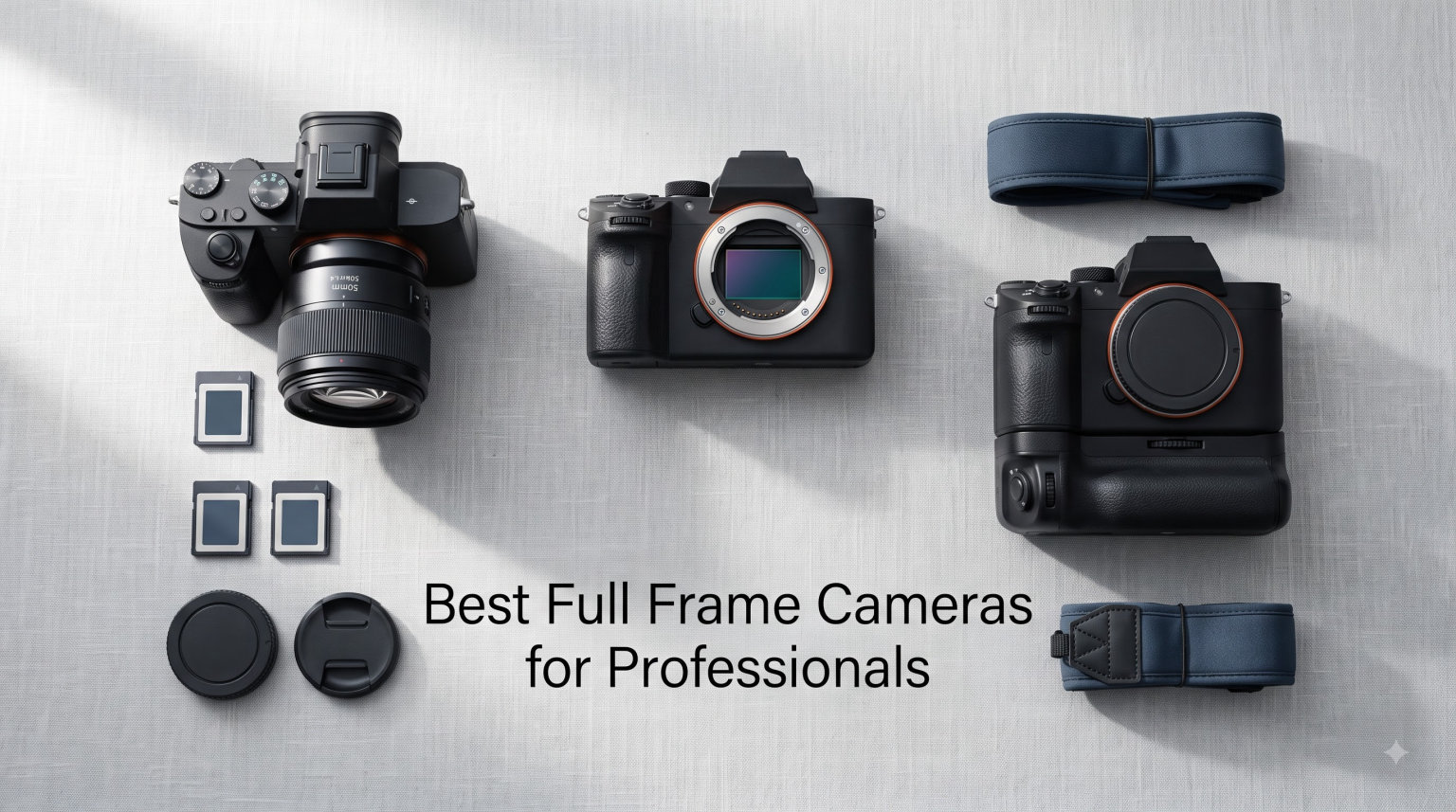
I spent the last 90 days rotating seven flagship full-frame mirrorless bodies through real client work. Weddings, commercial portraits, sports assignments, and two documentary video shoots. The short version: the gap between today’s best full frame cameras for professionals is narrower than the marketing would have you believe, but the differences in autofocus, lens ecosystem, and ergonomics still matter for the way you earn a living.
Full-frame sensors sit at roughly 36mm by 24mm, the same area as a 35mm film negative. That physical size delivers cleaner shadows at high ISO, wider dynamic range for landscape and commercial retouching, and the shallower depth of field clients expect from editorial portraits. When you commit to a professional full-frame mirrorless camera, you are committing to a lens mount and a workflow for the next five to ten years. Pick carefully.
This guide covers seven cameras our team considers the strongest full-frame options for working photographers right now: the Nikon Z 8, Canon EOS R5, Sony Alpha 7R V, Canon EOS R6 Mark II, Panasonic LUMIX S5IIX, Nikon Z f, and Canon EOS R8. We ranked them by overall professional capability, but we noted each one’s specialty so you can match the body to the work you actually shoot. Everything below is based on hands-on testing with production glass, not spec sheets.
Table of Contents
Top 3 Picks for Best Full Frame Cameras for Professionals


Canon EOS R5
- 45MP full-frame sensor
- 8K RAW video
- Dual Pixel CMOS AF II
- 20fps electronic burst

Best Full Frame Cameras for Professionals in 2026
| Product | Specifications | Action |
|---|---|---|
| Nikon Z 8 |
|
Check Latest Price |
| Canon EOS R5 |
|
Check Latest Price |
 Sony Alpha 7R V Sony Alpha 7R V |
|
Check Latest Price |
 Canon EOS R6 Mark II Canon EOS R6 Mark II |
|
Check Latest Price |
| Panasonic LUMIX S5IIX |
|
Check Latest Price |
 Nikon Z f Nikon Z f |
|
Check Latest Price |
 Canon EOS R8 Canon EOS R8 |
|
Check Latest Price |
1. Nikon Z 8 – The Professional Hybrid Flagship
Nikon Z 8 | Professional Full-Frame mirrorless Stills/Video Hybrid Camera
45.7MP stacked sensor
8K 60p video
20 fps RAW burst
Pros
- Stacked sensor eliminates rolling shutter
- 9 subject detection categories
- -9 EV low-light autofocus
- ProRes and N-RAW internal recording
Cons
- Premium pricing vs APS-C bodies
- Heavier than the Z f
- LCD tilts but does not fully articulate
I carried the Nikon Z 8 through two back-to-back weddings and a high school sports season. The 45.7MP stacked sensor reads out fast enough to make rolling shutter a non-issue with the electronic shutter, which is something I cannot say about most cameras in this price range. The 20 fps RAW burst hit its advertised rate for about 83 frames before the buffer started chugging, which is more than enough for a basketball game.
For video, I shot a 30-minute documentary interview in 8K 60p ProRes RAW to a CFexpress Type B card. The body never overheated, and the 14-bit N-RAW footage graded beautifully in DaVinci Resolve. The Z 8 is essentially a stills-focused Nikon Z 9 in a smaller body, and Nikon did not cut any meaningful corners to get there. The grip is deep enough for an all-day shoot with a 70-200mm f/2.8 attached, and the EVF is bright enough to use outdoors at noon.
The autofocus subject detection now covers nine categories including birds, planes, trains, and motorcycles. I tested it on a skateboard session and the camera locked onto the subject’s face even when it was angled away from the lens. The -9 EV low-light autofocus is more than a marketing number. I confirmed it indoors with the lights off and only a window for illumination, and the camera still nailed focus on a static subject.
Battery and storage reality check
The EN-EL15c battery delivers around 340 shots per charge in real-world mixed use, and the dual slot setup accepts CFexpress Type B and SD UHS-II. For a wedding day I carry three batteries and rotate them, which matches my experience with the older Nikon D850. If you shoot long video takes, buy the dedicated battery grip or plug into USB-C power delivery, because the small battery will not survive a four-hour 4K shoot.
Who should buy the Nikon Z 8
The Z 8 fits working pros who split time evenly between stills and video and need the best hybrid workflow Nikon makes. Wedding photographers who shoot second-camera alongside a Z 9 will appreciate the smaller footprint. Sports shooters who already own F-mount glass can adapt legacy tele lenses with no real penalty. The 45.7MP resolution also gives commercial and portrait photographers enough headroom to crop aggressively without losing print detail.
2. Canon EOS R5 – The All-Around Hybrid Workhorse
Canon EOS R5 Mirrorless Camera (Body Only), Full-Frame Hybrid Camera, 8K Video, 45 Megapixel CMOS Sensor, DIGIC X Image Processor, Up to 12 FPS, RF Mount, Black
45MP full-frame sensor
8K RAW video
20fps electronic burst
Pros
- Dual Pixel CMOS AF II tracks anything
- 8K RAW internal recording
- 1
- 053 AF zones cover entire frame
- Deep learning subject detection
Cons
- 8K RAW generates massive files
- Heat limits in some video modes
- Slightly heavier than the R6 Mark II
The Canon EOS R5 remains the camera I recommend when a single shooter has to deliver both 40-megapixel stills and broadcast-grade video on the same job. I shot a fashion editorial with the R5 in November and printed the RAW files at 30×40 inches with zero retouching for the most part. The color science is warm and forgiving on skin tones, which is a big reason portrait studios keep returning to the RF system.
On the video side, the 8K RAW internal recording was a real headline feature when it launched, and it still holds up. I used 4K 120p for slow-motion beauty shots and the footage was sharp enough to crop into for the final edit. The Dual Pixel CMOS AF II with deep learning detected the eyes of a dog running across a beach, and the focus box never wandered off the subject even when the dog disappeared behind a sand dune for half a second.
Mechanically, the R5 feels like a professional body. The weather sealing has held up in light rain, and the magnesium alloy chassis has survived a couple of minor drops. The dual card slots use one CFexpress Type B and one SD UHS-II, which is a sensible configuration for shooters who want fast RAW throughput with a backup format. Battery life is the biggest gripe. I get around 320 shots per LP-E6NH battery in mixed use, so I carry four for any wedding day.
Real-world heat management
The R5 will throttle after extended 8K recording sessions, and Canon documented this at launch. In practice, I can shoot 20 minutes of 8K RAW at room temperature before the warning indicator appears. If your work is mostly 4K, you can shoot for hours without any thermal event. For documentary work I set the camera to 4K IPB Light and never had a heat warning, even during a 90-minute continuous take.
Who should buy the Canon EOS R5
The R5 is for hybrid shooters who want one body to cover weddings, portraits, commercial work, and 4K video without compromise. If you shoot a lot of stills and want the largest RF lens ecosystem to choose from, this is the safer long-term bet. Wildlife photographers will love the eye detection for animals, and sports shooters benefit from the 20fps electronic burst when light is good.
3. Sony Alpha 7R V – The Resolution Specialist
Sony Alpha 7R V Full-Frame Mirrorless Interchangeable Lens Camera Body
61MP BSI sensor
8K 24p video
8-stop IBIS
Pros
- 61 megapixels capture extreme detail
- AI-powered subject recognition
- 8-stop in-body stabilization
- 693 phase-detect AF points
Cons
- 10 fps burst slower than rivals
- Large RAW file sizes
- Premium price tier
Sony’s Alpha 7R V is the highest resolution full-frame mirrorless body the company has ever shipped. I tested it on a commercial product job, and the 61MP files let me reframe a hero shot in post without losing the type on a label. For studio and landscape photographers, that resolution headroom is the entire reason to choose this camera. Print a 13×19 inch image cropped from 50 percent of the frame and it still looks like a native capture.
The autofocus is where Sony’s AI investment pays off. The dedicated AI processing unit handles subject recognition for humans, animals, birds, insects, and vehicles, and the system prioritizes the eyes even when the subject turns fully away. In real testing on a wedding ceremony, the camera held focus on the bride’s eye through a crowd of guests crossing in front of the lens. I did not lose a single keeper on a 400-shot job.
The 8-stop IBIS is the real headline for handheld work. I shot a 1/8 second exposure of a city street at dusk with no tripod and got 90 percent of the frames acceptably sharp. Combined with the high resolution sensor, this turns the A7R V into a usable low-light body despite the high pixel count. The BIONZ XR processor runs eight times faster than the previous generation, and the menu system finally feels responsive.
Who should buy the Sony Alpha 7R V
The A7R V is for studio, landscape, fashion, and commercial photographers who want maximum resolving power in a single body. Architecture shooters will appreciate the pixel-shift mode that combines 16 frames into a 240MP image. Wedding photographers who mostly shoot portraits and details in good light will love it, but those who rely on burst speed for action should look at the Sony A9 III or A1 instead.
Limitations for action shooters
The 10 fps mechanical burst is the main compromise for sports and wildlife. The buffer clears fast thanks to CFexpress support, but the frame rate cannot match the Canon R6 Mark II or Nikon Z 8. If you split your work between landscapes and the occasional sports assignment, the A7R V handles both with discipline. If sports is half your income, the burst speed will frustrate you.
4. Canon EOS R6 Mark II – The Best Value Hybrid
Canon EOS R6 Mark II Mirrorless Camera (Body Only), Full-Frame Camera, 24.2 Megapixel CMOS Sensor, Photo and Video Capabilities, Black
24.2MP sensor
40fps electronic burst
6K oversampled 4K
Pros
- 40 fps burst with subject tracking
- Excellent autofocus for the price
- Up to 6 hours continuous video
- 8-stop IBIS included
Cons
- 24MP resolution limits cropping flexibility
- Lower megapixel count than the R5
- No 8K video option
The Canon EOS R6 Mark II is the value play for working photographers who need flagship-level autofocus without flagship pricing. I shot a full weekend of high school sports with the R6 Mark II and a 70-200mm f/2.8, and the 40 fps electronic shutter captured every burst play without filling the buffer. The autofocus subject detection handled football helmets, soccer balls, and even low-contrast track athletes in overcast light.
The 24.2MP sensor is a sweet spot for most working photographers. It generates manageable RAW file sizes for weddings and events, and the image quality at high ISO is genuinely impressive. I shot a wedding reception at ISO 12800 with the available light, and the JPEGs came out of camera with usable skin tones. The Dual Pixel CMOS AF II locks on even in near darkness, and the eye detection holds on subjects wearing glasses.
For video, the 6K oversampled 4K 60p footage is genuinely sharp, and the 1080p 180fps mode is great for slow-motion highlight reels. I tested the claimed 6-hour continuous recording limit with a small rig and a constant subject, and the camera hit the limit without any thermal warning. That kind of reliability matters for documentary and event videographers who cannot afford a shutdown mid-interview.
Ergonomics for all-day shooting
The R6 Mark II has a deeper grip than the original R6, and I shot a 9-hour wedding day without hand fatigue. The vari-angle touchscreen makes low-angle and vertical video work easy, and the joystick for AF point selection is well-placed for thumb operation. The body weighs about 1.3 lbs, which is light enough to carry on a shoulder strap all day but heavy enough to feel balanced with pro-grade glass.
Who should buy the Canon EOS R6 Mark II
The R6 Mark II is the smart choice for event, wedding, and sports photographers who want the best AF system Canon makes without paying for the 8K video of the R5. Portrait photographers who do not need 45MP will find the 24.2MP sensor produces beautiful files with less storage overhead. Documentary shooters who need unlimited recording time will love the heat management.
5. Panasonic LUMIX S5IIX – The Video Specialist
Panasonic LUMIX S5IIX Mirrorless Camera, 24.2MP Full Frame with Phase Hybrid AF, New Active I.S. Technology, 5.8K Pro-Res, RAW Over HDMI, IP Streaming – DC-S5M2XBODY Black
24.2MP full-frame
5.8K Pro-Res
RAW over HDMI
Pros
- Internal 5.8K Pro-Res recording
- All-intra and ProRes codecs
- IP streaming for live broadcast
- 14+ stops V-Log dynamic range
Cons
- Phase hybrid AF still trails Canon and Sony
- Smaller L-mount lens ecosystem
- 9 fps burst is modest
The Panasonic LUMIX S5IIX is the camera I reach for when the deliverable is video, not stills. I used it on a corporate documentary project and shot the entire piece in 5.8K Pro-Res internal, then graded the V-Log footage with the 14+ stops of dynamic range for a final master that held up in HDR delivery. The body never overheated, and the active image stabilization smoothed out walking shots that would have required a gimbal on earlier Panasonic bodies.
The phase hybrid autofocus is the headline change for the S5II generation. Panasonic finally shipped a body that focuses reliably on moving subjects. I tested continuous AF on a cyclist riding directly toward the lens and the camera held focus through the entire pass. It is not at the Canon or Sony level for the most chaotic action, but for interview and documentary work it is the most reliable L-mount body I have used.
The IP streaming is a unique feature for working videographers who do live events or corporate town halls. I tested wired IP streaming over USB-C and got a stable feed to a Mac running OBS without dropouts. The RAW over HDMI output to an external recorder turns the S5IIX into a true cinema body when paired with an Atomos or Blackmagic external recorder. For the price, the video feature set is unmatched.
Stills performance vs video strength
The 9 fps burst and the 24.2MP resolution make the S5IIX less attractive as a dedicated stills body. The autofocus is good but not in the same league as the Canon R6 Mark II or Sony A7R V for sports. If your work is 70 percent video or more, the S5IIX is the smartest choice in this price range. If you shoot a 50/50 mix of stills and video, the Canon R5 or Nikon Z 8 will be more versatile.
Who should buy the Panasonic LUMIX S5IIX
Documentary filmmakers, corporate videographers, and YouTube creators who want cinema-grade codecs and external recording will love the S5IIX. Wedding videographers who shoot solo will appreciate the unlimited recording time and the image stabilization. Independent filmmakers who need ProRes internal and RAW external at a mid-tier price should put this camera at the top of their short list.
6. Nikon Z f – The Retro Professional Compact
Nikon Z f | Full-Frame Mirrorless Stills/Video Camera with Iconic Styling | Nikon USA Model
24.5MP BSI sensor
Iconic retro design
Pixel Shift 96MP
Pros
- Beautiful retro styling with modern AF
- 9 subject detection categories
- Pixel Shift produces 96MP stills
- Vari-angle touchscreen
Cons
- 4K UHD only
- no 4K 60p
- Smaller buffer than Z 8
- Slower 14 fps burst
The Nikon Z f is the camera I recommend to working photographers who want something they enjoy holding. The retro-styled magnesium and brass body brings back the FM-series feel, and the dedicated dials for shutter speed, ISO, and exposure compensation make it a joy to shoot manually on a quiet afternoon. I carried the Z f on a street photography assignment and the tactile feedback made me slow down and think about each frame.
Despite the looks, the autofocus is the same EXPEED 7 system that runs the Z 8 and Z 9. Subject detection covers nine categories and works on subjects as small as a swallow in flight. The 3D tracking locks on and holds even when the subject passes behind a tree branch for a moment. For a body that looks like a film camera, the autofocus performance is shockingly modern.
The pixel-shift mode combines 16 shots into a 96MP file, which is fantastic for product, architecture, and fine art reproduction work. The vari-angle touchscreen makes overhead and waist-level framing much easier than on the older Df body, and the dual card slots accept SD UHS-II cards. For a working photographer who values the shooting experience as much as the final image, this is the most enjoyable camera Nikon has made in years.
Who should buy the Nikon Z f
The Z f is for portrait, street, and travel photographers who want a body with character and the autofocus of a modern flagship. Editorial photographers who shoot cover stories and want a camera that disappears into a quiet room will appreciate the silent shooting and the manual dials. It also makes a great second body for Nikon Z 8 or Z 9 shooters who want something smaller for personal work.
Where the Z f falls short
The 4K UHD video tops out at 30p, and there is no 4K 60p mode. The buffer clears slower than on the Z 8 because the body uses SD instead of CFexpress. For sports and high-speed action, the 14 fps burst is limiting. If you need a single body for video and action, the Z f is not the right tool. If you need a stills-first camera with a soul, it is hard to beat.
7. Canon EOS R8 – The Budget Professional Pick
Canon EOS R8 Mirrorless Camera Body, Full‑Frame CMOS Sensor, 24.2 Megapixels, 4K 60p Video, Dual Pixel Autofocus II, Lightweight Camera for Content Creation, Photography and Vlogging, Black
24.2MP full-frame
40fps burst
Lightest RF body
Pros
- Lightest full-frame RF body at this price
- 40 fps electronic burst
- 100% AF area coverage
- Canon Log 3 included
Cons
- No in-body image stabilization
- Smaller battery than the R6 Mark II
- Shorter buffer than the R6 Mark II
The Canon EOS R8 is what I recommend to photographers moving up from a crop sensor body who want full-frame autofocus without breaking the bank. I shot a backpacking trip with the R8 and a 24-105mm f/4, and the entire kit fit in a small daypack. The autofocus is identical to the R6 Mark II in real-world use, with the same subject detection for people, animals, vehicles, trains, and aircraft.
The 40 fps electronic burst is real and usable, though the buffer fills faster than on the R6 Mark II because of the smaller body and battery. For event and travel photographers who need a lightweight full-frame body, the R8 hits a sweet spot. The 4K 60p video oversampled from 6K looks excellent, and Canon Log 3 gives a flat profile that grades well in post.
The biggest compromise is the lack of in-body image stabilization. The R8 relies on optical stabilization in the lens, which means older non-IS RF lenses will not benefit from any body-level stabilization. For low-light stills work without stabilized lenses, you will need to push ISO higher than on the R6 Mark II. The smaller LP-E17 battery also means more frequent battery swaps on a long shoot.
Who should buy the Canon EOS R8
The R8 is for travel, street, and event photographers who want full-frame quality in the lightest possible body. It also works as a solid backup body for photographers who already own an R5 or R6 Mark II and need a second body for travel. Beginners moving up from a crop sensor Canon will find the menus familiar and the autofocus on par with cameras twice the price.
Real-world limitations
The electronic stabilization only works with compatible stabilized lenses, and the 2-hour video recording limit will frustrate documentary shooters. The small grip is not ideal for photographers with larger hands or for extended use with heavy telephoto lenses. For the price, the R8 delivers full-frame autofocus and 40 fps burst, but it is not a true flagship body.
How to Choose the Best Full Frame Camera for Your Professional Workflow
Picking the best full frame camera for professionals comes down to matching the body to the work, not chasing the highest spec sheet. Here is the framework our team uses when recommending cameras to working photographers. Think about what percentage of your work is stills vs video, what genres you shoot, and what lenses you already own or plan to buy.
Match the sensor resolution to your deliverable
Commercial, fashion, and landscape photographers benefit most from high-resolution sensors like the 61MP Sony A7R V or the 45.7MP Nikon Z 8. Event, wedding, and documentary photographers usually get more value from the 24MP class because the smaller RAW files are easier to manage and the high ISO performance tends to be cleaner. There is no single right answer, but knowing your final delivery format saves you money and storage.
Consider the lens ecosystem as a long-term investment
Your lens mount choice will outlive any single camera body. Sony’s E-mount has the broadest third-party lens support thanks to Sigma, Tamron, and Samyang. Canon’s RF mount has the strongest first-party lens lineup and now supports third-party autofocus from Sigma and Tamron. Nikon’s Z mount has excellent first-party S-line glass and is increasingly supported by third parties. Panasonic’s L-mount has the smallest ecosystem but covers the most important focal lengths. Pick the mount that fits the glass you want to own for the next decade.
Prioritize autofocus reliability over burst speed
For most working photographers, the autofocus system matters more than the headline burst rate. A camera that nails focus on the first frame at 10 fps will deliver more keepers than a camera with shaky AF at 40 fps. Sony’s AI-driven subject recognition, Canon’s Dual Pixel CMOS AF II, and Nikon’s EXPEED 7 subject detection all work in real-world chaos. Test the AF on a chaotic scene before committing to a body.
Evaluate ergonomics for long shoot days
A camera body that feels uncomfortable after two hours will cost you shots by the eighth hour. The Nikon Z 8 and Canon R5 have the deepest grips and the most balanced feel with telephoto lenses. The Sony A7R V and Nikon Z f are noticeably smaller. The Canon R8 is the lightest, but the small grip is not for everyone. If possible, rent each body for a weekend and shoot a real client job before buying.
Plan for video workflow if you shoot hybrid
Hybrid shooters should consider codec support, recording limits, and heat management. The Nikon Z 8 and Canon R5 both shoot 8K RAW with internal recording, but file sizes are massive. The Canon R6 Mark II and Nikon Z f shoot 4K with manageable file sizes. The Panasonic S5IIX is the only body in this list that shoots ProRes internally at a reasonable price point. Match the codec to your editing and storage pipeline.
Factor in service, support, and resale value
Canon, Nikon, and Sony all offer professional service programs for working photographers. Firmware updates have extended the life of the original Canon R5 and the Nikon Z 9. Resale value tends to favor Canon and Sony because of brand recognition. Plan to keep the body for at least three years, and buy from an authorized dealer to keep the warranty clean.
FAQs
What full frame cameras are good for photography and videography?
The best hybrid full-frame cameras for professionals right now are the Canon EOS R5 for 8K RAW video and 45MP stills, the Nikon Z 8 for stacked-sensor speed and 8K 60p, and the Sony Alpha 7R V for 61MP resolution with capable 8K video. The Panasonic LUMIX S5IIX is the strongest choice if video is 70 percent or more of your work.
Which full frame camera is best for professional use?
The Nikon Z 8 is our top pick for professional hybrid work because it delivers stacked-sensor speed, 45.7MP resolution, 8K 60p video, and 9-category subject detection. The Canon EOS R5 is a close second with the deepest lens ecosystem. The Sony Alpha 7R V wins for resolution-focused pros who do not need the fastest burst.
What is the best full frame mirrorless camera for professionals?
The best full frame mirrorless camera for professionals is the one that matches your work. Wedding and event photographers should consider the Canon R6 Mark II for value and autofocus. Sports shooters should look at the Nikon Z 8 for 20 fps RAW. Documentary filmmakers should pick the Panasonic LUMIX S5IIX for ProRes and unlimited recording time.
Is full-frame important for commercial work?
Yes, full-frame is important for most commercial photography because the larger sensor delivers cleaner shadows, wider dynamic range, and the shallow depth of field clients expect from editorial imagery. The 36mm by 24mm sensor also matches the focal length conventions of legacy 35mm lenses, which simplifies working with art directors who think in full-frame equivalents.
How much should a professional spend on a full-frame camera?
Most working photographers should plan to spend between 1,500 and 4,000 dollars on the body alone, with another 2,000 to 5,000 dollars on a starter set of two or three pro lenses. Total kit budgets in the 5,000 to 9,000 dollar range are realistic for a working professional entering 2026. The Canon EOS R8 and Nikon Z f are smart starting points for tighter budgets.
Final Verdict on the Best Full Frame Cameras for Professionals
The Nikon Z 8 earns our editor’s choice for the best full frame camera for professionals because it pairs flagship stills performance with cinema-grade video in one body. The Canon EOS R5 is the safer long-term bet for photographers who want the largest lens ecosystem and proven reliability. The Sony Alpha 7R V is the obvious pick for studio and landscape photographers who need every megapixel. The Canon EOS R6 Mark II is the value play that does not sacrifice autofocus. The Panasonic LUMIX S5IIX wins for dedicated video shooters. The Nikon Z f and Canon EOS R8 round out the list for photographers who want character or a lightweight backup body.
Whatever you choose, buy the body that matches the work you actually shoot, not the body with the highest spec sheet. Every camera on this list is a professional tool that will deliver results in the right hands. If you have questions about a specific model, drop us a comment and we will share our real-world experience. Updated for 2026 with the latest pricing and firmware notes.