
Last tested October 2026. A “legal size” label on a filing cabinet tells you almost nothing. What actually decides whether your case folders, deeds and contracts fit is the internal drawer width and the spacing between the hanging rails inside each drawer.
Legal paper measures 8.5 by 14 inches, and a legal hanging folder needs an internal drawer width of at least 15.25 inches with roughly 14.25 inches between the rails. A letter-size cabinet gives you about 12 inches of rail spacing, which physically cannot take a legal folder. Plenty of listings say “legal size” and then ship something narrower, so we checked all ten cabinets below against the specs their own manufacturers publish.
We spent several weeks comparing the ten best filing cabinets for legal documents across three things that actually matter in a law office or home practice: whether a loaded legal folder actually hangs and slides, whether the cabinet locks every drawer with more than one key in the box, and whether it stays upright when a drawer is pulled all the way out. Ten products, two customer images each, and the same spec checklist for every one of them.
There is also a compliance angle nobody in this category talks about. Physical case files can sit under preservation obligations, so how you organize and secure a cabinet is an operational decision, not just a furniture purchase. We keep that framing non-legal-advice throughout, but it changes which features deserve your money.
Table of Contents
Top 3 Picks for Best Filing Cabinets for Legal Documents in October

DEVAISE 3 Drawer Mobile File Cabinet
- One lock secures all 3 drawers
- 3 removable hanging bars fit letter legal and A4 folders
- Full-extension ball-bearing slides
- Assembled except casters

Dripex 3 Drawer Metal Rolling File Cabinet
- Anti-tilt interlock opens one drawer at a time
- Bottom drawer fits letter legal and A4 folders
- 330 lb steel construction
- Five swivel wheels with two brakes

Letaya 3 Drawer Mobile File Cabinet
- 0.8 mm steel body
- Quiet ball-bearing slides
- Legal letter and A4 hanging bars
- Assembly limited to attaching wheels
Best Filing Cabinets for Legal Documents at a Glance in 2026
Every cabinet below stores letter, legal and A4 hanging folders according to its manufacturer. The differences that matter are drawer depth, drawer count, how the drawers lock, and how much of the cabinet arrives assembled.
| Product | Specifications | Action |
|---|---|---|
| DEVAISE 3 Drawer Mobile File Cabinet |
|
Check Latest Price |
| Dripex 3 Drawer Metal Rolling File Cabinet |
|
Check Latest Price |
| Letaya 3 Drawer Mobile File Cabinet |
|
Check Latest Price |
 Bush Home Salinas 2 Drawer Lateral File Cabinet Bush Home Salinas 2 Drawer Lateral File Cabinet |
|
Check Latest Price |
 Anxxsu 4 Drawer File Cabinet Anxxsu 4 Drawer File Cabinet |
|
Check Latest Price |
 MIIIKO 4 Drawer File Cabinet MIIIKO 4 Drawer File Cabinet |
|
Check Latest Price |
 PEUKC 4 Drawer File Cabinet PEUKC 4 Drawer File Cabinet |
|
Check Latest Price |
 Sauder Palladia 2 Drawer Lateral File Cabinet Sauder Palladia 2 Drawer Lateral File Cabinet |
|
Check Latest Price |
 Guizeeopo 3 Drawer Mobile File Cabinet Guizeeopo 3 Drawer Mobile File Cabinet |
|
Check Latest Price |
 Scranton and Co 4 Drawer Vertical File Cabinet Scranton and Co 4 Drawer Vertical File Cabinet |
|
Check Latest Price |
1. DEVAISE 3 Drawer Mobile File Cabinet: Best Overall for Under-Desk Legal Storage
DEVAISE 3 Drawer Mobile File Cabinet with Lock, Metal, White
Steel frame with polypropylene body
3 removable hanging bars for letter, legal and A4
23.6 inch high under-desk format
34.8 lb
Pros
- One key secures all three drawers with two keys included
- Ball-bearing full-extension slides
- Removable hanging bars fit letter legal and A4 folders
- Arrives fully assembled except the casters
- Quiet drawers that stay closed when moved
Cons
- Lock sits at the top right so coverage feels partial
- Lock is a deterrent rather than theft-proof
- Heavy at 34.8 lb and awkward to move alone
This is the cabinet I put at the top of the list because it solves the two problems that trip up most solo practices: a real all-drawer lock and drawers that actually take legal hanging folders. The three removable hanging bars are the detail that matters most here, and reviewers confirm they fit letter, legal and A4 folders rather than just accepting letter-size ones.
At 23.6 inches tall and 17.1 inches wide, it slides under a standard desk, which keeps the working surface free in a home office where space is the real constraint. Two of the drawers are stationery drawers with a pencil tray and the third is the file drawer, so the cabinet carries a legal file load without turning into a paper dumping ground.
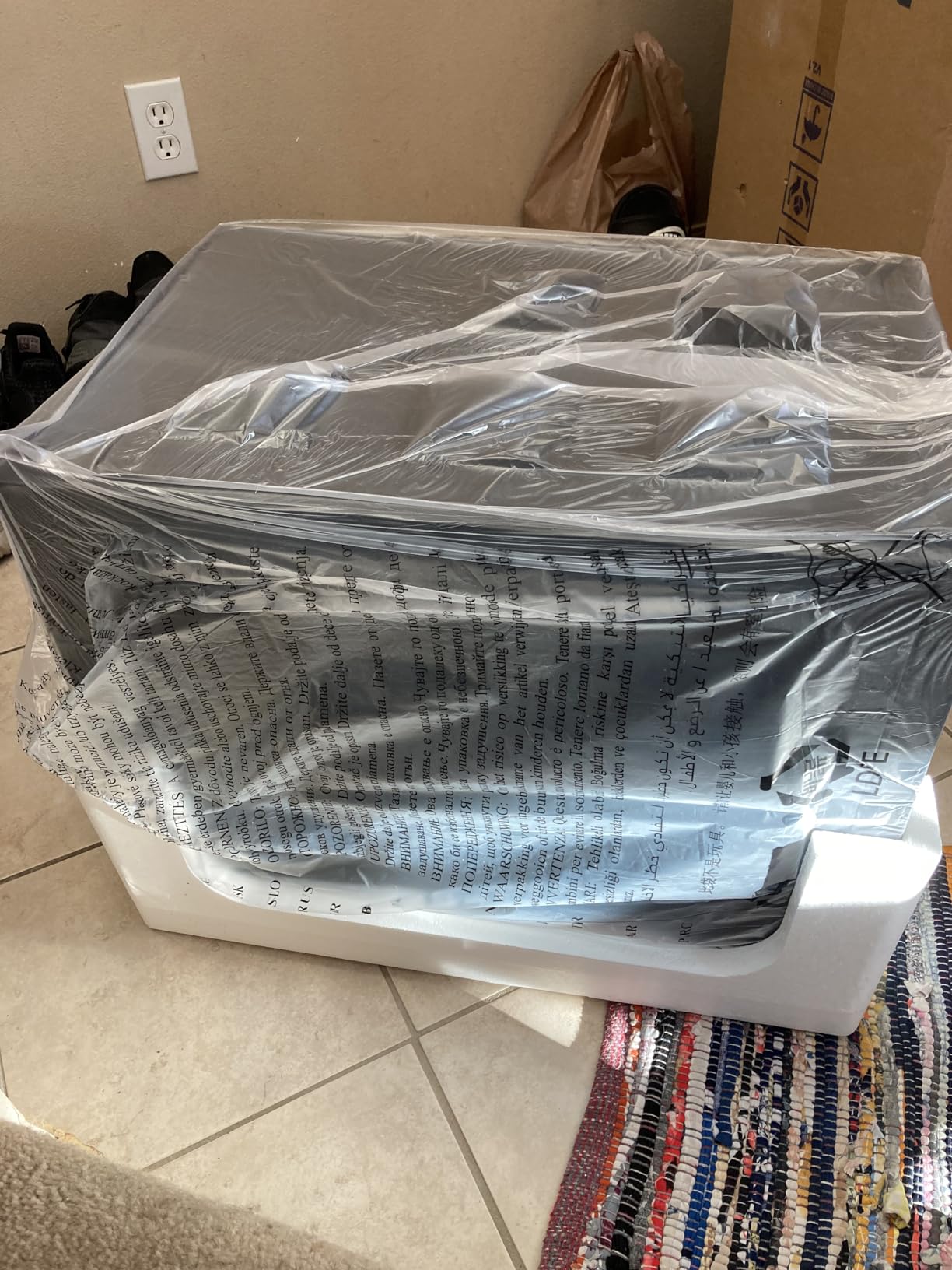
The build is steel through the frame, top and back, and the drawer rides on ball-bearing full-extension slides that stay smooth with a loaded legal folder. Reviewers repeatedly single out how quietly the drawers close and how they stay shut when you roll the cabinet over carpet. That last detail is small but it matters in a shared office where a rolling cabinet is a tipping hazard.
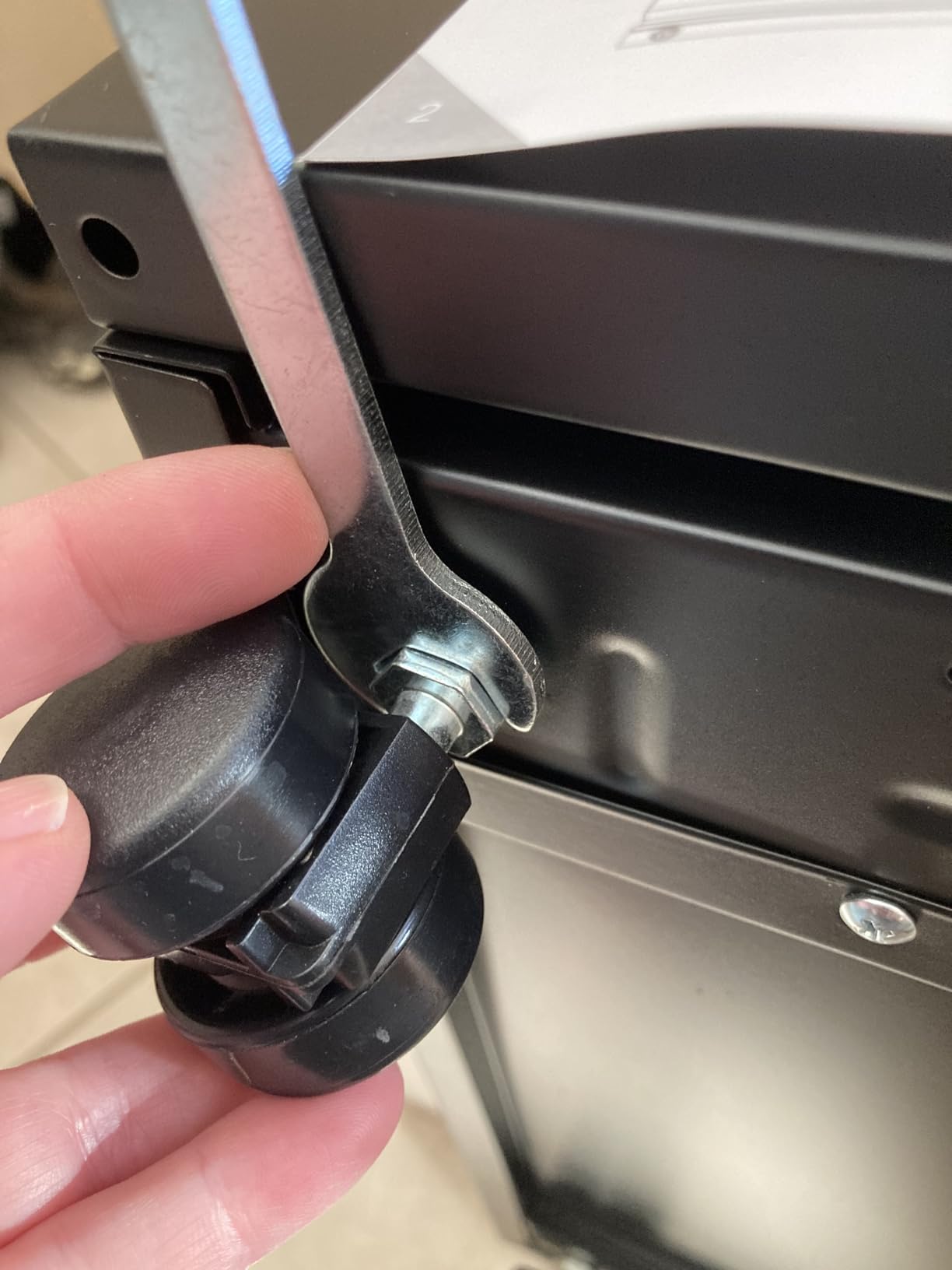
It arrives fully assembled apart from the casters, so setup is genuinely a five-minute job with a screwdriver. Packaging includes thick foam and edge protectors, which is why shipping damage is not a common complaint on this listing. Rated capacity is 330 pounds for the frame, and the warranty runs one year.
What you should check before buying
Check the lock position relative to your workflow. The lock is at the top right of the cabinet, so if your practice stores files in a specific drawer you open constantly, plan around the key turn every time. It is a deterrent and a privacy screen, not theft resistance, which is the honest expectation for a key lock at this level.
Also measure the clear height under your desk rather than the desk height itself. This cabinet is 23.6 inches tall, and a desk with a modesty rail or a cable tray underneath will eat into that clearance. If you cannot clear it, the Bush Home Salinas lateral is wider but far more forgiving on height.
Where it falls short for legal work
The file drawer is a single deep drawer, so it will not give you vertical separation between active matters and closed files. For a practice juggling many case numbers, that means a folder-labelling discipline you have to maintain yourself, because the cabinet will not sort for you.
At 34.8 pounds it is not a one-person lift, and moving it across a room alone is awkward. Several reviewers note the same thing. Plan to tip it onto its casters and roll rather than carry, and get help over thresholds and stairs.
2. Dripex 3 Drawer Metal Rolling File Cabinet: Best Value with an Anti-Tilt Interlock
Dripex 3 Drawer Metal Rolling File Cabinet Under Desk Filing Cabinet Grey
Alloy steel body rated to 330 lb
Anti-tilt interlock allows one open drawer
Bottom file drawer fits legal folders
40 lb, assembled except casters
Pros
- Anti-tilt mechanism permits only one open drawer at a time
- One lock with two keys secures all three drawers
- Large bottom file drawer fits letter legal and A4 folders
- Five swivel wheels with two lockable front wheels
- Removable 4-grid stationery tray
Cons
- Casters need fitting before first use
- Lock offers no core-removal option
- Heavier at 40 lb than most mobile cabinets
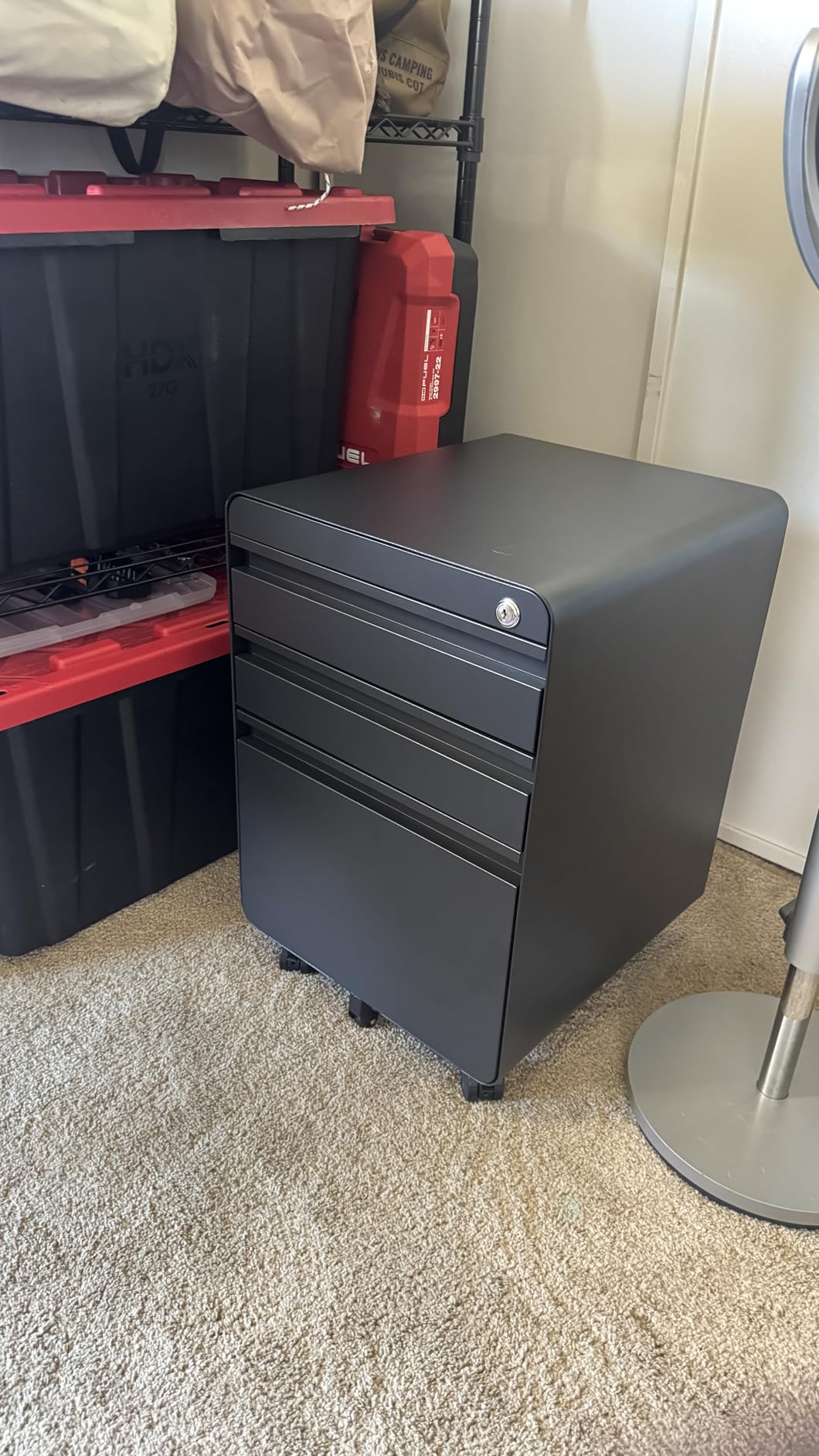
The Dripex is the pick for anyone who wants the security feature that separates a serious cabinet from a cheap one: an anti-tilt interlock. The mechanism physically prevents a second drawer from opening while one is extended, which removes the tip-over scenario that matters most when staff or children are in the room.
Alloy steel throughout, rated to 330 pounds, with full-extension glides on the file drawer. The bottom drawer takes letter, legal and A4 hanging files, and the two upper drawers carry the removable 4-grid stationery tray you can drop into either one. That tray is a small feature that keeps receipts, exhibit stickers and blank forms out of the case folders.
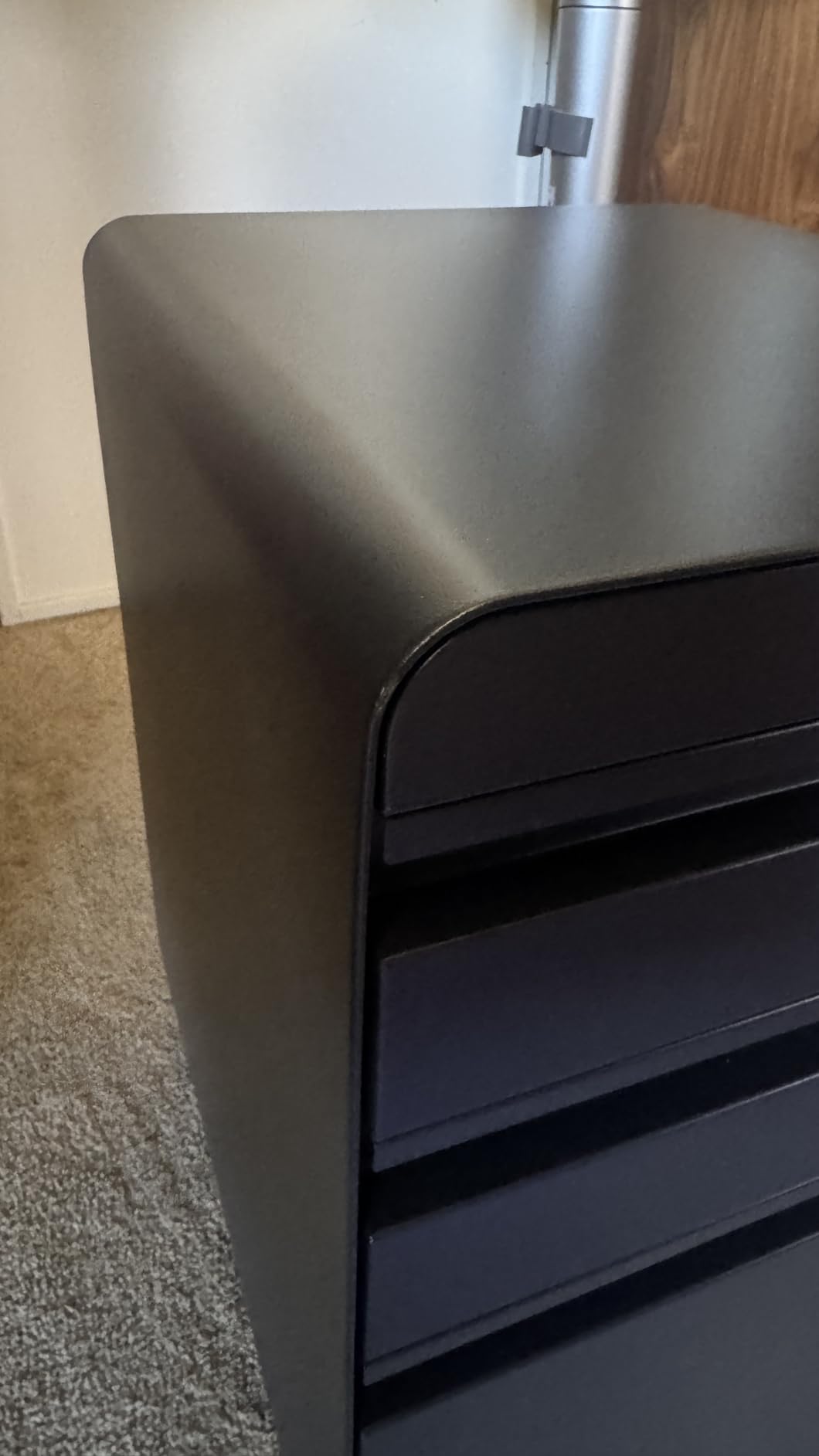
Five 360-degree swivel wheels roll over both wood and carpet, and the front pair locks so the cabinet stays put when you pull a drawer. Reviewers like the smoothness of the wheels almost as much as the lock. Setup is the one weak point: the casters need fitting at unboxing, which is the single most reported drawback across more than a thousand reviews.
Dimensions are 15.7 inches wide by 17.1 inches deep by 23.6 inches high including wheels, so it shares the under-desk footprint class with our top pick but gives you a slightly narrower body and a deeper one. That trade suits a home office where the desk return is tight.
Why the anti-tilt interlock is worth paying for
Anti-tip interlocks show up on three of the ten cabinets here, and they change how you can use the cabinet day to day. With the interlock engaged, a paralegal can never open two drawers at once to compare files, which is exactly the habit that bends a cheap frame out of square over a year.
Check whether the interlock is a mechanical latch or just a sprung plate, because the sprung type only discourages the habit. The Dripex uses a mechanism that genuinely permits one open drawer, and the same feature appears in listing specs for the Bush Home lateral’s successor units and the Sauder Palladia.
Where it falls short for legal work
There is no lock core removal mentioned in the specification, so if you lose both keys your realistic options are a locksmith or a new cabinet. For a solo practice with turnover and staff changes, that is a genuine operational cost compared with a core-removable commercial lock.
With one lock for three drawers, there is also no way to leave one drawer open for active work and lock the others. Some practices prefer per-drawer control. If that matters to you, look at a four-drawer cabinet with a keyed top lock or a separate accessory lock per drawer.
3. Letaya 3 Drawer Mobile File Cabinet: Best Steel Gauge Value Built on 0.8 mm
Letaya 3 Drawer Mobile File Cabinet with Lock,Under Desk Metal Filing Cabinets for Home Office Organizer Letters/Legal/A4((Fully Assembled-Black)
0.8 mm steel body
Enclosed file drawer, 24.4 inch high
Adjustable letter legal A4 hanging bars
Assembled except wheels
Pros
- 0.8 mm steel resists deformation moisture and fire
- Quiet ball-bearing slides
- Enclosed drawer keeps folders from slipping out
- Adjustable bars fit letter legal and A4
- Arrives nearly assembled with only wheels to fit
- Ranked number one in Office Pedestal Files
Cons
- Some drawers catch and need a slight lift
- Wheels are plastic and can mark hardwood
- Rated to only 120 pounds
- Black interior is hard to see in low light
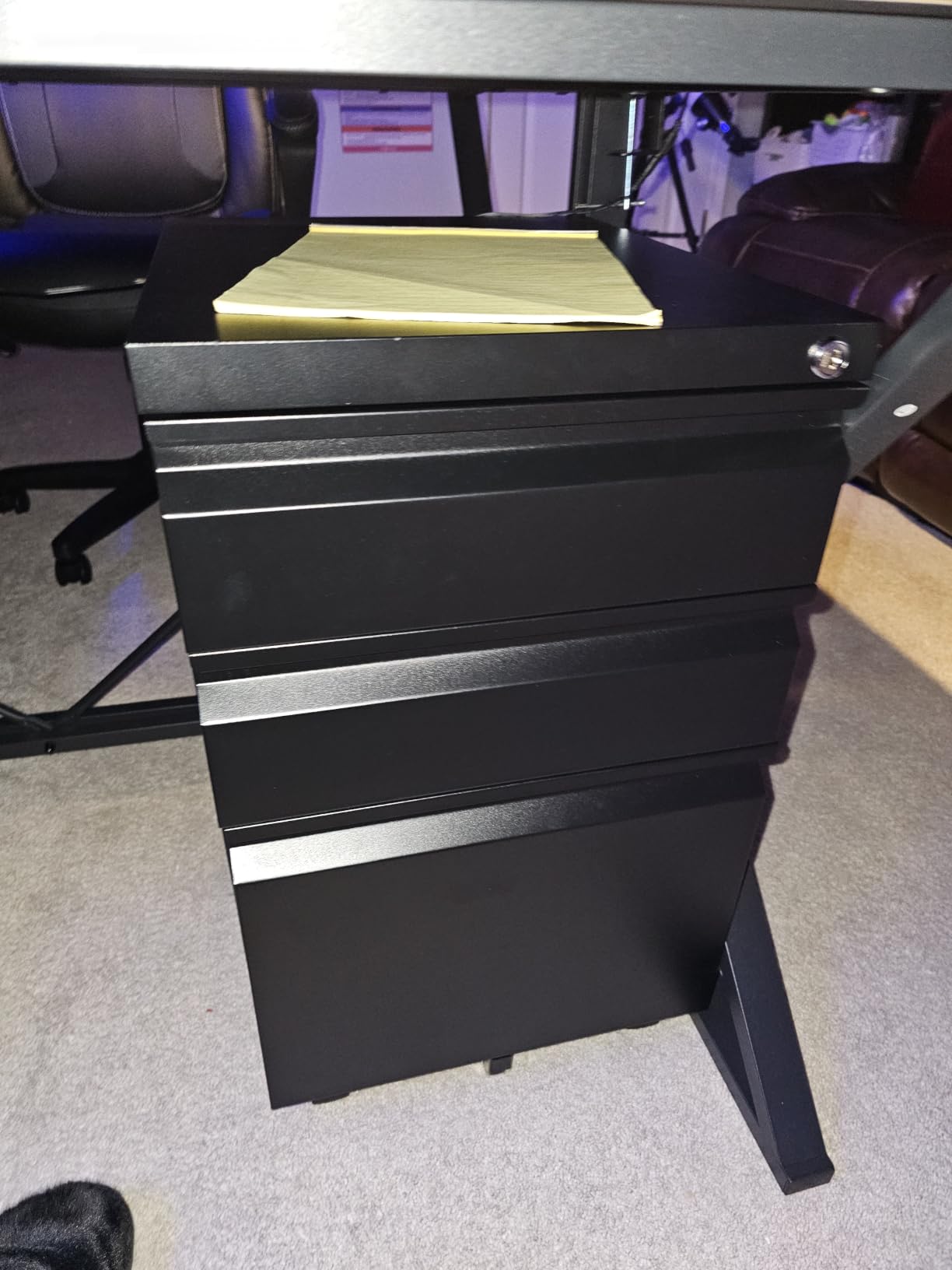
The Letaya is the steel-gauge answer in this roundup. Its listing states 0.8 mm steel construction, which is the threshold we treat as the commercial-grade minimum, and it is the only cabinet here that claims that number outright. At a price point well under the premium units, that specification alone makes it remarkable.
The file drawer is enclosed rather than open-topped, so hanging folders stay inside when you pull the drawer out. Reviewers treat that as the feature that keeps their files neat. Adjustable hanging bars accept letter, legal and A4 folders either front-to-back or side-by-side, so the same drawer works for a court filing and a real estate contract packet.
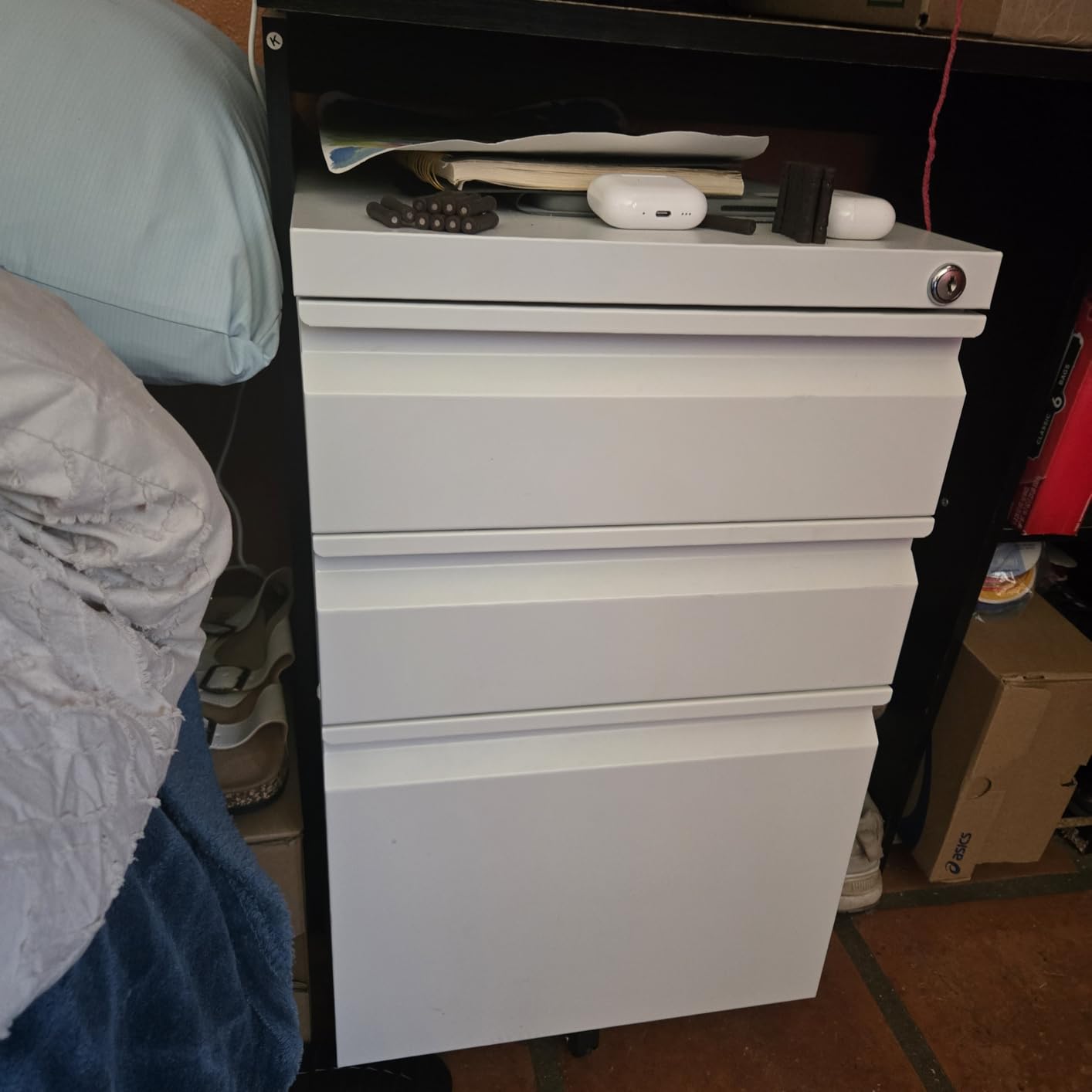
Ball-bearing slides glide quietly, and the powder-coated finish is described as resisting moisture and fire. At 24.4 inches tall it still fits under most desks, though it is the tallest of the three mobile cabinets here. Packaging is inch-thick cardboard with hard-shell corner protectors, which explains why reviewers rarely mention transit damage on this listing.
Five 360-degree wheels come with two locking casters in front so it will not roll away when a drawer is open. Assembly is limited to attaching those wheels. This is the closest thing here to a set-and-forget cabinet for a solo practice working from a spare room.
What 0.8 mm steel actually buys you
Steel gauge is the number most listings hide and the one that predicts whether a cabinet survives loaded legal paper. Guidance from the office-filing market is simple: 0.7 mm is the floor for a home office, 0.8 mm is the commercial minimum, and anything thinner starts flexing at the drawer rails under a full load. This cabinet is one of the few in the set that names its gauge.
Also look at the weight rating next to the gauge, because they disagree in this roundup. This cabinet is rated to 120 pounds while the Dripex in the same footprint class claims 330 pounds. A low rating usually reflects the slide and rail assembly rather than the steel skin, so treat the two numbers as separate signals.
Where it falls short for legal work
The most reported issue is that drawers occasionally catch and need a slight lift to open or close. It is a minor annoyance in a home office and a genuine irritation in a records room where a paralegal opens and closes these drawers dozens of times a day.
The wheels are plastic, and reviewers note they can mark hardwood floors without felt pads. If your office has wood flooring, buy a set of felt caster pads before the cabinet goes in. The interior is also black, which makes folders hard to spot in low light.
4. Bush Home Salinas 2 Drawer Lateral File Cabinet: Best Lateral Pick for a Styled Home Office
Bush Home Salinas 2 Drawer Lateral File Cabinet in Vintage Black, Home Office Storage Solution, Organizer with Drawers for Workspace, Filing Unit
32 inch wide lateral cabinet
Letter legal and A4 document capacity
Full-extension ball bearing slides
62.7 lb, assembly required
Pros
- Two wide lateral drawers hold letter legal and A4 documents
- Full-extension ball bearing slides give full reach
- Matches the Bush Home L-Shaped Desk with Storage height
- Mission-inspired styling with tapered legs
- Tested to ANSI/SOHO standards with 1 year warranty
Cons
- No lock at all so documents are unsecured
- Engineered wood is less durable than steel
- Top surface rated to only 50 pounds
- Requires assembly
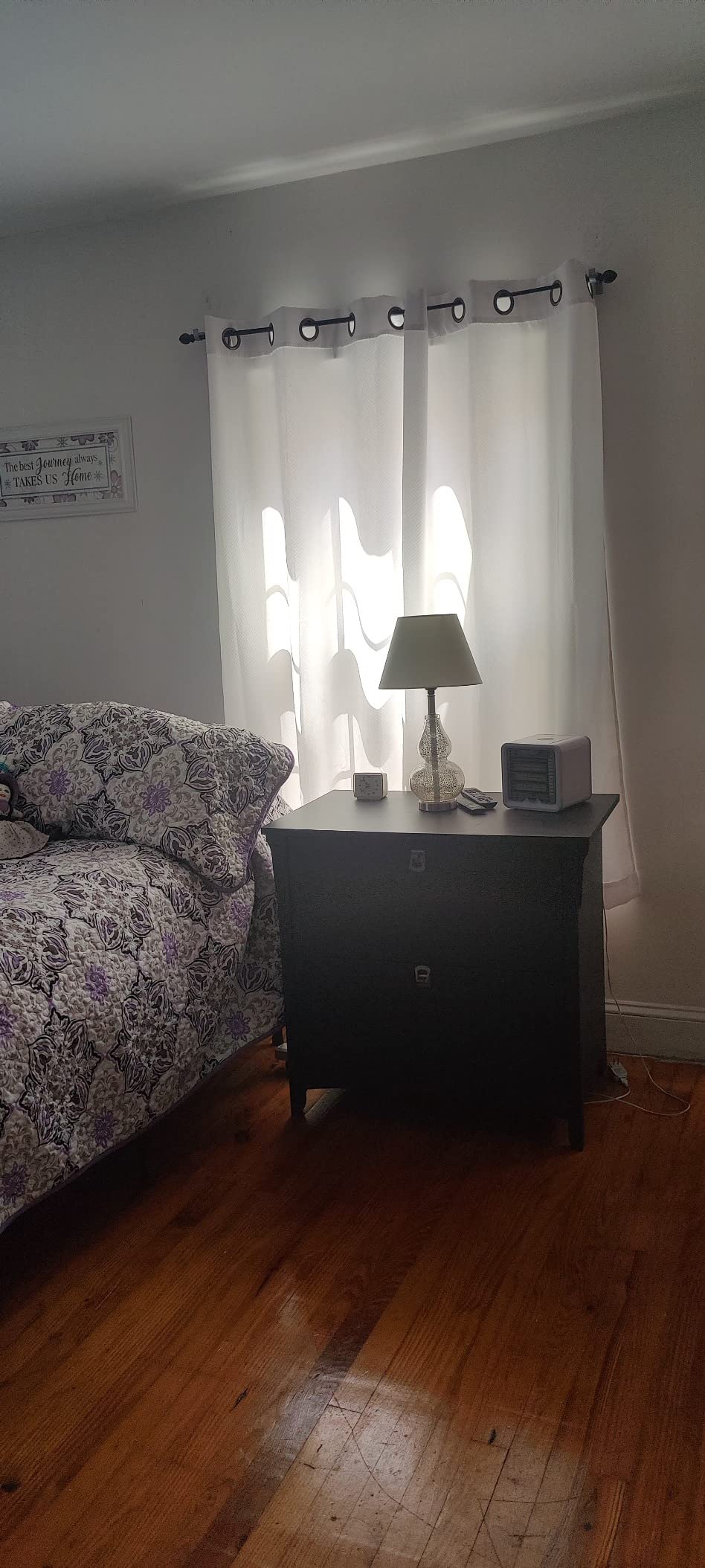
This is the only lateral cabinet in the set that is also a piece of furniture you would leave visible. The Salinas is built from engineered wood with tapered legs, curved base rails and a vintage black finish, and at 30 inches high it lines up exactly with the matching Bush Home L-Shaped Desk with Storage to form a continuous work surface.
Functionally it does the job. Both drawers are 32 inches wide laterally and run on full-extension ball bearing slides, so you reach the back of the drawer without scraping your fingers. It accommodates letter, legal and A4 documents, which covers most pleading and discovery packets.
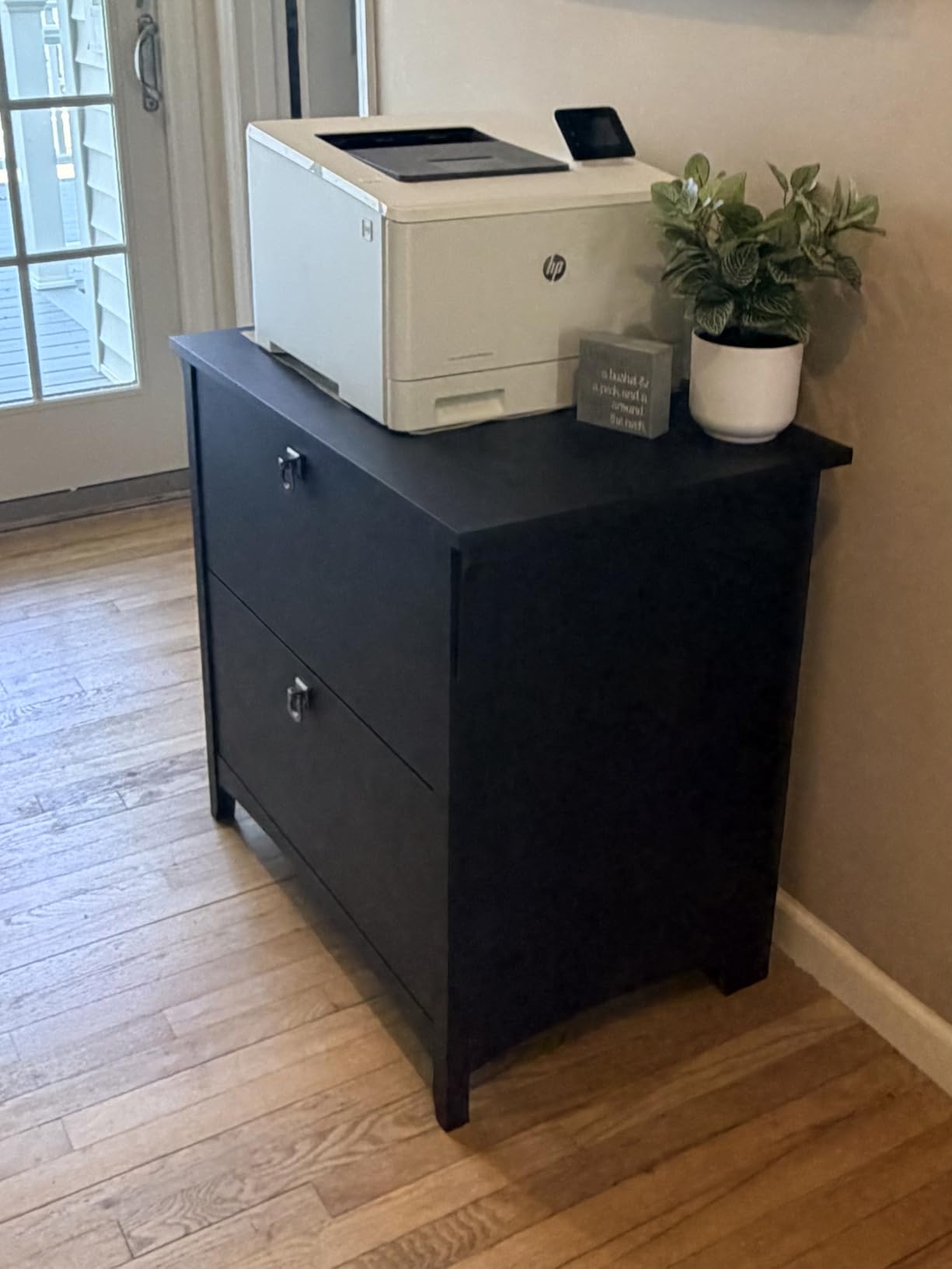
Reviewers like the styling and the slide quality almost universally. The cabinet is also offered in seven distressed finishes, which is unusual for office storage and makes it far easier to fit into a home office that already has furniture in it. Weight is 62.7 pounds, and the listing notes it is tested to meet ANSI/SOHO quality standards with a one year warranty.
The practical limitation is the same one reviewers flag most: there is no lock. For household legal paperwork like a deed, a will copy or a mortgage packet that only you can access, that is acceptable. For a working practice holding client files with confidential content, it is not.
When a lateral cabinet beats a vertical one
Lateral cabinets store folders side by side across a wide drawer rather than front to back in a narrow one. That means one open drawer shows you every folder in it at once, which is a real time saver when a paralegal pulls four case files to compare dates. It also means the cabinet footprint is wide, so measure the wall before you commit.
Wide drawers need wide clearances and, on this model, wide rails. At 32 inches wide and 20 inches deep, this cabinet needs a genuine corner rather than a nook beside a desk. If your space is narrow, the vertical cabinets further down this list are a better fit.
Where it falls short for legal work
Engineered wood loses to steel under sustained heavy use, and the top surface is rated to only 50 pounds, so do not park a large laser printer on it. That rating is enough for a laptop and a stack of files, nothing more.
Assembly is required, and unlike the Sauder Palladia this cabinet’s instructions are not consistently praised. Budget an evening rather than an afternoon, and check the panel labels twice because the wood grain and hardware placement are not always obvious from the diagrams.
5. Anxxsu 4 Drawer File Cabinet: Best Deep-Drawer Vertical at 17.7 Inches
Anxxsu 4 Drawer File Cabinet, Filing Cabinets for Home Office, Metal Vertical File Storage Cabinet with Lock, Locking File Cabinet for A4 Legal/Letter, 15″ W x 17.7″ D x 50.1″ H, Assembly Required
17.7 inch deep all-steel body
Four drawers, one lock with two keys
Adjustable rails for letter legal A4 and F4
71 lb, assembly required
Pros
- Deeper 17.7 inch body holds more per drawer
- Adjustable hanging rails for letter legal A4 and F4
- Fully extended silent slide rails
- One key locks all four drawers with anti-tilt interlock
- Cold-rolled steel resists rust and corrosion
- 50 inch height aligns with a desk surface
Cons
- Assembly is difficult and some need a second person
- Drawers may not close flush with the frame
- Occasional defective drawer brackets and shipping damage
- Smaller than a full-size commercial file cabinet
Drawer depth is the quiet advantage here. At 17.72 inches deep this cabinet holds legal folders front to back with room to spare, and the deeper body is the reason the company claims more capacity per drawer than comparable models. For case files with exhibits stapled inside, that extra depth matters.
The build is cold-rolled solid steel throughout, described as corrosion and rust resistant, with a powder-coated finish. All four drawers use fully extended silent slide rails, and each has adjustable hanging rails that take letter, legal, A4 and F4 folders. That F4 support is rare in this price band.
One lock with two keys secures all four drawers, and an anti-tilt mechanism means only one drawer opens at a time when the cabinet is unlocked. The 50.12 inch height is worth noting on its own, because it puts the top of the cabinet at roughly desk height, so you can set a monitor or a stack of binders on it and still reach the drawers comfortably.
Capacity is listed at 71 pounds and assembly is required, though the package includes written instructions and an installation video with customer support behind it. Dimensions are 15 inches wide by 17.72 inches deep by 50.12 inches high, a narrow vertical footprint for a four-drawer cabinet.
How drawer depth changes what you can file
Legal hanging folders are sold in two depths. The standard legal folder hangs front to back, while the legal-size “front-to-back and side-by-side” style doubles capacity in a deep drawer. A 17.7 inch drawer gives you room to run them both ways, which is how this cabinet can present itself as holding more per drawer than a shallower four-drawer model.
Deep drawers also change how the slides feel under load. More depth means a longer slide travel and more leverage on the rail, so the fully extended silent rails here are doing real work. Check that they extend fully, since a partial-extension slide on a 17.7 inch drawer leaves the last few folders effectively invisible.
Where it falls short for legal work
Quality control is the weak spot. Across its reviews the cabinet averages 4.3 stars with a noticeable share of one-star ratings, and the complaints cluster around drawer brackets, flush drawer closure and, on some cabinets, a lock that never engaged properly. Inspect every drawer and test the lock before you load anything.
Assembly is also the hardest in this roundup and reviewers frequently report needing a second person. At 71 pounds shipped, budget for two people and set aside real time. The upside is that written instructions and an installation video are included, which is more help than the picture-only booklets on some rivals.
6. MIIIKO 4 Drawer File Cabinet: Best Four-Drawer Pick with Wall Anchors Included
MIIIKO 4 Drawer File Cabinet with Lock, Metal File Cabinets for Home Office,Vertical Filing Cabinets Office Storage Cabinet for Letter,Legal,A4,File Folders(Black)
Cold-rolled steel 4-drawer vertical
Top lock with two keys, anti-tip per drawer
Wall anchors and tools in the box
90 lb, assembly required
Pros
- Four high-side drawers with adjustable hanging rails
- Full-extension glide rails open smoothly and quietly
- Top lock secures all four drawers with two keys
- Anti-tip mechanism on each drawer side
- Wall anchoring fixtures and screws included
- Packaging protects the flat-packed cabinet in transit
Cons
- Instruction booklet is poorly illustrated
- Some builders report 4 to 6 hours of assembly
- Some cabinets have a lock that secures only the upper drawers
- Heavy at 90 lb
- Occasional shipping damage
The MIIIKO is the pick when security and tip-over risk outrank convenience, because it is the only cabinet here that ships with wall anchoring fixtures in multiple screw sizes. In a law office with staff, a 50 inch tall steel cabinet is exactly the kind of object you do not want a child pulling open a drawer on, and anchoring it removes the argument entirely.
It is cold-rolled steel with a painted finish, and all four drawers are high-side with adjustable hanging rails for letter, legal and A4 files. Full-extension glide rails are fitted to every drawer. A top lock secures all four drawers with two keys included, and each drawer side carries its own anti-tip mechanism rather than one interlock for the whole cabinet.
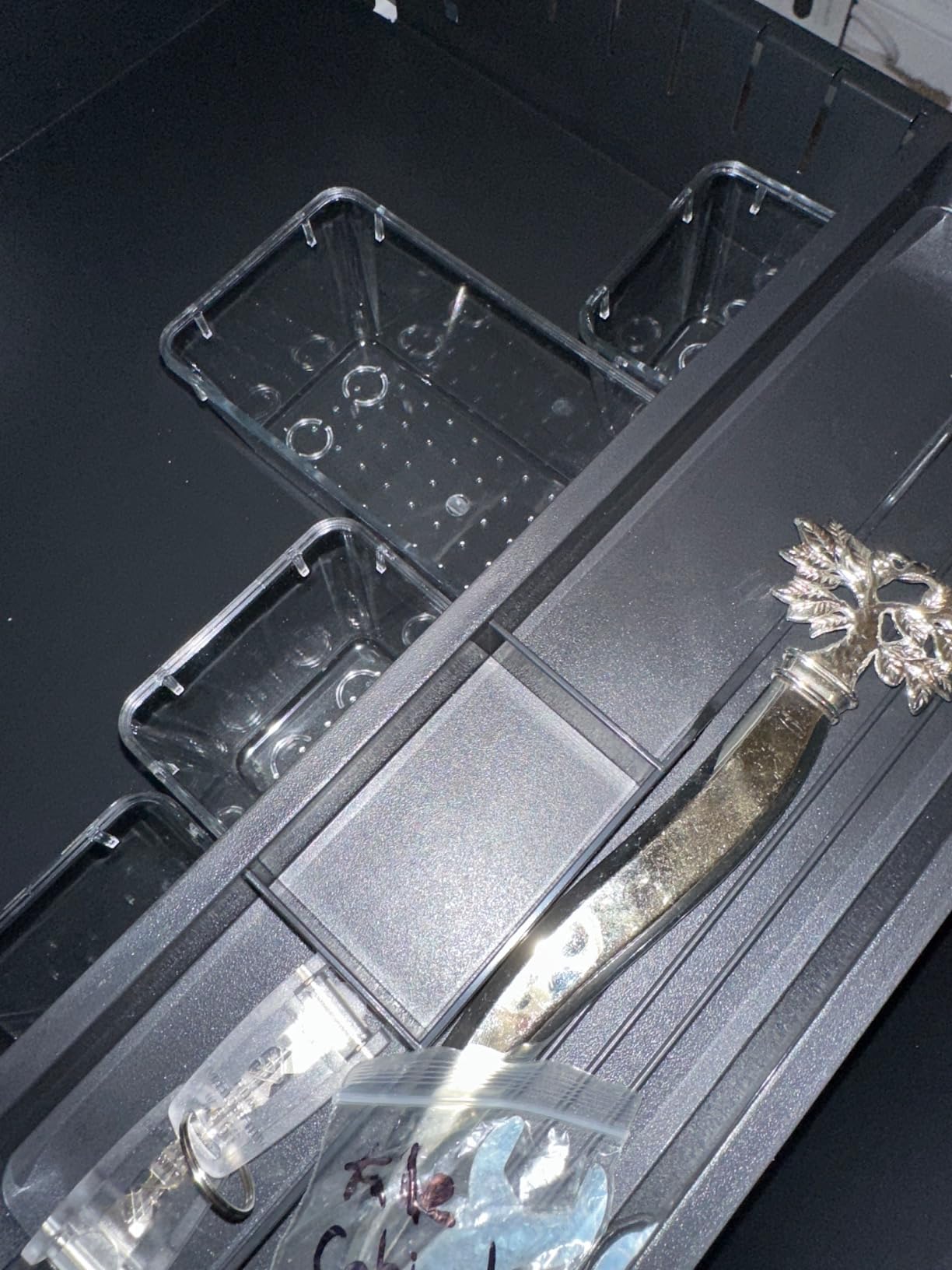
The listing also includes a screwdriver, wall fixtures and assorted screws, which saves a trip to the hardware store and makes anchoring straightforward. Footprint is 15 inches wide by 17.71 inches deep by 50.11 inches high, essentially the same envelope as the Anxxsu cabinet with more drawer height.
Capacity is listed at 220 pounds, and the room types given include garage and hallway alongside home office, which matches what reviewers report about using it in a basement or utility room. Packaging quality is repeatedly praised, with the flat-packed cabinet arriving protected.
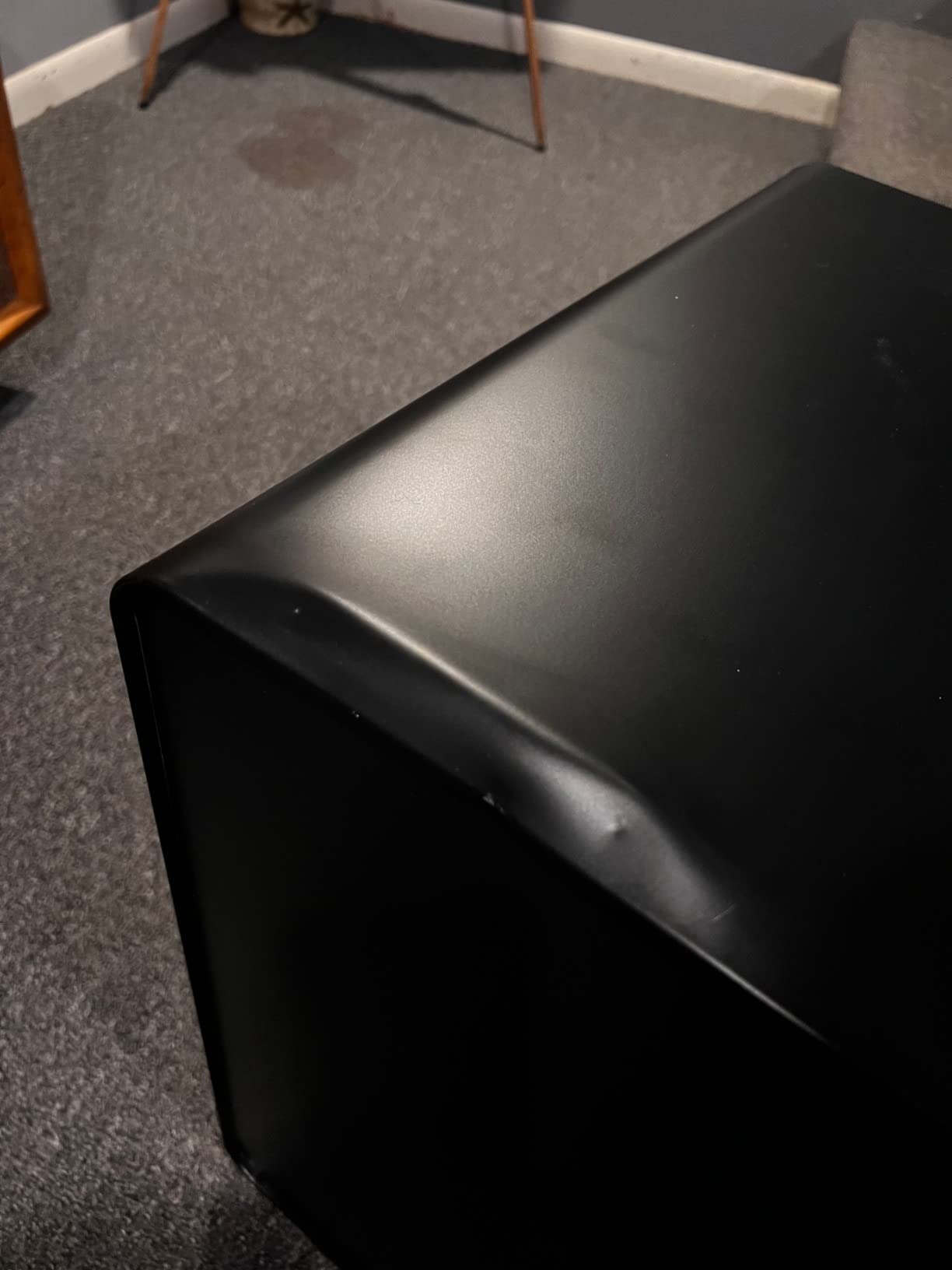
Why the included wall anchors matter
Anchoring a tall file cabinet takes ten minutes with a drill and removes the single largest safety concern in this category. Most cabinets here ship without fixtures or with a single bracket size, so the hardware store trip and the wrong screw diameter are the reasons most people skip the job. This cabinet removes that excuse.
Pair anchoring with the per-drawer anti-tip mechanism and you get two independent layers: one stops the cabinet moving, the other stops the drawer opening. For a practice that keeps original documents and privileged correspondence in the same room, that combination is the reason this cabinet earns its place.
Where it falls short for legal work
The instruction booklet is the dominant complaint. Reviewers describe it as incomplete, with diagrams that do not clearly label which panel goes where, and several report spending four to six hours on the build. Set aside an afternoon and treat the first hour as sorting hardware.
At 90 pounds it is heavy to reposition even before assembly, and a small share of owners report a lock that secures only the upper drawers. Test the lock on all four drawers before loading paper. If you want a lighter alternative with the same anchoring hardware, the PEUKC cabinet is 27 pounds lighter.
7. PEUKC 4 Drawer File Cabinet: Best for F4 and A4 Legal File Formats
PEUKC 4-Drawer File Cabinet, 16.3″ Deep Vertical Filing Cabinet with Lock, Metal File Cabinet for Home Office Furniture, Anti-Tip 4 Storage Drawers for Letter/Legal/F4 Size (Assemble Required, White)
16.3 inch deep all-metal drawers
Fits letter legal A4 and F4 documents
All four drawers lock together
Anti-tip one-drawer-at-a-time lock, 62.4 lb
Pros
- Deep 16.3 inch drawers fit letter legal A4 and F4 documents
- All four drawers lock simultaneously
- Anti-tip system permits only one open drawer
- Two ball-bearing slides per drawer keep tracking smooth
- Lowest price among four-drawer vertical cabinets
- Height options from 25.4 to 64.4 inches
Cons
- Assembly takes far longer than the advertised time
- Picture-only instructions omit the side-panel screws
- Two people often needed until fully assembled
- Some cabinets arrive with dents
- Thinner steel than competing units
Folder format is the reason to look at this cabinet. Its 16.3 inch drawers are specified for letter, legal, A4 and F4 documents, and F4 is the European legal format that international practices and cross-border matters actually use. Most cabinets in this roundup stop at A4.
Security is genuinely strong for the money. All four drawers lock simultaneously with one key, and the anti-tip lock system allows only one drawer open at a time, which is the same interlock idea as the Dripex applied to a stationary four-drawer body. Two ball-bearing slides per drawer are a step up from the single rail used on some budget cabinets.
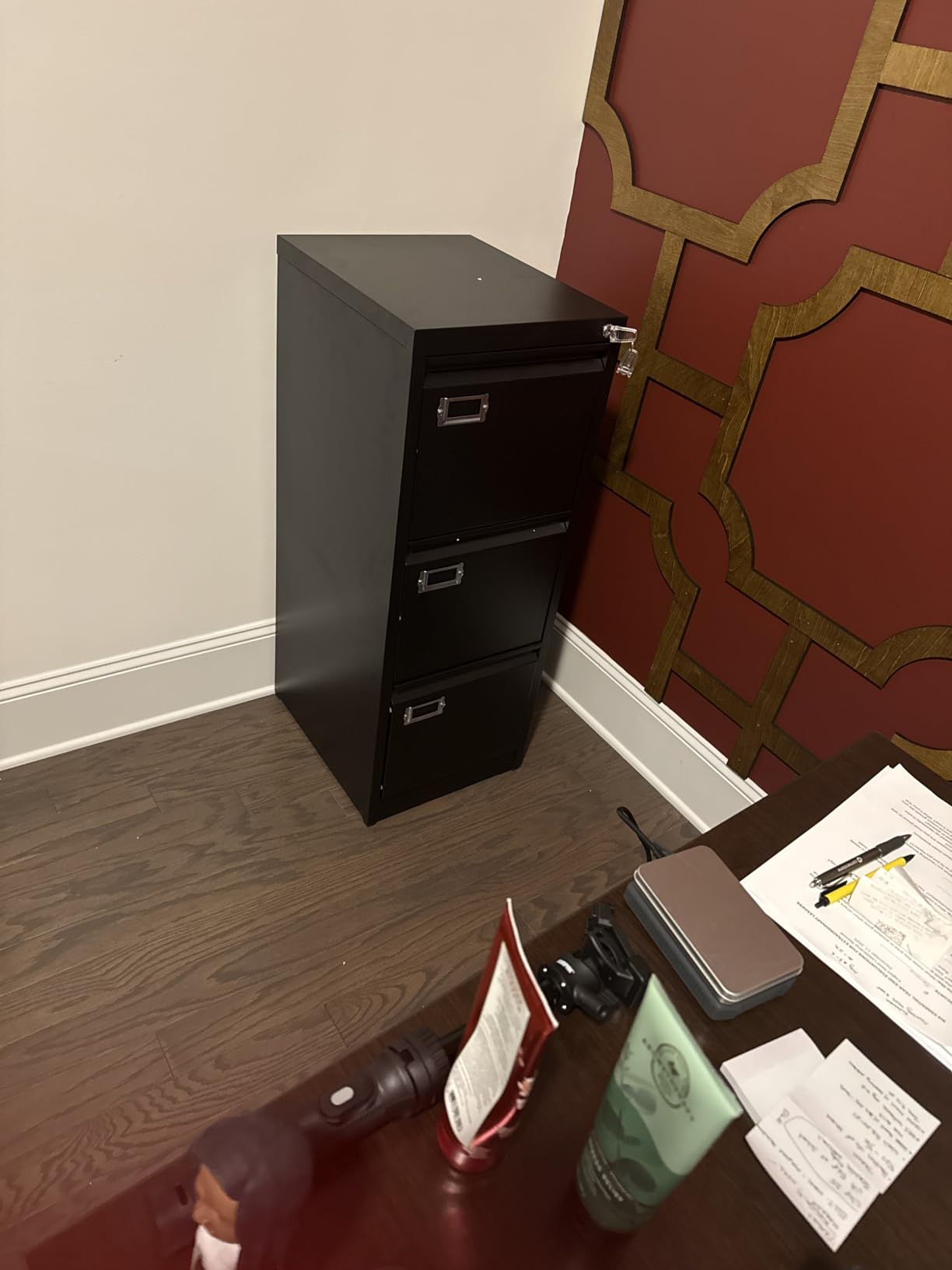
The finish is powder-coated over an all-metal body with a smooth surface that wipes clean, which matters in an office where you handle originals and do not want a textured panel holding dust. Dimensions are 15.1 inches wide by 17.7 inches deep by 52.4 inches high, and the range also comes in heights from 25.4 to 64.4 inches if your space does not suit a full-height cabinet.
Rating sits at 4.1 stars across 273 reviews, the lowest average in this set, and the reason is entirely assembly rather than function. The listing advertises roughly 30 minutes of flat-pack build; reviewers report two hours or more, often with a second person.
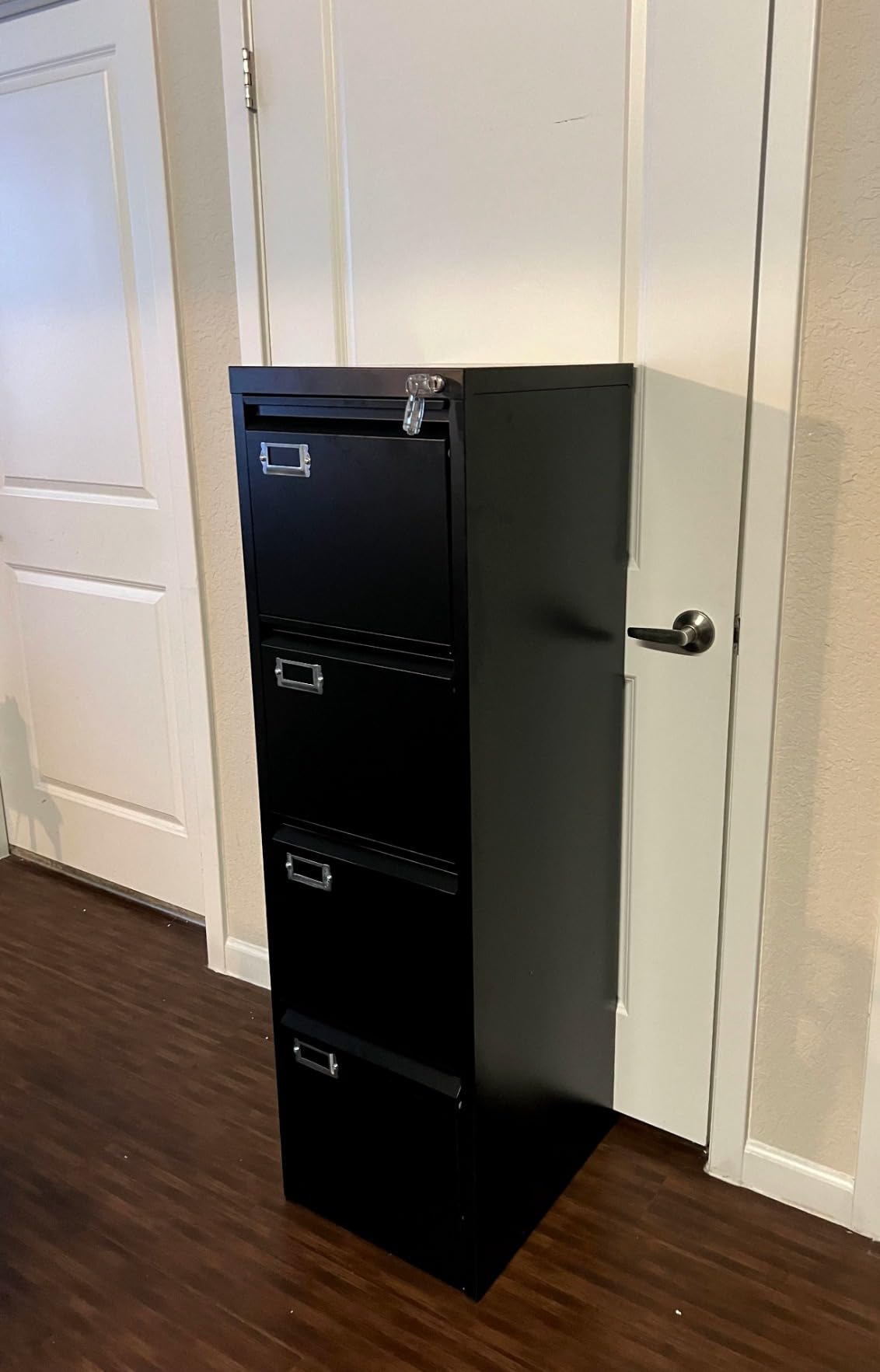
When F4 and A4 support changes the choice
A4 and F4 folders are physically a different shape from US letter and legal folders. If your practice handles matters involving European counterparties, or your office standard is A4 throughout, a cabinet specified only for letter and legal will leave you with folders that hang crooked or not at all. This is one of the narrowest but most concrete reasons to pick a specific cabinet.
The cabinet family is worth knowing about because it comes in a range of heights from 25.4 to 64.4 inches. A short under-desk model suits a home practice; the full-height version suits a records room. Match the height to where people actually stand when they use the cabinet, not just to your floor plan.
Where it falls short for legal work
The instructions are picture-only and, according to many reviewers, fail to mention that screws must be driven into the side panels. That omission alone accounts for a lot of the reported assembly struggle. The cabinet is not sturdy until fully assembled, so two people are often needed to keep it square.
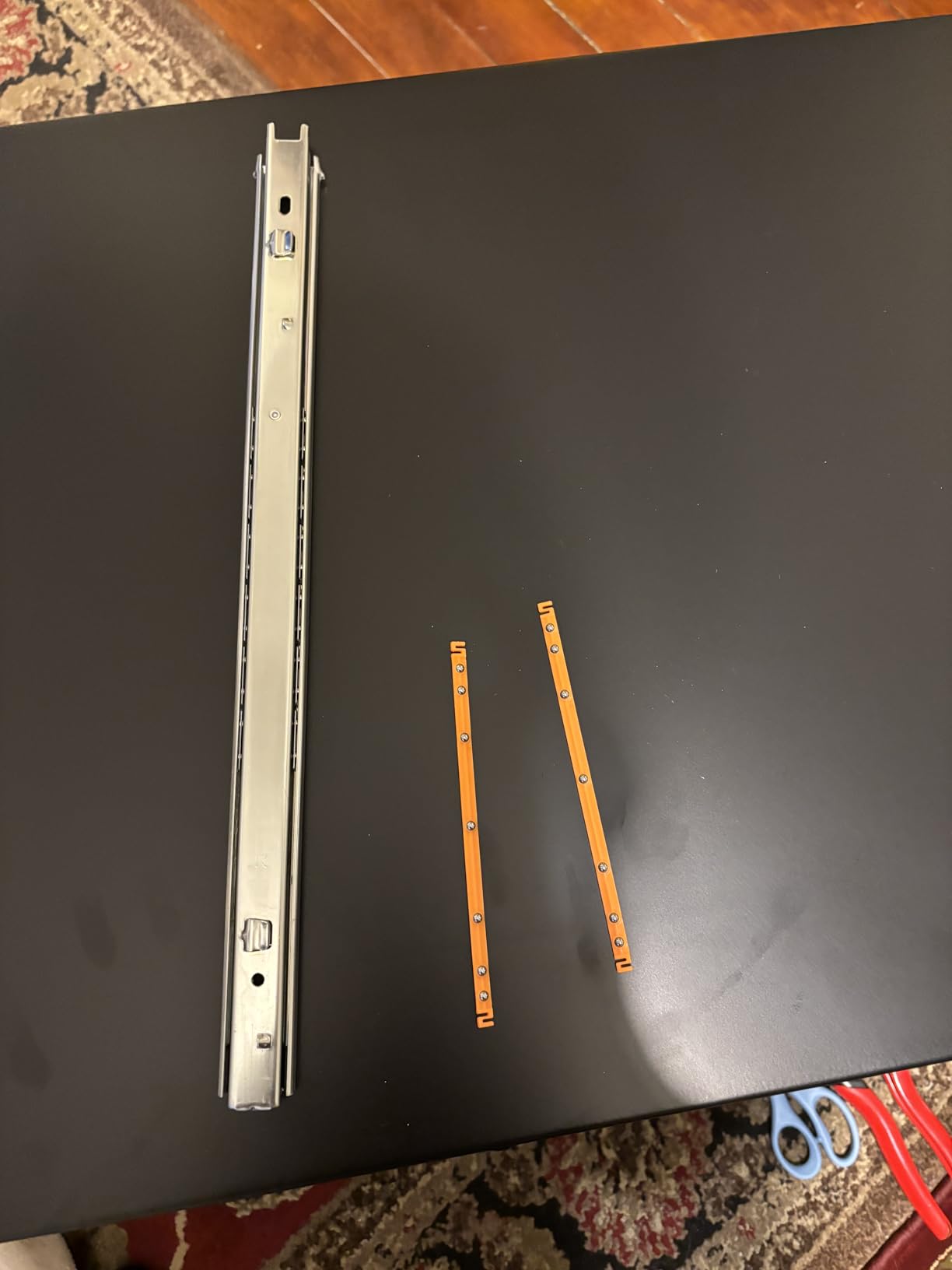
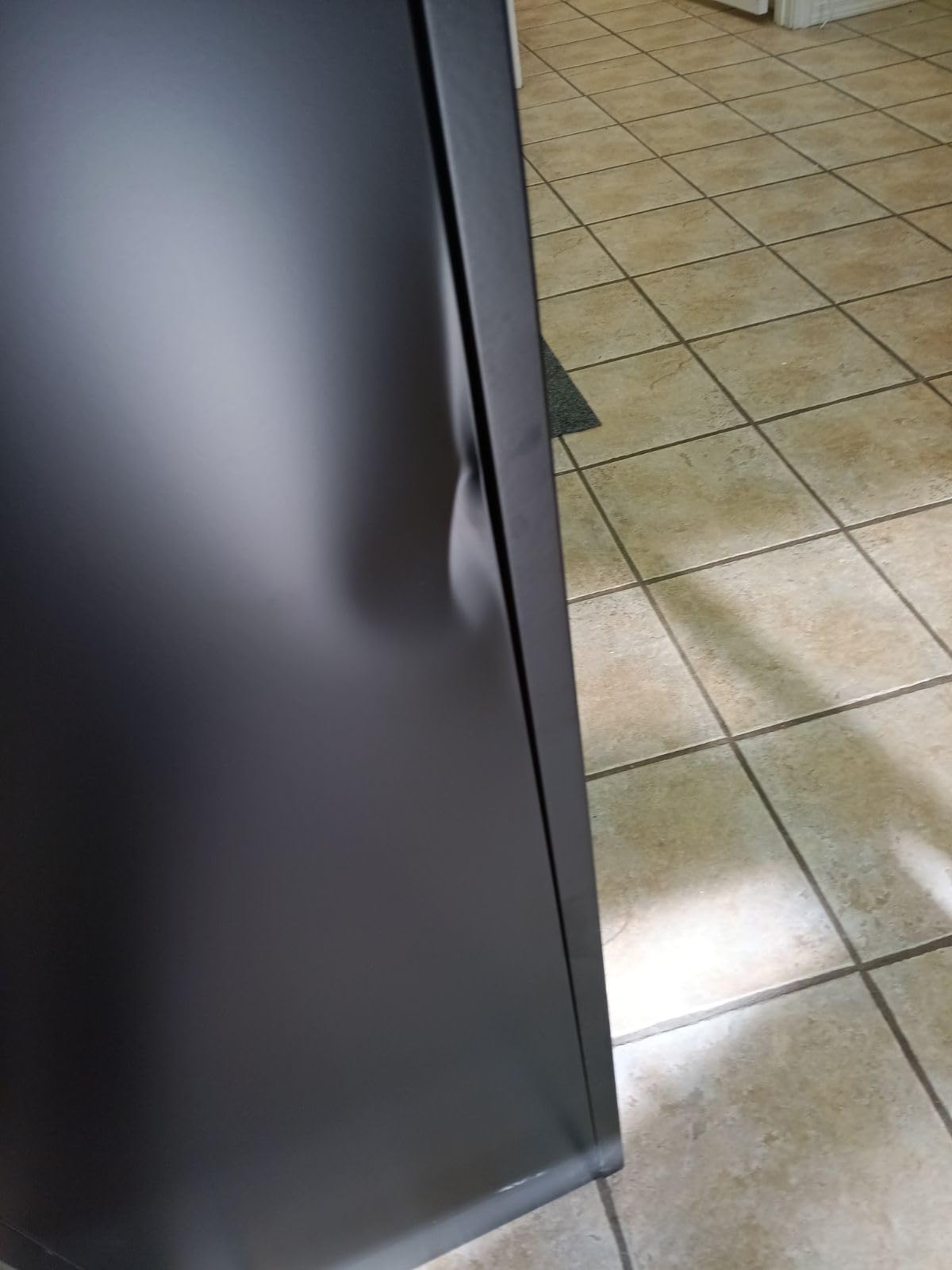
Several owners also report units arriving with dents that prevented drawers from opening or closing, and the steel is described as thinner than competing cabinets. Inspect the box carefully on arrival and assemble before you commit a week of file transfer to it.
8. Sauder Palladia 2 Drawer Lateral File Cabinet: Best Wide Lateral with a Printer Top
Sauder Palladia File Cabinet with 2 Drawers, Safety Mechanism, Lateral File Cabinet – Select Cherry Finish
36.8 inch wide lateral cabinet in cherry
Interlock allows one open drawer
Spacious top for a printer
108 lb, 5 year parts warranty
Pros
- Full-extension slides give complete reach to the back of each drawer
- Interlock allows only one drawer open at a time
- Well written and illustrated assembly instructions
- Attractive traditional cherry styling
- Backed by a 5 year parts warranty
- Holds letter legal and European hanging files
Cons
- No lock
- so documents are unsecured
- Very heavy at 108 lb and hard to move alone
- Assembly takes 2.5 to 4 hours for most buyers
- Drawer fronts are fussy to align evenly
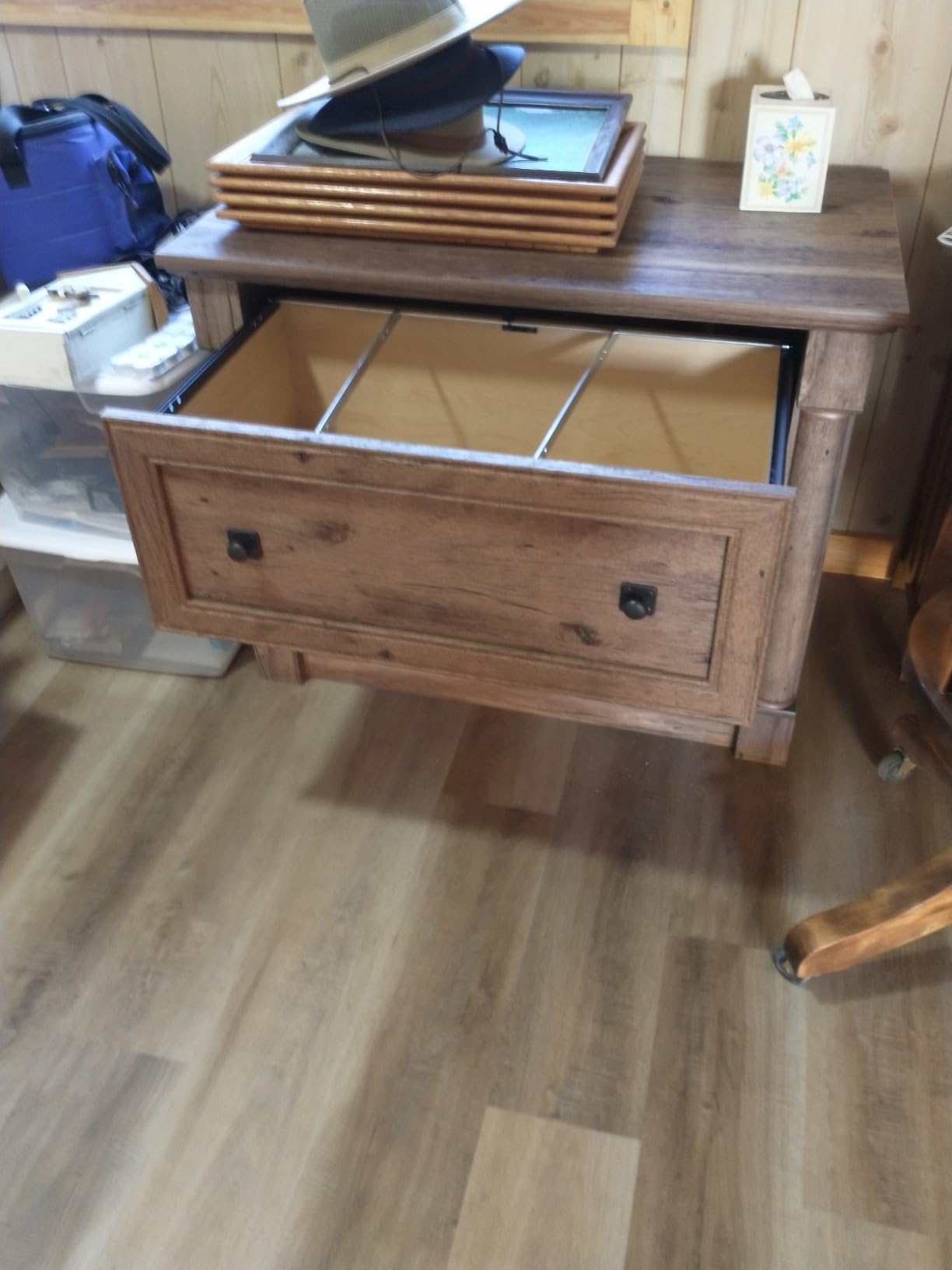
The Palladia is the widest cabinet here at 36.81 inches, and that width exists for one reason: to double as a printer stand. The top surface is deliberately spacious, so a home practice can put its printer on the cabinet instead of consuming a separate stand beside the desk.
Both drawers run on full-extension slides and accept letter, legal and European-style hanging files, so it covers the same folder formats as the PEUKC cabinet in a completely different body. An interlocking safety mechanism permits only one open drawer at a time, which is a real advantage on a cabinet this wide and this tall.
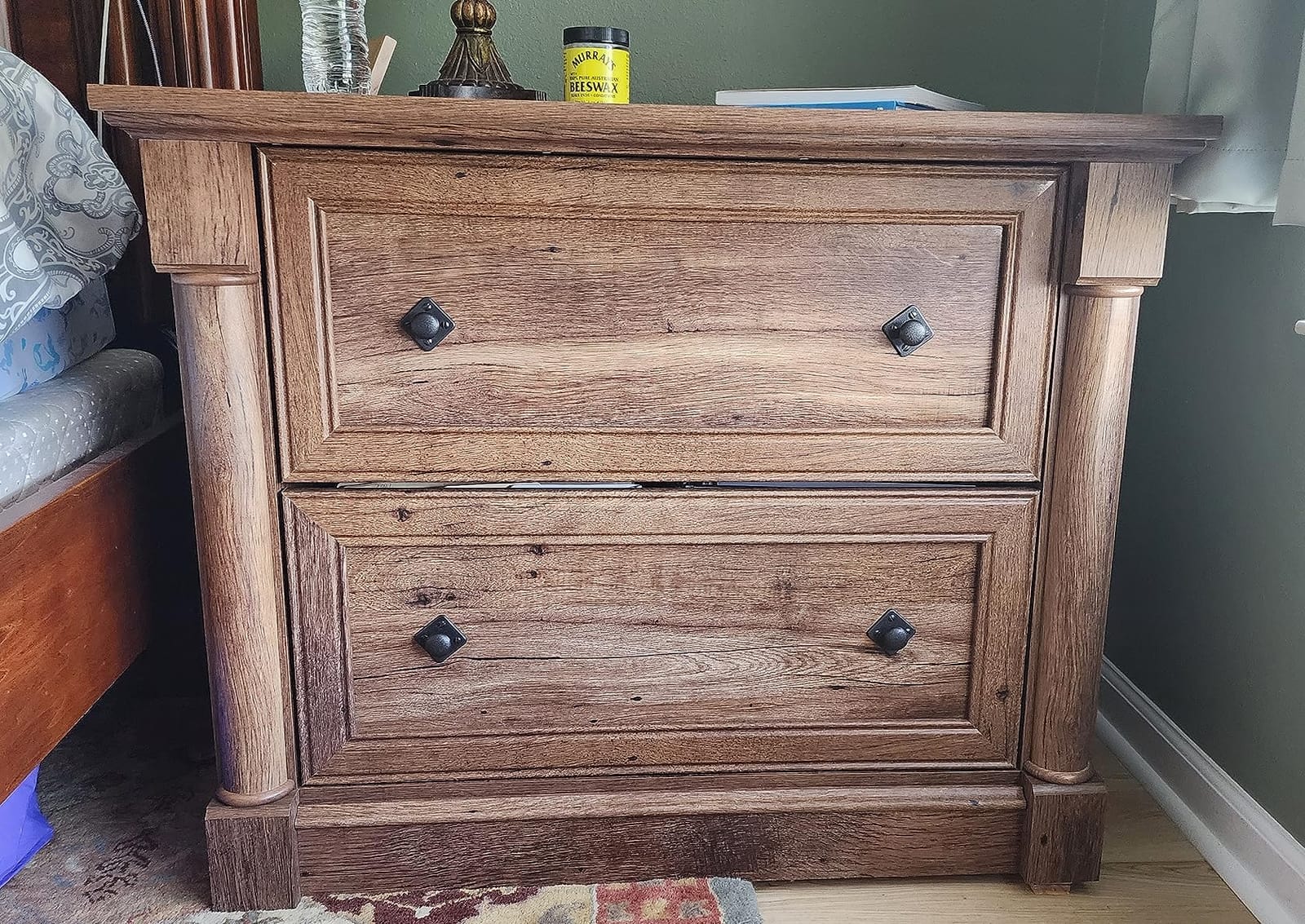
This is also the best warranty in the roundup: 5 year parts, which is rare in residential filing furniture and a strong signal about panel quality. Reviewers specifically note thicker panels than cheaper Sauder models, and the traditional cherry finish suits an office that is not styled around exposed steel.
It has the largest review base of any cabinet here, so the feedback is well established rather than anecdotal. The praise clusters on styling, the safety interlock, the slides and the instructions. The complaints cluster on weight, the missing lock and the build time.
What the one-drawer interlock actually does on a wide cabinet
On a 36 inch wide lateral cabinet, the tipping force when a drawer is extended is much higher than on a 15 inch vertical. Two open drawers on this model is a genuinely unstable configuration, so the interlock is not a gimmick here the way it might be on a light mobile pedestal. It is doing structural work.
That constraint has a workflow cost: you cannot have one drawer open while you pull a folder from another. For a practice that compares files side by side, that is an adjustment period. For a practice where one person works at a time, it removes a real hazard with no practical downside.
Where it falls short for legal work
There is no lock. In a home office with a family member who might open the wrong drawer, that is a genuine gap when you are storing wills, deeds or trust documents, and it is the single most-cited drawback across its reviews.
At 108 pounds it is the heaviest item in this roundup, and reviewers warn the frame can shift when dragged on carpet. Assembly takes 2.5 to 4 hours for most buyers and effectively needs two people, and drawer fronts need careful alignment with the plastic supports retightened. This is a weekend build, not an evening one.
9. Guizeeopo 3 Drawer Mobile File Cabinet: Best for a Fingerprint-Resistant Finish
Guizeeopo Filing Cabinets for Home Office, Mobile File Cabinet with Lock, 3 Drawer Filing Cabinet for A4/Letter/Legal Size Folder, Fully Assembled Except Casters, Matte Black
Matte black powder-coated steel
Key lock and five wheels with an anti-tilt wheel
Legal letter and A4 file drawer
42 lb, assembled except casters
Pros
- Matte black finish resists fingerprints and scratches
- Anti-tilt wheel under the file drawer keeps it stable
- Four main casters plus two front braking wheels
- Bottom drawer fits A4 letter and legal folders
- Arrives fully assembled except the casters
- Lowest price among the metal locking cabinets here
Cons
- Steel described as thin and light-duty
- Not deep front to back so files must sit angled
- Some variants arrive flat-packed despite the listing
- Reports of missing instructions keys and scuffed parts
The reason this cabinet earns a place is the finish. A matte black powder coat hides fingerprints in a way that a glossy black steel cabinet never does, and in a client-facing office where a visible smear on a drawer front reads as careless, that is a real quality-of-life difference.
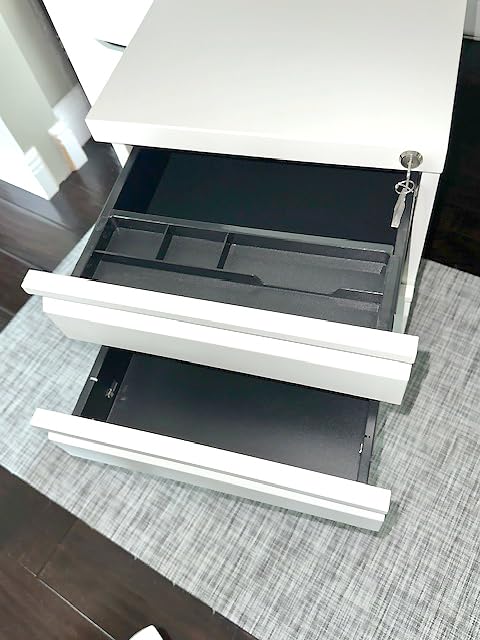
Mechanically it is a straightforward three-drawer mobile pedestal: a key lock, five wheels including an anti-tilt wheel under the large drawer and two front braking wheels, and a bottom file drawer sized for A4, letter and legal documents. Dimensions are 17.32 inches deep by 14.57 inches wide by 23.62 inches high, so it fits under a desk and rolls easily.
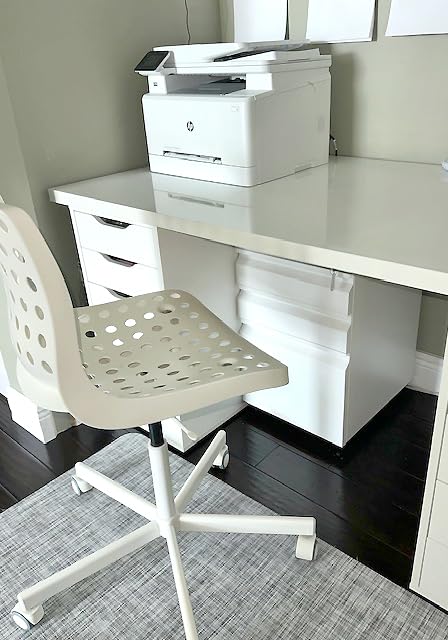
It is also the least expensive metal locking cabinet in this group, which makes it a reasonable choice for a student practice, a volunteer office or a second storage point where full steel gauge is not the priority. Steel construction is listed at 120 pounds, and the room types given include bedroom, utility room and living room.
The listing includes the caster set, the cabinet and a key box. Fully assembled except the casters, per the specification, so setup is short. Reviewers regularly praise the anti-tilt wheel under the drawer, which is not a feature you find on cabinets at this price very often.
When shallow depth is a real limitation
This cabinet is 14.57 inches wide and 17.32 inches deep, and reviewers specifically note that it is not deep front to back, so files must sit angled to reach the back of the drawer. For letter folders that is fine. For legal folders with tabbed dividers and thick case binders, an angled file is a file that eventually falls out.
If your documents are mostly deeds, contracts and single matters rather than thick case binders, this is a workable compromise. If you are archiving full case files, compare the 16.3 inch and 17.7 inch drawer cabinets instead and pay for the depth.
Where it falls short for legal work
Several reviewers describe the metal as thin and light-duty, which is the expected trade for the price point. It is fine for a home office with moderate volume and not fine for a records room taking daily abuse from a paralegal team.
There is also a listing inconsistency worth flagging: some variants arrive flat-packed despite the fully assembled specification. A smaller number of owners report missing instructions, missing keys and scuffed or bent parts on arrival. Open the box and confirm the keys are inside before you plan an afternoon of assembly.
10. Scranton and Co 4 Drawer Metal Vertical File Cabinet: Premium Pick for Deep Case Storage
Scranton & Co 4-Drawer Metal Vertical Filing Cabinet, 22 in Depth, Black Finish, Letter Width, Durable Steel Construction, Locking Mechanism, Compact Design for Office or Home Workspace Storage
22 inch deep steel vertical cabinet
Built-in lock and ball-bearing suspension
4 drawers, no assembly required
64 lb, 52 inch tall
Pros
- 22 inch depth suits legal case folders and binders
- Commercial-grade steel ball-bearing suspension
- Built-in lock for confidential documents
- Sturdy steel body with aluminum handles
- 15 inch width fits narrow spaces and cubicles
- No assembly required
Cons
- Highest price point in the roundup
- Open drawer extends to about 39 inches needing clearance
- Lock quality is inconsistent on some cabinets
- Shipping damage reported requiring careful unboxing
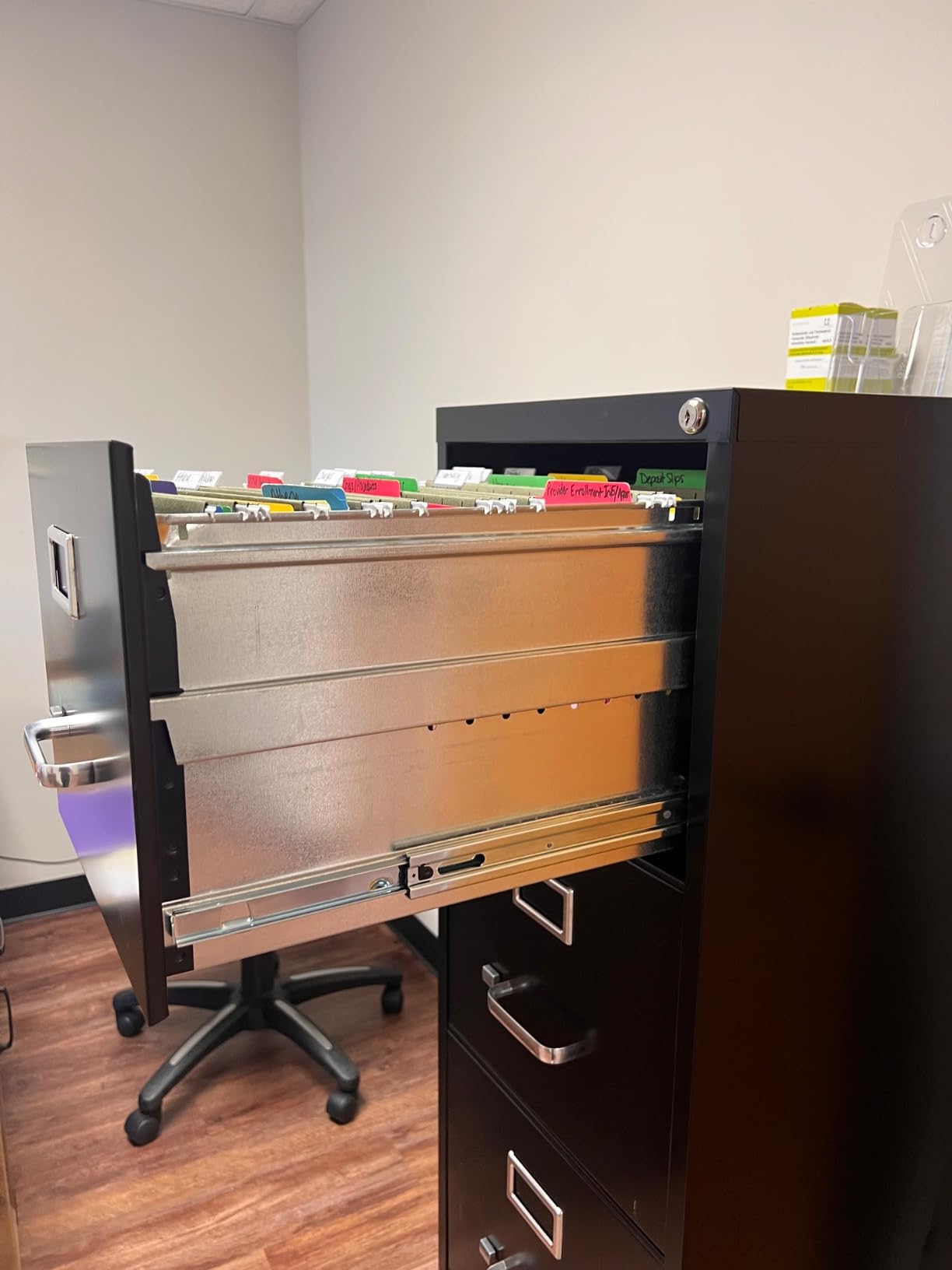
This is the deepest vertical cabinet here at 22 inches, and that depth is the entire argument for it. Legal case folders and binders need front-to-back room, and a 22 inch body means you can file a full case binder without canting it against the drawer front. At 15 inches wide and 52 inches tall it stays narrow enough for a cubicle or a tight records room corner.
The drawer suspension is the other differentiator. It uses commercial-grade steel ball-bearing suspension rather than a basic roller glide, and reviewers describe it as smooth and quiet even when fully loaded, which is what you want from a cabinet opened fifty times a day.
A built-in locking mechanism secures sensitive and confidential documents, which matters more for a practice than for a home office. The body is steel with aluminum handles and a black finish that reviewers report showing little wear after years of basement or office use. No assembly is required, so it arrives ready to load.
One practical point before you buy: a fully opened drawer extends the cabinet to about 39 inches of depth. Measure the clearance in front of wherever the cabinet will live, not just the footprint. That clearance requirement is the main reason this cabinet does not fit every office.
Where the deeper body changes the storage math
Depth changes how many files a drawer holds, and how many drawers you need. A 22 inch cabinet lets you run legal folders front to back, or side by side across a wider measure, which is how a single drawer can hold an entire closed matter rather than half of one. Fewer drawers needed means a narrower footprint in a records room with limited wall length.
It also changes the wear profile. Ball-bearing suspension under a deep, heavily loaded drawer is doing more work than the same slide in a shallow pedestal. If you are filing closed case archives rather than active matters, this is the construction that will still glide smoothly in year five.
Where it falls short for legal work
It is the most expensive cabinet in this roundup, and the price gap over the four-drawer metal units is real. If your practice only needs to store current matters, one of the four-drawer steel cabinets gives you more drawers for less money.
Lock quality is inconsistent, with some owners reporting cabinets that arrived unable to lock, and there are reports of shipping damage that buyers say the seller handles poorly. Inspect the lock and the corners at arrival, and keep the packaging until you have confirmed both work.
How to Choose a Filing Cabinet for Legal Documents in 2026
Start with the measurement that actually decides fit, then work through the build, security and workflow questions. These six checks are the ones we applied to every cabinet above.
1. Internal drawer width, not cabinet width
A legal hanging folder needs an internal drawer width of at least 15.25 inches and rail spacing of about 14.25 inches. A letter cabinet gives you roughly 12 inches of rail spacing, so it physically cannot accept a legal folder no matter what the listing says. This is the single most misunderstood spec in the category.
Check whether the listing states the internal width rather than the external width. External dimensions tell you the footprint; internal width tells you whether your files hang. Look for adjustable hanging bars as a secondary confirmation, since a bar that moves means the drawer was designed for more than one folder size.
2. Steel gauge and construction
Use 0.7 mm as the floor for a home office and 0.8 mm as the commercial minimum. Anything thinner starts to flex at the drawer rails under a full load of legal paper. Watch for cabinets described only as “metal” with no gauge, and treat metal-on-particleboard as a no for a practice with daily filing.
Steel gauge alone is not enough, which is why the weight rating matters too. Compare the two numbers side by side across cabinets in the same size class, as we did with the 120 pound and 330 pound ratings in the same footprint. Where they disagree, the lower number usually reflects the rail and slide assembly.
3. Slide extension and load rating
Full-extension slides let a drawer open far enough to reach the folders at the back. Partial-extension slides are cheaper and, in a deep drawer, hide the last row of files where they are easily forgotten. For daily legal file access, full extension is worth paying for.
Ball-bearing slides outperform plain roller slides under sustained load and stay quieter, which matters if anyone works late. Look for a stated cycle rating where the manufacturer offers one. On steel gauge, drawer depth and slide type together, that is most of what separates a three-year cabinet from a ten-year one.
4. Locking, key management and anti-tip
Rank the lock options like this: core-removable or rekeyable is best, then a single key that locks all drawers at once, then combination locks, then a single-drawer lock. Core removal matters in a practice with staff turnover, because a departing employee should not hold the only key to every client file.
Always confirm two keys are included, and keep one in a secure place separate from the cabinet. A key-based lock is a privacy control, not theft resistance. Pair it with an anti-tip interlock that permits only one open drawer, and anchor any cabinet over 48 inches tall to the wall.
5. Vertical, lateral or mobile
Vertical cabinets are narrow, cheap in wall space, and best for separating matters by drawer. Lateral cabinets are wide, show you every folder in an open drawer at once, and suit high-volume practices and home offices with printer-stand needs. Mobile pedestals roll under a desk and suit solo practitioners working from a spare room.
Whichever you pick, plan a 30 inch clearance in front of a vertical cabinet and roughly the drawer width plus handle depth for a lateral one. Mobile pedestals need less clearance but need floor that rolls, and plastic casters mark hardwood unless you fit felt pads.
6. Fireproof, waterproof and the digital alternative
If a cabinet holds irreplaceable originals, a will, a deed, a trust document or the only signed copy of anything, standard steel is not enough. Fireproof and waterproof filing cabinets are built to a UL 72 fire-resistance standard and carry media and water protection as well, and they cost several times what a powder-coated steel cabinet does. That premium buys a specific protection, not better drawers.
Also consider whether you need paper at all. More practices now scan case files on a consistent naming convention and keep a hybrid cabinet for originals and a short-term working set. Document management systems with audit trails handle retrieval and access logs, secure off-site storage handles overflow, and digital lockers handle handover. Digitizing does not remove the duty to keep records retrievable, so back up and keep the paper until the retention schedule says otherwise.
Two things to keep in mind that no product page will tell you. First, records-retention schedules, not case volume alone, determine how many drawers you need, because closed matters usually have to stay retrievable long after active files are cleared. Second, physical files can sit under preservation obligations during a dispute, which changes how you organise and secure the cabinet. If your practice faces a live preservation duty, confirm your storage and access procedure with your own counsel rather than a product page.
Finally, if you are still outfitting a home office rather than a records room, our home office filing cabinet guide covers the general case, and our lateral cabinet roundup goes deeper on wide-drawer models. For physical security beyond a cabinet, see our picks for office safes for documents, and for producing copies from those files, our coil binding machine guide covers the hardware side.
Frequently Asked Questions
What is the best file cabinet for legal size files?
The DEVAISE 3 Drawer Mobile File Cabinet is our top pick, because one key secures all three drawers, three removable hanging bars fit letter, legal and A4 folders, and full-extension ball-bearing slides keep a loaded legal folder moving smoothly. The key spec is an internal drawer width of at least 15.25 inches with about 14.25 inches of rail spacing. For a tighter budget, the Letaya 3 Drawer cabinet states 0.8 mm steel and accepts legal folders side by side.
What is the difference between a letter filing cabinet and a legal filing cabinet?
Legal paper is 8.5 by 14 inches and letter paper is 8.5 by 11 inches, and the cabinets are built to different internal dimensions. A legal cabinet gives you at least 15.25 inches of internal drawer width and roughly 14.25 inches between hanging rails. A letter cabinet gives you about 12 inches of rail spacing. That gap is why a letter-size cabinet physically cannot hold a legal hanging folder, no matter what the label says.
Do legal size folders fit in a standard file cabinet?
Only if the standard cabinet is genuinely legal width. Check for an internal drawer width of at least 15.25 inches and rail spacing near 14.25 inches, or look for adjustable hanging bars listed for legal folders. A cabinet described only as letter or letter and A4 has about 12 inches of rail spacing and will not take a legal folder. Judge by internal drawer width, not by the cabinet’s external dimensions.
What is the best locking filing cabinet?
The best locking filing cabinets use a core-removable or rekeyable lock, then a single key that locks all drawers at once, then a combination lock. Among the cabinets reviewed here, the Dripex 3 Drawer cabinet ranks highest on mechanism quality because its key lock secures all three drawers and its anti-tilt interlock allows only one drawer open at a time. Always confirm two keys are included and keep the spare away from the cabinet.
Which brand is considered the best for filing cabinets?
For commercial durability, HON is the long-standing reference with a full lifetime warranty and replaceable lock cores, and FireKing covers the fireproof and media-protection end of the market with UL 72 rated units. Staples offers the best price-to-durability balance in commercial steel. On Amazon, Letaya, MIIIKO and PEUKC cover home and small office needs with locking steel cabinets. Trade-offs matter more than a single winner.
What do people use instead of filing cabinets?
Most practices that reduce paper use a hybrid approach rather than one replacement. Common options include cloud document management with access logs, scanning case files on a consistent naming convention, secure off-site storage for archived matters, and digital lockers for handover. The hybrid pattern keeps originals plus a short-term working set in a locking cabinet. Digitized records still have to stay retrievable and backed up.
Final Verdict: Which Filing Cabinet Wins for Legal Documents
The DEVAISE 3 Drawer Mobile File Cabinet wins this roundup. It is the only mobile cabinet in the set that combines a single key securing every drawer, three removable hanging bars specified for letter, legal and A4 folders, and full-extension ball-bearing slides, with the highest review count we saw at more than 3,000 ratings. It also arrives fully assembled apart from the casters, which removes the most common complaint in this category.
For a specific situation, the rest of the line-up is straightforward. A home practice working from a spare room should take the Letaya 3 Drawer cabinet, since it is the only one stating 0.8 mm steel and it needs no assembly beyond the wheels. A small firm that opens drawers all day should take the Dripex, because the anti-tilt interlock is the feature that stops the cabinet going out of square.
A practice with a real records room should look at the four-drawer cabinets: the MIIIKO for the wall anchors and per-drawer anti-tip, the Anxxsu for the 17.7 inch drawer depth, or the PEUKC if files arrive in F4 and A4 formats. If case binders need genuine depth, the Scranton and Co 22 inch cabinet is the one that handles them properly. And if irreplaceable originals like wills and deeds are involved, a UL 72 fireproof cabinet is a different category of purchase from anything on this list.
Whichever you choose, measure the internal drawer width and the rail spacing before you order, and test the lock on every drawer on arrival. Those two checks prevent almost every complaint we read across more than 10,000 reviews in this roundup.