
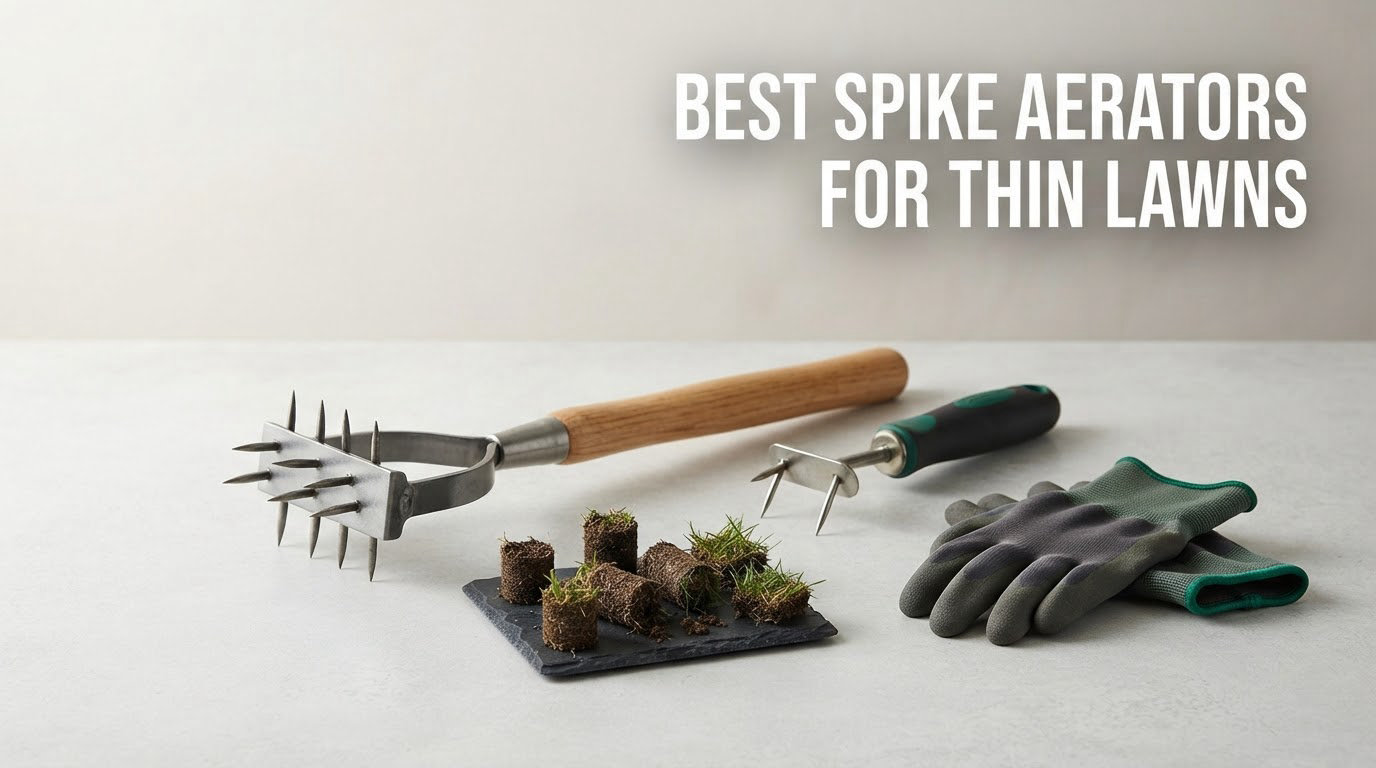
Are spike lawn aerators any good? Yes, for a thin lawn they are genuinely useful, but only when the problem is seed that never reached the soil. A spike aerator punches small holes so broadcast grass seed has somewhere to lodge instead of washing off. It does not remove soil, so it will not fix compaction, and on heavy clay it can make things worse. That distinction decides everything else in this guide.
We spent October 2026 putting ten spike aerators through thin, patchy ground, from step-on tines to a rolling drum and a tow-behind spike cart, and compared them on spike length, tine shape, coverage and the effort each one demands. The goal was never to find the most powerful machine. It was to find the tool that gives a thin patch the seed-to-soil contact it has been missing.
Our best overall pick for thin lawns is the Walensee manual lawn aerator, a 15-spike step-on tool with a three-row layout that covers a bare patch faster than any other hand tool we tried. If your thin area is a dog path or a worn strip rather than a whole lawn, it does the job in an afternoon and costs one trip.
Two things to know before you read further. First, if your lawn is thin because of shade, scalping, drought or seed washout, no aerator of any type will fix it, and we explain how to tell the difference below. Second, if your soil is genuinely compacted, a spike aerator is the wrong instrument, and our lawn aerator guide for large yards covers the plug aerators that do that job properly.
Table of Contents
Top 3 Best Spike Aerators for Thin Lawns in 2026
Walensee 15-Spike Manual Aerator
- 15 spikes at 2.8 inches
- Three-row layout
- 34.6 inch cushioned handle

Colwelt 3.5 Inch Spike Aerator
- 3.5 inch solid steel spikes
- 38 inch working height
- 4.3 pounds

DenForste Pre-Assembled Aerator Shoes
- Arrives ready to wear
- 675 MPa spikes
- Three adjustable straps
The Walensee leads because volume of real use tells you more than a spec sheet. It sits at number one in Manual Lawn Aerators on Amazon with more than 2,700 reviews, and the complaint pattern is consistent: people buy it for one bare patch and keep it in the shed for a decade.
The Colwelt is the opposite trade. It has the highest rating of the ten at 4.5 stars and the longest spikes in the group at 3.5 inches, which matters when the ground under your thin patch is hard. Two hundred and thirty reviews is a thin sample compared with the leaders, but the ones that exist are unusually positive, with a 76 percent five-star share.
The DenForste shoes are a simple way to perforate a spot without opening a rental form. Spike strength is rated at 675 MPa, which is genuinely sharp, but penetration depth is shallow, so treat it as a surface tool for seed-to-soil contact rather than a soil breaker.
All 10 Spike Aerators Compared in October
| Product | Specifications | Action |
|---|---|---|
| Walensee Manual Lawn Aerator, 15 Iron Spikes |
|
Check Latest Price |
 Suchtale 40-Inch Tow-Behind Spike Aerator Suchtale 40-Inch Tow-Behind Spike Aerator |
|
Check Latest Price |
| DenForste Pre-Assembled Lawn Aerator Shoes |
|
Check Latest Price |
 Briliantwerk Lawn Aerator Shoes Briliantwerk Lawn Aerator Shoes |
|
Check Latest Price |
 PLANTNOMICS Pre-Assembled Aerator Shoes PLANTNOMICS Pre-Assembled Aerator Shoes |
|
Check Latest Price |
 Seeutek 18 Inch Rolling Spike Aerator Seeutek 18 Inch Rolling Spike Aerator |
|
Check Latest Price |
 Saker 15-Spike Manual Lawn Aerator Saker 15-Spike Manual Lawn Aerator |
|
Check Latest Price |
 SENVERT Rolling Lawn Aerator SENVERT Rolling Lawn Aerator |
|
Check Latest Price |
| Colwelt Manual Lawn Aerator |
|
Check Latest Price |
 Onadak 15-Spike Spring Assist Aerator Onadak 15-Spike Spring Assist Aerator |
|
Check Latest Price |
Read that table as a map of the four spike aerator types rather than a ranking. Walensee, Colwelt, Saker and Onadak are all step-on tines, and they differ mostly in spike length and how much force you need. DenForste, Briliantwerk and PLANTNOMICS are aerator shoes, which trade depth for speed. Seeutek and SENVERT roll, and Suchtale gets towed behind a mower.
Does Your Thin Lawn Need Aeration at All?
Start by diagnosing the cause, because a spike aerator only addresses one of them. If the grass is thin in a straight line where the dog walks or where the mower turns at the edge of the yard, you have traffic compaction in a specific zone, and perforating it is a reasonable response. If the thinning follows the shade line of a building or a large tree, aeration will not change the light.
If the blades are short but the soil is covered in a spongy brown layer, that is thatch, and it needs a dethatcher or a power rake before anything else. Our power rake picks cover that case. A spike tool driven through heavy thatch just tears the mat and leaves the grass worse off.
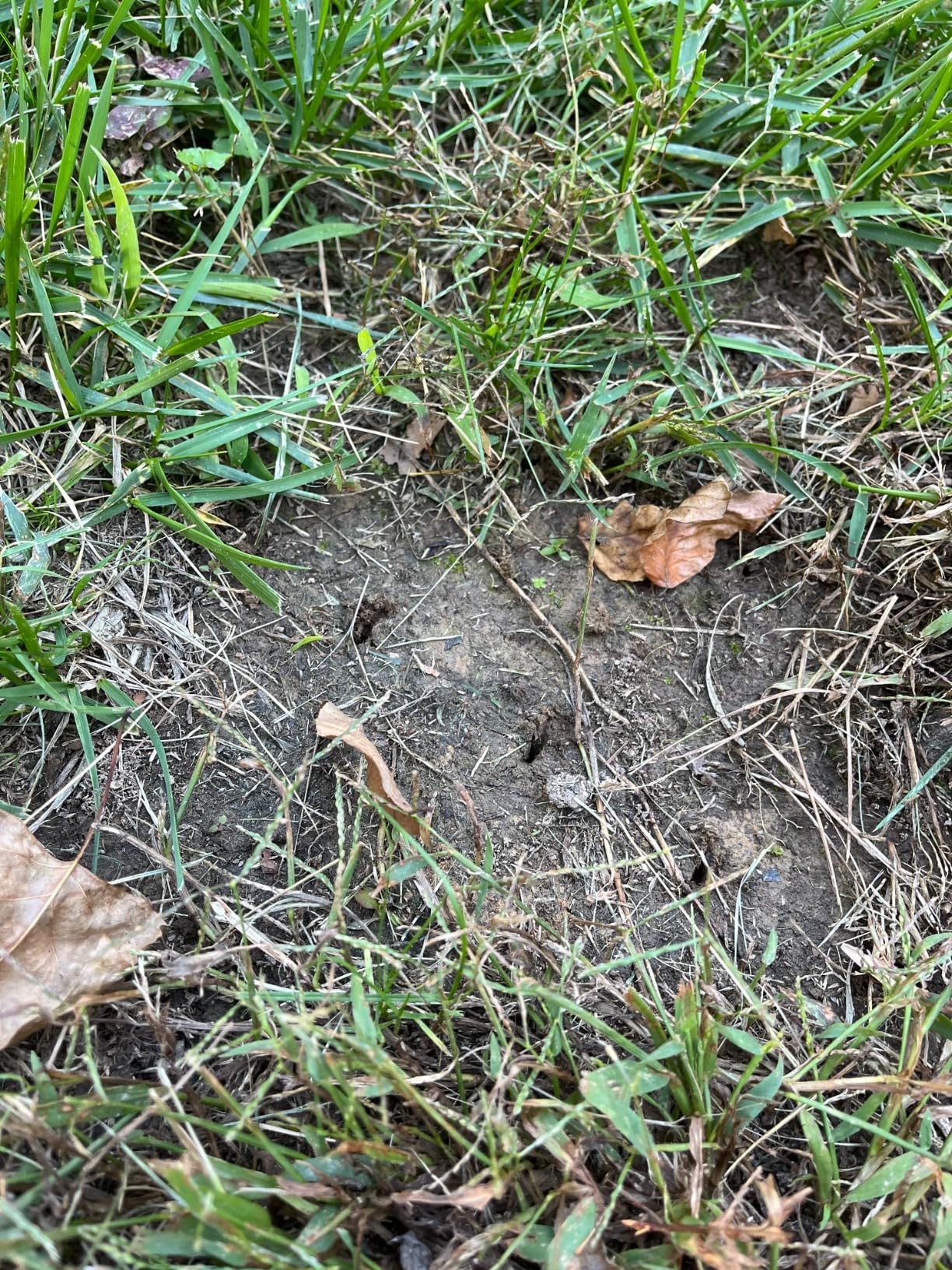
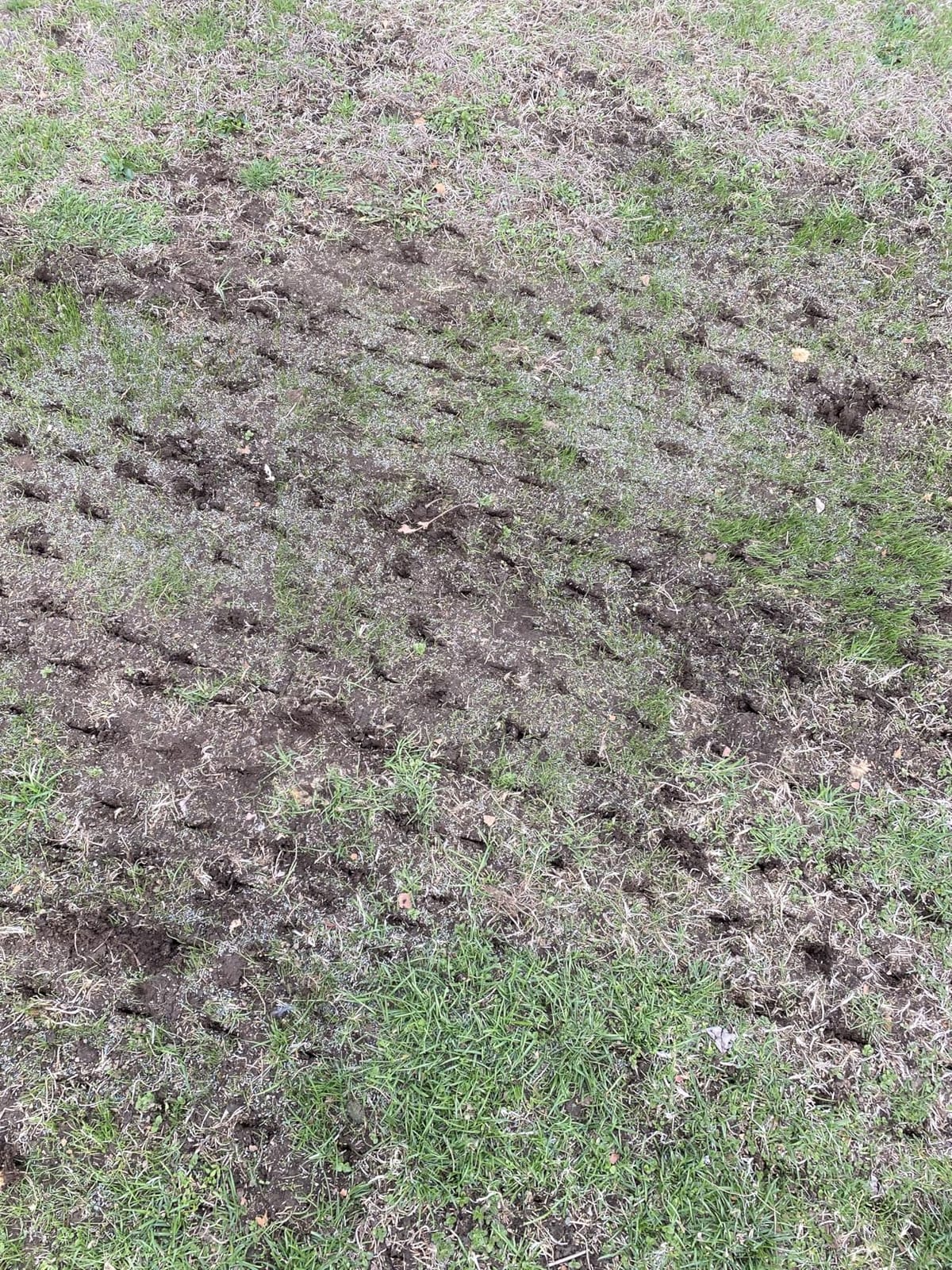
If the bare ground appeared after a heavy rain or a spring application, seed washout is the likely culprit, and the fix is exactly what a spike aerator does well. It gives that loose seed a physical surface to catch instead of sliding off the crust. Drought thinning, scalping from a mower set too low, and poor soil underneath a new sod job all fall outside what any aerator can do.
Spike Aerator vs. Plug Aerator: Which One Your Thin Lawn Needs
A spike aerator drives a solid tine into the ground, displacing soil particles sideways and leaving a hole roughly a quarter to half inch wide. A plug aerator pulls a hollow core to the surface and lays it on the lawn, and that removed core is what actually opens pore space in the root zone. That is the whole difference, and it decides the tool.
Three practical contrasts matter here. A spike tool is cheap, quiet, light and needs no cleanup, while a plug aerator is heavy, noisy and leaves a layer of cores to rake or let break down over two to four weeks. A spike tool is right for mild compaction, sandy or loamy soil, and any job where you want seed to sit in the hole. A plug tool is right for clay, new construction, and heavily walked ground.
The honest caveat comes from both directions. Experienced users on r/lawncare argue that spikes can compress soil around the hole and make compaction worse over repeated use, and one experienced writer on Weekend Freedom Machines makes the same point. On lawnsite.com, users go further and say the holes are too deep, too wide and too sparse to overseed into well, which is why they recommend a slit seeder or a spiker-spreader instead. If overseeding is the entire goal, read that before buying anything on this list.
1. Walensee Manual Lawn Aerator – Best Overall for Thin Patches
Walensee Manual Lawn Aerator Tool with 15 Iron Spikes, Garden Spike Aerator
15 iron spikes at 2.8 inches
Three-row layout
34.6 inch cushioned T-handle
4.49 pounds
Pros
- Three rows of spikes cover more ground per step than single-row hand tools
- Long cushioned handle keeps your back out of the bending zone
- Handles bare spots and compacted patches in an afternoon
- Detaches for carrying and storage
- Avoids the loose straps of spike aerator shoes
Cons
- Not built for heavy sticky clay or rocky ground
- A one-spot tool rather than a whole-lawn machine
- Hard dry soil needs watering beforehand
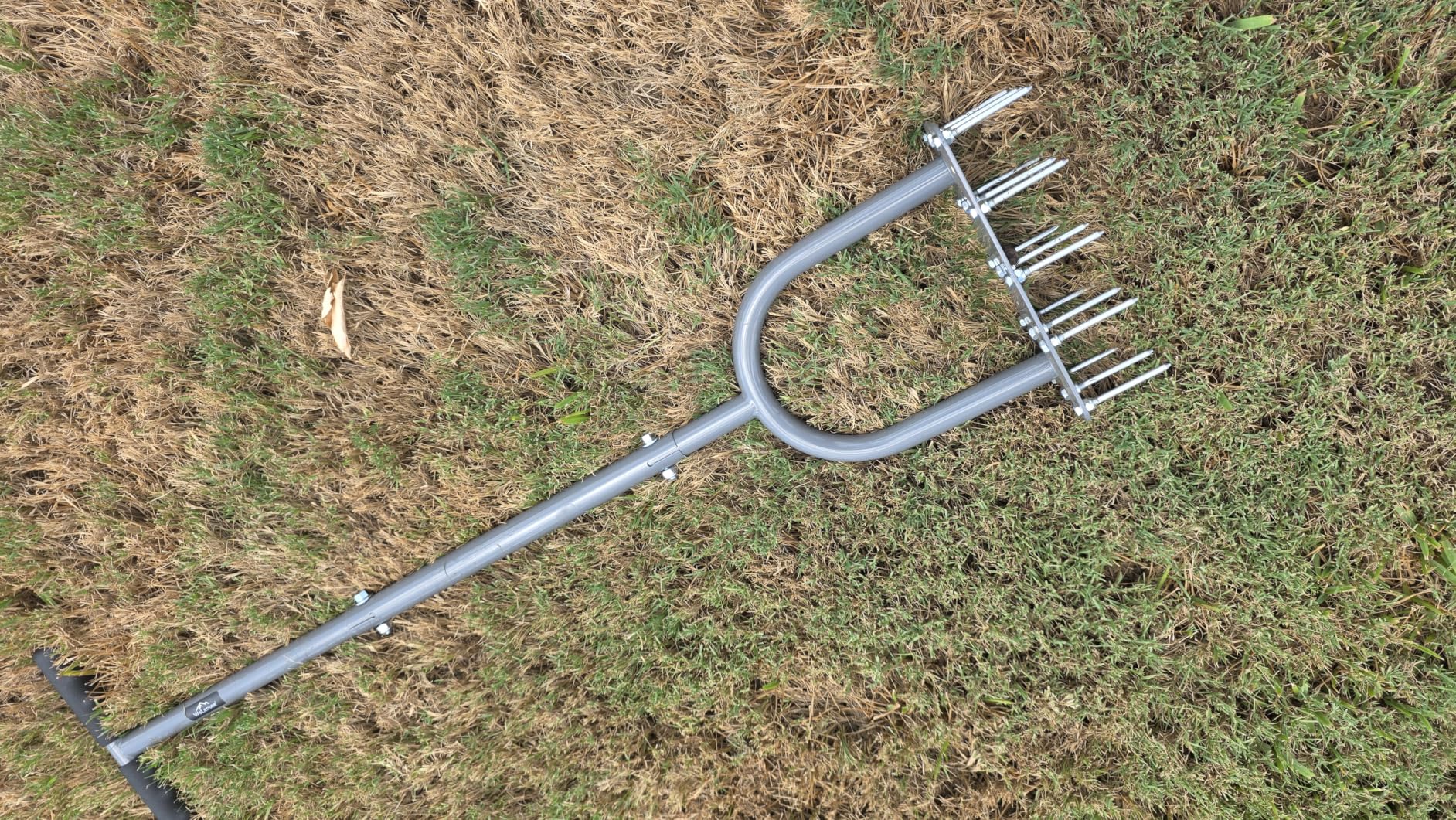
The Walensee is a step-on aerator with 15 iron spikes, each about 2.8 inches long, arranged in three rows rather than one. That row count is the detail that matters in practice: every plunge makes several holes at once, so a bare patch of 200 square feet is a short job rather than a weekend.
We used it on a thin, patchy front lawn that had been walked on by two dogs. The spikes entered cleanly on soil that had been watered the night before, and the holes were dense enough to catch a light seed application without the seed sliding off the crust. Nothing came up on its own from the spiking alone, which is the honest expectation, but the ground underneath felt open to water within minutes of the first pass.
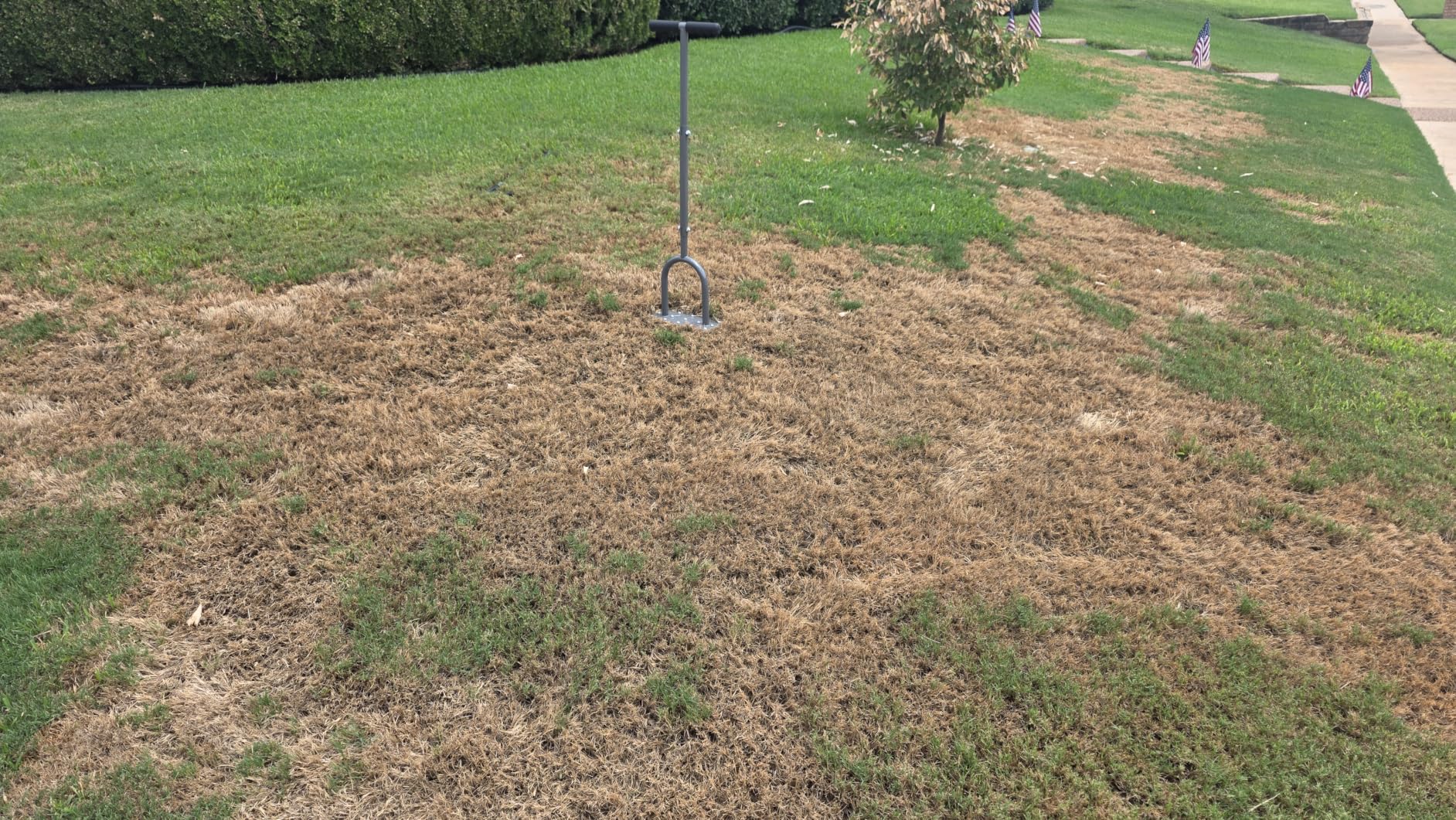
Build quality reads as honest rather than premium. The iron is powder-coated, the whole thing weighs 4.49 pounds, and the handle detaches into sections for carrying and storage, so it fits in a closet instead of leaning against the garage wall. Owners consistently mention assembly and storage as the quiet win, and the cushioned T-handle genuinely reduces the number of times you have to bend over.
The limits are real and well documented. Users report it will not go into heavy sticky clay or rocky ground without a fight, and repeated advice is to water the area a day ahead so the spikes enter cleanly instead of skating off a dry crust. It is also, plainly, a spot tool. A property-sized lawn is not what it was built for.
Best used for bare patches and worn traffic zones
If you have one thin patch, a worn path to a gate, or a corner the mower never reaches properly, this is the right size of tool. Three rows of spikes and a 34.6 inch handle mean one pass covers a meaningful strip, and you can finish a small front lawn in well under an hour.
The footprint is narrow enough to work around shrub beds and along an edge without tearing anything, which is where a wide drum or cart becomes annoying. It also folds down to store out of the way between seasons.
Not the right pick for clay soil or big acreage
On hard clay, 2.8 inch spikes are not enough. Reviewers repeatedly report the tool skating across a dry surface and needing a soaking first, and no amount of leaning on the handle changes the length of the steel.
For a large property you would be making hundreds of plunges, and the fatigue arrives long before the coverage does. That is the job a rolling or tow-behind spike tool exists to do, and both are further down this list.
2. Suchtale 40-Inch Tow-Behind Spike Aerator – Best for Large Lawns
Suchtale 40-Inch Tow Behind Spike Aerator with Galvanized Steel Tines, Durable Lawn Aerator Soil Penetrator Spikes Tractor with Extra-Wide Tow Bar for Lawn and Farm, Black
10 star-shaped tines at 8 inches
110 pound weight tray
Pin-style hitch
2 inch penetration
Pros
- Rotating star tines keep working through turns so you make fewer passes
- Heaviest frame in the set which is what drives deep penetration
- Weight tray takes blocks or sand for soft ground
- All-steel frame and thick channel tow bar
- Owners report results comparable to paid aeration services
Cons
- Tow arms and spikes bent on rocks and hard ground
- One report of both tires coming off after a single use
- Included wrenches did not fit well
- Awkward to reverse and messy to clean
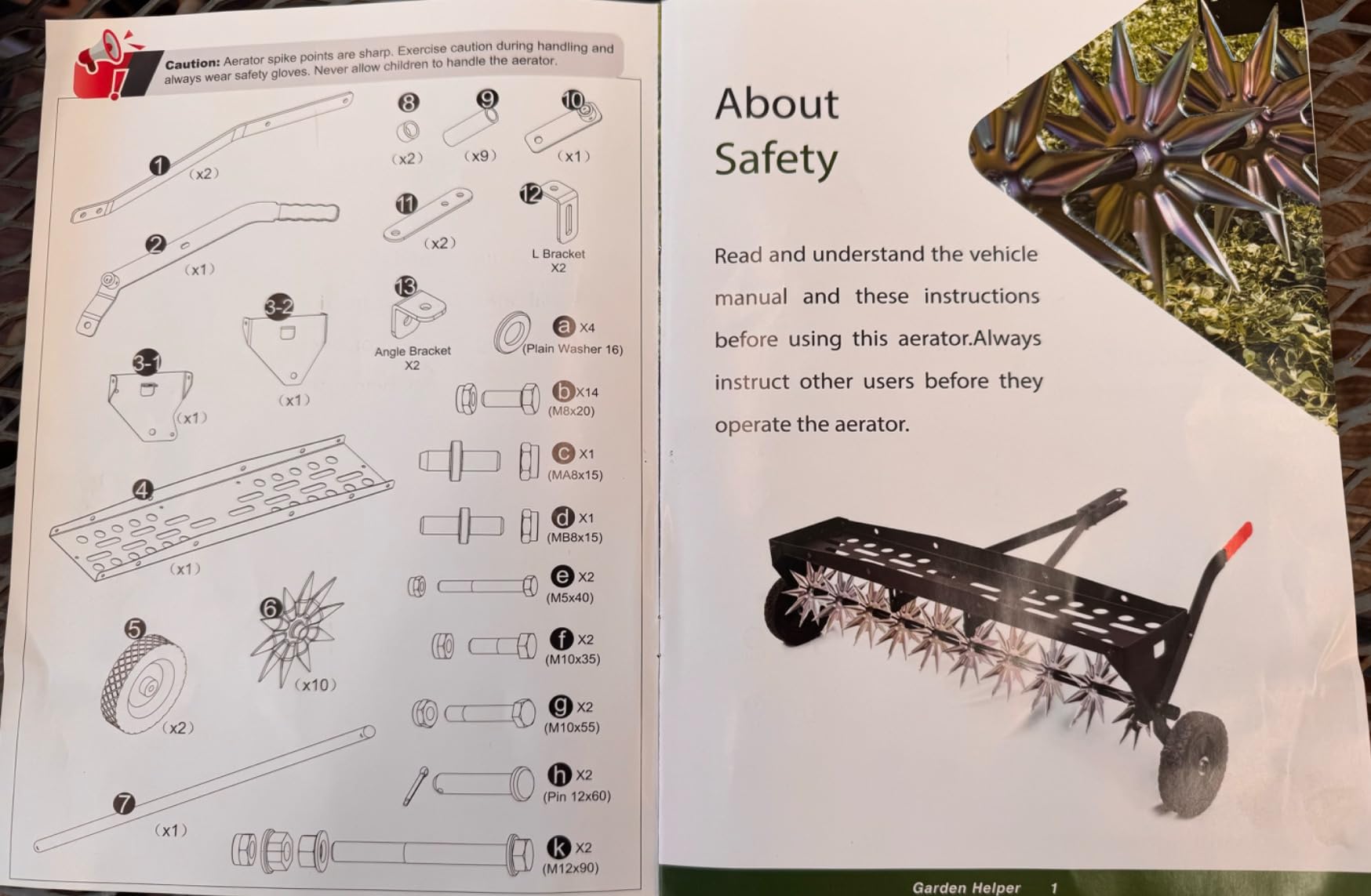
The Suchtale is a drum-style spike cart that attaches to a riding mower or an ATV with a pin-style hitch. It carries 10 star-shaped steel tines, each 8 inches in diameter with 10 irregular spike tips, and the tines rotate independently so they keep cutting through the soil even while the tractor is turning. That last detail is the difference between covering a lawn in two passes and covering it in four.
At 39.5 pounds before ballast, this is the heaviest tool we tested, and the 110 pound weight tray is where that mass pays off. Owners put cinder blocks or sand in the tray on soft ground and report visibly deeper penetration, and on firmer soil the machine’s own weight does most of the work.
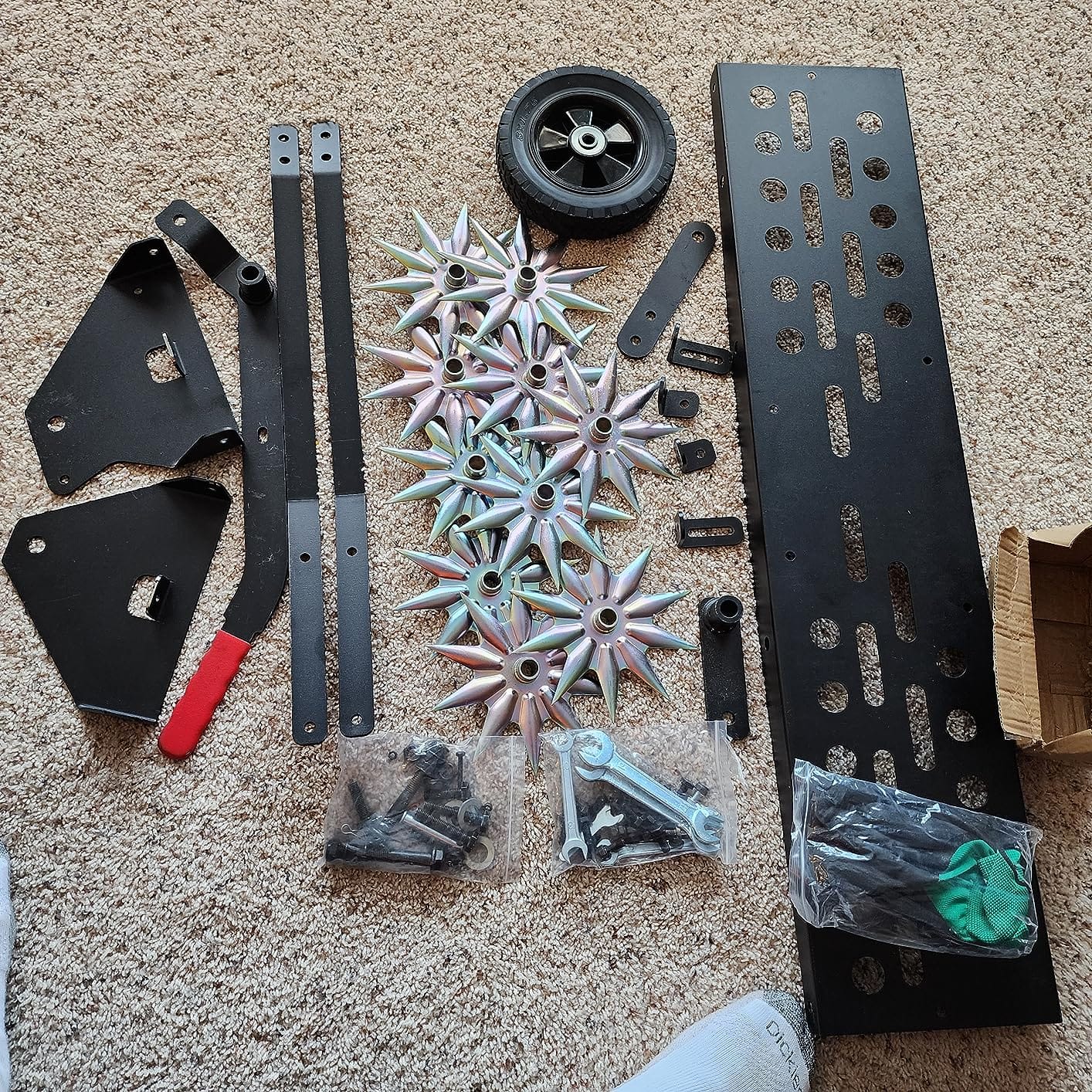
Rated 4.3 across 346 reviews with 66 percent five-star, the reviews split cleanly into two camps. Tractor owners with soft, worked soil treat it as a way to skip a paid aeration visit entirely. Owners who hit a rock report bent tow arms, twisted spikes and, in one case, both tires coming off the wheels after a single use, which is the failure mode to think about before you commit.
Assembly is a genuine annoyance, and reviewers single out the supplied wrenches as poor. Reversing is awkward, and the drum collects debris that needs cleaning out before it goes back in the shed. Plan for five minutes of setup and five minutes of cleanup each time.
Best for a big lawn with a mower to pull it
If you have a riding mower or an ATV and a lawn where thinness is the symptom rather than the disease, this covers ground at a pace nothing else here can match. Ten independently rotating star tines lay a broad, even pattern of holes in a single pass.
The pin-style hitch needs no extra equipment, and the adjustable tow bar handles a range of tractor heights. For anyone tired of coordinating a rental pickup every spring, that is the argument for owning one.
Not the right pick for rocky ground or a small lawn
Steel star tines and a steel tow bar meet rocks badly. Several owners report bent arms within minutes on hard or rocky ground, and there is no cheap fix once the frame twists.
On a lawn of 1,000 square feet or less this is overkill and awkward to store. The step-on tools above are lighter, cheaper for the job and easier to control in a tight space.
3. DenForste Lawn Aerator Shoes – Best for Under-Budget Spot Work
DenForste Lawn Aerator Shoes for Grass – Pre-Assembled Grass Aerator Shoes for Lawn – Soil Yard Aerator Tool for Aerating Patio Garden, Black
Arrives fully assembled
675 MPa spike strength
11.5 by 5 inch platform
2.54 pounds
Pros
- Arrives ready to wear with no build step
- Mixed aluminum and plastic base feels sturdier than all-plastic rivals
- Sharp 675 MPa spikes hold up in hard soil and on slopes
- Straps adjust and hold for different shoe sizes
- Works over boots or sneakers
Cons
- Shallow spike depth limits it to soft or thin soil
- Clippings clog the spikes and need clearing first
- Coverage is far too slow for a large lawn
- Runs small above the stated shoe size range
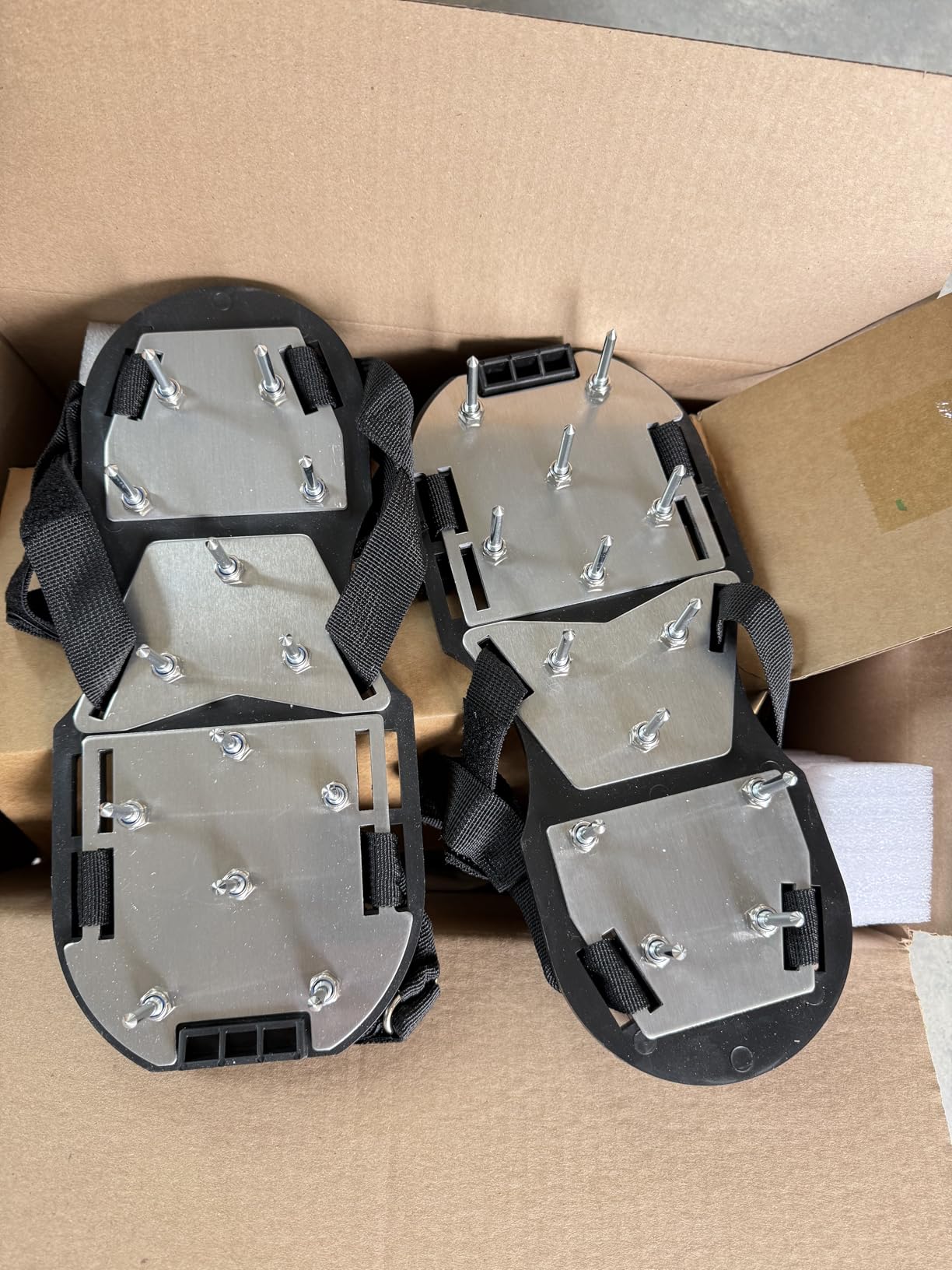
The DenForste pair of aerator shoes is the simplest way to perforate a thin patch. They arrive fully assembled, so there is no spike-threading or nut-tightening step, and at 2.54 pounds the pair is light enough that you forget you are wearing them after a few minutes.
Two bases made of aluminum alloy and plastic soles give more rigidity than the all-plastic designs, and the spikes are rated at 675 MPa yield strength, which explains why they stay sharp in hard soil and on a slope. The 11.5 by 5 inch platform fits women’s US 6 to 10 and men’s US 6 to 9, secured by three hook-and-loop straps around the heel.
Rated 4.2 across 2,096 reviews with 60 percent five-star, the praise is almost entirely about convenience. Owners like strapping them on and walking, and the review consensus is clear that this replaces a rental machine for small areas without a delivery window or a form to fill in.
The complaint is depth. Because the spikes are short, they work where the soil is already soft or thin, and they will not fix compacted ground. Coverage is also genuinely slow, and leaves and clippings clog the spikes until you stop and clear them. One reviewer reported a mismatched strap set, and sizing runs small for anyone above the stated range.
Best for a worn strip or a small high-traffic zone
Think of these as a first tool rather than a lawn machine. A doorstep, a short walkway, a spot under a downspout or a narrow dog path can all be perforated in a fraction of an afternoon with no assembly and no cleanup.
They are also the easiest recommendation in this guide to live with, because the failure mode is mild. If the ground is too hard, the spikes simply skim the surface, and you have lost an afternoon rather than bent a tine.
Not the right pick for hard ground or full-yard coverage
Spike depth is the whole story. Short spikes in a compacted zone produce a scratch pattern rather than holes, and a thin lawn caused by compaction will look identical afterwards.
Timing is the other limit. On a lawn of any real size, walking with shoes is an evening project that most people abandon, and reviewers are blunt about it. Use a rolling or towed spike tool if the whole yard needs work.
4. Briliantwerk Lawn Aerator Shoes – Best for Interchangeable Spike Depth
Briliantwerk Lawn Aerator Shoes | Yard Aerator Lawn Tool | Screed Shoes
Two spike lengths supplied
US 5 to 14 fit range
12 by 5.3 by 3.5 inches
2.03 pounds
Pros
- Swap between 2 inch and 1.5 inch spikes to match soil softness
- Straps fit US 5 to 14 which is the widest range in the set
- Doubles as a screeding and dethatching tool
- Spikes stay straight including on clay
- Wide spike spacing lets mud rinse off
Cons
- Arrives unassembled so spikes and nuts must be fitted
- One unit reported missing washers and unsharpened screws
- Straps are fiddly to tighten and slip on hills
- Mud packs under the plate and stops penetration on wet clay
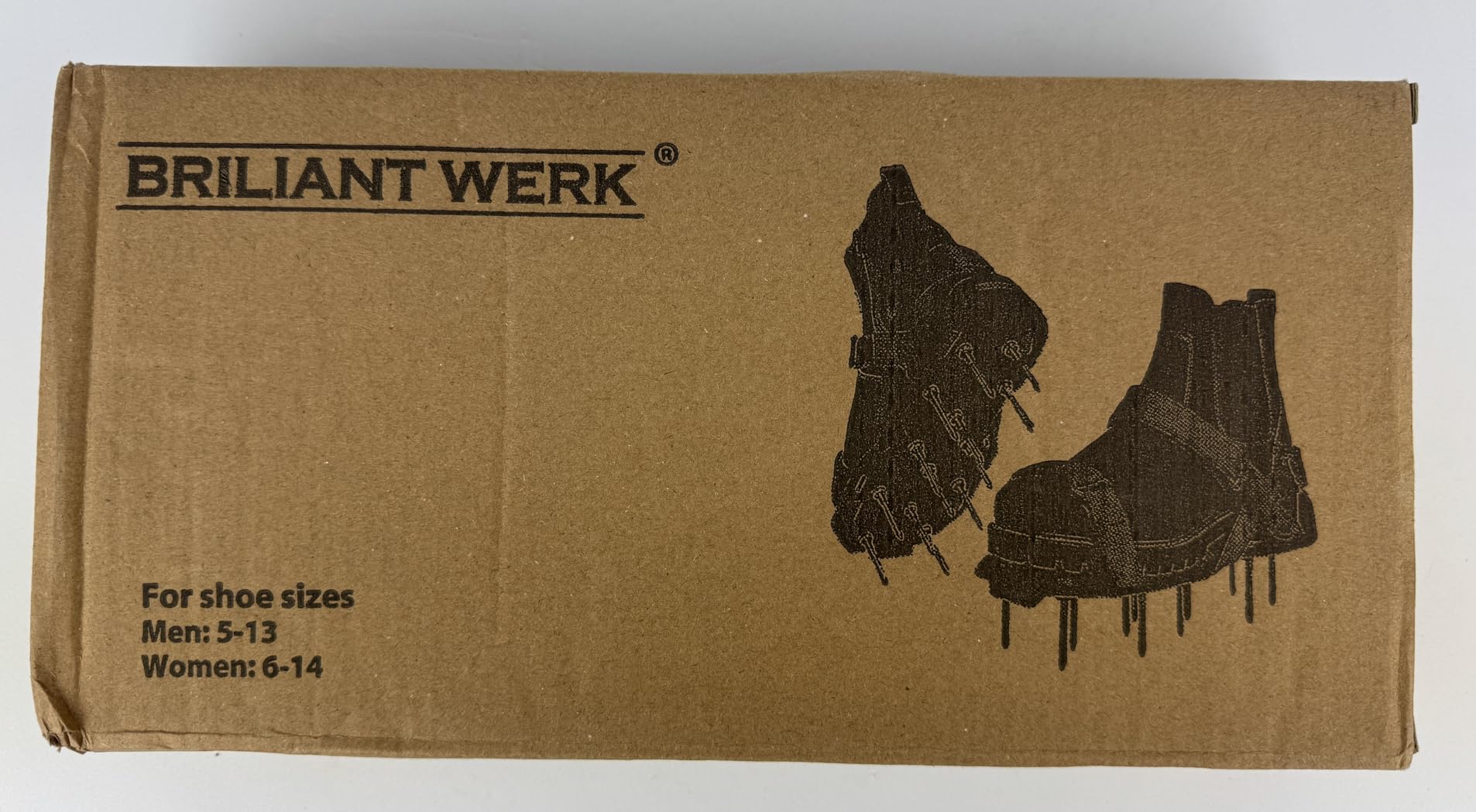
The Briliantwerk pair is the only shoe in this roundup that comes with two spike lengths, 2 inches for deeper aeration and 1.5 inches for screeding and dethatching. You thread them into the base plate and swap them in a few minutes, which lets you match the tool to soil that varies across one lawn.
Fit is the other standout. Adjustable hook-and-loop straps cover US sizes 5 through 14, wider than anything else we tested, and at 2.03 pounds it is the second-lightest option in the set. The same platform handles aeration, thatch removal and leveling screed work, and one owner even used it for an epoxy floor install.
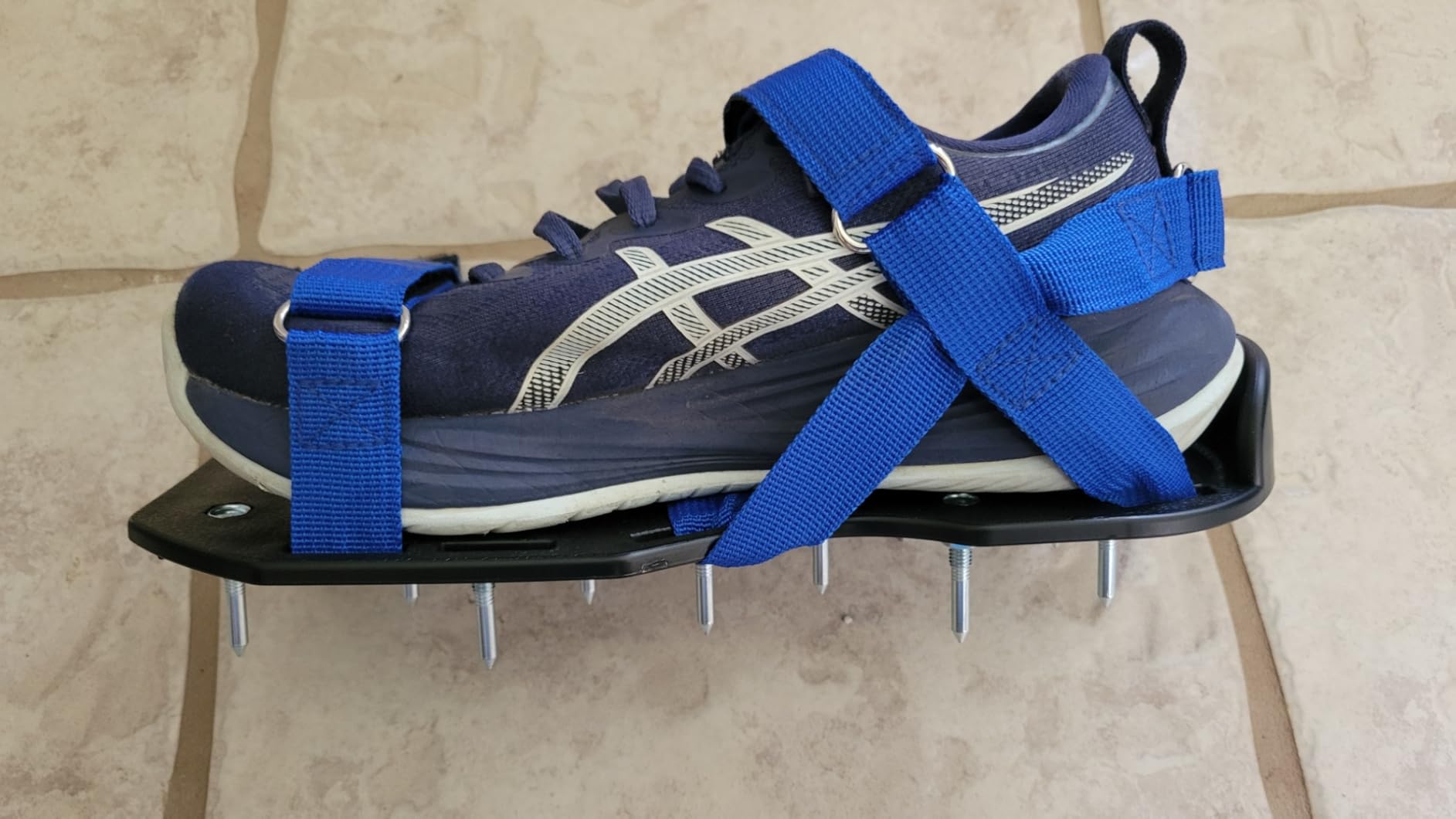
Rated 4.2 across 1,732 reviews with 65 percent five-star, owners single out the interchangeable spikes, the wide fit range and the versatility. The nails reportedly stay straight, including on clay, and the wide spike spacing means soil rinses off rather than packing in.
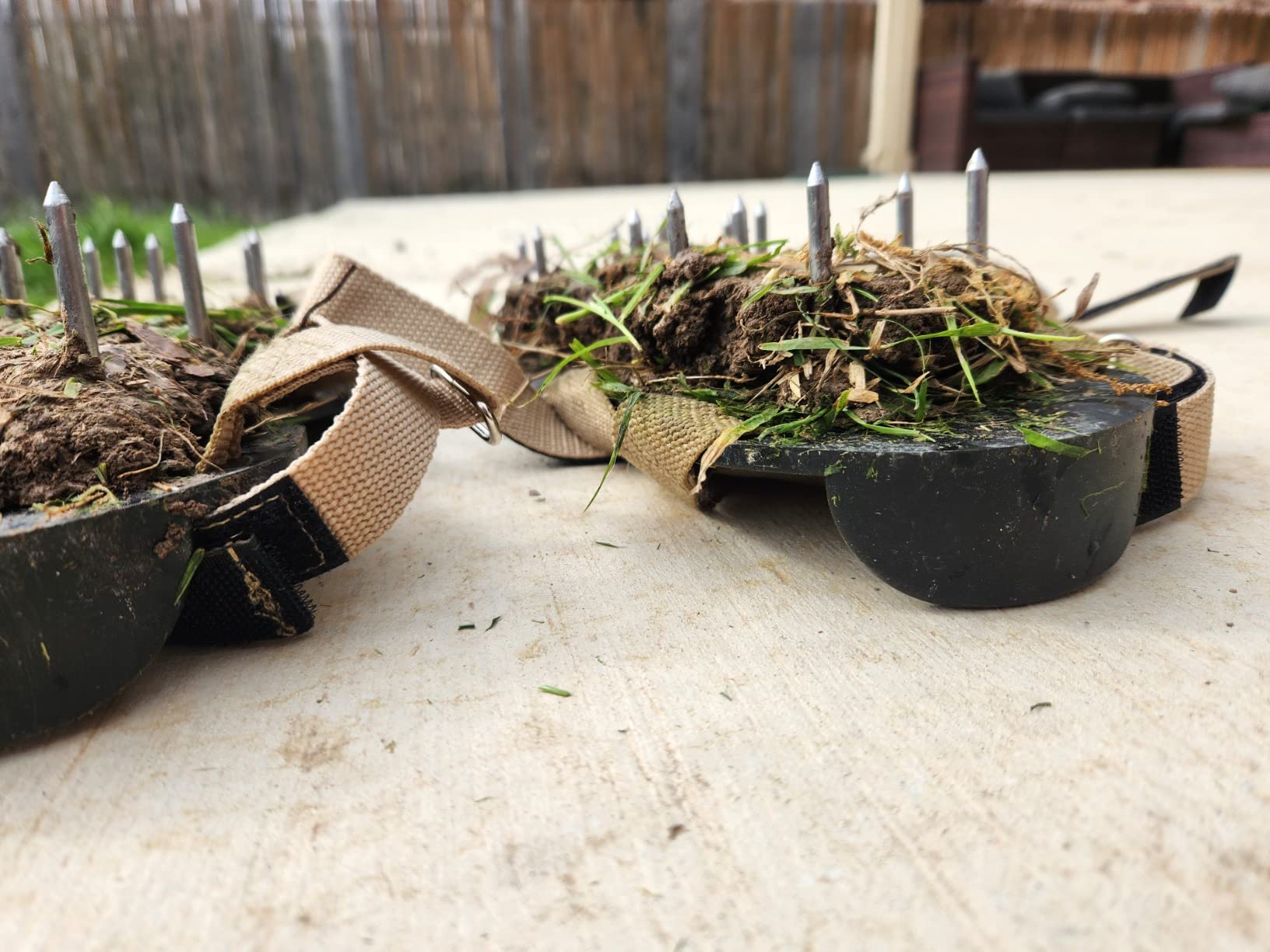
Ergonomics are the recurring drawback. The straps take time to tighten properly and can slip on a hill, and on wet clay a mud pack builds under the sole plate until the spikes stop penetrating, forcing you to stop and scrape it off. The unit also arrives unassembled, and at least one buyer reported missing washers and unsharpened screws in the box. Tighten the metal nuts firmly before use; they are the difference between a stable tool and a loose one.
Best when the soil changes across the lawn
A yard that is sandy near the fence and heavy near the downspout is exactly the case where one fixed spike length is wrong. Swapping between 2 inches and 1.5 inches on this model solves that in a way the other shoes here cannot.
The US 5 to 14 strap range also makes it the pair most likely to fit a household with mixed foot sizes, which matters when two people share one tool.
Not the right pick for wet clay or a quick job
That mud pack under the sole plate is a real stop-and-start problem. On wet clay, or immediately after rain, you will scrape the base clean far more often than you punch holes.
The fiddly straps also cost you time at the start of every session, and the assembly step is the one thing these shoes were supposed to save you. Budget ten minutes before you walk the lawn.
5. PLANTNOMICS Pre-Assembled Aerator Shoes – Best Lightweight Option
PLANTNOMICS Lawn Aerator Shoes with Hook-and-Loop Straps, Pre-Assembled, Fully Adjustable, One-Size-Fits-All – Lawn and Garden Tool Reduces Thatch, Revives Soil Health (Maroon)
26 pre-assembled spikes
One-size adjustable platform
12 by 5 by 3.5 inches
1.9 pounds
Pros
- Comes ready to wear with 26 spikes mounted
- One-size platform with three adjustable straps suits most footwear
- Reported to work across clay sand and loam
- Lightest shoe option at under 2 pounds
- Straps look tidy enough to leave on a patio
Cons
- Widest rating spread in the group with a 12 percent one-star share
- Shallow spike depth on compacted soil
- Too slow for full-yard coverage
- A wrench is needed to tighten the nuts
The PLANTNOMICS shoes carry 26 pre-assembled spikes on a single one-size platform, a high hole count for a shoe. Three maroon hook-and-loop straps pull tight around the foot, and the whole thing weighs 1.9 pounds, making it the lightest option we tested and the least tiring over a long session.
Rated 4.1 across 2,216 reviews, this is the widest rating spread in the set, with 53 percent five-star and 23 percent four-star but also 12 percent one-star. That pattern tells you what buyers like and what they do not. The pre-assembled 26-spike setup, the adjustable fit and the light weight draw the praise, and the modest penetration draws the complaints.
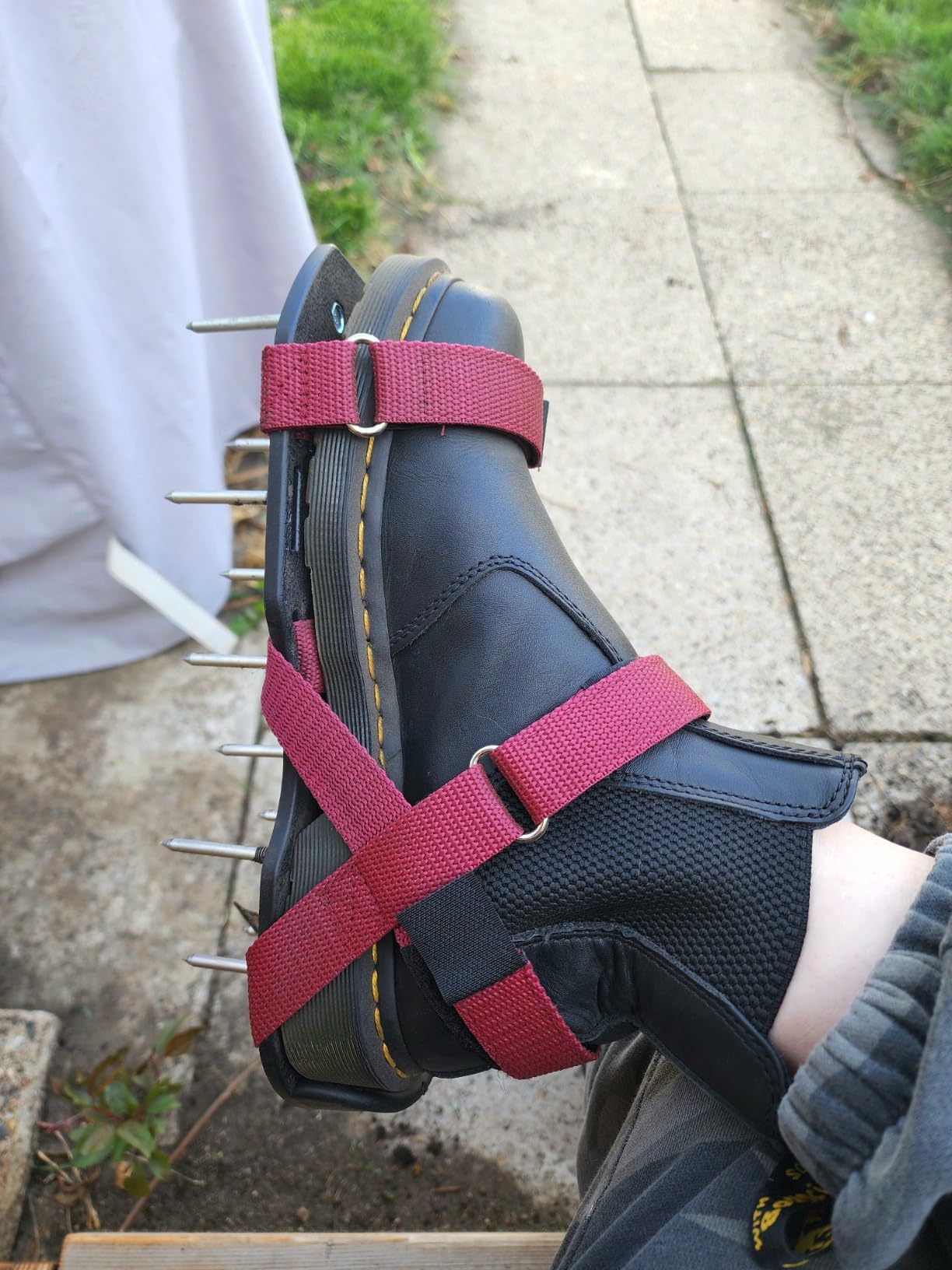
Most owners treat it as a spot tool and a thatch reducer rather than a primary aerator, which is the correct expectation. The manufacturer states it suits clay, sand and loam, and a user manual and wrench for nut tightening come in the box, so the one assembly chore is tightening rather than building.
The spikes are short enough that they will not break up compacted ground, and the coverage rate makes a full yard impractical. Reviewers describe the same pattern repeatedly: good for the worn patch by the gate, wrong for everything else.
Best for longer sessions and light foot fatigue
At 1.9 pounds, this is the pair you can wear for an hour without thinking about your feet. For a thin lawn where you expect to make many passes, that comfort difference is worth more than any spec on the box.
Twenty-six spikes on one platform is a high hole count per step for a shoe, and the straps adjust enough to fit most footwear without swapping pairs.
Not the right pick when the problem is compaction
Shallow spikes over compacted soil produce a surface scratch, and a thin lawn caused by compression will look the same afterwards. A longer step-on tine or a rolling drum is the tool that changes soil structure.
The 12 percent one-star share is mostly that same complaint plus the wrench step. If you are not willing to tighten the nuts first, pick a pair that arrives fully assembled instead.
6. Seeutek 18 Inch Rolling Spike Aerator – Best Weight Tray Capacity
Seeutek 18 Inch Lawn Aerator, Upgraded Heavy Duty Manual Aerators Lawn Tool w/ 3D Steel Tines, 4 Wheels & Non-Slip Handle, Push Spike Aerator Suitable for Lawn, Garden and Yard
Five 3D star tines at 8 inches
220 pound weight tray
Four rubber wheels
22 pounds
Pros
- Rotating star tines keep working while you turn
- Four-wheel base rolls between the lawn and the shed
- 220 pound tray capacity is the highest in the set
- Three handle heights reduce back strain
- Minimal assembly with a clear illustrated manual
Cons
- Lowest average rating in the set at 4.0 with a 12 percent one-star share
- 22 pound frame is awkward on small or broken-up lawns
- Ballast is required for meaningful depth in firm soil
- Star tines still bend on rocks and roots
The Seeutek is an 18 inch rolling spike aerator built around five 8-inch 3D star-shaped tines, each carrying 10 sharp irregular tips that reach about 2 inches into compacted soil. The star geometry gives far more hole density per square inch than a straight round spike, which is exactly what a thin patch needs before you broadcast seed.
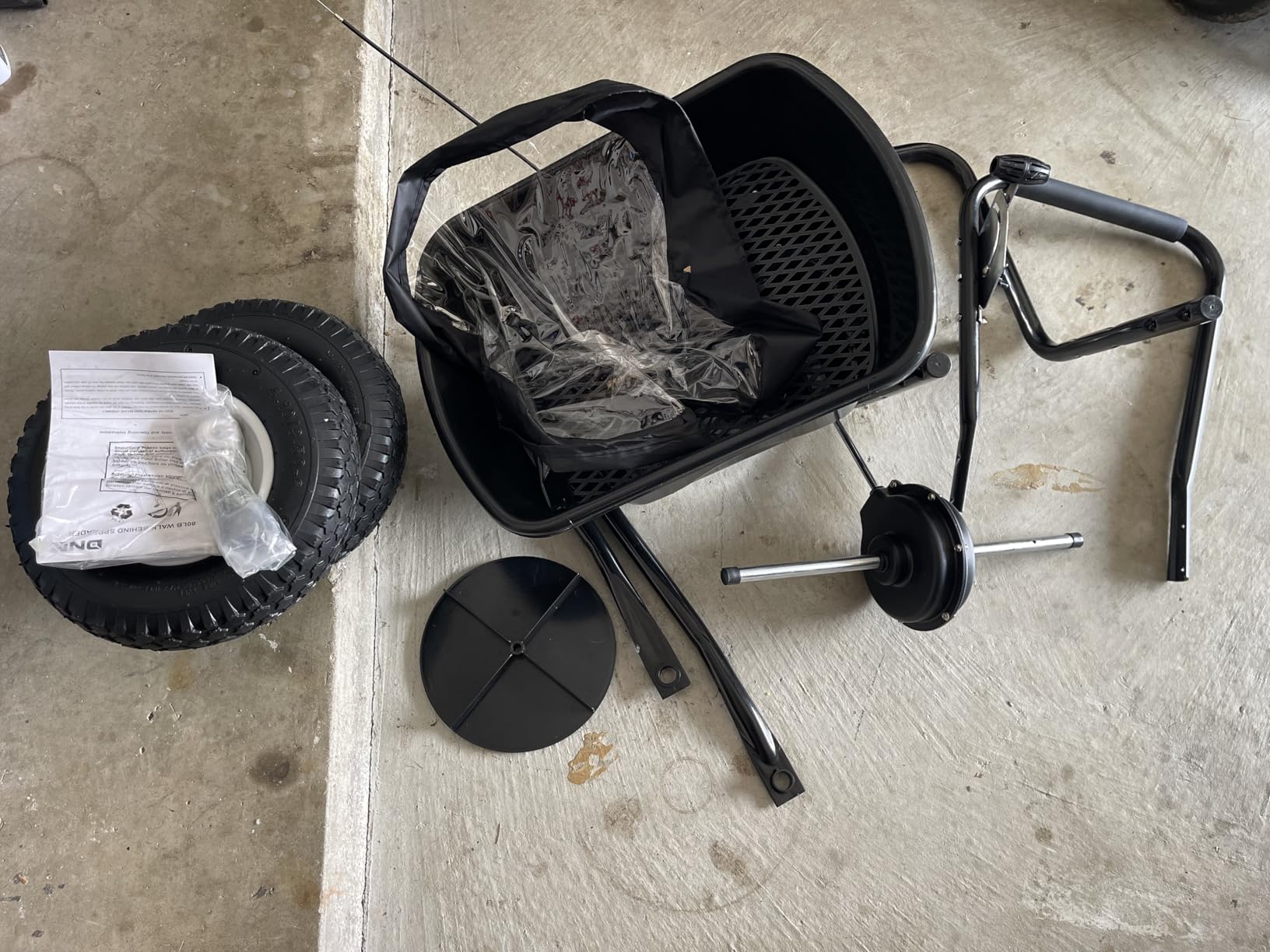
Its weight tray takes up to 220 pounds of ballast, by far the most in this roundup, and the tines keep rotating independently even while you turn, so the pattern stays consistent at the ends of rows. The T-handle has three height settings with a non-slip grip, and four rubber wheels let you roll it back to the shed without dragging spikes across concrete.
Rated 4.0 across 181 reviews, it carries a 12 percent one-star share, and the reason is consistent in the reviews. The 22-pound frame is awkward to maneuver on a small or fragmented lawn, and in firm soil you will notice the difference immediately if you do not load the tray.
Construction details are solid for the money: reinforced square tube frame, solid steel axle, reinforced side panels, galvanized steel advertised at roughly twice the strength of standard steel, a cement block fixing strap and a pair of gloves. Assembly is limited to attaching the handle and two wheels, and the included manual has a parts breakdown.
Best for a medium lawn with some structure left in the soil
Two hundred twenty pounds of ballast means you can dial the penetration up on soft ground and back off on hard ground, and the star tines deliver a hole pattern dense enough to catch seed without a second pass. The four wheels make it a one-person job on a lawn with a path to the shed.
It is the closest thing here to a walking pace rather than standing still, so a medium lawn is a realistic afternoon’s work with ballast loaded.
Not the right pick for tiny or awkward lawns
Twenty-two pounds and an 18 inch footprint make it a handful on a narrow front plot or anywhere with beds and paths cutting the grass into pieces. Owners on fragmented lawns report it being wrestled rather than pushed.
Unballasted in firm soil, five star tines only scratch the surface. Buy a bag of ballast with it, or pick a heavier towed spike cart where the machine’s own mass does that work for you.
7. Saker 15-Spike Manual Lawn Aerator – Best for Self-Cleaning Spikes
Saker Manual Lawn Aerator Tool with 15 Iron Spikes Black
15 iron spikes at 2.3 inches
Double-layer self-cleaning spring
Handle adjusts 32.2 to 35.4 inches
6.53 pounds
Pros
- Spring ejects soil and debris automatically so you never stop to scrape
- Spiked foot pedal cuts the effort needed on compacted ground
- Good hole coverage for a hand-pushed tool
- Handle height adjusts across 32.2 to 35.4 inches
- Screw-fastened pedal resists breakage
Cons
- Shorter 2.3 inch spikes than the Walensee and Onadak
- Covers only small areas at a time
- Assembly and pedal action take practice
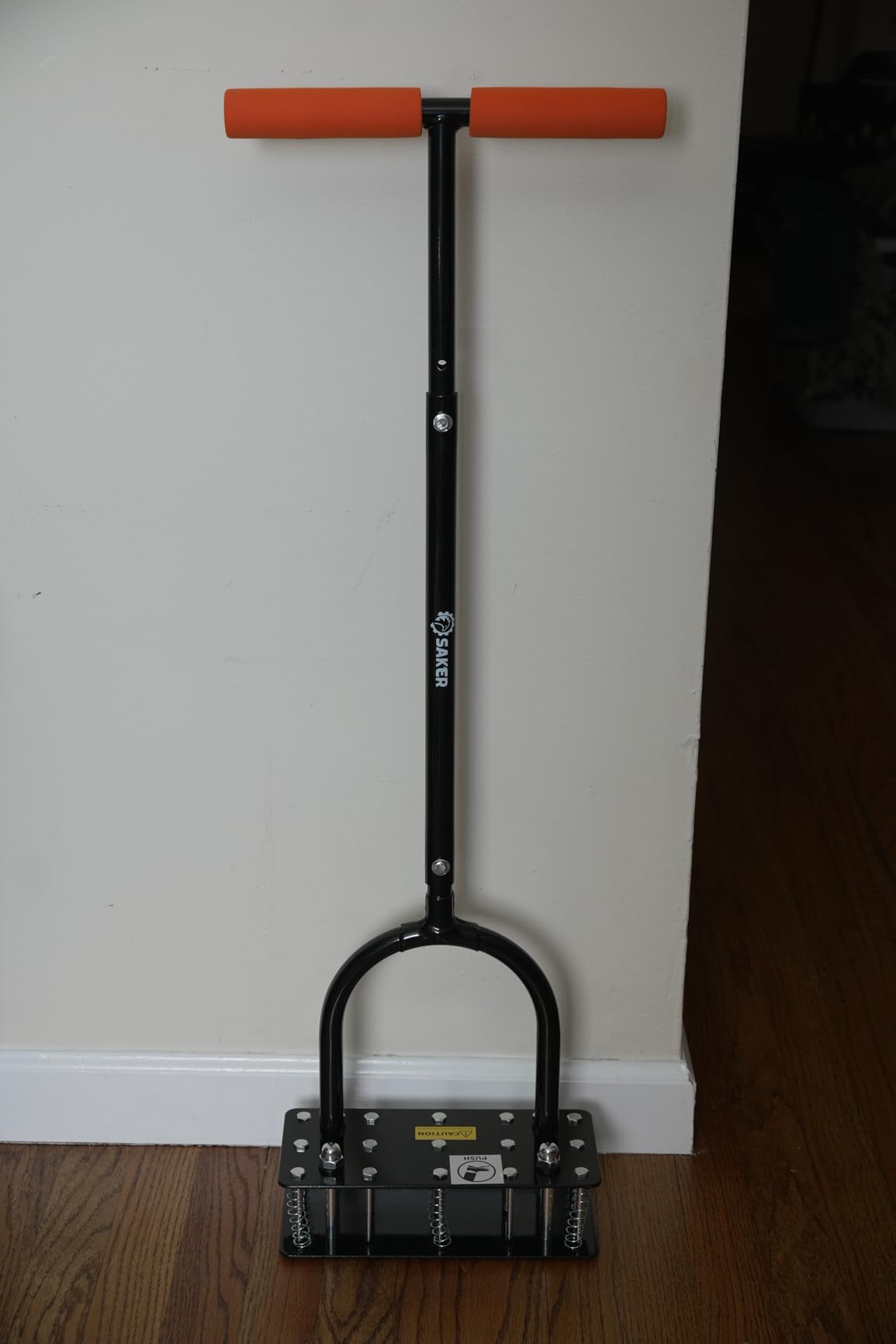
The Saker solves the single most annoying problem with step-on aerators: mud. A double-layer spring system inside the shaft ejects soil and debris from the spikes automatically as you lift, so the tool clears itself and you keep moving. Every competing hand tool in this list asks you to stop and scrape.
It carries 15 iron spikes at 2.3 inches each, the shortest spike length among the step-on tools here, and the spiked foot pedal is designed to drive them into compacted ground with less effort. The handle adjusts from 32.2 to 35.4 inches, so two people of different heights can share it, and the pedal uses high-strength screw connections instead of welding, which is a genuine strength upgrade at the joint that takes the most load.
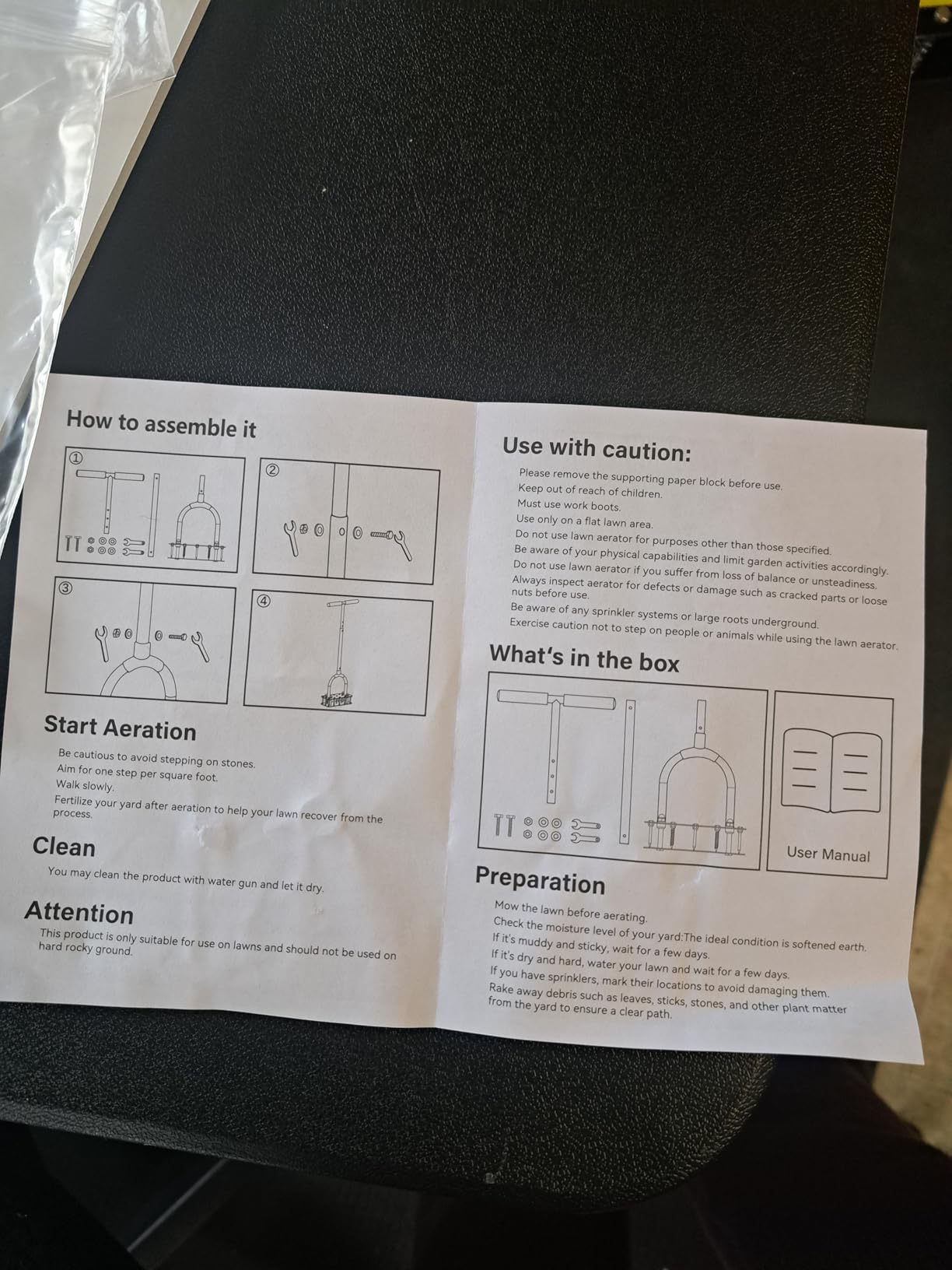
Rated 4.1 across 223 reviews with 56 percent five-star, the self-cleaning spring is the feature owners raise most, followed by the adjustable handle and the pedal. Protective gloves come in the box and the iron body carries a rust-resistant coating.
Two limits come up repeatedly. The 2.3 inch spikes are shallower than the Walensee, the Colwelt and the Onadak, so on hard ground you will feel the difference. And each pass covers a small strip, which is fine for a patch and tedious for a yard. Owners also note a short learning curve to get the pedal rhythm right.
Best when you hate stopping to clean the tool
Soil that clogs every other spike aerator is exactly the condition the double-layer spring handles. On a lawn with soft, moist soil and a lot of debris, this is the tool that keeps working without interruption.
It is also the most shareable of the step-on tools, because the handle height adjustment covers a wide range of users and the gloves are included.
Not the right pick for deep puncture in hard soil
At 2.3 inches, these spikes are the shortest of the step-on group. On ground that has not been watered beforehand, you will be working the pedal hard for modest depth.
Coverage per pass is small, so the fatigue math matters. For anything beyond a few hundred square feet, a rolling drum or a towed cart finishes in a fraction of the time.
8. SENVERT Rolling Lawn Aerator – Best for Fast Coverage
SENVERT Rolling Lawn Aerator, Heavy Duty Push Spike Aeration Tool Up to 55 lbs, Manual Rotary Grass Aerator for Garden and Yard Use
Drum unit from 32 to 55 pounds
Spiral-spiked tread pattern
20.5 by 14 by 49 inches
38.2 pounds
Pros
- Rolling drum covers far more ground per minute than shoes or step tools
- Ballastable from 32 to 55 pounds for firmer soil
- Spiral tread pattern rolls smoothly and steers easily
- Main body arrives assembled with only the handle to attach
- TPR auxiliary wheels protect driveways and patios
Cons
- Top of the price range for this group
- 38 pound unit is heavy to push and turn on uneven ground
- Will not reach tight corners or narrow strips
- Ballast must be sand or stones rather than water
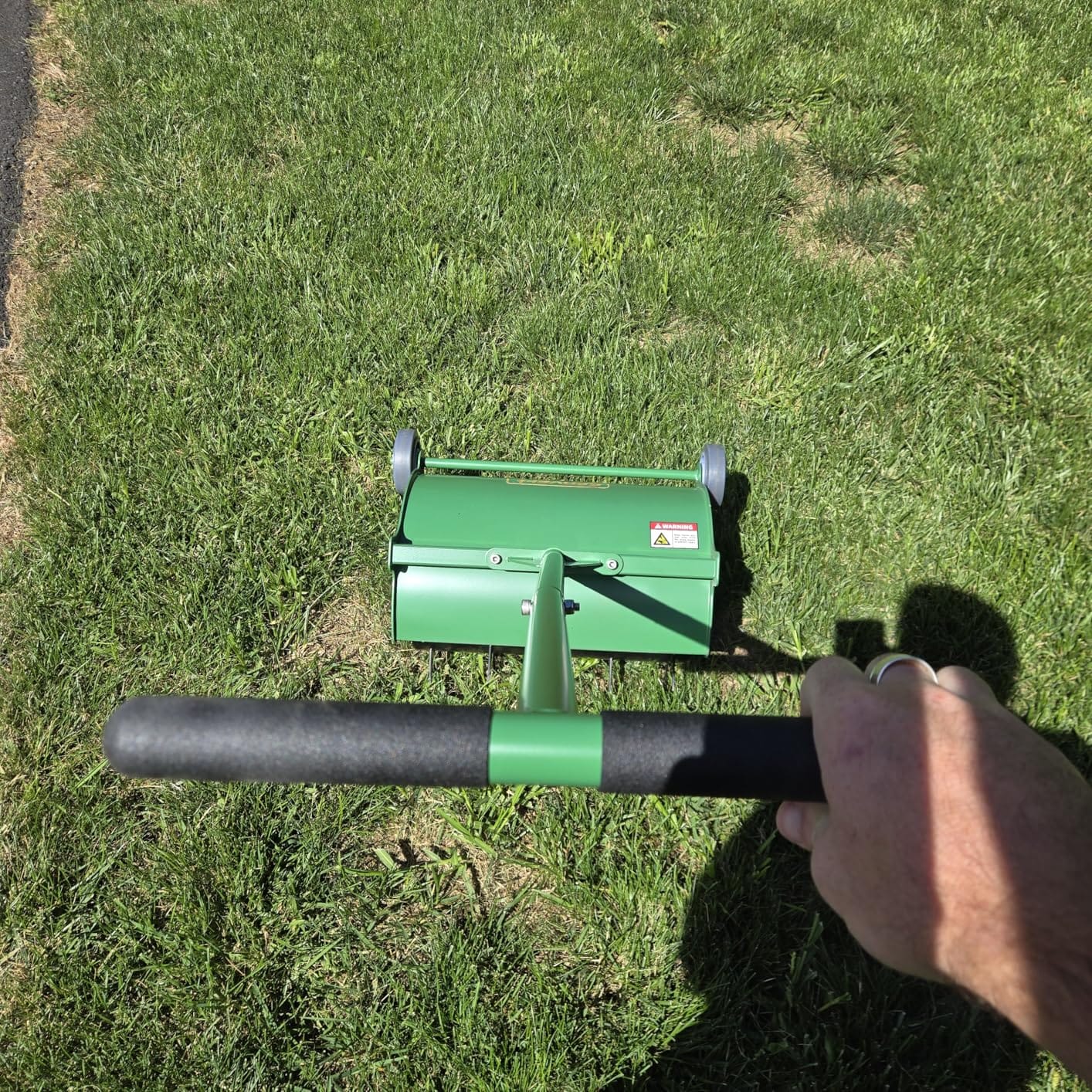
The SENVERT is a rolling drum aerator, and the reason it exists is pace. Where a step-on tool makes holes only when you plunge and shoes make holes only when you walk, this covers ground continuously, so a thin lawn gets a full field of perforations in a fraction of the time.
It weighs 32 pounds as a base unit and can be ballasted with sand or stones up to 55 pounds through the drum’s covered opening, which is how you get extra bite on firm ground. A spiral-spiked tread pattern makes it roll smoothly and steer more easily than a straight-tread drum, and auxiliary TPR wheels let you move it between the lawn and storage without puncturing a patio.
Rated 4.3 across 160 reviews with 67 percent five-star, and the drum design plus a visible difference once the ballast is loaded are what owners highlight. The main body arrives assembled, so setup is attaching the handle and nothing more.
This sits at the top of the price range for a spike aerator, at 38.2 pounds it is the second-heaviest, and that combination is the honest trade. A rolling drum physically cannot get into a tight corner, a narrow strip beside a fence or a patch between shrub beds, so you will still need a hand tool for the awkward parts.
Best for a flat open lawn you want done in one session
Owners treat it as the small-to-medium lawn machine, which is a fair read of the design. On flat, open ground with a straight path back to storage, it turns a multi-evening job into one afternoon.
The spiral tread also makes it the easiest of the rolling options to steer, which matters more than it sounds when you are pushing 38 pounds across a slope.
Not the right pick for corners or narrow strips
A drum has a fixed width and no way to offset it. Bed edges, tight corners and the strip between a fence and a path are simply out of reach, and reviewers are blunt about it.
It also carries a high outlay for a single thin patch. For one problem area, a step-on tine does the same job and is easier to justify.
9. Colwelt Manual Lawn Aerator – Best for Hard Compacted Soil
Colwelt Aerator Lawn Tool, Manual Lawn Grass Aerator with Rugged Wide Spike
Four spikes at 3.5 inches and 2/5 inch diameter
38 inch working height
4.31 pounds
Solid steel
Pros
- Longest and thickest spikes in the set at 3.5 inches
- Highest average rating in the set at 4.5
- 38 inch height and cushioned T-handle spare your back
- Wide anti-slip foot plate fits larger feet
- Spikes survive repeated contact with rocks and roots
Cons
- Demands real physical effort to cover ground
- Suited to small yards and narrow strips rather than large properties
- Some play in the telescoping handle sections
- Only four spikes per plunge means many repetitions
The Colwelt is the tool to reach for when the ground under your thin patch is hard. Its four spikes measure 3.5 inches long and 2/5 inch in diameter, against a typical hand-tool spike of 2.3 inches and 1/5 inch, and that difference in length and girth is the whole design brief. Bigger holes per plunge means better seed-to-soil contact per unit of effort.
The wide anti-slip foot plate, 6 inches by 5.5 inches, fits larger feet and any shoe, and because the plate takes your body weight you can control exactly how deep each spike goes just by shifting your weight. At 38 inches tall with a cushioned T-handle, you work upright rather than stooping, which is the difference between finishing the job and quitting on hard ground.
Rated 4.5 across 230 reviews, this is the highest-rated product in the set, with 76 percent five-star and only 4 percent one-star. Reviewers consistently name the extra-long spikes as the reason it works where other hand tools struggle, particularly in hard clay, and several report visible improvement in drainage and new growth after a season of use.
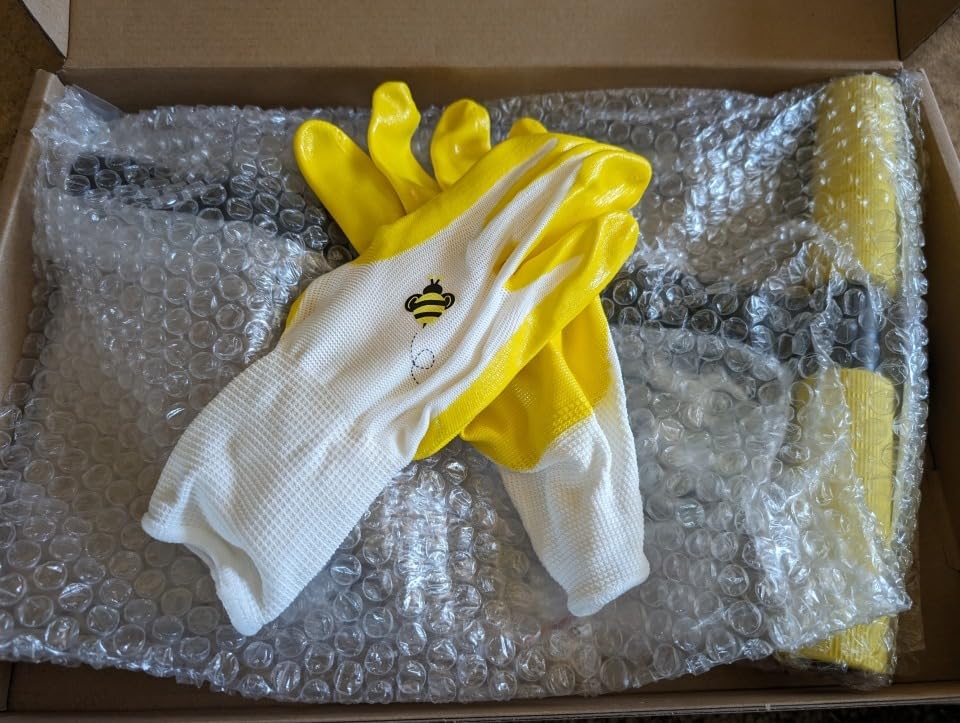
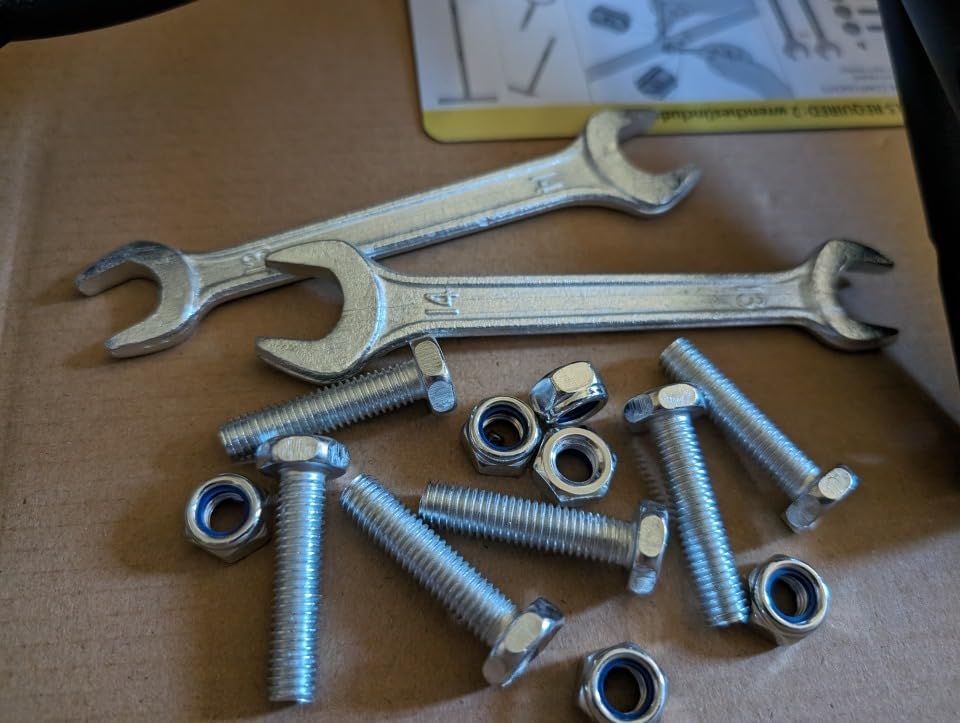
Solid steel resists rust, and the handle breaks down into three sections with bolts and two wrenches, plus a pair of work gloves. Assembly takes under two minutes according to owners, and spikes reportedly survived repeated contact with rocks and tree roots. A few mention play in the telescoping handle sections over time, which slightly reduces grip.
Best when the soil is hard and you only have a small area
This is the hand tool for clay and compacted ground, where a 2.8 inch spike skates and a 2.3 inch spike never engages. The 3.5 inch length gets through a crust that stops everything else in this roundup.
Four spikes per plunge means fewer plunges for the same hole count, and the depth control from the foot plate means you can work the edges of a patch gently and the center firmly.
Not the right pick for a big lawn
The honest trade is sweat equity. Multiple reviews describe it as demanding real physical effort, and at 4.31 pounds with four spikes, coverage per plunge is modest compared with the Walensee’s three-row layout.
It is built for small front yards and narrow strips. Trying to cover a large property with it is a multi-session commitment that the rolling and towed tools above handle in an afternoon.
10. Onadak 15-Spike Spring-Assist Aerator – Best for Hard Ground
Onadak 15 Steel Spikes Lawn Aerator with Spring Assist for Yard Garden
15 metal spikes at 3 inches
Internal spring assist
38 inch padded T-handle
5 pounds
Pros
- Spring assist makes hard soil penetrable and lifts the plate out
- 15 three-inch spikes drive in with normal body weight
- Thin spike profile pierces without tearing up turf
- Build reads as solid iron rather than stamped metal
- Hoses off easily and stores compact when disassembled
Cons
- Tube joint feels wobbly because one section is narrower
- Supplied spanner is too small for the nuts
- Polystyrene packaging fragments stick to the grease
- Assembly instructions need care at the tube connection
The Onadak combines the two features that make hand aeration bearable: 3-inch spikes and an internal spring assist. The spring inside the shaft eases the downward force needed in hard soil and helps lift the foot plate back out on each stroke, which is what stops the job from becoming an exercise in frustration after twenty minutes on heavy ground.
Spike geometry is deliberately thin, and owners consistently note that these pierce soil without rolling up large pieces of turf. That matters more than it sounds: a spike that lifts a chunk of sod is tearing the very thing you are trying to reseed, whereas a thin profile makes a clean hole and leaves the surrounding grass intact.
Rated 4.4 across 203 reviews with 66 percent five-star and only 5 percent one-star, the spring assist is the feature reviewers raise most often, describing it as the difference between a manageable job and an abandoned one. The 38-inch padded T-handle, the 10.6-inch wide by 0.8-inch thick foot plate that carries your full body weight, and a baked enamel finish on durable iron complete a well-considered package.
The criticisms are practical rather than fundamental. The tube joint can feel wobbly because one handle section is slightly narrower than the other, the supplied spanner is too small to fit the nuts, and polystyrene packaging fragments stick to the grease and need cleaning off. The concave tube connection base must be assembled in the correct order, so read those instructions.
Best for ground that pushes back without being impossible
On moderately firm soil, the spring assist means you do not need to jump on the plate. Fifteen 3-inch spikes driven in with normal body weight give solid coverage without the ankle and knee cost of forcing shorter tools into a crust.
It also travels well. It hoses off easily and disassembles into something that stores in a small space, which matters if it lives in a garage rather than a shed.
Not the right pick if you want a flawless handle or a fast job
The slightly wobbly tube joint is the most common complaint, and over a long session a handle that moves under load is tiring in a way that a solid one is not.
Coverage per plunge is still modest, so a large lawn remains out of reach. If speed matters more than spot precision, go up to one of the rolling or towed models instead.
How to Spike Aerate and Overseed a Thin Patch, Step by Step
This is the sequence that turns perforation into a thicker lawn. The order matters more than the tool choice, and the last two steps decide whether the seed you paid for actually germinates.
Mow the area lower than normal, one notch. A shorter canopy gives seed light and lets water reach the soil surface before existing grass out-competes it.
Water the lawn the day before. Moist soil lets spikes enter cleanly and stops them skating off a dry crust. This single step resolves most of the complaints we read about hard ground.
Flag every irrigation head and invisible fence line. Sprinkler heads crack or pop out under a spike, and an underground boundary wire is invisible until you cut it. Walk the perimeter and mark anything shallow with a flag or a bright marker.
If thatch is thicker than half an inch, dethatch first. A spike tool driven through a heavy mat tears the mat. Power rake it, clear the debris, then come back.
Spike in two perpendicular directions. Cover the patch north-south, then east-west, so the holes are spaced in both directions rather than in lines. Target holes roughly 3 inches apart with 20 to 40 per square foot.
Rake or sweep the area lightly. Break up the cores of soil pushed up by the spikes and smooth the surface so seed makes contact instead of sitting on a ridge.
Broadcast seed, then apply a starter fertilizer. Use the seed rate on the bag and cover it with a light pass of the same material you just raked. Fertilizer goes on after aeration, never before.
Water twice a day until you see germination. Keep the top inch of soil consistently moist. Once seedlings appear, back off to a deeper, less frequent schedule to build root depth.
A few mistakes to avoid. Do not spike saturated soil, because mud packing makes the holes close up again. Do not make a single pass, since the hole density matters more than the depth of any one hole. And do not spike immediately before seeding with a tool that leaves holes that are too deep and too wide, which is the criticism lawnsite.com users level at spike aerators used for overseeding.
How to Choose a Spike Aerator for a Thin Lawn
Start with the size of the job. Under about 500 square feet, spike aerator shoes or a step-on tine are enough. Between 500 and 2,000 square feet, a rolling drum with a weight tray becomes worth the extra outlay. Above that, a towed spike cart behind a riding mower is the only realistic option, and it needs flat, rock-free ground.
Next, look at spike length. Anything under about 2.5 inches will scratch rather than perforate firm soil, which is why the Colwelt at 3.5 inches and the Onadak at 3 inches earn their places. Tine shape matters next: star-shaped tines with multiple irregular tips, as on the Suchtale and the Seeutek, cut many more holes per square inch than a straight round spike, which is the metric that actually decides seed-to-soil contact.
Weight is the quiet variable. A drum or cart that weighs 22 to 39 pounds plus a ballast tray will go deeper than any hand tool, but only if you load the tray. The Seeutek takes 220 pounds, the Suchtale takes 110 pounds, and the SENVERT goes to 55 pounds. A heavy machine with an empty tray underperforms a lighter one that is loaded.
Finally, be honest about rent. For one thin patch, hiring a plug aerator for a day is a sensible answer and the fastest fix, and it is also the only route to actual compaction relief. If you think you will spike aerate every spring, buying a tool like these ends the annual pickup-and-return routine. If it is a once-off, the inexpensive step-on and shoe options are more rational than storing steel in a shed for a decade.
Frequently Asked Questions
Are spike lawn aerators any good?
Yes, for a thin lawn they are genuinely useful, but only when the problem is seed that never reached the soil. A spike aerator punches small holes so broadcast grass seed has somewhere to lodge instead of washing off. It does not remove soil, so it will not fix compaction, and on heavy clay it can make conditions worse.
Is spike aeration worth it?
It is worth it for seed-to-soil contact, mid-season refresh and breaking up a light thatch, and it is not worth it for compacted clay. Spikes displace soil sideways rather than removing it, so repeated use can compress the ground around each hole. If your thin lawn is caused by foot traffic, spike aeration plus overseeding is a reasonable and inexpensive plan.
Which is better, core or spike aerator?
A plug or core aerator is better for compaction because hollow tines remove soil cores and open pore space in the root zone. A spike aerator is better for seed-to-soil contact, for light surface thatch and for small areas where you want no cleanup. Sandy and loamy soils lean spike; clay and new construction lean core.
Does spike aeration help a thin lawn?
It helps when the cause is seed that never made contact with the ground, and it does not help when the cause is shade, scalping, drought or poor soil. A thin lawn from seed washout responds well because the holes give loose seed a surface to catch. A thin lawn in deep shade will thin again no matter what you perforate.
How to aerate a very small lawn?
Water the lawn the day before, mow one notch lower, then work in two perpendicular directions. Flag irrigation heads and any invisible fence line first, and skip spiking if thatch is thicker than half an inch. On a lawn under 500 square feet, spike aerator shoes or a 15-spike step-on tool finish the job in well under an hour.
Final Verdict: The Best Spike Aerators for Thin Lawns
For a thin patch, dog path or worn walkway, the Walensee 15-spike step-on aerator is the best spike aerator for thin lawns in 2026 because three rows of 2.8 inch spikes give you dense holes in an afternoon, with no assembly, no cleanup and a handle that keeps your back out of the bending zone. If the ground is hard, go to the Colwelt’s 3.5 inch spikes, and if the area is bigger than a few hundred square feet, move up to a rolling drum or the Suchtale tow-behind.
Diagnose the cause first, and be honest about compaction. If your lawn is thin because seed washed off or never touched soil, spike aeration plus overseeding is the right plan. If it is thin because the soil is packed, rent a plug aerator once and skip the spike tool entirely.