
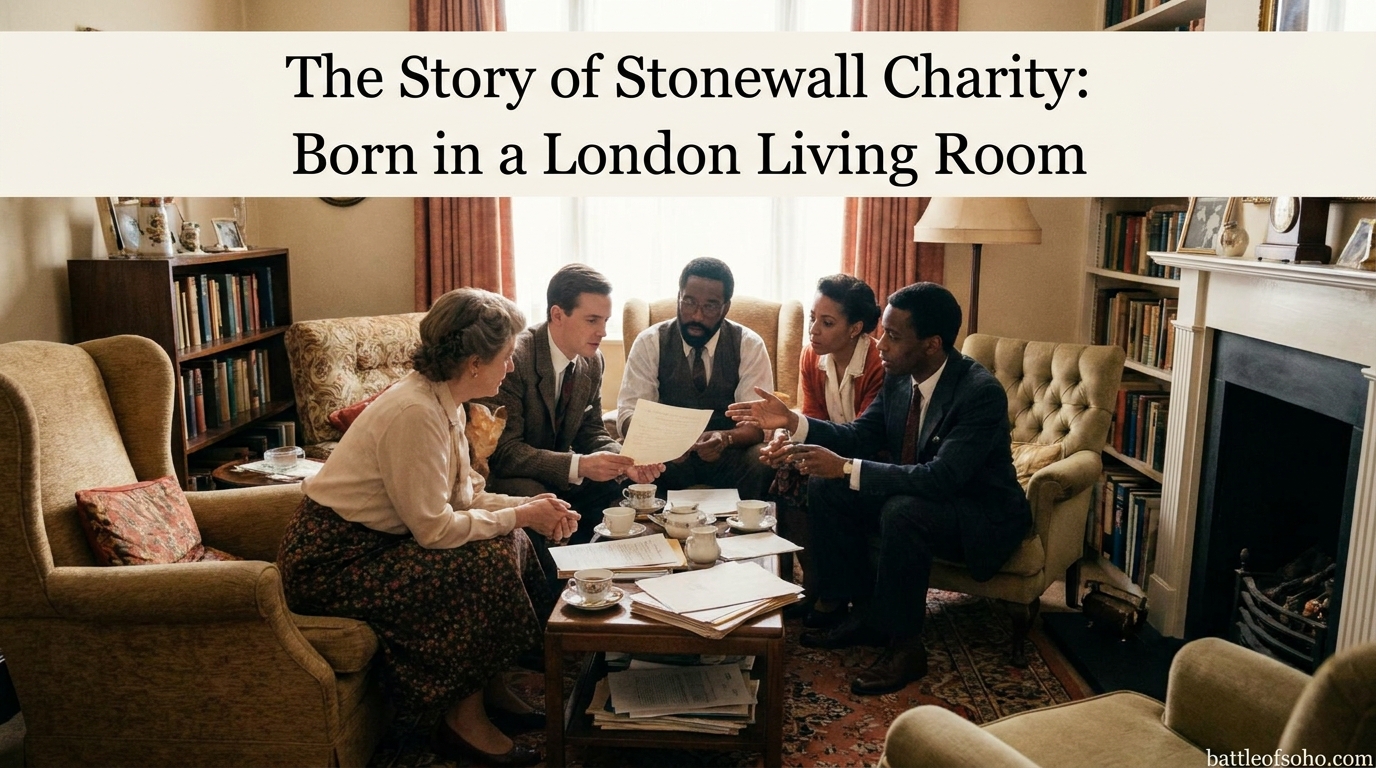
In 2026, it is easy to take LGBTQ+ rights for granted in Britain. Same-sex couples can marry, serve openly in the armed forces, and adopt children with the same legal standing as anyone else. But rewind to 1989, and the landscape was dramatically different. A piece of legislation called Section 28 had just criminalised the “promotion of homosexuality” by local authorities, sparking fear and outrage across the LGBTQ+ community. In response, a small group of activists gathered in a London living room to plan a fightback. That gathering gave birth to Stonewall, now one of Europe’s largest LGBTQ+ equality charities.
This is the Stonewall charity origin story. It begins around a kitchen table, involves some of Britain’s most recognisable public figures, and spans more than three decades of relentless campaigning. From the repeal of Section 28 to the legalisation of same-sex marriage, Stonewall has been at the centre of nearly every major LGBTQ+ rights victory in modern British history.
For readers of Battle of Soho, this story has a particular resonance. London, and specifically the streets of Soho, have long been the beating heart of Britain’s LGBTQ+ community. The charity that was born in a London living room grew up surrounded by the pubs, clubs, and activism of a city that has always been at the forefront of queer life in Britain. Understanding where Stonewall came from means understanding a crucial chapter in the history of LGBTQ+ London itself.
In this article, we trace the full arc of the Stonewall charity origin story, from the political crisis that created it to the living room meeting that launched it, through thirty-five years of campaigns, controversies, and transformation. Whether you know Stonewall as a household name or are discovering it for the first time, the story of how a scruffy outfit became Europe’s largest LGBT charity is one of the most compelling in modern British activism.
Table of Contents
The Context: Section 28 and 1980s Britain
To understand why Stonewall was founded, you first have to understand the political climate of late 1980s Britain. Margaret Thatcher’s Conservative government had been in power since 1979, and the broader culture was deeply hostile to LGBTQ+ people. Homosexuality had been partially decriminalised in England and Wales in 1967, but equality was still a distant dream. Gay men faced an unequal age of consent set at 21, compared to 16 for heterosexual couples. Same-sex relationships had no legal recognition whatsoever. LGBTQ+ people could be dismissed from their jobs, denied housing, and ostracised from their families with no legal recourse.
The situation worsened dramatically with the AIDS crisis. As HIV and AIDS swept through communities in the 1980s, fear and misinformation fuelled a backlash against gay men in particular. Tabloid newspapers ran sensationalist headlines demonising the LGBTQ+ community. The government was slow to respond to the public health emergency, and when it did, the messaging often stigmatised rather than supported those affected. Against this backdrop of fear and prejudice, a new piece of legislation would become the spark that lit a movement.
In 1988, Parliament passed the Local Government Act, which included a notorious clause known as Section 28. This provision stated that a local authority “shall not intentionally promote homosexuality or publish material with the intention of promoting homosexuality” or “promote the teaching in any maintained school of the acceptability of homosexuality as a pretended family relationship.” The language was vague, but the intent was clear. Section 28 was designed to silence LGBTQ+ visibility in schools and public services.
The impact was immediate and devastating. Teachers feared losing their jobs if they mentioned homosexuality in any context. Support groups for LGBTQ+ youth were shut down. Libraries removed LGBTQ+ books from their shelves. The law created a chilling effect that extended far beyond its legal scope. Even organisations not technically covered by the legislation self-censored out of fear. A generation of LGBTQ+ young people grew up without support, representation, or even the basic acknowledgment that they existed.
But Section 28 also galvanised a community. Protests erupted across the country. The most famous was the “lesbian abseil” in 1988, when a group of lesbians abseiled into the House of Lords from the public gallery to protest the legislation. Others involved chaining themselves to the gates of Buckingham Palace. The anger was real, and it needed a permanent outlet. Existing organisations like the Campaign for Homosexual Equality and the Gay Liberation Front had paved the way, but something new was needed. Something that could lobby Parliament directly, work across political divides, and sustain a long-term campaign for legal equality. That something would become Stonewall.
The founding of Stonewall was not inevitable. Before 1989, gay men and lesbians in Britain had organised separately, if at all. There was no single, unified lobbying organisation dedicated to legislative change for the LGBTQ+ community. The idea that a cross-community, cross-party group could come together and sustain a decades-long campaign for equality was, at the time, genuinely radical. Section 28 was the catalyst, but the vision went far beyond repealing a single law. The founders of Stonewall wanted nothing less than full legal equality for all LGBTQ+ people in Britain.
Looking back from 2026, it is hard to overstate how bleak the landscape looked in 1989. Public opinion polls showed majority opposition to any form of legal recognition for same-sex relationships. Politicians who supported LGBTQ+ rights were a tiny minority in Parliament. The media largely treated homosexuality as either a punchline or a threat. And yet, within this hostile environment, a group of people decided to fight back. Their story is the story of how the Stonewall charity was born in a London living room, and how that moment changed British history.
The Story of Stonewall the Charity Born in a London Living Room
The origin story of Stonewall charity begins, as so many great movements do, in someone’s home. Specifically, in the London living room of Sir Ian McKellen, the acclaimed actor who would become one of the organisation’s most prominent founding members. It was here, in 1989, that a small group of activists, politicians, and community figures gathered to discuss what could be done about the dire state of LGBTQ+ rights in Britain. Section 28 had been in force for a year, and the community was still reeling from its impact.
The meeting was not a grand affair. There were no suits, no strategy documents, no PR consultants. It was a group of concerned people sitting in a living room, talking about how to fight back against legislation that had criminalised their very existence. Lisa Power, one of the co-founders, later described Stonewall in its early days as a “scruffy outfit.” This was not a polished charity with a corporate headquarters and a communications team. It was a handful of people with a shared determination to change the law.
That first gathering in McKellen’s living room was about more than just venting frustration. The people in that room were serious political operators. They included actors, journalists, activists, and people with deep connections to both Westminster and the LGBTQ+ community. They understood that repeal of Section 28 would not happen overnight. It would require sustained lobbying, strategic alliances, and the kind of patient, unglamorous work that rarely makes headlines. What they were building was a long-term campaign machine for LGBTQ+ equality.
After the initial meeting at McKellen’s home, the organisation needed a name. According to Lisa Power, the naming happened around her kitchen table. The group wanted a name that carried weight, that connected their struggle to the broader history of LGBTQ+ resistance. They chose “Stonewall,” a direct reference to the 1969 Stonewall riots in New York City’s Greenwich Village, when LGBTQ+ people fought back against police harassment at the Stonewall Inn. That moment is widely regarded as the birth of the modern gay rights movement, and the founders wanted to invoke its spirit of defiance.
The choice of name was deliberate and layered. On one level, it was a tribute to the bravery of the people who had stood their ground outside the Stonewall Inn in 1969. Figures like Marsha P Johnson and Sylvia Rivera, who were at the forefront of those riots, had shown that marginalised people could resist institutional oppression. By adopting the name, the British founders were aligning themselves with a global tradition of LGBTQ+ resistance. On another level, “stonewall” carries a metaphorical meaning: to stonewall someone is to resist them, to refuse to give ground. The name suggested an organisation that would be immovable in its demand for equality.
The formal founding date of Stonewall is generally cited as 24 May 1989. The organisation was initially known as The Stonewall Lobby Group, reflecting its primary function as a parliamentary lobbying organisation. This was a critical distinction. Stonewall was not set up as a protest movement or a community support group. It was designed to work within the political system, to sit down with MPs and civil servants, to draft legislation, and to make the case for equality in the corridors of power. This approach was controversial among some radicals who preferred direct action, but it would prove remarkably effective over the coming decades.
The early days were characterised by improvisation and determination. There was no office, no staff, and virtually no budget. Meetings happened in living rooms and pubs. Decisions were made collectively. The group relied on the donated time and expertise of its founders, many of whom had other careers and commitments. What they lacked in resources, they made up for in connections and credibility. Ian McKellen’s profile as a celebrated actor opened doors. Michael Cashman’s experience as an actor turned politician gave the group insight into how Parliament worked. Lisa Power’s background in activism provided the grassroots credibility.
The concept behind Stonewall was genuinely innovative for its time. No previous LGBTQ+ organisation in Britain had attempted to bring together gay men and lesbians in a single, unified lobbying body. The two communities had often organised separately, with different priorities and different cultures. The founding group deliberately sought to bridge this divide by including equal numbers of men and women, an approach that gave the organisation a broader base and a more inclusive voice. This collaborative model would become one of Stonewall’s defining characteristics.
It is worth pausing to consider how remarkable the living room origin story really is. One of the most influential LGBTQ+ rights organisations in European history began with a conversation among friends in a London flat. There was no government grant, no philanthropic endowment, no institutional backing. What there was, in abundance, was anger at injustice, belief in the possibility of change, and a willingness to do the unglamorous work of political lobbying. That combination would take Stonewall from a scruffy outfit in a living room to the forefront of British public life.
The Founding Group: Ten Men and Ten Women
The Stonewall charity origin story is inseparable from the people who founded it. The organisation was established by a group often described as “ten men and ten women,” a deliberately balanced coalition that brought together some of the most influential figures in British LGBTQ+ life. These were not professional activists in the traditional sense. They were actors, journalists, lawyers, police officers, and political operatives who shared a common purpose: to dismantle the legal framework of discrimination against LGBTQ+ people in Britain.
Sir Ian McKellen is perhaps the most famous of the founding members. One of Britain’s most celebrated stage and screen actors, McKellen had come out publicly in 1988 during a BBC Radio 3 discussion about Section 28. His decision to speak openly about his sexuality was, at the time, an act of extraordinary courage. He was one of very few openly gay public figures in Britain, and his profile gave Stonewall instant visibility and credibility. McKellen’s home in London served as the venue for the founding meetings, and his willingness to lend his name and reputation to the cause was instrumental in attracting support from donors and politicians alike.
Lisa Power is the other figure most closely associated with Stonewall’s founding. A lifelong activist who had been involved in the lesbian and feminist movements of the 1970s and 1980s, Power brought grassroots credibility and strategic thinking to the group. Her kitchen table is where the organisation was named, and her recollections provide some of the most vivid details of Stonewall’s early days. Power has described the founding group in characteristically blunt terms, calling it a “scruffy outfit” and noting that the cross-section of people involved was unlike anything she had experienced before. “I had never sat down with a gay Tory or an openly gay police officer before,” she has said, capturing the unusual breadth of the coalition.
Michael Cashman was another central figure. A former actor best known for playing Colin Russell in the BBC soap opera EastEnders, Cashman had been part of the first-ever same-sex kiss on British television in 1987. He later transitioned into politics, serving as a Labour Member of the European Parliament and being elevated to the House of Lords as Baron Cashman. His combination of celebrity profile and political insider knowledge made him invaluable to Stonewall’s parliamentary lobbying strategy. Cashman understood how legislation was made, how to build alliances with MPs across party lines, and how to use media attention to advance the cause.
The founding group also included Duncan Campbell, an investigative journalist who had been involved in LGBTQ+ activism for years. Matthew Parris, the journalist and former Conservative MP, brought a cross-party dimension to the coalition. His presence was significant because it demonstrated that Stonewall was not going to be a partisan organisation. By including gay Conservatives alongside Labour supporters and non-aligned activists, the founders sent a clear message that LGBTQ+ equality was not a left-wing or right-wing issue. It was a human rights issue.
Olivette Cole-Wilson was another important founding member, bringing experience from the lesbian community and a deep commitment to intersectional activism. The group also included Peter Ashman, who would become Stonewall’s first director, and Tim Barnett, who later became a Member of Parliament in New Zealand and a leading figure in that country’s LGBTQ+ rights movement. Simon Fanshawe, a comedian and broadcaster, lent his public profile and communication skills to the cause. Each member brought something different, and the diversity of the group was its greatest strength.
The political diversity of the founding group was both a strength and a source of tension. In the early days, debates raged about strategy. Should Stonewall focus on lobbying Parliament, or should it also engage in direct action? Should it pursue incremental reform, or should it demand full equality immediately? The reformists generally won out, arguing that lasting change required working within the political system. This approach drew criticism from more radical activists who accused Stonewall of being too cautious, too establishment, too willing to compromise. Lisa Power has acknowledged this tension, noting that Stonewall was “hated because we were reformists” by parts of the radical left.
The decision to include equal numbers of men and women was not just symbolic. It reflected a genuine commitment to ensuring that lesbian voices were heard alongside those of gay men. In the 1980s, the lesbian and gay communities in Britain were largely separate, with their own social scenes, publications, and political organisations. The idea that they could work together in a single organisation was novel and, in some circles, controversial. Stonewall’s founders believed that unity was essential for achieving legislative change, and the ten-and-ten model was designed to build that unity from the start.
The founding members also represented a range of class backgrounds, professional experiences, and personal circumstances. This was not a clique of wealthy, metropolitan elites, though some members certainly had public profiles. It was a genuine coalition that reflected the diversity of the LGBTQ+ community as it existed in late 1980s Britain. The fact that people who might otherwise have had little in common were willing to sit down together and work towards a shared goal was, in itself, a radical act. That willingness to collaborate across difference would become one of Stonewall’s most enduring legacies.
The Naming: Why Is It Called Stonewall?
The question of why the charity is called Stonewall has a clear and compelling answer. The organisation was named after the 1969 Stonewall riots, a series of spontaneous demonstrations by members of the LGBTQ+ community in response to a police raid on the Stonewall Inn, a gay bar in the Greenwich Village neighbourhood of New York City. The riots began in the early hours of 28 June 1969 and lasted for several days, drawing widespread attention and sparking the formation of gay rights organisations across the United States and beyond.
The Stonewall Inn was a dingy, mafia-owned bar that catered to some of the most marginalised members of the LGBTQ+ community, including drag queens, transgender people, butch lesbians, and runaway youth. Police raids on gay bars were routine in 1960s America, but on the night of 27 June 1969, the patrons fought back. The spark that ignited the uprising is often attributed to figures like Storme DeLarverie, a biracial butch lesbian whose resistance inspired others, and Marsha P Johnson, a Black transgender woman and drag performer who became one of the most iconic figures associated with the riots. Sylvia Rivera, a Latina transgender activist, was also present and went on to co-found the Street Transvestite Action Revolutionaries (STAR) with Johnson.
The British founders of Stonewall chose this name deliberately. According to Lisa Power, the decision was made around her kitchen table during one of the group’s early planning sessions. They wanted a name that would immediately signal what the organisation stood for: resistance, visibility, and a refusal to accept second-class status. By invoking the 1969 riots, the founders were connecting their struggle to the broader global history of LGBTQ+ resistance. They were saying, in effect, that the spirit of Greenwich Village lived on in London.
The name also carries a powerful metaphorical weight. To “stonewall” someone means to obstruct, to refuse to cooperate, to stand firm against pressure. In choosing this name, the founders were signalling their intention to be an immovable force in the fight for equality. They would stonewall discrimination, stonewall prejudice, stonewall any attempt to deny LGBTQ+ people their full rights as citizens. The dual meaning, both historical reference and statement of intent, gave the organisation a name that was rich in significance from the very beginning.
It is worth noting that the name “Stonewall” is sometimes a source of confusion. People occasionally conflate the UK charity with the Stonewall Inn itself, or assume they are the same organisation. They are not. The Stonewall Inn is a bar in New York City. Stonewall UK is a British charity. The connection between them is one of inspiration and homage, not organisational affiliation. Understanding this distinction is important for appreciating the Stonewall charity origin story in its proper context.
The naming decision also reflected a broader pattern in LGBTQ+ activism, where organisations and events often take their names from significant moments in queer history. Just as Pride marches commemorate the Stonewall riots, the charity named itself after the same event to anchor its mission in a tradition of resistance. This connection to a shared global history gave the young organisation a sense of legitimacy and purpose that helped it punch above its weight in its early years.
Major Campaigns and Achievements: A Timeline
From its founding in 1989, Stonewall set to work on a long and ambitious agenda. The charity’s overarching goal was full legal equality for LGBTQ+ people in Britain, and over the next three decades, it would achieve a remarkable string of legislative victories. Each campaign was built on the last, creating a cumulative momentum that transformed the legal landscape for LGBTQ+ people in the UK. Here is a chronological look at the major milestones in Stonewall’s campaigning history.
The campaign to repeal Section 28 (1989 to 2003). This was the founding mission, and it would take fourteen years to accomplish. Stonewall lobbied MPs, produced research demonstrating the harm caused by the legislation, and worked to shift public opinion. The campaign faced repeated setbacks, including failed attempts at repeal under the Conservative government of John Major and the early years of Tony Blair’s Labour government. Section 28 was finally repealed in November 2003, when the Local Government Act of that year removed it from the statute book. It had taken fourteen years of relentless campaigning, but the law that had sparked Stonewall’s creation was gone.
The equalisation of the age of consent (1994 to 2001). When Stonewall was founded, the age of consent for gay men in England and Wales was 21, compared to 16 for heterosexuals. Stonewall campaigned vigorously for equalisation, arguing that the disparity was discriminatory and rooted in prejudice rather than evidence. The campaign achieved partial success in 1994, when Parliament voted to lower the age of consent for gay men to 18. It was not until January 2001, however, that the age of consent was finally equalised at 16, bringing it into line with heterosexual relationships. This was a hard-fought victory that required multiple parliamentary votes and persistent lobbying over seven years.
Lifting the ban on LGBTQ+ people in the armed forces (2000). Until 2000, it was official policy to dismiss any member of the British armed forces who was found to be gay, lesbian, or bisexual. Stonewall supported a legal challenge that ultimately went to the European Court of Human Rights, which ruled in 1999 that the ban violated the right to privacy under the European Convention on Human Rights. The British government was forced to lift the ban in January 2000, ending years of discriminatory dismissals. This victory demonstrated Stonewall’s willingness to use international legal mechanisms when domestic political channels were blocked.
Adoption rights for same-sex couples (2002). Stonewall campaigned for changes to adoption law that would allow same-sex couples to jointly adopt children. The Adoption and Children Act 2002, which came into effect in 2005, extended adoption rights to unmarried couples, including same-sex partners. This was a significant milestone because it recognised same-sex relationships as equally capable of providing loving, stable homes for children. The campaign required overcoming deeply entrenched prejudices about the suitability of LGBTQ+ people as parents.
Civil partnerships (2004). One of Stonewall’s signature achievements was the Civil Partnership Act 2004, which gave same-sex couples the right to enter into a legally recognised union with most of the rights and responsibilities of marriage. The first civil partnerships were registered in December 2005. Stonewall had lobbied for this legislation for years, arguing that same-sex couples deserved legal recognition and protection. The campaign drew on personal stories, research, and strategic alliances with sympathetic MPs across party lines.
The Equality Act 2010. Stonewall played a significant role in advocating for the inclusion of sexual orientation as a protected characteristic in the Equality Act 2010, which consolidated and strengthened anti-discrimination protections across British law. The Act made it illegal to discriminate against someone on the basis of their sexual orientation in employment, education, housing, and the provision of goods and services. This was a landmark piece of legislation that provided a comprehensive legal framework for LGBTQ+ equality.
Same-sex marriage (2013 to 2014). Perhaps the most celebrated of Stonewall’s achievements, the Marriage (Same Sex Couples) Act 2013 legalised same-sex marriage in England and Wales. The first same-sex marriages took place in March 2014. Stonewall had shifted its position on marriage equality over the years, initially prioritising civil partnerships as a more achievable goal. But as public opinion evolved and political momentum built, the charity threw its full weight behind the campaign for full marriage equality. The victory was the culmination of decades of work to normalise and legalise same-sex relationships in Britain.
Education for All and the “Some people are gay. Get over it!” campaign (2005). Stonewall’s work extended beyond legislative change to cultural and educational campaigns. In 2005, the charity launched the Education for All programme to tackle homophobic bullying in schools. This initiative included the famous “Some people are gay. Get over it!” campaign, which was originally designed as a poster and later appeared on billboards, badges, and T-shirts across the country. The slogan became one of the most recognisable LGBTQ+ rights messages in British history, cutting through prejudice with a simple, direct statement of fact.
Diversity Champions and workplace inclusion (2001 onwards). Recognising that legal equality was only part of the picture, Stonewall launched the Diversity Champions programme to help employers create inclusive workplaces. The programme offered training, resources, and benchmarking to organisations committed to LGBTQ+ inclusion. At its peak, hundreds of employers, including major corporations, universities, and government departments, participated in the scheme. This workplace-focused approach represented a significant evolution in Stonewall’s strategy, moving beyond legislative lobbying to direct engagement with the institutions that shape everyday life for LGBTQ+ people.
Trans equality (2015). In 2015, Stonewall announced that it would expand its remit to campaign for trans equality, marking a significant evolution for an organisation that had focused primarily on lesbian and gay issues since its founding. This decision was not without controversy, as debates about trans rights were becoming increasingly polarised within the LGBTQ+ community and beyond. Stonewall committed to using its resources and influence to advance trans inclusion, producing research, guidance, and campaign materials focused on transgender equality. This expansion of scope represented a return, in some ways, to the coalition-building spirit of the original founding group, which had brought together diverse communities under a single banner.
Rainbow Laces and sports inclusion. Stonewall also expanded into the world of sports with its Rainbow Laces campaign, which encouraged athletes, teams, and fans to show their support for LGBTQ+ inclusion in sport. The campaign, which involved professional football clubs, rugby teams, and other sporting organisations wearing rainbow-coloured laces, helped bring the conversation about LGBTQ+ equality into spaces that had traditionally been resistant to change. Sports remained one of the areas where LGBTQ+ people faced significant barriers, and Rainbow Laces was designed to address that gap.
Conversion practices ban campaign. In more recent years, Stonewall has been a vocal advocate for a ban on so-called conversion practices, which attempt to change someone’s sexual orientation or gender identity. These practices have been widely discredited by medical and psychological professionals and are recognised as deeply harmful. Stonewall has lobbied successive governments to introduce legislation banning conversion practices, arguing that no one should be subjected to treatment that denies their identity. This campaign has been part of a broader push to address remaining areas of inequality and discrimination.
From Lobby Group to Europe’s Largest LGBT Charity
The journey from a scruffy outfit founded in a London living room to one of Europe’s largest LGBTQ+ charities is a story of sustained growth, strategic evolution, and the gradual acceptance of LGBTQ+ rights into mainstream British life. In its early years, Stonewall operated with minimal staff and relied almost entirely on the donated time of its founders. The organisation’s first official director, Peter Ashman, was appointed to provide day-to-day leadership and coordination. From these humble beginnings, Stonewall would grow into a professional charity with dozens of staff, a substantial budget, and influence that extended across British public life.
A key milestone in Stonewall’s organisational evolution came in 2003, when it was granted formal charitable status. This was a significant step because it gave the organisation access to new sources of funding, including grants from trusts and foundations, corporate partnerships, and individual donations with Gift Aid. Charitable status also brought greater accountability, with reporting requirements to the Charity Commission and a formal governance structure through a board of trustees. The charity registration number, 1101255, became a marker of Stonewall’s legitimacy and permanence.
The organisation’s name also evolved over time. Originally known as The Stonewall Lobby Group, reflecting its primary function as a parliamentary lobbying body, it later changed its name to Stonewall Equality Limited. This name change signalled a broadening of the organisation’s mission beyond pure lobbying to encompass a wider range of activities, including research, education, workplace training, and community engagement. The word “equality” in the name made explicit what had always been implicit: Stonewall’s goal was not just to change specific laws, but to achieve comprehensive equality for all LGBTQ+ people.
Stonewall’s leadership has evolved significantly over the years, with each chief executive bringing their own priorities and style. Angela Mason, who led the organisation in the 1990s and early 2000s, was instrumental in building Stonewall’s parliamentary lobbying capacity and overseeing the campaigns for civil partnerships and Section 28 repeal. Ben Summerskill, who served as chief executive from 2003 to 2014, oversaw the organisation during the campaign for same-sex marriage and the expansion of workplace programmes. Ruth Hunt, who led Stonewall from 2014 to 2019, guided the organisation through its decision to campaign for trans equality and brought a focus on intersectionality and grassroots engagement.
Nancy Kelley succeeded Hunt and led the organisation through a particularly turbulent period, including the controversies surrounding the Diversity Champions programme and debates about trans rights. Kelley notably observed that many young LGBTQ+ people go through a phase of “hating” Stonewall before coming to appreciate its work, acknowledging the generational tensions that exist within the LGBTQ+ community about strategy and priorities. Simon Blake subsequently took on leadership, navigating the organisation through financial pressures and strategic repositioning in the mid-2020s.
The scale of Stonewall’s growth is remarkable. From a handful of people in a living room, it became an organisation with a national reach, working with hundreds of employers, schools, and public bodies. Its research reports have been cited in parliamentary debates, its campaigns have shifted public opinion, and its training programmes have influenced institutional cultures across the country. The claim that Stonewall is Europe’s largest LGBT charity is based on its combination of staff numbers, budget, programme reach, and public profile. While the exact metrics fluctuate from year to year, the organisation’s influence and scale are widely recognised across the European LGBTQ+ rights landscape.
Stonewall and Soho: A London Connection
For readers of Battle of Soho, the geography of Stonewall’s story carries a special significance. Stonewall was born in London, and London has always been the epicentre of LGBTQ+ life in Britain. Nowhere is this more true than Soho, the vibrant neighbourhood in the West End that has served as the cultural and social heart of the city’s queer community for generations. The connection between Stonewall and Soho is not just geographic. It is cultural, political, and deeply personal.
Old Compton Street, running through the heart of Soho, has been the symbolic centre of LGBTQ+ London since the mid-twentieth century. Its pubs, clubs, and cafes have been gathering places for queer people seeking community, safety, and a sense of belonging. When Stonewall was founded in 1989, Soho was already established as the place where LGBTQ+ Londoners came together. The founding meetings may have taken place in a living room, but the community that produced those founders was nurtured in the venues and streets of Soho and the wider London queer scene.
The relationship between Stonewall and the physical geography of London runs deeper than mere proximity. London Pride, the annual celebration that draws hundreds of thousands of people to the streets of the capital, has been a regular platform for Stonewall’s campaigns and messaging. The charity’s participation in Pride events, with its banners, marchers, and campaign materials, has helped keep LGBTQ+ rights visible in the public consciousness. The energy of London’s queer community, concentrated in neighbourhoods like Soho and Vauxhall, has fuelled Stonewall’s work from the beginning.
Soho itself has a rich history of LGBTQ+ resistance and resilience. From the raids on the Cave of the Golden Calf in the early twentieth century to the bombing of the Admiral Duncan pub in 1999, Soho has been both a haven and a battleground for queer Londoners. Stonewall’s campaigns for legal equality have always existed alongside this lived, physical experience of LGBTQ+ community in the streets of London. The charity may work in the corridors of Westminster, but its roots are in the same neighbourhoods that have sustained queer life in the capital for over a century. Understanding the Stonewall charity origin story means understanding London, and understanding London means understanding Soho.
Recent Developments and Challenges
The story of Stonewall is not one of unbroken success. In recent years, the charity has faced significant challenges, including intense public scrutiny, internal disagreements, and financial pressures. These difficulties reflect broader debates within the LGBTQ+ community about strategy, identity, and the future of the equality movement. Understanding these challenges is essential for a complete picture of Stonewall in 2026.
The Diversity Champions programme, once seen as a flagship initiative, became a focus of controversy in the early 2020s. Several high-profile organisations, including the BBC, University College London, the London School of Economics, and various government departments, withdrew from the scheme. Critics raised concerns about impartiality, cost, and the programme’s approach to trans inclusion. The BBC’s departure in 2021 attracted particular media attention, with the broadcaster citing the need to maintain editorial impartiality on contested issues. These withdrawals dealt a blow to Stonewall’s influence and finances, and prompted a period of reflection and restructuring.
The debate about trans rights has been the most divisive issue facing Stonewall in recent years. The charity’s decision in 2015 to campaign for trans equality was welcomed by many but criticised by others. Some argued that Stonewall was overstepping its remit, while others felt it was not doing enough. The controversy exposed genuine tensions within the LGBTQ+ community about the relationship between sexual orientation and gender identity. Matthew Parris, one of the original founding members, left Stonewall in 2020 over its stance on trans rights, a departure that was deeply painful for an organisation built on the principle of coalition. These internal divisions reflected broader cultural debates that show no sign of resolution.
In 2025, Stonewall underwent a significant strategic shift with the launch of the Proud Employers programme, which replaced the Diversity Champions scheme. This new initiative represented a rethinking of the charity’s approach to workplace inclusion, with a focus on direct employment support and more targeted employer engagement. The transition was part of a broader strategic plan covering the period from 2025 to 2028, which aimed to refocus the organisation’s work on its core mission of advancing LGBTQ+ equality through campaigning, research, and education.
Financial pressures have also been a factor. Like many charities, Stonewall faced economic headwinds in the mid-2020s, including reduced corporate partnerships and the broader economic climate. The organisation underwent workforce reductions and had to make difficult decisions about which programmes to prioritise. Despite these challenges, Stonewall has maintained its commitment to its founding mission and continues to campaign on issues including conversion practices, trans equality, and LGBTQ+ inclusive education.
The question of whether Stonewall has become too “establishment” is one that has dogged the charity for years. Critics argue that an organisation that began as a scruffy outfit in a living room has become too close to corporate interests, too willing to work within the system rather than challenge it. Supporters counter that lasting change requires engagement with institutions, and that Stonewall’s ability to work with employers, schools, and government bodies is a strength, not a weakness. This debate goes to the heart of what an equality charity should be, and it is unlikely to be resolved any time soon.
Despite these challenges, Stonewall’s significance in British public life remains substantial. The charity continues to produce research that shapes policy debates, to campaign on issues that matter to LGBTQ+ people, and to provide resources that help organisations become more inclusive. The fact that Stonewall attracts such intense scrutiny is, in a sense, a testament to its importance. Organisations that are irrelevant do not generate controversy. Stonewall matters precisely because its work has real consequences for real people, and that is why the debates about its direction are so passionate.
FAQs
Why was Stonewall charity founded?
Stonewall was founded in 1989 in direct response to Section 28 of the Local Government Act 1988, which prohibited local authorities from promoting homosexuality. A group of activists, including Ian McKellen, Lisa Power, and Michael Cashman, came together in a London living room to create a parliamentary lobbying organisation that could campaign for the repeal of Section 28 and broader legal equality for LGBTQ+ people in Britain.
Who founded Stonewall UK charity?
Stonewall was founded by a group of approximately ten men and ten women, including Sir Ian McKellen, Lisa Power, Michael Cashman, Duncan Campbell, Matthew Parris, Olivette Cole-Wilson, Simon Fanshawe, and Peter Ashman. The group represented a cross-party coalition of actors, journalists, activists, and political operatives who shared a commitment to LGBTQ+ equality.
Where was Stonewall charity founded?
Stonewall was founded in London, England. The initial meetings took place in the London living room of Sir Ian McKellen, and the organisation was named around Lisa Power’s kitchen table. The formal founding date is 24 May 1989.
Why is it called Stonewall charity?
The charity is named after the 1969 Stonewall riots, which began at the Stonewall Inn in Greenwich Village, New York City, when LGBTQ+ patrons fought back against a police raid. The founders chose the name around Lisa Power’s kitchen table to invoke the spirit of resistance associated with the riots and to signal their determination to stand firm against discrimination.
What is the Stonewall controversy?
Stonewall has faced controversy in recent years primarily over its stance on trans rights and its Diversity Champions workplace inclusion programme. Several organisations, including the BBC and various universities, withdrew from the programme citing concerns about impartiality and cost. The charity’s 2015 decision to campaign for trans equality also created tensions within the LGBTQ+ community, leading to the departure of founding member Matthew Parris in 2020.
Is Stonewall the largest LGBT charity in Europe?
Stonewall is widely regarded as one of the largest and most influential LGBTQ+ equality charities in Europe, based on its staff numbers, budget, programme reach, and public profile. While exact rankings can vary depending on the metrics used, Stonewall’s scale and influence across campaigning, workplace inclusion, and policy advocacy make it a leading organisation in the European LGBTQ+ rights landscape.
What was Section 28 and how did it lead to Stonewall?
Section 28 was a clause in the Local Government Act 1988 that prohibited local authorities from intentionally promoting homosexuality or teaching its acceptability as a pretended family relationship. It caused widespread fear and self-censorship in schools and public services. The outrage it generated was the direct catalyst for the founding of Stonewall in 1989, and its repeal in 2003 was one of the charity’s most significant campaign victories.
How did Stonewall charity start?
Stonewall started with informal meetings in the London home of Sir Ian McKellen in 1989. A small group of gay men and lesbians, angry about Section 28 and the broader legal inequality facing LGBTQ+ people in Britain, decided to form a professional lobbying organisation. The group was named around co-founder Lisa Power’s kitchen table and initially operated with no office, no budget, and no paid staff.
Conclusion: The Living Room Legacy
The Stonewall charity origin story is a reminder that transformative change often begins in the most ordinary of settings. A living room. A kitchen table. A conversation among friends who refused to accept the world as it was. From those humble beginnings in 1989, Stonewall grew into an organisation that helped dismantle the legal architecture of discrimination against LGBTQ+ people in Britain. Section 28 was repealed. The age of consent was equalised. Same-sex couples won the right to marry, to adopt, and to serve in the armed forces. Each of these victories can be traced back to the determination of a small group of people who sat down together and decided to fight.
The story is not without its complications. Stonewall has faced criticism, controversy, and internal division. The debates about trans rights, workplace programmes, and the organisation’s relationship with corporate power are real and unresolved. But these tensions are, in many ways, a reflection of the broader struggles within any social movement. An organisation that has been at the centre of LGBTQ+ rights in Britain for over thirty-five years will inevitably be a site of debate about what equality means and how best to achieve it.
For those of us who care about LGBTQ+ history in London and Soho, the Stonewall charity origin story is part of our shared heritage. It is a story that belongs to the living rooms of London, the streets of Soho, and the countless individuals who have fought, and continue to fight, for the simple right to be themselves. The kitchen table where the name was chosen may be long gone, but the organisation it helped create endures, still campaigning, still evolving, and still carrying forward the spirit of resistance that inspired its name.