
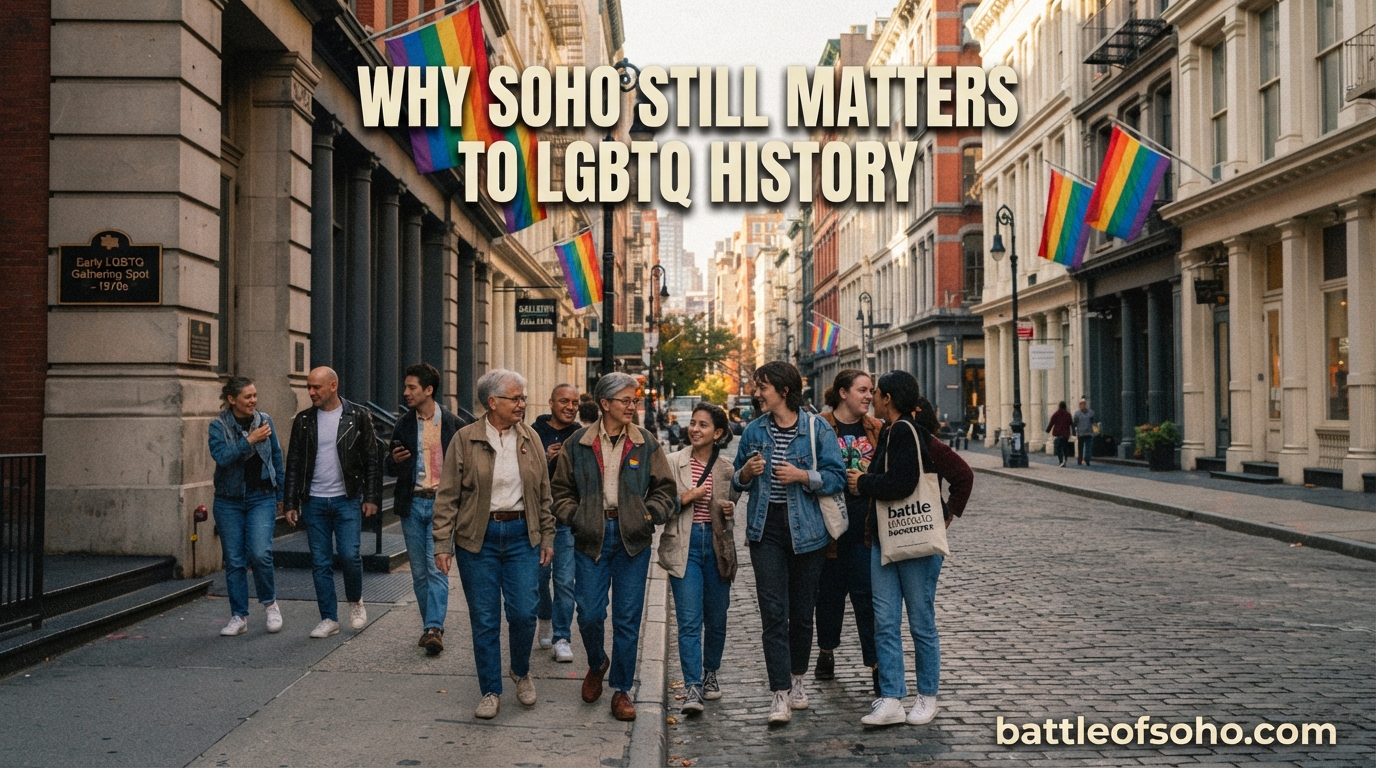
Soho has been the beating heart of LGBTQ life in London for over three centuries. From the secret molly houses of the 1700s to the neon-lit bars of Old Compton Street today, this small patch of central London has shaped queer identity, politics, and culture in ways no other neighbourhood can match. When people ask why Soho still matters to LGBTQ history, the answer is that no other place in Britain carries this much living memory of queer survival, resistance, and joy.
Our team at Battle of Soho has spent years documenting the stories embedded in these streets. Every brick, every closed venue, every surviving pub holds a chapter of LGBTQ history that deserves to be remembered and protected.
But Soho’s story is not just nostalgia. It is an active, ongoing battle. Venue closures, rising rents, and commercialisation threaten to erase centuries of queer heritage. Understanding why this neighbourhood matters is the first step toward defending it.
Table of Contents
The Origins: Molly Houses and Secret Gatherings
Soho’s LGBTQ history begins long before the word “gay” entered common use. In the late 1600s and early 1700s, this area was already a gathering point for people the rest of society wanted to criminalise and hide. The story starts with molly houses.
A molly house was a tavern, coffeehouse, or private room where men who loved men could meet, socialise, and express themselves freely. These were some of the earliest queer community spaces in recorded British history. Soho, with its dense population, transient residents, and already-notorious reputation for nightlife, became a natural home for them.
The most famous was Mother Clap’s molly house, which operated in the early 1720s just off Field Lane, not far from the Soho boundary. Margaret Clap ran the establishment as a safe gathering space where men could wear women’s clothing, dance together, and build community. It was raided in 1726, and several men were arrested and put on trial.
Three men from Mother Clap’s were hanged at Tyburn on 9 May 1726. Gabriel Griffin, Thomas Wright, and John Bleak Coggan were executed for the crime of existing as queer people in a society that punished them with death. Their names deserve to be remembered.
The trial records from the Court of Bow Street give us a rare, painful window into early queer life. Witnesses described men adopting female names, wearing aprons, and performing mock births. To the courts, this was evidence of depravity. To historians, it is evidence of a community that refused to disappear.
Molly houses were not casual meeting spots. They were lifelines. In a world where same-sex relationships carried the death penalty until 1861, these spaces offered the only chance many queer people had to be themselves. That tradition of carving out sanctuary in Soho started here, and it never stopped.
Victorian Soho: Persecution and the Wilde Trials
The Victorian era brought new waves of persecution to Soho’s queer community, but it also cemented the neighbourhood’s role as a place where marginalized people could find each other. By the mid-1800s, Soho had become London’s most cosmopolitan district. Immigrants, artists, performers, and sex workers all converged here, creating a social ecosystem where queerness could exist, however precariously.
The 1885 Criminal Law Amendment Act, specifically the Labouchere Amendment, made “gross indecency” between men a criminal offence. This law did not require proof of a specific sexual act. It criminalised any expression of male same-sex intimacy, and it was designed to trap and prosecute queer men.
Oscar Wilde was the most famous victim of this law. In 1895, after his disastrous libel suit against the Marquess of Queensberry, Wilde was arrested and prosecuted under the Labouchere Amendment. The trials destroyed him. He was sentenced to two years of hard labour at Reading Gaol.
Soho had direct connections to Wilde’s world. The cafes and clubs of the area were part of the network of spaces where artistic and literary circles gathered. Wilde himself moved through these streets. His imprisonment sent a chilling message to every queer person in London: you could be next.
But persecution did not erase the community. It drove it deeper underground, and Soho’s dense, chaotic, hard-to-police streets provided cover. By the late Victorian period, Soho had also developed its reputation as a red-light district. Sex shops, brothels, and illegal drinking clubs operated alongside legitimate businesses. This overlap between the sex industry and queer spaces would define Soho for the next century.
The queer community that survived the Victorian era did so through mutual aid, coded language, and trusted networks. Soho was where those networks had physical space to operate. That pattern of survival through community infrastructure became the template for everything that followed.
The Early 20th Century: Cave of the Golden Calf and Jazz Era
The early 1900s brought a new kind of venue to Soho. These were not the hidden molly houses of the previous century. They were semi-public clubs that pushed boundaries and attracted mixed crowds of queer people, artists, bohemians, and the simply curious.
The Cave of the Golden Calf opened in 1912 at 9 Heddon Street, just south of Regent Street, on the edge of Soho. It was a cabaret club with a distinctly subversive atmosphere. The interior was designed by Wyndham Lewis and included work by other members of the Vorticist movement. It attracted an extraordinary mix of people, including queer patrons who found the club’s anything-goes spirit liberating.
The Cave closed in 1914, but it set a precedent. Soho could host spaces where conventional rules about gender and sexuality were suspended, at least temporarily. That idea would expand dramatically in the decades that followed.
By the 1930s, Soho was home to clubs like the Caravan Club at 8 Endell Street, which was explicitly known as a gathering place for gender non-conforming and queer people. The Caravan was raided by police in 1934 in one of the most documented queer-club busts of the era. Trial records describe patrons in cross-dressing attire and same-sex dancing.
The Shim Sham Club on Wardour Street also played a role in this era. Named after the Shim Sham Shimmy tap dance routine, it drew mixed crowds and had strong connections to the jazz scene. This is where queer history intersects with Black cultural history in Soho. Jazz clubs were some of the most racially integrated spaces in London, and they often attracted queer patrons who felt alienated from mainstream venues.
This intersection matters. Soho’s queer spaces were never monochrome. They were shaped by immigrant communities, Black performers, working-class patrons, and bohemian artists. The diversity of Soho’s LGBTQ history is one of the reasons it cannot be reduced to a simple story of gay bars and nightclubs.
Post-War Soho and the Colony Room Era
After the Second World War, Soho’s queer scene entered a period of consolidation. The drinking club culture that emerged in the 1940s and 1950s created semi-private spaces where queer people could socialise with a degree of safety, provided they could get past the door.
The Colony Room Club at 41 Dean Street was perhaps the most famous. It opened in 1948 and was run by Muriel Belcher, a formidable figure who hand-picked her members. The Colony Room was technically a private drinking club, which meant it could operate outside normal licensing hours and, crucially, away from police scrutiny.
Francis Bacon was the Colony Room’s most famous patron. He practically lived there. The club’s walls were lined with his contemporaries: Lucian Freud, John Deakin, Jeffrey Bernard, and a rotating cast of artists, writers, drinkers, and outsiders. The Colony Room was not exclusively a gay venue, but it was deeply queer in its ethos. It was a space for people who did not fit anywhere else.
The club operated until 2008, surviving massive changes in Soho’s landscape. Its closure was a significant loss, not just as a venue but as a link to a specific era of bohemian queer culture that has largely vanished from central London.
Comptons of Soho, on Old Compton Street, also dates to this era. The pub originally operated as a traditional ale house called The Devonshire Arms before becoming a gay pub in the 1980s. Today, Comptons is one of the oldest continuously operating LGBTQ-friendly venues in Soho, and its survival is a testament to the community’s commitment to holding onto its spaces.
The Sexual Offences Act 1967 partially decriminalised homosexuality in England and Wales. This was a landmark moment, but it was deeply limited. The act applied only to men over 21, in private, and did not cover Scotland, Northern Ireland, the armed forces, or the merchant navy. Still, it marked a shift. For the first time, queer spaces in Soho could begin to operate with slightly less fear of police raids.
Old Compton Street: The Heart of Gay Soho
If Soho is the heart of London’s LGBTQ community, Old Compton Street is its pulse. This single road became the most visible gay high street in Britain, and its transformation tells the story of how queer life moved from the margins to the centre.
By the late 1980s and 1990s, Old Compton Street had become the undisputed centre of gay London. Pubs, bars, cafes, and shops lined the street. Comptons drew crowds every evening. The Admiral Duncan, a pub at 54 Old Compton Street, became one of the most popular gay pubs in the country.
Gay’s The Word bookshop, located just north of Soho on Marchmont Street in Bloomsbury, also served the Soho community as the UK’s first dedicated LGBTQ bookshop. Founded in 1979, it was raided by customs in 1984 in an attempt to seize imported LGBTQ literature. The raid became a cause celebre, and the subsequent campaign to defend the shop drew support from across the literary world. Gay’s The Word remains open today, a living archive of queer writing.
Old Compton Street was more than a collection of businesses. It was a statement of visibility. Walking down that street in the 1990s, holding a partner’s hand, was a radical act of public queerness. The street created a sense of safety and belonging that many LGBTQ people had never experienced anywhere else.
This was also the era when Soho became a tourist destination for LGBTQ visitors from around the world. People travelled to London specifically to experience the Soho gay scene. The area became, for a time, the gay capital of Britain in both reputation and reality.
The AIDS Crisis and Community Resilience
The 1980s brought devastation to Soho’s LGBTQ community. The AIDS crisis tore through queer networks, claiming lives at a staggering rate. Friends, partners, colleagues, and community leaders were lost. Soho’s bars and clubs became places where people processed grief, organised support, and fought back.
Section 28, passed in 1988, made things worse. This law prohibited local authorities from “promoting homosexuality” or teaching its acceptability. It had a chilling effect on LGBTQ education, community services, and self-expression. It sent a clear message that queer lives were still considered a threat to be legislated against.
But the Soho community responded with defiance. Activist groups like ACT UP and OutRage! organised protests, die-ins, and direct actions from within the neighbourhood. Soho was not just a place to drink. It was a base for political organising and mutual aid.
Community organisations set up support networks for people living with HIV and AIDS. Volunteer-led services provided food, companionship, and practical help. The bars and clubs of Soho became information hubs, fundraising centres, and spaces where people could grieve together.
This period showed what Soho’s queer infrastructure was really for. It was not just about nightlife. It was about community survival. When institutions failed LGBTQ people, when the government actively worked against them, when families rejected them, the spaces of Soho provided a safety net. That function has not disappeared, even as the nature of the crisis has changed.
The Admiral Duncan Bombing: A Turning Point
On 30 April 1999, a nail bomb exploded inside the Admiral Duncan pub on Old Compton Street. The attack was carried out by David Copeland, a neo-Nazi who targeted London’s Black, Bangladeshi, and LGBTQ communities in a campaign of terror. The Admiral Duncan was his third and final bomb.
Three people were killed: Andrea Dykes, John Light, and Nick Moore. Andrea was four months pregnant. More than 79 people were injured, many severely. The bomb was packed with nails and shrapnel designed to cause maximum harm to the people packed inside the small pub on a Friday evening.
The attack sent shockwaves through Soho and the entire LGBTQ community. But the response was immediate and powerful. Thousands of people gathered on Old Compton Street in the days that followed. Flowers piled up outside the pub. The community came together in grief, anger, and defiant solidarity.
The bombing was a hate crime aimed at the heart of LGBTQ London. But it also revealed the strength of the community that Soho had built. The outpouring of support came not just from LGBTQ people but from Londoners of every background who recognised that an attack on Soho was an attack on the city itself.
The Admiral Duncan reopened and continued operating for years afterward. The pub stood as a symbol of refusal to be intimidated. Today, the attack is remembered as one of the darkest chapters in Soho’s history, but also as proof that this community does not break under violence.
This event alone answers the question of why Soho still matters to LGBTQ history. It is a place where hate tried to destroy community, and community refused to be destroyed.
Gentrification and the Loss of Queer Spaces
The greatest threat to Soho’s LGBTQ heritage today is not a bomb or a law. It is rent. Over the past two decades, property development, rising commercial rents, and infrastructure projects have hollowed out the queer venue landscape at an alarming rate.
Madame Jojo’s, one of Soho’s most iconic cabaret and club venues, had its licence revoked in 2014 after a violent incident involving bouncers. The venue on Walker’s Court never reopened. Its closure was felt as a genuine loss, particularly for the drag, burlesque, and trans communities that called it home.
The Astoria, a major live music and club venue on Charing Cross Road at the edge of Soho, was demolished in 2009 to make way for the Crossrail project, now the Elizabeth Line. The Astoria and its sister venue, the Astoria 2 (formerly the LA2), had hosted countless LGBTQ club nights. Their destruction removed a significant chunk of Soho’s queer nightlife infrastructure.
Man Bar, The Ghetto, First Out Cafe, Barcode, and many others have all closed. Each closure represents lost jobs, lost community, and lost history. Lesbian spaces have been particularly hard hit. Soho once had dedicated women’s bars and nights, but the majority have disappeared as rents made small, community-run venues financially unviable.
The Crossrail development has been especially damaging. The construction disrupted Soho for years, and the resulting Tottenham Court Road station expansion swallowed several venues. While the Elizabeth Line is now operational, the queer spaces that were sacrificed for it are gone permanently.
Reddit users on r/londonlgbt and r/lgbthistory have documented this loss in real time. People describe the current Soho scene as “expensive” and “tourist-focused.” Long-time residents and community members report feeling that venues like G-A-Y, while popular, cater more to stag parties and tourists than to the local LGBTQ community. There is a pervasive sense that authenticity is being replaced by commercialisation.
But there is also hope. New venues continue to open. She Bar launched as a dedicated women’s space, addressing the gap left by closures. Community organisations continue to campaign for the preservation of queer venues, and heritage groups have begun to formally recognise the historical significance of LGBTQ sites in Soho.
Why Soho Still Matters to LGBTQ History Today
Soho still matters to LGBTQ history because it is not just history. It is a living, breathing community space that continues to serve the function it has served for centuries: providing a physical home for people who need one.
Here is what that means in practice. Soho remains the most concentrated cluster of LGBTQ venues in London. When a young person comes out and wants to find community, Soho is still the first place many of them go. When tourists visit London and want to experience LGBTQ culture, Soho is the destination. When community organisations need a physical presence, Soho provides the address.
Soho also matters because of its political history. The battles fought here, from the molly house raids of the 1720s to the Section 28 protests of the 1980s to the vigil for the Orlando shooting victims in 2016, form a continuous thread of resistance. That history is written into the streets themselves.
The green plaque on St. Anne’s Gardens, commemorating the LGBTQ community of Soho, is a physical acknowledgment of this heritage. The annual Pride in London parade routes through the area. The Peter Tatchell Foundation continues its human rights work from nearby. These are not relics. They are active institutions.
But the reason Soho still matters most is that the fight is not over. Transgender rights are under attack. Hate crimes against LGBTQ people have been rising. Venues continue to close. The lesson of Soho’s history is that queer spaces are never permanently safe. They have to be defended, over and over, by each generation.
When we ask why Soho still matters to LGBTQ history, we are really asking whether the physical infrastructure of queer community is worth preserving in a digital age. The answer is yes. Online spaces are valuable, but they cannot replace the experience of standing on Old Compton Street surrounded by people who share your identity. They cannot replace the accidental friendships formed in a crowded bar. They cannot replace the political power of being visible, together, in public space.
Soho matters because it proves that queer people have always been here, have always built community, and have always refused to disappear.
FAQs
Is Soho in London still a red light district?
Soho retains traces of its red-light district past, with a few remaining sex shops and adult venues around Berwick Street and Walker’s Court. However, gentrification and redevelopment have significantly reduced this aspect of the area. Soho today is better known as London’s LGBTQ hub and a centre for dining, nightlife, and media businesses.
Why are LGBTQ venues closing in Soho?
Rising commercial rents, property redevelopment, infrastructure projects like Crossrail, and changing consumer habits have forced many LGBTQ venues to close. Venues like Madame Jojo’s, The Astoria, The Ghetto, and First Out have all shut down. Community groups continue to campaign for the protection of remaining queer spaces through heritage recognition and planning protections.
What was a molly house?
A molly house was a tavern or private gathering space in 1700s and 1800s England where men who were attracted to men could socialise, cross-dress, and express themselves freely. Mother Clap’s molly house near Soho, raided in 1726, is the most famous example. Molly houses were among the earliest recorded LGBTQ community spaces in British history.
What happened at the Admiral Duncan pub in 1999?
On 30 April 1999, a neo-Nazi named David Copeland detonated a nail bomb inside the Admiral Duncan pub on Old Compton Street. Three people were killed and over 79 were injured. The attack targeted London’s LGBTQ community and remains one of the deadliest hate crimes in modern British history. The community responded with mass solidarity vigils on Old Compton Street.
Is Soho still safe for LGBTQ people today?
Soho remains one of the safest areas in London for LGBTQ people, with a high concentration of queer-friendly venues and a visible community presence. However, no area is entirely free from risk, and hate crimes against LGBTQ people have risen across London in recent years. The community presence in Soho itself provides a degree of collective safety that most other neighbourhoods cannot match.
Conclusion
Understanding why Soho still matters to LGBTQ history means recognising that this neighbourhood is not a museum. It is a living community with a continuous thread of resistance, survival, and joy stretching back more than 300 years. From Mother Clap’s molly house to the Colony Room to the Admiral Duncan to the venues fighting to stay open today, Soho has been the place where queer Britain built itself.
The forces threatening that legacy, gentrification, commercialisation, and political backlash, are the same forces that have always threatened queer communities. The difference is that now we have the history to understand what is at stake.
Protecting Soho means protecting the physical spaces where community forms. It means supporting the venues that remain. It means remembering the people who paid the price for visibility. And it means insisting, as every generation before us has insisted, that queer people deserve a place in the world that is ours.