
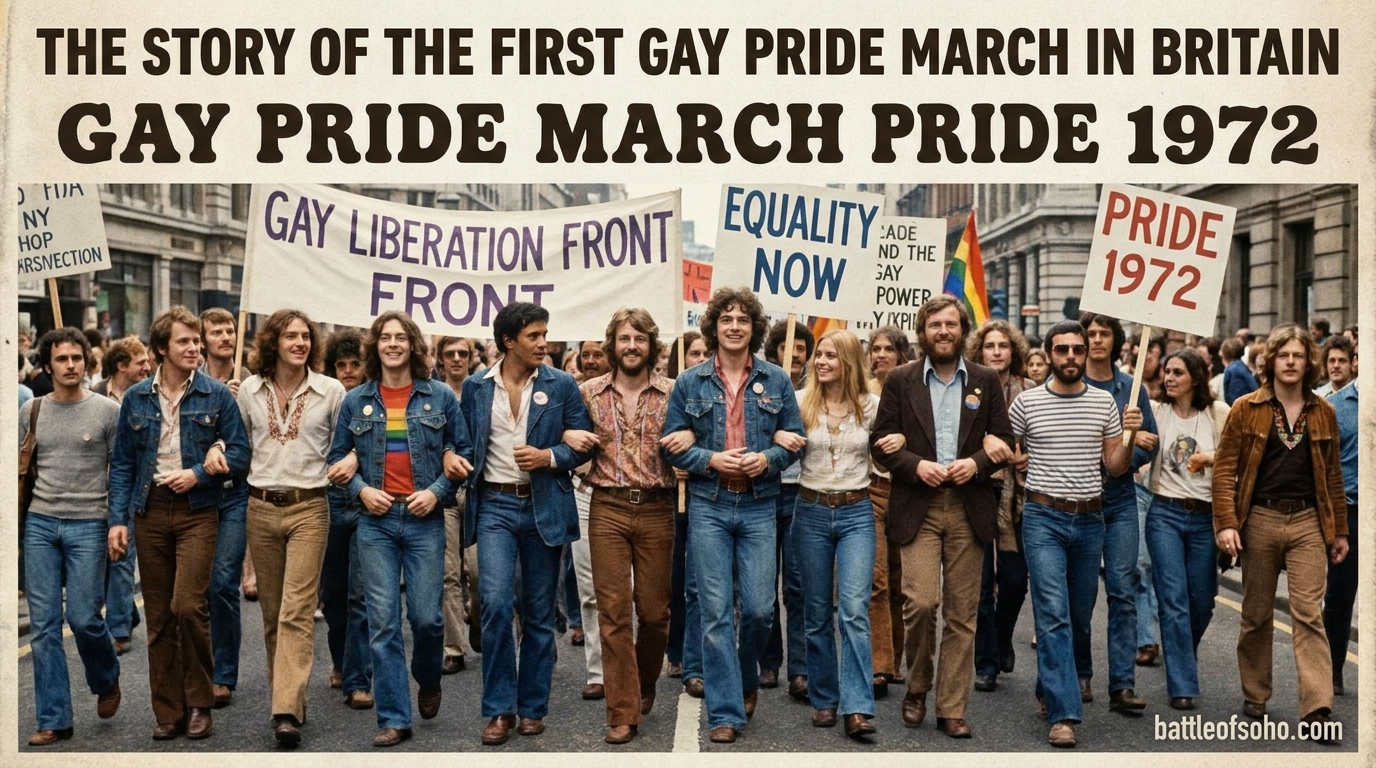
Britain’s first official Gay Pride march took place in London on 1 July 1972, when several hundred people walked through the streets from Trafalgar Square to Hyde Park in what organisers called a “carnival parade of protest.” The march was jointly organised by the Gay Liberation Front (GLF) and the Campaign for Homosexual Equality (CHE), inspired by the Stonewall uprising in New York three years earlier. It was the nearest Saturday to the anniversary of those riots at the Stonewall Inn on 28 June 1969.
That single afternoon in 1972 gave birth to a movement that would transform British society. What began with somewhere between 700 and 2,000 brave marchers, many terrified of arrest, has grown into Pride in London, one of the largest annual events in the country. Today, Pride celebrations take place in cities across the UK, from Brighton to Belfast, attracting millions of attendees and broadcast on national television.
But the story of that first march is about far more than numbers. It is a story of ordinary people who risked everything, their families, their jobs, their freedom, to walk openly through the streets of a city where most of their identities were still criminalised. It is a story of radical politics, community organising, and the stubborn refusal to remain invisible.
In this article, we trace the full arc of the first gay pride march in Britain, from the legal and social conditions that made it necessary, through the Stonewall uprising that ignited it, to the individuals who stood on Trafalgar Square on that overcast Saturday afternoon and changed history.
Table of Contents
Britain’s First Gay Pride March at a Glance
Britain’s first official Gay Pride march took place in London on Saturday, 1 July 1972. Organised by the Gay Liberation Front and the Campaign for Homosexual Equality, an estimated 700 to 2,000 participants marched from Trafalgar Square through central London to Hyde Park. The date was chosen as the nearest Saturday to the third anniversary of the Stonewall uprising in New York City. The march was billed as a “carnival parade” and ended with an impromptu “Gay Day” gathering in Hyde Park.
Here are the essential facts at a glance:
- Date: Saturday, 1 July 1972
- Location: Central London, starting at Trafalgar Square
- Route: Trafalgar Square through the Strand, Aldwych, and Kingsway to Hyde Park
- Organisers: Gay Liberation Front (GLF) and Campaign for Homosexual Equality (CHE)
- Estimated attendance: Between 700 (Peter Tatchell’s count) and 2,000 (Museum of London and House of Lords Library estimates)
- Format: A “carnival parade of protest” with banners, tambourines, balloons, whistles, and costumes
- Post-march: An impromptu “Gay Day” in Hyde Park with shared food, drink, music, and party games
- Police presence: Heavy, with officers photographing marchers and creating an atmosphere of intimidation
Before the March: Britain in the 1960s and the Sexual Offences Act
To understand why the first gay pride march in Britain mattered so deeply, you have to understand the legal world that LGBTQ+ people inhabited in the early 1970s. Homosexuality had only been partially decriminalised in England and Wales five years before the march, and the reforms were narrowly drawn.
The story of legal change began with the Wolfenden Report of 1957, which recommended that homosexual behaviour between consenting adults in private should no longer be a criminal offence. The report, chaired by Sir John Wolfenden, took three years to produce and was considered radical for its time. But the government sat on its recommendations for a decade.
The Sexual Offences Act 1967 finally implemented partial decriminalisation in England and Wales. The Act decriminalised homosexual acts between two men over the age of 21, conducted in private. Scotland did not follow suit until 1980. Northern Ireland waited until 1982. And the definition of “in private” was so narrow that sharing a hotel room could render an act illegal.
Even after the 1967 Act, the lived reality for gay men in Britain remained one of persecution. The age of consent was set at 21, five years higher than for heterosexual couples. Police actively used laws against “gross indecency” and “importuning” to arrest men for cruising, soliciting, or simply making eye contact in public. The number of prosecutions for homosexual offences actually increased after 1967, as police forces felt emboldened by the new legal clarity.
Lesbians faced a different but equally punishing form of erasure. Lesbianism had never been explicitly criminalised in British law, a historical quirk attributed to Queen Victoria’s alleged refusal to believe women did such things. But the absence of legal recognition meant lesbians had no legal protections either. They could lose their children, their housing, and their jobs with no recourse.
Bisexual and transgender people existed in a legal no-man’s-land. There was no framework for recognising trans identity, and the psychiatric establishment treated gender variance as a disorder to be corrected. For all LGBTQ+ people, the medical profession classified homosexuality as a mental illness. It was not removed from the World Health Organization’s classification of diseases until 1990.
This was the Britain that birthed the first gay pride march in Britain. Not a country on the path to freedom, but one where most LGBTQ+ people lived in fear, secrecy, and isolation. The 1972 march was an act of defiance against that entire system.
The Stonewall Uprising: The Spark That Crossed the Atlantic
The direct catalyst for the first gay pride march in Britain was an event that took place 3,000 miles away: the Stonewall uprising in New York City. In the early hours of 28 June 1969, police raided the Stonewall Inn, a gay bar on Christopher Street in Greenwich Village. Such raids were routine. What happened next was not.
The Stonewall Inn was a Mafia-owned establishment that catered to some of the most marginalised members of the LGBTQ+ community, including drag queens, transgender people, hustlers, and homeless youth. It was one of the few places where same-sex dancing was tolerated, albeit with regular payoffs to police. On that June night, the New York Police Department’s Public Morals Squad arrived to conduct a standard raid, lining up patrons and checking identification.
Instead of complying as usual, the crowd fought back. The initial resistance has been attributed to several individuals, including Storme DeLarverie, a biracial butch lesbian and drag performer who is reported to have struck a police officer. The confrontation escalated into a full-scale uprising that lasted six days, with thousands of LGBTQ+ people and allies clashing with police in the streets of Greenwich Village.
The Stonewall uprising was not the first instance of LGBTQ+ resistance against police violence in America. Earlier demonstrations included the Compton’s Cafeteria riot in San Francisco in 1966 and the protests at Cooper Do-nuts in Los Angeles in 1959. But Stonewall became the flashpoint, the event that crystallised a movement, because it came at a moment of broader political ferment: the civil rights movement, the anti-war movement, second-wave feminism, and the Black Power movement had all normalised the idea of militant, visible protest.
News of Stonewall travelled fast. Within months, new militant organisations had formed, most notably the Gay Liberation Front in New York, founded in July 1969. The GLF took its name from the National Liberation Front of Vietnam, signalling its radical, anti-establishment orientation. On 28 June 1970, exactly one year after the uprising, the first Pride marches took place in New York City, Los Angeles, and Chicago, commemorating what was then called Christopher Street Liberation Day.
In Britain, LGBTQ+ activists followed these developments closely. The British press covered Stonewall, and activists maintained transatlantic contacts through letters, publications, and personal visits. The idea of a visible, public, unapologetic march was intoxicating to a community that had been told, for generations, to keep itself hidden.
The Gay Liberation Front Arrives in Britain
The British Gay Liberation Front was founded at the London School of Economics in October 1970, just over a year after Stonewall. Its co-founders, Aubrey Walter and Bob Mellors, had both been influenced by the American GLF and the broader countercultural movements of the late 1960s. Walter had travelled to the United States and met with GLF organisers in New York, bringing back both inspiration and organisational know-how.
The first GLF meeting in London drew approximately 19 people. Within months, the group had grown to hundreds, with chapters forming in other cities. The GLF’s rapid expansion was fuelled by its radical, inclusive message. Unlike earlier homophile organisations, such as the Albany Trust, which had pursued quiet, behind-the-scenes lobbying, the GLF demanded nothing less than total liberation.
The GLF was explicitly influenced by other liberation movements of the era. Members drew connections between queer oppression and the struggles of the Black Panthers, the women’s movement, and anti-colonial movements. Huey P. Newton, leader of the Black Panther Party, had publicly expressed support for gay liberation in 1970, a radical position for the time. This solidarity between movements shaped the GLF’s intersectional politics from the beginning.
The GLF’s demands went far beyond legal reform. Their founding manifesto called for an end to all discrimination, the abolition of the nuclear family as the only legitimate social unit, and the transformation of society to allow people to freely express their sexuality and gender. The GLF’s key demands included:
- An end to all legal discrimination against LGBTQ+ people, including equal age of consent laws
- An end to police harassment, raids, and entrapment of gay men and women
- The removal of homosexuality from all psychiatric and medical classifications of illness
- Freedom from discrimination in employment, housing, and education
- The right to custody of children regardless of sexual orientation
- The abolition of gender roles and the nuclear family as compulsory social structures
- Solidarity with all oppressed groups, including people of colour, women, and the working class
Alongside the GLF, the Campaign for Homosexual Equality (CHE) played a significant role. Founded in 1964 as the North Western Homosexual Law Reform Committee, CHE took a more moderate approach than the GLF. It focused on legal reform, social support, and building local groups across the country. While the GLF burned brightly and briefly (it dissolved by 1973 due to internal divisions), CHE provided steady, persistent organising muscle.
The two organisations collaborated on the first Pride march, combining the GLF’s radical energy with CHE’s organisational infrastructure. This partnership was essential. Without the GLF, there would have been no bold vision of public Pride. Without CHE, there would have been no network to turn that vision into reality.
The GLF existed for only three years, from 1970 to 1973, but its impact was outsized. It normalised the concept of “coming out” in British culture, pioneered direct action tactics like kiss-ins and sit-ins, and created a generation of activists who would go on to shape LGBTQ+ politics for decades. The first gay pride march in Britain was the GLF’s crowning achievement.
Pride Before Pride: The Demonstrations of 1970-1971
The 1972 march was not the first time LGBTQ+ people had demonstrated publicly in Britain. A series of earlier actions, sometimes called “Pride before Pride,” paved the way and built the confidence needed for a full Pride event.
In November 1970, the GLF held its first public demonstration in central London. Approximately 150 men marched through Highbury Fields in Islington to protest the arrest of Louis Eakes, a young GLF member who had been arrested for importuning, essentially for chatting to another man in a public space. The Highbury Fields demonstration was modest by later standards, but it was a breakthrough. It was the first time a significant group of gay men had marched openly together in Britain.
Throughout 1971, the GLF escalated its activities. An age of consent march brought demonstrators to Parliament, demanding the equalisation of the age of consent from 21 to 16. This demand would not be fully met until the Sexual Offences (Amendment) Act 2000, nearly thirty years later. The GLF also organised protests outside pubs that refused to serve gay customers, demonstrated against psychiatric hospitals that used aversion therapy to “treat” homosexuality, and staged dramatic “kiss-ins” in public spaces.
The kiss-ins were particularly powerful. Ted Brown, a GLF member who participated in the first Pride march, described them as “a declaration of freedom, a declaration of rights, and we did that in front of the police almost as a challenge.” Same-sex kissing in public could be interpreted as an arrestable offence under public order laws. By kissing openly and collectively, GLF members dared the police to arrest them, forcing a confrontation that exposed the absurdity of the law.
The GLF also organised “Gay Days” in London parks, including Victoria Park and Finsbury Park. These were communal gatherings where members brought food, played music, held discussions, and simply existed openly in public space. They were part picnic, part political statement, part community-building exercise. The Gay Days created the social bonds and the collective courage that made the 1972 march possible.
By late 1971, the GLF was ready for something bigger. The American model of an annual Pride march, timed to the Stonewall anniversary, was the template. All that was needed was the courage to actually do it.
The Story of the First Gay Pride March in Britain: 1 July 1972
The first gay pride march in Britain took place on Saturday, 1 July 1972. The date was deliberate: it was the nearest Saturday to 28 June, the third anniversary of the Stonewall uprising. The GLF and CHE had spent months planning the event, designing it not just as a protest but as a celebration, a “carnival parade of protest” that would combine political demands with public joy.
The march began at Trafalgar Square, the symbolic heart of British public protest. From Nelson’s Column, the procession moved through central London, heading westward toward Hyde Park. The planned route took marchers along the Strand, around Aldwych, up Kingsway, and through to Hyde Park Corner, passing some of the busiest streets in the capital.
Marchers came prepared. They brought banners with slogans demanding gay liberation, tambourines and whistles for noise, balloons in bright colours, and what Peter Tatchell described as “your best frocks.” The emphasis on costumes and celebration was deliberate. The GLF wanted to show that being gay was not something to be ashamed of but something to celebrate openly and flamboyantly.
The programme for the day described the event as a “Gay Pride carnival parade.” The use of the word “pride” itself was radical. For generations, the dominant social message had been that homosexuality was a source of shame. By marching under a banner of pride, the participants were making the most fundamental political statement possible: we are not ashamed, and we will not hide.
The atmosphere, by all accounts, was a mixture of exhilaration and terror. Peter Tatchell, one of the organisers, later recalled: “Only 700 people turned up. Many of my friends were too scared to march. They thought everyone would be arrested.” The fear was genuine. Walking through central London identifying yourself as gay could mean losing your job, your family, your housing. There was no legal protection against discrimination. You could be fired, evicted, or disowned simply for being seen at this march.
Those who did march described a profound sense of solidarity. For many, it was the first time they had been surrounded by other openly LGBTQ+ people in a public space. The psychological impact of that experience cannot be overstated. People who had spent their entire lives hiding suddenly found themselves part of a visible, vocal, joyful community.
The public reaction was, as one participant put it, “predominantly curiosity and bewilderment.” Most bystanders had never knowingly seen an openly gay person, let alone hundreds of them marching through the streets with tambourines and balloons. Some onlookers cheered. Others stared. A few shouted abuse. But the march proceeded without major incident, and the fact that it did so was itself a victory.
The police presence was heavy and deliberately intimidating. Officers lined the route, and plainclothes photographers were spotted taking pictures of marchers from the sidelines. For anyone in attendance, the possibility of being identified and subsequently targeted was real. The police photography was a form of psychological warfare, a reminder that the state was watching and recording.
When the procession reached Hyde Park, the march itself was over. But the day was not.
The Route Through London: From Trafalgar Square to Hyde Park
No competitor covering the first gay pride march in Britain provides a detailed, street-by-street account of the route. We believe this matters. The streets that marchers walked are the same streets that millions of people traverse every year. Knowing exactly where history happened connects the abstract past to the physical present.
The march assembled at Trafalgar Square, the traditional gathering point for protests in central London. From there, the procession moved east along the Strand, one of London’s most famous thoroughfares, lined with theatres, shops, and restaurants. On a Saturday afternoon, the Strand would have been busy with shoppers and tourists, providing maximum visibility for the marchers.
At the eastern end of the Strand, the route took marchers around Aldwych, the crescent-shaped road that connects the Strand to Kingsway. Aldwych was then, as now, a busy junction. Turning the corner, the procession headed north up Kingsway, a wide boulevard running through the heart of Bloomsbury. Kingsway passes the London School of Economics, where the GLF had been founded two years earlier, a detail that must have been poignant for those marchers who were LSE students.
From Kingsway, the route continued westward toward Hyde Park, London’s largest royal park. Hyde Park Corner, one of the busiest intersections in the city, served as the entry point. The choice of Hyde Park as the destination was significant. The park had been the site of the GLF’s Gay Days and was a traditional space for public gatherings and political rallies. By ending at Hyde Park, the marchers were claiming public space, not just marching through it but settling in and occupying it.
This route also brought the march close to Soho, the heart of London’s gay scene. While the 1972 route did not pass directly through Old Compton Street, the proximity was meaningful. Soho in the early 1970s was the centre of London’s emerging gay village, home to pubs, clubs, and cafes where LGBTQ+ people could find each other. The march and Soho were part of the same ecosystem of visibility and community.
Today, you can walk this route in about 45 minutes. In 1972, with hundreds of marchers, banners, tambourines, and a heavy police escort, it took considerably longer. But every step was a statement.
How Many People Actually Marched?
The question of how many people attended the first gay pride march in Britain is one of the most contested details in LGBTQ+ British history. The figures vary dramatically depending on the source, and the discrepancy reveals something important about how history is recorded.
Peter Tatchell, one of the organisers who was present on the day, has consistently stated that approximately 700 people marched. In his first-hand account for the Peter Tatchell Foundation, he wrote: “Only 700 people turned up.” Tatchell’s figure is specific and comes from someone who was actively involved in organising the event, counting participants, and coordinating the procession.
The Museum of London and the House of Lords Library both cite a figure closer to 2,000 participants. The House of Lords Library, drawing on archival sources, states that the march attracted around 2,000 people. The Museum of London’s account similarly references approximately 2,000 attendees.
Why the discrepancy? Several factors may explain it. Tatchell’s count of 700 may refer specifically to marchers in the procession itself, while the higher figure may include bystanders, supporters who joined at various points along the route, and people who attended the Gay Day in Hyde Park without participating in the march proper. It is also possible that different sources are counting at different moments: the assembly at Trafalgar Square, the march in progress, or the gathering at Hyde Park.
The honest answer is that we do not know precisely. What we do know is that the number was small by modern standards. Pride in London now attracts over a million people. In 1972, a few hundred or perhaps two thousand people walked through the streets. But every single person who marched did so at enormous personal risk. The small numbers are not a sign of failure. They are a sign of how courageous those marchers were.
Tatchell himself acknowledged this: “Many of my friends were too scared to march. They thought everyone would be arrested.” The people who stayed home were not cowards. They were people living in a society that gave them every reason to be afraid. The people who marched were the tip of a much larger iceberg, representing thousands more who could not yet bring themselves to be visible.
The Soho Connection: London’s Gay Village in 1972
Soho occupies a unique place in the story of LGBTQ+ London. Long before the first gay pride march in Britain, Soho was the neighbourhood where queer people could find each other. Understanding Soho’s role in 1972 adds a dimension that no other account of the first Pride march covers.
By the early 1970s, Soho had a well-established gay scene centred on Old Compton Street and the surrounding alleys and courtyards. Pubs like the Admiral Duncan, clubs like the Cave of the Golden Calf (in its earlier incarnation), and various cellar bars and members’ clubs provided spaces where gay men and lesbians could socialise. These venues operated in a legal grey area. The 1967 Act had partially decriminalised homosexuality, but it did not prevent landlords from refusing service or police from raiding establishments on various pretexts.
The Royal Vauxhall Tavern, located south of the river in Vauxhall rather than Soho, was another crucial venue. Dating back to the 1860s, it had been a gathering place for drag performers and LGBTQ+ patrons for decades. Its distance from the West End made it somewhat safer from police attention, and it developed a reputation as a space where performers and audiences could push boundaries.
Soho’s gay scene in 1972 was a complex ecosystem. On one hand, it was a sanctuary, a place where people could be themselves, meet partners, build friendships, and find community. On the other hand, it was a site of constant surveillance and occasional violence. Police raids were a regular occurrence. Undercover officers would entrap men for importuning. Names and photographs could end up in the newspapers, destroying lives overnight.
The GLF was deeply connected to this Soho world. Many GLF meetings were held in pubs and community spaces in and around the West End. The kiss-ins that the GLF organised often took place in Soho squares and on its streets. When marchers gathered at Trafalgar Square on 1 July 1972, many of them had travelled from Soho, either physically or culturally. Soho was the incubator, the place where queer community had survived in the decades before Pride made public visibility possible.
After the march, Soho became the unofficial afterparty destination. Pubs that catered to gay clientele saw a surge of customers, people buzzing with the adrenaline of having just walked openly through central London. The connection between the march and Soho was organic and unbreakable. The march was the public face of a community that Soho had quietly sustained for decades.
For a site called Battle of Soho, this connection is personal. Soho is not just a backdrop for the story of Pride. Soho IS the story of Pride, the place where the community survived long enough to demand the right to be visible everywhere.
Key Figures Who Made the First March Happen
The first gay pride march in Britain was not the product of a single leader. It was a collective effort, born from meetings, arguments, banner-making sessions, and late-night phone calls. But certain individuals played outsized roles in making it happen.
Peter Tatchell is perhaps the most well-known figure associated with the 1972 march. A GLF member in his early twenties at the time, Tatchell helped organise the event and marched on the day. He went on to become one of Britain’s most prominent LGBTQ+ rights activists, famous for his direct-action protests and his willingness to confront political figures publicly. His first-hand accounts of the 1972 march are among the most detailed primary sources available. Tatchell has spent decades keeping the memory of the first Pride alive, reminding people that Pride began as a protest, not a party.
Ted Brown was another key GLF member who participated in the 1972 march. Brown is particularly remembered for his role in organising the kiss-ins that preceded Pride. His description of the kiss-ins as “a declaration of freedom, a declaration of rights” captures the spirit of the era perfectly. Brown has continued to speak about the early days of the movement, providing eyewitness testimony that enriches the historical record.
Aubrey Walter co-founded the British GLF in 1970 alongside Bob Mellors. Walter’s visit to the United States, where he connected with the American GLF, was a pivotal moment. He brought back not just ideas but practical knowledge about how to build a radical, member-led organisation. Walter’s vision of a liberation movement, not a reformist one, shaped the GLF’s politics and, by extension, the character of the first Pride march.
Bob Mellors co-founded the GLF with Walter. Together, they convened the first meeting at the London School of Economics in October 1970. Mellors was instrumental in connecting the GLF to broader left-wing politics and building alliances with other liberation movements. His contribution to the organisational infrastructure that made the 1972 march possible cannot be overstated.
The role of women in the 1972 march deserves special attention, as it is often underrepresented in historical accounts. The GLF Women’s Group was an active and vocal part of the organisation. Lesbian activists played key roles in planning the march, producing materials, and mobilising participants. The GLF was unusual among organisations of its era in insisting on the inseparability of gay and lesbian liberation. Women were not an afterthought in the first Pride march. They were co-creators of it.
Transgender people were also part of the movement, though the language and understanding of gender identity were different in 1972. The GLF’s demand for the abolition of rigid gender roles was, in part, an early articulation of what we now recognise as trans-inclusive politics. The presence of trans people at the first Pride march is documented, even if specific names are harder to recover from the historical record.
Gay Day in Hyde Park: What Happened After the March
When the march reached Hyde Park, the formal demonstration was over. But for many participants, the most memorable part of the day was just beginning. The impromptu “Gay Day” in Hyde Park was part celebration, part community gathering, and part political statement.
Marchers spread out across the grass, bringing food and drink they had carried with them. Someone produced a guitar. Someone else brought a tambourine. The atmosphere shifted from the tense, adrenaline-fuelled energy of the march to something warmer and more relaxed. For many, this was the first time they had been in a large group of openly LGBTQ+ people in a setting that felt safe, even if the safety was temporary and fragile.
Party games broke out, including, as Peter Tatchell fondly recalled, a game of spin the bottle. The image of a few hundred LGBTQ+ people sitting in Hyde Park playing spin the bottle on a Saturday afternoon in 1972 is both charming and radical. It was a refusal to let the state define the boundaries of acceptable queer behaviour. It was joy as resistance.
There was music, there was laughter, and there were conversations that would have been impossible anywhere else in Britain. People exchanged phone numbers and addresses. Friendships formed. Political discussions continued. Some people simply lay on the grass and cried, overwhelmed by the emotion of having walked through the streets of London without hiding who they were.
The Gay Day was not a planned event with a permit or a stage. It was organic and spontaneous, the natural consequence of several hundred people suddenly realising they were not alone. This sense of spontaneous community would become a hallmark of early Pride events. Before there were floats and corporate sponsors and VIP areas, there were people sitting on the grass, sharing sandwiches, and daring to be visible.
How Pride in Britain Has Evolved Since 1972
The trajectory of Pride in Britain from that small march in 1972 to the massive events of 2026 is a story of extraordinary growth, political struggle, and ongoing debate about what Pride should be.
In the years immediately following 1972, Pride remained a relatively small, radical event. Attendance grew slowly through the 1970s. The GLF dissolved in 1973, but other organisations carried the torch. The Campaign for Homosexual Equality continued its work, and new groups emerged to address specific issues, from lesbian rights to transgender advocacy.
Pride expanded beyond London in 1973, when Brighton held its first Pride march. Brighton, with its large LGBTQ+ community and liberal reputation, was a natural second city for Pride. Manchester followed with its first LGBTQ+ event in 1985. Over the subsequent decades, Pride celebrations spread to Birmingham, Edinburgh, Glasgow, Bristol, Leeds, Liverpool, Cardiff, Belfast, and dozens of smaller towns and cities across the UK. By 2026, there are over 150 Pride events held annually in Britain.
The 1980s brought a significant setback. Section 28 of the Local Government Act 1988, introduced by Margaret Thatcher’s government, prohibited local authorities from “promoting homosexuality” or “the acceptability of homosexuality as a pretended family relationship.” The law had a chilling effect on LGBTQ+ visibility, particularly in schools. Teachers could be disciplined for acknowledging the existence of gay people. Libraries were forced to remove LGBTQ+ materials. Section 28 was not repealed in Scotland until 2000, and in England and Wales until 2003.
Paradoxically, Section 28 galvanised the LGBTQ+ movement. The anger it generated fuelled larger, more militant Pride marches in the late 1980s and 1990s. Europride came to London in 1992, bringing international attention. Lesbians and Gays Support the Miners (LGSM), the group depicted in the film Pride, demonstrated the power of cross-movement solidarity during the miners’ strike of 1984-85.
By the 2000s, Pride in London had become a massive event. The legal landscape changed rapidly: the age of consent was equalised in 2000, Section 28 was repealed in 2003, civil partnerships were introduced in 2004, adoption rights followed, and same-sex marriage became legal in England and Wales in 2014. Each legal victory was celebrated at Pride, and each Pride event grew larger than the last.
But growth brought controversy. As Pride events attracted hundreds of thousands of attendees, corporate sponsorship became integral to funding them. Companies that had ignored or actively discriminated against LGBTQ+ people suddenly discovered the marketing value of rainbow flags. The term “pinkwashing” emerged to describe this phenomenon. Critics argued that Pride had become a commercial carnival rather than a political protest.
The slogan “innovate, don’t assimilate,” coined during the GLF era, captured this tension. The original Pride marchers wanted to transform society, not fit into it. Modern Pride, with its corporate floats, uniformed police contingents, and politician appearances, looks very different from what the GLF envisioned. In 2026, debates about corporate sponsorship, police participation, and the commodification of Pride continue to shape the movement.
Alternative Pride events have emerged to address these concerns. UK Black Pride, founded by Phyll Opoku-Gyimah, celebrates LGBTQ+ people of colour who often feel marginalised at mainstream Pride events. Trans+ Pride centres the experiences of transgender and non-binary people. Reclaim Pride advocates for a return to the radical, grassroots spirit of the original march. These events are not competitors to Pride in London but complements, each addressing aspects of the LGBTQ+ experience that the mainstream event may overlook.
The contrast between 1972 and 2026 is stark. In 1972, a few hundred people risked arrest to walk through London. In 2026, Pride in London attracts over a million participants and spectators. The police, who once photographed marchers as a form of intimidation, now march in uniform. Politicians who once voted against LGBTQ+ rights now give speeches from Pride stages. Whether this transformation represents triumph or co-option is a debate that the LGBTQ+ community continues to have, and it is exactly the kind of debate that the GLF would have wanted.
Key milestones in LGBTQ+ rights since 1972:
- 1980: Homosexuality decriminalised in Scotland
- 1982: Homosexuality decriminalised in Northern Ireland
- 1988: Section 28 enacted, prohibiting the “promotion” of homosexuality
- 1994: Age of consent for gay men reduced from 21 to 18
- 2000: Age of consent equalised at 16; Section 28 repealed in Scotland
- 2003: Section 28 repealed in England and Wales; Employment Equality Regulations protect against workplace discrimination
- 2004: Civil partnerships introduced; Gender Recognition Act allows legal gender change
- 2014: Same-sex marriage legalised in England and Wales
- 2020: Same-sex marriage legalised in Northern Ireland
FAQs
When was the first Gay Pride march in the UK?
The first gay pride march in Britain took place on Saturday, 1 July 1972 in London. The date was chosen as the nearest Saturday to the third anniversary of the Stonewall uprising of 28 June 1969.
Which UK city held the first official Gay Pride march in 1972?
London held the first official Gay Pride march in Britain on 1 July 1972. The march was organised by the Gay Liberation Front and the Campaign for Homosexual Equality and proceeded from Trafalgar Square to Hyde Park.
How many people took part in the first Pride festival in London in 1972?
Estimates vary. Peter Tatchell, an organiser who was present, counted approximately 700 participants. The Museum of London and the House of Lords Library cite a figure of around 2,000. The discrepancy likely reflects differences between those who marched in the procession and those who attended the broader event including the Gay Day in Hyde Park.
How was homosexuality viewed in the 1970s?
In 1970s Britain, homosexuality was widely stigmatised despite partial decriminalisation in 1967. The age of consent was set at 21, five years higher than for heterosexual couples. Police actively prosecuted men under gross indecency and importuning laws. Homosexuality was classified as a mental illness by the medical establishment. There was no legal protection against discrimination in employment, housing, or education.
How did the Pride march start?
The Pride march was inspired by the Stonewall uprising in New York on 28 June 1969, when LGBTQ+ patrons of the Stonewall Inn fought back against a police raid. The British Gay Liberation Front, founded at the London School of Economics in October 1970, organised the first British Pride march for 1 July 1972, the nearest Saturday to the Stonewall anniversary.
Where was the first Gay Pride march?
The first gay pride march in Britain took place in central London on 1 July 1972. Marchers assembled at Trafalgar Square, walked along the Strand, around Aldwych, up Kingsway, and ended with a Gay Day gathering in Hyde Park.
What was the route of the first London Pride march?
The 1972 Pride march started at Trafalgar Square, proceeded east along the Strand, curved around Aldwych, headed north up Kingsway past the London School of Economics, then continued westward to Hyde Park. The post-march celebration took place inside Hyde Park itself.
Who organised the first gay pride march in Britain?
The first gay pride march in Britain was jointly organised by the Gay Liberation Front (GLF), co-founded by Aubrey Walter and Bob Mellors, and the Campaign for Homosexual Equality (CHE). Key individuals included Peter Tatchell and Ted Brown, both GLF members who participated in and documented the march.
The Legacy of Britain’s First Pride March
The story of the first gay pride march in Britain is a story about courage. A few hundred people, in a country where their identities were still largely criminalised, walked through the streets of London and refused to be invisible. They carried tambourines and balloons. They played spin the bottle in Hyde Park. They dared the police to arrest them and dared society to ignore them.
That single afternoon in 1972 set in motion a chain of events that would transform British law, culture, and society. From the repeal of Section 28 to the legalisation of same-sex marriage, from the founding of UK Black Pride to the emergence of Trans+ Pride, every step forward has been built on the foundation laid by those first marchers. The GLF existed for only three years, but its vision of radical, unapologetic visibility changed everything.
The debate about what Pride should be, a protest or a celebration, a radical march or a corporate-sponsored festival, is itself a continuation of the conversation that began in 1972. Peter Tatchell’s words still resonate: “innovate, don’t assimilate.” The question is whether modern Pride lives up to that charge or has forgotten where it came from.
If you want to learn more about LGBTQ+ history in Britain, the Hall-Carpenter Archives at the London School of Economics hold an extraordinary collection of photographs, documents, and ephemera from the GLF era. The Museum of London’s Pride collection includes banners, programmes, and personal items from the early marches. And every July, when Pride in London fills the streets with colour and music, you can walk the same route that 700 brave people walked in 1972, from Trafalgar Square to Hyde Park, and remember that it all started with a few hundred people who refused to hide.