
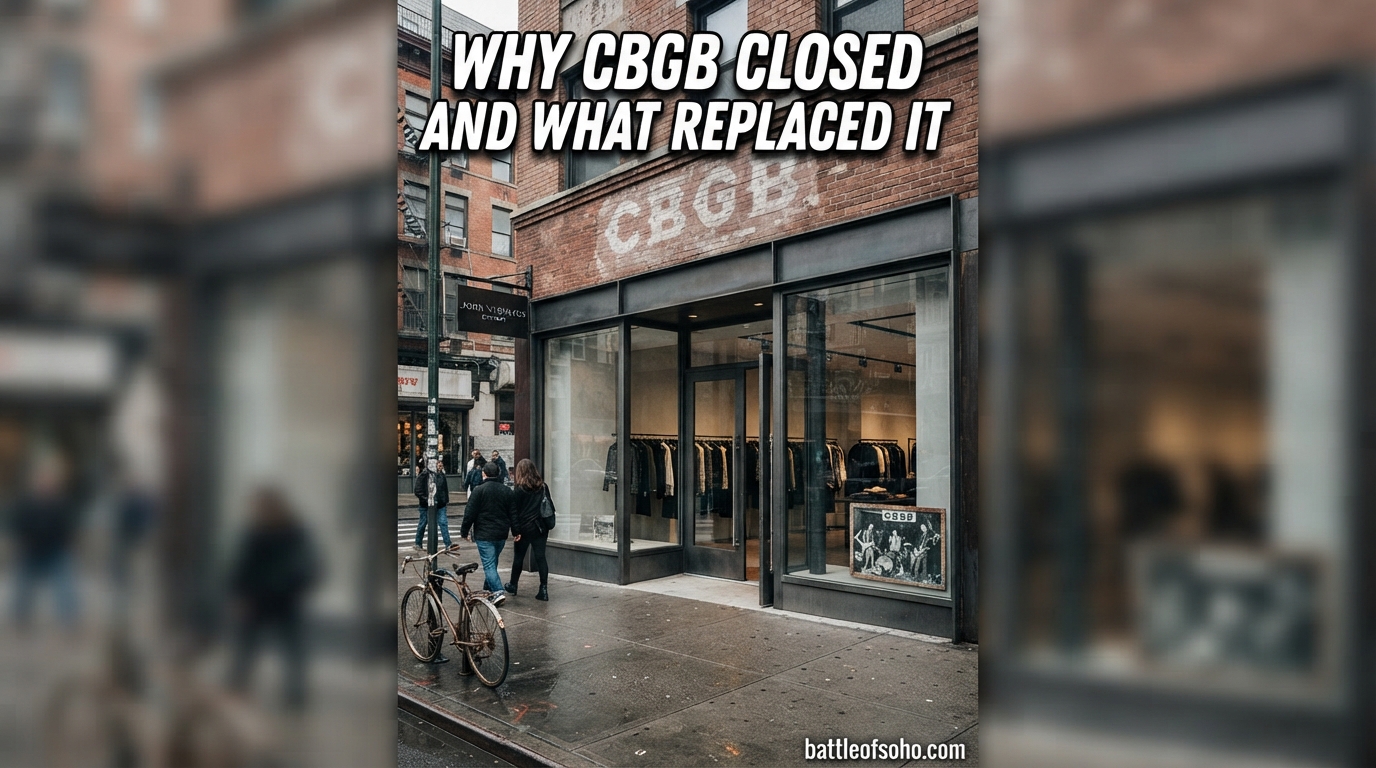
For 33 years, a grimy club at 315 Bowery in Manhattan’s East Village served as ground zero for American punk rock, new wave, and hardcore. CBGB was not a polished venue with velvet ropes and bottle service. It was a dive with sticky floors, blackened walls, and a sound system that somehow made every band sound like they were either about to break through or break apart. When the doors finally shut on October 15, 2006, musicians, fans, and cultural historians around the world asked the same question: why did CBGB close, and what replaced it?
The story of why CBGB closed and what replaced it is more complicated than a simple tale of gentrification or landlord greed. It involves a bitter rent dispute between a club owner and a homeless services nonprofit, a legal battle that dragged through Manhattan civil court, and a cultural institution that many believe was allowed to die. The space where the Ramones, Blondie, Talking Heads, and Patti Smith launched their careers is now a high-end fashion boutique. The CBGB brand survives as a radio station, a festival, and an airport restaurant, but the physical club that changed music history is gone forever.
In this article, we trace CBGB from its unlikely founding in 1973 through its golden era, the rent dispute that sealed its fate, the emotional final show, and everything that has occupied 315 Bowery since. We also connect CBGB’s closure to the broader pattern of New York City losing its iconic cultural venues, a battle that continues to shape the city in 2026.
Table of Contents
CBGB at a Glance: Key Facts
If you are looking for a quick answer to why CBGB closed and what replaced it, here are the essential facts.
Founded: December 1973 by Hilly Kristal at 315 Bowery, Manhattan
Full name: CBGB & OMFUG (Country, Bluegrass, Blues and Other Music for Uplifting Gourmandizers)
Capacity: Approximately 350 people
Closed: October 15, 2006, following a final performance by Patti Smith
Why it closed: A rent dispute with the Bowery Residents’ Committee (BRC), the nonprofit landlord that raised monthly rent from $19,000 to $35,000 and claimed approximately $90,000 in owed back rent
What replaced it: A John Varvatos luxury fashion boutique (2008 to 2014), followed by a Morrison Hotel Gallery and later a Patagonia store
Current status: The building at 315 Bowery was added to the National Register of Historic Places in 2013. The CBGB brand continues through festivals, radio, and merchandise.
What Was CBGB? The Name, The Vision, and The Reality
CBGB’s full name tells you something surprising about its origins. The letters stood for Country, Bluegrass, and Blues. Hilly Kristal, a former Marine and music lover who had previously managed the legendary Village Vanguard jazz club, opened the venue in December 1973 with a straightforward vision: he wanted to present country, bluegrass, and blues music in the Bowery neighborhood.
The venue’s complete name was CBGB & OMFUG. The OMFUG portion stood for Other Music for Uplifting Gourmandizers. A gourmandizer, in Kristal’s playful definition, was someone with a ravenous appetite for music. The name was quirky, wordy, and completely at odds with what the club would actually become famous for.
That original vision lasted only months. The Bowery in 1973 was a neighborhood of flophouses, recovery programs, and abandoned storefronts, not exactly a country music audience. Kristal started booking whatever acts wandered through the door, and the bands that showed up were not playing bluegrass. They were playing loud, fast, raw rock and roll that nobody else in New York City would book.
Television, led by Tom Verlaine and Richard Lloyd, became the first band to play a regular residency at CBGB in 1974. They were followed by the Ramones, Patti Smith, Blondie, and Talking Heads, none of whom fit Kristal’s original country-blues concept. Kristal did not turn them away. He had one rule that became legendary: bands had to play original music. No cover bands were allowed, which meant CBGB became the only place in New York where unsigned, original artists could get stage time.
That single rule, more than anything else, transformed a failing Bowery bar into the most important music venue in American underground history. Kristal never planned for it to happen, but his willingness to let unknown bands play their own songs created an ecosystem where punk rock and new wave could take root and grow.
The Golden Era: Bands That Made CBGB Legendary
The bands that launched at CBGB reads like a hall of fame roster for American alternative music. The Ramones played their first show there in August 1974, blasting through a set of two-minute songs that would define the punk sound for decades. Patti Smith performed poetry and rock at CBGB starting in 1975, blending literary ambition with garage-band energy. Blondie, fronted by Debbie Harry, developed their mix of punk attitude and pop melody on the CBGB stage.
Talking Heads, three art school graduates from Rhode Island, played their first New York gig at CBGB in 1975. David Byrne’s nervous energy and the band’s angular, intellectual rock became a defining sound of the new wave movement. Television’s intricate, dual-guitar compositions gave the venue artistic credibility that extended far beyond three-chord punk.
The scene at CBGB in the mid-1970s was unlike anything before or since. The club was small, dark, and dirty. The walls were covered in band stickers and graffiti. The bathrooms were legendary for their filth. The sound system was basic. None of that mattered. What mattered was that unsigned bands could play original music to an audience that wanted to hear something new.
By the late 1970s, CBGB’s reputation had spread internationally. The Damned, The Police, and other British acts made pilgrimages to play the stage. The Cramps, Dead Boys, and Richard Hell and the Voidoids became CBGB regulars. The club was reviewed in major publications and drew attention from record labels that had never previously scouted the Bowery.
The 1980s brought a different scene to CBGB. Hardcore punk took over, with bands like Agnostic Front, Bad Brains, and the Misfits drawing intense, sweating crowds to Sunday matinee shows. These afternoon concerts became legendary in their own right, creating a second generation of CBGB faithful who never experienced the 1970s punk era but found their own community in the same room.
In the 1990s and 2000s, CBGB continued booking bands even as the neighborhood around it changed dramatically. Green Day, Korn, Guns N’ Roses, and Joan Jett all played the tiny stage. The club had become a pilgrimage site for musicians worldwide. Playing CBGB, even in its later years, carried a significance that no other venue could match.
The Rent Dispute That Killed CBGB
The closure of CBGB was not a sudden event. It was the result of a rent dispute that simmered for years between Hilly Kristal and the Bowery Residents’ Committee, the nonprofit organization that owned the building at 315 Bowery. Understanding this conflict is central to understanding why CBGB closed and what replaced it.
The Bowery Residents’ Committee, or BRC, is a social services nonprofit that provides shelter, food, and rehabilitation programs to homeless and vulnerable populations in New York City. The organization was founded in 1971 and operated programs in the Bowery area long before the neighborhood became fashionable. BRC became the landlord of 315 Bowery and leased the ground-floor commercial space to Kristal for CBGB.
For decades, the arrangement worked. CBGB paid its rent, BRC provided homeless services upstairs, and the two coexisted in a neighborhood that most New Yorkers avoided. But as the East Village gentrified in the late 1990s and early 2000s, real estate values along the Bowery exploded. The building itself was not glamorous, but its location became increasingly valuable.
The dispute centered on two issues. First, BRC claimed that Kristal owed approximately $90,000 in back rent. Kristal disputed this amount, arguing that some of the charges were for improvements BRC had agreed to absorb. Second, BRC sought to raise CBGB’s monthly rent dramatically, from approximately $19,000 per month to $35,000 per month. The increase reflected market rates for commercial space in a rapidly gentrifying area, but it was a figure Kristal said the club could not sustain.
Muzzy Rosenblatt, the executive director of BRC, became the public face of the push to terminate CBGB’s lease. Rosenblatt argued that BRC’s mission was to serve homeless individuals, not to subsidize a music club below market rent. From BRC’s perspective, every dollar of below-market rent was a dollar that could not be spent on shelter beds, meals, and counseling programs for people in crisis.
This is where the moral complexity of the story deepens. The conflict was not a simple case of a greedy corporate landlord evicting a beloved cultural institution. BRC was a nonprofit doing essential work for vulnerable people. Kristal was running a business that had not kept pace with rising costs. Both sides had legitimate positions, which is why so many observers felt CBGB was not killed but rather allowed to die, the victim of forces that nobody could fully control.
The legal battle played out in Manhattan Civil Court in 2005 and 2006. A judge ruled that CBGB’s lease could be terminated due to the disputed back rent, though Kristal had already paid the amount in question. The ruling effectively ended CBGB’s tenancy. Kristal explored options to keep the club open, including seeking landmark designation and rallying public support, but none of these efforts changed the legal outcome.
Celebrities and musicians rallied to CBGB’s defense. Flea of the Red Hot Chili Peppers spoke publicly about the club’s importance. The music community organized benefit concerts and petition drives. None of it moved the needle. BRC was within its legal rights to terminate the lease, and the court upheld that position. By mid-2006, Kristal accepted that CBGB would close.
Could CBGB have been saved? In hindsight, a compromise might have been possible if both sides had been willing to meet earlier. BRC might have accepted a phased rent increase rather than an immediate jump. Kristal might have found additional revenue streams sooner. But by the time negotiations became serious, positions had hardened, trust had collapsed, and the clock had run out.
The Final Show: Patti Smith Closes the Doors
CBGB closed the way it lived: loud, emotional, and on its own terms. The final show took place on October 15, 2006, with Patti Smith headlining the last night. Smith was the fitting choice. She had been one of the first artists to define the CBGB sound in the mid-1970s, and her blend of poetry and punk embodied everything the club represented.
Smith’s final set ran over three hours. She played songs from throughout her career, spoke between numbers about what CBGB had meant to her and to music history, and paid tribute to the artists who had come through the venue. At one point, she acknowledged the Ramones, several of whose members had already passed away. The moment was a reminder that CBGB was not just a club but a community, and that community was aging and dispersing.
Flea of the Red Hot Chili Peppers joined Smith on stage during the encore, adding to the sense of generational connection. The audience included longtime CBGB regulars, musicians who had played the stage, journalists, and fans who had traveled from across the country to be present for the final night. The atmosphere was simultaneously celebratory and mournful.
Smith closed the show with “Elegie,” a somber, poetic piece that she had used to close shows for decades. On this night, the song felt like a funeral and a graduation at once. When the final note faded, CBGB was effectively over. The doors at 315 Bowery would not reopen for live music.
The weeks leading up to the final show were their own chapter. Kristal booked a farewell run of concerts featuring bands associated with different eras of CBGB. Agnostic Front, The Dictators, and other hardcore and punk veterans played their last sets on the stage. Photographers documented the interior, knowing that the graffiti-covered walls, the worn stage, and the legendary filth would soon be gone or radically altered.
What Replaced CBGB at 315 Bowery
The question of what replaced CBGB has a multi-part answer because 315 Bowery has gone through several occupants since the club closed in 2006. Each new tenant has engaged with the building’s history in a different way, sometimes respectfully and sometimes controversially.
The first major occupant was John Varvatos, the luxury menswear designer, who opened a boutique at 315 Bowery in April 2008. Varvatos made a deliberate decision to preserve elements of the original CBGB interior. The walls still bore the decades of band stickers, graffiti, and markings that musicians and fans had left behind. Varvatos kept much of this intact, encasing the original walls behind glass or leaving them exposed as design features.
The decision to preserve the CBGB interior was met with mixed reactions. Some fans saw it as a genuine act of respect, a way of honoring the building’s history even as it sold expensive clothing. Others viewed it as commodification, turning punk rock’s gritty birthplace into a theme park backdrop for luxury fashion. The reality was somewhere in between. Varvatos did preserve the interior, and fans could visit and see the original walls, but the context had fundamentally changed.
John Varvatos occupied 315 Bowery until 2014, when financial troubles led the designer to close several retail locations. The space then became home to a Morrison Hotel Gallery outpost, which specialized in music photography. This felt to many like a more natural fit, a gallery dedicated to music imagery housed in a building that had been central to music history.
The Morrison Hotel Gallery did not stay long. By the late 2010s, 315 Bowery had changed hands again. A Patagonia outdoor clothing store moved into the space, representing another shift from music to retail. The building’s exterior remained recognizable to CBGB pilgrims, but the interior had been altered multiple times.
Despite these changes, 315 Bowery remains a destination for music fans visiting New York City. Fans still travel to the address to photograph the building, stand on the sidewalk where crowds once lined up for shows, and pay quiet tribute to what happened there. The building may no longer be a music venue, but its significance has not faded.
In 2013, the building at 315 Bowery was added to the National Register of Historic Places as part of the Bowery Historic District. This designation recognized the cultural and historical significance of the structure, including its association with CBGB. While National Register status does not prevent commercial use of the interior, it ensures that the building’s place in American cultural history is formally documented and preserved.
What Happened to 313 Bowery: CB’s Gallery and Beyond
CBGB was not just one space. Next door at 313 Bowery, Hilly Kristal operated CB’s 313 Gallery, an art and performance space that hosted exhibitions, smaller bands, and experimental music. The gallery was an extension of the CBGB ethos, providing a platform for artists who did not fit the main stage’s format.
After CBGB closed in 2006, 313 Bowery went through its own series of occupants. CBGB Fashions, a merchandise store selling CBGB-branded clothing and memorabilia, operated for a time at a different location on St. Mark’s Place, keeping the brand commercially alive even as the physical venues disappeared.
The space at 313 Bowery later became a Morrison Hotel Gallery location before transitioning again. As of 2022, 313 Bowery has been home to Spazio Amanita, a contemporary art gallery. The transformation from punk rock incubator to high-end art gallery is a fitting symbol of the Bowery’s broader evolution from skid row to one of Manhattan’s most expensive corridors.
Fans who visit the Bowery today will find a street that bears almost no resemblance to the gritty, dangerous neighborhood where CBGB took root. The flophouses have been replaced by boutique hotels. The recovery programs still exist but are surrounded by luxury condos and high-end restaurants. The Extra Place alley behind CBGB, once a grim service corridor, is now a landscaped pedestrian mall.
CBGB’s Enduring Legacy: Brand, Festival, and Radio
While the physical club at 315 Bowery is gone, the CBGB name has proven remarkably durable. The brand has been bought, sold, and reinvented multiple times since 2006, taking on new forms that would have been unimaginable to Hilly Kristal.
In 2011, a group of anonymous investors purchased the remaining CBGB assets, including the name, logo, and intellectual property. The new owners set about building a modern brand ecosystem around the CBGB identity. This included launching CBGB Radio on iHeartRadio, a streaming station that plays punk, new wave, and alternative music associated with the club’s legacy.
The CBGB Festival has become the most visible expression of the brand’s continued relevance. The festival has taken various forms over the years, presenting concerts, film screenings, and events across New York City. A notable edition took place in Brooklyn at Under the K Bridge Park, bringing the CBGB name to a new generation of music fans. The festival represents an effort to carry the club’s spirit forward even without the original venue.
Perhaps the most unexpected destination for the CBGB brand is Newark Liberty International Airport. A CBGB L.A.B. (Listen and Buy) location opened in the airport, offering travelers a taste of CBGB-branded food, music, and merchandise. For longtime fans, seeing the CBGB logo in an airport terminal is surreal, a far cry from the sticky floors and deafening volume of the original club. But it also speaks to the brand’s enduring recognition and commercial power.
Hilly Kristal did not live to see most of these developments. He passed away on August 28, 2007, less than a year after CBGB closed. Kristal had announced plans to relocate the club to Las Vegas, carrying the name and concept to a new city, but he died before those plans could materialize. His daughter, Lisa Kristal Burgman, became involved in managing the CBGB legacy and was part of the legal and business decisions that followed.
The National Register of Historic Places designation in 2013 was a posthumous recognition of what Kristal had built. The building at 315 Bowery is now formally documented as a site of national cultural significance. The awning that once read CBGB is gone, replaced by retail signage, but the building itself stands as a monument to one of the most important chapters in American music history.
The Battle of Soho: CBGB and NYC Venue Displacement
CBGB’s closure was not an isolated event. It was part of a decades-long pattern of New York City losing its iconic music venues and cultural spaces to rising rents, gentrification, and development pressure. Understanding this broader context is essential to understanding why CBGB’s loss still resonates.
Max’s Kansas City, the restaurant and club where Andy Warhol held court and the Velvet Underground performed, closed in 1981. The Mudd Club, a downtown art and music landmark, shut down in 1983. The Palladium, a massive concert hall on 14th Street, was demolished in 1997 to make way for a New York University dormitory. The Limelight, housed in a former church, closed and reopened multiple times before becoming a retail market. Each closure erased a piece of New York’s cultural architecture.
CBGB’s closure in 2006 became the symbol of this pattern because the club was so deeply embedded in the identity of American punk rock. When CBGB died, it felt like the city was making a statement about what it valued and what it was willing to lose. The fact that the landlord was a homeless services nonprofit, not a corporate developer, made the story even more complex. There was no villain to blame, just two missions that could not coexist.
The pattern continues in 2026. Music venues across New York City face the same pressures that killed CBGB: rising rents, changing neighborhoods, and audiences that increasingly consume music through streaming rather than live shows. Independent venues in Brooklyn, Queens, and Manhattan fight to survive in a real estate market that offers no discount for cultural significance.
This is the battle we document at Battle of Soho. The story of why CBGB closed and what replaced it is not just nostalgia. It is a warning about what happens when cities fail to protect the spaces where culture is born. The next CBGB exists somewhere right now, in a basement, a warehouse, or a storefront, and the forces that closed the original are still at work.
FAQs
What did CBGB and OMFUG mean?
CBGB stood for Country, Bluegrass, and Blues, and OMFUG stood for Other Music for Uplifting Gourmandizers. Founder Hilly Kristal chose the name to reflect his original vision of presenting country and blues music. The club became famous for punk and new wave instead, but the name never changed.
Why did CBGB close down?
CBGB closed because of a rent dispute with its landlord, the Bowery Residents Committee, a nonprofit providing homeless services. The BRC raised monthly rent from approximately $19,000 to $35,000 and claimed about $90,000 in back rent. A Manhattan Civil Court judge upheld the lease termination in 2006, and the club held its final show on October 15, 2006.
What famous bands started at CBGB?
CBGB launched the careers of the Ramones, Blondie, Talking Heads, Television, and Patti Smith in the 1970s. Later eras brought hardcore punk bands like Agnostic Front, Bad Brains, and the Misfits. In the 1990s and 2000s, acts including Green Day, Korn, and Joan Jett also played the CBGB stage.
What replaced CBGB?
The space at 315 Bowery was first replaced by a John Varvatos luxury fashion boutique in 2008, which preserved some of the original CBGB graffiti and interior walls. After Varvatos left in 2014, the space housed a Morrison Hotel Gallery and later a Patagonia store. The building was added to the National Register of Historic Places in 2013.
What is CBGBs now?
The CBGB brand continues today through CBGB Radio on iHeartRadio, the CBGB Festival held in New York City (including a recent edition in Brooklyn), a CBGB L.A.B. location at Newark Airport, and CBGB-branded merchandise. The original venue at 315 Bowery is no longer a music venue.
What year did CBGB close?
CBGB closed on October 15, 2006. The final performance was a three-hour set by Patti Smith, who had been one of the defining artists of the CBGB scene since the mid-1970s.
Conclusion
CBGB closed because a rent dispute between Hilly Kristal and the Bowery Residents’ Committee could not be resolved, and a court upheld the lease termination in 2006. The club’s final show on October 15 of that year, headlined by Patti Smith, marked the end of 33 years of music history at 315 Bowery. What replaced CBGB was a succession of retail tenants, starting with a John Varvatos boutique that preserved fragments of the original interior and continuing through gallery and clothing store occupancies to the present day.
The story of why CBGB closed and what replaced it is ultimately a story about how cities decide what is worth protecting. The building still stands, recognized on the National Register of Historic Places, but the function that made it legendary is gone. The CBGB brand survives as a festival, a radio station, and an airport novelty, but no amount of merchandising can recreate what was lost when the doors shut on the Bowery.
The lesson of CBGB is not that the past can be preserved through plaques and T-shirts. It is that the conditions which allow culture to emerge, cheap rent, permissive booking policies, neighborhoods on the margins, are fragile and temporary. When those conditions disappear, the culture they produced becomes history. The next battle for New York’s cultural spaces is happening right now, and the outcome will determine what the next generation remembers.