
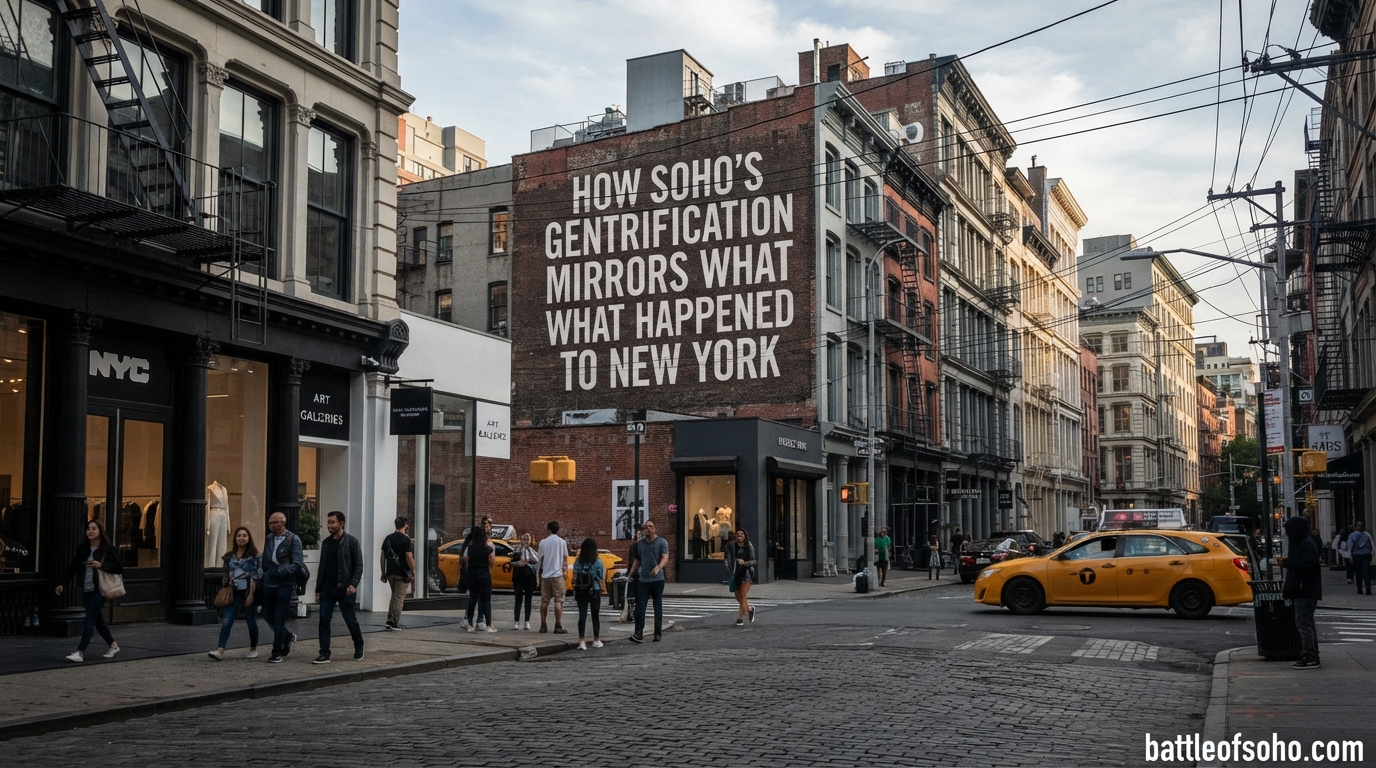
Walk down Spring Street today and you will pass Prada, Chanel, and Apple Stores lining cobblestone blocks that once smelled of machine oil and printer’s ink. The contrast tells a story that goes far beyond one neighborhood. SoHo’s gentrification mirrors what happened to New York in a way no other Manhattan district can claim. It was the original template, the proof of concept for a transformation that would repeat across the city for the next sixty years.
In short: SoHo’s gentrification began in the 1960s when artists moved into abandoned cast-iron factory lofts south of Houston Street, attracted by cheap rent and enormous spaces. They fought for legal residency, won zoning changes, and inadvertently triggered a wave of residential conversion, gallery openings, luxury retail, and skyrocketing property values that displaced both industry and artists alike. This exact pattern, from industrial decline to artist occupation to luxury neighborhood, then replicated across Williamsburg, Bushwick, the East Village, the Lower East Side, and beyond, making SoHo the prototype for how New York City would transform in the late twentieth and early twenty-first centuries.
Understanding how SoHo’s gentrification mirrors what happened to New York means understanding the playbook itself. Every neighborhood that followed, from Brooklyn to the Bronx, borrowed from the script that SoHo wrote. The artists came first, the galleries followed, then the boutiques, then the condos, and finally the chains. By the time anyone noticed the pattern, it was already too late to stop.
Our team spent months tracing this history through archival records, oral histories, urban planning studies, and the experiences of residents who lived through the transformation. What emerged is a story not just about real estate or architecture, but about how cities decide who belongs, who gets to stay, and who gets pushed out. SoHo’s story is New York’s story, and it is still being written.
Table of Contents
Industrial SoHo: Cast Iron, Factories, and Working-Class Life Before the Artists
Before SoHo was a shopping destination or an artist enclave, it was simply a manufacturing district. The neighborhood, whose name derives from its location South of Houston Street, was built in the mid-to-late 1800s as a commercial and industrial hub. Textile manufacturers, printers,warehouses, and small factories filled blocks of distinctive cast-iron buildings that would later become famous as architectural treasures.
Cast-iron architecture was the defining feature of the area. Builders constructed these facades from pre-fabricated iron components cast in molds, allowing for ornate classical details at a fraction of the cost of carved stone. The buildings featured massive windows to let in natural light for factory workers, high ceilings to accommodate industrial machinery, and wide floor plates for production lines. Between 1840 and 1880, developers erected hundreds of these structures, creating the largest concentration of cast-iron architecture in the world.
By the early twentieth century, the area was a working industrial zone. The garment industry had a significant presence, alongside printing companies, textile merchants, hardware suppliers, and light manufacturing. Workers streamed in each morning, operated looms and presses, loaded trucks at loading docks, and went home at night. It was not glamorous, but it was productive. Thousands of industrial jobs depended on these blocks.
Then deindustrialization hit. After World War II, manufacturing began leaving New York City for cheaper labor markets in the American South and overseas. Companies that had operated in SoHo for generations closed their doors or relocated. By the late 1950s, entire floors of cast-iron buildings sat empty. Property owners struggled to find tenants. The area earned a reputation as a blighted, dangerous industrial wasteland. The city government considered it a problem to be solved, not a neighborhood to be preserved.
That characterization would prove fateful. When planners looked at SoHo in the late 1950s and early 1960s, they did not see cast-iron facades worth saving. They saw underused land in a declining district, exactly the kind of blank slate that urban renewal projects were designed to clear. The stage was set for a battle that would determine whether SoHo would be demolished for a highway or saved for a future nobody had imagined yet.
The Highway That Never Was: How Community Opposition Saved SoHo
The most consequential event in SoHo’s history almost destroyed it entirely. In the 1960s, Robert Moses, New York’s powerful transportation and construction czar, proposed the Lower Manhattan Expressway, commonly known as LoMEX. The highway would have cut a massive swath through SoHo, Little Italy, and the Lower East Side, connecting the Holland Tunnel to the Manhattan and Williamsburg Bridges with a ten-lane elevated expressway.
Moses envisioned LoMEX as part of a larger network of urban highways that would move automobile traffic efficiently through Manhattan. The project had powerful political support and seemed inevitable. Plans called for demolishing entire blocks of cast-iron buildings to make way for the expressway right-of-way. Had the highway been built, there would be no SoHo as we know it today, no artist lofts, no gallery district, no luxury shopping mecca. The buildings that would house Donald Judd’s studio and hundreds of other creative pioneers would have been reduced to rubble.
The opposition was led by Jane Jacobs, the urbanist and activist whose 1961 book The Death and Life of Great American Cities challenged the entire philosophy of top-down urban planning. Jacobs organized community resistance, packed public hearings, and argued that the highway would destroy vibrant, functioning neighborhoods to serve suburban commuters. She was joined by local residents, business owners, and a growing coalition of preservationists who recognized the architectural value of the cast-iron district.
The fight lasted years. Moses pushed relentlessly, but the political tide turned. In 1969, Mayor John Lindsay officially killed the Lower Manhattan Expressway, dealing Moses the most significant defeat of his career. The highway was dead, and SoHo’s buildings would stand.
This victory had an enormous unintended consequence. The buildings that survived the highway threat were still empty or underused industrial spaces. By saving them from demolition, the anti-highway coalition inadvertently preserved exactly the raw material that artists would need: large, cheap, vacant lofts in architecturally distinctive buildings close to Manhattan’s cultural core. The defeat of LoMEX was the precondition for everything that followed.
The Artist Invasion: How Creative Pioneers Discovered the Lofts
In the early 1960s, a handful of artists began exploring the empty industrial buildings south of Houston Street. They were looking for something Manhattan’s traditional artist neighborhoods could no longer provide: large, affordable spaces with enough room to paint, sculpt, and install ambitious work. The lofts of SoHo offered exactly that, thousands of square feet per floor, enormous windows, ceilings fourteen feet high or taller, and floors strong enough to support heavy equipment and materials.
The rent was almost unimaginably cheap by today’s standards. In the early 1960s, an artist could rent an entire floor of a cast-iron building for thirty to fifty dollars a month. Some artists paid even less by taking on raw, unrenovated spaces that lacked basic residential amenities like kitchens, bathrooms, or hot water. They hauled in portable stoves, installed makeshift showers, and slept on mattresses in the corner of their studios. It was technically illegal, the buildings were zoned for manufacturing, not residential use, but the city had little incentive to enforce code violations in a district it considered blighted.
The artist who would become most associated with this migration was Donald Judd, the minimalist sculptor. In 1968, Judd purchased a five-story cast-iron building at 101 Spring Street for sixty-eight thousand dollars. He renovated it into a combined living and studio space, installing his work across multiple floors in what became one of the first and most influential live-work loft conversions in the neighborhood. Judd’s presence lent credibility to the area and attracted other artists who wanted to be near the scene.
What made SoHo’s artist community distinctive was not just the loft living, it was the density and intensity of creative activity. Within a few years, dozens of artists had moved in, and they began opening galleries in their own buildings. The SoHo gallery scene of the late 1960s and early 1970s was unlike anything New York had seen: artist-run spaces showing experimental, avant-garde work in raw industrial settings. The 112 Workshop, the Paula Cooper Gallery, and dozens of others created a cultural energy that drew critics, collectors, and curators from around the world.
There was also a vibrant LGBTQ+ community within early SoHo’s artist scene. Gay and lesbian artists found in the loft district a space where they could live and work with a degree of freedom that more traditional neighborhoods did not always offer. This aspect of SoHo’s cultural history is often overlooked in favor of the better-known narrative about straight male artists like Judd, but it was part of what made the neighborhood’s early creative culture so rich and so ahead of its time.
The artists who moved into SoHo in this period genuinely believed they were building something new. They were not trying to gentrify anything. They were looking for affordable space to make art, and they found it in a district that the city had effectively abandoned. But what they built, a community of creative people living and working in beautiful old buildings, would turn out to be the most desirable real estate formula in the world.
Fighting for Legality: The Artist-in-Residence Movement and Zoning Battles
The problem was that living in SoHo was illegal. The entire district was zoned M1-5, a manufacturing classification that prohibited residential use. Artists who occupied the lofts were technically squatters, living in buildings that lacked certificates of occupancy for housing. They faced the constant threat of eviction, building inspections, and code violations. City officials could shut them down at any time, and some artists were indeed forced out when the Buildings Department cracked down.
This precarious legal situation led to one of the most remarkable organizing efforts in New York City history. Artists formed groups like the Artist-Tenants Association and the SoHo Artists Association to lobby for legal recognition. They argued that they were bringing life and economic activity to a district the city had given up on. They pointed out that they were maintaining buildings, deterring crime, and preserving architecture that would otherwise deteriorate. They made a case that artist residency was a legitimate land use that benefited the city.
A key moment came with the Chester Rapkin study. In the early 1960s, the city commissioned urban planner Chester Rapkin to study the SoHo industrial district and assess whether it was truly blighted. Conventional wisdom held that the area was dying and its industrial jobs were disappearing. But Rapkin’s research told a more nuanced story. He found that while large factories were leaving, smaller manufacturing businesses, printers, garment workers, hardware merchants, were still active and still employed thousands of people. The district was not dead, it was transitioning.
Rapkin’s findings complicated the narrative. They showed that artists were not moving into truly vacant buildings, they were displacing functioning industrial businesses. This tension between artists and industry would persist throughout SoHo’s transformation. But the study also demonstrated that the old zoning framework was inadequate for a district that was changing in ways no one had anticipated.
The political breakthrough came in 1971. After years of advocacy, the city created the Artist-in-Residence program, which allowed certified artists to live legally in SoHo’s manufacturing buildings. To qualify, an artist had to be certified by the Department of Cultural Affairs as a professional creative worker. Once certified, they could obtain a permit to occupy a loft as a combined living and working space.
The AIR program was hailed as a progressive solution, but it contained the seeds of its own undoing. By legalizing residential use in SoHo, even limited to certified artists, the city opened the door to broader residential conversion. Property owners now had permission to think of their buildings as residential assets rather than industrial ones. And once residential use was permitted for artists, the question of who counted as an artist became the next battleground.
Many artists themselves opposed the spread of legalization. They recognized that making loft living fully legal for everyone would invite developers, speculators, and wealthy non-artists who would drive up prices. Some artists fought to keep the AIR restrictions strict, hoping to preserve the neighborhood for working creatives. But the economic forces unleashed by legalization were already too powerful to contain.
The Great Displacement: How Artists and Industry Were Both Priced Out
SoHo’s gentrification involved a double displacement that is often misunderstood. The first displacement was industrial. As artists moved in and the neighborhood gained cultural cachet, property owners found they could charge higher rents to artists and gallery owners than to manufacturing tenants. Printers, garment shops, and warehouse operators faced rising rents and shrinking space. Many were forced to relocate to other parts of the city or close entirely.
This first wave of displacement is frequently overlooked because it did not fit the standard gentrification narrative. When we talk about gentrification, we usually focus on residential tenants being pushed out by wealthier newcomers. In SoHo, the first people displaced were not residents at all, they were workers and small business owners. The manufacturing jobs that Rapkin had documented disappeared, replaced by art galleries and eventually by retail stores and restaurants. An entire industrial ecosystem was erased.
The second displacement was the one most people recognize: the artists themselves being priced out. As SoHo became known as a trendy art district, it attracted attention from outside the creative community. Wealthy professionals, attracted by the architectural character and the cultural scene the artists had created, began buying lofts and renovating them into luxury residences. Real estate developers recognized the opportunity and began purchasing buildings for conversion.
The J-51 tax abatement program accelerated this process. Designed to encourage the renovation of older buildings, J-51 provided property tax breaks for residential conversion of industrial and commercial structures. Developers used these incentives to transform SoHo’s lofts into high-end apartments. The same large windows and high ceilings that had attracted artists now became selling points in luxury real estate listings.
Property values climbed steeply. A loft that an artist had rented for fifty dollars a month in the early 1960s could command thousands by the late 1970s. Purchase prices followed the same trajectory. The artists who had bought buildings cheaply in the 1960s, like Donald Judd at 101 Spring Street, found themselves sitting on extremely valuable real estate. But the artists who rented, which was most of them, faced rents they could no longer afford.
By the 1980s, the gallery scene was changing. Commercial galleries that catered to wealthy collectors replaced the artist-run spaces that had defined SoHo’s early culture. Chain retail stores began moving in, drawn by the foot traffic and the neighborhood’s fashionable reputation. The area that had been an underground art scene became a shopping district. The cycle was complete: artists had transformed an industrial wasteland into a cultural destination, and then been displaced by the very forces their creativity had unleashed.
The Economic Data: How Property Values and Rent Exploded in SoHo
One of the most striking gaps in the coverage of SoHo’s transformation is quantitative economic data. No competitor provides a detailed picture of how dramatically property values and rents changed over time. Yet public records and historical estimates paint a staggering picture.
In the early 1960s, rent for an entire floor of a SoHo loft building ran roughly thirty to seventy dollars per month. Adjusted for inflation, that is approximately three hundred to six hundred dollars in 2026 dollars. Today, a comparable loft space in SoHo commands anywhere from five thousand to fifteen thousand dollars per month, and many luxury loft apartments list for significantly more. That represents a real increase of more than tenfold even after accounting for inflation.
Purchase prices tell an even more dramatic story. When Donald Judd bought 101 Spring Street in 1968, he paid sixty-eight thousand dollars for a five-story building. In 2026, a similar property in SoHo would easily list for fifteen to twenty-five million dollars or more. The building’s value has increased by a factor of more than two hundred. Even accounting for renovation costs and inflation, the appreciation is extraordinary.
The demographic shift matched the economic transformation. In the 1960s, SoHo had virtually no residential population; it was an industrial district. By 1980, the artist community numbered in the hundreds. By 2026, SoHo is one of the most affluent zip codes in the United States, with median household incomes well above two hundred thousand dollars and median property values exceeding three million dollars.
The commercial transformation was equally stark. In the 1960s, the businesses in SoHo were printers, garment manufacturers, and hardware wholesalers. By the 1990s, the primary commercial tenants were luxury fashion boutiques, art galleries, and high-end restaurants. By 2026, chain retail dominates Broadway and the main commercial corridors, with flagship stores for global brands that have no connection to the neighborhood’s artistic heritage.
How SoHo’s Gentrification Mirrors What Happened to New York
SoHo’s gentrification mirrors what happened to New York because it established the exact five-stage pattern that would repeat in nearly every transitioning neighborhood across the city. Understanding these stages explains why gentrification happens the same way everywhere, and why it is so difficult to stop once it begins.
Stage 1: Industrial Decline. Manufacturing leaves, buildings empty out, property values drop, and the area acquires a reputation as dangerous or undesirable. SoHo in the 1950s, Williamsburg in the 1980s, Bushwick in the 1990s.
Stage 2: Artist Discovery. Creative people seeking affordable space move into empty industrial or commercial buildings. They are attracted by low rents, large spaces, and the freedom of an unregulated environment. They live semi-legally and build a cultural scene.
Stage 3: Legalization and Legitimization. The artist community organizes and wins some form of legal recognition. Property owners begin to see residential or commercial potential. Media coverage draws attention. The neighborhood becomes known as cool and edgy.
Stage 4: Commercial and Residential Conversion. Developers and wealthier residents move in, attracted by the cultural scene and architectural character the artists created. Rents rise. Galleries, boutiques, and restaurants replace industrial tenants. The original artist community begins to be priced out.
Stage 5: Luxury Neighborhood. Chain retail, luxury condos, and high-income residents dominate. The neighborhood’s character is fundamentally transformed. What was once affordable and creative is now exclusive and expensive. The cycle is complete, and the pattern begins again in the next affordable neighborhood down the line.
This is exactly what happened to New York City as a whole in the late twentieth and early twenty-first centuries. The SoHo model was not just a pattern, it became a conscious strategy. Real estate developers, city planners, and even arts organizations began using the same formula deliberately. They would identify an industrial or working-class neighborhood, encourage artist settlement, wait for the area to become trendy, and then capitalize on the resulting property value increases. The artist-led gentrification cycle was industrialized.
The SoHo Model Spreads: Williamsburg, Bushwick, and the Brooklyn Effect
The clearest evidence that SoHo’s gentrification mirrors what happened to New York is the way the pattern replicated across Brooklyn and Manhattan with mathematical precision. Each neighborhood followed the same arc, often at an accelerating pace, as the playbook became better known.
Williamsburg is the most direct parallel. In the 1990s, artists priced out of Manhattan began crossing the East River into North Brooklyn, where industrial lofts along the waterfront offered the same combination of cheap rent and large spaces that SoHo had provided thirty years earlier. The neighborhood went through the identical stages: industrial decline, artist discovery, legalization battles, gallery and bar openings, then explosive rent increases. The 2005 rezoning of the Williamsburg waterfront, which allowed luxury residential towers on former industrial land, was the equivalent of SoHo’s Artist-in-Residence legalization, it opened the floodgates to development. By the 2010s, Williamsburg had become one of the most expensive neighborhoods in New York. The cycle that took SoHo thirty years to complete took Williamsburg about fifteen.
Bushwick followed next. As Williamsburg became unaffordable, artists moved east into neighboring Bushwick, an industrial and working-class neighborhood with even cheaper rents. The pattern repeated: studios opened, galleries followed, articles were written, and rents began climbing. The Bushwick Collective, an open-air street art project, became the equivalent of SoHo’s gallery scene, a cultural attraction that drew visitors and signaled the neighborhood was transforming. By 2026, Bushwick is in Stage 4, with luxury apartments rising alongside the remaining industrial buildings.
The East Village and Lower East Side followed their own versions of the cycle. These were residential rather than industrial neighborhoods, but the pattern was the same: artists and immigrants created a vibrant cultural scene, the scene attracted attention, property values rose, and longtime residents were displaced. The East Village’s transformation from a working-class immigrant neighborhood to a punk and arts hotspot to a luxury district mirrors SoHo’s arc almost exactly, just with brownstones instead of cast-iron lofts.
Tribeca is a special case because it was explicitly created as a safety valve for SoHo. When demand for SoHo lofts exceeded what the Artist-in-Residence program could accommodate, the city legalized residential use in neighboring Tribeca, another former industrial district with large loft buildings. Tribeca became the overflow zone for wealthy buyers who wanted the SoHo loft aesthetic but could not get into SoHo itself. Today, Tribeca is the most expensive neighborhood in New York City by median home price.
The South Bronx is widely cited as the next frontier. Real estate listings already use language lifted directly from the SoHo playbook, describing the area as having raw industrial character, artist potential, and cultural authenticity. Whether the cycle can be stopped or managed differently this time remains the open question of New York’s future.
Reddit users on r/Urbanism and r/AskNYC have noted this pattern repeatedly. One common observation is that East Williamsburg still feels like Williamsburg did in 2002, meaning the cycle is already repeating one neighborhood over. The SoHo model is not just a historical phenomenon; it is an active process that continues to reshape New York in real time.
The Architecture of Gentrification: Cast-Iron Buildings as a Template
SoHo’s cast-iron buildings played a more important role in the neighborhood’s transformation than is usually acknowledged. These structures were not just incidental backdrops to the artist story; they were active participants in creating the conditions for gentrification. The architecture itself was the draw.
The features that made cast-iron buildings ideal for artists, large windows, high ceilings, open floor plans, solid construction, are the same features that make them desirable as luxury residences. When artists moved in, they discovered and publicized the aesthetic appeal of these industrial spaces. Exposed brick walls, original wooden floors, and cast-iron column details became design elements that would define the loft aesthetic for decades. The raw, unfinished character that artists found practical became a style that wealthy buyers would pay millions to replicate.
In 1973, the city designated the SoHo Cast-Iron Historic District, preserving approximately twenty-six blocks of cast-iron architecture. This landmark status was intended to protect the buildings from demolition and inappropriate alteration. But it had an unintended economic effect: by officially designating these buildings as historically significant, the city confirmed that they were special, rare, and worth preserving. That recognition increased their value and made them even more attractive to wealthy buyers and developers.
This is one of the central paradoxes of preservation-led gentrification. Historic designation protects buildings from being destroyed, but it also makes them more desirable and more expensive, which can displace the very people who fought for preservation in the first place. The artists and activists who campaigned for SoHo’s landmark status were trying to save the neighborhood’s character. Instead, they helped create the conditions that would transform it beyond recognition.
The cast-iron loft aesthetic that originated in SoHo has since been replicated across the world. Developers in cities from Los Angeles to London now build new condominiums designed to look like converted industrial lofts, complete with exposed brick, oversized windows, and open floor plans. SoHo did not just create a gentrification model; it created an architectural style that signals gentrification wherever it appears.
Current Debates: Is SoHo Still Gentrifying in 2026?
SoHo’s transformation is not entirely a closed chapter. The neighborhood remains a battleground for competing visions of what New York should be, and the policy debates of 2026 echo the conflicts of the 1970s.
In 2026, the city approved the SoHo/NoHo rezoning plan, the first major zoning change in the area in decades. The plan allows taller residential buildings and mixed-use development in a district that had been tightly restricted. Supporters argue the rezoning will create more housing, including affordable units, in one of the city’s most exclusive neighborhoods. Critics contend it will accelerate displacement, destroy the neighborhood’s scale and character, and primarily benefit luxury developers.
The rezoning debate mirrors the Artist-in-Residence battles of the 1970s. Then, as now, the question was whether legalization and development would benefit the existing community or pave the way for wealthier newcomers. Then, as now, artists and activists found themselves on both sides of the issue, some arguing for more housing and others for preservation of the status quo.
Meanwhile, the remaining artist community in SoHo continues to shrink. The AIR program still exists, but certified artists living in SoHo lofts are increasingly rare. Property owners have found ways to convert buildings to unrestricted residential use, and the artist certification requirement has become more of a historical artifact than an active policy tool. The neighborhood that artists built is no longer a place where most artists can afford to live.
The broader gentrification debate in New York has shifted to YIMBY versus NIMBY politics, with some arguing that more development is the only solution to the city’s housing crisis and others warning that new construction primarily serves luxury buyers. SoHo’s history offers lessons for both sides: legalization and development can create housing, but without strong affordability protections, they can also accelerate displacement.
FAQs
Is gentrification really bad?
Gentrification is genuinely complex and does not have a simple good or bad answer. It brings investment, improved safety, better services, and renovated infrastructure to neglected areas. But it also displaces longtime residents and small businesses, erases cultural identity, and homogenizes neighborhoods. SoHo’s transformation illustrates both sides: the neighborhood gained world-class galleries and restored architecture, but lost its manufacturing economy and eventually its artist community. The harm depends largely on whether existing residents are protected during the transition, and in most NYC cases, they have not been.
How did NYC deal with gentrification in the past?
New York City’s primary early response to gentrification was the Artist-in-Residence program established in 1971, which allowed certified artists to live legally in SoHo’s manufacturing buildings. This was a unique attempt to manage transformation by reserving space for a specific group. However, the program ultimately failed to prevent broader displacement because it could not control market forces once residential use was legalized. Other responses have included rent stabilization laws, the J-51 tax abatement program, and inclusionary zoning requirements, but none have fully stopped the gentrification cycle that SoHo initiated.
What is SoHo culture?
SoHo culture emerged in the 1960s and 1970s when artists transformed industrial lofts into live-work spaces, creating a distinctive blend of industrial aesthetics, avant-garde art, and countercultural community. It was characterized by cast-iron architecture, underground artist-run galleries, minimalist art installations, and a DIY ethos. SoHo culture was one of the most influential artistic movements in American urban history, establishing the loft-living aesthetic and the artist-district model that would be copied around the world. Today, the original culture has largely been replaced by luxury retail, though its architectural and artistic legacy remains.
How did the Soho-i-fication of Williamsburg happen?
Williamsburg underwent the same artist-led gentrification cycle as SoHo but at a much faster pace. In the 1990s, artists priced out of Manhattan crossed into North Brooklyn’s industrial waterfront lofts seeking cheap rent and large spaces. Galleries, bars, and music venues followed, making the neighborhood trendy. The 2005 waterfront rezoning allowed luxury high-rises, triggering explosive rent increases. What took SoHo roughly thirty years to complete took Williamsburg about fifteen. By the 2010s, Williamsburg had become one of the most expensive neighborhoods in New York, completing the identical five-stage cycle from industrial decline to luxury destination.
Are the different perspectives on NYC gentrification valid?
Yes, the competing perspectives on NYC gentrification are all valid because they reflect genuinely different experiences. Longtime residents who are displaced experience gentrification as loss and violence. Newcomers who find housing and improved safety experience it as opportunity. Artists who are priced out after pioneering a neighborhood experience it as betrayal. Small business owners experience it as threat or windfall depending on whether they own or rent. The SoHo story shows that even the artists who initiated gentrification were themselves displaced by it, which means the process creates winners and losers at every stage, and no single perspective captures the full truth.
What caused the transformation of SoHo?
SoHo’s transformation was caused by a combination of deindustrialization, the defeat of the Lower Manhattan Expressway, artist migration seeking affordable loft space, the Artist-in-Residence legalization of 1971, the J-51 tax abatement program for building renovations, and rising demand for unique residential properties in Manhattan. No single factor caused the change; it was the interaction of industrial decline, community activism, creative migration, zoning policy, and real estate economics that produced the transformation. This same combination of factors would later drive gentrification across New York City.
Conclusion: What SoHo Teaches Us About the Future of New York
SoHo’s gentrification mirrors what happened to New York because it was the first time the cycle played out in full, and it set the pattern for everything that followed. The five stages, industrial decline, artist discovery, legalization, commercial conversion, and luxury neighborhood, have repeated so many times across so many boroughs that they now feel inevitable. But they are not inevitable. They are the result of specific policy choices, market dynamics, and cultural forces that could have been managed differently.
The lesson of SoHo is not that gentrification is unstoppable. It is that cities need to act before Stage 4 to protect the communities that make neighborhoods worth living in. Once property values begin their steep climb, displacement is already underway. Rent stabilization, community land trusts, affordable housing mandates, and protections for small businesses and industrial tenants can slow or redirect the cycle. SoHo had none of these protections when it mattered, and the result is a neighborhood that retains its beautiful buildings but has lost the people who gave it soul.
As New York continues to transform in 2026 and beyond, the SoHo story remains the reference point. Every debate about rezoning, every article about the next hot neighborhood, every conversation about whether artists or developers will shape a community’s future, all of them circle back to the same question: will we learn from SoHo, or will we keep repeating it? The answer will determine what kind of city New York becomes, and whether the creativity and diversity that make it extraordinary can survive the very success they create.