
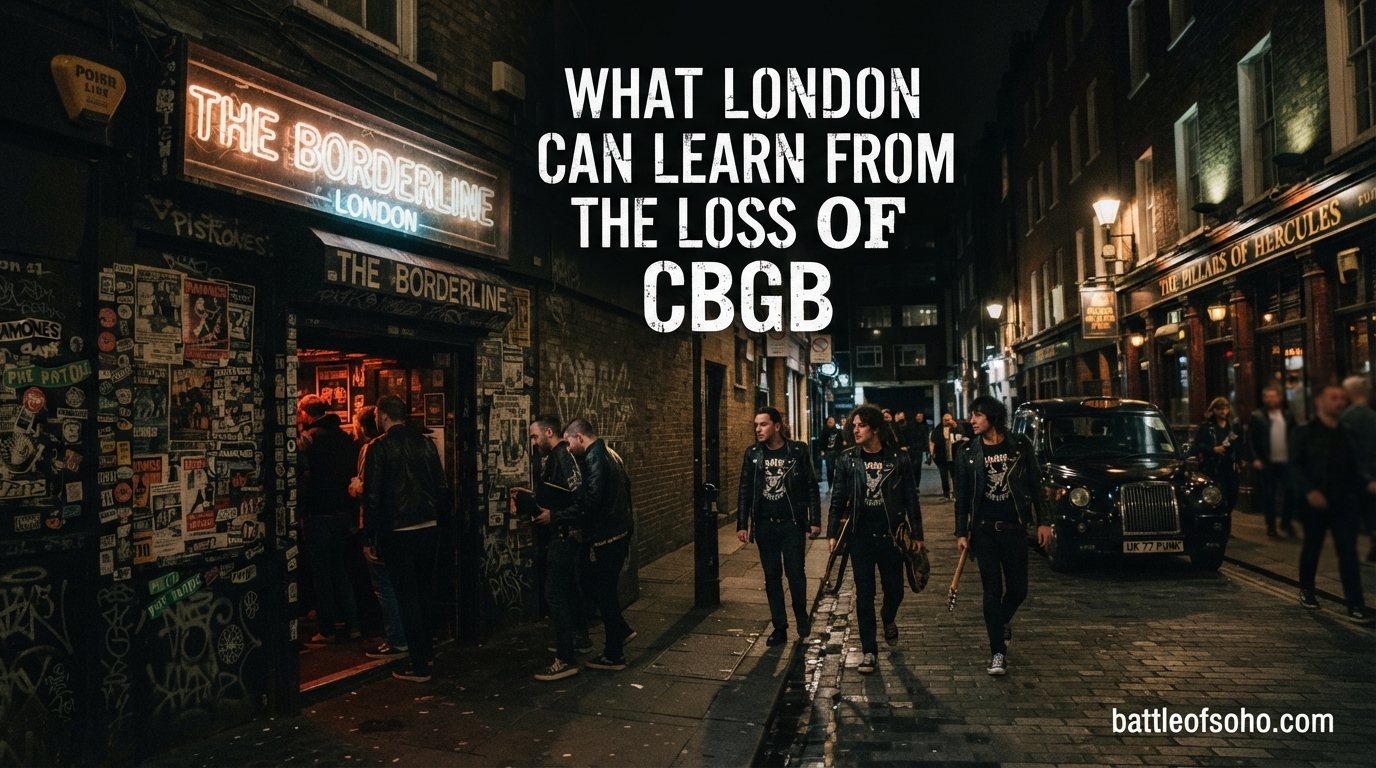
When CBGB closed its doors on October 15, 2006, it was not just a bar shutting down. It was a cultural earthquake that ripped through the global music world, and its aftershocks are still being felt in cities like London today. The legendary Bowery venue had launched the Ramones, Patti Smith, Talking Heads, and Blondie, and its loss raised a question that every major music city must now confront. What happens to a city’s creative soul when the spaces that nurture underground art are priced out of existence?
London has been asking itself that same question with increasing urgency. Grassroots venues across the capital have been vanishing at an alarming rate, squeezed by rising rents, redevelopment, and a planning system that treats live music as a nuisance rather than a cultural asset. The parallels between 2006 New York and 2026 London are impossible to ignore.
In this article, I want to explore what London can learn from the loss of CBGB, not as a nostalgia trip, but as a practical warning and a call to action. The story of CBGB is not just about a dirty bar with terrible toilets. It is about how a single room with the right policy, the right owner, and the right atmosphere can change the trajectory of popular music forever, and how easily that can be taken away.
We will trace the CBGB story from its unlikely founding to its bitter end, follow the transatlantic thread that connected it to London’s own punk explosion, and then draw out the specific lessons London must absorb if it wants to avoid losing its own grassroots venues the same way New York lost CBGB. The stakes could not be higher, and the clock is already ticking.
Table of Contents
The Rise of CBGB: How a Bowery Dive Bar Changed Music Forever
CBGB did not set out to change the world. When Hilly Kristal opened the club at 315 Bowery in December 1973, his plan was straightforward and completely wrong. He wanted to book country, bluegrass, and blues acts, which is exactly what the acronym CBGB stood for. The full name was CBGB and OMFUG, standing for Country, Bluegrass, Blues and Other Music For Uplifting Gormandizers.
The Bowery in 1973 was not a desirable address. It was a strip of flophouses, pawnshops, and men sleeping in doorways, and the rent reflected that. Kristal, a former US Marine and folk singer who had run the Village Vanguard-style club Hilly’s on Bleecker Street, took over the former Palace Bar at the corner of Bowery and Bleecker Street. Nobody else wanted the space.
What changed everything was a single policy decision. Kristal decided that bands playing at CBGB had to perform original music only. No covers. This was not a grand artistic manifesto at first. It was partly a practical choice, since cover bands expected to be paid and the struggling club had almost no money. But the effect was transformative.
By demanding originality, Kristal accidentally created a filter that attracted musicians who had something to say and could not say it anywhere else. The first band to answer that call was Television, led by Tom Verlaine and Richard Hell, who secured a Sunday night residency in March 1974. Within months, word spread through the downtown Manhattan underground that something unprecedented was happening at 315 Bowery.
Patti Smith performed there on Valentine’s Day 1975 and would record parts of her debut album Horses at the venue. The Ramones played their first CBGB show in August 1974 and became the club’s house band in all but name. By 1975, the stage at CBGB was the most important square metre of floor space in the entire music world, and Hilly Kristal, the man who had wanted to book bluegrass, found himself running ground zero for a revolution.
What Made CBGB Special: More Than Just a Bar
People who never visited CBGB often assume its reputation is purely sentimental, a myth inflated by nostalgia. They are wrong. CBGB possessed a combination of qualities that, taken together, have never been replicated in a single venue before or since. Understanding those qualities is essential to understanding what London is at risk of losing.
The first quality was the original music only policy, which I have already described. The second was the physical space itself. CBGB was a long, narrow room with a low ceiling, a tiny stage barely raised above floor level, and some of the most famously revolting toilets in New York City. The walls were covered in layers of band flyers and graffiti. Lenny Kaye, Patti Smith’s guitarist, recalled in a 2026 Guardian interview that “the bathrooms were rank, but we didn’t care” because the room itself crackled with creative electricity.
The third quality was Kristal himself. He did not curate the bookings with an A&R executive’s ear. He let bands play, charged almost nothing at the door, and let the audience decide what was good. This hands-off approach meant that CBGB functioned as an artistic laboratory rather than a showcase. Bands could fail, experiment, and develop over multiple Sunday night residencies without the pressure of commercial expectations.
The fourth quality was affordability. Bands were not charged rent to play. They kept the door money. Kristal took a percentage of the bar, which worked because the audiences drank. This model meant that unknown bands with zero following could afford to get on stage and build one. It is worth pausing on that point, because it is the exact model that is vanishing from London right now.
Finally, there was the intangible factor of community. CBGB was not just a venue. It was a meeting place, a post office for the downtown scene, and a headquarters for fanzines like Punk magazine, which was founded by Legs McNeil and John Holmstrom and helped document and define the scene from inside it. Bands met other bands, formed friendships, started collaborations, and built a network that eventually exported itself around the world.
The Bands That Built a Legacy
The list of artists who got their start or defined their sound at CBGB reads like a Rock and Roll Hall of Fame induction roll call. These were not bands that played CBGB on their way up. They became what they were because of CBGB, and that distinction matters enormously.
The Ramones played their first gig at CBGB on August 16, 1974, and went on to play the venue dozens of times. Their fast, stripped-down, two-minute songs became the sonic template for punk rock worldwide. Joey, Johnny, Dee Dee, and Tommy Ramone were not polished musicians when they started. CBGB gave them the stage time to become the band that would influence every punk act that followed, from the Sex Pistols to Green Day.
Patti Smith brought poetry and art-rock to the CBGB stage. Her performance style, equal parts shaman and street preacher, expanded what a rock frontperson could be. Her album Horses, recorded in part at CBGB, is widely regarded as one of the greatest debut albums in history.
Talking Heads, formed by Rhode Island School of Design students David Byrne, Tina Weymouth, and Chris Frantz, played their first show at CBGB in June 1975 opening for the Ramones. Their nervy, intelligent, rhythmic music would eventually evolve into some of the most acclaimed pop music of the 1980s. Blondie, led by Debbie Harry and Chris Stein, were CBGB regulars who fused punk energy with pop hooks and became one of the biggest bands of the new wave era.
Television, with Tom Verlaine’s intricate guitar work and Richard Hell’s ripped-shirt aesthetic, gave CBGB its first residency and its first sense of identity. Mink DeVille, The Dead Boys, Suicide, and later Sonic Youth all passed through the club’s doors. The point is not just that famous bands played there. The point is that without CBGB’s stage, its policy, and its patience, most of these bands might never have developed at all.
The Malcolm McLaren Connection: How London Absorbed the CBGB Blueprint
Here is where the story crosses the Atlantic, and where the question of what London can learn from the loss of CBGB becomes deeply specific. In 1975, a London entrepreneur and boutique owner named Malcolm McLaren travelled to New York City. He was managing the New York Dolls at the time, a glam rock band in their final days, but what he found downtown would change the course of British music history.
McLaren spent time at CBGB watching the Ramones, Television, and the nascent punk scene. He was struck by the do-it-yourself attitude, the torn clothing, the spiked hair, and the raw energy. Richard Hell, Television’s bassist, was sporting a short, jagged haircut and torn shirts held together with safety pins. McLaren later admitted that this look, born of necessity and poverty on the Bowery, became the visual template for what he would manufacture back in London.
When McLaren returned to London, he and his partner Vivienne Westwood transformed their King’s Road boutique, originally called Let It Rock and later renamed SEX, into the epicentre of a new British punk aesthetic. He assembled a band to promote the shop’s clothing line. That band was the Sex Pistols. The look, the attitude, and the anti-establishment energy were directly imported from what McLaren had observed at CBGB.
This transatlantic pipeline is one of the most important cultural exchanges in modern music history. CBGB provided the raw material, the working model, and the aesthetic language. London provided the theatricality, the class warfare, and the mass media spectacle that turned punk into a national panic. Without CBGB, there may well have been no Sex Pistols in the form we know them.
The irony, of course, is that London’s punk explosion quickly outgrew its CBGB-inspired roots. The 100 Club Punk Festival in September 1976, the Roxy opening in January 1977, and the Sex Pistols’ infamous television appearances turned British punk into a phenomenon far bigger than anything happening on the Bowery. But the seed came from New York, and the seed was planted at CBGB.
Garth Cartwright, writing in his Substack newsletter in February 2026, emphasised this connection explicitly. He noted that McLaren studied CBGB like a student studies a textbook, absorbing not just the music but the entire DIY infrastructure, the fanzines, the fashion, and the community-building ethos. London did not just borrow CBGB’s sound. It borrowed CBGB’s entire operating system and then scaled it up.
London’s Punk Explosion: The 100 Club, The Roxy, and Beyond
Once McLaren brought the CBGB blueprint back to London, the city needed its own version of the venue. It got several, and their stories are instructive for anyone thinking about how grassroots music scenes take root and what threatens them.
The 100 Club on Oxford Street is London’s oldest still-operating live music venue, having hosted jazz, blues, and rock since 1942. In September 1976, it staged the 100 Club Punk Festival, featuring the Sex Pistols, The Clash, The Damned, The Buzzcocks, and Siouxsie and the Banshees. This single event crystallised the London punk scene in the same way Television’s CBGB residency had crystallised the New York scene two years earlier. The 100 Club remains open today, but only after surviving its own near-closure battles and relying on community campaigns and corporate partnerships to stay alive.
The Roxy, located in Covent Garden, was even more directly modelled on CBGB. It had operated as a brutalist cinema since the 1910s, was repurposed as a punk club in December 1976, and became London’s answer to CBGB for roughly a year. Bands like Generation X, The Adverts, and Sham 69 played there. The Roxy closed as a punk venue by late 1977 and the building was demolished in 1988. Its brief, intense life is a perfect illustration of how fragile grassroots music spaces can be.
Other venues filled the gap. The Nashville Rooms in West Kensington, the Nashville at the Albany in Great Portland Street, and various pub back rooms across the capital formed a circuit that allowed punk and post-punk bands to develop. The important point is that this ecosystem was organic, cheap, and largely invisible to planners and developers, which is exactly what made it possible and exactly what makes it impossible to recreate today without deliberate protection.
London’s punk scene also generated its own documentation infrastructure. Fanzines like Sniffin’ Glue and Mark P’spunk paralleled New York’s Punk magazine. Independent labels like Stiff Records and Rough Trade operated on DIY principles that echoed Kristal’s low-overhead, artist-first approach at CBGB. The entire architecture of independent British music in the late 1970s owed a debt, sometimes acknowledged and sometimes not, to the model CBGB had pioneered.
The Death of CBGB: How Gentrification Killed a Cultural Landmark
The closure of CBGB is the cautionary tale at the heart of this article, and London needs to understand it in detail. The venue did not close because it stopped being popular or because audiences disappeared. It closed because of a rent dispute with a landlord that did not value what the venue represented.
The Bowery Residents Committee, a non-profit organisation that provided services to homeless people, owned the building at 315 Bowery and had been CBGB’s landlord since the 1970s. In 2005, BRC claimed that CBGB owed approximately 90,000 dollars in back rent. Hilly Kristal disputed the amount and the legitimacy of some of the charges, arguing that BRC had been billing the club for improvements that benefited the entire building, not just the club.
The dispute went to court. A judge ruled that CBGB did not owe the full amount claimed but that the lease, which expired in August 2005, would not be renewed. A massive public campaign to save CBGB drew support from musicians, fans, and politicians, but it ultimately failed. The club’s final show, played by Patti Smith on October 15, 2006, was broadcast on radio and streamed online. Kristal died less than a year later, in August 2007.
What replaced CBGB at 315 Bowery is a story London knows all too well. The space became a John Varvatos luxury clothing boutique, which opened in 2008 and preserved some of the venue’s graffiti and walls as design features. It later became a Patagonia store. The Bowery itself, once a skid row of flophouses and poverty, became one of Manhattan’s most expensive neighbourhoods, lined with luxury condos and high-end restaurants.
Reddit users who frequented CBGB in its final years express a particular bitterness about this transformation. They describe the original location as “sacred ground” and lament that the neighbourhood is now home to the very wealthy and nothing raw exists there. The anger is not just about a bar closing. It is about a cultural ecosystem being replaced by a commercial one, with the original community priced out and erased.
What London Can Learn From the Loss of CBGB
Now we arrive at the core of this article. What London can learn from the loss of CBGB is not a single lesson but a set of interconnected principles, each of which speaks to a specific failure that doomed CBGB and that is currently dooming London venues. Let me lay them out clearly.
Lesson 1: Protect the original music policy. CBGB existed because Hilly Kristal insisted on original music only. This single rule created the conditions for innovation by filtering out safe, commercial acts and forcing bands to develop their own material. London venues that survive on function bands, tribute acts, and DJ nights may stay in business, but they will never incubate the next wave of original music. London needs venues that explicitly prioritise original artists, and it needs policy support to make that economically viable.
Lesson 2: Keep the door price low and let bands keep the money. The CBGB model worked because unknown bands could afford to play. Kristal did not charge bands to perform and let them take the door money. London’s current pay-to-play culture, where venues charge bands for the privilege of performing or demand they sell tickets to friends, is the exact opposite of what made CBGB successful. It filters out the broke, the young, and the experimental, which is to say it filters out the future.
Lesson 3: Long leases are the only real protection. CBGB died because its lease expired and the landlord refused to renew. No amount of public campaigning, celebrity support, or media attention could overcome a property owner who wanted the space for something else. London venues on short leases or rolling agreements are living on borrowed time. Community ownership models, where venues are bought by trusts, cooperatives, or community benefit societies, remove the landlord problem entirely. The Music Venue Trust in the UK has been advocating for exactly this approach.
Lesson 4: Planning law must treat venues as cultural infrastructure. In both New York and London, music venues are treated as commercial tenants like any other, with no special protection against redevelopment or noise complaints from new residents. The UK introduced the Agent of Change principle in 2018, which requires developers building near existing venues to fund soundproofing, but enforcement has been inconsistent and the principle does not protect against rent hikes. London needs stronger, more aggressively enforced protections.
Lesson 5: Nostalgia will not save you. The campaign to save CBGB was one of the most visible venue preservation efforts in history. It had famous supporters, international media coverage, and genuine public passion. It still failed. London cannot rely on last-minute campaigns and emotional appeals once a closure is announced. The protection has to happen before the crisis, through structural and legal mechanisms that make closure difficult in the first place.
Lesson 6: The atmosphere matters. CBGB was grimy, uncomfortable, and visually chaotic, and that was part of its power. The torn flyers, the bad toilets, the low ceiling, all of it signalled that this was a space where commerce took a back seat to art. London does not need replica dives, but it does need venues that prioritise creative atmosphere over commercial polish. When every new venue looks like a cocktail bar with a small stage, something has been lost.
Lesson 7: Document the scene while it is alive. Gary Green’s photography book When Midnight Comes Around and the Cherry Red Records box set CBGB: A New York City Soundtrack 1975-1986, released in 2026, both exist because someone was paying attention at the time. London’s current grassroots scene is producing music worth documenting right now. Fanzines, independent photographers, and small labels are the archive that future generations will draw on.
London Venues at Risk: The CBGB Pattern Repeating Today
The reason all of this matters is that London is not theorising about a hypothetical problem. The CBGB pattern is already repeating. Research from the Music Venue Trust and academic studies, including work published on Academia.edu examining grassroots venue closures in London from 2007 to 2016, shows that dozens of grassroots venues have closed in the capital over the past two decades.
The causes are identical to what killed CBGB. Rising commercial rents, lease disputes, redevelopment pressures, and noise complaints from residents who moved in next to a music venue and then complained about the music. Venues like The George Tavern in Stepney, which has fought multiple planning battles against developers, and Corsica Studios in Elephant and Castle, which has faced ongoing uncertainty, are living through the same dynamics that destroyed CBGB.
The BBC reported in 2026 that London nightclubs and grassroots music venues are closing at what venue advocacy groups call an alarming rate. Each closure removes not just a room but a node in the creative network, a place where the next Patti Smith or Talking Heads might have had their first gig. You cannot measure what is lost because it never gets the chance to exist.
The comparison between CBGB-era New York and 2026 London is not exact, of course. London has stronger tenant protections than New York, a more active venue advocacy sector, and the Agent of Change principle in law. But these advantages are being overwhelmed by the sheer scale of the housing crisis, commercial rent inflation, and a planning system that still overwhelmingly favours development over cultural preservation. The lesson of CBGB is that partial protections are not enough. The Bowery Residents Committee was a non-profit with a social mission, and it still evicted CBGB for financial reasons.
FAQs
Why was CBGB important?
CBGB was important because it was the only venue in 1970s New York that actively booked and nurtured original, unpolished music. Founded by Hilly Kristal at 315 Bowery in 1973, the club’s original music only policy created a laboratory where the Ramones, Patti Smith, Talking Heads, and Blondie developed their sound, serving as ground zero for punk and new wave.
Where did the punks hang out in London?
London punks in the mid-1970s gathered at the 100 Club on Oxford Street, which hosted the first international punk festival in September 1976, The Roxy in Covent Garden, which opened as a punk venue in January 1977, and various pub venues across Soho and West London. The Sex Pistols, The Clash, and The Damned all developed their live sound on this circuit.
What is the legacy of CBGB?
CBGB’s legacy is that it invented the template for the modern independent music venue. It proved a club could be a cultural incubator rather than just a business, launching multiple Rock and Roll Hall of Fame artists while championing DIY ethics. Its influence extends beyond music into fashion, art, and journalism, and its model continues to inspire venue owners worldwide.
Who got famous from CBGB?
The Ramones, Patti Smith, Talking Heads, and Blondie are the most famous artists to emerge from CBGB. Additional notable acts include Television, Mink DeVille, The Dead Boys, Suicide, and Sonic Youth. These bands went on to influence virtually every rock genre that followed, from punk and new wave to alternative and indie rock.
Why did CBGB close?
CBGB closed in October 2006 after a lease dispute with its landlord, the Bowery Residents Committee, a non-profit that claimed the venue owed approximately 90,000 dollars in back rent. Despite a massive public campaign to save the club, the lease was not renewed. Hilly Kristal died less than a year later in August 2007.
How did Malcolm McLaren use CBGB for the Sex Pistols?
Malcolm McLaren visited CBGB in 1975, observed the Ramones, Television, and the downtown punk scene, and absorbed the DIY aesthetic, torn clothing, and raw energy. He brought this blueprint back to London, where he and Vivienne Westwood translated it into the visual and attitudinal style of the Sex Pistols, effectively importing CBGB’s operating model into British music.
Conclusion: The Lessons Are Written, Will London Read Them?
The story of CBGB is a gift to every city that cares about its grassroots music scene, because it lays out in painful detail exactly what works, what fails, and what is at stake. What London can learn from the loss of CBGB is not abstract or theoretical. It is a concrete set of lessons about original music policies, affordable door prices, long leases, planning protections, community ownership, and the irreplaceable value of unpolished creative atmosphere.
Hilly Kristal built something extraordinary by accident, and the city of New York let it die over a rent dispute with a landlord who saw more value in a clothing store than in the room where Horses was performed. London has the chance to learn from that failure, to look at venues like the George Tavern and Corsica Studios and the dozens of small rooms across the capital, and to act before the next closure notice is served.
The Cherry Red Records box set and Gary Green’s photographs are beautiful tributes to what CBGB was. But the best tribute London could pay to the legacy of CBGB is to make sure its own grassroots venues do not need to be memorialised. They need to be protected, funded, and kept alive while they are still creating the music that future generations will want to archive.
The lessons are written. The pattern is visible. The only question that remains is whether London will read them in time.