
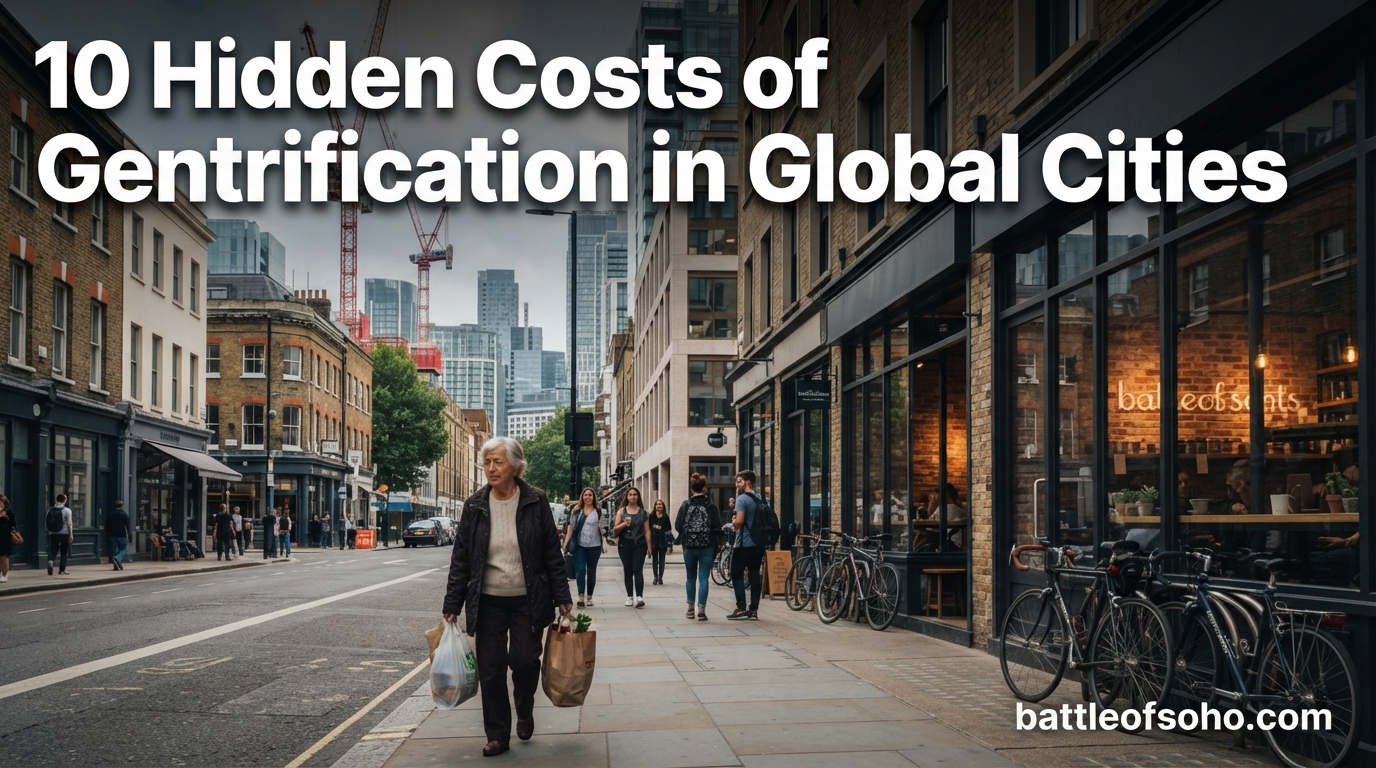
Walk through any rapidly changing neighborhood in London, Brooklyn, or Berlin and you will see the same story unfolding. Cranes tower over construction sites. Sleek coffee shops replace corner stores that served families for generations. Rents climb, and the people who built the community’s character quietly disappear.
The hidden costs of gentrification in global cities run far deeper than rising rents. They include cultural erasure, mental health decline, small business collapse, and political polarization. Most discussions stop at the surface, focusing on whether gentrification brings investment or harm. Our team wanted to look past that debate and examine what residents actually lose when their neighborhoods transform around them.
I have spent years researching urban displacement across multiple continents. What consistently stands out is that the damage gentrification causes is rarely measured in traditional economic metrics. City officials celebrate new tax revenue and improved infrastructure. Meanwhile, long-term residents face stress, isolation, and the slow unraveling of everything familiar.
This guide breaks down what gentrification really costs communities worldwide. We cover the economic theory behind it, the human toll it takes, and what cities are doing to push back. Whether you are a student, planner, community organizer, or simply someone watching your own neighborhood change, you will find a clear, honest accounting here.
By the end, you will understand why the hidden costs of gentrification in global cities represent one of the most urgent urban challenges of 2026 and what can actually be done about it.
Table of Contents
What Is Gentrification? Definition and Origins
Gentrification is the process by which wealthier residents move into lower-income neighborhoods, raising property values and the overall cost of living. This influx systematically displaces long-term residents who can no longer afford to stay. The term was coined by British sociologist Ruth Glass in 1964 to describe what she observed happening in working-class London neighborhoods.
Glass noticed that modest Victorian-era neighborhoods were being “gentrified” as middle-class professionals bought and renovated old properties. What started as a London phenomenon soon spread. Today, gentrification shapes urban landscapes on every populated continent.
The process typically follows a recognizable pattern. First, artists, students, or other lower-income newcomers gravitate to affordable areas with architectural character. They bring cultural energy that attracts media attention. Then developers and wealthier professionals follow, drawn by the newly cool atmosphere. Property values spike, and the original residents begin to leave.
Neil Smith, a geographer who studied urban transformation extensively, developed the rent gap theory to explain why gentrification happens. The rent gap is the difference between what a property currently earns in rent and what it could earn after reinvestment. When that gap is large enough, developers see profit potential and capital floods in.
Gentrification is not a single event but a cascading series of changes. Once reinvestment begins, it accelerates. Banks lend more readily in “improving” areas. City governments offer tax incentives for development. Before long, the neighborhood is unrecognizable to those who called it home a decade earlier.
Understanding gentrification requires distinguishing between neighborhood revitalization and gentrification. Revitalization brings investment while preserving existing communities. Gentrification brings investment at the expense of existing communities. The difference matters enormously to the people living through it.
The Hidden Costs of Gentrification: An Overview
When people ask what are the hidden costs of gentrification, they usually expect a short list. The reality is that the costs branch into nearly every aspect of community life. Here is a structured breakdown of the major hidden costs:
- Residential displacement: Long-term renters and homeowners forced out by rising rents and property taxes.
- Cultural erasure: Neighborhoods lose the traditions, businesses, and identity that defined them.
- Small business collapse: Independent shops cannot afford commercial rent increases and close or relocate.
- Mental health decline: Displaced and remaining residents experience anxiety, depression, and chronic stress.
- Social network fragmentation: Tight-knit communities scatter, severing support systems built over decades.
- Public services strain: New wealthier populations demand different services, sometimes at the expense of existing residents.
- Political displacement: Newcomers vote differently, shifting local priorities away from longtime community needs.
- Healthcare access disruption: Clinics and community health resources relocate or lose funding as demographics shift.
- Increased homelessness: Displaced residents who cannot find affordable alternatives end up unhoused.
- Educational disruption: Children change schools mid-year, and local schools lose enrollment and funding.
These costs rarely appear in economic impact reports. City governments tend to track rising property values, new business permits, and increased tax revenue. The human consequences remain hidden in the margins.
Residential Displacement: The Most Visible Hidden Cost
Residential displacement is the most immediately recognizable cost of gentrification. When rents double or triple within a few years, families who have lived in a neighborhood for generations face an impossible choice: pay more than they can afford or leave.
Research from the National Community Reinvestment Coalition found that over the past fifty years, approximately 15 percent of urban neighborhoods in the United States show signs of gentrification. The number of gentrifying neighborhoods grew from 246 in the 1970s to 1,807 in the 2010s. That growth is accelerating.
Displacement takes several forms. Direct displacement happens when a landlord raises rent, sells the property, or evicts tenants. Indirect displacement occurs when the overall cost of living rises so sharply that residents leave even without an explicit eviction. Cultural displacement happens when the neighborhood changes so fundamentally that remaining residents feel like outsiders.
On forums like Reddit’s r/Urbanism, users share personal stories that put faces to these statistics. One Brooklyn resident described being priced out after twenty years when their building was sold to a corporate buyer. Rents jumped 60 percent overnight. They moved to a cheaper suburb, losing proximity to their job, their church, and their social network.
These stories are not isolated. In London, social housing tenants in estates like the Aylesbury Estate fought years-long battles against redevelopment plans that would have scattered their communities. In San Francisco’s Mission District, Latino families faced mass displacement as tech industry wealth flooded the housing market.
Property tax increases represent another displacement mechanism that affects homeowners, not just renters. When property values surge, tax assessments follow. Elderly homeowners on fixed incomes suddenly cannot afford taxes on homes they own outright. They are forced to sell, often to investors who flip the property for a profit.
The emotional toll of displacement is profound. People lose not just their homes but their sense of belonging. They lose the corner shop owner who knew their name. They lose the neighbor who watched their children. These connections, built over decades, cannot be rebuilt overnight in a new location.
Economic Hidden Costs Beyond Rising Rent
Rising rent is the most discussed economic cost of gentrification, but it is far from the only one. The economic ripple effects touch nearly every aspect of daily life for existing residents.
Small business displacement represents a massive hidden cost. When commercial rents rise alongside residential ones, independent shops cannot keep up. The family-owned bakery, the hardware store run by the same person for thirty years, the barbershop that doubled as a community gathering space, all face closure. National chains with deeper pockets replace them, homogenizing the neighborhood and draining money out of the local economy.
Property tax burden increases hit homeowners hard. A home assessed at $200,000 might see its valuation jump to $500,000 during a gentrification wave. Even if the owner has no intention of selling, their tax bill balloons. This forces long-term residents, particularly elderly ones, to choose between keeping their home and financial survival.
Public services strain in unexpected ways. Gentrifying neighborhoods often see improved street cleaning, better transit, and increased policing. But those improvements come with trade-offs. Existing residents report that heightened policing disproportionately targets them rather than newcomers. And city budgets redirected toward gentrifying areas may leave other neighborhoods without resources.
Transportation costs rise for displaced residents. When families are pushed to suburbs or peripheral neighborhoods, they often face longer commutes and higher transit expenses. A family that once walked to work now spends hundreds of dollars monthly on gas, bus fare, or train tickets. This erodes any savings from cheaper rent.
The cost of basic goods also climbs. Gentrification brings upscale grocery stores and specialty markets. While these offer more selection, they also eliminate the budget-friendly options that low-income residents relied on. A neighborhood that once had three affordable produce stands may end up with one organic market where apples cost four dollars each.
Visible Benefits vs Hidden Costs: A Comparison
- Visible: New construction and renovated buildings / Hidden: Original residents displaced before improvements arrive
- Visible: Increased property tax revenue for cities / Hidden: Higher taxes force fixed-income homeowners to sell
- Visible: Lower reported crime rates / Hidden: Over-policing targets existing residents and strains community trust
- Visible: New businesses and job creation / Hidden: Long-standing small businesses close, eliminating community anchors
- Visible: Improved public infrastructure / Hidden: Resources diverted from other underserved neighborhoods
- Visible: Rising property values / Hidden: Wealth gains benefit investors and newcomers, not original residents
- Visible: Enhanced cultural amenities / Hidden: Original culture is commodified and eventually erased
Social and Cultural Displacement
Beyond economic costs, gentrification inflicts deep social and cultural wounds. These costs are harder to quantify but no less devastating to the communities that experience them.
Cultural erasure happens gradually, then suddenly. A historically Black neighborhood in Atlanta or a Latino community in Los Angeles develops decades of cultural infrastructure: churches, murals, festivals, mutual aid networks, and informal gathering spaces. Gentrification replaces these with generic amenities that appeal to wealthier, often whiter newcomers. The culture that made the neighborhood attractive in the first place is packaged, sold, and ultimately erased.
The National Community Reinvestment Coalition’s research emphasizes Black cultural displacement as a central consequence of gentrification. Majority-Black neighborhoods that experienced gentrification saw significant demographic turnover. The institutions that anchored these communities, churches, barbershops, social clubs, disappeared alongside the residents who sustained them.
Social capital, the networks of relationships that help people navigate daily life, disintegrates under gentrification. When neighbors scatter, they lose the ability to borrow a cup of sugar, share childcare, or watch out for each other’s safety. This is particularly damaging for elderly residents and single parents who rely on community support.
Community identity loss is perhaps the most intangible but most deeply felt cost. Neighborhoods carry stories. The corner where civil rights were organized, the park where generations learned to ride bikes, the storefront that hosted community meetings. When these spaces are replaced or repurposed, the collective memory of the community fades.
The #DontMuteDC movement in Washington DC exemplified this tension. Long-time Black residents in Shaw faced noise complaints from new arrivals about go-go music that had played from a local store speaker for decades. What seemed like a minor dispute revealed a deeper clash: whose culture gets to exist in a changing neighborhood?
Political displacement compounds these losses. As wealthier, often younger residents move in, voting patterns shift. Local representatives begin prioritizing different issues, from dog parks to bike lanes, over affordable housing and tenant protections. The original community loses not just its place but its political voice.
Health and Mental Health Impacts
The health consequences of gentrification are among the most underexplored hidden costs. Research increasingly shows that neighborhood transformation affects both physical and mental health in measurable ways.
Chronic stress is the most common health impact reported by residents in gentrifying neighborhoods. The constant threat of displacement, the anxiety of rising costs, and the grief of watching a community unravel create sustained psychological pressure. Studies link this stress to elevated blood pressure, sleep disorders, and weakened immune function.
Mental health decline extends well beyond stress. Displaced residents report symptoms consistent with depression, anxiety, and post-traumatic stress. The loss of home, community, and identity can trigger genuine grief reactions. Yet mental health services in gentrifying areas often become less accessible as clinics face their own rent increases and client displacement.
Healthcare access disruption is a critical concern. Community health clinics that served low-income populations for decades may relocate or close when their neighborhoods gentrify. The populations that depended on them are scattered across wider geographic areas, making continuity of care nearly impossible.
For residents who manage to stay, the health environment changes in ways that are not always positive. New wellness-focused businesses, boutique fitness studios, and organic cafes cater to newcomers. Existing residents may feel unwelcome in these spaces or unable to afford them, creating a paradox: the neighborhood looks healthier, but its original residents are not the beneficiaries.
How Gentrification Reshapes Global Cities
One of the biggest gaps in existing coverage is the lack of a truly global perspective on gentrification. Most analysis focuses on American cities. But gentrification is a worldwide phenomenon, and the hidden costs of gentrification in global cities look different depending on where you stand.
London, United Kingdom
London pioneered the concept of gentrification. Ruth Glass coined the term here in the 1960s. Decades later, the process has intensified dramatically. Boroughs like Hackney, Brixton, and Tower Hamlets transformed from working-class areas to some of the most expensive neighborhoods in the world. Social housing estates face demolition and redevelopment, displacing thousands of tenants. The Greater London Authority has struggled to maintain affordable housing quotas amid relentless market pressure.
New York City, United States
Brooklyn stands as one of the most studied gentrification cases globally. Neighborhoods like Williamsburg, Bushwick, and Crown Heights shifted from industrial and working-class communities to highly desired residential areas. The influx of tech and finance workers drove rents to staggering heights. Long-term residents, particularly in Black and Latino communities, faced systematic displacement. Community organizations fought back with tenant protections and affordable housing advocacy, but the scale of change has been overwhelming.
Berlin, Germany
Berlin’s gentrification story is unique because of its post-reunification context. After the Wall fell in 1989, East Berlin offered vast swaths of cheap housing that attracted artists and squatters. By the 2000s, that creative influx had made neighborhoods like Kreuzberg and Neukolln highly desirable. Rents doubled and tripled. Berlin’s government attempted aggressive interventions, including a rent freeze in 2020, though courts later struck down the policy. The city remains a battleground between residents seeking affordability and investors chasing returns.
Tokyo, Japan
Tokyo presents a different model. Japan’s relaxed zoning laws allow faster housing construction, which keeps overall housing costs more stable than in Western cities. However, specific neighborhoods still experience gentrification-like displacement. Areas like Shimokitazawa, once known for their countercultural music scene, have seen independent venues replaced by chain stores and luxury apartments. The cultural cost is significant even when the economic displacement is less severe than in London or New York.
Lagos, Nigeria
In the Global South, gentrification takes on additional dimensions. Lagos, Africa’s largest city, has experienced rapid urban transformation driven by both domestic investment and international capital. Areas like Lekki and Eko Atlantic represent luxury development that displaces informal settlements and fishing communities. The hidden costs here include not just displacement but the destruction of informal economies that sustained thousands of families. Government-led evictions in communities like Otodo Gbame removed an estimated 30,000 residents to make way for waterfront development.
Mumbai, India
Mumbai’s gentrification is deeply tied to its real estate market, one of the most expensive in the world. Slum redevelopment projects promise new housing for displaced residents but often deliver far fewer units than promised. The Dharavi redevelopment, one of Asia’s largest slum upgrading projects, has been debated for over two decades. Meanwhile, mill lands in central Mumbai have converted to luxury malls and premium housing, erasing industrial heritage and displacing workers who depended on those economies.
Why This Global Perspective Matters
No two cities experience gentrification identically. Legal frameworks, cultural norms, housing markets, and government capacity all shape outcomes. But the underlying pattern repeats: capital flows into undervalued neighborhoods, and existing residents bear the costs. Understanding these global parallels helps communities learn from each other’s strategies and mistakes.
The Economics Behind Gentrification: Rent Gap Theory Explained
To understand why gentrification happens, you need to understand the economic forces driving it. Two main theoretical frameworks dominate the discussion: supply-side and demand-side explanations.
Neil Smith’s rent gap theory represents the supply-side perspective. Smith argued that gentrification occurs when there is a significant gap between the current ground rent of a property (what it earns in its current use) and its potential ground rent (what it could earn after redevelopment). When investors identify this gap, they buy cheap, invest, and capture the difference as profit. This mechanism explains why capital flows into specific neighborhoods at specific times.
The demand-side perspective focuses on the preferences and behaviors of gentrifiers themselves. This theory emphasizes cultural capital: the tastes, education, and social networks that lead certain groups to seek out urban living. The rise of the knowledge economy created a class of professionals who value walkable, culturally rich neighborhoods. Their demand drives up prices.
In reality, both forces operate simultaneously. Supply-side capital investment and demand-side demographic shifts reinforce each other. Developers build because demand exists. Demand grows because developers create attractive new spaces. The cycle accelerates once it begins.
Government policy plays a larger role than many realize. Tax incentives for development, zoning changes that allow denser construction, infrastructure investments like transit extensions, and urban renewal programs all can trigger gentrification. Well-intentioned policies designed to improve declining neighborhoods sometimes accelerate displacement instead.
Corporate involvement has intensified gentrification’s reach. In previous decades, gentrification was driven largely by individual “pioneer” buyers. Today, private equity firms, corporate landlords, and international investors buy properties at scale. This financialization of housing removes any personal connection between property owners and tenants, making displacement a purely business decision.
Policy Solutions: Can Cities Mitigate the Hidden Costs?
Gentrification is not an unstoppable natural force. Cities around the world have tested strategies to manage neighborhood change while protecting existing residents. Some approaches work better than others, but the key insight is that intervention matters.
Community Land Trusts
Community land trusts are nonprofit organizations that acquire and hold land for the benefit of the community. By removing land from the speculative market, trusts ensure long-term affordability. Residents own their homes but lease the land beneath them from the trust, which keeps prices stable. The Champlain Housing Trust in Burlington, Vermont, is one of the most successful examples, serving thousands of residents with permanently affordable housing.
Inclusionary Zoning
Inclusionary zoning requires developers to include a percentage of affordable units in new residential projects. In exchange, developers may receive density bonuses or tax incentives. New York City, San Francisco, and Montgomery County, Maryland, have all used this tool. The effectiveness varies depending on enforcement and the percentage required, but it creates permanently affordable housing that would not otherwise exist.
Rent Control and Stabilization
Rent regulation limits how much landlords can increase rent for existing tenants. Germany, Sweden, and parts of the United States have implemented various forms of rent control. Critics argue it discourages new construction, but evidence is mixed. Berlin’s attempted rent freeze was struck down by courts, but other cities have maintained successful stabilization programs for decades.
Tenant Protections and Right to Return
Strong eviction protections, legal aid for tenants, and “right to return” policies for displaced residents can slow displacement. When redevelopment occurs, right-to-return policies guarantee that original residents can move back into new units at affordable rates. San Francisco’s Ellis Act reforms and Amsterdam’s anti-displacement measures offer models worth studying.
Community Benefits Agreements
These are legally binding agreements between developers and community organizations. In exchange for community support of a project, developers commit to specific benefits like local hiring, affordable units, or funding for community programs. When well-negotiated, these agreements ensure that development delivers tangible value to existing residents.
No single policy solves gentrification alone. The most effective cities combine multiple strategies and adapt them to local conditions. The common thread is that communities must have a seat at the table when decisions about their neighborhoods are made.
Key Gentrification Statistics and Data
Data helps cut through rhetoric and reveals the true scale of gentrification’s impact. Here are the numbers that define the issue in 2026:
- 15 percent of urban neighborhoods in the United States show signs of gentrification, according to NCRC research spanning five decades.
- 1,807 neighborhoods were classified as gentrifying in the 2010s, up from just 246 in the 1970s, a sevenfold increase.
- 10,000+ census tracts experienced significant demographic turnover tied to gentrification in major US metropolitan areas.
- 135,000+ Black and Hispanic residents were displaced from gentrifying neighborhoods across the 50 largest US cities between 2000 and 2013.
- 30,000 residents were displaced by evictions in Lagos communities like Otodo Gbame to make way for luxury waterfront development.
- Over 50 percent rent increases occurred in rapidly gentrifying London boroughs like Hackney between 2010 and 2020.
- One in four gentrifying neighborhoods in the US saw majority-minority communities transition to majority-white demographics within two decades.
These figures tell a story of acceleration. Gentrification is not slowing down. It is spreading to more cities, affecting more communities, and producing displacement at a scale that demands attention from anyone who cares about urban equity.
FAQs
What are the social and economic impacts of gentrification?
Gentrification produces both social impacts (displacement, cultural erasure, community fragmentation, and political marginalization of long-term residents) and economic impacts (rising rents, property tax increases, small business closures, and shifting consumer markets). While it can increase tax revenue and improve infrastructure, the benefits typically accrue to newcomers and investors while existing residents bear the costs.
What are four social negatives of gentrification?
The four major social negatives of gentrification are: 1) Residential displacement that forces families from their homes, 2) Cultural erasure that destroys neighborhood identity and traditions, 3) Social network fragmentation that severs community support systems, and 4) Political displacement where newcomers shift local priorities away from existing resident needs.
Why is gentrification a global issue?
Gentrification is a global issue because it occurs in cities across every continent, driven by international capital flows, global housing financialization, and worldwide demographic shifts toward urban living. From London to Lagos, Mumbai to Berlin, the same pattern repeats: investment transforms neighborhoods faster than existing residents can adapt, producing displacement and inequality on a worldwide scale.
How does gentrification affect cities?
Gentrification affects cities by reshaping their demographic composition, raising housing costs, altering local business landscapes, changing political priorities, and straining public services. It creates a visible divide between improved infrastructure in gentrifying areas and neglect elsewhere, while displacing the very residents who gave neighborhoods their character and cultural value.
Is gentrification always bad?
Gentrification is not inherently bad in concept. Neighborhood investment, improved infrastructure, and increased economic activity can benefit communities. The problem is that in practice, gentrification almost always displaces existing residents rather than including them. When cities implement strong tenant protections, affordable housing mandates, and community benefits agreements, some negative effects can be mitigated while preserving the benefits of investment.
What causes gentrification in cities?
Gentrification is caused by a combination of supply-side factors (investors seeking profit from undervalued properties, government development incentives, and corporate housing investment) and demand-side factors (professionals seeking urban lifestyles, cultural preferences for diverse neighborhoods, and proximity to employment centers). The rent gap between current and potential property values drives the initial investment that starts the cycle.
How can cities mitigate gentrification displacement?
Cities can mitigate displacement through community land trusts that remove property from the speculative market, inclusionary zoning that requires affordable units in new developments, strong rent stabilization laws, tenant legal protections, right-to-return policies for displaced residents, and community benefits agreements that ensure development delivers value to existing communities.
Conclusion: What the Hidden Costs of Gentrification Mean for the Future of Cities
The hidden costs of gentrification in global cities extend far beyond rising rents. They encompass cultural erasure, mental health decline, social network collapse, political marginalization, and the systematic displacement of communities that gave neighborhoods their soul. These costs are real, measurable, and accelerating worldwide.
What makes these costs truly hidden is that they rarely appear in the metrics cities use to measure success. Rising property values, new business permits, and increased tax revenue tell a story of progress. The human displacement behind those numbers tells a different story entirely.
But this is not a hopeless situation. Cities around the world are proving that neighborhood investment does not have to come at the expense of existing residents. Community land trusts, inclusionary zoning, strong tenant protections, and genuine community engagement can reshape how cities grow. The question is whether leaders have the will to prioritize people over profit.
If there is one takeaway from examining gentrification across global cities, it is this: communities are not interchangeable. When a neighborhood loses its long-term residents, it loses something no amount of new construction can replace. The culture, the relationships, the shared history, these are the true foundation of urban life.
The hidden costs of gentrification in global cities will only grow as urbanization continues and housing financialization intensifies. Understanding these costs is the first step toward addressing them. Acting on that understanding, through policy, advocacy, and community organizing, is the work that follows.
Cities belong to the people who live in them, not just those who can afford to move in. Protecting that principle is the challenge of 2026 and beyond.