
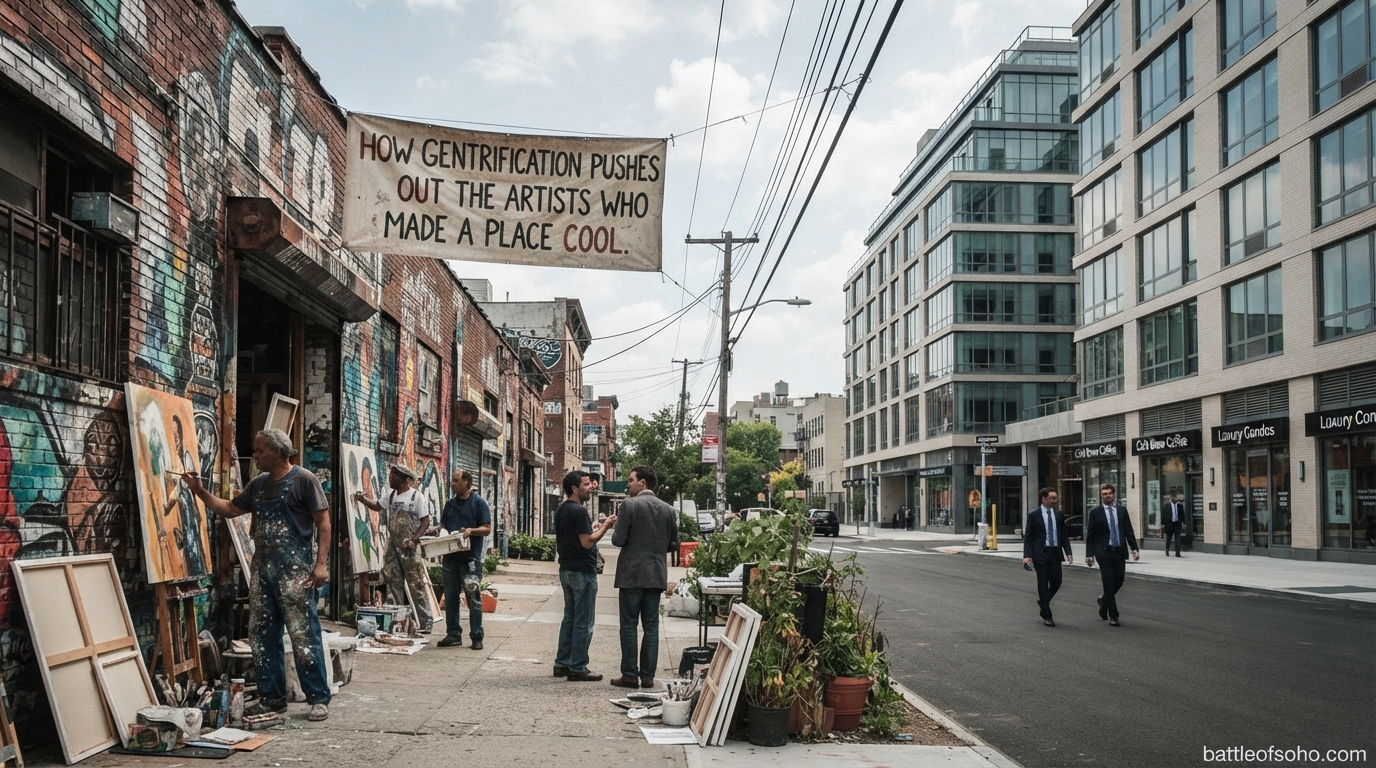
Walk through SoHo, Williamsburg, or Shoreditch on a Saturday afternoon and you will see something odd. The galleries are gone or shrinking. The lofts that once held painters and sculptors now sell for millions. The dive bars where bands played for door money have been replaced by cocktail lounges with fourteen-dollar drinks. The very people who gave these neighborhoods their creative identity, the artists who made them cool in the first place, have been pushed out by the forces they unintentionally set in motion.
Understanding how gentrification pushes out the artists who made a place cool requires looking at a cycle that has repeated itself for decades across cities worldwide. Artists move into cheap, neglected areas because they need affordable space. They build studios, open galleries, and host underground shows. The neighborhood gains a reputation as edgy and interesting. Developers and affluent newcomers take notice. Rents climb. And the artists who did the cultural groundwork find themselves unable to afford the neighborhood they helped transform.
I have watched this pattern play out in real time. Friends who rented Bushwick studio space for under a thousand dollars a month in the early 2010s now commute from Philadelphia or Providence because New York priced them out. Gallery owners I spoke with described watching entire creative ecosystems vanish within five years of a neighborhood becoming desirable. This is not an abstract policy debate. It is a human story about people losing the communities and workspaces they built with their own hands.
In this article, we will break down exactly how this cycle works, why artists are uniquely vulnerable to it, what cities around the world are doing about it, and whether the pattern can actually be broken. Whether you are an artist worried about your own neighborhood, a community organizer looking for solutions, or simply someone who has noticed your favorite creative district disappearing, this guide will give you the full picture.
Table of Contents
What Gentrification Actually Means for Artists
Gentrification is the process by which wealthier residents and businesses move into a lower-income neighborhood, driving up housing costs and displacing the existing community. The term was coined in 1964 by British sociologist Ruth Glass, who used it to describe what was happening to working-class neighborhoods in London. She saw wealthy buyers, or gentry, snapping up cheap properties and transforming them, fundamentally changing the social character of entire districts.
For artists, gentrification hits in a specific and particularly painful way. Artists are often the first wave of newcomers in a neglected area, drawn by cheap rent and large industrial spaces. They are not wealthy investors. They are people looking for a place to work that they can actually afford. A painter needs a room with good light. A sculptor needs a garage or warehouse. A musician needs a basement where neighbors will not call the police at midnight. These practical needs push artists into neighborhoods that most middle-class professionals would avoid.
The technical term for what happens next is exclusionary displacement. Once a neighborhood starts gentrifying and homes are vacated by lower-income residents, other lower-income residents, including artists, cannot afford to move in because rents and sale prices have climbed too high. The artist who would have taken that vacant loft in 2015 cannot touch it in 2026. The door has closed.
There is also cultural displacement, which is harder to measure but just as devastating. When the artists, immigrants, and working-class families who gave a neighborhood its character are replaced by affluent professionals, the cultural identity of the place erodes. The bodegas become artisanal coffee shops. The music venues become bank branches. The community murals are painted over or, worse, commodified and sold as the neighborhood rebrands itself.
How Gentrification Pushes Out the Artists Who Made a Place Cool: The Playbook
The gentrification cycle follows a recognizable pattern. Scholars, urban planners, and community organizers have studied it for decades, and the stages are remarkably consistent across cities. Here is how it typically unfolds.
Stage 1: Artists Discover a Cheap Neighborhood
It starts with necessity. Artists need space and cannot afford established arts districts. They find neighborhoods that have been ignored by developers, often former industrial zones or areas with aging housing stock. Rents are low because the area is considered rough, inconvenient, or simply off the radar of most renters. Artists move in quietly, setting up studios in converted warehouses, living in lofts, and hosting informal shows.
Stage 2: A Scene Begins to Form
Within a few years, a critical mass of artists creates a visible scene. Galleries open. warehouses host weekend open-studio events. Word spreads through art schools, music forums, and word of mouth. The neighborhood starts appearing in lifestyle blogs and local press as an up-and-coming area. This is the phase where the area gains what urban theorists call cultural cachet. It becomes cool, but only to a small subculture of people in the know.
Stage 3: Developers and Investors Take Notice
This is the turning point. Real estate investors and developers recognize that the neighborhood now has a desirable brand. The cool factor that artists created becomes a marketing tool. Properties are bought up, renovated, and flipped. New construction begins, often luxury apartments marketed to young professionals who want to live in a vibrant, artistic area. The phrase artist lofts starts appearing in real estate listings, sometimes for buildings where no actual artist could afford to live.
Stage 4: Rents Spike and Businesses Change
As new residents arrive, demand for different goods and services increases. Independent bodegas, cheap diners, and dive bars are replaced by high-end restaurants, boutique fitness studios, and craft cocktail bars. Commercial landlords raise rents, forcing out long-term small businesses. Residential rents climb sharply. In Bushwick, Brooklyn, one artist I followed saw rent on a studio and apartment go from $2,300 per month in 2020 to $3,800 by 2025. That is not a gradual increase. That is a forced eviction by economics.
Stage 5: Artists Are Priced Out
The final stage is displacement. Artists who never owned property have no equity to fall back on. When the lease is up, the new rent is beyond reach. Galleries close because foot traffic from collectors now favors more established districts. Music venues shut down because they cannot compete with the revenue a restaurant or retail store can generate in the same space. The artists leave, usually for the next cheap neighborhood on the fringe, and the cycle begins again somewhere else.
A common question is whether artists are the main cause of gentrification. The honest answer is nuanced. Research suggests that arts workers and arts-related businesses are implicated in gentrification, though arts workers tend to lead neighborhood change while arts businesses tend to follow it. Artists are not wealthy developers buying up blocks of housing. But their presence does signal to investors that an area is ready for transformation. Artists are the leading edge of a wave they cannot control and rarely benefit from.
The Historical Roots: From Industrial Lofts to Brooklyn Brownstones
This pattern is not new. The artist-as-unwitting-gentrifier story has been playing out since at least the 1960s. Understanding this history helps explain why the cycle is so hard to break.
The story of modern gentrification begins with Ruth Glass, who in 1964 coined the term while observing London neighborhoods. She wrote: “Nowadays many of these houses are being sub-divided into costly flats. Once this process of gentrification starts in a district it goes on rapidly until all or most of the original working class occupiers are displaced and the whole social character of the district is changed.” That description, written over sixty years ago, perfectly captures what happened to SoHo, Williamsburg, Shoreditch, and Kreuzberg decades later.
In 1970s New York, artists began moving into SoHo, which was then a district of empty cast-iron factories and warehouses. The spaces were massive, cheap, and technically illegal to live in. Artists formed organizations like the SoHo Artists Association to fight for loft living rights. They won, and SoHo became the template for artist-driven neighborhood transformation. Within twenty years, SoHo was one of the most expensive neighborhoods in Manhattan. Most of the artists who fought for the right to live there were long gone.
The same story repeated in the East Village and the Lower East Side in the 1980s. Then in Williamsburg in the 1990s. Then Bushwick in the 2000s. Each time, artists moved into a neglected area, built a scene, attracted attention, and were eventually priced out. The cycle even acquired a name among urban planners: the gentrification lifecycle.
In 2026, we can see this pattern accelerating. What took twenty years in SoHo took fifteen in Williamsburg and perhaps ten in Bushwick. The speed of displacement is increasing as real estate technology, investment capital, and social media make it easier for investors to identify and target emerging neighborhoods faster than ever before.
Cities Where Artists Are Being Pushed Out: A Global Snapshot
This is not just a New York story. Artist displacement is happening in major cities across the world, and different cities are responding in very different ways. Here is a look at how several key cities are experiencing and addressing the crisis.
New York City: The Canary in the Coal Mine
New York has lost artists at an alarming rate. A 2026 report from the Center for an Urban Future found that the city’s artist population fell for the first time in decades. The Lower East Side and Chinatown saw artist populations drop by 55 percent. The Upper West Side dropped 32 percent. These are not marginal declines. They represent the hollowing out of entire creative ecosystems.
At the same time, cities like Philadelphia saw their artist population increase by 8 percent since 2019, and Nashville grew by 19 percent. Artists are not disappearing. They are migrating to places they can afford. New York has responded with affordable artist housing programs, but the scale is dwarfed by the need. Gallery owner Daniel Aycock of Front Room Gallery told reporters that the city is losing the very people who make it a cultural capital, and the proposed solutions feel like a band-aid on a hemorrhage.
London: The Night Mayor Experiment
London has taken a more experimental approach. The city appointed a Night Mayor, a position inspired by Amsterdam, specifically to protect nightlife and music venues from being closed by development pressure and noise complaints from new luxury residents. The London Music Venue Task Force brought together venue owners, city officials, and community groups to address the rapid loss of independent music spaces.
London’s approach recognizes that protecting artists means protecting the spaces where they work and perform. The Night Mayor does not have the power to freeze rents, but the role gives venues an advocate inside city government when developers push for demolition or conversion. It is a partial solution, but one that has been copied by Paris, Berlin, and other cities facing similar pressures.
Berlin: Rent Caps and Cultural Protection
Berlin’s Kreuzberg neighborhood followed the classic pattern. Artists and squatters moved into cheap, often abandoned buildings in the 1980s and 1990s, creating one of Europe’s most vibrant alternative art scenes. By the 2010s, international investors were buying up buildings and rents were surging. Berlin responded with a rent cap policy, though it was struck down by Germany’s constitutional court in 2021. The city has also designated specific areas as protected cultural zones where development is restricted.
The Berlin experience shows both the potential and limits of policy solutions. Rent caps can provide temporary relief, but they face legal challenges and political opposition. The deeper issue, that property ownership is concentrated in the hands of investors who have no connection to the community, remains unaddressed.
Los Angeles: The Arts District Paradox
Los Angeles has its own version of this story. The downtown Arts District was built by artists who moved into converted warehouses in the 1980s. By 2026, it is one of the most expensive neighborhoods in LA, with luxury lofts and craft breweries replacing artist studios. The city created an Affordable Artist Housing preference program, but critics note that the number of units available is a fraction of what is needed.
What Cities Are Trying
Across these cities, several policy tools have emerged. Inclusionary zoning requires developers to include a percentage of affordable units in new buildings. Community land trusts allow communities to collectively own land and keep it affordable in perpetuity. Artist cooperatives pool resources to buy buildings and protect them from speculative markets. Social-purpose real estate organizations like Toronto’s Artscape buy properties specifically to house artists at below-market rates.
None of these solutions has been implemented at sufficient scale to stop the cycle. But together, they represent a toolkit that cities can draw from. The question is whether there is enough political will to use them aggressively before more creative communities disappear.
Why Artists Are Especially Vulnerable
You might wonder why artists are hit harder by gentrification than other low-income residents. The answer lies in a combination of economic, professional, and structural factors that make artists uniquely exposed to housing instability.
Irregular Income
Most working artists do not have steady paychecks. Income comes in bursts from sales, commissions, grants, and gig work. A painter might sell three pieces in one month and nothing for the next four. This irregular income makes it nearly impossible to compete with tech workers, finance professionals, or even middle managers who have reliable monthly salaries. When a landlord is choosing between a tenant with a W-2 job making $90,000 a year and an artist who made $45,000 last year through a patchwork of sales and teaching, the choice is obvious.
Lack of Property Ownership
The single biggest factor in whether someone survives gentrification is whether they own property. Artists who rented for decades have no equity. When rents triple, they have nothing to fall back on. They cannot take out a home equity loan. They cannot sell at a profit and move somewhere cheaper. They simply lose their space and start over from zero. This is why artist cooperatives and community land trusts, which focus on collective ownership, have become such important parts of the solution conversation.
Space Requirements
Artists need more space than the average renter. A writer can work from a kitchen table, but a sculptor needs a studio. A printmaker needs ventilation and equipment. A musician needs soundproofing. These space requirements push artists into the exact kinds of large, industrial, or warehouse spaces that developers find most attractive for conversion to luxury lofts. The artist’s workspace and the developer’s target property are often the same building.
Community Dependency
Art does not happen in isolation. Artists need other artists, galleries, supply stores, performance venues, and an audience. When gentrification breaks up a creative community, it does not just displace individuals. It destroys the ecosystem that made the work possible. A sculptor who moves to a cheaper town forty miles away may have a studio but no community, no gallery representation, and no audience. This is why artist displacement is not just a housing problem. It is a cultural infrastructure problem.
The Guilt Factor
One thing that rarely gets discussed is the guilt many artists feel. They know that their presence in a neighborhood can be the first step in a process that ultimately displaces working-class families and immigrant communities. As one Reddit commenter in r/bayarea put it, every neighborhood their artist aunt has moved to has eventually gotten hot and the original residents got pushed out. Artists did not intend to cause this, but they often feel complicit. This emotional burden adds another layer to the vulnerability artists face. They are economically marginalized while also being culturally scapegoated for forces driven by real estate capital.
When Art Fights Back: Community Resistance and Solutions
The story is not entirely hopeless. Across the world, artists and communities are organizing to resist displacement and build alternatives to the gentrification cycle. Some of these efforts are small and local. Others are reshaping city policy. Here is what resistance looks like on the ground.
Artist Cooperatives
Artist cooperatives pool financial resources to collectively buy or lease buildings. By owning property together, artists gain protection from rent increases and speculative sales. The model has been used successfully in cities from New York to Minneapolis. Cooperatives require significant upfront organizing and capital, but they offer one of the most durable protections against displacement because they remove the property from the speculative market entirely.
Community Land Trusts
A community land trust is a nonprofit organization that holds land in trust for the benefit of the community. The trust owns the land and leases it to residents, often at below-market rates, with strict rules against speculative resale. This model permanently removes land from the speculative market and ensures it remains affordable for future generations. Several cities are exploring land trusts specifically to protect artist housing and workspace.
Community Organizing and Public Art
In New York’s Chinatown, the W.O.W. Project, led by Mei Lum, uses art and oral history to organize against displacement. The project’s Chinatown Is Not For Sale campaign brought together artists, residents, and small business owners to resist the commodification of their neighborhood. In Brooklyn, Groundswell creates community murals that are not just decorative but explicitly political, giving neighborhoods a visible reminder of their identity and a tool for organizing.
In East New York, Arts East NY, founded by Catherine Green, took a different approach. Rather than resisting development outright, the organization worked to ensure that existing residents and artists had a seat at the table when new projects were planned. The idea is that community-led development can coexist with neighborhood change if the people who already live there have power in the process.
The Outside Artist vs. Community Artist Debate
One of the most important conversations happening within these resistance movements is the distinction between outside artists and community artists. An outside artist moves into a neighborhood with no connection to its existing residents or culture. A community artist is embedded in the neighborhood, often a long-term resident whose work reflects and serves the people who already live there.
This distinction matters because outside artists can inadvertently accelerate displacement. They bring a cool factor that attracts developers without bringing organizing power or community ties. Community artists, by contrast, tend to fight for their neighbors because their fates are intertwined. Organizations like Flux Factory in New York have developed frameworks for artists to work ethically in neighborhoods they did not originate from, including hiring locally, collaborating with existing organizations, and refusing developer funding that comes with strings attached.
Policy Solutions: What Governments Can Do
Beyond community organizing, several policy tools have shown promise. Rent stabilization limits how much landlords can raise rents on existing tenants. Inclusionary zoning requires developers to set aside affordable units. Artist housing preference programs give artists priority for affordable housing lotteries. Tax incentives can encourage property owners to lease to artists at below-market rates.
The challenge is scale. A city might create a hundred units of affordable artist housing in a year while losing a thousand artist-occupied units to market-rate conversion in the same period. As the Shelterforce investigation noted, many of these solutions arrive too late and too small to counteract the massive financial incentives driving displacement. The solutions work in principle but need to be deployed at a scale that matches the problem.
What You Can Do: Actions for Artists and Allies
If you are reading this and wondering what you can actually do, here are concrete steps that individuals and communities can take.
For artists, the most powerful step is pursuing property ownership, whether individually or through a cooperative. Renting will always leave you vulnerable to the market. If buying is not possible, get involved in tenant organizing. Join or form a tenants association in your building. Know your rights as a renter, including protections against illegal eviction and harassment. Connect with local arts organizations that are working on displacement issues.
For community members and allies, support artist-owned businesses rather than the chain stores and luxury retail that replace them. Attend community board meetings and speak up about development projects. Vote for candidates who support affordable housing and tenant protections. If you are a homeowner in a changing neighborhood, consider renting to an artist at below-market rate or donating space for community use.
For policymakers, the research is clear. The most effective interventions combine ownership models, like cooperatives and land trusts, with strong tenant protections and zoning requirements. Piecemeal solutions that create a small number of affordable units while allowing market-rate displacement to continue will not stop the cycle. The political will to act at scale is what has been missing.
Frequently Asked Questions
How does gentrification push people out?
Gentrification pushes people out through a process called exclusionary displacement. When wealthier residents move into a lower-income neighborhood, property values and rents rise. As homes become vacant, lower-income residents, including artists, cannot afford to move in. Eventually, even existing tenants are forced out when their leases end and rents are raised beyond their means.
Are artists the main cause of gentrification?
Artists are not the main cause of gentrification, but they are often the first wave. Research shows that arts workers tend to lead neighborhood change while arts businesses follow it. Artists signal to developers that an area is ready for transformation, but the actual displacement is driven by real estate investment, speculation, and policy decisions that favor property owners over renters.
What did Ruth Glass say about gentrification?
Ruth Glass coined the term gentrification in 1964. She wrote that once the process starts in a district, it goes on rapidly until all or most of the original working-class occupiers are displaced and the whole social character of the district is changed. Her observation, made about London neighborhoods, described the exact same pattern we see today in cities worldwide.
How does gentrification impact culture?
Gentrification erodes cultural identity by displacing the people who created it. When artists, immigrants, and working-class families are replaced by affluent professionals, the neighborhood’s character changes. Independent galleries, music venues, and community spaces close. Public art is removed or commodified. The creative energy that made the area distinctive disappears, leaving behind a homogenized landscape of chain stores and luxury housing.
Can gentrification be stopped or reversed?
Gentrification can be slowed and partially reversed through strong policy interventions. Community land trusts, artist cooperatives, rent stabilization, and inclusionary zoning have all shown results in specific neighborhoods. However, no city has successfully stopped the cycle at scale. The solutions exist but require political will and funding that most municipalities have not yet committed.
Why do artists move to cheap neighborhoods?
Artists move to cheap neighborhoods out of economic necessity. They need large, affordable spaces for studios, rehearsals, and storage. Established arts districts are too expensive for most working artists. Neglected or industrial neighborhoods offer the space and low rents artists need, along with a freedom to make noise and mess that more regulated areas do not allow.
What are artist land trusts?
Artist land trusts are nonprofit organizations that hold property in trust specifically to keep it affordable for artists. The trust owns the land or building and leases it to artists at below-market rates, with rules preventing speculative resale. By removing the property from the speculative real estate market, the trust ensures it remains affordable for artists in perpetuity.
What happens to artists after they are displaced?
Displaced artists typically migrate to cheaper cities or neighborhoods on the urban fringe. Many New York artists have moved to Philadelphia, which saw its artist population grow 8 percent since 2019. Others relocate to smaller cities like Providence, Detroit, or Baltimore. Some leave the art world entirely because the disruption to their community, studio space, and professional network is too severe to recover from.
Conclusion: Can the Cycle Be Broken?
The question of how gentrification pushes out the artists who made a place cool does not have a simple answer. The cycle is driven by powerful economic forces, real estate speculation, and decades of policy choices that prioritize property values over communities. Artists are caught in a system they did not design and cannot control. They arrive looking for affordable space, build something culturally valuable, and then watch as that value is monetized and used against them.
But the cycle is not inevitable. The solutions exist. Community land trusts, artist cooperatives, inclusionary zoning, rent stabilization, and community organizing have all been shown to work at the neighborhood level. What has been missing is the scale and political will to deploy these tools comprehensively. Cities that take the crisis seriously, like London with its Night Mayor or Berlin with its cultural protection zones, show that policy can make a difference even when it cannot solve everything.
If there is one lesson from decades of watching this pattern repeat, it is that ownership matters. Renters are always vulnerable. Communities that own their land and buildings, whether through cooperatives, land trusts, or other collective models, have a fighting chance. The artists who survive gentrification are the ones who found a way to own a piece of the ground they stand on.
The next time you walk through a neighborhood known for its galleries, music venues, and creative energy, ask yourself a question. How many of the artists who made this place what it is can still afford to be here? The answer, in most cities, is fewer than you think. And that should concern anyone who believes that cities need more than luxury apartments and chain coffee shops to be worth living in.