
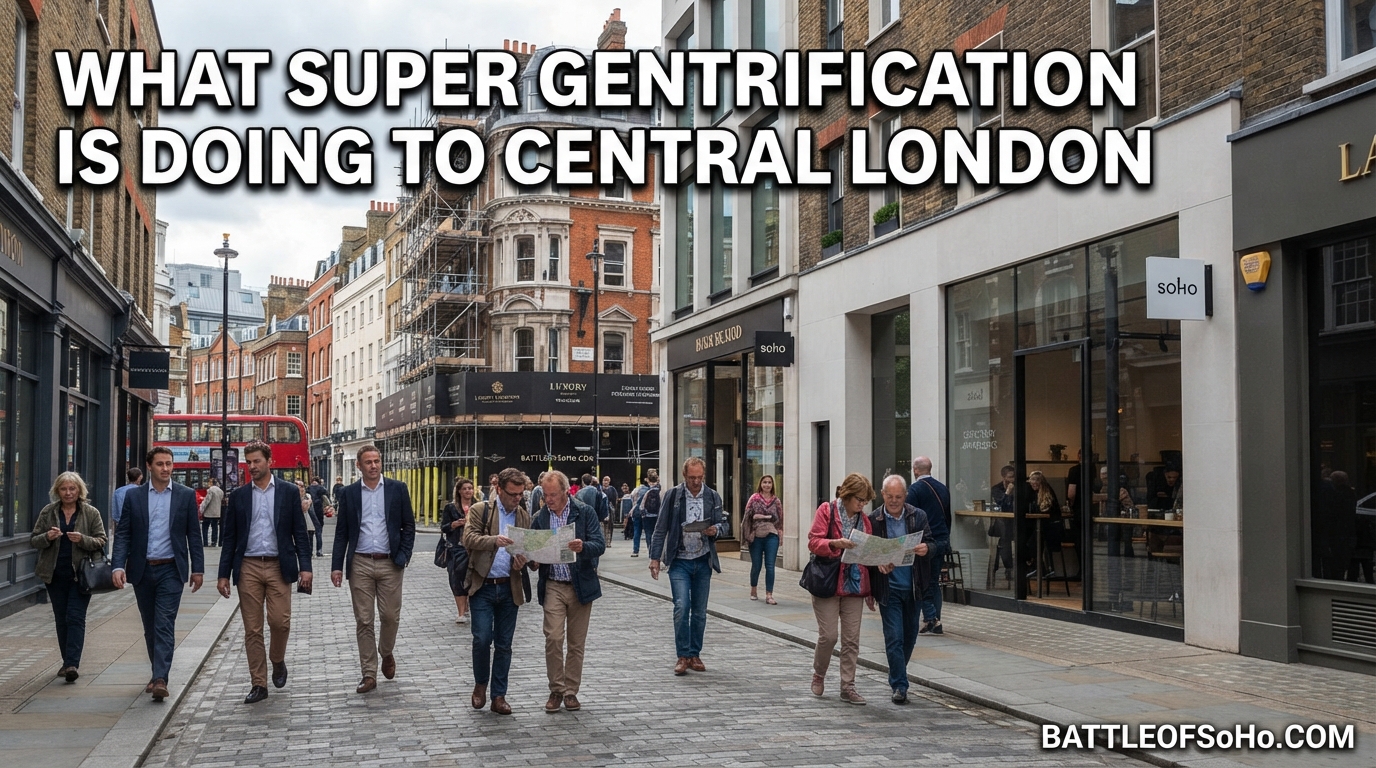
You can feel it before you can name it. The cornershop that sold everything for 30 years becomes a craft beer bar. The family that lived on the street for generations quietly moves to Zone 5. The primary school down the road has fewer applicants every September. What super gentrification is doing to central London goes far beyond coffee shops and estate agents. It is rewriting who gets to live in the heart of one of the world’s most influential cities.
Super gentrification London is a phenomenon where already-gentrified neighbourhoods undergo a second wave of class upgrading. Wealthier residents, typically finance industry professionals and international investors, displace the middle-class gentrifiers who arrived in earlier decades. The result is a city centre that increasingly belongs only to the very rich.
Research from Trust for London identified 53 low-income neighbourhoods across the capital experiencing the most extreme demographic shifts. Average incomes in these areas rose by 11% in real terms between 2002 and 2015. House prices in the same neighbourhoods grew at roughly two and a half times the London average. These are not slow, organic changes. They are rapid, data-confirmed transformations happening block by block.
This article breaks down exactly what super gentrification is, where it is hitting hardest, who is being displaced, and what it means for the future of central London. Whether you are a Londoner watching your neighbourhood change, a researcher studying urban displacement, or a policy maker looking for solutions, what follows is a clear-eyed look at the forces reshaping the city.
Table of Contents
What Is Super Gentrification?
Super gentrification is the process by which an already-gentrified neighbourhood undergoes further class upgrading, with an even wealthier group displacing the previous middle-class residents who had originally gentrified the area. The term was coined by urban geographers Loretta Lees and Tim Butler to describe what they observed in London neighbourhoods like Barnsbury in Islington during the early 2000s.
To understand super gentrification, it helps to see it as the top of a staircase. Regular gentrification happens when middle-class professionals move into a working-class area, attracted by cheaper housing and period architecture. Over time, they renovate properties, attract new businesses, and push up prices. Super gentrification is the next step up: global elites, often working in financial services or investing from abroad, buy into these already desirable areas and push prices to levels that even the original gentrifiers cannot afford.
Researchers generally identify four types of gentrification that have shaped London over the past six decades. Each wave has been driven by different forces and has displaced different groups of people.
The first type is organic or pioneer gentrification, which began in the 1960s when young professionals started buying cheap Georgian and Victorian properties in areas like Islington and Notting Hill. These early gentrifiers were often drawn by the architectural character of the housing stock and the proximity to central London.
The second type is state-led or developer-led regeneration, where local authorities and private developers partner to demolish and rebuild council estates. This form of gentrification accelerated from the 1990s onward and has transformed large swaths of social housing across inner London boroughs.
The third type is super-gentrification itself, the focus of this article. It occurs in neighbourhoods that are already considered desirable and expensive. Finance workers, corporate executives, and international buyers purchase properties at extraordinary prices, often outbidding even affluent professional families.
The fourth type is sometimes called hyper-gentrification or financialized gentrification. This involves housing being treated primarily as a financial asset rather than a place to live. Properties are bought by investment funds, left empty, or used as safe-deposit boxes for global capital. This phenomenon is closely linked to what researchers call the buy-to-leave trend.
The drivers of super gentrification are specific and identifiable. London’s status as a global financial centre means that tens of thousands of highly paid workers in the City and Canary Wharf have the purchasing power to bid up property prices in central neighbourhoods. International investment, particularly from wealthy buyers in the Middle East, Asia, and North America, adds another layer of demand that local salaries simply cannot compete with. Together, these forces create a housing market in central London that operates on a completely different financial plane from the rest of the country.
A Brief History of Gentrification in London
London’s gentrification story did not begin overnight. It is the product of decades of policy decisions, economic shifts, and cultural changes that have progressively transformed the city’s social geography. Understanding this history helps explain how we arrived at the super gentrification crisis facing central London today.
After the Second World War, large parts of inner London were in serious decline. Bomb damage, slum housing, and population loss left neighbourhoods like Islington, Hackney, and Battersea with abandoned buildings and falling property values. Working-class communities lived alongside increasingly dilapidated housing stock, and many middle-class families had already left for the suburbs or new towns.
The first wave of gentrification began in the late 1950s and 1960s. Young, often bohemian professionals discovered that they could buy Georgian terraces and Victorian villas in places like Barnsbury, Notting Hill, and parts of Chelsea for remarkably low prices. These pioneer gentrifiers were attracted by the architectural quality of the housing, the central location, and the cultural diversity of the areas. They renovated properties, started local campaigns, and gradually made these neighbourhoods fashionable.
The 1980s marked a turning point. The Big Bang of 1986 deregulated London’s financial markets and triggered a massive expansion of the City’s financial services sector. Suddenly, thousands of highly paid bankers, traders, and corporate lawyers were looking for homes close to the Square Mile. Areas like Islington, which had been gentrifying slowly for two decades, experienced a rapid acceleration. Property prices began climbing at rates that priced out not only working-class residents but also the earlier, more modest gentrifiers.
The 1990s and 2000s saw the rise of state-led estate regeneration. Council estates across inner London were earmarked for demolition and rebuilding, often in partnership with private developers. The stated goal was to improve substandard housing and create mixed communities. In practice, these schemes frequently resulted in a net loss of social housing units and the displacement of existing tenants. Estates like Woodberry Down in Hackney, the Aylesbury in Southwark, and Heygate in Elephant and Castle became flashpoints for debates about regeneration and social cleansing.
By the 2010s, super gentrification had taken hold in earnest. International capital was flooding into London property at unprecedented rates. The aftermath of the 2008 financial crisis saw governments worldwide pump liquidity into financial markets, and much of that money found its way into prime central London real estate. Neighbourhoods that had been gentrified once were now being gentrified again, this time by a global elite for whom a two-million-pound flat was a casual investment.
Today, in 2026, we are living with the consequences. Central London neighbourhoods that were once mixed communities are now among the most socially homogeneous in the country. The question is no longer whether gentrification will happen, but whether anything can slow the march of super gentrification before it fundamentally changes what London is.
Where Super Gentrification Is Hitting Hardest in Central London
Super gentrification is not evenly distributed across London. It clusters in specific areas where global wealth meets desirable housing stock, transport links, and cultural cachet. The Trust for London research identified 53 neighbourhoods, technically known as Lower Layer Super Output Areas or LSOAs, where the most extreme changes have occurred. These are spread across several inner London boroughs, each with its own story.
Islington stands as one of the clearest examples of completed super gentrification. Areas like Barnsbury, which Loretta Lees studied in her foundational research, have been through the full cycle. What was once a working-class neighbourhood with slum housing in the 1950s became a pioneer gentrification hotspot in the 1960s and 1970s. By the 2000s, finance workers and international buyers were purchasing family homes for sums that would have been unimaginable a generation earlier. Today, Barnsbury is one of the most expensive residential areas in Britain.
Hackney tells a slightly different story. Parts of the borough, particularly around Shoreditch and Hoxton, experienced rapid gentrification from the late 1990s as artists and creative professionals moved in attracted by cheap studio space and industrial architecture. Within fifteen years, the creative pioneers were themselves being priced out by tech workers, bankers, and international investors. The Borough of Hackney now contains some of the most stark contrasts in London, with council estates sitting alongside apartments that sell for over a million pounds.
Tower Hamlets presents yet another pattern. The borough contains both Canary Wharf, one of the largest financial districts in Europe, and some of the highest levels of poverty in the country. Super gentrification here happens in the shadow of the skyscrapers themselves. Spitalfields, Wapping, and parts of Bethnal Green have seen property prices driven to extraordinary levels by proximity to the financial district. Long-term residents, particularly from the Bangladeshi community, face intense pressure from rising rents and property prices.
Notting Hill and Chelsea represent the endpoint of super gentrification. These areas are so thoroughly transformed that they have become global symbols of wealth. Notting Hill’s journey from a Caribbean working-class area in the 1950s to one of the most expensive postcodes in the world is perhaps the single most dramatic example of gentrification in London’s history. The Notting Hill Carnival remains as a reminder of the area’s Caribbean heritage, but the community that created it has largely been displaced.
Battersea has experienced a more recent wave of super gentrification. The opening of the American Embassy in Nine Elms and the redevelopment of Battersea Power Station have poured billions of pounds of investment into the area. Luxury apartment developments, many marketed primarily to overseas buyers, have transformed the riverside. Long-term residents of the borough watch as their local shops and pubs are replaced by high-end restaurants and boutique fitness studios.
Clapham, particularly around Clapham Common and Clapham Old Town, shows how super gentrification follows transport links. The Northern Line stations that once served working-class commuters now deliver young finance workers and corporate professionals to gastropubs and artisan bakeries. The demographic shift has been so pronounced that local schools have seen significant drops in applications as fewer families can afford to stay.
What unites all these areas is a pattern: desirable housing stock, good transport connections, and proximity to employment centres. Once an area ticks these boxes, it becomes a target for the investment flows that drive super gentrification. No central London neighbourhood with period housing and a Tube station is immune.
The Demographic Earthquake: Who Is Being Pushed Out
The statistics behind super gentrification London reveal a demographic earthquake. It is not just that neighbourhoods are getting wealthier. The composition of who lives there is changing at a fundamental level, and the data tells a stark story about who is being displaced and who is moving in.
One of the most striking findings from the Trust for London research is the dramatic decline in Black communities across the 53 most rapidly gentrifying neighbourhoods. Between 2001 and 2016, these areas saw an average drop of more than 10% in their Black population. This is not a random fluctuation. It represents thousands of people who were part of established communities being systematically pushed out of the areas they had called home for decades.
The decline in Black communities is partly a story about the end of social housing as a stabilising force. Many Black Londoners historically lived in council housing in inner London boroughs. As estates were demolished and regenerated with a net loss of social rented units, these communities had nowhere to go within the same neighbourhoods. The promise of right-to-return schemes was frequently broken or undermined by eligibility criteria that priced out former tenants.
Children are disappearing from these neighbourhoods too. The same 53 areas saw a significant decline in the number of families with dependent children. Primary school applications, one of the most reliable real-time indicators of demographic change, have dropped sharply in rapidly gentrifying areas. Schools that once had waiting lists now have empty places. Some have closed entirely.
The BBC reported on this trend, highlighting that London neighbourhoods gentrifying most rapidly are seeing fewer and fewer children. This is not because families are choosing not to have children. It is because they cannot afford the housing. A two-bedroom flat in a super-gentrified area can cost more per month than the median household income for the entire country. Families are pushed to outer London boroughs or out of the city altogether.
The loss of social housing tenants is another defining feature. The 53 gentrifying neighbourhoods experienced a huge drop in the proportion of residents living in social rented accommodation. This reflects both the demolition of council estates and the right-to-buy policy that allowed tenants to purchase their homes, many of which were subsequently sold on to private buyers at market rates.
Who replaces these departing communities? The data shows a clear rise in people working in managerial and professional occupations. In the most rapidly gentrifying neighbourhoods, the proportion of residents in senior managerial or professional roles increased dramatically. These are not the pioneer gentrifiers of the 1960s, who were often teachers, artists, and junior professionals. These are corporate executives, senior bankers, international business people, and partners in law firms.
The result is a central London that is becoming socially monolithic. Where there were once mixed communities of working-class families, social tenants, middle-class professionals, and diverse cultural groups, there is increasingly a single demographic: very wealthy, often white, often childless, often working in finance or related sectors. This is not the London that most Londoners recognise. It is a London being remade in the image of global capital.
The human cost of these statistics is immense. Behind every percentage point is a family that had to leave the area where they grew up. Behind every closed school is a community network that has been scattered across the suburbs. Behind every demolished estate is a social fabric that took generations to build, torn apart in a few years of regeneration.
The Financial Machine Behind Super Gentrification
To understand what super gentrification is doing to central London, you have to follow the money. The forces driving this transformation are not mysterious. They are identifiable, traceable, and rooted in specific economic structures that have made London property one of the most sought-after asset classes in the world.
London’s financial services economy is the engine of super gentrification. The City of London and Canary Wharf together employ hundreds of thousands of people in banking, insurance, asset management, and related professional services. A significant proportion of these workers earn bonuses that dwarf the median UK salary. When a single year’s bonus can exceed the cost of a deposit on a central London flat, the housing market is inevitably distorted. These bonus-fuelled purchases create a floor price for property in desirable central areas that shuts out nearly everyone else.
International investment is the second great driver. London has been deliberately positioned as an open property market, welcoming foreign capital with minimal restrictions. Buyers from the Gulf states, Russia, China, Southeast Asia, and North America have poured billions into London property over the past two decades. For many of these buyers, the property is not primarily a home. It is a safe haven for capital, a hedge against political instability in their home countries, or simply a store of value. This demand is entirely disconnected from local wages and local need.
The buy-to-leave phenomenon is perhaps the most visible and galling manifestation of this financialization of housing. Properties are purchased by investors who have no intention of living in them or even renting them out. They sit empty, held as appreciating assets while the surrounding community struggles with a housing shortage. Research has documented entire developments in prime central London where more than half the apartments are dark at night. These dead zones are the physical embodiment of housing as a financial instrument rather than a social good.
The financialization of housing extends beyond individual buyers. Institutional investors, pension funds, and sovereign wealth funds now own significant portfolios of London residential property. Properties are packaged into investment vehicles and traded on international markets. The people who actually live in these buildings have no relationship with the ultimate owner, who may be a fund manager in another country making decisions based on spreadsheet returns.
The connection between global finance and local displacement is direct. Every million-pound flat bought by an overseas investor is a home that a London family cannot occupy. Every bonus-fuelled purchase prices out another household. Every empty investment property in a dead zone represents housing stock removed from the supply that ordinary Londoners need. The system is working exactly as designed. It is just not designed to serve the people who actually make London function.
This is why super gentrification is fundamentally different from earlier waves of gentrification. The pioneer gentrifiers of the 1960s were buying homes to live in. The estate regenerators of the 1990s at least paid lip service to creating mixed communities. Super gentrification, driven by global finance and international capital, has no such connection to place. It treats central London as a series of postcodes on a balance sheet, and the people who live there as obstacles to optimal returns.
Case Study: Woodberry Down and the Manor House Regeneration
Woodberry Down, a large post-war council estate in the Manor House area of Hackney, offers one of the most instructive case studies of how estate regeneration contributes to super gentrification London. The estate was built in the late 1940s and 1950s to provide high-quality social housing for working-class families. By the early 2000s, after decades of underinvestment, it had fallen into serious disrepair.
Hackney Council, in partnership with private developers, launched one of the largest regeneration programmes in Europe. The plan promised to replace aging housing stock with modern, energy-efficient homes and to create a mixed, sustainable community. The reality has been more complicated and more painful for existing residents.
The regeneration involved demolishing the existing estate and rebuilding it over a period of 20-plus years. A significant proportion of the new homes were sold privately to fund the development. The new towers rising above the reservoirs at Manor House are marketed as luxury living, with concierge services and price tags that only the wealthiest buyers can afford. The estate that once housed thousands of working-class families is now a mixed development where social tenants, private renters, and millionaire owners live side by side but rarely interact.
The impact on existing residents has been severe. Many were decanted, the official term for being temporarily relocated, to other areas and never returned. Those who did come back found a transformed community. The social networks that had sustained the estate for decades were fragmented. The new private residents had different needs, different expectations, and different relationships with the area. Woodberry Down is now physically improved but socially unrecognisable from the community that existed before regeneration.
This pattern is not unique to Woodberry Down. Across London, estate regeneration schemes have followed a similar trajectory. The Aylesbury Estate in Southwark, the Heygate Estate in Elephant and Castle, the Cressingham Gardens in Lambeth, and many others have seen long-established communities broken up in the name of improvement. The common thread is that physical regeneration comes at the cost of social destruction, and the benefits flow disproportionately to incoming wealthy residents rather than the people the estates were originally built to house.
What This Means for London’s Culture and Communities
The impact of super gentrification London extends far beyond housing statistics and demographic charts. It is reshaping the cultural fabric of the city in ways that are visible on every high street and felt in every community space. The London that millions of people around the world love, the messy, creative, diverse, unpredictable London, is being sanded down into something far more uniform and far less interesting.
The transformation of high streets is one of the most visible signs. Independent shops that served local communities for decades are replaced by chain restaurants, luxury boutiques, and artisan coffee bars. The pattern is so consistent it has become almost a parody: first comes the coffee shop, then the craft beer bar, then the boutique gym, then the estate agent. Long-term residents find that the shops they relied on, the newsagents, the hardware stores, the affordable grocers, have vanished.
Pubs, which have always been at the heart of London community life, are closing at an alarming rate. Many that survive have been refurbished beyond recognition, their interiors gutted and replaced with the same mid-century furniture and overpriced gastropub menus you can find in any gentrified area from Clapham to Camden. The social function of the pub, as a place where different types of people mixed, is being lost as prices rise and clienteles narrow.
Markets tell a similar story. Traditional wholesale and retail markets that served working-class communities for generations have been redeveloped as tourist destinations and foodie destinations. Spitalfields Market, once a working wholesale market, is now a polished shopping centre. Borough Market, while still beloved, has become so expensive that locals shop elsewhere. The markets that survive often do so by catering primarily to visitors and new residents rather than the communities they originally served.
The creative and cultural industries that have been one of London’s greatest strengths are under particular pressure. Artists, musicians, designers, and small creative businesses need affordable space to work. As super gentrification drives up commercial rents alongside residential ones, these people and businesses are pushed further out. Hackney, once a magnet for artists because of cheap studio space, has seen its creative community scatter to the outer boroughs and beyond the M25. The irony is brutal: the creative energy that made areas attractive to wealthy buyers in the first place is destroyed by the wealth that follows.
Online forums and community groups are full of the human cost of these changes. On Reddit, Facebook community groups, and urban discussion boards, Londoners describe the visceral feeling of watching their neighbourhoods change around them. People talk about the pharmacist that became a cocktail bar, the corner shop that became a deli, the school friends who have all moved to the same town in Kent because none of them could afford to stay. There is a consistent theme of grief: not just for individual shops or neighbours, but for a way of life that is disappearing.
Community erasure is perhaps the deepest wound. When a neighbourhood loses its long-term residents, it loses its institutional memory. The people who knew the history of the streets, who ran the community groups, who organised the street parties, who looked out for their neighbours, are gone. In their place is a transient population of wealthy renters and owners who may stay for a few years before moving on. The social infrastructure that makes a neighbourhood more than just a collection of buildings takes decades to build and can be destroyed in a single development cycle.
What Can Be Done: Solutions and Resistance
The picture is grim, but it is not hopeless. Across London, communities, researchers, and some politicians are pushing back against super gentrification and developing solutions that could slow or even reverse the trend. Understanding these efforts is essential for anyone who wants to see a more equitable future for central London.
Community land trusts offer one promising model. A community land trust is a non-profit organisation that acquires and holds land for the benefit of the local community, ensuring that housing on that land remains permanently affordable. The London Community Land Trust, based in Lewisham, has successfully developed genuinely affordable housing that is insulated from the speculative market. Scaling this model across more of London could create permanently affordable pockets within super-gentrified areas.
Stronger affordable housing requirements on new developments are another key tool. Many London boroughs require developers to include a percentage of affordable housing in new schemes, but the definitions of affordability are often misleading. A home priced at 80% of market rate in a super-gentrified area is still unaffordable for most Londoners. Genuine affordability, tied to local wages rather than inflated market rates, needs to be the baseline.
Controls on foreign ownership and empty properties could also make a difference. Several cities around the world, including Vancouver and Singapore, have introduced taxes on empty homes and restrictions on foreign buyers to cool speculative property markets. London has been slow to follow suit, but the political pressure is building. An empty homes premium, charged at a progressively higher rate the longer a property sits vacant, could discourage the buy-to-leave phenomenon that creates dead zones in central neighbourhoods.
Community resistance has scored some notable victories. Campaign groups across London have fought estate demolitions, challenged planning applications, and organised tenant unions. The residents of Cressingham Gardens in Lambeth fought their estate’s demolition for years and won significant concessions. The Aylesbury Estate campaign, while ultimately unsuccessful in stopping demolition, galvanised a generation of housing activists. These movements show that organised communities can push back, even against powerful developers and compliant councils.
For individuals and families facing displacement, there are resources available, though they are often inadequate. Housing charities like Shelter and Crisis provide advice and support. Local authority housing waiting lists exist, though waiting times in inner London can stretch over a decade. Some community organisations offer practical help with finding affordable housing, navigating the benefits system, and understanding tenants’ rights. The reality is that the system is stacked against ordinary Londoners, but knowledge and solidarity can make a difference.
Ultimately, solving super gentrification requires political will at the national and citywide level. It means treating housing as a human right rather than a financial asset. It means building genuinely affordable homes at scale. It means regulating the financial flows that treat London property as a casino. And it means listening to the communities that are being destroyed before it is too late.
FAQs
What is super gentrification?
Super gentrification is the process by which an already-gentrified neighbourhood undergoes further class upgrading, with an even wealthier group, typically finance industry professionals and international investors, displacing the previous middle-class residents who had originally gentrified the area. It was identified in London neighbourhoods like Barnsbury in Islington during the early 2000s.
What areas are being gentrified in London?
Super gentrification is concentrated in central and inner London areas including Islington (particularly Barnsbury), Hackney (especially Shoreditch and Hoxton), Tower Hamlets (Spitalfields and Wapping), Chelsea, Notting Hill, Battersea, and Clapham. Research from Trust for London identified 53 specific neighbourhoods experiencing the most extreme demographic shifts.
What is the most gentrified area in London?
Notting Hill is widely considered the most thoroughly gentrified area in London. Its transformation from a Caribbean working-class neighbourhood in the 1950s to one of the most expensive postcodes in the world represents perhaps the most dramatic example of gentrification in the city’s history. Islington’s Barnsbury area is also frequently cited as a textbook case of completed super gentrification.
How did Notting Hill get gentrified?
Notting Hill began gentrifying in the late 1950s and 1960s when young professionals were attracted by the area’s large Victorian houses, which were then divided into cheap bedsits. The process accelerated through the 1970s and 1980s as properties were bought, renovated, and converted back into single-family homes. By the 1990s and 2000s, international buyers and finance workers had driven prices so high that the original Caribbean community and even the first wave of gentrifiers were largely priced out.
Why are people moving away from London?
People are moving away from London primarily because they can no longer afford to live there. Super gentrification has driven property prices and rents in central and inner London to levels that exclude not only working-class residents but also middle-class families. Rising rents, the closure of local amenities, the loss of community networks, and the inability to get onto the housing ladder are pushing families to outer boroughs, commuter towns, and other regions entirely.
Is gentrification always bad?
Gentrification is not universally condemned. It can bring investment to neglected areas, improve housing quality, and increase local services. However, super gentrification in central London has overwhelmingly negative effects because it displaces existing communities, erases cultural diversity, homogenises neighbourhoods, and treats housing as a financial asset rather than a home. The core problem is not improvement itself, but improvement that excludes the people who already live there.
Conclusion
What super gentrification is doing to central London is nothing short of a social transformation. In 53 neighbourhoods and counting, the communities that gave the city its character, its diversity, its creativity, and its soul are being replaced by a monolithic culture of extreme wealth. The forces behind this change are identifiable: the financial services economy, international investment, the buy-to-leave phenomenon, and the financialization of housing as an asset class.
Super gentrification London is not an inevitable natural process. It is the result of specific policy choices, economic structures, and political decisions. Understanding those forces is the first step toward changing them. Whether through community land trusts, stronger affordable housing mandates, controls on empty properties, or organised community resistance, there are tools available to push back.
The question for London in 2026 is whether the tipping point has already been reached, or whether there is still time to build a city that belongs to more than just the global elite. The answer depends on whether enough people understand what is happening and are willing to fight for a different future.