
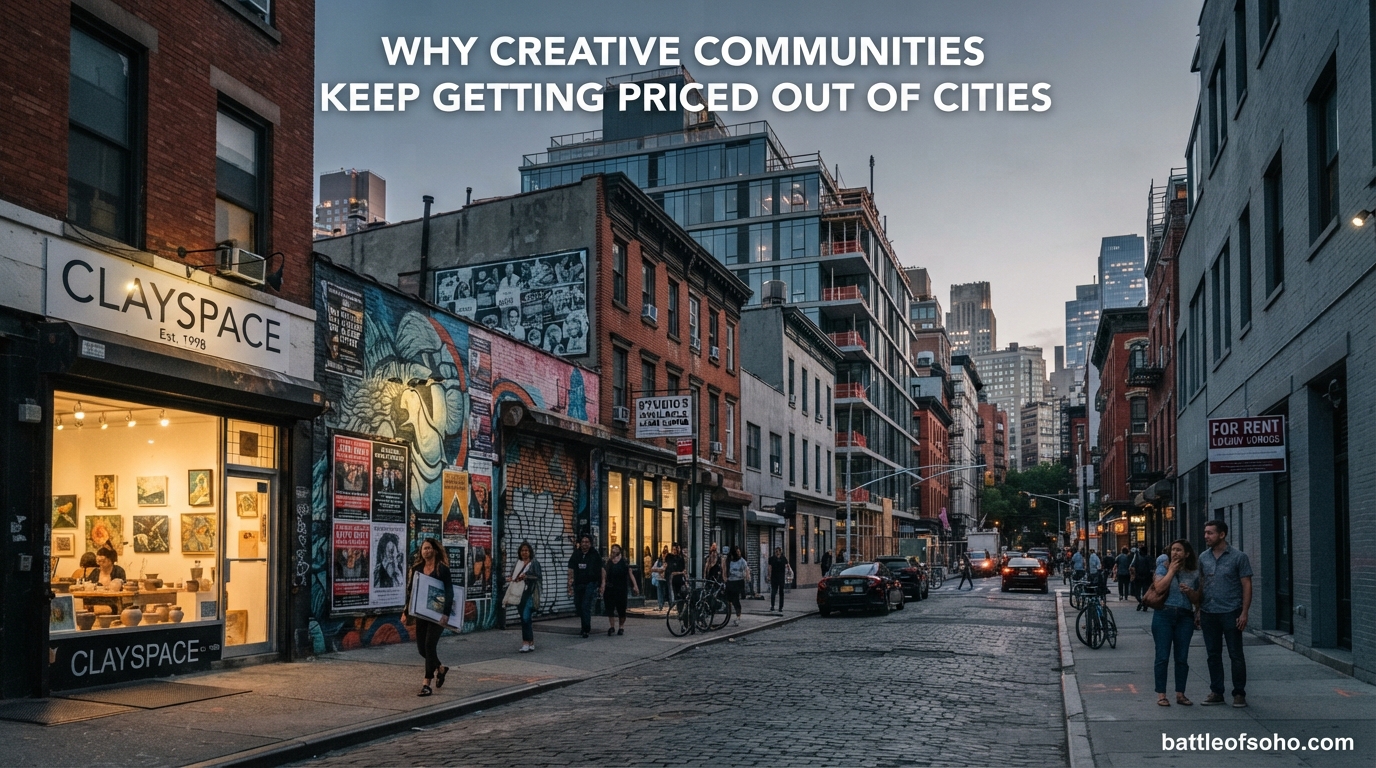
Every few years, the same story plays out in cities across the world. Artists move into an affordable, overlooked neighborhood. They open galleries, host shows, paint murals, and build a scene. Within a decade, rents double, developers move in, and the people who made the neighborhood worth visiting can no longer afford to live there.
This is the story of why creative communities keep getting priced out of cities. It happened in SoHo in the 1980s, in Williamsburg in the 2000s, and in Wynwood in the 2010s. Now in 2026, it is happening in Austin, Atlanta, Toronto, and dozens of other cities worldwide.
The pattern is so consistent that urban planners, economists, and artists themselves have spent decades trying to understand and interrupt it. What they have found is that creative displacement is not an accident. It is a structural feature of how modern housing markets interact with the unique economic vulnerabilities of creative work.
In this article, we break down exactly how this cycle works, why housing costs hit artists harder than almost any other group, what cities lose when their creative communities disappear, and what policies might actually fix the problem.
Table of Contents
The Displacement Cycle: How Artists Get Pushed Out
Creative community displacement follows a predictable sequence that researchers have documented across dozens of cities. Understanding this cycle is the first step to understanding why creative communities keep getting priced out of cities despite widespread awareness of the problem.
It starts with artists seeking affordability. Painters, musicians, performers, and other creatives need large, inexpensive spaces to live and work. They gravitate toward industrial areas, historically disinvested neighborhoods, and other places where rent is low because demand is low. These neighborhoods often have diverse, working-class communities that have been there for generations.
The artists bring cultural activity. They convert warehouses into studios, host open studio events, start DIY venues, and create the kind of street-level energy that attracts foot traffic. Word spreads. Magazines write about the “new cool neighborhood.” Food blogs publish guides to the area. Real estate listings begin describing properties as being in an “up-and-coming” or “vibrant” district.
Then the money follows. Developers and investors see rising interest and start buying properties, renovating them, and marketing them to higher-income tenants. Coffee shops, cocktail bars, and boutique retailers replace the dive bars, supply stores, and informal venues that artists relied on. Property values climb, and landlords raise rents to match what the new market will bear.
Finally, the artists leave. Their rents have doubled or tripled while their incomes have not changed. The studios they rented for $600 a month now cost $2,000. The warehouse they used for performances has been converted to luxury lofts. They pack up and move to the next affordable neighborhood, and the cycle begins again somewhere else.
Forum discussions across Reddit communities in Austin, Brooklyn, Portland, and Atlanta confirm this pattern with remarkable consistency. One Bushwick resident noted that the creative scene from the early 2010s is “long since vacated.” Another user described watching the process repeat across three different neighborhoods in their lifetime.
Root Causes: Why Housing Costs Hit Creatives Hardest
The affordable housing crisis affects nearly everyone in major cities, but creative workers face specific vulnerabilities that make them among the first to be displaced. These vulnerabilities explain why creative communities keep getting priced out of cities even before the broader population feels the squeeze.
Irregular Income and the Gig Economy
Most artists and creative workers do not have salaried positions with predictable monthly income. A musician might earn well in December from holiday gigs and barely scrape by in February. A visual artist might sell nothing for months and then land a commission that covers half a year of expenses. This income volatility means that when rents rise, they have no steady paycheck to absorb the increase.
Creative work also tends to pay less than comparable professional work. The median income for fine artists in the United States hovers around $50,000 per year, well below what is needed to afford market-rate housing in cities like New York, San Francisco, or Miami. Musicians, dancers, and craftspeople often earn even less.
Space Requirements Beyond a Bedroom
A software developer needs a laptop and a desk. A painter needs ventilation, natural light, and room for large canvases. A musician needs soundproofing. A ceramicist needs a kiln and water access. These space requirements mean creatives cannot simply downsize to a smaller apartment when rents rise. They need dedicated work space, and that space is exactly what gets converted to luxury housing first.
Live-work spaces, where artists could legally live and create in the same unit, used to exist in many cities through specific zoning provisions. These have been disappearing as neighborhoods gentrify and property owners find they can charge far more for residential-only or commercial-only use.
Short-Term Rentals and Investor Purchasing
The rise of short-term rental platforms has compounded the problem. Buildings that once housed artists on month-to-month leases have been converted to full-time vacation rentals. In some neighborhoods in Miami, Lisbon, and New Orleans, entire blocks of formerly affordable housing are now listed nightly to tourists.
Investor purchasing adds another layer. Private equity firms and corporate landlords buy up affordable buildings, renovate them, and raise rents significantly. They are not interested in the cultural character of a neighborhood. They are interested in maximizing returns, and displacing long-term tenants is often the fastest way to do that.
Declining Public Investment in the Arts
At the same time that housing costs are rising, public support for artists is shrinking. The National Endowment for the Arts has faced repeated budget cuts over the past decade. State and local arts funding has been inconsistent. Without subsidies, grants, and affordable space programs, creative workers have fewer safety nets when their rent increases.
This stands in stark contrast to countries like Germany, where arts funding is embedded in the federal budget at a much higher per-capita rate. In France, artists qualify for subsidized housing through specific programs. Canada has experimented with cultural space preservation policies. The United States has no comparable national framework.
Why Cities Need Their Creative Class
When creative communities leave, cities lose more than galleries and music venues. They lose the economic engine that drives innovation, tourism, and long-term growth. Understanding this economic dimension is essential to understanding why creative displacement is not just a cultural loss but an economic policy failure.
The concept of the creative class, popularized by urban studies scholar Richard Florida in the early 2000s, argues that cities that attract creative workers tend to experience stronger economic growth. Creative people, the theory goes, are innovation catalysts. They start businesses, develop new products, and create the kind of dynamic environment that attracts other talented workers.
This is not just academic theory. The economic multipliers of creative communities are measurable. A study of arts districts across multiple U.S. cities found that every dollar spent at a local arts organization generated additional spending at nearby restaurants, parking garages, and retail shops. Live music venues create jobs for sound engineers, bartenders, security staff, and promoters. Galleries support framers, shippers, and art supply stores.
Tourism is deeply tied to cultural vibrancy. People do not travel to cities because of their office parks. They travel for the food scene, the music, the street art, the galleries, and the sense that a place has its own distinct character. When that character is sanitized away, cities become what some urban theorists call “vanilla cities” — interchangeable places with the same chain stores and the same luxury apartments but no soul.
The paradox is that cities often pursue tech industry attraction and luxury development while simultaneously eroding the creative infrastructure that makes them attractive in the first place. A city that trades its artists for tech workers may see short-term economic gains, but it risks losing the cultural ecosystem that made it a desirable location for those tech workers to move to.
City Case Studies: From Wynwood to Williamsburg
The pattern of creative displacement is visible in cities across the globe. Examining specific cases reveals both the common mechanics and the unique local factors that drive why creative communities keep getting priced out of cities.
Wynwood, Miami
Wynwood was once an industrial district with warehouses and garment factories. In the early 2000s, artists began using the walls of these warehouses for murals, creating what became the Wynwood Walls. The neighborhood attracted international attention as a street art destination. Within fifteen years, rents in Wynwood had soared to over $4,000 per month for spaces that once cost a fraction of that. Reports surfaced of artists sleeping in their cars while searching for affordable studio space. The murals remain as a tourist attraction, but many of the artists who created them have been pushed to peripheral neighborhoods or out of Miami entirely.
Williamsburg, Brooklyn
Williamsburg was the defining artist neighborhood of the early 2000s. Musicians, visual artists, and writers moved into former industrial lofts along the East River and built a scene that drew national attention. The 2005 rezoning of the waterfront accelerated development, and luxury high-rises replaced industrial buildings. By the mid-2010s, the creative community that defined Williamsburg had largely dispersed. Long-time residents describe the neighborhood as unrecognizable from what it was even ten years ago.
Austin, Texas
Austin built its identity on live music and creative culture. The city’s slogan, “Live Music Capital of the World,” depends on musicians being able to afford to live there. But Austin has been one of the fastest-growing cities in the United States, and property costs have risen accordingly. Forum discussions on Reddit document the frustration of musicians and venue owners who cannot keep up with rising rents. One user summarized the situation bluntly: the cost of rent is making it impossible for the artists and eclectic businesses that make Austin worth living in to actually live there.
Richmond, Virginia
Richmond has a strong creative ecosystem anchored by VCUarts, one of the largest art schools in the country. The city has historically been more affordable than coastal creative hubs, making it attractive to artists. But as housing advocates have documented, even Richmond is experiencing pressures on creative space. Rising property values and lack of dedicated affordable studio programs are putting strain on the community that has been building for decades.
International Cases: Montreal, Toronto, and Beyond
This is not an American problem alone. Montreal, long celebrated as one of North America’s most vibrant creative cities, has been losing its cultural edge according to local residents. Toronto’s rapid condo development has displaced music venues and artist studios across the city. In London, neighborhoods that once defined British music and art have been hollowed out by luxury development.
Who Gets Displaced First: Race, Class, and Creative Communities
It is impossible to talk about creative displacement without talking about race. The neighborhoods that artists move into are often historically Black, Latino, or immigrant communities. When gentrification pushes up rents, it is not just the artists who leave. It is the original residents who have built lives and institutions there for decades.
In Atlanta, tensions have been rising as historically Black neighborhoods face rapid transformation. Long-time residents watch as their churches, barbershops, restaurants, and cultural institutions are replaced by businesses catering to newer, wealthier, and often whiter populations. The creative energy that attracted new development was often rooted in Black cultural traditions that get commodified and then erased.
The same pattern has played out in Bushwick, where the Latino community that shaped the neighborhood’s character has been steadily displaced. In Oakland, Black artists who were central to the city’s cultural identity have been pushed to the suburbs or out of the Bay Area entirely.
This intersectional dimension is one of the least discussed aspects of why creative communities keep getting priced out of cities. It is not just individual artists losing studio space. It is entire communities losing cultural continuity, intergenerational knowledge, and the social networks that sustained creative practice in the first place.
Solutions: How Cities Can Keep Their Creative Communities
The displacement cycle is not inevitable. Cities around the world are experimenting with policies and programs designed to preserve creative communities and affordable cultural space. While no single solution is a silver bullet, several approaches show real promise.
Community Land Trusts and Nonprofit Ownership
Community land trusts are nonprofit organizations that acquire and hold land permanently for community benefit. By removing property from the speculative market, land trusts can keep rents stable for artists and other residents. Several cities have used this model to preserve cultural space, and arts-focused land trusts are emerging as a targeted tool for creative community preservation.
Zoning Reform and Artist Housing Programs
Zoning reform can protect creative space by creating legal frameworks for live-work use, mandating that new developments include affordable studio space, or designating cultural districts where displacement protections apply. Some cities offer housing stipends or dedicated affordable units for verified creative workers, similar to programs for teachers or public service employees.
Increased Public Arts Funding
The United States lags far behind peer nations in public arts investment. Germany spends roughly four times more per capita on arts and culture than the U.S. France provides direct housing support to artists through its social welfare system. Increasing NEA funding, expanding state arts council budgets, and creating dedicated creative worker support programs would help address the income side of the equation.
Cities Getting It Right
Not every city is losing its creative community. Philadelphia and Baltimore are frequently cited in forum discussions as cities that still maintain affordable creative ecosystems. These cities benefit from lower overall cost of living and active community organizing around cultural preservation. Their success suggests that affordability and intentionality can keep creative communities intact even as they face development pressure.
Some smaller cities are actively recruiting displaced artists with affordable space grants and relocation incentives. This represents a shift from treating artists as a side effect of urban development to treating them as essential infrastructure that requires deliberate investment.
FAQs
Why are people less creative now?
People are not necessarily less creative, but creative output is harder to sustain when the cost of living makes it impossible to dedicate time to artistic practice. When artists spend 60 hours a week working side jobs to pay rent, they have less time and energy for creative work. The decline is economic, not biological.
Why is it so hard to get affordable housing?
Affordable housing is scarce because housing supply has not kept pace with demand in major cities. Investor purchasing, short-term rentals, zoning restrictions on new construction, and stagnant wages relative to housing costs all contribute. For creative workers with irregular incomes, qualifying for affordable housing programs can be especially difficult because these programs often require proof of consistent earnings.
Why do places become creative hubs?
Places become creative hubs when they offer affordable space, cultural diversity, and a tolerance for unconventional lifestyles. Artists gravitate toward neighborhoods where they can afford large work spaces and where existing communities provide cultural inspiration and collaboration opportunities. The combination of low costs and rich cultural context creates the conditions for creative scenes to flourish.
Does gentrification make things more expensive?
Yes, gentrification consistently drives up housing costs. As higher-income residents move into a neighborhood, property owners raise rents to capture the new market rate. Property taxes increase as assessed values rise. Local businesses shift to serve wealthier customers, raising the cost of everyday goods and services. The net effect is that the neighborhood becomes more expensive for everyone, especially long-term residents on fixed or modest incomes.
Why do artists struggle financially?
Artists struggle financially because creative work is undervalued in the market economy. Most artists earn irregular income from commissions, gigs, and sales rather than steady salaries. They lack benefits like health insurance and retirement contributions. Their work requires expensive materials and dedicated space. And public funding for the arts in the United States is among the lowest of any developed nation, leaving artists without the support structures that exist in other countries.
Conclusion
The story of why creative communities keep getting priced out of cities is not a mystery. It is a well-documented cycle driven by rising housing costs, the economic vulnerability of creative work, declining public arts investment, and policy frameworks that prioritize speculative development over cultural preservation.
Cities that ignore this problem do so at their own peril. When artists leave, they take with them the economic multipliers, tourism appeal, and cultural identity that make urban places worth living in and visiting. The vanilla city that results may look polished, but it is hollow at its core.
But this cycle can be broken. Community land trusts, zoning reform, dedicated artist housing programs, and increased public arts funding have all shown results. Cities like Philadelphia and Baltimore demonstrate that affordability and intentionality can preserve creative ecosystems. The question is whether more cities will act before their creative communities are gone for good.