
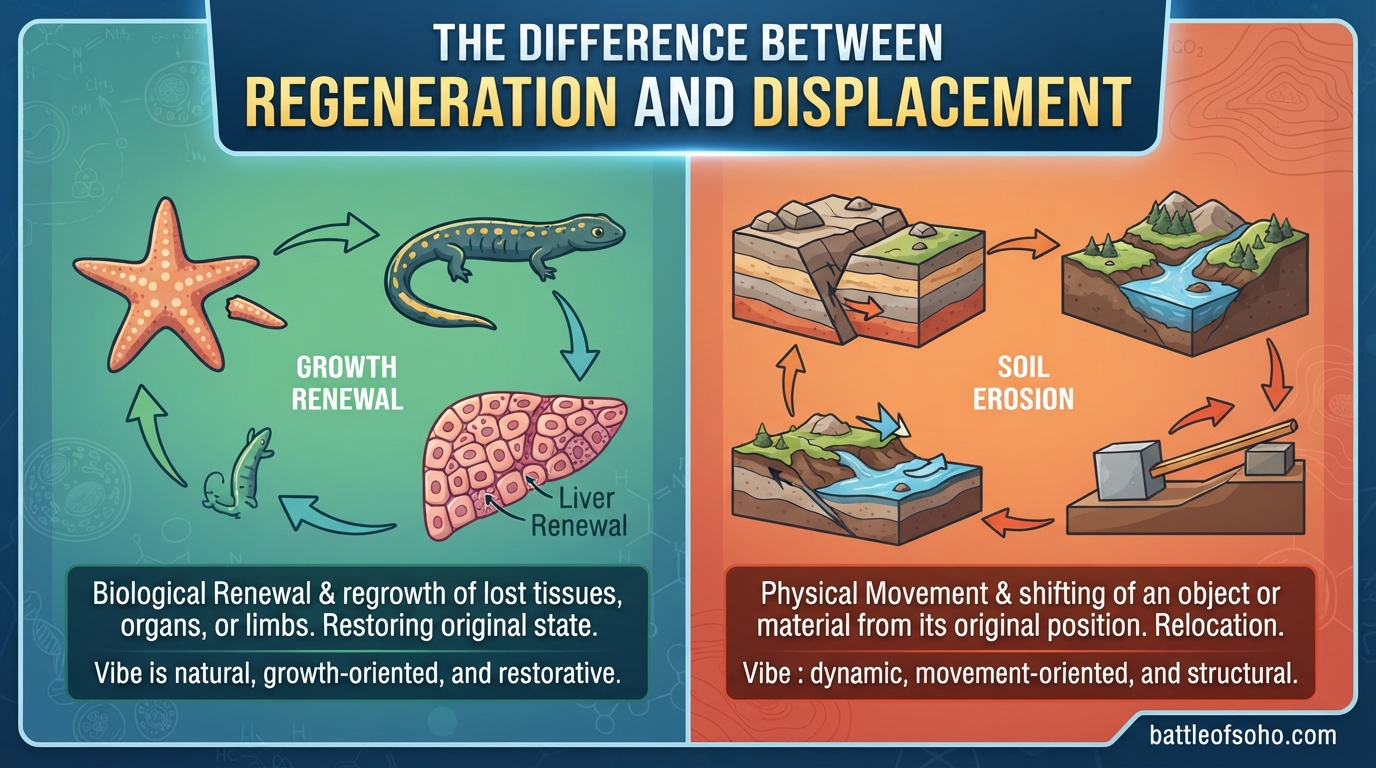
Walk through any changing neighborhood and you will hear two words tossed around like they are opposites: regeneration and displacement. One sounds hopeful, the other sounds harmful. But if you have ever watched a community transform block by block, you know the relationship between these two concepts is far more complicated than a simple good-versus-bad story.
Our team has spent years researching urban planning, community development, and housing policy to break down these terms in a way that actually makes sense. Whether you are a resident worried about rising rents, a planner trying to do right by your city, or a student trying to understand neighborhood change, this guide will give you a clear, practical explanation.
The difference between regeneration and displacement comes down to this: regeneration is the process of renewing and restoring a declining area, while displacement is what happens when the people who already live there can no longer afford to stay. Regeneration is the intended improvement. Displacement is often the unintended consequence. Understanding how these two forces interact is essential for anyone who cares about the future of cities in 2026.
In this article, we will define each term clearly, explore how they connect, look at the different types of displacement, dig into the history that shaped these dynamics, and examine what communities can do to achieve revitalization without pushing people out.
Table of Contents
What Is Regeneration? Definition and Meaning
Urban regeneration is the comprehensive process of renewing, restoring, and reviving areas that have experienced economic decline, physical deterioration, or social hardship. It involves investment in infrastructure, housing, public spaces, transportation, and local businesses with the goal of making a neighborhood more livable and economically viable.
In simple terms, regeneration means taking an area that has been neglected and making it function well again. Think of it as healing a wounded part of a city. This can include demolishing abandoned buildings, upgrading water and sewer systems, creating parks, attracting new businesses, improving transit access, and renovating housing stock.
Regeneration projects are typically driven by local governments, sometimes in partnership with private developers or community organizations. The inspiration often comes from areas that suffered decades of disinvestment. These might be former industrial zones, neighborhoods cut off by highway construction, or communities that were systematically denied investment through practices like redlining.
Academics and policy experts tend to describe regeneration as having multiple dimensions. Physical regeneration focuses on buildings and infrastructure. Economic regeneration targets job creation and business development. Social regeneration aims to improve community services, education, and quality of life for existing residents. When done well, all three dimensions work together.
Examples of large-scale regeneration include the transformation of London’s Docklands from derelict port facilities into a commercial and residential hub, or the ongoing renewal of Detroit’s neighborhoods after decades of population loss and economic decline. These projects brought new life to struggling areas. But they also raised difficult questions about who benefits from that new life.
That tension leads directly to the concept that regeneration, despite its good intentions, can trigger the very displacement it should prevent. The paradox is real and worth understanding deeply.
What Is Displacement? Understanding the Forced Relocation of Residents
Displacement occurs when households are forced to move from their homes and neighborhoods against their will due to conditions beyond their control. In the context of neighborhood change, displacement happens when rising costs, evictions, building demolitions, or shifting market conditions make it impossible for current residents to remain in their communities.
Unlike someone who simply chooses to move for a new job or a bigger house, a displaced resident has no real option to stay. The decision has effectively been made for them by economic pressure, policy decisions, or direct action like building clearance.
The connection to gentrification is well documented. According to research from the Urban Displacement Project at UC Berkeley, gentrification and displacement are closely linked but not identical. Gentrification describes the influx of higher-income residents and investment into a neighborhood. Displacement is what happens when that influx drives up costs beyond what existing residents can afford.
Who faces the greatest risk? Studies consistently show that low-income renters, communities of color, elderly residents on fixed incomes, and immigrant populations are the most vulnerable to displacement. These are often the same groups that endured decades of disinvestment in the first place. The cruel irony is that the neighborhoods that were abandoned by investors for years suddenly become desirable, and the people who stuck it out through the hard times are the first to be pushed out when conditions improve.
Research from the University of Texas Gentrification Project identifies specific vulnerability indicators. Neighborhoods with high percentages of renters, low median incomes, older housing stock, and proximity to transit or downtown areas face elevated displacement risk. When regeneration announcements hit the news in these neighborhoods, property speculation often follows within months.
Displacement is not a single event. It is a process that unfolds over years as rents creep up, property tax assessments climb, local businesses change, and the social fabric of a community gradually shifts. By the time a family receives an eviction notice or a no-cause lease termination, the displacement process has likely been underway for years.
The Difference Between Regeneration and Displacement: Key Distinctions
The fundamental difference between regeneration and displacement lies in their intent, their targets, and their outcomes. Regeneration is a planned intervention designed to improve a place. Displacement is the forced removal of people from that place. One is a policy strategy. The other is a human consequence.
Here is how they differ across several key dimensions:
Intent: Regeneration aims to improve living conditions and economic opportunity. Displacement occurs when those improvements come at the cost of existing residents. Regeneration is supposed to help the people who already live in an area. Displacement means those people are gone before the help arrives.
Direction: Regeneration brings resources into a community. Displacement pushes people out of it. They can happen at the same time and in the same place, which is what makes the relationship so difficult to manage.
Beneficiaries: Regeneration ideally benefits long-term residents. Displacement primarily benefits new arrivals, property owners, and developers. When regeneration fails to protect existing residents, the benefits flow almost entirely to incoming higher-income households.
Visibility: Regeneration is announced with press conferences and groundbreaking ceremonies. Displacement happens quietly, one household at a time, through expired leases, rent hikes, and cash-for-keys offers.
This creates what researchers call the regeneration paradox. The process of improving a neighborhood can destroy the community that made the neighborhood worth improving. As property values rise during regeneration, landlords raise rents to match the new market rate. Long-term tenants who paid affordable rents suddenly face monthly costs that consume half or more of their income. Some are evicted outright. Others leave voluntarily because they cannot keep up.
Our team has observed this pattern in city after city. The announcement of a new transit line, a renovated park, or a mixed-use development triggers a wave of real estate speculation. Within five years, the neighborhood looks shinier and newer. But the census data tells a different story. Population turnover accelerates. Median income jumps. Racial demographics shift. The community that existed before regeneration is gone.
Understanding this paradox is not an argument against regeneration. Struggling neighborhoods genuinely need investment. The point is that regeneration without protections for existing residents is not really regeneration at all. It is displacement dressed up in the language of renewal.
Types of Displacement in Regenerating Neighborhoods
Displacement is not a single phenomenon. Researchers and urban planners categorize it into several distinct types, each with its own causes, timelines, and affected populations. Understanding these categories helps communities identify warning signs early and advocate for targeted protections.
1. Direct Displacement
Direct displacement happens when residents are physically forced to leave their homes through specific, identifiable actions. This is the most visible and immediately recognizable form. A landlord evicts a tenant to renovate the unit and rent it at a higher price. A developer buys a building and issues move-out notices. A city demolishes a public housing complex as part of a regeneration project.
Direct displacement also occurs through rent increases that exceed what a household can pay. If a landlord raises rent by 40 percent overnight, the tenant is effectively displaced even if no formal eviction proceeding takes place. The mechanism is economic rather than legal, but the result is the same: the resident has to leave.
2. Indirect or Exclusionary Displacement
Indirect displacement is more subtle and harder to measure. It occurs when rising costs and changing neighborhood conditions gradually make it impossible for residents to remain, even without a single dramatic event. A family might not be able to afford groceries at the new upscale market that replaced the discount store. A renter might move out of a worn-down apartment and discover that every available unit in the neighborhood now costs double what they were paying.
Exclusionary displacement specifically refers to what happens when low-income households can no longer move into a neighborhood. As regeneration drives up rents, the area effectively closes its doors to anyone who is not affluent. Over time, this changes the demographic composition of the neighborhood without a single eviction.
Researchers at the Urban Displacement Project found that indirect displacement affects far more people than direct displacement. For every household that receives an eviction notice, many more leave through attrition. They move in with family, relocate to cheaper suburbs, or double up with other households as their financial situation deteriorates.
3. Cultural Displacement
Cultural displacement happens when the character, institutions, and daily life of a neighborhood change so dramatically that long-term residents no longer feel like they belong. The local bodega becomes a specialty coffee shop. The community center becomes a coworking space. The annual cultural festival gets replaced by a food truck event catering to new residents.
This form of displacement is psychological and social, but its effects are deeply real. People leave not because they cannot pay rent but because they no longer recognize their own neighborhood. The social networks that sustained them for decades dissolve as neighbors move away one by one. Community institutions that served specific cultural groups lose their clientele and close.
For communities of color, cultural displacement carries a particularly heavy weight. A neighborhood that served as a cultural hub for generations can lose its identity entirely within a decade of aggressive regeneration. The buildings remain, but the community is gone.
Historical Context: From Redlining to Urban Renewal
You cannot understand the relationship between regeneration and displacement without understanding the history that created the conditions for both. The story goes back decades and involves deliberate government policies that shaped which neighborhoods received investment and which were systematically starved of it.
In the 1930s, the federal government created maps that ranked urban neighborhoods by lending risk. This practice, known as redlining, assigned the lowest grade to neighborhoods with high concentrations of Black, immigrant, and low-income residents. Banks routinely denied mortgages in redlined areas. The government effectively made it official policy to deny wealth-building opportunities to entire communities based on race and class.
The effects were devastating and long-lasting. Redlined neighborhoods experienced decades of disinvestment. Property values stagnated. Housing stock deteriorated. Businesses left. Schools declined. Crime increased. By the time these areas became targets for regeneration, they had been denied the investment that other neighborhoods received as a matter of course.
In the 1950s and 1960s, the federal urban renewal program aimed to fix deteriorating neighborhoods by clearing them and starting over. The reality was devastating for existing communities. Urban renewal, which the author James Baldwin famously described as “Negro removal,” demolished entire neighborhoods. Hundreds of thousands of families were displaced, disproportionately Black and low-income. The promise was that they would be relocated to better housing. The reality was that many ended up in worse conditions or crowded into neighboring areas that then became overcrowded.
White flight compounded these dynamics. As middle-class white families moved to the suburbs in the postwar period, urban tax bases eroded. Cities had fewer resources to provide services. Neighborhoods that had already been starved of investment suffered even more. By the 1970s and 1980s, many urban neighborhoods were in deep crisis, with abandoned buildings, high crime, and crumbling infrastructure.
This is the context that makes regeneration both necessary and fraught. The neighborhoods targeted for renewal today are often the same ones that were redlined, cleared, and abandoned in previous decades. The communities living there survived policies designed to erase them. When regeneration arrives, the question on everyone’s mind is whether this time will be different, or whether the latest wave of investment will simply complete the work that earlier policies started.
Are Regeneration and Gentrification the Same Thing?
This is one of the most common questions in urban planning discussions, and the answer requires some nuance. Regeneration and gentrification are related but not identical. Understanding the distinction matters for policy, advocacy, and community planning.
Gentrification is a market-driven process in which a declining neighborhood experiences an influx of middle-class and wealthy residents, leading to rising property values, new businesses catering to higher-income tastes, and changes in neighborhood culture. It happens organically as real estate markets shift and demand increases in previously affordable areas.
Regeneration, by contrast, is typically a planned, policy-driven intervention. Governments and institutions deliberately invest in infrastructure, housing, and economic development to reverse decline. The intent is different even if some outcomes overlap.
However, many critics argue that modern regeneration has become indistinguishable from what scholars call state-led gentrification. When governments partner with private developers to regenerate an area, the resulting rent increases and demographic shifts look remarkably like gentrification. The difference is that gentrification is supposed to be an unplanned market process, while regeneration is a deliberate choice. If regeneration produces the same displacement outcomes as gentrification, the distinction starts to feel academic.
Neil Smith’s rent gap theory helps explain why this happens. According to this framework, gentrification and regeneration both occur when there is a significant gap between what land is currently earning and what it could potentially earn under a higher-value use. When that gap gets large enough, developers and investors see an opportunity. Regeneration policies often close that gap by subsidizing or facilitating new investment, which in turn drives up land values and triggers displacement pressure.
The practical takeaway is this: regeneration can be done without gentrification and without displacement, but only if policies are specifically designed to protect existing residents. Without those protections, regeneration and gentrification produce the same results under different names.
The Impacts: What Happens When Regeneration Causes Displacement
The consequences of displacement extend far beyond the loss of a physical home. Research from public health, sociology, and urban planning consistently shows that displacement damages individuals and communities in ways that persist for years, sometimes generations.
Health Consequences
Studies published by the National Institutes of Health have linked displacement to a range of negative health outcomes. Displaced residents report higher rates of depression, anxiety, and stress-related illnesses. Children who experience housing instability show increased rates of asthma, developmental delays, and behavioral problems. Elderly residents who are displaced face elevated risks of mortality in the years following relocation.
The stress of displacement is not just emotional. It is physiological. Losing your home, your neighbors, and your community networks triggers chronic stress responses that affect cardiovascular health, immune function, and mental wellbeing. For communities already burdened by health disparities, displacement compounds existing problems.
Loss of Social Networks
Neighborhoods are not just collections of buildings. They are webs of relationships. People rely on neighbors for childcare, elder support, shared meals, emergency help, and daily social interaction. When displacement scatters a community, those networks collapse.
Research on social capital shows that low-income and immigrant communities often rely heavily on neighborhood-based social networks for survival. These informal support systems are invisible to policymakers and economists, but they are essential to daily life. Displacement severs these connections, leaving relocated residents isolated and vulnerable.
Economic Consequences
Displaced families often end up paying more for housing in their new locations while earning the same income. They may face longer commutes, which means higher transportation costs and less time for work, family, and rest. Some are pushed into overcrowded or substandard housing because nothing affordable is available.
The economic damage also extends to local businesses. When a neighborhood’s population turns over, businesses that served long-term residents lose their customer base. A corner store that relied on regulars for twenty years cannot survive on foot traffic from new residents who shop online or at chain stores. These businesses close, and with them go jobs and services that the community depended on.
Cultural and Community Loss
Perhaps the hardest impact to quantify is the loss of community identity. A neighborhood that took decades to develop its character, its traditions, and its sense of place can lose all of it within a few years of rapid transformation. The physical space remains, but the soul of the community is gone.
Forum discussions on Reddit’s urban planning communities capture this frustration well. Residents describe watching their neighborhoods become unrecognizable. They talk about the specific stores, restaurants, gathering spaces, and people that made their community feel like home. Once those elements disappear, the neighborhood is just a location, not a community.
How to Prevent Displacement During Urban Regeneration
The good news is that displacement is not inevitable. Cities and communities around the world have developed effective strategies to achieve regeneration without pushing out existing residents. These approaches require political will, sustained investment, and genuine community engagement, but they work.
Preserve and Expand Affordable Housing
The single most effective anti-displacement tool is preserving existing affordable housing and building more of it. When a neighborhood has a substantial stock of permanently affordable units, regeneration pressure cannot displace residents because their housing costs are protected. Community land trusts, where a nonprofit holds land in trust and leases it to residents at affordable rates, have proven highly effective in cities like Burlington, Vermont, and Atlanta, Georgia.
Inclusionary zoning policies require developers to include a percentage of affordable units in new construction. When paired with strong enforcement and long-term affordability requirements, these policies ensure that regeneration benefits a mix of income levels rather than exclusively affluent newcomers.
Implement Right of Return Policies
Right of return policies give displaced residents the first opportunity to move back into regenerated neighborhoods. These policies acknowledge that if public investment is making an area better, the people who lived there before should be the first to benefit. Cities like Portland, Oregon, have experimented with right of return programs for communities displaced by past urban renewal projects.
While implementation is challenging, the principle is powerful. Regeneration should not be a one-way door that lets new people in while keeping former residents out.
Strengthen Tenant Protections
Strong rent stabilization laws, just-cause eviction protections, and relocation assistance requirements all reduce displacement pressure during regeneration. When landlords cannot raise rents arbitrarily or evict tenants without a documented reason, regeneration-driven rent spikes are slower and more manageable.
Cities like Berlin, Germany, and Barcelona, Spain, have experimented with rent caps and strict tenant protection laws specifically to combat displacement in regenerating neighborhoods. While these policies face legal and political challenges, they demonstrate that tools exist to slow the displacement process.
Build Enough Housing Supply
One of the most consistent findings across urban planning research is that building enough housing to meet demand reduces displacement pressure. When supply keeps up with demand, rents stabilize across the board rather than spiking in specific neighborhoods. This insight comes up repeatedly in community discussions about housing policy.
This does not mean simply building luxury units. It means building a range of housing types at various price points so that the overall market absorbs new demand without squeezing existing residents. Cities that have aggressively expanded housing supply, such as Tokyo, have managed to keep housing costs relatively stable even as their populations grow.
Center Community Voice in Planning
Regeneration projects are far less likely to cause displacement when existing residents have a genuine voice in what gets built and who benefits. Community benefit agreements, participatory budgeting, and representation on planning boards all help ensure that regeneration serves the people who already live in a neighborhood rather than treating them as obstacles to progress.
Too often, regeneration plans are designed by consultants and approved by officials with minimal input from the communities most affected. When residents are involved from the beginning, projects tend to include affordable housing protections, preserve local businesses, and maintain cultural institutions.
Conclusion: Understanding the Difference Between Regeneration and Displacement
The difference between regeneration and displacement is the difference between a neighborhood getting better for its residents and a neighborhood getting better at the expense of its residents. Regeneration is the goal: investment, improvement, and renewal that makes a community more livable. Displacement is the failure mode: a process where the people who endured years of neglect are pushed out just as things start to improve.
Throughout this article, we have seen that these two concepts are connected but not identical. Regeneration can happen without displacement, but only when policies and community protections are built into the process from the start. The history of redlining, urban renewal, and disinvestment explains why the stakes are so high for the communities facing regeneration today. And the research on health impacts, social networks, and economic consequences shows why getting this right matters so deeply.
If there is one takeaway, it is this: regeneration is not automatically good, and displacement is not inevitable. The choices that cities, developers, and communities make determine which outcome prevails. By demanding affordable housing protections, tenant rights, community voice, and sufficient housing supply, we can push toward a model of revitalization that lifts up existing residents instead of replacing them.
Understanding the difference between regeneration and displacement is the first step. Acting on that understanding is what comes next.
FAQs
What is the difference between regeneration and replacement?
Regeneration is the process of renewing and restoring a declining area through investment in infrastructure, housing, and economic development. Replacement refers to the substitution of one population, building, or use with another. In urban planning, regeneration is the intended improvement of a place, while replacement often describes what happens when existing residents are swapped out for new ones during neighborhood change.
Are regeneration and gentrification the same?
No, but they are closely related. Regeneration is a planned, policy-driven effort to reverse neighborhood decline through investment. Gentrification is a market-driven process where higher-income residents move into an area, causing rising costs and demographic change. Critics argue that modern regeneration often functions as state-led gentrification because it produces similar displacement outcomes, but the terms describe different mechanisms.
What does displacement mean in gentrification?
Displacement in gentrification refers to the forced relocation of existing residents when rising housing costs and neighborhood changes make it impossible for them to stay. It takes several forms: direct displacement through eviction or rent hikes, indirect displacement through gradual cost increases, exclusionary displacement when new residents price out existing ones, and cultural displacement when community character changes so dramatically that long-term residents no longer feel they belong.
What is regeneration in simple terms?
Regeneration in simple terms is the process of fixing up and improving a rundown area so it becomes a better place to live and work. It involves investing in buildings, roads, parks, businesses, and community services to reverse decline and bring new life to neighborhoods that have been neglected.