
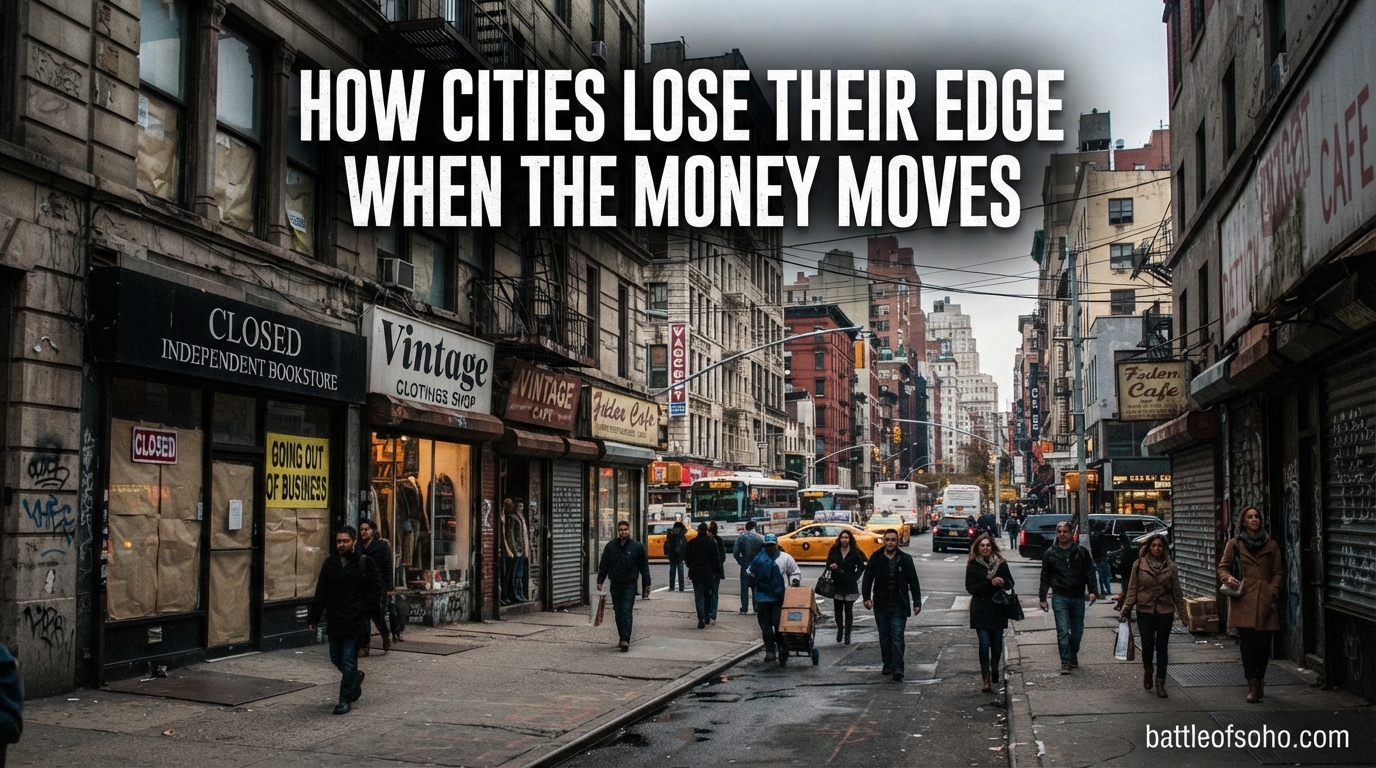
Walk through the Lower East Side of Manhattan today and you will find craft cocktail bars where garment workers once haggled over piece rates. The lofts that housed print shops and small manufacturers now sell for seven figures. Something similar has happened in San Francisco’s Mission District, in London’s Hackney, and in neighborhoods across dozens of cities worldwide. When capital floods into an area, it brings investment, renovated facades, and new amenities. But it also brings something harder to measure: the gradual erosion of what made the place economically and culturally distinctive in the first place.
Understanding how cities lose their edge when the money moves in requires looking past the surface-level improvements. Yes, streets get cleaner. Yes, crime often drops. But beneath the polished storefronts, a more complex story unfolds involving displaced workers, shuttered small businesses, lost industrial knowledge, and tax policies that favor corporate giants over the entrepreneurs who actually build urban economies from the ground up.
Gentrification is a process where increased investment in a neighborhood drives up property values and rents, displacing lower-income residents and fundamentally changing the character of communities. This definition only scratches the surface. The full picture involves economic development strategies gone wrong, the decline of process knowledge, the hollowing effects of financialization, and policy choices that treat transformation as inevitable rather than designed.
In this article, we break down the mechanisms behind urban decline disguised as revival. We will trace the history from mid-century urban planning disasters to modern corporate attraction strategies, examine what Jane Jacobs understood about city economies that policymakers still ignore, and explore how generative AI may accelerate the pattern in 2026 and beyond.
Table of Contents
What Is Gentrification and How Does It Change Cities?
Gentrification refers to the transformation of a working-class or low-income neighborhood when wealthier residents and investors move in. Property values rise. Rents climb. Long-time businesses close. The demographic and cultural makeup of the area shifts, sometimes dramatically and sometimes so gradually that residents only notice when their favorite diner has become a cold-brew coffee shop.
The process typically begins when artists, students, or young professionals identify an undervalued neighborhood with cheap rent and good transit access. They bring cultural energy that makes the area attractive to developers. Capital follows. Then come the luxury condos, the chain retailers, and eventually the original residents who can no longer afford to stay.
Academic researchers categorize gentrification into distinct types, each with different drivers and consequences:
- Supply-side gentrification: Driven by developers and investors who see profit potential in undervalued urban land. Government policies like tax abatements and zoning changes often accelerate this process.
- Demand-side gentrification: Occurs when changing consumer preferences push wealthier residents back toward city centers. The millennial preference for walkable, transit-rich neighborhoods fueled this pattern across many American cities.
- State-sponsored gentrification: Government-led urban renewal programs, infrastructure projects, and redevelopment zones that intentionally or unintentionally displace existing communities.
- Supergentrification: A later-stage phenomenon where already-gentrified neighborhoods become targets for the ultra-wealthy, pushing out even the upper-middle-class professionals who arrived during the first wave.
One critical distinction that forums and academic discussions keep surfacing is the difference between gentrification and displacement. Gentrification can theoretically occur without displacement if policies protect existing residents through rent stabilization, community land trusts, or affordable housing mandates. The problem is that most American cities do not implement those protections aggressively enough. On Reddit’s urban planning communities, users repeatedly point out that the worst gentrification occurs in areas with competitive housing markets and primarily renting populations, where tenants have no equity stake to buffer rising costs.
Cultural displacement deserves equal attention. Even when residents manage to stay physically, the neighborhood around them changes so completely that they feel like strangers. The bodega closes. The church congregation shrinks. The street festivals celebrate the new arrivals rather than the communities that built the neighborhood. This cultural erasure is harder to quantify than rent increases, but residents consistently rank it among the most painful consequences of urban transformation.
The Attraction-Retention Trap: How Cities Lose Their Edge When the Money Moves In
Most American cities and states rely on some version of the same economic development strategy. They identify large anchor employers and offer them sufficient tax incentives and infrastructure investment to choose their jurisdiction over a competing one. This approach dominates economic development offices from coast to coast, and it represents the core mechanism of how cities lose their edge when the money moves in.
The logic sounds reasonable on paper. Attract a major corporation. Create jobs. Generate tax revenue. Watch the surrounding economy grow. But the reality rarely matches the pitch deck.
When a city offers tens of millions in tax breaks to lure a corporate headquarters, it sacrifices revenue that could have funded schools, transit, affordable housing, and small business support. The promised jobs often go to commuters from suburbs rather than existing residents. The corporation has no deep roots in the community and can threaten to relocate whenever another city offers a better deal, creating a permanent cycle of concession.
The numbers tell a sobering story. Studies of corporate subsidy deals routinely find that the cost per job created far exceeds what the same investment would have generated through small business grants, workforce training programs, or startup incubators. A city might spend $200,000 in tax breaks per job at a corporate campus when a $20,000 microloan to a local entrepreneur would have created the same position with deeper community roots.
The attraction-retention model also creates a dependency cycle. Once a city bets its economic strategy on landing big employers, it neglects the small and midsize firms that actually generate sustained job growth. Startup rates per capita decline. Local supply chains wither. When the anchor employer eventually downsizes or leaves, the city has no diversified economy to fall back on.
Consider the competitive bidding wars between cities for Amazon’s second headquarters. Multiple municipalities offered billions in incentives for a project that would ultimately land in already-wealthy corridors of Northern Virginia and Queens. The cities that lost the bidding spent years and millions in consulting fees pursuing a prize that would have accelerated displacement without solving underlying economic problems.
The deeper issue is one of economic philosophy. The attraction-retention model treats cities as passive vessels waiting to be filled by external corporations. Jane Jacobs argued the opposite: cities are active engines of economic creation. Their value comes from the dense, messy interaction of diverse people, businesses, and ideas. When you replace that organic ecosystem with a few government-subsidized corporate campuses, you hollow out the very thing that made the city attractive in the first place.
Historical Context: From Robert Moses to Modern Urban Planning
To understand how we arrived at the current economic development consensus, we need to look back at mid-century urban planning. The story of how cities lose their edge when the money moves in has deep historical roots, and few figures loom larger than Robert Moses.
Moses reshaped New York City and its surrounding region from the 1930s through the 1960s. He built parks, bridges, highways, and public housing at a scale that no single individual had matched before. He also displaced hundreds of thousands of people, predominantly in low-income and minority neighborhoods, to make way for his projects.
The Cross Bronx Expressway stands as the canonical example. Moses routed the highway directly through stable working-class neighborhoods rather than taking a longer path through less populated areas. The construction destroyed dozens of blocks of housing, severed communities from each other, and accelerated a decline that lasted decades. The South Bronx went from a vibrant, dense, largely immigrant neighborhood to a symbol of urban decay, all in the name of moving suburban commuters more quickly.
This pattern repeated across America. Urban renewal programs, despite their optimistic branding, demolished more housing than they built. Highway construction carved through Black and immigrant neighborhoods in city after city. Federal mortgage policies redlined minority communities, starving them of investment while subsidizing suburban expansion.
Against this backdrop, Jane Jacobs published “The Death and Life of Great American Cities” in 1961. She argued that Moses-style planning was fundamentally destructive because it ignored how cities actually work. Cities thrive on diversity: diverse uses, diverse building ages, diverse populations, and diverse business sizes. When planners impose order from above, they kill the organic processes that generate economic vitality.
Jacobs later expanded her thinking in “The Economy of Cities,” where she argued that cities are the primary engines of economic growth, not passive recipients of it. Economic development emerges from the addition of new work to existing work. A locksmith starts making specialized tools. A restaurant owner begins catering. A manufacturer spins off a component supplier. This incremental, unplanned growth is what creates resilient urban economies.
The tragedy of modern economic development is that most cities ignored Jacobs. They followed Moses. They built highways through neighborhoods, offered subsidies to outside corporations, and treated local entrepreneurs as afterthoughts. The results surround us in 2026: struggling downtowns, declining startup rates, productivity stagnation, and cities that look increasingly identical to one another.
The Process Knowledge Problem
One of the most overlooked factors in urban economic decline is the loss of process knowledge. This concept, highlighted by analyst Dan Wang, refers to the accumulated understanding of how to actually make things. Not just the blueprint or the patent, but the hands-on experience that lives in the muscles and habits of skilled workers.
Process knowledge is built through years of doing. A machinist who has spent decades working with metal knows things that no engineering document can fully capture. Which cutting speed works best for a particular alloy. How to detect a problem by the sound of the machine. How to adapt when a supplier sends slightly out-of-spec material.
When a city loses its manufacturing base, it loses more than jobs. It loses this embedded knowledge. The machinist retires. The tool-and-die shop closes. The apprentices who would have learned the craft never get the chance. Within a generation, the knowledge that took a century to build simply disappears.
This matters enormously for urban economies because process knowledge underpins innovation. You cannot design better manufacturing processes if you have no one who understands the current ones. You cannot spin off new companies from existing expertise if the existing expertise has vanished. Startup rates decline not because people lack ambition, but because they lack the deep, practical knowledge base from which new ventures grow.
The connection to urban economic strategy is direct. When cities abandon their industrial sectors in favor of corporate office parks and luxury condos, they are not just changing land use. They are destroying knowledge ecosystems that took generations to build. A tax incentive might lure a corporate headquarters, but it cannot recreate the process knowledge that a thousand small manufacturers accumulated over fifty years.
This is one reason productivity growth has stagnated across advanced economies. The manufacturing knowledge that drove productivity gains in the mid-twentieth century has eroded, and the knowledge economy that replaced it has not generated equivalent gains. Cities that once produced goods now produce services, and many of those services are increasingly vulnerable to automation.
Small Businesses vs Anchor Employers: What Actually Builds City Economies
The debate between small business-led development and anchor employer attraction is not abstract. It determines how billions in public money gets spent, and it shapes the economic trajectory of cities for decades. The evidence consistently favors the approach that most economic development offices neglect.
Small and midsize firms create the majority of new jobs in the American economy. They also generate what economists call spillover effects: knowledge transfer, supply chain development, and the kind of face-to-face interaction that Jacobs identified as the lifeblood of city economies. When a neighborhood has fifty small businesses, each one is a node of economic activity that connects to suppliers, customers, and potential collaborators.
An anchor employer, by contrast, operates as a closed system. The corporate headquarters brings its own suppliers. Its employees commute from suburbs. Its profits flow to shareholders scattered across the globe. The local economic multiplier is far smaller than what a comparable investment in local businesses would generate.
The Brooklyn Navy Yard offers a compelling example of what happens when cities invest in small-scale industrial ecosystems instead of chasing corporate white elephants. Once a declining naval shipyard, the facility was redeveloped as a manufacturing hub for hundreds of small and midsize businesses. It now houses over 500 companies employing thousands of workers in everything from furniture making to film production to precision manufacturing.
The Navy Yard succeeds because it preserves and builds on process knowledge. Small manufacturers share space, equipment, and expertise. New firms can start small and scale up without leaving the city. The economic activity stays local because the businesses are local. No one is threatening to relocate to another state for a better tax deal.
Contrast this with the typical corporate attraction deal. A city offers a package of incentives. The corporation builds a glass-and-steel headquarters. A few thousand jobs appear, many filled by transfers rather than local residents. Ten years later, the corporation restructures, the jobs disappear, and the city is left with an empty building and a reduced tax base.
The pattern is not hypothetical. It has played out in city after city, from the automotive departures that devastated Detroit to the financial industry shifts that reshaped Charlotte and Wilmington. Cities that bet on anchor employers are betting on entities that have no loyalty to the community. Cities that invest in small business ecosystems are building economic capacity that cannot easily leave.
Financialization and the Hollowing Out of Urban Economies
Financialization refers to the growing dominance of financial markets and financial actors in the economy, often at the expense of productive enterprise. In urban contexts, financialization has transformed housing from a place to live into an asset class to be traded, and it has reshaped commercial real estate in ways that hurt local economies.
When private equity firms and institutional investors buy up apartment buildings, their incentive structure changes the housing market. The goal is no longer to provide decent shelter at a reasonable return. The goal is to maximize short-term revenue so the asset can be flipped or refinanced at a profit. Rents rise aggressively. Maintenance is deferred. Long-term tenants are pushed out through harassment, buyout offers, or simply making the building unpleasant enough that people leave voluntarily.
The consequences for cities are severe. Housing costs consume an ever-larger share of household income, particularly for middle-class and working-class residents. Teachers, nurses, restaurant workers, and artists can no longer afford to live in the cities that need them. The labor force that actually makes a city function gets pushed to the periphery, increasing commute times and reducing quality of life.
Commercial financialization follows a similar pattern. When buildings are valued based on their potential as investment vehicles rather than their role in the local economy, landlords prioritize national chain tenants over local businesses. Chains can pay higher rents because they have corporate backing. Local businesses cannot compete, and the street-level economy becomes an interchangeable parade of bank branches, pharmacy chains, and fast-casual restaurants.
This is why so many gentrified neighborhoods look identical. The financial logic that governs real estate investment produces the same outcome regardless of location. If your revenue model depends on extracting maximum rent from each square foot, you will favor tenants who can pay those rents. And those tenants are overwhelmingly corporate chains, not the family-run businesses that give a neighborhood its character.
Forum discussions capture the frustration well. Reddit users in urban planning communities consistently identify financialization as a root cause of urban homogenization. They point out that the problem is not individual gentrifiers moving into a neighborhood. The problem is a financial system that treats housing and commercial space as commodities to be optimized rather than infrastructure for community life.
New York City: A Test Case for Urban Economic Transformation
No American city illustrates the dynamics of urban economic transformation more vividly than New York. Once a manufacturing powerhouse with tens of thousands of small firms producing garments, printed goods, food products, and precision instruments, the city has spent decades transitioning toward a finance, tech, and services economy.
The transition brought enormous wealth to some. Manhattan’s residential property values rank among the highest in the world. The financial sector generates billions in tax revenue. Tech companies have established major offices in Chelsea, the Flatiron District, and Brooklyn. By conventional measures, the city has never been richer.
But the transition also erased enormous economic capacity. The garment industry that once employed hundreds of thousands of workers in Manhattan and Brooklyn is a shadow of its former self. The printing districts have been converted to luxury housing. The small machine shops that lined industrial corridors in Queens and Brooklyn have closed by the thousands.
With that erasure came the loss of entry-level and middle-skill jobs that provided pathways into the middle class for generations of immigrants. The jobs that replaced them tend to cluster at the top of the income distribution (finance, tech, law) and the bottom (food service, delivery, cleaning). The middle has hollowed out.
The political response to these trends has shifted in recent years. Mayor Zohran Mamdani’s election on a platform of economic justice signals a rejection of the corporate-attraction model that has dominated city policy for decades. His proposals for free buses, city-owned grocery stores, and rent freezes represent a fundamentally different approach to urban economic development, one that prioritizes existing residents over outside investors.
Whether these policies succeed remains to be seen. But the fact that voters in one of the world’s wealthiest cities chose this direction indicates growing recognition that the current model is broken. Cities cannot simply attract capital and expect prosperity to trickle down. They need active, intentional strategies to build inclusive economies from within.
AI, Automation, and the Future of Urban Employment
As we move through 2026 and beyond, generative AI threatens to accelerate many of the patterns that have already weakened urban economies. The technology is not just automating routine physical tasks. It is beginning to replace cognitive work that has been the foundation of the urban knowledge economy for the past three decades.
White-collar jobs in marketing, legal research, financial analysis, customer service, and software development are all being reshaped by AI tools. These are precisely the jobs that cities have been counting on to replace lost manufacturing employment. If they disappear or shrink significantly, cities face a employment crisis with no obvious replacement sector waiting in the wings.
The creative destruction that AI brings could mirror the industrial restructuring of the late twentieth century, but at a much faster pace. Cities that are already struggling with economic diversity, affordable housing, and equitable development will face enormous pressure. Those that have maintained diverse economies with strong small business ecosystems, industrial sectors, and process knowledge will be better positioned to adapt.
This is where the earlier arguments about economic development strategy come full circle. Cities that bet everything on attracting corporate offices full of knowledge workers are highly exposed to AI-driven disruption. Cities that invested in diverse local economies, manufacturing infrastructure, and small business support have more resilience built into their systems. The lesson is the same one Jacobs offered sixty years ago: diversity is strength, and monocultures are fragile.
FAQs
What is it called when rich people move into poor neighborhoods?
Gentrification is the term used when wealthier residents move into lower-income neighborhoods, driving up property values and rents. This process typically leads to economic and cultural displacement of long-term residents who can no longer afford to stay. Gentrification can take several forms, including supply-side, demand-side, state-sponsored, and supergentrification.
How does gentrification affect cities?
Gentrification affects cities in multiple ways. Property values and tax revenues increase, neighborhoods see improved infrastructure and services, and crime rates often decline. However, these benefits come with significant costs including displacement of low-income residents, loss of affordable housing, closure of small businesses, cultural homogenization, and the hollowing out of economic diversity as corporate chains replace local enterprises.
What are the 4 types of gentrification?
The four main types of gentrification are supply-side (driven by developers and investors), demand-side (driven by changing consumer preferences for urban living), state-sponsored (driven by government urban renewal programs and infrastructure projects), and supergentrification (where already-gentrified areas become targets for the ultra-wealthy).
Why did many working class people remain in cities even though suburbs with better living conditions were available?
Many working-class residents remained in cities because urban areas offered proximity to industrial jobs, established community networks, affordable rental housing, and access to public transportation. Suburban living required car ownership and mortgage access, which discriminatory lending practices often denied to minority and immigrant workers. Cultural ties, ethnic enclaves, and support systems also kept communities anchored to urban neighborhoods.
Is financialization a good or bad thing?
Financialization is neither inherently good nor bad, but its effects on cities have been largely negative. While financial markets provide capital for investment, the financialization of housing and commercial real estate has driven up costs, displaced residents, replaced local businesses with corporate chains, and prioritized short-term returns over long-term community stability. The key issue is that financial logic often conflicts with the conditions that make cities diverse, affordable, and economically resilient.
Conclusion
Understanding how cities lose their edge when the money moves in requires recognizing that investment alone does not build healthy urban economies. The attraction-retention model that dominates American economic development policy has produced a generation of cities that look polished on the surface but lack the economic diversity, process knowledge, and small business ecosystems that sustain long-term prosperity.
The path forward is not complicated, but it requires political courage. Cities need to stop subsidizing outside corporations and start investing in the entrepreneurs and manufacturers already in their communities. They need to protect residents from displacement rather than treating gentrification as inevitable. And they need to recognize that the coming wave of AI-driven automation makes economic diversity more urgent, not less.
Jane Jacobs understood this sixty years ago. The question for 2026 is whether our cities are finally ready to listen.