
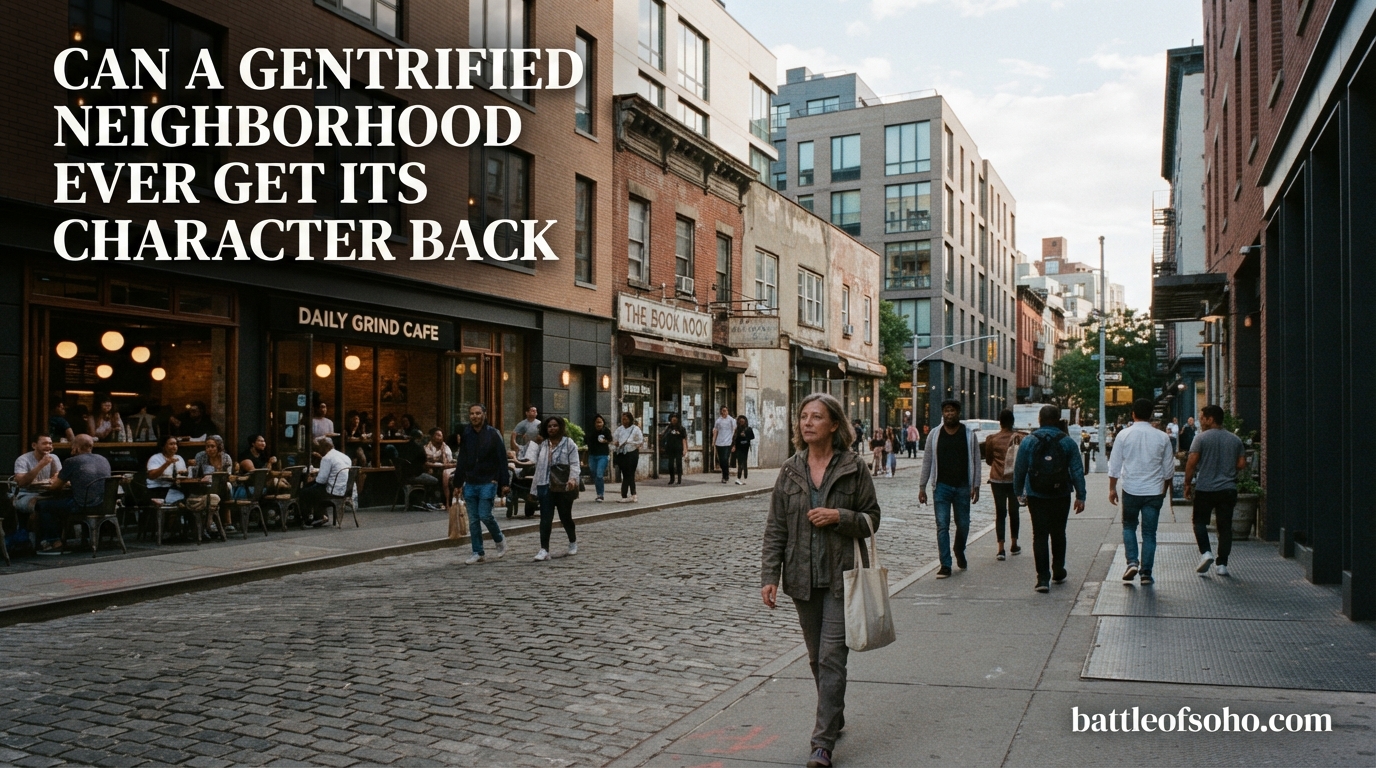
Walk through a neighborhood that has gentrified in the last decade, and you will notice the signs almost immediately. The corner bodega is now a craft cocktail bar. The laundromat where everyone caught up on gossip is a boutique fitness studio. The church that hosted community meetings for forty years shares its block with a luxury condo lobby.
If you have ever asked yourself whether a gentrified neighborhood can ever get its character back, you are not alone. It is one of the most emotionally charged questions in urban planning, housing policy, and community advocacy today. Long-time residents feel it in their bones. New arrivals sense it in the tension. City planners wrestle with it in every rezoning hearing.
The question matters because neighborhood character is not just aesthetics. It is the accumulated social fabric, cultural memory, economic networks, and daily rhythms that give a place its identity. When gentrification replaces that fabric with something homogeneous, the loss runs deeper than building facades.
Our team spent months researching this topic, digging through census tract data, community forum discussions, academic studies, and on-the-ground accounts from residents who have lived through neighborhood transformation. We looked at the National Community Reinvestment Coalition’s fifty-year longitudinal study of gentrification in American cities. We read hundreds of Reddit threads where residents describe watching their blocks change overnight. We examined case studies from Washington DC’s U Street, Harlem, the Mission District, Williamsburg, and Bronzeville.
What we found is that the answer is not a simple yes or no. A gentrified neighborhood rarely returns to exactly what it was before. But character is not a fixed artifact locked in time. It is a living, evolving thing. With the right mix of policy, grassroots action, institutional preservation, and genuine community integration, a neighborhood can develop a new character that honors its past rather than erasing it.
In this article, we will break down what neighborhood character actually means, why gentrification destroys it so efficiently, whether reverse gentrification is real, and what communities are doing right now to fight for their identity. We will look at neighborhoods that lost everything and neighborhoods that found a way to hold on. We will examine the role of race, economics, policy, and personal choice. By the end, you will have a clear, evidence-based answer to one of the defining urban questions of 2026.
Table of Contents
The Short Answer: Can a Gentrified Neighborhood Ever Get Its Character Back?
A gentrified neighborhood almost never returns to its original character, but it can develop a new identity that genuinely includes and honors long-time residents and their cultural legacy. The original character, built over generations by a specific community with specific traditions, businesses, and social networks, is extremely difficult to reconstruct once displacement has scattered its people and institutions.
However, this does not mean all hope is lost. Neighborhoods are not museum exhibits frozen in amber. They are living ecosystems. When communities actively fight to preserve cultural landmarks, protect affordable housing, and integrate new residents into existing traditions rather than replacing them, a different kind of recovery becomes possible.
Think of it less as restoration and more as regeneration. You cannot un-displace the families who were priced out. You cannot un-demolish the historic buildings that were torn down. But you can protect what remains, build new institutions that reflect the community’s heritage, and ensure that the people who stayed have a real voice in what comes next.
The National Community Reinvestment Coalition found that between 1980 and 2020, gentrification impacted 523 majority-Black neighborhoods in the United States. A third of those, 155 neighborhoods, experienced full racial turnover. That scale of transformation does not reverse on its own. Recovery requires intention, policy, money, and organized community power working together over years and decades.
It is also worth noting that not every neighborhood experiences gentrification the same way. Some neighborhoods undergo what researchers call rebound, where investment arrives but the original community largely remains. Others experience full cultural erasure. The path to character recovery looks very different depending on which scenario a neighborhood has gone through. We will explore both paths in detail below.
What Is Gentrification and Why Does It Change Neighborhood Character?
Gentrification is a process in which increased public and private investment in a historically disinvested neighborhood drives up property values and rents, attracting wealthier residents while displacing lower-income ones. The term was coined by British sociologist Ruth Glass in 1964 to describe what she saw happening in London neighborhoods, where working-class districts were being taken over by middle-class professionals.
Glass observed that once this process starts in a district, it goes on rapidly until all or most of the original working-class residents are displaced. More than sixty years later, her observation remains remarkably accurate. The mechanism she identified has played out in cities around the world, from London to San Francisco to Berlin to Mexico City.
The process typically begins when a neighborhood has experienced decades of disinvestment, redlining, or population decline. These conditions make housing cheap relative to the rest of the city. Artists, students, and young professionals looking for affordable space move in first. Their presence signals to developers and investors that the area has growth potential.
Then the cycle accelerates. Developers buy cheap properties, renovate them, and sell or rent them at higher prices. New businesses open to serve the incoming population, which has more disposable income. Property values rise. Property taxes follow. Rents climb. Long-time residents, especially renters and fixed-income homeowners, face mounting financial pressure.
What makes gentrification so destructive to neighborhood character is not just the physical change to buildings and streets. It is the demographic turnover. When the people who created a neighborhood’s culture are replaced by people with different tastes, incomes, and social networks, the culture itself changes. The corner store stops carrying the spices you grew up cooking with. The barber who knew every family on the block closes because commercial rent tripled. The park that hosted weekend cultural festivals gets taken over by dog owners and yoga classes.
Neighborhood character, in the context of gentrification, refers to the combination of people, businesses, institutions, architectural styles, public spaces, and cultural practices that make a place recognizable and meaningful to its residents. It is not a single thing. It is an ecosystem. When gentrification removes enough pieces of that ecosystem simultaneously, the character does not just change. It fractures.
This is why the question of whether a gentrified neighborhood can get its character back is so complex. You are not asking whether the buildings can look the same. You are asking whether an entire social and cultural ecosystem can be reconstructed after significant parts of it have been removed. That is a fundamentally different challenge from architectural restoration or streetscape redesign.
It is also important to understand that gentrification does not affect all communities equally. Research consistently shows that Black and Latino neighborhoods are more vulnerable to full cultural erasure than white working-class neighborhoods. This is partly because Black wealth has been systematically suppressed through redlining, predatory lending, and discriminatory appraisal practices. When Black neighborhoods gentrify, the wealth gap means original residents have fewer resources to hold on.
What Neighborhood Character Actually Means
Before we can answer whether character can be recovered, we need to define what we are even talking about. Neighborhood character is a term that gets used constantly in gentrification debates but rarely gets defined with precision. This creates confusion because different people mean very different things when they say a neighborhood has lost its character.
At its core, neighborhood character has several interlocking dimensions. The first is demographic. Who lives in the neighborhood? What are their racial, ethnic, educational, and economic backgrounds? How long have they been there? A neighborhood’s character shifts fundamentally when its demographic composition changes dramatically, even if the buildings look the same.
The second dimension is commercial. What businesses exist in the neighborhood? Are they locally owned or chain stores? Do they serve the existing community or cater to a new demographic? When the commercial landscape of a neighborhood transforms, the daily experience of living there changes with it. The places where people ran into each other, formed relationships, and built community disappear.
The third dimension is institutional. What churches, schools, community centers, cultural venues, and civic organizations operate in the neighborhood? These institutions are the backbone of community life. They host the events, provide the services, and sustain the traditions that give a neighborhood its identity. When they close or are replaced, the community loses critical infrastructure.
The fourth dimension is cultural. What music, food, art, language, religious practices, and social customs define daily life in the neighborhood? This dimension is the most intangible but also the most powerful. It is what makes a neighborhood feel like home to the people who belong there. When cultural practices are silenced, marginalized, or commodified for tourists and new residents, character erodes from the inside out.
The fifth dimension is architectural. What do the buildings look like? How tall are they? What materials are they made of? Is there continuity with the neighborhood’s history, or has the physical environment been radically transformed? Architecture alone does not equal character, but it contributes to the felt experience of a place. When historic buildings are demolished and replaced with generic luxury developments, the neighborhood physically ceases to be the same place.
When all five dimensions are disrupted simultaneously, which is what happens during intense gentrification, character does not just change. It undergoes what sociologists call a phase transition, like water turning to steam. The neighborhood may occupy the same geographic coordinates, but it is fundamentally a different place.
Why Neighborhood Character Gets Erased During Gentrification
Neighborhood character erasure does not happen because new residents are malicious or because developers are cartoon villains. It happens through a series of economic and social mechanisms that, individually, seem benign but collectively produce cultural displacement.
The first mechanism is commercial rent inflation. When property values rise, commercial landlords raise rents or sell to new owners who do. Small businesses that operated on thin margins for decades, the barbershops, the family restaurants, the corner stores, the music venues, cannot absorb the increase. They close. Chain stores, upscale restaurants, and trendy bars that can afford the new rents take their place.
This commercial turnover has cascading effects. When the barbershop closes, the men who gathered there every Saturday lose their social anchor. When the family restaurant shuts down, the recipe for the dish that everyone in the neighborhood grew up eating disappears with it. When the music venue goes dark, the artists who performed there have nowhere to play. Each business closure removes a thread from the social fabric.
The second mechanism is residential displacement. As rents and property taxes rise, long-time residents leave. Some are forced out through eviction or buyout offers. Others leave voluntarily but would have preferred to stay. Either way, the social networks that held the community together start breaking apart. The neighbor who watched your kids after school moves to a suburb forty minutes away. The grandmother who knew everyone’s family history passes away and her house is sold to a young couple from out of state.
Research from the Philadelphia Federal Reserve, reviewed by City Observatory, found that over ten years, about 60 percent of less-educated renters moved out of non-gentrifying neighborhoods, compared to 66 percent in gentrifying neighborhoods. The difference of six percentage points may seem small in the aggregate, but it represents thousands of additional families displaced from communities where they had deep roots. And the aggregate data does not capture the qualitative experience of watching your neighbors disappear one by one.
The third mechanism is cultural commodification. This is perhaps the most insidious. Developers and city boosters often market a neighborhood’s cultural authenticity to attract new residents, while simultaneously displacing the people who created that culture. A historically Black neighborhood becomes a destination for its soul food restaurants and jazz history, but the actual Black residents who sustained those traditions are priced out. The culture becomes a theme park version of itself.
This commodification is particularly painful for long-time residents because it feels like a double theft. First, the community loses its economic footing. Then, the culture that the community created is repackaged and sold as an amenity for the people who replaced them. The neighborhood becomes cool precisely because of the culture that gentrification is destroying.
The fourth mechanism is institutional disruption. Churches, community centers, mutual aid networks, and cultural organizations depend on their membership. When members are displaced, these institutions weaken. A church that once had five hundred active congregants may struggle to maintain two hundred after gentrification. The loss of these institutions removes the infrastructure that allowed community identity to persist through challenges.
Forum discussions on Reddit capture this dynamic viscerally. One user described returning to their childhood neighborhood in Brooklyn after ten years away and finding that every store they remembered was gone. Another described the painful irony of new residents praising the neighborhood’s authentic character while complaining about the noise from the very cultural practices, like outdoor music and street vendors, that gave it that character in the first place.
A third user, a real estate investor, posted on a real estate investing subreddit asking how to deal with the guilt of contributing to gentrification. The responses revealed a deep ambivalence. Some commenters argued that investing in underserved neighborhoods was ultimately positive because it brought needed capital. Others pointed out that without anti-displacement protections, that capital almost always benefits newcomers at the expense of existing residents.
These online discussions reveal that people on all sides of the gentrification dynamic, long-time residents, new arrivals, investors, and policymakers, struggle with the same fundamental tension. How do you bring investment into a neighborhood without destroying what made the neighborhood worth investing in?
This is why gentrification is so often described not just as change but as erasure. The new neighborhood may be cleaner, have better coffee, and feature renovated storefronts. But for the people who built the original community, it feels like theft. And unlike a stolen object, stolen character is nearly impossible to recover.
The Difference Between Neighborhood Rebound and Cultural Erasure
One of the most important frameworks for understanding gentrification comes from the National Community Reinvestment Coalition’s report “Displaced by Design.” The report distinguishes between what it calls rebound neighborhoods and neighborhoods that undergo full cultural erasure. This distinction is critical for answering our central question.
Rebound neighborhoods are areas that experience investment and demographic change but retain a significant portion of their original residents and cultural institutions. In these neighborhoods, gentrification brings improvements like better schools, safer streets, and improved city services without completely displacing the existing community. The original residents may be a smaller percentage of the population than before, but they are still present in large enough numbers to maintain the neighborhood’s cultural identity.
Culturally erased neighborhoods, on the other hand, undergo such complete demographic turnover that the original community is effectively gone. The NCRC study found that 155 of the 523 majority-Black neighborhoods it identified as gentrified experienced this kind of full racial turnover between 1980 and 2020. These neighborhoods may retain some physical markers of their history, like a historic church building or a renamed street, but the living community that gave those markers meaning has been scattered.
The distinction matters enormously for our central question. A rebound neighborhood has a realistic path to preserving and even deepening its character, because the people and institutions that create character are still there. A culturally erased neighborhood faces a much harder road, because the human infrastructure of character has been dismantled.
Think of it this way. If a neighborhood loses thirty percent of its long-time residents but retains its major cultural institutions, a community land trust can protect remaining affordable housing, and new residents who genuinely engage with the existing culture can be absorbed, the neighborhood’s character can survive and evolve. If a neighborhood loses seventy percent of its original residents and its cultural institutions collapse, rebuilding character from scratch is a fundamentally different and far more difficult challenge.
The NCRC report uses two specific case studies to illustrate this distinction. Lafayette Square in St. Louis represents a successful rebound. The neighborhood experienced significant investment and demographic change, but it retained enough of its historic character and community to remain recognizably itself. U Street and Shaw in Washington DC, by contrast, experienced cultural erasure so complete that the neighborhood is almost unrecognizable from what it was a generation ago.
Some researchers argue that rebound neighborhoods represent a third path between the false binary of either total gentrification or total disinvestment. These neighborhoods suggest that investment and improvement do not have to mean erasure, if they are managed with community preservation as a priority rather than an afterthought.
The challenge is that rebound neighborhoods are the exception, not the rule. Most gentrified neighborhoods in the United States trend closer to the cultural erasure end of the spectrum than the rebound end. The conditions that produce rebound, strong existing institutions, early community organizing, supportive policy environments, and a critical mass of residents who can afford to stay, are not present in every neighborhood facing development pressure.
Is Reverse Gentrification Possible?
The concept of reverse gentrification gets thrown around a lot in online discussions, but it means different things to different people. Let us break down what it could mean and whether any version of it is actually happening.
In the strictest sense, reverse gentrification would mean a wealthy, gentrified neighborhood becoming affordable again for working-class residents and recovering its original cultural demographics. By this definition, true reverse gentrification is extremely rare. Once property values in a neighborhood have risen, they almost never fall back to pre-gentrification levels without a broader economic catastrophe. The 2008 financial crisis caused some gentrified neighborhoods to see price declines, but those declines were temporary, and prices eventually resumed their upward trajectory.
A second definition of reverse gentrification involves cultural rather than economic reversal. This would mean a gentrified neighborhood’s cultural institutions and community identity being actively rebuilt and reclaimed by the original community or its descendants. This version is more plausible, though still difficult. It requires organized effort, institutional investment, and often policy intervention to create the conditions for cultural return.
A third, more nuanced definition comes from Quora and Reddit discussions where users ask whether gentrification can go backward. Some point to neighborhoods that experienced gentrification, then saw a wave of departure as the original wave of gentrifiers aged out or moved to suburbs. This phenomenon, sometimes called gentrification reversal or youth flight, does happen but typically does not restore the neighborhood to its pre-gentrification state. The housing stock has already been renovated, the small businesses have already been replaced, and the property values remain elevated.
What is more realistic than full reverse gentrification is what we might call partial cultural recovery. This happens when organized community efforts succeed in establishing new cultural institutions, reclaiming public spaces, or bringing back displaced residents through affordable housing programs. It is not reversal in the sense of going back in time, but it is a form of cultural reassertion within a changed landscape.
There are a few real-world examples that approach this idea. In some cities, descendants of displaced communities have organized to establish cultural centers, museums, or community spaces that explicitly preserve and celebrate the neighborhood’s original identity. These efforts do not undo gentrification, but they create pockets of cultural continuity within a gentrified context.
The honest answer is that reverse gentrification, in the sense most people mean it, does not really exist as a natural process. Neighborhoods do not un-gentrify on their own. What can happen, and what we will explore in the next sections, is intentional, organized efforts to rebuild community character within a gentrified context. The distinction between natural reversal and intentional recovery is critical because it tells us that character recovery is something communities must actively build, not something that happens to them.
Real-World Examples of Neighborhoods That Lost Their Character
To understand what is at stake when we ask whether a gentrified neighborhood can get its character back, we need to look at specific places that have gone through this transformation. These case studies reveal patterns that repeat across cities and decades. They also show the range of outcomes, from near-total cultural erasure to partial preservation and ongoing resistance.
U Street and Shaw, Washington DC
U Street and Shaw in Washington DC were once known as Black Broadway, a thriving center of African American culture, music, and commerce. Duke Ellington grew up there. The neighborhood was home to Black-owned businesses, jazz clubs, and a strong middle-class community that had built itself in the face of segregation.
Beginning in the early 2000s and accelerating through the 2010s, the neighborhood underwent intense gentrification. The U Street Metro station, opened in 1991, was a catalyst. New condos, restaurants, and retail followed. By 2020, the neighborhood that was once overwhelmingly Black had become majority white. Long-time residents described the transformation as a loss that went far beyond economics. The cultural ecosystem that made U Street unique, the music venues, the Black-owned restaurants, the community networks, was largely gone.
As one analysis from the Evangelical Lutheran Church in America noted, the U Street neighborhood has not been restored but transformed into something different, diminishing the historical and cultural character of the area. This distinction between restoration and transformation is critical. Restoration implies bringing back what was there. Transformation means creating something new that may not include the original community.
The DontMuteDC movement, which we will explore in detail later, emerged directly from this context. When long-time cultural practices like Go-Go music playing from storefront speakers came under threat from new residents who found them noisy, the community recognized that cultural erasure was not just a historical process but an ongoing one that required active resistance.
Harlem, New York City
Harlem is perhaps the most iconic African American neighborhood in the United States, the birthplace of the Harlem Renaissance and a global symbol of Black cultural achievement. It has also been a battleground for gentrification for over two decades.
The changes in Harlem have been profound. Brownstones that were once affordable to working-class Black families now sell for millions. National chain stores have replaced many local businesses. The demographic shift has been significant enough that some observers have questioned whether Harlem can still be called the capital of Black America.
Yet Harlem also demonstrates the complexity of neighborhood character. The neighborhood has not been completely culturally erased. Institutions like the Apollo Theater, the Studio Museum in Harlem, and numerous churches remain. Community organizations continue to fight for affordable housing and cultural preservation. Harlem may be the closest thing to a rebound neighborhood among heavily gentrified Black communities, though the pressure is relentless.
The tension in Harlem is visible on every block. On one corner, a new artisanal coffee shop serves customers who can afford five-dollar lattes. On the next, a Black-owned restaurant that has been there for thirty years posts a sign explaining that it needs community support to survive another year. The question of whether Harlem’s character can survive is answered differently every day, depending on which institution wins its battle and which one loses.
The Mission District, San Francisco
San Francisco’s Mission District was for generations the heart of the city’s Latino community. It was known for its murals, its taquerias, its community activism, and its working-class culture. The tech boom of the 2010s changed everything.
As tech workers with high salaries moved into the neighborhood, rents skyrocketed. Many Latino families were displaced. Beloved local businesses closed. The murals remained on the walls, but the community that created them was shrinking. Community organizers fought back with eviction defenses, cultural programming, and political organizing, but the scale of economic pressure from the tech industry made preservation extremely difficult.
The Mission District is a sobering example of how rapidly gentrification can transform a neighborhood when the broader regional economy creates extreme income inequality. It also shows how cultural symbols can persist even as the living community behind them fades. The murals are still beautiful. Tourists still come to photograph them. But the artists who painted them and the community they depicted have been substantially displaced.
Williamsburg, Brooklyn
Williamsburg tells the story of gentrification in fast-forward. In the late 1990s, it was a working-class neighborhood with a large Hasidic Jewish community, industrial warehouses, and a nascent artist scene. Within fifteen years, it had become one of the most expensive neighborhoods in New York City, filled with luxury condos, high-end restaurants, and residents who had no connection to the community that preceded them.
What happened in Williamsburg is often cited as a textbook case of gentrification proceeding through predictable stages. Artists arrive because rent is cheap. Their presence makes the neighborhood cool. Developers and wealthier residents follow. The artists themselves get priced out. The original working-class community is almost entirely displaced. What remains is a neighborhood that has brand-new character but almost no continuity with its past.
Bronzeville, Chicago
Bronzeville on Chicago’s South Side was once the cultural and commercial heart of Chicago’s Black community. It was known as the Black Metropolis, home to Black-owned banks, insurance companies, newspapers, and music venues. The neighborhood produced luminaries like Ida B. Wells, Gwendolyn Brooks, and Louis Armstrong.
Decades of disinvestment, demolition for public housing, and population decline left Bronzeville vulnerable. In recent years, investment has returned, bringing renovated homes, new businesses, and an influx of new residents. But the question of whose investment and for whom looms large. Long-time residents have organized to ensure that the neighborhood’s Black cultural heritage is not erased in the name of revitalization, but the tension between economic improvement and cultural preservation remains acute.
These five examples share a common thread. In each case, investment and improvement came at the cost of community displacement. The neighborhoods are objectively cleaner, safer, and have more amenities than before. But the people and culture that gave them their identity were largely replaced. The degree of replacement varies, but the pattern is consistent across cities.
Community-Led Preservation: How Some Neighborhoods Are Fighting Back
While the case studies above are sobering, they are not the whole story. Across the country, communities are developing strategies to resist cultural erasure and preserve neighborhood character even amid intense development pressure. These efforts offer a blueprint for what intentional, community-led preservation looks like.
One of the most powerful examples is the DontMuteDC movement in Washington DC. In 2019, a new resident of the Shaw neighborhood complained to city officials about the Go-Go music that had been playing from a Metro PCS store speaker for nearly twenty-five years. Go-Go music, a funk-derived genre created in Washington DC, is deeply tied to the city’s Black cultural identity. When the store was told to silence the music, the community erupted.
Residents organized rallies, flooded city phone lines, and rallied around the hashtag DontMuteDC. Within days, the music was restored. The movement did not just save a speaker. It became a symbol of broader resistance to the cultural erasure that gentrification was causing in DC. It showed that organized community power could push back against the seemingly inexorable forces of neighborhood change.
The DontMuteDC movement is significant because it illustrates several key principles of effective cultural resistance. First, it had a clear, actionable demand. Second, it leveraged social media to organize rapidly. Third, it framed the issue not just as a local nuisance dispute but as a question of cultural survival. Fourth, it mobilized both long-time residents and sympathetic allies to create a coalition too large for city officials to ignore.
Community land trusts represent another powerful preservation strategy. A community land trust is a nonprofit organization that acquires and holds land for the benefit of the community, ensuring that housing on that land remains permanently affordable. By removing land from the speculative market, community land trusts create a buffer against the displacement that drives character loss.
Cities like Burlington, Vermont, and Atlanta, Georgia, have used community land trusts to preserve affordable housing in neighborhoods facing gentrification pressure. The Dudley Street Neighborhood Initiative in Boston is one of the most famous examples, having successfully used a community land trust to revitalize a neighborhood without displacing its primarily Black and Latino residents. The model is not a silver bullet, but it provides a structural mechanism for keeping long-time residents in place, which is the single most important factor in preserving neighborhood character.
Black-led cultural institutions play a critical role as well. In neighborhoods where churches, museums, cultural centers, and Black-owned businesses remain strong, the community has anchors around which identity can persist. These institutions serve as gathering spaces, cultural transmission points, and organizing hubs. When they survive gentrification, the neighborhood has a foundation on which to rebuild.
The role of churches deserves special attention. In many historically Black neighborhoods, churches are the longest-lasting and most deeply rooted institutions. They have survived redlining, urban renewal, and disinvestment. But gentrification presents a different challenge because it directly attacks their membership base. When congregants are displaced, churches face declining attendance, reduced giving, and pressure to sell valuable real estate. Churches that have resisted this pressure and remained in their neighborhoods have often become the strongest defenders of community character.
Historic preservation offers another tool. When a neighborhood is designated as a historic district, its architectural character is protected, which limits demolition and out-of-scale development. While historic preservation alone does not prevent demographic change, it does slow the pace of physical transformation and gives communities time to organize. Some advocates argue that combining historic district designation with anti-displacement policies creates the strongest protection for neighborhood character.
Community benefits agreements are yet another strategy. These are legally binding agreements between developers and community organizations that require developers to provide specific benefits, such as affordable housing units, local hiring commitments, or community space, in exchange for community support of a project. When negotiated from a position of community strength, these agreements can ensure that new development serves existing residents rather than replacing them.
The common thread across all these strategies is that they require organization, resources, and political power. Communities that are already organized, that have strong institutions, and that have political allies are much better positioned to preserve their character than communities that are fragmented and disempowered. This is why building community organization before gentrification arrives is so important. Once the bulldozers are rolling and the eviction notices are flying, it is often too late.
Can New Residents Become Part of a Neighborhood’s Character?
This is one of the most uncomfortable and least discussed questions in the gentrification debate. The default assumption in many community conversations is that new residents are inherently destructive to neighborhood character. But this framing oversimplifies a complex reality.
Neighborhoods have always changed. Immigrants arrived in waves. Ethnic groups shifted. Economies rose and fell. The character of any living neighborhood is the product of layer upon layer of change over time. The question is not whether change happens. It is whether change adds to the existing community or replaces it.
Forum discussions on Reddit reveal a real tension. Some new residents genuinely want to integrate into the existing community. They shop at local businesses, attend community events, send their children to neighborhood schools, and build relationships with long-time residents. Others treat the neighborhood as a consumer product, extracting its cool factor while remaining socially isolated from the people who created it.
One Millennial homeowner posted on Reddit about buying a house in what they described as an up-and-coming neighborhood and feeling deep conflict about their role in gentrification. The responses were a mix of empathy, defensiveness, and practical advice. Several long-time residents of gentrifying neighborhoods weighed in to say that the question was not whether new residents belonged, but how they behaved once they arrived.
The difference between these two types of new residents is significant. When new arrivals approach a neighborhood with humility and a genuine desire to contribute to its existing culture, they can become part of its evolving character. This is not the same as preserving the original character unchanged. It is more like adding a new instrument to an existing band. The music changes, but it builds on what came before rather than silencing it.
The challenge is that this kind of genuine integration requires intentionality. It does not happen by default. New residents have to actively choose to engage with the existing community rather than simply occupying space in it. Long-time residents have to be willing, despite the trauma of displacement and cultural pressure, to make room for newcomers who are acting in good faith.
Some community organizers have developed frameworks for what responsible neighborhood integration looks like. These include supporting existing local businesses rather than waiting for new ones to open, respecting existing cultural practices rather than complaining about them, advocating for affordable housing policies, contributing to community organizations financially and through volunteer work, and listening to long-time residents about what the neighborhood needs rather than imposing external priorities.
No one who moves into a changing neighborhood is free from complicity in the broader forces of gentrification. But the degree to which new residents either reinforce or mitigate cultural erasure is not predetermined. It is a daily set of choices that, collectively, shape whether a neighborhood’s character evolves or collapses. The most honest new residents acknowledge their role in the process and work actively to minimize harm rather than pretending they have no impact.
What Role Does Policy Play in Saving Neighborhood Identity?
Individual choices and community organizing matter, but they operate within a policy framework that either supports or undermines neighborhood character preservation. Local, state, and federal policies create the rules of the game. When those rules prioritize developer profits over community stability, preservation is nearly impossible regardless of how hard residents fight.
Inclusionary zoning is one of the most discussed policy tools. This policy requires developers of new housing to include a certain percentage of affordable units in their projects or pay into an affordable housing fund. Done well, inclusionary zoning ensures that new development creates housing for a range of income levels rather than exclusively for the wealthy. Done poorly, with loopholes and weak enforcement, it produces token affordable units while allowing mass displacement to continue.
Rent stabilization and tenant protections are equally important. In cities with strong rent control laws, long-time residents have legal protection against dramatic rent increases that would otherwise force them out. These policies do not stop gentrification entirely, but they slow the pace of displacement and give communities more time to adapt and organize. The erosion of rent protections in many cities has directly accelerated the loss of neighborhood character.
Property tax relief for long-time homeowners is another critical tool. Many fixed-income homeowners in gentrifying neighborhoods face property tax bills that double or triple as property values rise. Programs that cap property tax increases for long-time residents, like California’s Proposition 13 or various homestead exemption programs, can help keep original homeowners in place even as property values climb. These programs are not without controversy, as poorly designed versions can benefit wealthy property owners who do not need relief, but the basic principle of protecting long-time residents from tax-driven displacement is sound.
Commercial rent stabilization is a less common but increasingly discussed policy. Just as residential rent control protects tenants, commercial rent stabilization protects small businesses from being priced out. New York City has experimented with commercial rent regulation, and other cities are exploring similar measures. Protecting the small businesses that define a neighborhood’s commercial character is essential to preserving its overall identity. When the barbershop, the bodega, and the family restaurant disappear, the daily texture of neighborhood life changes fundamentally.
Cultural district designation is a policy approach that goes beyond historic preservation. Some cities have created cultural districts that come with specific protections and investments designed to preserve the cultural identity of a neighborhood, not just its buildings. These designations can include funding for cultural programming, priority for local businesses in city procurement, and protections against displacement of cultural institutions. San Francisco’s Cultural Heritage Districts and Los Angeles’s Visionary Cultural Neighborhoods programs are examples of this approach.
Community benefits agreements, mentioned earlier, operate at the intersection of policy and community power. While they are technically private agreements, cities can formalize them by requiring CBAs as part of the development approval process. This transforms an ad hoc negotiation into a standard policy expectation. The strongest CBA frameworks give communities real leverage by making developer cooperation a condition of project approval.
The bottom line is that policy is the structural foundation on which neighborhood character either survives or crumbles. Communities can fight hard and still lose if the policy environment is hostile to preservation. Conversely, strong anti-displacement policies can create space for community-led preservation efforts to succeed. The most effective approach combines multiple policy tools simultaneously, because no single policy is sufficient to counteract the economic forces driving gentrification.
The Economics of Preserving Neighborhood Character
Behind every question about neighborhood character is an economic reality. Gentrification is fundamentally an economic process, driven by real estate markets, investment capital, and income inequality. Any attempt to preserve character must contend with these economic forces, not just the cultural and social dimensions.
The core economic problem is that neighborhood character is what economists call a positive externality. It benefits everyone who experiences it, but the people who create it do not get paid for it. A thriving street culture, a tight-knit community network, a unique commercial ecosystem, these things add enormous value to a neighborhood. But that value is captured by property owners and developers, not by the residents and business owners who built it.
This creates a perverse incentive structure. The more vibrant and authentic a neighborhood’s character, the more attractive it becomes to investors and new residents. The more attractive it becomes, the higher property values rise. The higher property values rise, the more pressure builds on the people who created the character in the first place. Eventually, the character is destroyed by the very attractiveness it produced.
Breaking this cycle requires intentional economic intervention. Community land trusts, as discussed earlier, address the problem by removing land from the speculative market. Affordable housing set-asides in new development ensure that at least some housing remains accessible to lower-income residents. Commercial rent stabilization protects the small businesses that create commercial character. Each of these tools addresses a specific economic mechanism of displacement.
Tax increment financing, or TIF, is another economic tool that can be redirected toward preservation. Traditionally, TIF districts capture the increased property tax revenue generated by development and redirect it toward further development. But some cities have used TIF revenue to fund affordable housing, community programs, and small business support. This transforms a tool that typically accelerates gentrification into one that mitigates it.
The economic argument for preservation is not just moral. It is practical. Studies have shown that neighborhoods that maintain demographic diversity and cultural character tend to have more resilient local economies over the long term. Monocultural neighborhoods, whether wealthy-gentrified or impoverished-disinvested, are more economically fragile. Diversity, in both demographics and business types, creates economic resilience.
What Happens After a Neighborhood Gets Gentrified?
After a neighborhood gentrifies, the physical environment typically improves with renovated buildings, new businesses, and increased city services, but the social and cultural fabric that defined the community is often severely damaged or destroyed. Long-time residents who remain may feel like strangers in their own neighborhood. Property values and rents stabilize at new, higher levels, making it nearly impossible for displaced residents to return. The neighborhood enters a new equilibrium that bears little resemblance to what came before, though it may retain superficial cultural markers that have been commodified for the new demographic.
The post-gentrification phase can last decades. In some neighborhoods, a second wave of change eventually arrives as the initial gentrifiers age and new development pressures emerge. In others, the neighborhood settles into a relatively stable but unrecognizable state. Long-time residents who have stayed often describe a profound loneliness, living in a place that looks familiar geographically but feels completely alien culturally.
Strategies Communities Use to Preserve Character
Communities use several proven strategies to preserve neighborhood character during and after gentrification:
1. Establish community land trusts to remove property from the speculative market and keep housing permanently affordable for long-time residents.
2. Fight for inclusionary zoning policies that require new development to include affordable housing units rather than exclusively market-rate or luxury housing.
3. Organize around cultural preservation, including protecting landmarks, funding cultural programming, and resisting attempts to silence existing cultural practices as the DontMuteDC movement did.
4. Negotiate community benefits agreements with developers that legally bind them to provide community amenities, local hiring, and affordable units in exchange for project approval.
5. Push for commercial rent stabilization to protect the small businesses that give a neighborhood its commercial and cultural identity from being priced out.
6. Advocate for historic and cultural district designations that provide legal protections for the physical and cultural characteristics of the neighborhood.
7. Support and strengthen existing cultural institutions, including churches, museums, community centers, and locally owned businesses, so they can survive economic pressure.
8. Build political power through voter registration, candidate endorsement, and sustained advocacy at city council meetings and planning hearings.
Conclusion: The Honest Answer About Character Recovery
So, can a gentrified neighborhood ever get its character back? The most honest answer we can give, after all this research, is that it depends entirely on what you mean by character and what you mean by getting it back.
If character means the exact same community, the same people, the same businesses, the same daily rhythms that existed before gentrification arrived, then no. That character cannot be recovered once it has been dispersed. Displacement is not reversible. The families who were priced out are not coming back unless specific, well-funded programs make it possible, and even then, only a fraction will return.
If character means a neighborhood that retains meaningful connections to its history, that protects its remaining long-time residents and cultural institutions, that integrates new members into an existing cultural framework rather than replacing it, and that continues to evolve in ways that honor its past, then yes. That kind of character can survive, and in some cases, even strengthen after gentrification.
The difference between these two outcomes is not random. It is the product of policy choices, community organizing, institutional strength, and the cumulative decisions of everyone who calls the neighborhood home. Communities that fight for their character with organized, sustained effort have a real chance of preserving it. Communities that do not, or cannot, will see it erased.
The question of whether a gentrified neighborhood can get its character back is ultimately a question about power. Who has the power to shape what a neighborhood becomes? Who benefits from the changes? Who is protected and who is sacrificed? Until those questions are answered in favor of the communities that built these neighborhoods in the first place, character recovery will remain aspirational rather than achievable. But the fight itself, as movements like DontMuteDC have shown, can produce real victories that keep the spirit of a community alive even under enormous pressure.
For anyone reading this who lives in a neighborhood facing gentrification, or who has moved into a neighborhood that is changing, the most important takeaway is this. Character is not something you wait for someone else to preserve. It is something you actively build, defend, and contribute to every day. The neighborhoods that hold on to their soul are the ones where enough people decided that holding on was worth the fight.
FAQs
What happens after a neighborhood gets gentrified?
After gentrification, a neighborhood typically sees improved physical conditions like renovated buildings and new businesses, but loses much of its original social fabric and cultural identity. Long-time residents who remain often feel culturally displaced. Property values stabilize at higher levels, making it nearly impossible for displaced residents to return.
Is there such a thing as reverse gentrification?
True reverse gentrification, where a gentrified neighborhood becomes affordable again for working-class residents, is extremely rare. Property values almost never fall back to pre-gentrification levels without a major economic crisis. However, partial cultural recovery through organized community efforts, affordable housing programs, and new cultural institutions is possible.
How to fight back against gentrification?
Communities fight gentrification through community land trusts, inclusionary zoning advocacy, community benefits agreements with developers, commercial rent stabilization, historic and cultural district designation, and grassroots cultural preservation movements like DontMuteDC. Organized political pressure on local government is essential for enacting anti-displacement policies.
How long does it take for a neighborhood to gentrify?
Gentrification typically unfolds over 10 to 20 years, though the pace varies by city and neighborhood. The process often begins slowly with artists and early adopters, accelerates rapidly once developers and chain businesses arrive, and stabilizes once the neighborhood has been fully transformed and prices plateau at new levels.
Does gentrification always destroy neighborhood culture?
Not always, but frequently. Neighborhoods classified as rebound neighborhoods by the NCRC retain enough original residents and institutions to preserve cultural identity. However, neighborhoods that undergo full demographic turnover, which happened in 155 of 523 gentrified majority-Black neighborhoods studied, experience near-total cultural erasure.
Can gentrified areas become diverse without displacement?
Yes, but only with intentional policy. Inclusionary zoning, rent stabilization, community land trusts, and strong tenant protections can create conditions where neighborhoods diversify economically without displacing long-time residents. Without these policies, market forces almost always produce displacement alongside diversification.