
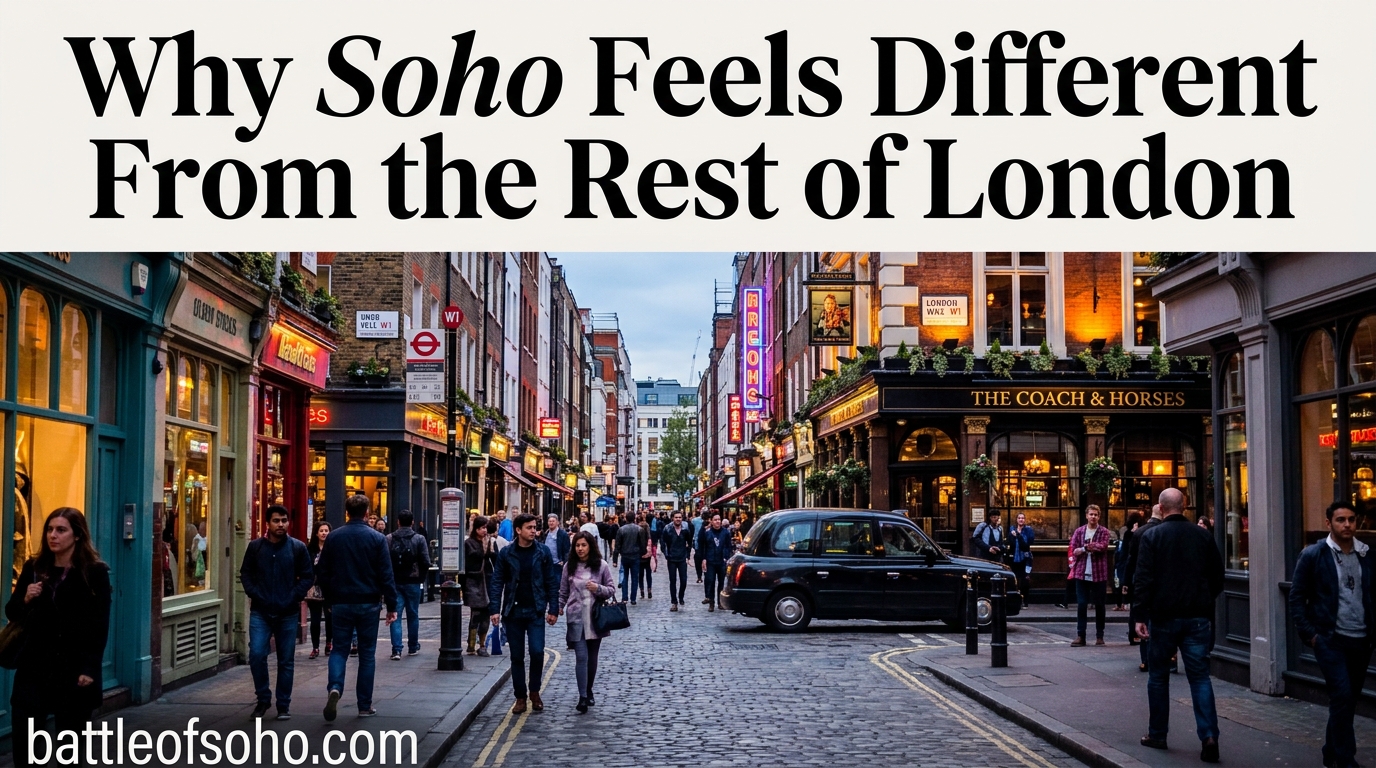
Walk south from Oxford Circus on a Friday evening and you will feel the city change before you see a single sign. The foot traffic thickens. The restaurant patios get louder. Somewhere between Regent Street and Wardour Street, the air itself seems to carry a different kind of energy. That shift is what people mean when they talk about why Soho feels different from the rest of London.
Most guides tell you what Soho is. They list the bars, mention the theatres, point you toward Old Compton Street, and move on. But ask anyone who has spent real time in central London, and they will tell you that Soho does not just look different. It feels different. There is a pulse to this neighborhood that you do not find in Mayfair, Marylebone, or even neighboring Covent Garden.
In this guide, I want to break down exactly what creates that feeling. We will look at the history that shaped the streets, the sensory experience of walking through them, the communities that have called Soho home for generations, and how the area compares to other pockets of London. Whether you are visiting for a weekend or trying to understand why locals get protective about this square mile, this is the full picture of what makes Soho London unique.
Table of Contents
Why Soho Feels Different From the Rest of London: The Short Answer
Soho feels different from the rest of London because it compresses more history, diversity, and round-the-clock energy into one square mile than any other district in the city. It is the only central London neighborhood that was built as an entertainment district from the ground up, and that original purpose still courses through its streets today.
Here is a quick breakdown of the key reasons:
1. It was designed for pleasure. Unlike Mayfair, which was built for the wealthy, or the City, which was built for commerce, Soho was built to entertain. That DNA is still present in every bar, theatre, and late-night restaurant.
2. The street layout refuses to be orderly. Soho’s grid is chaotic, narrow, and winding. You cannot walk in a straight line for long, and that forces you to slow down, look around, and notice things. It feels intimate in a way that grand London boulevards never do.
3. It never fully shuts down. Soho operates on a different clock than the rest of London. While other neighborhoods go quiet after 9 PM, Soho is just getting started. This nocturnal rhythm gives the area a restless, alive quality that most of the city lacks.
4. It has always been a refuge for outsiders. From French Huguenots in the 1680s to the LGBTQ+ community today, Soho has been the place where people who did not fit in elsewhere found a home. That legacy of acceptance gives the neighborhood an emotional warmth that feels genuinely different.
5. Everything is compressed. Soho is tiny. You can walk across it in about ten minutes. But within that space are hundreds of restaurants, dozens of bars, legendary music venues, independent shops, and centuries of stories. That density creates a feeling of abundance you cannot fake.
The Historical Roots That Shaped Soho’s Character
You cannot understand why Soho feels different without understanding where it came from. The atmosphere people sense today is the residue of 400 years of layered history, and each era left its mark on the streets.
From Farmland to Fashionable District
In the 1500s, the land we now call Soho was open countryside. It was hunting ground, farmland, and fields on the edge of a much smaller London. When Henry VIII converted nearby land into a royal park, the surrounding area began attracting the aristocracy. By the late 1600s, Soho had become one of the most fashionable addresses in the city, with grand houses built for wealthy families who wanted to be near the court without living inside the old city walls.
That period of aristocratic wealth gave Soho its initial street pattern. Many of the roads laid out in the 1670s and 1680s, like Wardour Street and Greek Street, still exist today. But the grandeur did not last.
The Bohemian Shift
By the 1800s, the wealthy had moved westward to Mayfair and Belgravia. Soho became a neighborhood of immigrants, artists, musicians, and people living on the margins. This is when the character that defines modern Soho began to take shape. The area became affordable, chaotic, and creatively fertile. Writers, painters, and performers moved in because the rent was cheap and nobody was watching too closely.
This bohemian period planted the seeds for everything Soho is known for today. The music venues, the theatres, the late-night culture, and the artistic energy all trace back to this era when the neighborhood stopped being respectable and started being interesting.
The Entertainment District Is Born
The late 19th and early 20th centuries turned Soho into London’s entertainment capital. Theatres went up along Shaftesbury Avenue. Music halls opened on nearly every corner. The area became the place where London went to forget its problems. That identity stuck. Even as industries changed and the city modernized around it, Soho remained the neighborhood where you went for a night out.
What makes this history matter for how the area feels today is continuity. Soho did not reinvent itself as an entertainment district. It has been one for over a century. When you walk through it, you are walking through a place that has been hosting, feeding, and entertaining people for generations. That accumulated purpose creates an atmosphere that newer districts simply cannot replicate.
The Sensory Experience: What Soho Actually Feels Like
This is the section that most guides skip, and it is exactly what makes Soho feel different from the rest of London. Let me try to put the experience into words.
The Sound
Soho is loud, but not in the way Oxford Street is loud. Oxford Street is the noise of commerce: delivery trucks, bus announcements, and crowds shuffling past shop windows. Soho is the noise of social life. You hear glasses clinking on outdoor tables, music bleeding out of doorways, laughter from groups spilling onto the pavement, and the low hum of conversation that never fully stops.
Walk down Old Compton Street on a Saturday afternoon and the sound is almost physical. It wraps around you. There is a strange paradox that forum users on Reddit have pointed out: Soho is objectively noisy, but it does not feel stressful the way other busy London areas do. The noise is made by people enjoying themselves, and your brain processes that differently than it processes traffic and construction.
The Smell
Food. That is the first thing you notice walking through Soho. The neighborhood has one of the highest concentrations of restaurants in London, and the smells layer on top of each other. Italian coffee from one doorway, Thai spices from the next, the yeasty warmth of a bakery, and underneath it all, the faintly damp, old-London smell that comes from streets that have been lived on for centuries.
The smell changes by street. Brewer Street smells different from Frith Street. Berwick Street, with its market, has its own distinct scent of fresh produce and street food. This olfactory variety keeps your senses engaged as you move through the area, which is a big part of why it feels more alive than a place like Mayfair, where the dominant smell is car exhaust and expensive perfume.
The Energy
This is the hardest thing to describe, but it is the core of what makes Soho feel different. There is an electricity to the neighborhood that comes from the sheer density of people who are there on purpose. Nobody accidentally wanders into Soho. It is not a thoroughfare. You do not pass through it to get somewhere else. You go to Soho because Soho is where you want to be.
That intentionality creates a shared mood. The people around you are not commuting. They are not running errands. They are eating, drinking, socializing, performing, watching, and exploring. When an entire square mile is full of people doing those things, the collective energy is unmistakable. It feels like the city is vibrating at a slightly higher frequency than everywhere else.
The Visual Texture
Soho looks different too, and not just because of the neon signs. The buildings are shorter than in the rest of central London. There are very few glass towers or corporate facades. The architecture is human-scale: four and five story buildings with shop fronts directly on the pavement. You can see doorways, windows, and people’s faces. It feels designed for humans rather than for institutions.
The narrow streets mean that sunlight hits the neighborhood differently. Shadows fall at sharp angles. The light feels warmer and more intimate than on the wide avenues of the West End. At night, the glow from restaurant windows and bar signs gives everything a cinematic quality that photographers have been chasing for decades.
A Cultural Melting Pot Unlike Anywhere Else in London
One of the biggest reasons Soho feels different is who you find there. The neighborhood has always been a gathering point for communities that existed on the edges of mainstream London society, and that diversity of people creates a richness you do not feel in more homogeneous districts.
The LGBTQ+ Community
Old Compton Street is the historic heart of London’s LGBTQ+ scene, and that presence shapes the entire neighborhood’s character. Soho has been a safe space for LGBTQ+ Londoners since long before it was legally or socially safe to be open anywhere else. The bars, clubs, and businesses along and around Old Compton Street are not just venues. They are institutions that have sustained a community through decades of struggle and celebration.
What this means for how the area feels is simple but important: Soho is a place where different kinds of people coexist openly. You see same-sex couples holding hands without a second glance. You see drag performances advertised on pub walls. You see a level of visible diversity in identity and expression that most London neighborhoods still do not have. That openness gives Soho a relaxed, accepting atmosphere that feels fundamentally different from the more buttoned-up parts of the city.
Creative Industries
Soho is also the historic home of London’s film, music, and media industries. Film companies, record labels, advertising agencies, and post-production houses have been based here since the mid-1900s. Denmark Street, sometimes called Tin Pan Alley, was the center of the British music industry for decades. The streets where the Rolling Stones and David Bowie once recorded still carry that creative legacy.
Even as some of those industries have decentralized, the creative energy remains. You can feel it in the independent shops, the street art, the impromptu performances, and the constant stream of people who work in creative fields living their daily lives in and around the neighborhood.
Food From Everywhere
The cultural melting pot shows up most vividly in the food. Soho has one of the most diverse restaurant scenes in London for its size. Within a few blocks, you can eat French, Italian, Thai, Japanese, Korean, Chinese, Lebanese, Indian, and modern British. This is not a food court situation. These are restaurants run by people from those cultures, many of them family businesses that have been in the neighborhood for generations.
Chinatown borders Soho to the south, and the influence bleeds through. The result is a neighborhood where the culinary options reflect the actual diversity of London rather than a curated version of it. Eating in Soho feels like the world is genuinely accessible, one restaurant at a time.
The Nightlife and Entertainment Heartbeat
You cannot talk about why Soho feels different without talking about what happens after dark. Soho at night is a different place than Soho during the day, and that transformation is a huge part of its unique character.
The Theatre District
Shaftesbury Avenue, which runs along the southern edge of Soho, is the spine of London’s West End theatre district. On any given evening, thousands of people pour into this area to see plays, musicals, and performances. That steady influx of theatre-goers gives the neighborhood a nightly rhythm that most areas do not have.
The pre-theatre dinner rush, the post-show drink crowds, and the general buzz of people dressed up and going out create an atmosphere of occasion. Even if you are not seeing a show, you are surrounded by people who are, and that shared sense of anticipation is contagious.
Live Music and Legendary Venues
Soho has hosted some of the most important moments in British music history, and the venues that made that history are still operating. Ronnie Scott’s, on Frith Street, has been hosting jazz legends since 1959. The 100 Club on Oxford Street is one of the oldest live music venues in the world. These are not museums. They are working venues where you can hear live music any night of the week.
The presence of these venues means that music is not background noise in Soho. It is part of the neighborhood’s identity. Walk past Ronnie Scott’s on a Tuesday night and you will hear a saxophone solo drifting out into the street. That kind of spontaneous encounter with live music is something you simply do not get in most London neighborhoods.
The Nocturnal Energy Shift
Here is where Soho’s uniqueness becomes most obvious. In most of central London, the streets start emptying around 9 or 10 PM. Offices close, shops shut, and the energy drains out of the area. In Soho, that is when things ramp up. Bars fill up after the theatre crowds leave. Restaurants keep serving late. The streets stay busy well past midnight, especially on weekends.
This creates a feeling that the neighborhood is always awake. There is no dead zone between daytime commerce and nighttime activity. The energy flows continuously from morning coffee through lunch service through theatre crowds through late-night drinks. That unbroken chain of human activity is rare in London, and it is one of the main reasons Soho feels like it has a pulse rather than a schedule.
How Soho Compares to Other London Neighborhoods
To really understand why Soho feels different, it helps to put it side by side with other well-known London areas. The contrast makes the distinction sharper.
Soho vs Covent Garden
Covent Garden is right next to Soho, and the two are often lumped together by visitors. But they feel distinctly different. Covent Garden is polished, tourist-oriented, and centered around the market building and the piazza. It has a curated, almost theatrical quality. Soho is messier, more organic, and more lived-in. Covent Garden feels like a place designed for visitors. Soho feels like a place where Londoners actually spend their time.
Soho vs Mayfair
Mayfair is the wealthy neighbor to the west, and the difference could not be starker. Mayfair is quiet, pristine, and expensive. Its streets are wide, its buildings are grand, and its atmosphere is restrained. Walking through Mayfair feels like walking through a private estate. Walking through Soho feels like walking through a crowded dinner party. They are both central, both historic, but emotionally they are opposite worlds.
Soho vs Shoreditch
Shoreditch, in east London, is the closest modern parallel to what Soho has historically been. Both are creative hubs with strong nightlife and a bohemian streak. But Shoreditch is younger, more spread out, and still finding its identity. Soho has centuries of accumulated character. Shoreditch feels like a neighborhood in progress. Soho feels like a neighborhood that has already become itself and is comfortable with what it is.
Soho vs Camden
Camden has the music scene and the alternative culture, but it feels different because it is not in the center of London. Camden has a suburban sprawl quality compared to Soho’s compressed density. You walk between Camden’s venues. In Soho, everything is within a few minutes of everything else, which creates a different kind of energy.
Is Soho Losing Its Edge? The Modern-Day Character
This is a question that comes up constantly on forums like Reddit’s London communities. People who have known Soho for decades often feel that it is changing. Chain restaurants have moved in. Rents have gone up. Some of the independent venues that gave the neighborhood its character have closed.
There is truth to this concern. Rising commercial rents have pushed out some of the smaller, weirder businesses that made Soho feel genuinely bohemian. The sex industry that once defined parts of the area has largely disappeared. Some longtime residents and business owners mourn what they see as a sanitization of the neighborhood.
But the core of what makes Soho feel different is still intact. The street layout has not changed. The density of restaurants and bars has not decreased. The LGBTQ+ community is still present. The creative industries are still there. The nocturnal energy is still running. Soho may be cleaner and more expensive than it was 30 years ago, but it still feels fundamentally unlike anywhere else in London.
The real threat is not change itself but the pace of it. If the neighborhood loses too many of its independent businesses too quickly, the atmosphere that makes it special could erode. For now, though, the feeling that draws people to Soho, that sense of compressed, electric, diverse, round-the-clock life, is still very much alive as of 2026.
FAQs
What makes Soho London unique?
Soho is unique because it combines centuries of entertainment history, a dense concentration of restaurants and bars, a strong LGBTQ+ community presence, and a street layout that forces intimacy. No other London neighborhood packs this much activity and diversity into such a small area.
What is the history of London’s Soho?
Soho began as farmland in the 1500s, became a fashionable aristocratic district in the late 1600s, transformed into a bohemian and immigrant neighborhood in the 1800s, and evolved into London’s primary entertainment district by the early 1900s. Each era left layers that still shape the neighborhood’s character today.
Is Soho in London still a red light district?
No. While Soho had a significant sex industry presence through much of the 20th century, that has largely disappeared. The neighborhood is now dominated by restaurants, bars, theatres, music venues, and creative businesses, though a small number of adult venues remain in certain pockets.
What is special about Soho, London?
Soho is special for its unmatched density of nightlife, dining, and entertainment options, its historic role as a refuge for marginalized communities, its chaotic and intimate street layout, and its round-the-clock energy that keeps the neighborhood alive long after the rest of central London has gone quiet.
Is Soho London safe to visit?
Yes, Soho is generally safe to visit. It is one of the busiest and most heavily populated areas of central London, with consistent foot traffic and a strong police presence, especially on weekends and evenings. Like any busy urban area, visitors should take normal precautions with personal belongings.
Why Soho Still Feels Different, and Always Will
Understanding why Soho feels different from the rest of London comes down to one thing: this is a neighborhood that was built for human experience and has never stopped serving that purpose. Every other central London district was designed around something else. The City was built for money. Westminster was built for government. Mayfair was built for wealth. Soho was built for eating, drinking, watching, listening, socializing, and staying out late.
The history gave it depth. The street layout gave it intimacy. The communities gave it soul. The density gave it energy. And the fact that all of these things have been operating continuously for over a century means that when you walk into Soho, you are stepping into an atmosphere that has been building for generations.
You can build a new entertainment district. You can open new restaurants and bars. What you cannot manufacture is the accumulated weight of 400 years of people choosing this particular square mile as the place where they wanted to be themselves. That is what makes Soho feel different, and that is why it still matters in 2026.
If you are planning a visit, do not just walk through. Sit down. Stay a while. Eat something. Listen to the music coming out of the doorways. Let the neighborhood work on you the way it has worked on every generation before. That feeling you are looking for, the one that tells you this place is not like the rest of London, is not hiding. It is everywhere.