
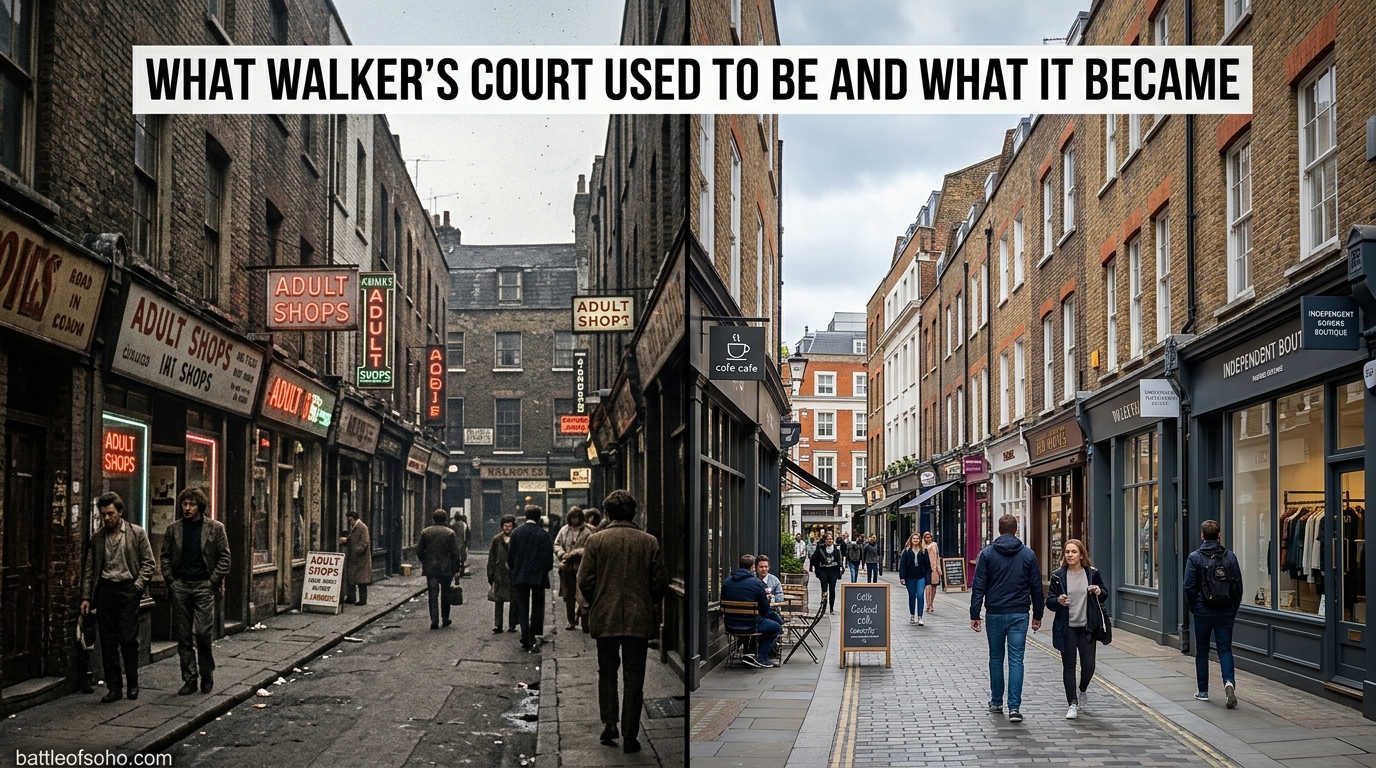
Walker’s Court is a narrow pedestrian alleyway in the heart of London’s Soho that dates back to the early 1700s. Originally a respectable shopping lane lined with small family-run businesses, it transformed in the late 1950s into the infamous epicentre of Soho’s sex trade, earning the nickname “Sex Alley,” before being redeveloped in the 2010s into a modern entertainment destination.
Few streets in London capture the full arc of a neighbourhood’s identity quite like this one. In just over three centuries, it went from a quiet residential cut-through to the most notorious strip of pavement in Soho’s red light district, and then to a polished nightlife hub hosting cabaret, theatre, and live music.
If you have walked down Berwick Street past the market stalls and turned toward Brewer Street, you have probably passed through it without realising the weight of what happened there. Our team has spent months tracing the history of this alley through archival maps, firsthand accounts, and the voices of Londoners who remember it when it was a very different place.
This article traces what Walker’s Court used to be and what it became, from its early 18th-century origins through the Raymond Revuebar era, the cleanup campaigns of the 1980s and 1990s, and the redevelopment that reshaped it into what you see in 2026. We will cover the geography, the people, the cultural connections, and the social impact of Soho’s gentrification on the communities that once defined this street.
Table of Contents
Where Is Walker’s Court? Location and Geography
Walker’s Court sits in the City of Westminster, in the London W1 postal district, right in the middle of Soho. It runs roughly north-south, connecting Berwick Street at its northern end to the junction of Brewer Street and Rupert Street at its southern end.
The alley is narrow enough that two people walking in opposite directions need to angle their shoulders. That original 18th-century layout was never widened, even as the surrounding streets were modernised and rebuilt around it. It escaped the Victorian redevelopment that flattened much of Soho in the late 1800s, which is why it still feels like a passageway from another century.
A distinctive private bridgeway crosses overhead at first-floor level, connecting the two sides of the alley. This bridge was once part of the Raymond Revuebar complex and is one of the most photographed architectural features in modern Soho. Walk through today and you will see it above you, a reminder of the building’s past life.
The alley is less than a five-minute walk from Piccadilly Circus tube station and sits just south of Berwick Street Market. Peter Street meets the western side near the Brewer Street end. Everything about its geography made it a natural artery for Soho: hidden enough to feel discreet, central enough to attract foot traffic.
That geography is the key to understanding its whole story. A narrow, hard-to-police alley between two busy commercial streets was the perfect setting for both the small shops of the 1800s and the adult entertainment venues of the 1960s.
The Early Years: What Walker’s Court Used to Be in the 1700s and 1800s
Walker’s Court was laid out in the early 1700s as Soho transitioned from rural open fields to a built-up London neighbourhood. The land was part of the wider development of the Soho area, which accelerated after the expansion of the West End during the Georgian period.
The passage was most likely named after a local landowner or developer with the surname Walker, though the precise individual remains a matter of historical debate. What is clear from building lease records is that the name appears in property documents from at least the mid-18th century, confirming its establishment as a named thoroughfare during Soho’s first wave of urban development.
In its earliest decades, Walker’s Court was a respectable place. It was lined with small shops and dwellings catering to the growing middle-class population of Soho, which at the time was a fashionable residential district rather than the entertainment quarter it would become. The alley had a practical purpose: it gave residents and tradespeople a convenient cut-through between the major streets on either side.
Richard Horwood’s landmark map of London, published in sections between 1799 and 1819, shows Walker’s Court clearly marked. Horwood’s map is one of the most detailed pre-Ordnance Survey records of London’s street plan, and it confirms that the alley’s narrow footprint has remained essentially unchanged for over 200 years. The layout you walk through today is the same one Georgian Londoners used.
The Small Shops That Once Lined the Alley
Before the sex trade arrived, Walker’s Court was home to an eclectic mix of small businesses. These were the kind of family-run shops that characterised pre-war Soho: food sellers, tradespeople, and specialist retailers serving the local residential community.
One of the most colourful was Isow’s Kosher Restaurant, which served the Jewish community that was a significant part of Soho’s population in the late 19th and early 20th centuries. Soho had a substantial Eastern European Jewish immigrant population, and kosher eateries, bakeries, and delicatessens were common in the streets around Berwick Street and Brewer Street.
There was also an eel pie shop, a fixture of working-class London life. Eel pies were a staple of Victorian and Edwardian London diets, and shops selling them dotted the streets of the West End. These businesses gave Walker’s Court the character of a busy, working market alley rather than anything associated with vice.
The transition from these ordinary small shops to adult entertainment venues happened gradually. As Soho’s residential population shifted and the area became more commercialised in the early 20th century, the traditional retailers closed one by one. The spaces they left behind would soon be filled by something very different.
The 1873 Redevelopment Plans That Almost Destroyed It
Walker’s Court nearly did not survive the 19th century at all. In 1873, a major redevelopment scheme was proposed that would have seen the alley widened and modernised along with large sections of surrounding Soho. The plan called for the demolition of the existing narrow buildings and their replacement with wider, more uniform commercial premises in line with Victorian ideas of urban improvement.
The scheme fell through, partly due to cost and partly because of the complexity of the many individual building leases that governed ownership in the area. Soho’s property structure, divided among numerous freeholders and leaseholders, made large-scale redevelopment extremely difficult to execute. This legal patchwork is the reason so much of historic Soho survived into the 20th century when other parts of central London were comprehensively rebuilt.
The failure of the 1873 plan is the reason Walker’s Court retains its original narrow layout today. Had it gone ahead, the alley would have been absorbed into the wider street grid and its distinctive character would have been lost forever. Sometimes bureaucratic inertia is the best preservation tool there is.
The Raymond Revuebar Era: How Walker’s Court Became Sex Alley
The transformation of Walker’s Court into the centre of Soho’s sex trade began in the late 1950s, and one man was responsible more than any other: Paul Raymond. Born Geoffrey Anthony Quinn in 1925, Raymond was a showman and entrepreneur who would become known as the “King of Soho” for his dominance of the area’s adult entertainment industry.
In 1958, Raymond opened the Raymond Revuebar in Walker’s Court. It was a private members’ club that offered striptease and nude performances, and it was the only venue in London where full-frontal nudity could legally be shown on stage. That exclusivity made it an immediate sensation and a magnet for tourists, celebrities, and curious locals.
Raymond marketed the venue with brass signs declaring it the “World Centre of Erotic Entertainment.” The signage, mounted on the building’s facade along the alley, became one of the most recognisable landmarks in Soho. For decades, those brass letters were what people pictured when they thought of Walker’s Court.
The Revuebar occupied the building that straddled the alley, with the famous bridgeway at first-floor level connecting the two sides. This bridge, part of the structure known as Maurice House, became an iconic visual feature. Walking underneath it at night in the 1960s or 1970s meant walking through the literal and figurative gateway to Soho’s sex district.
Inside the Raymond Revuebar
The Revuebar was not just a strip club. It was a full-scale entertainment venue with a theatre, a bar, and a reputation that drew visitors from around the world. Raymond staged elaborate nude tableaux and themed shows that were as much about theatrical spectacle as they were about titillation. The quality of production was high enough that the venue attracted serious showbusiness attention.
One quirky detail that long-time Soho watchers remember: the Revuebar window once featured a carousel horse on display. It was the kind of eccentric touch that made Paul Raymond’s empire feel like a carnival rather than a purely commercial operation. That horse became a small piece of Soho folklore.
The venue operated continuously from 1958 until 2004, an extraordinary 46-year run. During that time it weathered changing obscenity laws, police raids, licensing reviews, and shifting public attitudes. Its longevity is a testament to Raymond’s political connections and business acumen as much as to the demand for what it offered.
What Were Soho Walk-Ups?
The Raymond Revuebar was the headline attraction, but it was far from the only adult business in Walker’s Court. The alley and the streets around it were lined with sex shops, adult cinemas, peep show booths, and the famous Soho walk-ups.
Soho walk-ups were flats in first-floor and second-floor premises above shops where sex workers operated. They were called “walk-ups” because clients literally walked up a narrow staircase from the street to a door, typically marked with a simple sign or a doorbell. A woman would open the door, negotiate a price, and provide services inside the flat.
The walk-up system was a defining feature of Soho’s sex trade from the 1960s through the early 2000s. Walker’s Court and the immediately surrounding streets had a concentration of them. The blue-lit doorways and small signs on first-floor windows were part of the visual landscape of the alley for decades.
This is what earned Walker’s Court its enduring nickname: Sex Alley. It was the most concentrated strip of adult entertainment in a neighbourhood already famous for it. You did not need to look hard to find what was on offer. It was right there, at eye level, in every doorway.
What Walker’s Court Was Actually Like in the 1960s and 1970s
Forum accounts from people who worked in Soho during this era paint a vivid picture of what Walker’s Court was like at its peak as a red light district. One former Barclays Bank employee who worked on Wardour Street from 1974 to 1978 describes the alley as unmistakably “Sex Alley,” with active prostitution, adult shops on both sides, and a constant stream of men walking through at all hours.
A Reddit user whose family friends owned a flat just off Carnaby Street in the early 1980s recalls the area as “rough and seedy” in a way that is hard to imagine today. The atmosphere was one of open transaction: the sex trade was not hidden or apologetic, it was the primary business of the street.
Another reader who worked at St Anne’s Court between 1966 and 1968 remembers a specific sensory detail: “a sort of stale curry smell in those narrow Courts.” That mix of food, sweat, and stale air is the kind of detail that archival records never capture but that people who were there carry with them forever.
A reader from Canada recalls visiting Soho as a young woman and seeing “all the action” on open display. The alley was a place where boundaries were pushed and social norms were suspended. For some it was exciting, for others threatening, but no one walked through it without forming a strong impression.
One reader shared that their great nephew ran a shop in Soho selling pornographic magazines and was raided by police and heavily fined. This was the reality of the trade: it existed in a grey area of legality, tolerated at times and cracked down on at others, depending on the political winds.
The famous reader comment that captures the era most succinctly: “Spent many many many nights in the sex shops of Soho. It’s pretty vanilla these days.” That contrast between what was and what is lies at the heart of the Walker’s Court story.
The Beatles, Oasis, and Cultural Connections
Walker’s Court and its immediate surroundings have surprising connections to some of the biggest names in British music and culture. These links are barely mentioned by most sources, but they add a rich cultural layer to the alley’s history.
The Beatles and the 1963 Rupert Court Photoshoot
In 1963, The Beatles posed for a photographs session at Rupert Court, which sits at the southern end of Walker’s Court where it meets Rupert Street. The band was on the cusp of global fame, and the Soho location was chosen for its gritty urban backdrop. The images from that shoot capture the raw energy of the era: four young men in a narrow Soho alley, just months before they would become the biggest band in the world.
The Beatles connection places Walker’s Court at a specific cultural moment. In 1963, the alley was already a fully established part of Soho’s sex trade, but it was also embedded in the broader cultural explosion of 1960s London. The same streets that hosted strip clubs and walk-ups also hosted photographers, musicians, artists, and writers who were drawn to Soho’s energy and its refusal to conform.
Berwick Street and the Oasis Connection
Just steps from the northern end of Walker’s Court, Berwick Street gained its own piece of music history in 1995 when it was used as the location for the cover of Oasis’s second album, (What’s the Story) Morning Glory? The album cover photo was taken looking south down Berwick Street, and the market stalls and shopfronts in the image are visible from the entrance to Walker’s Court.
This means that one of the best-selling albums in British history was photographed within a few yards of the alley. The connection ties Walker’s Court to the Britpop era of the 1990s, when Soho was transitioning from its sleazy past toward something more commercially polished but still culturally vital.
Madame Jojo’s and Soho Showbiz
Madame Jojo’s, the famous cabaret and nightclub venue on Walker’s Court, was another cultural landmark. Originally opened in the 1960s as a venue tied to the Raymond empire, it evolved into one of London’s most beloved nightlife spots, hosting cabaret, drag shows, and club nights for decades. The venue’s glass-fronted facade was a fixture of the alley’s streetscape.
Madame Jojo’s had its licence revoked in 2014 following a violent incident, and it closed permanently. Its loss was felt deeply by London’s nightlife and cabaret communities. The building was later incorporated into the broader redevelopment of Walker’s Court, and the space it occupied became part of the new entertainment venues that line the alley today.
The actress Jessie Matthews, one of the biggest stars of British stage and screen in the 1920s and 1930s, also has connections to the Soho area surrounding Walker’s Court. Soho’s history as an entertainment district predates the sex trade by decades, and the legacy of music hall, theatre, and cabaret runs deep in these streets.
The Decline: When Soho Started Cleaning Up
The sex trade that defined Walker’s Court for nearly half a century did not disappear overnight. Its decline was the result of sustained political pressure, changing social attitudes, technological shifts, and aggressive law enforcement that unfolded over decades.
The Soho Society and Community Pushback
The Soho Society was formed in 1972 by residents and business owners who were frustrated by the dominance of the sex industry in their neighbourhood. The organisation became a powerful lobbying force, pressing Westminster Council and the Metropolitan Police to take action against the proliferation of sex shops, walk-ups, and adult venues in Soho.
No existing competitor article covers the Soho Society in any depth, which is a significant gap. The Society’s campaigns were instrumental in shifting the political climate around Soho’s sex trade. They argued that the concentration of adult businesses was damaging the quality of life for residents and squeezing out legitimate commercial activity.
The Society’s approach was methodical: they documented nuisance issues, filed complaints about licensing applications, and built relationships with council planners and police commanders. Over time, this steady pressure contributed to a policy environment that was increasingly hostile to the sex trade that had flourished unchecked in the 1960s and 1970s.
Westminster Council Crackdowns
Westminster Council launched a series of crackdowns on Soho’s sex industry beginning in the 1980s and intensifying through the 1990s and early 2000s. These operations targeted unlicensed sex shops, illegal walk-up flats, and venues operating outside their licensing terms. Police raids became a regular occurrence in the streets around Walker’s Court.
The council used licensing law as its primary weapon. By tightening the rules on what constituted a legitimate adult entertainment venue and how many could operate in a given area, they gradually reduced the number of sex-related businesses in Soho. Venues that could not meet the new requirements were forced to close.
At the same time, the rise of the internet in the late 1990s and early 2000s fundamentally changed the economics of the sex trade. The walk-up model, which relied on foot traffic and street-level visibility, was undercut by online platforms that offered anonymity and reach without the need for a physical Soho premises. Demand for the alley’s traditional offerings declined as alternatives moved online.
The Closure of the Raymond Revuebar
The end of the era came in 2004, when the Raymond Revuebar closed its doors after 46 years. Paul Raymond had died in March 2004 at the age of 78, and his property empire, managed through Soho Estates, began a process of strategic shift. The buildings he owned in and around Walker’s Court were gradually repurposed for new uses.
The closure of the Revuebar removed the anchor of the alley’s adult entertainment identity. Without its most famous venue, Walker’s Court lost the gravitational pull that had drawn visitors to the sex trade for nearly five decades. The brass “World Centre of Erotic Entertainment” signs came down, and a chapter of London history ended.
The Social Impact of the Cleanup
The cleaning up of Walker’s Court and Soho more broadly had real human consequences that are often glossed over. Sex workers who had operated in the walk-ups and nearby flats were displaced. Some moved to other areas, some moved online, and some left the industry altogether. The community that had existed around the trade was fragmented.
Forum discussions reveal a genuine sadness among many Londoners about what was lost. Residents express frustration that sex workers were displaced rather than protected, pushed out of relatively safe and familiar premises into less visible and potentially more dangerous situations. The cleanup solved a set of problems for residents and council officials while creating a different set of problems for the workers themselves.
There is also a broader cultural loss that longtime Londoners feel acutely. The raw, unfiltered, anything-goes character of old Soho is gone. In its place is a cleaner, safer, more commercial version of the neighbourhood. Whether that is progress or erasure depends very much on who you ask.
Walker’s Court Then vs Now: A Comparison
To understand what Walker’s Court used to be and what it became, it helps to place the two eras side by side. The transformation is not just about which businesses occupied the buildings. It is about the entire character, atmosphere, and social function of the alley.
In the 1960s, the alley was dominated by the sex trade. The Raymond Revuebar sat at its centre, flanked by sex shops, adult cinemas, and walk-up flats. The atmosphere was raw, transactional, and unapologetically adult. Visitors came specifically for what the alley offered, and the street had an international reputation as the heart of London’s red light district.
In 2026, the alley is home to The Box Soho, a high-end cabaret and nightclub venue known for its provocative performances. Underbelly Boulevard, a theatre and live entertainment venue, occupies space along the passage. A handful of adult retail shops remain, but they are vestiges rather than the main attraction. The atmosphere is polished, curated, and designed for a different kind of night out.
Then, the alley was a place where social norms were suspended and boundaries were tested. Now, it is a managed entertainment destination where the edginess is part of a carefully constructed brand experience. The Bridgeway overhead remains, but the brass signs are gone.
Then, Walker’s Court was a place you might warn a friend about. Now, it is a place you might recommend for drinks and a show. That shift, in a single sentence, captures what Walker’s Court used to be and what it became.
What Walker’s Court Became: The Modern Transformation
The physical transformation of Walker’s Court was driven by Soho Estates, the property company that inherited Paul Raymond’s extensive Soho property portfolio. After Raymond’s death in 2004, the company began a long-term strategy of redeveloping its holdings, including the buildings along Walker’s Court, for modern entertainment and hospitality uses.
The most significant redevelopment project was the Walker’s Court scheme, a major refurbishment completed in phases between 2015 and 2019. The project involved the restoration of the historic alleyway, the creation of new entertainment spaces, and the installation of the Boulevard Theatre, a unique venue with a revolving auditorium that can be reconfigured for different performance types.
The Box Soho
The Box Soho is perhaps the most direct spiritual successor to the Raymond Revuebar. It is a cabaret and nightclub venue known for its provocative, boundary-pushing performances that blend burlesque, sideshow acts, and theatrical spectacle. Opening in the redeveloped Walker’s Court, it caters to a wealthy, celebrity-heavy clientele and has become one of London’s most exclusive nightlife destinations.
The Box maintains a link to the alley’s adult entertainment past, but in a thoroughly modernised form. Where the Revuebar was accessible to anyone willing to pay for membership, The Box is a high-price, invitation-influenced venue that curates its audience. The performance style is more elaborate and theatrical, but the underlying appeal of transgressive entertainment remains.
Underbelly Boulevard and the Boulevard Theatre
Underbelly Boulevard is a theatre and live entertainment venue that occupies space along Walker’s Court. It is part of the Underbelly brand, known for its venues at the Edinburgh Festival Fringe and on London’s South Bank. The venue brings cabaret, comedy, and live music to the alley, adding to its new identity as an entertainment destination rather than a red light district.
The Boulevard Theatre, with its innovative revolving auditorium, represents the architectural ambition of the redevelopment. The rotating design allows the performance space to be reconfigured for different show formats, from intimate cabaret to larger theatrical productions. It is the kind of venue that would have been unimaginable in the Walker’s Court of the 1970s.
The Penthouse Club Controversy
Not everyone agrees that Walker’s Court has moved on from its sex trade past. In 2026, a planning dispute emerged over The Penthouse Club, a proposed underground strip club in the Walker’s Court area. The controversy highlighted the tension between those who see the alley’s adult entertainment history as something to be left behind and those who see it as a legitimate part of Soho’s identity.
Opponents argued that a new strip club would be a backward step, undoing decades of progress in cleaning up Soho and reviving the very problems the community had worked to address. Supporters countered that adult entertainment has always been part of Soho’s character and that venues operating within proper licensing frameworks are preferable to the unregulated trade of the past.
What Walker’s Court Looks Like in 2026
Walk through Walker’s Court today and you will see a narrow alley that retains its historic footprint but has been comprehensively spruced up. The building facades are cleaned and restored. The bridgeway overhead remains as an architectural feature. The sex shops that survive are outnumbered by bars, restaurants, and entertainment venues.
The alley still functions as a cut-through between Berwick Street and Brewer Street, just as it did in the 1700s. But the people walking through it are different. They are heading to a show at Underbelly Boulevard, a night out at The Box, or simply taking a shortcut through one of Soho’s most historically charged streets.
The atmosphere is quieter, cleaner, and more controlled. Some would say it has lost its soul. Others would say it has finally found a sustainable identity after decades of notoriety. The truth, as always, is somewhere in between.
Timeline: Key Events in Walker’s Court History
Here is a chronological summary of the events that shaped what Walker’s Court used to be and what it became:
Early 1700s: Walker’s Court is laid out as Soho develops from rural fields into a residential London neighbourhood. Named after a local landowner or developer called Walker.
1799-1819: Richard Horwood’s map of London confirms the alley’s narrow layout, which remains unchanged to this day.
1873: A major redevelopment scheme proposes widening and modernising Walker’s Court. The plan falls through due to cost and complex leasehold structures, preserving the alley’s historic character.
Early 20th century: Traditional small shops including Isow’s Kosher Restaurant and an eel pie shop line the alley. The area is still primarily commercial rather than associated with vice.
1958: Paul Raymond opens the Raymond Revuebar in Walker’s Court, the only London venue offering full-frontal nudity on stage. The transformation to Sex Alley begins.
1963: The Beatles pose for a photoshoot at Rupert Court, the southern end of Walker’s Court, months before achieving global fame.
1960s-1970s: The alley reaches its peak as the heart of Soho’s sex trade. Walk-up flats, sex shops, adult cinemas, and peep shows line the passage. The nickname “Sex Alley” becomes firmly established.
1972: The Soho Society is formed by residents and business owners to campaign against the dominance of the sex industry in Soho.
1980s-1990s: Westminster Council launches sustained crackdowns on unlicensed sex venues. Licensing laws are tightened, reducing the number of adult businesses in the area.
1995: Oasis photographs the cover of (What’s the Story) Morning Glory? on Berwick Street, steps from the northern entrance to Walker’s Court.
2004: Paul Raymond dies in March. The Raymond Revuebar closes after 46 years, ending the era of large-scale adult entertainment in the alley.
2014: Madame Jojo’s, the iconic cabaret venue on Walker’s Court, loses its licence and closes permanently following a violent incident.
2015-2019: Soho Estates undertakes a major redevelopment of Walker’s Court, including the creation of the Boulevard Theatre with its revolving auditorium and new entertainment spaces.
2026: Walker’s Court operates as a modern entertainment destination housing The Box Soho, Underbelly Boulevard, and a handful of remaining adult shops. A planning controversy over The Penthouse Club reignites debate about the alley’s identity.
FAQs
What is the history of Walker’s Court, Soho?
Walker’s Court is a narrow pedestrian alleyway in Soho, London, dating back to the early 1700s. Originally lined with small shops and residential dwellings, it became associated with Soho’s sex trade from the late 1950s when Paul Raymond opened the Raymond Revuebar there in 1958. The alley served as the heart of London’s red light district for decades before being redeveloped into a modern entertainment destination between 2015 and 2019.
What’s special about Walker’s Court in Soho?
Walker’s Court is special because it encapsulates the entire history of Soho’s transformation in a single street. It retains its original narrow 18th-century layout, features a distinctive overhead bridgeway from the Raymond Revuebar era, and was once the most concentrated strip of adult entertainment in London, earning the nickname Sex Alley. Today it houses The Box Soho and Underbelly Boulevard, making it a living record of Soho’s journey from respectable shopping lane to notorious red light district to modern entertainment hub.
Is Soho in London still a red light district?
Soho is no longer a functioning red light district in 2026. The sex shops and walk-up flats that once dominated the area have been drastically reduced through Westminster Council licensing crackdowns, the closure of the Raymond Revuebar in 2004, and the rise of online alternatives. A small number of licensed adult shops remain in and around Walker’s Court, but the large-scale sex trade that defined Soho from the 1950s through the early 2000s has effectively been eliminated.
Why is Soho London so famous?
Soho is famous for its long history as London’s centre of entertainment, nightlife, and counter-culture. From the music halls of the early 20th century through the sex trade era of the 1960s and 1970s, to its current status as a hub for media, dining, and nightlife, Soho has always been the part of London where conventions were challenged and new cultural movements took root. Walker’s Court, with its Raymond Revuebar and Sex Alley reputation, was one of the key locations that gave Soho its notoriety.
Is Soho still seedy?
Soho in 2026 is far less seedy than it was in its 1960s and 1970s heyday. Gentrification, licensing enforcement, and property redevelopment have transformed the area into a cleaner, more commercially polished district. Walker’s Court itself now hosts high-end venues like The Box Soho and Underbelly Boulevard rather than walk-up flats and peep shows. However, some longtime Londoners argue that the area has lost the raw, distinctive character that once made it unique, replacing genuine edge with a curated version of naughtiness.
What Walker’s Court Used to Be and What It Became: A Summary
Walker’s Court began life in the early 1700s as a modest shopping alley connecting Berwick Street to Brewer Street in the heart of Soho. For its first two centuries, it was an ordinary London passageway serving residents and small tradespeople with kosher restaurants, eel pie shops, and family-run businesses.
In 1958, Paul Raymond opened the Raymond Revuebar and everything changed. For nearly five decades, Walker’s Court was Sex Alley, the undisputed centre of London’s red light district. The alley’s narrow 18th-century layout, once home to grocers and bakers, became the setting for strip clubs, sex shops, walk-up flats, and peep shows that drew visitors from around the world.
Today, Walker’s Court is a redeveloped entertainment destination. The Box Soho, Underbelly Boulevard, and the Boulevard Theatre have replaced the Revuebar and the walk-ups. The bridgeway overhead remains, but the brass “World Centre of Erotic Entertainment” signs are long gone. A few adult shops survive as the last echoes of a previous life.
What has been lost is the raw, unfiltered character of old Soho, the kind of place where a former Barclays employee could walk through in 1974 and know instantly he was in Sex Alley. What has been gained is a cleaner, safer, more sustainable streetscape that still trades on the alley’s notoriety but in a polished, curated form.
The story of what Walker’s Court used to be and what it became is the story of Soho itself. It is a story about respectability, notoriety, commerce, sex, music, community politics, and the relentless pressure of property development on a neighbourhood that has always refused to stand still. The alley is still there, narrow as ever. But the world around it, and the world that once existed inside it, has changed completely.