
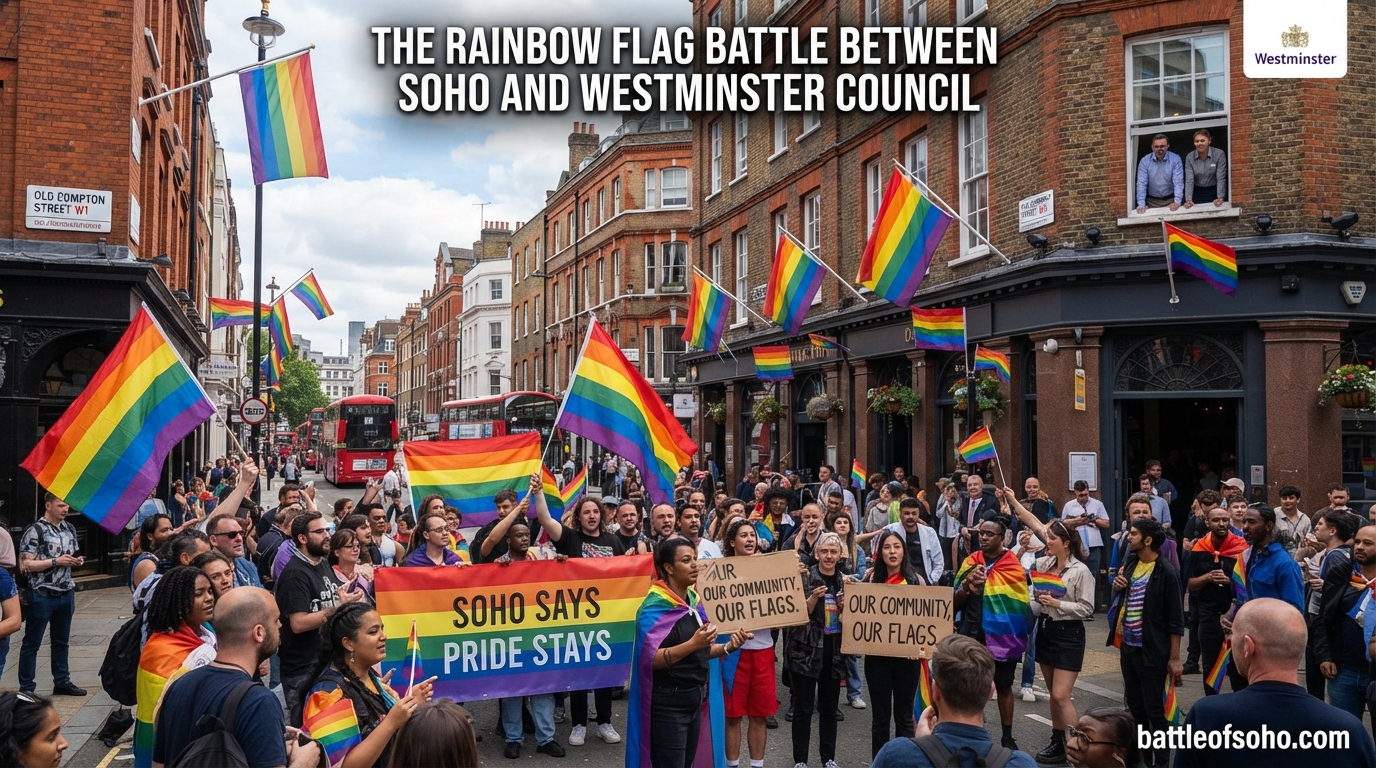
Every June, more than 300 Progress Pride flags line Regent Street in central London, transforming one of the city’s most famous shopping thoroughfares into a sweeping canopy of colour. But behind the vibrant display lies a years-long political fight that has drawn in campaign groups, lawyers, councillors, and thousands of petitioners. The rainbow flag battle between Soho and Westminster Council is not a single event but an ongoing story stretching back over two decades.
This article traces the full arc of that dispute, from the 2005 ban on rainbow flags in Soho through to the 2026 legal threats from Christian Concern over Progress Pride flags on Regent Street. I have dug through council records, news reports, community forums, and legal filings to build a unified picture no single source has assembled before.
Whether you live in Soho, care about LGBTQ+ rights, follow local government politics, or simply want to understand what all the fuss is about, this guide breaks down every angle. We will cover the history, the key players, the legal arguments, the flag symbolism, and what comes next.
Table of Contents
Quick Overview: What Is the Rainbow Flag Battle Between Soho and Westminster Council?
The rainbow flag battle between Soho and Westminster Council refers to two connected conflicts separated by twenty years. In 2005, Westminster Council banned businesses in Soho from flying rainbow flags, only to reverse the decision months later after public backlash. In 2026, the same council now faces legal threats from Christian Concern for flying over 300 Progress Pride flags along Regent Street, with critics arguing the display breaches planning regulations and promotes ideological “indoctrination.” The council defends the flags as a fitting celebration for a cosmopolitan city.
The 2026 Dispute: Progress Pride Flags on Regent Street
Westminster City Council, in partnership with the Crown Estate, installs the Progress Pride flag display along Regent Street each year for Pride Month. The flags run from Piccadilly Circus northward past landmarks like Hamleys, creating one of the most photographed Pride installations in the world. The display typically runs from late June through mid-July, though critics have accused the council of leaving flags up beyond the approved planning window.
The specific flag used is the Intersex Progress Pride flag, a variant that adds a purple-and-yellow circle to the chevron design. This detail matters because it is not the traditional six-stripe rainbow flag that flew over Soho in the early 2000s. It is a newer, more politically charged design that explicitly includes trans and intersex communities.
Christian Concern and its legal arm, the Christian Legal Centre, have described the display as evidence that Westminster Council has earned the nickname “Wokeminster.” The groups accuse the council of replacing Union Jacks with Pride flags in some locations and argue the display goes far beyond what a local authority should endorse.
Reddit users in communities like r/london and r/transgenderUK have tracked the display closely. Some noted with disappointment that flags appeared delayed or reduced in 2025, wondering whether the legal threats had succeeded. Others praised the council for maintaining the installation despite mounting pressure.
Christian Concern’s Legal Threat Explained
Christian Concern, led by chief executive Andrea Williams, has been the most vocal opponent of the Regent Street Pride display. The organisation, through its Christian Legal Centre division, has formally threatened legal action against both Westminster City Council and the Crown Estate. The threat centres on two main arguments.
The first argument is a planning regulation breach. Christian Concern claims the council has displayed flags beyond the time period permitted under its own planning orders, effectively using a temporary display framework to make a permanent political statement. They argue this circumvents proper public consultation and planning oversight.
The second argument is ideological. Andrea Williams has called the Progress Pride flag a “secular religious ideology” that promotes trans-inclusive beliefs conflicting with Christian teaching. She has pointed to the Cass Review, the independent review of gender identity services for children led by Dr Hilary Cass, as evidence that the scientific basis for trans-inclusive messaging is under serious question. The Cass Review led to the closure of the Tavistock Gender Identity Development Service, and Christian Concern argues the council is ignoring these developments.
Christian Concern also references the 2024 Supreme Court ruling on the legal definition of “sex” under the Equality Act as further evidence that the landscape has shifted against the council’s position. A 31,000-signature petition from 2024 opposing the Pride flag display has been cited as proof of substantial public support for their stance.
The Christian Legal Centre has warned that if the flags go up again, it will pursue judicial review. That would mean asking a court to determine whether the council acted unlawfully in approving or maintaining the display.
Westminster Council’s Defense
Westminster City Council has consistently defended the Regent Street Pride display. Lord Mayor Paul Dimoldenberg has personally raised the Pride flag outside City Hall to mark the start of Pride Month, calling the display a celebration of the city’s diversity. The council frames the flags as a proportionate and fitting tribute in one of the world’s most cosmopolitan areas.
Council chief executive Stuart Love has been equally unapologetic. In an interview with Management Today, Love openly embraced the concept of “wokeness,” arguing that being attentive to social justice is a positive quality for public servants. Critics seized on this interview as evidence the council is driven by ideology rather than duty. Supporters see it as honest leadership.
A council spokesperson has stated that the Pride display follows all necessary planning processes and that the council consults with the Crown Estate as the freeholder of Regent Street. The council points out that Pride flags are one of many themed displays that appear on Regent Street throughout the year, including seasonal decorations and commemorative installations.
For the LGBTQ+ community in Soho and across Westminster, the council’s stance is seen as essential. Forum discussions on Reddit reveal that many residents view the flags not as political messaging but as symbols of safety and belonging. One user in r/UKLGBT wrote that seeing the flags on Regent Street tells them “you exist here, you are safe here.”
What Are Progress Pride Flags and Why Do They Matter?
The Progress Pride flag was designed in 2018 by Daniel Quasar, a non-binary graphic designer. It takes the traditional six-stripe rainbow flag created by Gilbert Baker in 1978 and adds a chevron on the left side. The chevron uses six colours drawn from the Philadelphia Pride flag and the trans pride flag.
The black and brown stripes represent LGBTQ+ people of colour, communities that have historically been marginalised even within LGBTQ+ spaces. The light blue, pink, and white stripes are the colours of the trans pride flag, designed by Monica Helms in 1999. The arrow shape of the chevron points to the right, symbolising forward progress, while its position on the left edge signals the work still ahead.
The Intersex Progress Pride flag, designed by Valentino Vecchietti in 2021, adds a purple circle on a yellow triangle within the chevron. The circle is intentionally unornamented, representing wholeness and completeness, and the yellow and purple colours are intentionally chosen because they do not reinforce traditional binary colour associations. Westminster Council uses this Intersex Progress Pride variant on Regent Street.
The choice of this specific flag is central to the controversy. Critics like Christian Concern argue the flag does not represent the broader LGBTQ+ community but instead promotes a specific trans-inclusive and intersex-inclusive ideology. Supporters argue it reflects the evolving understanding of inclusivity within the community itself.
The original rainbow flag designed by Gilbert Baker in 1978 originally had eight stripes, each with an assigned meaning. Pink stood for sexuality, red for life, orange for healing, yellow for sunlight, green for nature, turquoise for magic and art, indigo for serenity, and violet for spirit. The pink stripe was dropped because hot pink fabric was expensive and hard to source in 1978. Turquoise and indigo were later combined into a standard blue stripe for manufacturing simplicity, producing the now-familiar six-stripe flag.
The 2005 Soho Rainbow Flag Ban and U-Turn
Before the Progress Pride flag existed, the dispute was about the traditional rainbow flag. In early 2005, Westminster City Council refused planning permission for businesses in Soho to fly rainbow flags above their premises. The council, then led by Conservative councillor Simon Milton, cited “visual clutter” as the reason.
The ban affected some of Soho’s most iconic gay venues. The Prowler shop on Brewer Street was ordered to remove its flag. The Admiral Duncan pub, the site of a devastating nail bomb attack by a neo-Nazi in 1999 that killed three people, was also told to take down its flag. For the community, ordering a bombing survivor’s pub to remove its rainbow flag felt like an act of erasure.
The council’s planning committee rejected the flag applications despite officers recommending approval. Councillor David Boothroyd publicly criticised the decision, calling it petty and mean-spirited. The charity Kairos Soho, which supported LGBTQ+ youth, condemned the ban as homophobic.
Then-London Mayor Ken Livingstone weighed in forcefully. He called the council’s actions those of “neanderthals” and accused Westminster Conservatives of trying to sanitise Soho’s identity. Stonewall, the LGBTQ+ rights charity, joined the chorus of opposition. Andy Forrest, a Stonewall spokesperson, said the flags were a vital signal of acceptance in an area where the community had fought hard for visibility.
The backlash was immediate and intense. National newspapers covered the story. Businesses threatened legal action. Community groups organised protests. Within months, by November 2005, Westminster Council performed a complete U-turn. The council announced it would grant retrospective planning permission for existing flags and would review its flag policy. The reversal was seen as a total capitulation to public pressure.
That 2005 reversal created an institutional memory within Westminster Council. The council learned that opposing rainbow flags in Soho carried enormous political cost. Two decades later, the same council is now one of the most proactive in Britain when it comes to Pride displays, flying over 300 flags along a mile of Regent Street.
Timeline: The Rainbow Flag Battle Between Soho and Westminster Council (2005-2026)
The following timeline traces the full arc of the dispute from the original Soho ban to the current legal threats:
2005 (June): Westminster Council bans businesses in Soho from flying rainbow flags, citing “visual clutter.” The Prowler shop and Admiral Duncan pub are ordered to remove their flags.
2005 (November): After intense public backlash, including condemnation from Ken Livingstone and Stonewall, Westminster Council reverses the ban and grants planning permission for the flags.
2018: Daniel Quasar designs the Progress Pride flag, adding a trans-inclusive chevron to the traditional rainbow flag.
2021: Valentino Vecchietti creates the Intersex Progress Pride flag, adding the intersex circle to Quasar’s design.
2022: Christian Concern lobbies the Church of England to oppose Pride flag displays on public buildings, laying groundwork for future legal challenges.
2024 (May): The Telegraph reports criticism of Westminster Council’s trans-inclusive Pride flags on Regent Street. The “Wokeminster” nickname gains traction. A petition opposing the display reaches 31,000 signatures.
2024: Council chief executive Stuart Love publicly embraces “wokeness” in a Management Today interview, further inflaming critics.
2025 (June 1): Lord Mayor Paul Dimoldenberg raises the Pride flag at City Hall to mark the start of Pride Month.
2025 (June 16): PinkNews reports that Christian Concern and the Christian Legal Centre have threatened legal action against the council and the Crown Estate over the Regent Street display.
2025 (June 22 – July 17): The Progress Pride flags are displayed along Regent Street despite the legal threats.
2026: The dispute continues, with both sides maintaining their positions. Christian Concern has indicated it will pursue judicial review if the display continues.
The Broader UK Context: Council Flag Disputes Nationwide
The Westminster dispute does not exist in isolation. Across the UK, local councils are caught in similar battles over which flags to fly and when. Reddit discussions in r/AskBrits and r/unitedkingdom have highlighted how Sunderland Council took an anti-Pride-flag stance, putting it in direct contrast with Westminster’s pro-flag position. This national divide shows how flag displays have become a proxy war for deeper cultural disagreements.
Other councils have faced pressure over flying the Pride flag from town halls, with some Conservative-led authorities declining to do so. The Idaho Trust, which promotes traditional family values, has been active in opposing Pride displays in several boroughs. Meanwhile, councils like Lambeth, Camden, and Islington have expanded their Pride flag programs.
What makes Westminster unique is the scale of the Regent Street display and the direct legal threat from a well-funded campaign group. Most council flag disputes stay in the realm of public meetings and petitions. The Westminster case could set a legal precedent that affects every council in the country.
Internationally, the pattern is even more pronounced. In the United States, several states have passed or proposed legislation restricting the display of Pride flags on government property. The forum discussions show that UK observers are watching the American debates closely, concerned that similar legislation could eventually cross the Atlantic.
What the Legal Challenge Could Mean for Pride Displays
If Christian Concern follows through on its threat of judicial review, the case would ask a judge to determine whether Westminster Council acted lawfully in approving the Regent Street display. This is not a criminal matter but an administrative law challenge. The court would examine whether the council followed proper planning procedures, whether it consulted adequately, and whether it acted within its statutory powers.
A ruling against the council could force it to remove the flags or apply for fresh planning permission with full public consultation. More significantly, it could set a precedent that other campaign groups use to challenge Pride displays in other boroughs. Councils across the country would need to review their flag policies.
A ruling in the council’s favour would vindicate its approach and likely encourage other authorities to expand their own Pride displays. It would also weaken the legal argument that Progress Pride flags constitute ideological promotion rather than celebration.
The Cass Review and the 2024 Supreme Court ruling on the definition of sex under the Equality Act add a new dimension that did not exist in 2005. Christian Concern argues these developments undermine the legitimacy of trans-inclusive flag displays. The council and its supporters argue that legislative and clinical reviews do not change the fundamental right of a community to be represented in public space.
Why Soho Matters: London’s Gay Village
Soho has been the beating heart of London’s LGBTQ+ community since the mid-twentieth century. The area around Old Compton Street became a focal point for gay bars, clubs, shops, and community spaces in the decades following the partial decriminalisation of homosexuality in England and Wales in 1967. By the 1990s, Soho was internationally recognised as one of the world’s premier gay villages, comparable to the Castro in San Francisco or Le Marais in Paris.
The 1999 Admiral Duncan nail bomb attack was a defining moment. A neo-Nazi planted a device in the pub on Old Compton Street, killing three people including a pregnant woman. The attack was part of a series of bombings targeting Black, Asian, and Bangladeshi communities in London. For the LGBTQ+ community, it reinforced why visible symbols of identity matter. The rainbow flag over the Admiral Duncan was not decoration. It was defiance.
This is why the 2005 ban hit so hard. Ordering the Admiral Duncan to remove its flag felt, to many, like telling the community to go back into hiding. And it is why the current Regent Street display matters so much to supporters. The flags are a declaration that LGBTQ+ people belong in the heart of the capital.
Soho’s identity has shifted over the years, with rising rents pushing out some long-standing LGBTQ+ venues. But the area remains a pilgrimage site during Pride Month, and the Regent Street flags are now part of that tradition. Tourists and locals alike photograph the display, and it has become one of the most shared images of London Pride on social media.
The “Wokeminster” Nickname and Its Origins
The term “Wokeminster” emerged as a portmanteau of “woke” and “Westminster,” used by critics to mock the council’s progressive stance. The nickname gained wider attention in May 2024 when The Telegraph used it in a headline criticising the council’s trans-inclusive Pride flag proposals on Regent Street.
The label stuck because it captured a perception that Westminster Council had moved significantly to the left on social issues under its current leadership. Stuart Love’s interview embracing “wokeness” provided ammunition for those who already saw the council as ideologically driven.
Reddit users have noted the irony of a council whose chief executive embraces the term “woke” being challenged by religious groups on the grounds of ideological bias. For supporters, the council’s openness about its values is refreshing honesty. For critics, it is proof that the council has abandoned political neutrality.
The nickname has become a rallying cry for both sides. Critics use it dismissively, while some supporters have begun reclaiming it as a badge of pride. This linguistic battle reflects the deeper cultural fight over what public space should look like and whose identity gets celebrated.
FAQs
What is the rainbow flag battle between Soho and Westminster Council?
The rainbow flag battle refers to two connected conflicts. In 2005, Westminster Council banned Soho businesses from flying rainbow flags, then reversed the decision after public backlash. In 2026, the same council faces legal threats from Christian Concern for displaying over 300 Progress Pride flags on Regent Street, with critics arguing the display breaches planning regulations and promotes ideological indoctrination.
Why did Westminster Council ban rainbow flags in Soho in 2005?
Westminster Council, then led by Conservative councillor Simon Milton, cited visual clutter as the reason for refusing planning permission. Businesses including the Prowler shop and the Admiral Duncan pub were ordered to remove their flags. The decision was reversed within months after intense public backlash, condemnation from Ken Livingstone and Stonewall, and national media coverage.
What is the Progress Pride flag?
The Progress Pride flag was designed by Daniel Quasar in 2018. It adds a chevron to the traditional rainbow flag with black and brown stripes representing LGBTQ+ people of colour and blue, pink, and white stripes representing trans communities. The Intersex Progress Pride variant, designed by Valentino Vecchietti in 2021, adds a purple circle on a yellow triangle to represent intersex people.
Why is Christian Concern threatening to sue Westminster Council?
Christian Concern, through its Christian Legal Centre, argues that the Regent Street Pride flag display breaches planning regulations by exceeding the approved time period and that it promotes a trans-inclusive ideology conflicting with the Cass Review. The group has collected a 31,000-signature petition and threatened judicial review if the display continues.
What does Wokeminster mean?
Wokeminster is a portmanteau of woke and Westminster, coined by critics to mock the council’s progressive stance on social issues. The term gained traction after a May 2024 Telegraph headline and was reinforced when council chief executive Stuart Love publicly embraced the concept of wokeness in an interview.
What did the rainbow flag originally mean?
The original rainbow flag was designed by Gilbert Baker in 1978 with eight coloured stripes. Pink represented sexuality, red for life, orange for healing, yellow for sunlight, green for nature, turquoise for art, indigo for serenity, and violet for spirit. The pink stripe was dropped due to fabric costs, and turquoise and indigo were combined into blue, producing the familiar six-stripe flag.
How does the Cass Review relate to Pride flags?
The Cass Review, led by Dr Hilary Cass, examined gender identity services for children and led to the closure of the Tavistock clinic. Christian Concern cites the review as evidence that the scientific basis for trans-inclusive messaging is under question, arguing that the Progress Pride flag promotes an ideology the review has undermined. Supporters argue clinical reviews do not affect the right to community visibility.
Are Pride flags replacing Union Jacks on Regent Street?
Christian Concern has claimed that Westminster Council replaced Union Jacks with Progress Pride flags in some locations. The council and the Crown Estate have not confirmed this, and the Regent Street display runs alongside other themed decorations throughout the year. The claim has been contested by council supporters who argue the flags are seasonal rather than replacements.
Conclusion
The rainbow flag battle between Soho and Westminster Council has been fought for over twenty years, and it is far from over. What began as a 2005 ban on rainbow flags over gay businesses has evolved into a complex legal and cultural fight over Progress Pride flags on one of London’s most famous streets. The same council that once ordered the Admiral Duncan to remove its flag now flies 300 flags a mile down the road.
The outcome of the current legal threat from Christian Concern could reshape how every council in Britain approaches Pride displays. Whether you see the Regent Street flags as a vital symbol of belonging or an ideological overreach, the stakes are real. Watch for developments on the judicial review front, as any court ruling will set a precedent that extends far beyond Westminster.