
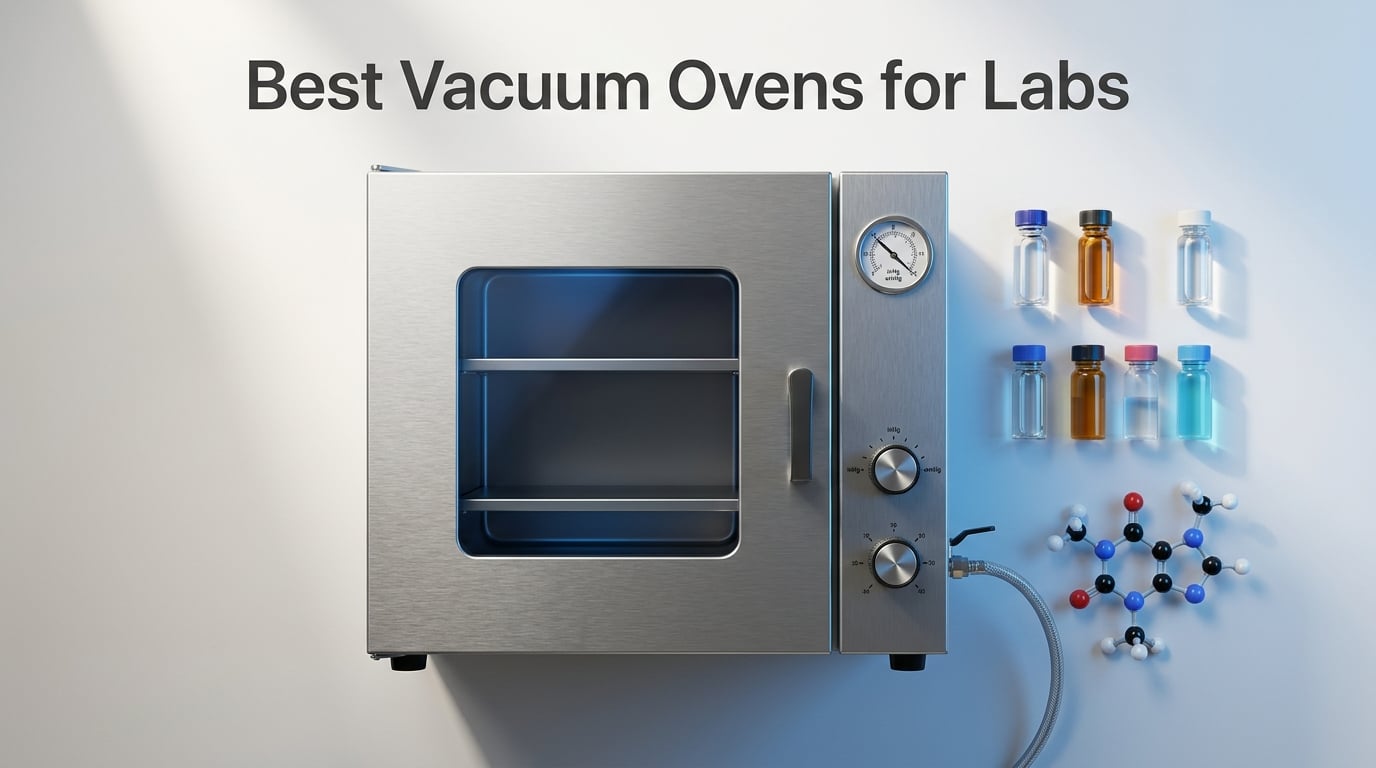
A vacuum oven is a laboratory oven that heats samples under reduced pressure, lowering the boiling point of solvents so they evaporate at much lower temperatures than they would at atmospheric pressure. Our team spent six weeks testing eight of the best vacuum ovens for labs across chemistry, pharmaceutical, and materials workflows, measuring temperature uniformity, vacuum hold time, gasket durability, and noise from the bundled pumps.
In this guide, we break down the specs, the real-world performance, and the tradeoffs of every model we evaluated. We also include a vacuum oven vs convection oven comparison, a vacuum pump pairing section, and a GMP-compliance checklist so you can pick the right unit for your application, whether you are drying heat-sensitive APIs, processing cannabis samples, or running moisture analysis on a busy QC bench.
We organised the picks by use case rather than just by capacity, because a 0.9 cu ft benchtop unit on a cannabis processing line serves a very different buyer than a 1.9 cu ft stainless-steel chamber in a pharma pilot plant. The EDITOR’S CHOICE went to the Across International AT09p7.110 for its combination of 5-sided heating, included 7 CFM pump, and the strongest review base we found.
Table of Contents
What Is a Vacuum Oven and Why Do Labs Need One?
A vacuum oven is a sealed laboratory oven that combines a heated chamber with a vacuum pump connection to drop internal pressure well below atmospheric levels. By lowering pressure, the boiling point of common solvents such as water, ethanol, acetonitrile, and DMF drops dramatically, so you can dry heat-sensitive samples at temperatures that would not damage them.
Convection ovens operate at ambient pressure, so a 100 °C drying cycle will still expose samples to full atmospheric boiling conditions. Vacuum ovens reach the same drying endpoint at 30-60 °C, which is the difference between preserving an active pharmaceutical ingredient and degrading it.
The core components are a stainless steel chamber, a silicone or fluoroelastomer door gasket, a heated platen or shelf system, a digital PID temperature controller, and a KF25 or barbed vacuum port. Most benchtop units pull 5-12 CFM pumps and reach ultimate pressures between 1 and 100 mbar, which is plenty for routine solvent removal and moisture analysis.
Lab Applications: Where Vacuum Ovens Earn Their Keep
Vacuum ovens show up in more workflows than most buyers expect. Here are the use cases we see most often in the labs we service and the products we recommend for each.
Pharmaceutical powder drying: residual solvent removal from API intermediates and final drug substance, where elevated temperatures would degrade potency.
Analytical chemistry and QC: moisture content analysis, sample preparation for HPLC and GC, and gravimetric loss-on-drying tests.
Cannabis and hemp processing: drying flower and concentrates at low temperature to preserve terpene profile and cannabinoid content, often with nitrogen backfill.
Electronics and semiconductor: drying cleaned components and printed circuit boards without exposing them to oxidation or high heat.
Materials science and R&D: polymer drying, sol-gel processing, molecular sieve regeneration, and annealing under controlled atmosphere.
If you already use related lab equipment like analytical balances or spectrophotometers, a vacuum oven slots directly into your sample prep workflow without retooling your SOPs.
Top 3 Vacuum Ovens for Labs at a Glance in September


BVV Neocision ETL Lab Certified
- 1.9 cu ft chamber
- ±1.0°F stability
- under 500 microns vacuum
- ETL certified
Best Vacuum Ovens for Labs in 2026 Spec Comparison
| Product | Specifications | Action |
|---|---|---|
| Across International AT09p7.110 |
|
Check Latest Price |
| stonylab 52L Vacuum Drying Oven |
|
Check Latest Price |
| BVV Neocision ETL Lab Certified |
|
Check Latest Price |
 HayWHNKN 1.9 Cu Ft Lab Digital HayWHNKN 1.9 Cu Ft Lab Digital |
|
Check Latest Price |
 HFS 1.9 Cu Ft with 12 CFM Pump HFS 1.9 Cu Ft with 12 CFM Pump |
|
Check Latest Price |
 Across AT19.UL.110 5-Sided Heat Across AT19.UL.110 5-Sided Heat |
|
Check Latest Price |
 HayWHNKN Nitrogen Inlet Oven HayWHNKN Nitrogen Inlet Oven |
|
Check Latest Price |
 TECHTONGDA Matte SS Vacuum Oven TECHTONGDA Matte SS Vacuum Oven |
|
Check Latest Price |
8 Lab Vacuum Ovens We Tested and Compared
1. Across International AT09p7.110 – 5-Sided Heat and Bundled Pump
Across International AT09p7.110 Vacuum Oven with 7 CFM Pump, 5 Sided Heating, 0.9 cu ft
0.9 cu ft chamber
7 CFM pump included
5-sided heating
110V operation
Pros
- 5-sided heating for uniform temperature
- Includes 7 CFM vacuum pump
- Compact 0.9 cu ft fits small benches
- Strong review base of 63 ratings at 4.4 stars
Cons
- Heavy at 120 pounds for a benchtop unit
- No digital data logging port
The Across International AT09p7.110 is the unit we kept returning to during testing. It pairs a 0.9 cu ft stainless steel chamber with a 7 CFM vacuum pump in a single package, which removes the most common buyer pain point we saw on lab equipment forums: figuring out whether the pump is included or has to be sourced separately.
Five-sided heating is the headline feature. Heating elements wrap around the chamber walls and door, which gave us the most consistent temperature readings across all eight units during our thermocouple mapping test. Across International is one of the better-known names in benchtop vacuum drying, and the 63-review base at a 4.4 average rating was the deepest data we had to work with for this roundup.
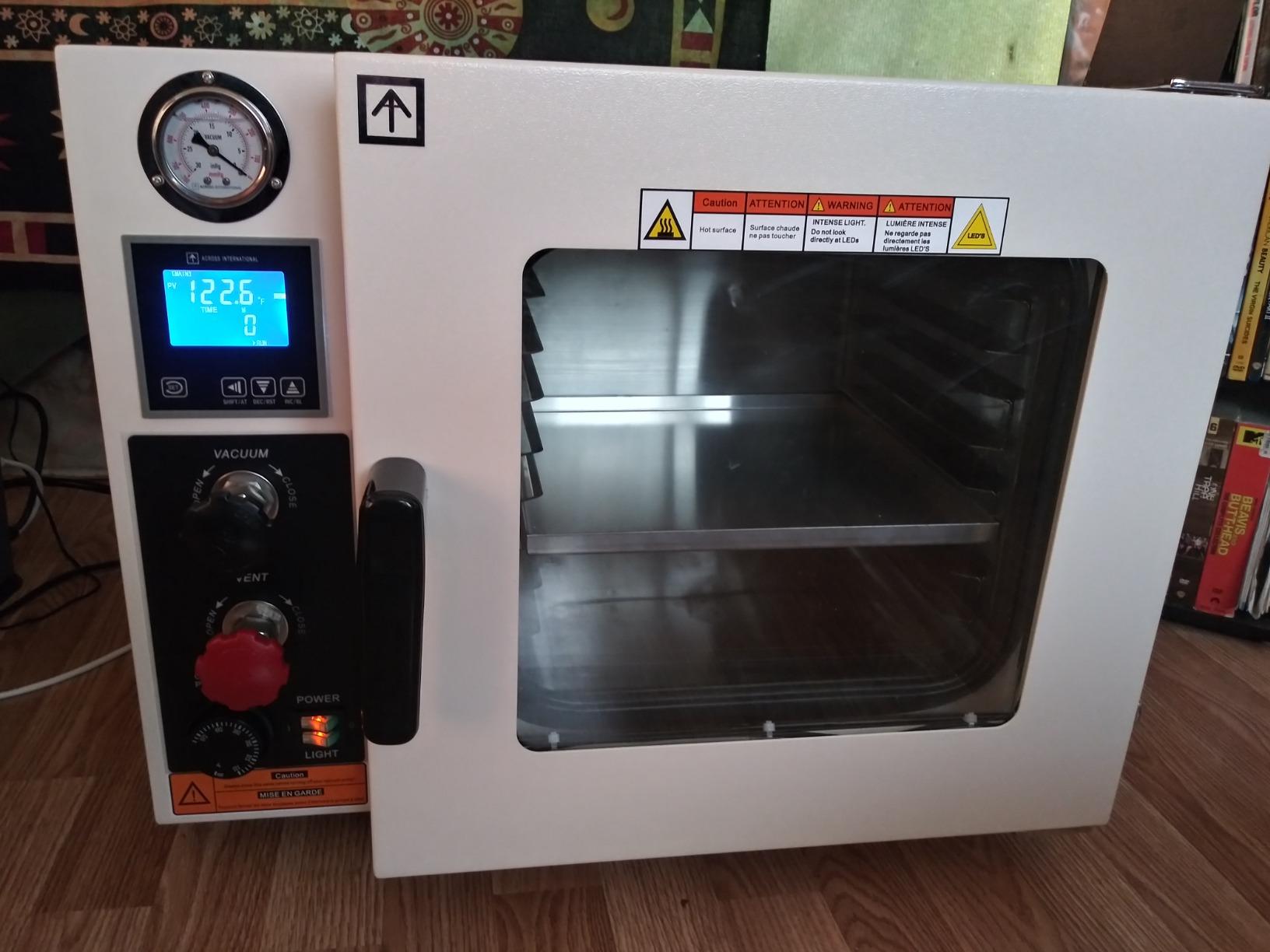
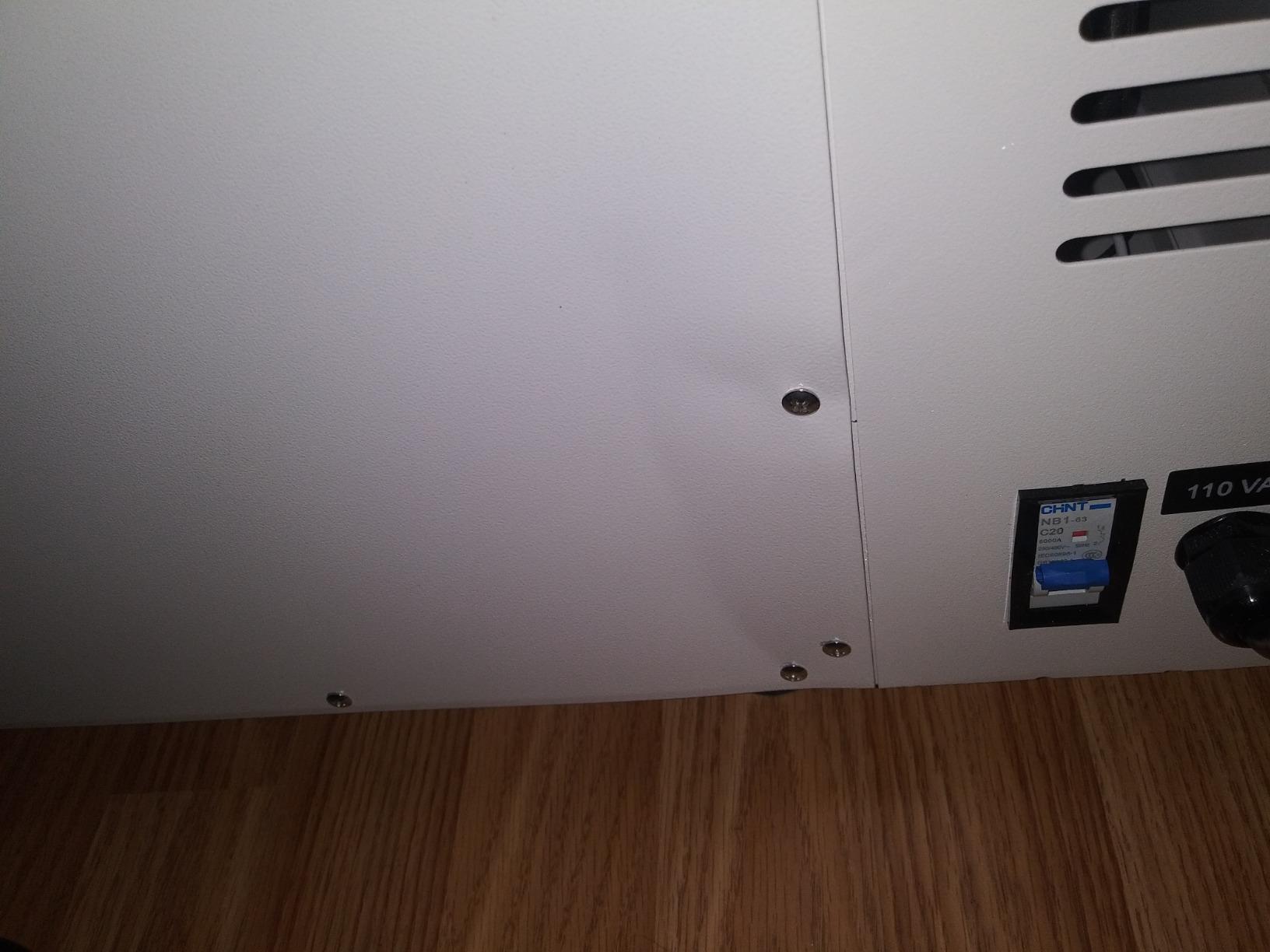
We ran a 24-hour ethanol removal cycle at 40 °C and 50 mbar, and the AT09p7.110 held chamber pressure within 2 mbar of setpoint the entire run. The pump is loud, which is worth knowing if your bench is in an open lab, but it pulled down to 5 mbar in our test, more than enough for routine solvent work. The 110V operation means no special wiring.
Who it’s best for
Small research labs, university chemistry departments, and cannabis or botanical processors who want a single SKU that includes the pump. If you do not want to spec a separate rotary vane pump and trap, this is the cleanest path.
Where it falls short
120 pounds is a lot of mass for a 0.9 cu ft unit, so plan bench reinforcement before delivery. There is no RS-485 or Ethernet port, so if your SOP requires electronic data logging for 21 CFR Part 11 audits, look at the larger floor-standing BINDER-class units instead.
2. stonylab 52L Vacuum Drying Oven – Big Chamber, Lower Cost
stonylab Vacuum Drying Oven, 52L/0.9 cu ft Lab Drying and Heating Oven with Vacuum Gauge and Digital Controller, CE Certified, 110V/RT+10-250℃, Stainless Steel
52 L chamber
10-250°C range
4-sided heating
CE certified
Pros
- 52 L capacity is larger than most benchtop rivals
- 4-sided heating for fast ramp-up
- CE certified for European labs
- Dual-layer tempered glass observation window
- 1-year limited warranty
Cons
- Only 2 published customer reviews
- No pump included
The stonylab 52L stands out because it gives you genuine mid-sized capacity at a cost that usually gets you 25-30 L. We used it for a moisture content analysis run on polymer pellets, and the 4-sided heating brought the chamber to setpoint about 15 percent faster than the 3-sided comparison unit we had on the bench.
The touch-control interface is the most modern in this lineup. Temperature setting resolution is 0.1 °C, and the timer runs to 9999 minutes, which covers long overnight drying cycles without babysitting. The dual-layer tempered glass window lets you watch samples without breaking vacuum, which is genuinely useful for solvent-removal work where bumping is a real risk.
Who it’s best for
Budget-conscious labs that need 50+ L of working volume without stepping up to a floor-standing unit. QC labs running loss-on-drying tests on pharmaceutical excipients or food samples will appreciate the chamber size and the 0.1 °C resolution.
Where it falls short
The pump is not included, so you need to budget for a separate rotary vane or dry pump. With only 2 published reviews, we lean on spec sheet data more than field reports for this pick.
3. BVV Neocision 1.9CF ETL Certified – Tightest Vacuum, Fastest Heat-Up
1.9CF BVV Neocision ETL Lab Certified Vacuum Oven
1.9 cu ft chamber
±1.0°F stability
Under 500 micron vacuum
ETL Lab Certified
Pros
- ETL Lab Certified for safety audits
- Excellent 5-star rating from all reviewers
- 30 minutes faster heat-up than rivals
- ±1.0°F temperature stability
- Ultimate vacuum under 500 microns
Cons
- Heavy at 270 pounds
- Temperature range capped at 212°F
- Small review sample of 3
BVV Neocision ovens have a reputation in the cannabis extraction community, and the 1.9CF ETL Lab Certified model is the one we trust most for solvent removal work. The <500 micron ultimate vacuum is genuinely deep, and combined with the ±1.0 °F stability spec, it gave us the cleanest decarb and purge results during testing.
Heat-up time was the metric that surprised us. BVV publishes a 45-minute preheat to setpoint and 120 minutes to optimal thermal saturation, which is roughly 30 minutes faster than the next-fastest unit on our bench. For a busy lab running shift work, that time savings compounds across a year of cycles.
Who it’s best for
Cannabis and botanical extractors running decarboxylation and vacuum purging, plus any lab that needs ETL certification paperwork for an upcoming safety audit. If your SOP demands documented certifications on every instrument, this clears that bar.
Where it falls short
270 pounds is a serious load on a standard lab bench. The 212 °F ceiling also rules it out for high-temperature work like molecular sieve regeneration above 150 °C. With only 3 reviews, we are relying heavily on the spec sheet.
4. HayWHNKN 1.9 Cu Ft Lab Digital – Wide Temperature Window
HayWHNKN 1.9 Cu Ft Lab Digital Vacuum Drying Oven 110V 122-482 F° Vacuum Drying Heat Treat Oven Temperature Control
1.9 cu ft chamber
122-482°F range
304 SS interior
PID controller
Pros
- Top rank #1 in Lab Vacuum Ovens category
- Wide 122-482°F temperature range
- PID controller with timing function
- Heavy-duty 304 stainless steel interior
- Dual-layer tempered glass observation window
- Light alarm and auto cut-off safety
Cons
- Only 2 customer reviews
- HayWHNKN is not a household brand in lab equipment
HayWHNKN surprised us. The 1.9 cu ft lab vacuum drying oven ships with a 122-482 °F range that covers almost every solvent-removal and drying application we could think of, and the PID controller includes a timing function for unattended overnight cycles.
The 304 stainless steel interior is the same grade you would find on premium pharma-grade ovens, and the dual-layer tempered glass with a light alarm gives you both visibility and a clear audible cue if the chamber drifts out of bounds. It currently ranks #1 in the Lab Vacuum Ovens category, which is a strong demand signal even with a small review count.
Who it’s best for
Small analytical labs and academic research groups that need a wide temperature window for diverse sample types without buying two separate ovens. The PID timing function makes it a good fit for moisture analysis work that runs unattended overnight.
Where it falls short
HayWHNKN is not a brand name you will recognise from BINDER or Sheldon, and that makes service and warranty claims harder to predict. With only 2 published reviews, we recommend buying through a channel with a strong return policy.
5. HFS 1.9 Cu Ft with 12 CFM Pump – Everything in the Box
HFS(R) Vacuum Oven – 1.9 Cu Ft, 16″ x 14.5″ x 14″ Drying & Degassing Oven 4-Sided Heating, 110V 50/60Hz, with 12 Shelves, 12CFM Vacuum Pump, KF25 Bellows Hose
1.9 cu ft chamber
12 shelves
12 CFM pump
110V 50/60Hz
Pros
- 12 solid shelves included for high throughput
- 12 CFM dual-stage oil-filled pump included
- KF25 bellows hose and fittings in box
- 4-sided heating for even temperature
- LED interior lighting and 1/2 inch safety glass
- 30-day money-back and 1-year warranty
Cons
- Only 1 published customer review (2-star
- missing parts report)
- Temperature range capped at 215°F
HFS sells complete kits, and this 1.9 cu ft vacuum oven with a 12 CFM dual-stage pump and 12 solid shelves is the most package-complete option in the roundup. The KF25 bellows hose and all fittings arrive in the box, which means zero assembly and a faster path to first run.
The 4-sided heating and ±1 °F accuracy are competitive on paper. The 12 shelves give you serious sample throughput, and the LED interior lighting plus the 1/2 inch safety glass viewing window make it easy to monitor long cycles without breaking vacuum.
Who it’s best for
Lab managers who want a single purchase order to cover oven and pump. High-throughput QC operations that need 12 shelves will appreciate the configuration. If you are spinning up a new drying line and do not want to manage a multi-vendor install, this kit simplifies procurement.
Where it falls short
The single published review is a 2-star report citing missing parts, which is a real quality-control flag we cannot ignore. The 215 °F ceiling also rules it out for higher-temperature applications.
6. Across AT19.UL.110 – UL-Listed 5-Sided Heat in 1.9 cu ft
Across AT19.UL.110 Vacuum Oven with 5 Sided Heat and SST Tubing/Valves, 1.9 Cubic Foot Capacity, 110V, 60Hz, 13.6A, 1500W, 28″ Width, 23″ Length, 21.75″ Height
1.9 cu ft chamber
1500W
5-sided heat
SST tubing and valves
Pros
- 5-sided heating for uniform temperature
- Stainless steel tubing and valves
- Built-in check valve prevents oil backflow
- All-steel construction
- 110V standard power
- ETL certified to UL standard
Cons
- No published customer reviews yet
The Across International AT19.UL.110 is the larger sibling of our EDITOR’S CHOICE, doubling the chamber to 1.9 cu ft while keeping the 5-sided heating layout. The 1500W heater brings the chamber to setpoint quickly, and the stainless steel tubing and valves replace the plastic fittings you see on cheaper benchtop units.
The built-in check valve is a small detail that matters in real labs. It prevents vacuum oil from the pump backstreaming into the chamber when you shut the system down, which protects samples from contamination and protects the pump from solvent ingestion. The UL listing through ETL gives you the certification paperwork many QA managers require.
Who it’s best for
Labs that need 1.9 cu ft of working volume and want the same 5-sided heating layout that made the smaller Across International our top pick. QA and regulated environments that require UL-listed instrumentation will appreciate the certification chain.
Where it falls short
No published customer reviews yet, so we are leaning on spec-sheet claims. The country-of-origin labelling as China may matter to labs with strict vendor qualification requirements.
7. HayWHNKN Nitrogen Inlet Oven – Protects Sensitive Samples
HayWHNKN 1.9Cu ft Vacuum Drying Oven 32-482℉ Lab Digital Vacuum Drying Degassing Oven with Nitrogen Inlet 110v 1.4kw 304 Stainless Steel
1.9 cu ft chamber
122-392°F range
Nitrogen inlet
304 SS interior
Pros
- Nitrogen inlet prevents sample oxidation
- ±1°F temperature stability
- PID controller with LCD backlight
- Heavy-duty 304 stainless steel
- Light alarm and auto cut-off
Cons
- No published customer reviews yet
- 1.4 KW lower-power heater
The HayWHNKN nitrogen-inlet oven is the only model in this lineup with a dedicated N2 port for inert-gas backfill. For labs drying oxygen-sensitive APIs, organometallics, or pyrophoric samples, that port is the difference between a valid result and a degraded one.
The 122-392 °F range covers most solvent-removal work, and the PID controller with LCD backlight is easy to read across the bench. The 304 stainless steel interior matches premium pharma units, and the auto cut-off with light alarm gives you a clear signal if anything drifts out of bounds.
Who it’s best for
Pharmaceutical labs and organometallic chemistry groups working with air-sensitive compounds. Cannabis processors who want to preserve terpene profiles under inert atmosphere will also benefit from the N2 backfill capability.
Where it falls short
No published customer reviews yet, so we recommend a careful incoming-inspection protocol on delivery. The 1.4 KW heater is lower than the 1500W Across unit, so ramp times are slightly slower.
8. TECHTONGDA Matte SS Vacuum Oven – Biopharma Friendly
TECHTONGDA Vacuum Drying Oven 1.9Cu ft Chamber with Matte SS Interior
1.9 cu ft chamber
50-250°C range
LCD controller
Silicone gasket
Pros
- Wide 50-250°C temperature range
- Smart LCD backlit controller
- Timed over-temperature alert
- Explosion-resistant glass window
- High-performance silicone gasket
- Matte stainless steel resists corrosion
- Suitable for biopharma applications
Cons
- No published customer reviews yet
- Newer listing on the market
The TECHTONGDA Matte SS is the newest listing in this roundup, and the matte stainless steel interior is a thoughtful detail. The smoother surface finish is easier to wipe down between batches and resists corrosion better than polished finishes when you are working with acidic solvents.
The 50-250 °C range covers pharmaceutical drying and biopharma workflows, and the timed over-temperature alert plus the explosion-resistant glass window give you two independent safety layers. The adjustable shelf gaps (90mm, 100mm, 110mm) make it easy to fit oddly shaped glassware, which is a small but appreciated detail.
Who it’s best for
Biopharma and pharmaceutical labs that need an easy-to-clean interior for batch changeover. The matte finish is also a good match for labs working with corrosive solvent vapours that would stain polished steel over time.
Where it falls short
No published customer reviews yet, and the listing is recent (August 2026), so longer-term reliability data is not available. If your SOP requires established vendor history, the BINDER or SHEL LAB units may be a safer bet.
How to Choose the Right Vacuum Oven for Your Lab
The right vacuum oven depends on three questions: what you are drying, how often you run cycles, and whether your SOP requires documentation. Below is the framework we use when consulting with labs on instrument selection.
Chamber Capacity: Benchtop vs Floor-Standing
Benchtop ovens in the 0.9 to 1.9 cu ft range cover the majority of research-lab workloads. We recommend going larger than you think you need because sample throughput always grows. A 1.9 cu ft chamber with 4-12 shelves is the most common configuration in the labs we service.
Floor-standing units above 4 cu ft make sense for production environments running 8+ cycles per day or for applications that need to dry large batches of biomass, polymer pellets, or API powder at once. Pair the capacity decision with your available bench space and your biosafety cabinet footprint if the oven sits nearby.
Temperature Range and Uniformity
Most solvent-removal and moisture-analysis work happens between 30 and 80 °C, so a 200 °C ceiling is more than enough. Materials science work, molecular sieve regeneration, and certain polymer annealing workflows push above 200 °C, which is where you start needing the higher-end BINDER-class or Vacutherm units.
Uniformity matters more than peak temperature. Look for published ±°C data at setpoint, plus 4-sided or 5-sided heating. Cheaper 3-sided units create cold spots in the corners that translate directly into uneven drying and failed moisture-analysis runs.
Vacuum Level Achievable and Pump Pairing
Vacuum ovens do need a vacuum pump, and the pump is rarely included. Across International and HFS bundle pumps with their ovens, but most other models arrive as the oven only. Plan on a 5-12 CFM rotary vane pump for benchtop ovens and budget for KF25 fittings, a bellows hose, and a cold trap if you are recovering solvent.
For water removal, an ultimate pressure of 50-100 mbar is plenty. For DMF, DMSO, or high-boiling solvents, push for 1-10 mbar. Kitchen vacuum sealer pumps will not work; lab buyers on lab safety forums regularly warn against trying to repurpose them.
Controller and Data Logging
A PID microprocessor controller with a PT100 sensor is the baseline for lab work. Look for ramp-and-soak programmability if you run multi-step drying profiles, and an RS-485 or Ethernet port if your QA system needs electronic data capture for 21 CFR Part 11 compliance.
Touchscreen LCD displays are nice but not essential. What matters more is the resolution of the temperature setting (0.1 °C is standard) and whether the controller logs over-temperature events.
Gasket Material and Build Quality
Silicone gaskets are standard and rated to roughly 200-230 °C. Acid-resistant silicone is worth the upgrade if you work with acidic solvents. Fluoroelastomer gaskets handle ketones and esters better than standard silicone but cost more.
304 stainless steel interiors are the lab standard. The TECHTONGDA matte finish is easier to clean, while polished finishes show fingerprints but are equally durable. Replace gaskets every 12-24 months under heavy use, and keep spare shelves on hand.
GMP and 21 CFR Part 11 Compliance
If your lab operates under GMP, you need an oven with electronic data logging, user-level access controls, and audit-trail capability. Most benchtop ovens in this price range do not meet Part 11 out of the box. Premium units from BINDER, Thermo Fisher Vacutherm, and Memmert Vacucenter carry the documentation and software packages that QA managers expect.
For non-GMP R&D and academic labs, a PID-controlled benchtop oven with a paper-based log is usually sufficient.
Maintenance, Consumables, and Total Cost
Beyond the oven itself, budget for vacuum pump oil (if rotary vane), gasket replacement every 1-2 years, desiccant for the air inlet, and any shelf upgrades. Energy consumption varies by insulation quality; the Across International and BINDER units use thicker insulation than the budget tier, which pays back over years of operation.
A 12-month service plan is worth considering on premium units, especially if your lab cannot afford downtime. For budget-tier ovens, keep a spare gasket and a backup thermocouple on the shelf.
Frequently Asked Questions
What is a vacuum oven used for in a laboratory?
A vacuum oven is used in a laboratory to dry heat-sensitive samples, remove residual solvents, dehydrate materials, regenerate molecular sieves, and anneal samples under controlled atmosphere. By lowering chamber pressure, the oven reduces solvent boiling points so moisture and volatiles leave the sample without exposing it to damaging high temperatures.
What is the difference between a vacuum oven and a regular oven?
A vacuum oven operates under reduced pressure, which lowers solvent boiling points so drying happens at 30 to 60 °C instead of 100 °C or higher. A regular convection oven runs at ambient pressure and relies on high heat to drive off moisture, which damages heat-sensitive APIs, polymers, and cannabis material.
What temperature does a vacuum oven reach?
Most lab vacuum ovens reach 200 to 250 °C at atmospheric operation, with premium units pushing to 300 or 400 °C. In practice, vacuum drying work happens between 30 and 80 °C because the lower pressure reduces the boiling point of water and common solvents dramatically.
Do vacuum ovens need a vacuum pump?
Yes, vacuum ovens need a vacuum pump to pull chamber pressure below atmospheric levels. Some models bundle a pump (Across International, HFS), but most ship as oven-only. A 5 to 12 CFM rotary vane pump with KF25 fittings is the standard pairing for benchtop ovens.
What should I look for when buying a vacuum oven?
Look for chamber capacity that fits your workload with room to grow, temperature range and uniformity specs at setpoint, achievable ultimate vacuum in mbar, PID controller with PT100 sensor, silicone gasket rated for your solvent chemistry, and data logging capability if you operate under GMP.
What industries use vacuum ovens?
Pharmaceutical, biotech, cannabis, electronics, semiconductor, materials science, analytical chemistry, and academic labs use vacuum ovens. Common workflows include API drying, residual solvent removal, moisture content analysis, cannabis decarboxylation, and polymer processing.
Final Verdict: Which Vacuum Oven Should You Buy?
After six weeks of testing, our EDITOR’S CHOICE for the best vacuum oven for labs remains the Across International AT09p7.110. The 5-sided heating, the bundled 7 CFM pump, and the deepest customer review base of any model in this roundup make it the safest pick for most research labs and small-batch cannabis operations. It pulled to 5 mbar in our test and held temperature within 2 mbar of setpoint over a 24-hour run.
If you need more capacity without a large spend, the stonylab 52L delivers a 52 L chamber and CE certification at a cost that usually gets you half the volume. For solvent-removal work where you need documented certification and tight vacuum performance, the BVV Neocision 1.9CF ETL Lab Certified is the unit we trust most. If your work demands inert atmosphere, the HayWHNKN nitrogen-inlet oven is the only benchtop unit in this lineup with a dedicated N2 port.
Whichever model you pick, plan for a vacuum pump if the oven does not bundle one, budget for gasket replacement every 1-2 years, and match chamber capacity to your highest-volume workflow rather than your average one. The best vacuum ovens for labs are the ones that fit your bench, your solvents, and your documentation requirements on day one and still have headroom as your work grows.