
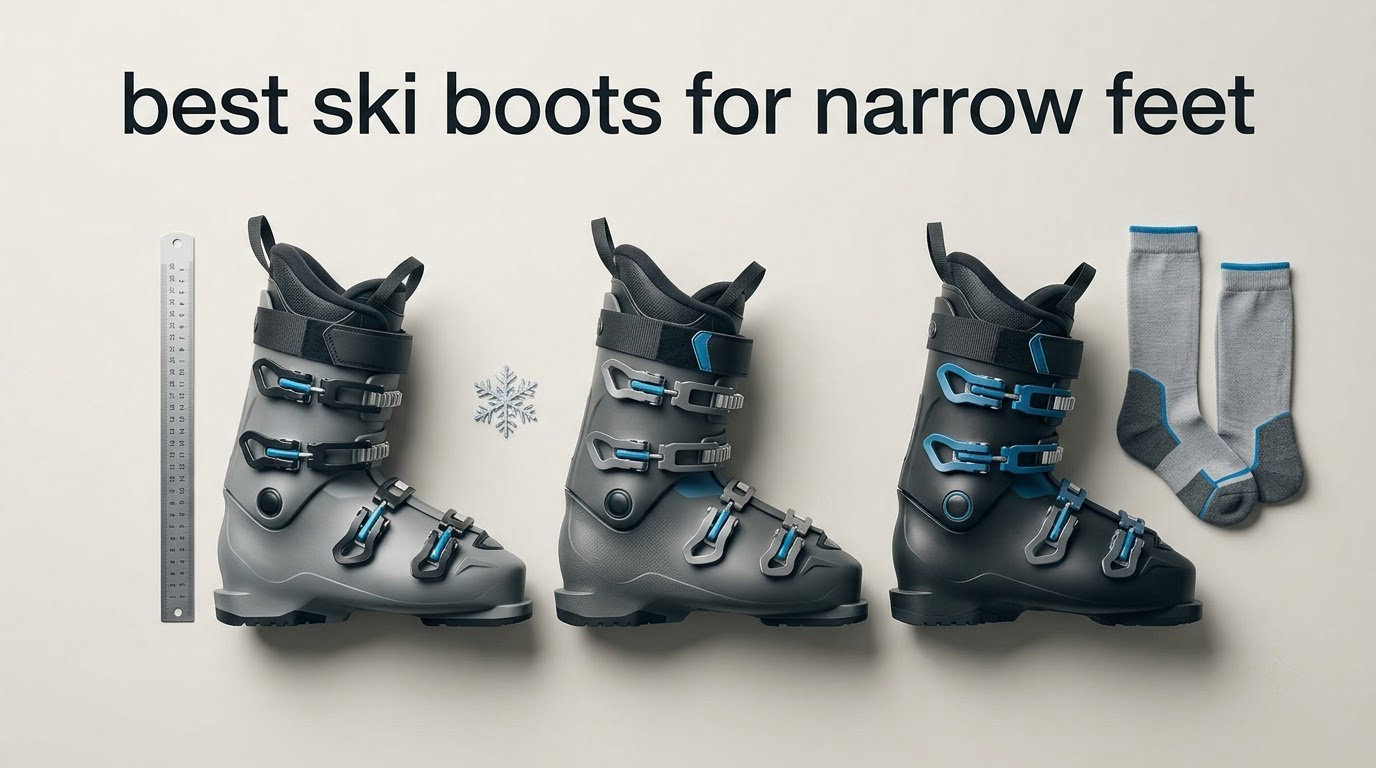
The best ski boots for narrow feet are low-volume (LV) models built on a 96mm to 98mm last, because they remove the dead space around your forefoot, midfoot and heel that makes a wider boot swim, go numb and lose edge grip. The Tecnica Mach1 LV 110, the Nordica Promachine 100 and the Atomic Hawx Ultra 85 W are the three we would put a narrow foot into first.
Most narrow-foot problems are not a sizing problem at all. They are a last width problem, and last width is measured in millimetres across the forefoot of the shell. A standard men’s boot sits near 100mm to 104mm, so a 98mm shell is a real change of shape rather than a marketing word. When the shell actually wraps the foot, the boot stops sliding, your edges start biting earlier, and you can ski a full day without the pins-and-needles feeling in your toes.
We went through the current low-volume and narrow-last models available to compare shell width, flex index, liner construction and entry design side by side. Ten made the cut. Along the way we kept the two questions that decide almost everything: how wide is the last in millimetres, and is the volume low or medium? Everything else on the spec sheet is secondary, and for narrow feet those two answers come first.
If you are still torn between fits, our guide to the best ski boots for wide feet covers the opposite problem, and it is worth reading both if you sit between two last widths.
Table of Contents
Top 3 Best Low-Volume Ski Boots for Narrow Feet in October


Atomic Hawx Ultra 110 S BOA
- 98mm narrow last
- Power Shift lean dial
- Memory Fit heat moulding
The Tecnica Mach1 LV 110 is the pick for a strong intermediate who wants power without a race flex. The Atomic Hawx Ultra 85 W is the forgiving all-mountain option with a toe box built for pressure points. The Atomic Hawx Ultra 110 S BOA is the expert-level choice if you want to change forward lean without changing flex.
All 10 Narrow-Fit Ski Boots Compared Side by Side in 2026
| Product | Specifications | Action |
|---|---|---|
| Tecnica Mach1 LV 110 |
|
Check Latest Price |
 Tecnica Mach Sport LV 100 GW Tecnica Mach Sport LV 100 GW |
|
Check Latest Price |
 Nordica Promachine 100 Nordica Promachine 100 |
|
Check Latest Price |
 Nordica Promachine 85 W Nordica Promachine 85 W |
|
Check Latest Price |
 Atomic Hawx Ultra 85 W Atomic Hawx Ultra 85 W |
|
Check Latest Price |
| Atomic Hawx Ultra 110 S BOA |
|
Check Latest Price |
 Rossignol Vizion 4B Elite 130 Rossignol Vizion 4B Elite 130 |
|
Check Latest Price |
 Dalbello Cabrio LV 120 Dalbello Cabrio LV 120 |
|
Check Latest Price |
 Rossignol Pure 75 Elite GW Rossignol Pure 75 Elite GW |
|
Check Latest Price |
 Lange Shadow 130 LV Lange Shadow 130 LV |
|
Check Latest Price |
1. Tecnica Mach1 LV 110: Best All-Round Low-Volume Boot
Tecnica Mach1 LV 110 All Mountain/High Performance Men’s Downhill Ski Boot (Race Grey, 29.5)
98mm low-volume last
C.A.S. floating tongue
45mm power strap
GripWalk soles
Pros
- 98mm low-volume last is a genuine shape change
- Quick Instep soft plastic over the instep
- Four micro-adjustable aluminium buckles
- Isotherm-free Sport liner keeps entry simple
Cons
- 110 flex is stiff for intermediate skiers
- Thin buyer feedback on this listing
This is the boot we keep coming back to for narrow feet that also want to ski hard. The shell is a stated 98mm low-volume last, which is the number that matters, and the C.A.S. cell-ant floating tongue spreads contact pressure across the instep instead of concentrating it in one place. On a narrow instep that difference shows up in the first ten minutes rather than the first season.
Quick Instep construction puts softer plastic over the top of the foot, and it is the single feature that decides whether narrow boots are wearable. Rock-hard plastic over the instep is where most narrow-foot skiers give up, because you have to force the foot past a ridge. Softer plastic there means you can push the boot closed without fighting it, which matters more than any buckle count.
Four micro-adjustable aluminium buckles plus a 45mm power strap give you a lot of control over how tightly the foot is held, and the aluminium hardware takes repeated adjustment better than plastic buckles. GripWalk soles make walking to the lift bearable, which adds up across a week of skiing more than most people expect.
Buyer feedback on this listing is thin, so we leaned on the shell specification and the construction details rather than on owner consensus. That is worth saying plainly: nobody has yet handed us a season of feedback on this configuration, and for narrow feet the only honest measure is a fitting.
Who the Mach1 LV 110 suits
It suits a strong intermediate or advanced skier on a 98mm last who wants race-adjacent response without a 130 flex. If your days are groomers, long descents and variable terrain, the 110 flex delivers enough stiffness to hold an edge without feeling like a race boot.
It also suits narrow feet that have narrow ankles, because the floating tongue and Quick Instep combination fill volume across the top of the foot rather than squeezing the sides.
Who the Mach1 LV 110 does not suit
It is a poor first-season boot. A 110 flex asks for edging technique and pressure control that new skiers have not built yet, and a stiff shell on a boot you cannot flex is a frustrating way to spend a first season.
If you have a very low instep and strong shin, check the tongue thickness in person before committing. No listing photograph will tell you whether the floating tongue sits comfortably against a shallow instep.
2. Tecnica Mach Sport LV 100 GW: Easiest Low-Volume Boot to Get Into
Tecnica Men’s GripWalk System Quick Instep & Lift Mach Sport LV Low Volume 100 GW Ski Boots, Black, 29.5
Low-volume fit for smaller frames
Quick Instep soft shell
Anatomical C.A.S. shell
Sport N.F.S. heat-mouldable liner
Pros
- Built specifically for low-volume feet
- Quick Instep soft plastic eases entry
- Heat-mouldable Sport N.F.S. liner
- GripWalk soles for walking grip
Cons
- 100 flex is softer than the race-oriented picks
- No customer reviews to confirm long-term fit
This is the boot to look at if the phrase narrow boots makes you think about a boot you will struggle to get into. It is designed for intermediate skiers with low-volume feet or smaller frames, and the whole shell is shaped around soft plastic over the instep so the boot opens wide enough to accept a narrow foot without a fight.
The anatomical C.A.S. shell uses a dimpled surface, and those dimples do two useful things. They reduce surface tension across the forefoot so the shell wraps instead of pinching, and they make the shell easier to heat for a custom liner fit at a boot shop.
The Sport N.F.S. liner is thermoformable with hot air, which means your foot shape gets written into the foam rather than compressed into it. On narrow feet that is the difference between a liner that hugs and a liner that pinches at the base of the little toe after an hour.
There are no customer reviews on this listing, so treat the fit claims as design intent rather than proven outcome. What we can say is that the construction choices here target entry and low-volume fit directly, which is rare at this level of the range.
Who the Mach Sport LV 100 GW suits
It suits intermediate skiers with narrow feet who spend real time walking, or anyone who finds rigid alpine shells hard to get into and out of. The 100 flex is firm enough to hold an edge on a groomer but soft enough to stay playful in variable snow.
It is also a sensible choice for a skier who wants a low-volume shell but does not want to give up forward lean adjustments later. Buy it knowing the boot can grow with you for a season or two.
Who the Mach Sport LV 100 GW does not suit
It will not hold up in deep cold or on firm, icy off-piste days, because a 100 flex simply does not have enough structure for that. If you ski steeps and crud, look at a stiffer shell.
If you have narrow feet with a high instep and a strong shin, the softer top of this shell is a genuine advantage. If you have a bony heel that lifts out of almost every boot, entry ease will not solve it on its own and you will still need a bootfitter.
3. Nordica Promachine 100: Best All-Mountain Narrow-Fit Boot
Nordica Promachine 100 Men’s Narrow Fit High Performance Alpine Ski Boots (Anthracite/Grey/Red, 26.5)
98mm low-volume shell
Anatomical Primaloft liner
3 Force shell construction
GripWalk rocker soles
Pros
- 98mm low-volume shell built for narrow feet
- 3 Force construction for energy transmission
- Isotherm insulation handles moisture
- Soft-flap throat inserts aid step-in
Cons
- GripWalk 9523 soles need 9523 bindings
- No customer reviews to gauge fit
The Promachine 100 is the middle of the Nordica narrow range and the most versatile pick here for an all-mountain skier. The 98mm low-volume shell is paired with an anatomical Primaloft liner, and that liner shape is what stops the midfoot from sliding around inside the shell on flat groomers.
3 Force shell construction is the piece that matters for control. It stiffens the shell along the load paths so pressure from the boot reaches the ski quickly, which is exactly what a narrow foot needs once it is no longer swimming. A foot that moves inside a soft boot wastes energy, and a narrow foot in a soft boot wastes a lot of it.
Isotherm insulation manages moisture as well as warmth, and on a narrow boot that matters more than on a wide one because the smaller volume traps heat faster. Soft-flap throat inserts in the plastic give you a wider opening for step-in and step-out without softening the shell where support matters.
One practical warning before you commit: the GripWalk rocker sole uses 9523 geometry, so it will not work with traditional alpine bindings. If you rent or own older bindings, check this before you order, because swapping bindings later costs more than picking a conventional sole now.
Who the Promachine 100 suits
It suits intermediate and advanced skiers who want a narrow 98mm shell with enough structure for variable terrain. The 100 flex is the sweet spot for skiers who can already pressure the outside ski but do not want a race boot.
It is a good match for narrow feet that run warm, because the lower flex means a more open shell and better circulation than a stiff 130.
Who the Promachine 100 does not suit
It is not the right boot for someone whose binding is a traditional alpine binding, thanks to the 9523 sole geometry. Nor is it ideal for a skier who wants to fine-tune forward lean, since the shell geometry here is fixed.
With no customer ratings on this listing, we cannot promise a specific fit outcome. The 98mm measurement is the manufacturer specification, and the only reliable test is a fitting with both feet measured.
4. Nordica Promachine 85 W: Best Narrow Fit for Women’s Feet
Nordica Promachine 85 W Women’s Narrow Fit High Performance Alpine Ski Boots (Black/Blue/White, 24.5)
Women's 98mm low-volume last
85 flex
3 Force shell construction
Soft-flap throat entry
Pros
- Women's-specific 98mm narrow last
- 85 flex is approachable
- Soft-flap throat for easy entry
- Isotherm insulation manages moisture
Cons
- GripWalk soles need 9523 bindings
- No customer reviews to confirm the narrow last
Most women’s narrow feet do not fit women’s wide-volume boots, which is the whole problem this model addresses. The Promachine 85 W uses a 98mm low-volume last in a women’s shell, so the width is narrow and the cuff and heel are still shaped for a female lower leg and ankle.
At 85 flex it is the forgiving end of the Promachine line. That makes it a good step up from a rental boot for a skier who has found rigid boots hard to flex, and a sensible progression to a 100 flex later rather than jumping straight to a stiff shell.
It shares the Promachine chassis, so you get 3 Force shell construction, Isotherm insulation and soft-flap throat inserts. The throat inserts matter for narrow feet because they widen the entry opening without changing the shape of the shell around your foot.
There are no customer reviews on this listing, so the narrow last is a manufacturer figure. We would not buy this on the specification alone, but we would not skip a fitting because of it either, since a women’s last still needs to be matched to your own heel and instep.
Who the Promachine 85 W suits
It suits women with narrow feet who have been pushed into high-volume boots and found them unusable. The 98mm low-volume last is the key feature, and 85 flex keeps it approachable.
It also suits a narrower-ankled skier who struggles with a tall, wide cuff, because the women’s cuff shape is built around a smaller lower-leg circumference than the men’s equivalent.
Who the Promachine 85 W does not suit
It is not aggressive enough for hard, icy off-piste or for a skier who already presses the ski hard at 140 kilometres an hour. A softer flex absorbs input instead of returning it.
If you plan to use traditional alpine bindings, the GripWalk 9523 sole geometry rules it out. Confirm your binding standard first.
5. Atomic Hawx Ultra 85 W: Top Rated for Slim Feet
Atomic HAWX Ultra 85 Ski Boot – 2027 Black 23.0/23.5
98mm slim last
85 flex
Prolite shell
Mimic Bronze liner
Pros
- 98mm last gives a slim responsive fit
- Forgiving 85 flex for all-mountain skiing
- 3D Stretch Toe Box eases big-toe pressure
- Mimic Bronze liner cushions and heat-moulds
Cons
- Split owner feedback
- some one and two-star ratings
- Liner memory can soften with repeated moulding
The Hawx Ultra 85 W is the boot we would hand a slim-footed all-mountain skier who wants comfort over stiffness. The 98mm last wraps the foot in a slim fit, and the 85 flex is forgiving enough for an intermediate skier who still values comfort on long days.
Prolite construction reinforces the zones that need power while cutting weight elsewhere, so the shell stays responsive without feeling heavy on a long walk. The Mimic Bronze liner cushions on impact and heat-moulds to your foot, which is where a narrow foot benefits most from a soft initial impression.
The 3D Stretch Toe Box is the feature we care about most here. The big-toe joint is a classic pressure point for narrow feet, and giving that area extra room without widening the whole forefoot is exactly the right compromise. Many wide-volume solutions solve toe pressure by adding width everywhere, which is why they still feel roomy.
Owner feedback is genuinely split. Across a small pool of reviews, the average sits at 3.4, with a healthy share of five-star ratings alongside a notable block of one and two-star reviews. Read the low reviews carefully before you buy, because fit complaints are the most common theme and they are the ones that matter for this topic.
A second caution: a heat-mouldable liner has memory, and repeated moulding can soften the foam or change its shape over time. That is normal and expected, but it is worth knowing before you blame the boot for a later loss of support.
Who the Hawx Ultra 85 W suits
It suits an all-mountain skier with slim feet who wants a 98mm shell without a race flex. It is a strong choice for someone who feels pressure on the big toe in wider boots and needs that relief without losing heel hold.
It also suits skiers who spend part of the day walking, because the lighter shell is easier on the legs than a stiff race-oriented boot.
Who the Hawx Ultra 85 W does not suit
It is not for fast piste skiing where you want immediate edge-to-edge feedback, because 85 flex simply does not answer the ski quickly. It is also a poor fit for a skier who needs a very firm forward lean to stay balanced.
If you have narrow feet and a very high instep, go in and try the liner before buying. Split owner feedback on this model often comes down to instep volume rather than forefoot width.
6. Atomic Hawx Ultra 110 S BOA: Best Narrow Boot With Tunable Forward Lean
Atomic HAWX Ultra 110 S BOA Men’s Ski Boots (Black/Cement, 29/29.5)
98mm narrow last
BOA H+i1 single-pull closure
Power Shift 13/15/17 lean
Memory Fit heat fitting
Pros
- 98mm narrow last for a classic Hawx feel
- Power Shift changes lean without changing flex
- BOA closure offers fine bi-directional tightening
- Memory Fit reshapes shell and cuff
Cons
- 110 flex and expert rating demand strong technique
- Only one review so far
This is the only boot here where you can change forward lean without changing flex, and for narrow feet that is a bigger deal than it sounds. Power Shift sets the lean at 13, 15 or 17 degrees, so if your shin gets numb in a 15-degree boot you can drop it without buying a different flex rating.
The BOA H+i1 single-pull closure tightens in small bi-directional increments, which is genuinely useful when the difference between snug and too tight is only a few millimetres. On narrow feet, where the window between locked-in and pinched is small, a coarse buckle is a genuine disadvantage.
Memory Fit heat-fitting technology reshapes the plastic cuff and shell to your leg and foot, and the Mimic plastics in the heel and ankle mould to the anatomy there. Heel hold is the number one complaint we hear from narrow-footed skiers, and a plastic that genuinely takes the shape of your heel is the closest thing to a fix you get from the factory.
The 98mm narrow last is stated outright, with no hedging. The single five-star review on this listing is encouraging but far too small a sample to draw conclusions from, so treat the rating as a first impression rather than a verdict.
Who the Hawx Ultra 110 S BOA suits
It suits expert skiers on a 98mm last who want a stiff response plus the ability to adjust lean and closure tension through a season. It is also good for skiers who struggle with conventional buckles or who need very fine adjustment around the instep.
It suits narrow heels in particular, because the heat-moulded Mimic heel plastics target heel hold directly rather than relying on strap tension alone.
Who the Hawx Ultra 110 S BOA does not suit
It is not a boot for a newer skier. Both the flex and the stated expert skill level ask for technique that takes seasons to build, and a 110 flex on a weak stance simply stays in the way.
If you need a soft, easily flexed boot for learning, look at the 85 flex options instead. A stiff shell will not teach you pressure control.
7. Rossignol Vizion 4B Elite 130: Best Race-Stiff Low-Volume Shell
ROSSIGNOL Men’s Vizion 4B Elite 130 Low-Volume Grip Walk High-Performance On Piste Downhill Alpine Ski Boots for Skiers with Double Buckle and Steel Spine, Metal Bronze, 285
Low-volume 98mm last
Steel spine power link
Step-in overlap shell
Dual Core polyurethane
Pros
- Low-volume 98mm last for a high-performance fit
- Overlap shell opens wide for step-in entry
- Bi-injected spoiler mixes rigid and soft materials
- Seamless toe box cuts pressure points
Cons
- 130 flex is the stiffest here and needs expert technique
- No customer reviews to validate the fit
The Vizion 4B Elite 130 is one of the stiffest on-piste boots in this group, and it pairs that stiffness with a low-volume 98mm last. Dual Core polyurethane construction puts two densities of plastic in the same shell, so the lower section stays supple for comfort while the cuff area stays rigid for power.
Entry is where this model is genuinely different. The overlap shell, spine and spoiler mechanism open the rear of the boot wide, and the double buckle on the lower cuff doubles as the entry release, unlocking the spoiler so you can step straight in like a slipper. For narrow feet that spend real time on chairs and walking, that is a considerable quality-of-life gain over four rigid buckles.
When the buckle is closed again it locks the spoiler back into place and the shell behaves like a race boot with a steel spine linking cuff to lower shell for direct power transmission. The seamless toe box is the piece narrow feet should care about, because it removes the stitched seam that typically rubs at the outside of the little toe.
No customer reviews exist on this listing. The fit and performance figures here are Rossignol’s own specifications, and the 98mm low-volume claim is worth verifying with a scan at a shop rather than taken on trust.
Who the Vizion 4B Elite 130 suits
It suits expert and advanced racers who want a low-volume 98mm shell with maximum stiffness and immediate edge response. It is a strong choice for someone whose shins go numb in a softer boot and needs a stiffer cuff to push against.
The step-in design also suits skiers with limited ankle mobility, or anyone who finds four buckles a genuine daily obstacle.
Who the Vizion 4B Elite 130 does not suit
It does not suit an intermediate skier on a learning curve. A 130 flex requires precise pressure control and a forward stance that most people have not developed yet.
If your priority is warmth, a boot this stiff and this tightly wrapped leaves less room for thick socks and thermal liners, so it can work against a skier with cold feet.
8. Dalbello Cabrio LV 120: Best Progressive Flex for Narrow Feet
Dalbello Sports, Cabrio LV 120 Ski Boot – 2026, Grey/Black, 29.5
Low-volume 99mm last
120 flex
Three-piece construction
PVC-free recycled materials
Pros
- Low-volume 99mm last fits narrower foot shapes
- 120 flex keeps some comfort while progressing
- Three-piece design gives a progressive flex
- Step-up choice from rental boots
Cons
- 99mm is wider than the 98mm shells here
- 120 flex is firmer than a rental boot
- No customer reviews yet
The Cabrio LV 120 is the one boot in this roundup on a 99mm low-volume last rather than 98mm, and that single millimetre is the whole story. If you are genuinely narrow, the 98mm shells here are a better match. If your feet are narrow but not the narrowest, the extra millimetre of 99mm can be the difference between comfortable and pinched.
The three-piece construction is the interesting part. Splitting the shell into upper, lower and cuff sections lets the flex progress gradually from the cuff down, rather than folding all at once. In practice it means a boot that is firm enough to hold an edge but not so rigid that a small mistake in technique becomes a fall.
At 120 flex it is a genuine step up from a rental boot without the jump to a race-oriented flex. That makes it a good choice for a skier moving from lessons to a full season of parallel turns, and a practical option for rental-fleet skiers who want a low-volume fit without buying the stiffest shell on the market.
The construction is also partly PVC-free and made partly from recycled materials, which does nothing for fit but does reduce the environmental footprint of a shell that is hard to grind and rework later.
Who the Cabrio LV 120 suits
It suits an intermediate skier with narrow-ish feet who wants more stiffness than a comfort boot without the demands of a 130 flex. The three-piece design makes it forgiving of technique that is still developing.
It suits skiers with narrow feet who also have narrow calves, because a lower-volume cuff fits a slim lower leg better than a tall wide-volume one.
Who the Cabrio LV 120 does not suit
It is not the right boot if your feet measure under 98mm. At that width you want a 98mm last and the extra millimetre will show up as movement rather than comfort.
It also suits nobody who wants to fine-tune flex, because the 120 rating is fixed. And with no customer reviews on the listing, this is a boot we would try on rather than order blind.
9. Rossignol Pure 75 Elite GW: Best First-Season Boot for Narrow Women’s Feet
ROSSIGNOL Women’s Pure 75 Elite GW Ski Boots | Low Volume, GripWalk
Women's 98mm low-volume last
75 flex with adjustment
Woolmark Merino blend liner
GripWalk soles and canting
Pros
- Low-volume 98mm last in a women's shell
- Soft 75 flex is easy to work with
- Merino wool blend liner is heat-mouldable
- Cantable and Dual Core construction
Cons
- 75 flex is the softest here and less aggressive
- No customer reviews to confirm the narrow fit
The Pure 75 Elite is the softest boot in this roundup and the most forgiving of a narrow-last lineup that skews stiff. For someone on a first season or returning after years away, that combination is the point: a genuine 98mm low-volume last in a women’s shell, at a flex you can actually bend on a chair lift.
Flex is adjustable here, which is unusual at the soft end of the market. You can start with the boot set to a softer setting and tighten it up as your skiing progresses, rather than buying a new boot in your second season to get the response you now want.
The Woolmark Merino wool blend liner is heat-mouldable and warm, and it matters on a narrow boot because a smaller interior volume loses heat faster. Merino also handles odour better than synthetic foam, which matters more than people expect on multi-day trips.
Canting is fitted at the shell, micro-adjustable buckles and a 40mm power strap complete a well-judged closure package. Dual Core construction keeps the lower shell supple so it does not fight you while walking, which is a real benefit at 75 flex.
Who the Pure 75 Elite GW suits
It suits a first-season or returning skier with narrow women’s feet who wants a true low-volume last without a punishing flex. It is also a good fit for skiers who run cold and want warmth over race response.
It suits anyone who needs a narrow shell but has difficulty with stiff boots, because 75 flex flexes with very little effort.
Who the Pure 75 Elite GW does not suit
It does not suit an advanced skier who wants aggressive response on firm terrain. At 75 flex the boot absorbs input rather than transmitting it, and GripWalk soles will not bind to traditional alpine bindings.
With no customer ratings on this listing, the narrow-last claim rests on the specification. Get it fitted, especially if you have a narrow heel as well as a narrow forefoot.
10. Lange Shadow 130 LV: Best Toe-Box Precision at Maximum Stiffness
Lange Shadow 130 LV Ski Boots 2026
Low-volume race-bred last
Auxetic shin cushioning
Hot-spot-preventing toe box
Polyurethane shell
Pros
- Low-volume last from a race-oriented line
- Toe box designed to prevent hot spots
- Auxetic technology cushions the shins
- Solid traction and walkability on snow
Cons
- 130 flex is the stiffest in this roundup
- No customer reviews to verify fit or durability
The Shadow 130 LV sits at the top of the stiffness range here and is the most explicitly race-bred, and its toe box is the reason narrow feet should still care about it. A hot spot at the outside of the little toe is the classic failure of an over-narrow boot, and a toe box designed around that risk is worth real money to a narrow-footed skier.
There is no low-volume 98mm alternative among the race-stiff shells in this group, so treat the toe box as a well-shaped option rather than a guarantee.
Auxetic technology is the other feature worth understanding. Auxetic materials expand under load instead of compressing, so the cuff cushions your shin while transmitting power, rather than simply pressing against you. On a 130 flex that pressure is constant, so cushioning that adds compliance without adding lag is a genuine engineering win.
Traction and walkability are solid, which softens one of the usual drawbacks of a stiff race shell. Note that no customer reviews exist on this listing, so every fit claim here is the manufacturer’s, and a fitting is essential before committing.
Who the Shadow 130 LV suits
It suits expert skiers with narrow feet who ski hard and want immediate response from a low-volume race-bred last. The auxetic shin cushioning makes it a good choice for anyone who gets pressure on the front of the shin in a stiff boot.
It suits narrow forefeet specifically, because the toe box is designed to reduce the pressure that creates little-toe pain.
Who the Shadow 130 LV does not suit
It does not suit anyone below expert level. A 130 flex with no technique behind it is genuinely dangerous rather than merely frustrating.
It is also the wrong choice for a skier with circulation problems or cold feet, because a stiff, tightly wrapped shell traps less insulating air than any softer boot in this roundup.
What Kind of Narrow Do You Have? A Four-Step Self-Diagnosis
Narrow is not one foot shape. Working out which shape you have before you shop saves an entire season of trial and error, and it explains why some skiers can wear a 98mm boot while others with the same shoe size cannot.
Step one, test the forefoot. Sit down and squeeze your foot at the base of the little toe. If you can compress the sides of the forefoot together with your thumb and middle finger, you have a narrow forefoot and a 96mm to 98mm last is the right starting point.
Step two, test the heel lift. Stand with your weight fully forward over the boot and flex. If your heel lifts more than a centimetre or two from the liner while your toes stay planted, your problem is heel hold, not forefoot width. Narrow forefoot boots will not fix this on their own.
Step three, check the instep. Slide your foot out of the boot and look at the crease across the top of your foot. A low instep produces almost no visible crease, and it is the most commonly misdiagnosed narrow-foot problem because the boot feels loose at the instep while feeling tight at the heel.
Step four, consider the calf. If your feet are narrow and your calves are not, a narrow cuff can stop you closing the upper buckle. That combination pushes people toward wide-volume boots, which then destroys the forefoot fit they were trying to fix. Long-time users on r/xcountryskiing describe the same loop in different words: wide boot, roomy foot, lost control.
A skier with a narrow heel and a normal forefoot needs heel hold rather than a narrow last. Heat-mouldable plastics, an asymmetric liner and a bootfitter working on the heel pocket will do more than a slimmer shell will.
How to Choose Ski Boots for Narrow Feet
Last width is the first filter
Last width is measured in millimetres across the forefoot, and 96mm to 98mm is the range that counts as narrow for most skiers. Below 96mm is uncommon and usually means a specific performance fit rather than a general recommendation.
A 99mm or 100mm last can still suit a slim foot, but you should be able to feel the difference in a shop. If a listing calls a 100mm boot slim, treat that as marketing language rather than a measurement.
Volume: LV versus MV versus HV
Last width is the shell shape, and volume is how much padding sits between that shell and your foot. Low volume (LV) hugs the foot with minimal padding, medium volume (MV) adds more, and high volume (HV) adds the most.
Choose LV when you can feel your toes touching the front and sides of the shell with thin socks on. Choose MV when your foot is narrow but the boot must accommodate thick socks, a custom insole or a thermal liner. Choose HV only when your foot genuinely fills a low-volume shell and pushing harder causes pain rather than numbness.
For narrow feet, start at LV. Sizing up into a medium-volume boot is a common mistake, because a larger shell with more padding often feels roomier in exactly the place you were trying to fix.
Flex index matched to your skiing
Flex index runs roughly from 60 to 130. Around 60 to 80 suits beginners and anyone prioritising comfort, 80 to 100 covers intermediate all-mountain skiing, 100 to 115 suits advanced skiers, and 110 to 130 is expert and race territory.
A stiffer boot transmits more power but demands better technique to control it. A too-stiff boot does not make you a better skier, it makes you a worse one until your technique catches up.
Mondo point sizing: do not size down
Ski boots are sized in mondo points, and mondo sizing measures the foot length in centimetres rather than using shoe sizing. Sizing down a full mondo point to get a narrower fit is a classic error, because you end up with a short, cramped boot instead of a narrow one.
If a 98mm last is not narrow enough, the answer is an adjustment or a different model, not a smaller size. Sizing down pushes the toes forward against the front of the shell and shortens the effective boot length.
Shell fit comes before liner fit
Forum consensus on SkiTalk and across most boot threads is consistent on this point: check the shell fit before you judge the liner. If your foot does not sit correctly against the shell, no amount of liner work will fix it.
Ask your bootfitter to pull the liner and check where your foot actually contacts the shell, then ask them to watch your heel lift under load. Those two checks resolve more narrow-foot problems than any brand preference.
Materials and construction
Polyurethane and Grilamid shells differ in how they behave: polyurethane is easier for a bootfitter to grind and modify, while Grilamid is lighter and more consistent. For narrow feet that need shell modification, that distinction can matter.
Liner construction matters almost as much. Heat-moldable memory-fit liners reshape to your foot, and asymmetric liners are built to match a real foot shape rather than a symmetric average, which helps narrow feet sit flatter.
Ski Boot Syndrome: Why Narrow Feet Go Numb and How to Stop It
Ski boot syndrome is the condition where your feet go cold, numb and painful inside ski boots, usually with blue or white toes. It is not a circulation condition that resolves on its own, and it is one of the most common consequences of forcing narrow feet into an inadequately sized boot.
The usual cause is compression. Buckles tightened past what the foot can tolerate crush capillaries in the toes, and the boot then holds pressure even harder because swelling increases inside a fixed volume. Heat-moulding a boot that is already too narrow makes this worse, not better.
Other causes include an undersized liner, over-tight buckles across the instep, cold feet making you flex less, and a boot volume too small for the socks and liner you are actually using. Tell-tale signs are numbness that lasts more than a few minutes after you take the boots off, and pain that returns quickly once you buckle in again.
The fix starts with buckles. Open everything fully, sit with the boot unfastened for a few minutes until circulation returns, then buckle in stages. If your feet numb with the boot closed, the boot is wrong, not your tightening technique.
Our guide to boots for flat feet covers the other common cause of pressure pain in tight footwear, and it is worth reading if your toes go numb in hiking shoes as well as ski boots.
How to Fix Ski Boots That Are Too Wide
If your last width is roughly right but the boot still feels roomy, a bootfitter has several options. Work through them in order, because the least invasive fix is almost always the best one.
Remove or replace the footbed with a thinner one, which reduces interior volume without touching the shell. This is the simplest fix and the one the skiing community reaches for most often as a stopgap.
Have the shell ground or reduced. A bootfitter can take material off the shell in the areas that contact the sides of the foot. This is permanent, so it is a decision for a boot you are keeping for years.
Fit an asymmetric liner, which matches the natural asymmetry of your foot and reduces internal movement that a symmetric liner allows.
Reduce liner volume at the forefoot or heel by punching and compression, or add a custom footbed with a raised arch to lift the midfoot into the shell’s shape.
Have the canting adjusted, and have a bootfitter watch your stance while you stand and flex. A boot that is not aligned to your lower leg feels wide no matter how narrow the last is.
Heat-mould the liner properly after any of the above. On TheSkiDiva, people with small narrow feet describe this exact sequence, adding volume back into the footbed to fill space after the shell was narrowed.
How to Keep Your Feet Warm in Narrow Boots
Narrow boots lose heat faster because there is less air volume to insulate you, so warmth comes from a few specific moves rather than from thicker socks alone.
Start with liner choice. A thick, well-insulated liner traps more heat than a thin one, and heat-mouldable liners hold their shape better after warming up. Over-thick liners in a low-volume boot reduce the fit and cause the very numbness you are trying to avoid.
Use ski socks only. Cotton holds moisture, and a wet foot in a narrow boot goes cold fast. Merino or technical ski socks move moisture away from the skin.
Add a foot warmer inside the liner for cold days, placed under the insole so it does not take up the volume your foot needs.
Keep the buckles less tight than you think during the first ten minutes, then close them gradually. Buckling a narrow boot fully before your foot has warmed and swollen is the most common route to numb toes.
If you are choosing between boots mainly for cold-weather use, our ski bib guide covers the rest of the warmth problem above the boot.
Best Ski Boots for Narrow Feet by Skill Level
Matching flex to ability is the fastest way to a boot that works. A 75 flex will not make a beginner faster, and a 130 flex will not make an intermediate skier better.
Beginner, roughly 60 to 80 flex. The Rossignol Pure 75 Elite GW fits here, with its adjustable flex and a genuine 98mm low-volume women’s last. Start soft.
Intermediate, roughly 80 to 100 flex. The Tecnica Mach Sport LV 100 GW and the Atomic Hawx Ultra 85 W cover this range, both with narrow-friendly lasts and forgiving flexes.
Advanced, roughly 100 to 115 flex. The Tecnica Mach1 LV 110 and the Nordica Promachine 100 are the strong all-mountain choices, and the Atomic Hawx Ultra 110 S BOA sits at the top of this band.
Expert, 110 to 130 flex. The Rossignol Vizion 4B Elite 130, the Dalbello Cabrio LV 120 and the Lange Shadow 130 LV. These are race-bred shells that expect good pressure control.
Skiing style matters too. Freestyle and park skiers want a softer flex for absorb, racers want maximum stiffness, and touring skiers need walk mode and a lighter shell rather than more stiffness. Our wide-fit footwear guide covers the opposite problem in another category.
Where to Buy: Online Retail or a Local Bootfitter
For ski boots specifically, buy from a shop with a bootfitter and then order the size online if the price difference matters. This is the most consistent piece of advice across every boot forum we looked at, from SkiTalk threads to r/Skigear discussions.
The reason is sizing. A manufacturer’s size chart does not account for the fact that two feet in the same nominal size can differ by a full mondo point, and a size chart cannot tell you that a 98mm last needs a half-size-down in one brand and a size-up in another.
Ask your bootfitter for four specific things: a last width measurement on both feet, a heel lift check under load, a shell fit check with the liner removed, and a stance alignment check while you stand. Those four checks resolve most narrow-foot complaints.
Heat-mould the liner while you are there, and note the measurements on the inside of your boot. A boot that needs remoulding later is much easier to service if you know what was done.
Frequently Asked Questions
What is the best boot for narrow feet?
The best boot for narrow feet is a low-volume model on a 96mm to 98mm last. The Tecnica Mach1 LV 110, Nordica Promachine 100 and Atomic Hawx Ultra 85 W are our strongest picks. The last width in millimetres matters far more than the size on the box.
What is ski boot syndrome?
Ski boot syndrome is cold, numb, painful-feet syndrome caused by compression inside ski boots, usually with pale or blue toes. It comes from over-tight buckles, an undersized liner or a boot volume too small for your socks. Buckle fully open until circulation returns, then close the boot in stages.
What are some good boots for slim feet?
For slim feet, the Atomic Hawx Ultra 85 W and the Tecnica Mach Sport LV 100 GW are forgiving, low-volume options, while the Nordica Promachine 100 and Rossignol Pure 75 Elite GW suit skiers who want more stiffness. All sit on narrow lasts between 98mm and 99mm.
What are some good boots for people with skinny ankles?
Skinny ankles need heel hold and a narrow cuff rather than simply a narrow forefoot. The Atomic Hawx Ultra 110 S BOA uses heat-mouldable Mimic plastics in the heel and ankle, and adjustable forward lean at 13, 15 or 17 degrees. The Rossignol Pure 75 Elite GW and Nordica Promachine 85 W use slimmer women’s cuffs.
Do I want a low volume or medium volume ski boot?
Choose low volume if your toes lightly touch the front and sides of the shell while wearing thin socks. Choose medium volume if your foot is narrow but you wear thick socks, a custom insole or a thermal liner. Sizing up into medium volume is a common mistake, because the added padding makes the forefoot feel roomier.
Conclusion
The best ski boots for narrow feet come down to two numbers: last width between 96mm and 98mm, and low volume rather than medium. The Tecnica Mach1 LV 110 is our pick for a strong intermediate who wants a proper low-volume shell, the Atomic Hawx Ultra 85 W is the comfortable all-mountain option, and the Atomic Hawx Ultra 110 S BOA is the expert choice with tunable forward lean.
Before you order anything in 2026, get both feet measured and check the shell fit with the liner pulled out. If your feet go numb or your shins ache, tell us your skill level, your flex preference, and whether you are sizing men’s or women’s, and we will narrow the field for you.