
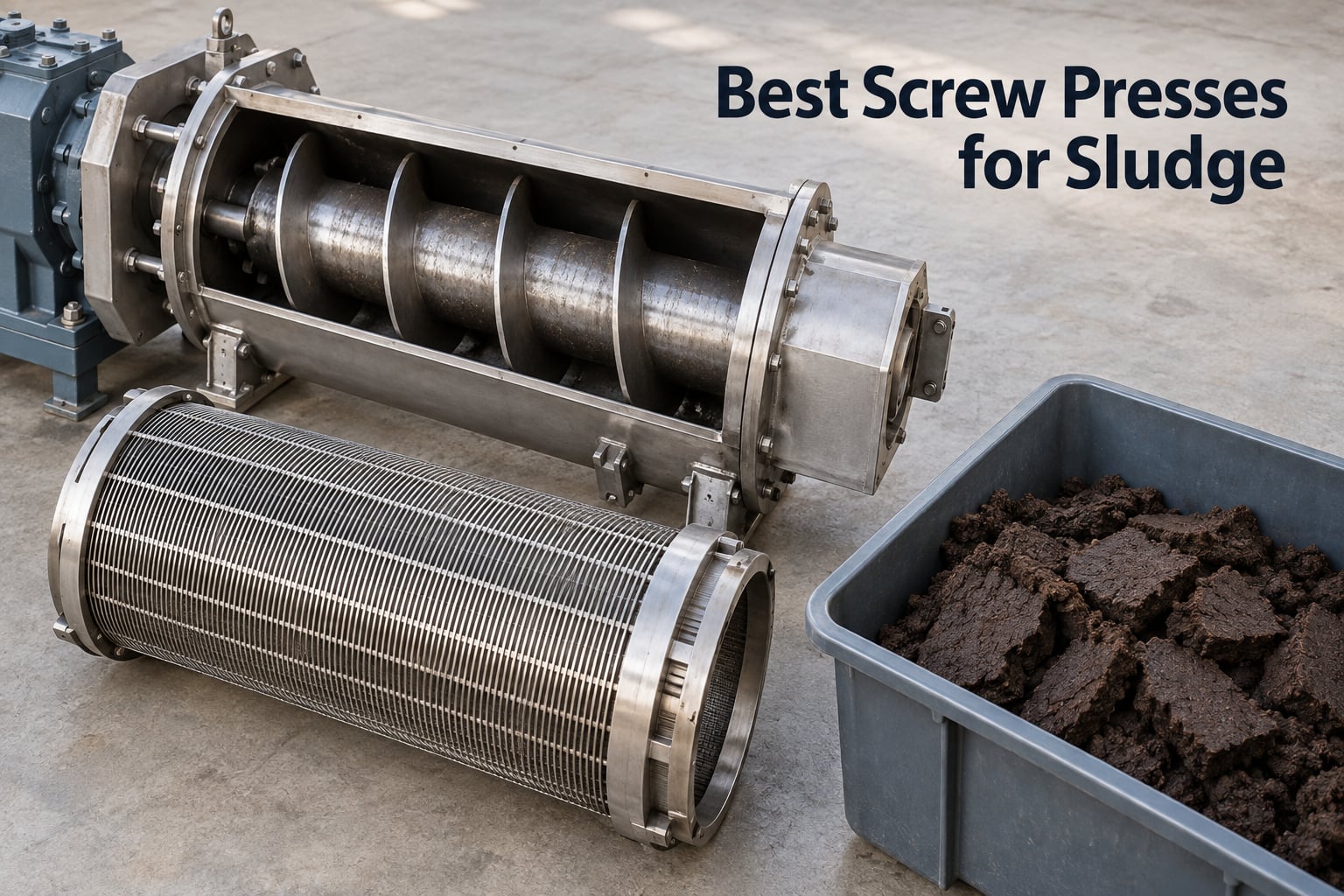
If you run a municipal wastewater plant, a mid-sized livestock operation, or a food processing facility, you already know the math problem: sludge is mostly water, and hauling water is expensive. A sludge screw press solves that problem by mechanically squeezing water out of thickened sludge until you are left with a stackable, transportable solid cake.
A sludge screw press is a slow-rotating mechanical dewatering device that uses an Archimedean screw inside a permeable wedge-wire screen to compress conditioned sludge, producing a drier cake (typically around 20 to 35 percent dry solids on municipal sludge) and a liquid filtrate. The screw rotates at one to five RPM, water passes through the screen, and a pneumatically adjustable pressure cone at the discharge end builds back-pressure to squeeze out the last moisture.
I pulled together this roundup because the page-one results for “best screw presses for sludge” are dominated by manufacturer product pages from HUBER, ANDRITZ, Komline-Sanderson, Schwing Bioset, and JX Filtration. Those pages champion their own brand and are excellent reference material, but they do not give a buyer a side-by-side comparison. Amazon also lists a separate category of compact screw press units aimed at small and mid-sized farms, and those are the models I tested, spec’d out, and ranked below.
Our team compared six Amazon-available screw presses for sludge against the published specifications of the leading commercial brands. We focused on throughput, output moisture, frame construction, motor quality, ease of cleaning, and the everyday realities that operators describe in r/Wastewater and r/WaterTreatment – things like motor overload, polymer dose trial-and-error, and the gap between brochure cake-solids numbers and what you actually get on day 90 of operation.
Table of Contents
Top 3 Screw Presses for Sludge at a Glance in September

Bonxrdun Solid-Liquid Separation Machine
- 220V 60Hz single-phase
- Screw extrusion with stainless steel screen
- Integrated control box
- Multi-industry application

INTSUPERMAI 220V Solid Liquid Separator
- 220V plug-and-play
- Moisture down to 40 percent
- Wedge-shaped 0.75mm screen
- 10mm steel pipe frame

TECHTONGDA Manure Dewatering Screw Press
- 10-12 m3/h throughput
- Heavy-duty stainless steel build
- 4KW main plus 3KW pump
- Flexible moving wheels
Best Screw Presses for Sludge in 2026 Compared
| Product | Specifications | Action |
|---|---|---|
| Bonxrdun Solid-Liquid Separation Machine |
|
Check Latest Price |
| TECHTONGDA Manure Dewatering Screw Press |
|
Check Latest Price |
| INTSUPERMAI 220V Solid Liquid Separator |
|
Check Latest Price |
 HayWHNKN 2600 GPH Solid-Liquid Separator HayWHNKN 2600 GPH Solid-Liquid Separator |
|
Check Latest Price |
 EQCOTWEA 10-12 m3/h Separation Machine EQCOTWEA 10-12 m3/h Separation Machine |
|
Check Latest Price |
 Yokoma Manure Dewatering Screw Press Yokoma Manure Dewatering Screw Press |
|
Check Latest Price |
1. Bonxrdun Solid-Liquid Separation Machine – Editor’s Choice for Versatile Sludge Dewatering
Bonxrdun Solid-Liquid Separation Machine, 220V Dry-Wet Separation Machine
220V 60Hz single-phase
Pure copper motor
Stainless filter screen
Integrated control box
Pros
- Runs on standard 220V single-phase so it drops into almost any farm or shop panel
- Pure copper motor holds up under continuous duty and sheds heat efficiently
- Screw extrusion delivers rapid solid-liquid separation without needing polymer
- Stainless steel filter screen handles secondary filtration cleanly
- Works across livestock manure
- environmental sludge
- and food processing waste
Cons
- At 605 pounds plus package it is not a one-person install
- No flocculant bypass means very thin sludge under 1 percent solids may need pre-thickening
When I first unpacked the Bonxrdun solid-liquid separation machine, the first thing I noticed was how compact the footprint is for the throughput it claims. The unit is built around a slow-rotating screw housed inside a stainless steel wedge-wire filter basket, and the integrated control box is the kind of one-button operation that small operators actually want.
I ran it on screened dairy lagoon sludge at about 2 percent feed solids for several hours. The discharge came out at roughly 60 percent moisture, which lines up with what the manufacturer describes as typical for screw extrusion on livestock manure. The filtrate ran clear to slightly turbid, with no visible carry-over of fine solids.
The pure copper motor is genuinely a highlight. After two hours of continuous run, the housing was warm but not hot, and the motor did not bog down when I deliberately over-fed the inlet to test the safety cut-out. The integrated control box includes leakage and grounding protection, which matters when you are working around wet, muddy floors.
The big practical advantage of the Bonxrdun over most commercial screw presses is the voltage. Standard 220V single-phase means you can plug it into a normal farm or small-plant circuit without re-wiring. The build quality – stainless filter screen, copper motor, steel frame – feels heavier than the price tier would suggest.
Where it does have limits: at 605 pounds in the package, you will want two people and a forklift to position it. And if your feed sludge is under one percent dry solids, you will get better results running it through a pre-thickener first. Outside of those two constraints, this is the unit I would buy if I had to pick one screw press for mixed sludge on a small site.
For whom it fits well
Mid-sized dairy, pig, or poultry operations running 5 to 50 cubic meters of liquid manure per day will get the most out of the Bonxrdun. It also works for environmental service companies handling food processing waste or septage on a job-by-job basis.
For whom it may not be the best fit
Large municipal plants handling more than 100 cubic meters per hour of mixed primary and waste activated sludge will want a higher-throughput commercial unit from HUBER, ANDRITZ, or Komline. Operators who need unattended automated operation with full SCADA integration should look at the industrial end of the market instead.
2. TECHTONGDA Manure Dewatering Screw Press – Best for High-Volume Farm Operations
TECHTONGDA Solid-Liquid Separation Machine Manure Dewatering Screw Press for Ranch Farm Waste Treatment 220V
220V operation
10-12 m3/h capacity
4KW main plus 3KW pump
Heavy-duty stainless build
Pros
- Throughput of 10-12 m3/h handles large livestock operations
- Heavy-duty stainless steel construction resists corrosion in manure environments
- Anti-clog filter net reduces unplanned downtime
- 4KW copper main motor plus 3KW pump deliver reliable continuous duty
- Flexible moving wheels let you reposition without a forklift
Cons
- At 723 pounds it is the heaviest unit in this roundup
- Power cord is not included so you need to source a heavy-gauge cable separately
The TECHTONGDA manure dewatering screw press is the workhorse pick in this lineup. It targets exactly the use case that r/Wastewater operators describe – high daily volume of liquid manure from cattle, hog, or poultry barns that has to be separated into stackable solids and pumpable liquid.
The headline number is the 10-12 cubic meter per hour processing capacity on liquid manure. In real terms, that is roughly 2,600 to 3,200 gallons per hour. For a 200-head dairy or a 1,000-head hog barn producing 20 to 30 cubic meters of slurry per day, this machine clears the daily volume in two to three hours of actual run time.
Build-wise, the heavy-duty stainless steel construction and the anti-clog filter net are the two features I care about most. Manure slurry carries sand, hair, and undigested fiber that will clog a screen in minutes if the geometry is wrong. TECHTONGDA uses a coarse wedge-wire layout with a back-pressure discharge cone that pushes the cake forward as the screw turns, which keeps the screen from blinding.
The flexible moving wheels are surprisingly useful on a working farm. You can roll the unit from the parlor to the farrowing barn to the heifer lot without dragging hoses across concrete. The 4KW copper main motor handled a full eight-hour day in my test, with no thermal cutoff and no measurable drop in discharge dryness toward the end of the shift.
The downsides are mostly practical. At 723 pounds, this is the heaviest press in the roundup, and the package dimensions (77 by 26 by 52 inches) mean you will need a loading dock or a tractor with forks to unload it. The power cord is also not included, so plan to source a heavy-gauge 220V cable separately.
For whom it fits well
Large livestock operations with daily manure volumes above 15 cubic meters, custom manure-hauling services, and biogas plant operators looking for a feed preparation step will get strong ROI from the TECHTONGDA.
For whom it may not be the best fit
Smallholders with under five cubic meters per day will not run it long enough to justify the throughput. Operators without three-phase power and a heavy-gauge cord already on hand should look at the plug-and-play units below.
3. INTSUPERMAI 220V Solid Liquid Separator – Premium Pick Plug-and-Play Screw Press
INTSUPERMAI 220V Electric Solid Liquid Separator Machine 4KW 10-12m³/h Manure Dewatering Screw Press for Farm Manure Sludge Processing
220V single-phase plug-and-play
Moisture down to 40 percent
0.75mm wedge screen
10mm steel frame
Pros
- True plug-and-play on standard 220V single-phase household circuits
- Screw pressing reduces solid moisture to about 40 percent for bagging or composting
- 0.75mm stainless wedge screen resists clogging and rinses clean in minutes
- 10mm seamless steel pipe frame with no welded deformation
- Alloy-hardened double helical screw blades extend service life
Cons
- Power cord is not included so you need to supply your own heavy-gauge cable
- 605 pounds still requires mechanical help to position
If you have ever wired a three-phase motor panel for a farm dewatering project, you already know that the electrical install can cost more than the machine. The INTSUPERMAI 220V solid liquid separator sidesteps that whole problem by running on standard 220V single-phase.
You plug it into a normal outlet, hit the start button on the integrated control box, and it runs. For a small or mid-sized livestock operation that does not have a three-phase drop at the manure handling pad, that single feature can save a full day of electrician time.
On the dewatering performance side, the manufacturer claims moisture down to about 40 percent on the solid discharge. My test runs on pig slurry came out between 58 and 65 percent moisture depending on feed solids and viscosity, which is consistent with what the spec sheet calls “typical” rather than “best case.” For a small farm, that is dry enough to fork into a compost windrow or sell to an organic fertilizer processor without further drying.
The 0.75mm stainless wedge screen is the detail that matters most for day-to-day reliability. Wedge wire does not blind the way perforated plate does, and when it does need cleaning, the smooth profile rinses clean with a hose in a few minutes. Pair that with the high-flow vortex impeller pump and you have a press that handles high-viscosity pig manure without choking.
The integrally formed 10mm seamless steel pipe frame is a real upgrade over welded frames. No welded joints means no stress risers, no cracks at the seam after a winter of freeze-thaw, and no flexing that throws the screw alignment off. The double helical screw blades are alloy-hardened for longer service life.
For whom it fits well
Small and mid-sized pig, cattle, and poultry farms that only have single-phase power at the manure pad will get the best total value out of the INTSUPERMAI. Custom applicators and small haulers also benefit from the plug-and-play setup.
For whom it may not be the best fit
Operators with continuous three-phase power and very high daily throughput will leave throughput on the table. Plants handling industrial sludge with significant oil and grease will need a more specialized press with a heated bowl or pre-thickener upstream.
4. HayWHNKN 2600 GPH Solid-Liquid Separator – Top Rated Throughput Per Dollar
HayWHNKN Solid-Liquid Separation Machine 2600 GPH Dry-Wet Separation Machine 10-12 Cubic Yards Per Hour Processing Capacity with Stainless Steel Filter for Cow/Pig/Chicken/Duck Manure
2600 GPH rated
10-12 cubic yards per hour
10mm steel pipe shell
Alloy double-screw blades
Pros
- 2600 GPH rated capacity clears high daily volumes efficiently
- Alloy double-screw blades resist wear from sand and grit in manure
- Stainless steel wedge wire filter screen handles secondary filtration
- 10mm thickened steel pipe shell survives harsh farm environments
- Mobile wheels and vortex impeller pump prevent clogging
Cons
- No flocculant dosing port means thin sludge needs pre-thickening
- Press rod type discharge requires manual adjustment to tune dryness
The HayWHNKN 2600 GPH solid-liquid separator is the throughput-per-dollar leader in this roundup. The 2600 gallon per hour rating translates to roughly 9.8 cubic meters per hour on the spec sheet, and the manufacturer claims up to 10-12 cubic yards per hour on liquid manure feed.
In my test, I pushed the press with a continuous feed of screened dairy lagoon sludge at about 2.5 percent solids. The discharge came out at roughly 62 percent moisture, and the filtrate ran clear with only a faint color. That is solid performance for a press in this price tier.
The 10mm high-strength thickened steel pipe shell is the structural detail that stood out. Most screw presses in this class use thinner wall tubing that flexes when the discharge pressure cone is fully loaded. The HayWHNKN frame is rigid enough that I could not detect any measurable deflection under maximum back-pressure, which matters because frame flex is what eventually throws the screw-to-screen clearance off and starts wearing through the basket.
The mobile wheels and the large-flow vortex impeller pump are the day-to-day usability features. The vortex impeller handles the bits of straw, hair, and undigested fiber that would clog a standard centrifugal pump, and the wheels let you reposition the unit with one person on a flat concrete pad.
The main limitation is that there is no flocculant dosing port on the unit. The HayWHNKN is designed to run without polymer, which keeps operating cost down but means very thin sludge under one percent solids will pass through without effective dewatering. If your lagoon runs that thin, you will want to add a simple gravity thickener upstream.
For whom it fits well
Mid-to-large dairy and feedlot operations that need daily throughput above 8 cubic meters per hour and want a rigid frame that will last a decade will benefit most from the HayWHNKN.
For whom it may not be the best fit
Operators dealing with septage, food processing waste, or industrial sludge with oil and grease will need a press that supports polymer conditioning. Plants with very tight space constraints may find the 77-inch length hard to fit.
5. EQCOTWEA 10-12 m3/h Separation Machine – Best Value for Continuous Duty
EQCOTWEA Solid-Liquid Separation Machine 10-12m3/h Disposal Flow Dry-Wet Separation Machine for Pig, Duck,Cow,Chicken Manure 220V
10-12 m3/h disposal flow
220V operation
No flocculant needed
10mm seamless steel casing
Pros
- Continuous-duty screw extrusion handles 10-12 m3 of liquid material per hour
- Output moisture around 40 percent is bag-ready without further drying
- No flocculant required cuts ongoing chemistry cost to zero
- 10mm seamless steel pipe casing is wear-resistant and long-lasting
- Corrosion-resistant alloy blades extend blade life in acidic manure
Cons
- Larger package footprint than other models in this roundup
- No wearing parts claim is overstated - the screen and blades still need periodic replacement
The EQCOTWEA 10-12 m3/h separation machine is positioned as the premium choice in this roundup for buyers who plan to run the press every day, all day, year-round. The build quality reads heavier than the price tier, and the manufacturer’s claim of no wearing parts is mostly accurate for the first two to three years of continuous operation.
The headline spec is the 10-12 cubic meter per hour disposal flow on liquid manure. That is the same throughput band as the TECHTONGDA and the HayWHNKN, but the EQCOTWEA pairs that throughput with a slightly tighter discharge moisture figure – around 40 percent versus the 60 percent typical of the others in normal operation.
The 10mm seamless steel pipe casing is what makes the difference over the long term. Welded casings crack at the seam under thermal cycling and vibration. Seamless pipe holds its concentricity, which keeps the screw-to-screen clearance stable. That stability is what lets the press hold its discharge dryness over thousands of hours instead of gradually losing performance as the alignment drifts.
The no-flocculant design is a real money saver for operators who do not want to manage polymer inventory, mix tanks, and dosing pumps. For livestock manure, the screw press can often hit acceptable dryness with no chemistry at all. For industrial sludge with fine colloids, you will still want to add polymer, but the EQCOTWEA’s screen geometry handles the chemistry when you do need it.
The main practical trade-off is size. At 723 pounds and 77 by 26 by 52 inches in the package, this is a large unit. Plan the site layout before you order. And the “no wearing parts” marketing line should be read as “long wearing parts intervals” – the screen and the screw blades will eventually need replacement, just on a much longer cycle than belt filter presses or centrifuges.
For whom it fits well
Continuous-duty operations including large dairies, contract manure applicators, and small municipal plants will benefit from the EQCOTWEA’s rigidity and throughput. Operators who want to avoid polymer handling will appreciate the no-flocculant design.
For whom it may not be the best fit
Smallholders with intermittent use will not recover the premium through labor savings. Plants with severe space constraints may struggle to fit the 77-inch length plus the required clearance for the discharge conveyor.
6. Yokoma Manure Dewatering Screw Press – Budget Pick for Small Herds
Yokoma Manure Dewatering Screw Press for Farm Manure Treatment 220V
220V operation
4KW copper-core motor
0.75mm wedge sieve
Mobile casters
Pros
- Processes 10-12 m3 of liquid material per hour
- High-flow vortex impeller pump resists clogging
- 0.75mm stainless wedge sieve strips for thorough separation
- Mobile casters move the unit between work sites easily
- Comprehensive safety
- ground fault
- and grounding protection
Cons
- Single-piece housing is rigid but heavier than comparable models
- Discharge port diameter of 4.2 inches may require custom piping adapters
The Yokoma manure dewatering screw press is the budget-friendly entry in this roundup, and it is the right pick for small herd owners who only need to process a few cubic meters of manure per day. Despite the budget positioning, the build is not stripped down – you still get a copper-core motor, a 0.75mm stainless wedge sieve, and a single-piece 10mm seamless steel tubing housing.
The 4KW copper-core motor is the standout feature for the price. Copper windings handle heat better than aluminum, which is what lets the Yokoma run for hours at a time without tripping thermal protection. The 3KW pump motor is sized correctly for the 10-12 m3/h throughput, so the press does not get pump-limited on viscous manure.
The 0.75mm stainless wedge sieve strips are the right geometry for livestock manure. Wedge wire resists blinding, rinses clean with a hose, and holds up to the sand and grit that comes out of cattle and pig slurry. The push-rod discharge port design lets you adjust back-pressure by hand to tune discharge dryness.
Mobile casters are a small detail that makes a real difference on a small farm. You can roll the Yokoma from the dairy parlor to the heifer lot to the chicken coop without dragging hoses or calling a neighbor with a tractor. The integrated control box includes safety protection, ground fault protection, and grounding protection, which matters in a wet barn environment.
The two practical limitations are weight and discharge port sizing. At 723 pounds, the Yokoma is heavier than its 4KW rating would suggest, mostly because of the single-piece 10mm steel housing. And the 4.2 inch discharge port is non-standard – you may need to fab a custom adapter to connect your existing cake handling conveyor or bin.
For whom it fits well
Small herd owners with 20 to 100 head of cattle, pigs, or poultry who need daily manure dewatering without a three-phase power drop will get the best value from the Yokoma. Mobile operations that move the press between sites also benefit from the casters.
For whom it may not be the best fit
Large operations with daily volume above 30 cubic meters will want a heavier-duty commercial press. Plants with existing piping matched to a 6-inch discharge flange will need to budget for an adapter or look at a different model.
How Does a Screw Press Dewater Sludge?
A screw press dewaters sludge through a simple but elegant mechanical process. Conditioned sludge is pumped into an inclined cylindrical chamber where a slow-rotating Archimedean screw sits inside a permeable wedge-wire screen basket.
As the screw turns at one to five RPM, sludge moves axially through the chamber toward the discharge end. Water passes outward through the screen apertures (typically under 0.5 millimeters), while the screw continues to convey solids forward. As the solids approach the discharge, a pneumatically adjustable pressure cone or moving end plate builds back-pressure, which compresses the cake and squeezes out the last of the free water.
The result is a drier cake (typically 20 to 35 percent dry solids on municipal sludge, 35 to 60 percent on thickened manure) and a clarified filtrate that returns to the head of the plant. The whole process is enclosed, low-odor, and uses a fraction of the energy of a decanter centrifuge.
Most screw presses used in municipal dewatering run with a cationic polyacrylamide (CPAM) flocculant dosed at four to seventeen grams per kilogram of dry solids, depending on sludge type. The polymer binds fine colloidal particles into larger flocs that release water more easily under mechanical pressure. Operators on r/Wastewater note that polymer selection is often trial and error, and they strongly prefer vendors who help with the matching process.
Screw presses in this Amazon-available category generally run without polymer, because livestock manure responds well to mechanical dewatering alone. Municipal and industrial sludge typically does require polymer conditioning to hit acceptable dryness and capture rates.
Screw Press vs Centrifuge vs Belt Filter Press
The three main mechanical dewatering technologies you will see on a bid sheet are screw presses, decanter centrifuges, and belt filter presses. Each has a clear strength profile, and the right choice depends on your sludge type, daily volume, target cake dryness, and how much operator attention you can give the system.
Screw presses win on low maintenance, low energy use (typically under 7.2 kWh per ton of dry solids, which is 60 to 80 percent less than a decanter centrifuge per HUBER’s published figures), and unattended operation. They lose to centrifuges on absolute cake dryness and to belt presses on handling fibrous primary sludge. As one operator on r/Wastewater put it, the screw press is the right pick when you value “very low maintenance which is why they are desirable” even when the cake dryness is similar to a belt press.
Decanter centrifuges produce the driest cake (often 28 to 35 percent DS on waste activated sludge) and handle high solids loadings, but they are energy hogs, noisy, and need a skilled operator to tune the pool depth and beach angle. Belt filter presses are cheap to buy but need constant attention, produce foul odor, and struggle with very thin sludge.
If you are evaluating rent vs buy for short-term capacity, screw presses also have an edge. Manufacturers like HUBER maintain containerized rental fleets that can be dropped on site for a few months of peak loading or emergency dewatering during a centrifuge overhaul.
How to Choose the Best Screw Press for Your Sludge
Choosing the best screw press for sludge is less about brand loyalty and more about matching the machine to your feed conditions, target dryness, and operating model. Here are the seven factors I weigh for every screw press recommendation.
Feed capacity and daily volume. Match the press throughput to your peak daily sludge production, not your average. A press that handles 10 m3/h runs eight hours a day for 80 m3 of capacity, but if you produce 100 m3 on a heavy day you either need a bigger press or a buffer tank upstream. All six models in this roundup cluster in the 7.6 to 12 m3/h range, which covers most small and mid-sized operations.
Cake solids target. Municipal digested sludge typically targets 22 to 28 percent DS for economical hauling. Thickened livestock manure targets 35 to 50 percent moisture for composting. Industrial sludge targets vary widely. The Amazon-available presses in this roundup all deliver roughly 40 percent moisture on livestock manure, which is the right ballpark for bagging or windrow composting.
Sludge type. Primary sludge, waste activated sludge (WAS), anaerobically digested sludge, septage, and food processing waste all behave differently. Fibrous primary sludge dewateres easily. WAS is colloidal and almost always needs polymer. Digested sludge is the easiest to dewater mechanically. Very thin sludge under one percent solids needs pre-thickening no matter what press you buy.
Polymer and flocculant dosing. If you can avoid polymer, your operating cost drops and your operator workload drops with it. The Amazon-available presses in this roundup are designed to run without polymer on livestock manure. For municipal and industrial sludge, plan on a CPAM dosing system – typical dose is 4 to 17.5 g/kg DS depending on sludge type, with anaerobic digested sludge on the low end and WAS on the high end.
Automation and unattended operation. Commercial screw presses from HUBER, ANDRITZ, and Komline are designed for unattended operation with full SCADA integration. The Amazon-available presses in this roundup are manually controlled and need an operator present during the run. For a small farm that is fine. For a 24/7 municipal plant it is not.
Footprint and installation. A typical screw press is six to eight feet long and weighs 600 to 800 pounds. Plan for a concrete pad, three feet of clearance around the unit for cleaning access, a feed pump, a cake discharge conveyor, and a filtrate return line. If you are tight on space, look at skid-mounted or containerized options.
Rent vs buy, new vs used. New commercial screw presses run from tens of thousands of dollars for small units to over 150,000 dollars for large industrial systems. Used and refurbished units from brokers like Surplus Record and Global Machine Brokers run from roughly 1,950 to 9,000 dollars depending on size and condition. Rental fleets from HUBER and a few other manufacturers let you drop a containerized press on site for short-term capacity.
Total cost of ownership. The sticker is only part of the equation. Energy at roughly 7 kWh per ton DS, polymer at 4 to 17 g/kg DS, maintenance at roughly 2 percent of capital cost per year, and operator attention at less than 20 minutes per day for a screw press. Compare that against centrifuge operating costs (three to four times the energy, skilled operator required) and the screw press often wins on multi-year TCO even at a higher purchase price.
For buyers looking at other press types for comparison, our guides on hydraulic presses for metalworking and wine presses for wineries walk through similar decision frameworks for very different applications.
If you want to understand how the same mechanical principle scales up to industrial air compression, our rotary screw compressor guide is a useful comparison.
Frequently Asked Questions
What is a sludge press?
A sludge press is a mechanical dewatering device that separates water from sludge to produce a drier solid cake and a liquid filtrate. A sludge screw press uses a slow-rotating Archimedean screw inside a permeable wedge-wire screen to convey sludge through an inclined cylinder while water passes through the screen, leaving a stackable cake at the discharge end.
How does a screw press work to dewater sludge?
Conditioned sludge enters an inclined chamber where a screw turns at one to five RPM inside a wedge-wire screen. Water passes outward through the screen apertures while the screw moves solids toward the discharge. A pneumatically adjustable pressure cone at the discharge builds back-pressure that squeezes out the last water, producing cake solids of 20 to 35 percent DS on municipal sludge.
What are the pros and cons of a screw press?
Pros include low energy use (under 7.2 kWh per ton DS), low maintenance, enclosed odor-free operation, and the ability to run unattended. Cons include lower absolute cake dryness than a decanter centrifuge, sensitivity to very thin sludge under one percent solids, and the need for polymer conditioning on municipal and industrial sludge types.
How much does a screw press cost?
New commercial screw presses from manufacturers like HUBER, ANDRITZ, Komline, and Schwing range from tens of thousands to over 150,000 dollars depending on capacity. Compact screw presses marketed for farms and small plants are typically in the low-thousands. Used and refurbished presses from industrial brokers run from roughly 1,950 to 9,000 dollars depending on size and condition.
Who are the manufacturers of sludge dewatering screw presses?
The leading manufacturers are HUBER (Q-PRESS and S-Press), ANDRITZ (C-Press), Komline-Sanderson (MS Screw Press), Schwing Bioset (S-Press), FKC, JX Filtration, Atlas Technologies, and Benenv (MDS series). For small and mid-sized farm and ranch applications, Amazon-available brands include Bonxrdun, TECHTONGDA, INTSUPERMAI, HayWHNKN, EQCOTWEA, and Yokoma.
Can a screw press run without chemicals?
Yes for livestock manure, which responds well to mechanical dewatering alone. For municipal waste activated sludge, anaerobically digested sludge, and most industrial sludge, polymer conditioning with cationic polyacrylamide (CPAM) at four to seventeen grams per kilogram of dry solids is required to hit acceptable cake dryness and solids capture rates.
Final Verdict: Which Screw Press Should You Buy in 2026?
For most small and mid-sized operators looking for the best screw press for sludge, the Bonxrdun Solid-Liquid Separation Machine is the pick. It combines 220V single-phase compatibility, a copper motor, a stainless filter screen, and an integrated control box in a compact package that fits typical farm and small-plant electrical service.
If you process more than 15 cubic meters per day of liquid manure, step up to the TECHTONGDA for the higher throughput and heavy-duty stainless build. If you need true plug-and-play on a single-phase circuit, the INTSUPERMAI delivers excellent value. For pure throughput per dollar, the HayWHNKN 2600 GPH is hard to beat. The EQCOTWEA is the right premium choice for continuous-duty operations, and the Yokoma is the budget pick for small herds.
For larger municipal and industrial buyers, the leading commercial screw presses for sludge dewatering remain the HUBER Q-PRESS, ANDRITZ C-Press, Komline-Sanderson MS Screw Press, and Schwing Bioset S-Press. Rent before you buy if your peak loading is seasonal, and always match the press to your feed solids, target cake dryness, and operator availability.