
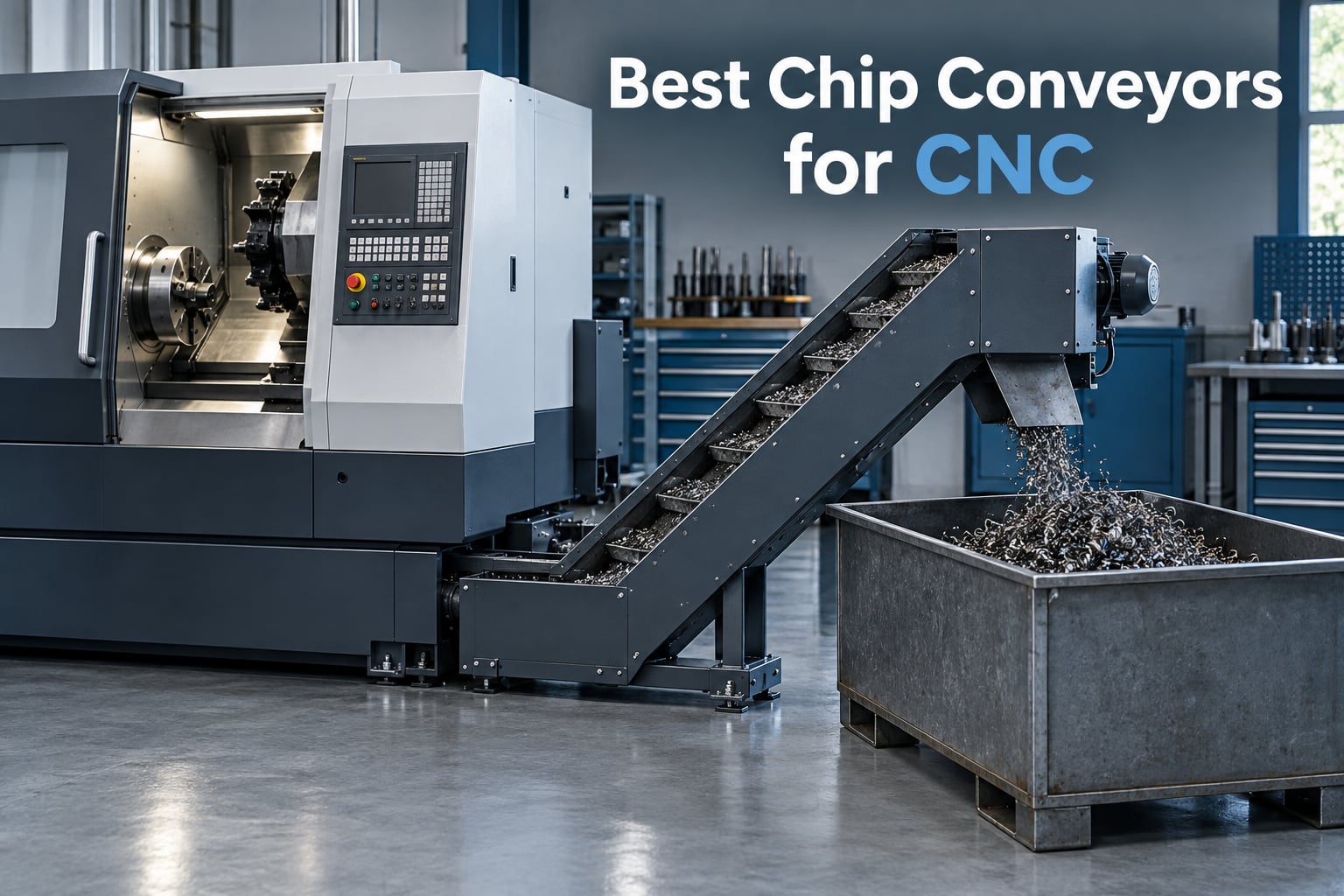
Chip handling is the least glamorous part of CNC production and the one that quietly eats your week. When a part drops 60 pounds of aluminum swarf into the pan, someone stops cutting, opens the door, and spends an hour with a shovel and a bucket. A chip conveyor fixes that, and the best chip conveyors for CNC take the whole job off the operator’s hands so the spindle keeps turning between parts.
Our team spent weeks reading shop reports, manufacturer catalogs, and owner threads on machining forums to work out which conveyor design actually survives contact with real metal. We narrowed the field to seven incline chain-plate machines, the format that dominates the current crop of purchasable chip conveyors, and compared them on construction, power draw, published dimensions, and how each one handles the chip shapes that cause jams.
One thing to say up front: not every shop needs one. If you run a single low-volume spindle and clear the pan twice a day with a brush, a conveyor is a luxury. If you are running aluminum, stainless, or cast iron in volume, or you are trying to get to unattended production, the math changes fast. We will show you where the line falls.
Before we get into the machines, it helps to know that conveyor selection is a different problem from most other CNC accessories. Nobody buys a chip conveyor on brand loyalty alone. They buy it on whether the chain path, the bottom drive, and the infeed geometry suit the chip morphology coming off their own parts. We will come back to that in the buying guide.
Table of Contents
Types of Chip Conveyors Explained
There are five main families of chip conveyor, and each one is built around a different way of gripping a moving chip. Belt-style machines use interlocking hinged steel plates, scraper machines drag chips with bars on a chain, magnetic machines slide them on a moving magnetic bed, screw machines rotate an auger through a tube, and pneumatic machines blow them through ducting. The right answer depends almost entirely on chip shape and material.
For general CNC turning and milling in ferrous, non-ferrous, and cast iron work, the hinged belt and the scraper drag chain are the two workhorses. Everything else is a specialist answer to a specialist chip problem.
Here is how the five types compare, and where each one gives up.
Belt-style conveyors, including hinged belt and steel belt designs, carry chips on overlapping articulated plates or a continuous steel band. They handle broken chips, short coils, and heavy swarf well, drain coolant through perforations, and take up a lot of vertical space. The plates wrap chips around the drive end, so they need regular running to keep the material moving.
Scraper or drag chain conveyors use bars welded to a chain running inside a trough. They are aggressive with the material and tolerate bulky scrap, tangled chips, and long strand swarf that would defeat a belt. The design depends heavily on how the bottom of the trough is built, which we will get to in the failure section.
Magnetic slide conveyors use a magnetic belt or oscillating magnetic head to move ferrous chips with no physical gripping at all. They are quiet, simple, and cheap to maintain. Non-ferrous chips are not attracted and pass straight through, so a magnetic conveyor in an aluminum shop is a very expensive mistake.
Screw and auger conveyors rotate a flighting shaft inside a tube. They are cheap, compact, and fit under a machine, but they are also the least tolerant of stringy material, the quietest at high volume, and the type most often outgrown by the workload.
Pneumatic chip conveyors use air to blow chips down a duct. They move a lot of material with no moving contact parts, but they need a receiver at the far end, they separate coolant poorly, and they are noisy in a way that wears on people.
Our seven picks are all chain-plate incline machines, a construction where a continuous loop of hinged steel plates rides on a chain and lifts material up a slope to a discharge point. That format is the sweet spot for general CNC work because it grips broken and coiled chips across multiple metals without needing an auger tube or a magnetic bed.
Top 3 Picks for the Best Chip Conveyors for CNC in 2026

HayWHNKN Incline Chain-Plate Conveyor
- Handles coiled tangled and broken chips
- Works with lathes mills and machining centers
- High-strength chain plate
- 220V single phase

LGXEnzhuo 250W Chain-Plate Conveyor
- Precision-formed steel chain plate
- 250W 220V single phase
- Serviceable chain plate design
- Floor mounted

TECHTONGDA Incline Chain-Plate Conveyor
- Low chip adhesion on the chain plate
- Baking paint steel finish
- Easy chain plate replacement
- 250W 220V single phase
The HayWHNKN leads the group because its published construction claims cover the widest spread of chip shapes and materials, and its integrated-machinery description matches how most shops actually deploy a conveyor. The LGXEnzhuo is the straightforward middle of the pack, with the clearest dimensional data. The TECHTONGDA stands out for light debris handling, which matters if you are cutting small parts all day.
Because none of these listings carry customer ratings yet, we are not ranking on star averages. Everything below is based on published specifications, construction details, and how those details map to the failure modes shop owners actually report. We tell you exactly where that limits us.
Quick Picks Best Chip Conveyors for CNC in September
| Product | Specifications | Action |
|---|---|---|
| HayWHNKN Incline Chain-Plate Chip Conveyor |
|
Check Latest Price |
| LGXEnzhuo Chain-Plate Chip Conveyor |
|
Check Latest Price |
| TECHTONGDA Incline Chain-Plate Chip Conveyor |
|
Check Latest Price |
 EQCOTWEA Heavy-Duty Inclined Scrap System EQCOTWEA Heavy-Duty Inclined Scrap System |
|
Check Latest Price |
 Yokoma 191.8 lb Chain-Plate Conveyor Yokoma 191.8 lb Chain-Plate Conveyor |
|
Check Latest Price |
 INTSUPERMAI Adjustable-Incline Chip Conveyor INTSUPERMAI Adjustable-Incline Chip Conveyor |
|
Check Latest Price |
| Banfluxion 220V Chain-Plate Scrap Conveyor |
|
Check Latest Price |
Seven machines, one format, and the differences are narrower than the marketing suggests. Six of them share a 250 watt motor class, 220 volt single-phase power, and a steel body. The three that actually stand out are the Yokoma for published weight data, the INTSUPERMAI for adjustable incline and PLC integration, and the EQCOTWEA for frame mass.
If you want background on conveying equipment generally, our guide to gravity conveyors for packing covers the same sizing logic without the coolant and swarf complications. For the CNC side of the shop, we have also compared CNC plasma tables for metal.
1. HayWHNKN Incline Chain-Plate Chip Conveyor
HayWHNKN CNC Chain-Plate Chip Conveyor Incline Cnc Machine Belt Chip Conveyor Chip Removal for Waste Chip Collection Metal Filings CNC Conveyor 220V 1PH
Incline chain-plate conveyor
250W class on 220V single phase
292 lb item weight
Pros
- Handles coiled tangled and broken chips in steel aluminum and copper
- Integrates with CNC lathes mills machining centers and grinders
- High-strength chain plate built for heavy loads and long service life
- Automated removal cuts manual chip handling
Cons
- Heavy 292 lb unit needs planned placement and installation
- Single-phase 220V power configuration only
This is the machine we would put behind a general-purpose CNC lathe. The manufacturer states it suits CNC lathes, milling machines, machining centers, and grinding machines, which is a broad claim, but the chip types named alongside it, coiled, tangled, and broken, cover the three shapes that actually show up in general machining.
Material coverage is the part we like most. Steel, aluminum, and copper are all named, so this is not a ferrous-only design dressed up as a general machine. On a shop that runs a mix of jobs, that flexibility is worth more than any single specialty feature.
The construction claim is high-strength chain plate designed for heavy loads and long service life. We cannot verify that independently, because this listing has no customer ratings and no customer photos to check it against. Take it as a manufacturer statement rather than a field-tested one.
Integration is the other headline. The description frames the conveyor as something that pairs with the machine tool for automated removal rather than a standalone unit you shovel into. That is how you want it installed if you care about unattended cycles.
What to check before you buy
Weight comes first. At a 292 pound item weight, this is not a unit you walk into place with a hand truck after a long shift. Measure the floor area, confirm the discharge height clears your bin, and make sure two people can get it into position.
Second, confirm the electrical side. This is a 220 volt single-phase machine, not three-phase. Most shops already have that at the machine, but a few do not, and the gearmotor is the part you cannot easily change later.
Third, ask what is in the box and what the connection point looks like. There is no published port size on this listing, so the interface with your chip pan is a question for the seller, not something you can read off a spec sheet.
Who should skip it
Skip it if your shop runs mostly stringy plastic, PVC, or rubber. Chip plates grab tangled material, but the birds-nest type material that wraps around the drive end needs a run schedule and a chip breaker on the tool, not a better conveyor.
Skip it if your chip volume is genuinely low. A conveyor that runs a few minutes a week is a maintenance object with no payoff, and a brush and a bucket will serve you better.
Skip it if the discharge point lands somewhere chips can slide back into the machine. A conveyor solves transport. It does not solve a bin that fills into a cone under a fixed spout, and that is the problem owners hit in month one.
2. LGXEnzhuo 250W Chain-Plate Chip Conveyor
LGXEnzhuo CNC Chain-plate Chip Conveyor Metal Chip Conveyor Chain Plate Scrap Machine Steel Material for CNC Lathe Machine 220V/1PH
Floor-mounted chain-plate conveyor
250W 220V AC single phase
52 x 16.5 x 36.2 inch
Pros
- High-strength precision-formed steel chain plate resists impact and friction wear
- Chain plate reduces chip adhesion and scattering for cleaner collection
- Simple compact design makes chain plate replacement straightforward
- 250W motor draws little shop power
Cons
- Floor-mounted 291 lb unit needs a dedicated footprint
- No customer ratings available to validate long-term durability
This is the most straightforward machine in the group and the one whose specification sheet gives you the most to work with. Conveyor size is published at 52 by 16.5 by 36.2 inches, the power source is AC, and the mounting type is floor. Those three facts answer most of the questions you would otherwise spend an email thread on.
The chain plate is described as precision-formed high-strength steel with good impact resistance and low noise. The claim we find genuinely useful is reduced chip adhesion, because plates that let chips slide off instead of sticking to the surface are the difference between a conveyor you clear weekly and one you clear daily.
Maintenance is the quiet strength here. The design is called out as simple and compact with a chain plate that can be disassembled and replaced, which matters far more over five years than any headline feature. Chain wear is the normal failure point on this format, and a plate you can swap yourself changes the economics of that repair.
The 250 watt motor is modest. For a machine handling general chip volume that is appropriate, and it means the electrical install is trivial compared to a three-phase unit.
What to check before you buy
Confirm the 291 pound item weight against your floor plan. Floor-mounted means it takes a permanent footprint, so measure the clearance behind the machine and the run to your bin before the pallet arrives.
Ask about the port or connection interface. The published 52 by 16.5 by 36.2 inch envelope tells you the machine, not the connection to your chip pan, and the interface is the part that has to match.
Ask what is included. This listing names the conveyor and one accessory kit, which is a fair starting point, but wiper blades, a coolant return pan, and a fines pan are usually separate.
Who should skip it
Skip it if you need a low-profile unit. The published height of 36.2 inches is a standard incline format, not a machine that tucks under a low chip pan.
Skip it if you cut very heavy continuous swarf from large castings. A 250 watt motor is fine for general duty, and heavy foundry-type loads are what the frame is not sized for.
Skip it if you have no patience for a first-month commissioning period. With no customer ratings on the listing, you are the first field test, so budget time to watch it with different chip types.
3. TECHTONGDA Incline Chain-Plate Chip Conveyor
TECHTONGDA Incline CNC Chain-Plate Chip Conveyor 250W Machine Tool Plate Scrap Conveyor Machine Chip Removal Device Suitable for Metal Processing Equipment Single-Phase 220V
Incline chain-plate conveyor
250W 220V AC single phase
52 x 16.5 x 36.2 inch
Pros
- Light and small debris is less prone to adhering to the chain plate
- Baking paint surface treatment adds durability to the steel frame
- Chain plate is easy to disassemble and replace
- Handles coiled tangled and broken chips in three metals
Cons
- Heavy 292 lb machine requires adequate floor space and handling
- No published customer ratings to confirm service life
This machine makes a specific and useful claim: light and small debris is not prone to adhering to the chain plate. If you run small parts, thin wallings, or high-speed finishing work where the chip volume is small but constant, that is exactly the failure you would hit on a plate conveyor, and the manufacturer says this design resists it.
The body is steel with a baking paint surface treatment. On a machine that lives next to coolant and swarf, a proper coating is the difference between a frame that lasts and one that pits and rusts, so we like seeing it specified.
Chain plate replacement is called out again as easy to disassemble. This is the same advantage as the LGXEnzhuo and it is a real one, because on this conveyor format the plate is a consumable and you will replace it eventually.
Like the others, it handles coiled, tangled, and broken chips in steel, aluminum, and copper, and integrates with CNC lathes, mills, machining centers, and grinders. The application breadth is identical across this group, which tells you how standardized the format has become.
What to check before you buy
Ask about the discharge height and where the chips land. A 36.2 inch tall machine discharging into a short cart means chips pile under the spout and grow back toward the machine, which defeats the whole exercise.
Confirm the electrical supply is 220 volt AC single phase at 250 watts. The motor rating is small, so any dedicated circuit you need is modest.
Ask the seller for the connection detail, since no port size is published here. Bring the chip pan dimensions from your machine and confirm the interface before you commit.
Who should skip it
Skip it if you produce large, heavy chips in bulk. The low-adhesion advantage is aimed at small debris, and a shop throwing big chip volumes wants raw capacity rather than a clean surface finish on small pieces.
Skip it if you run under high-pressure flood coolant continuously. A conveyor that runs around the clock carries coolant out with the material, and the loss adds up.
Skip it if you need a machine that has already proven itself in service. There are no customer ratings on this listing, so all of the construction detail above comes from the manufacturer.
4. EQCOTWEA Heavy-Duty Inclined Scrap Removal System
EQCOTWEA CNC Chip Conveyor Heavy-Duty Inclined Chain-Plate Scrap Removal System for Lathes, Milling and Grinding Machines, Auto-Cleaning, 250W Industrial Grade 220V 1PH
Heavy-duty incline chain-plate system
250W 220V single phase
300 lb item weight
Pros
- Heaviest frame in the group at 300 lb for demanding chip loads
- Centralized scrap collection limits scattering and supports recycling
- Simple structure makes chain plate replacement quick and low-cost
- Smooth low-noise chain plates suit quiet shops
Cons
- Heaviest unit in the set so installation needs planning
- No customer ratings available to confirm real-world service life
This is the heaviest machine here at a 300 pound item weight, and we read that as a frame spec rather than a gimmick. Shops running cast iron, structural steel, or heavy swarf from big cuts want a frame that does not flex at the load, and mass is the cheapest way to get stiffness out of a welded structure.
The chip handling claim is broad: coiled, tangled, and broken, across steel, aluminum, and copper, for lathes, mills, machining centers, and grinders. Nothing about this listing suggests a specialty niche.
Centralized scrap collection is the feature that gets less attention than it deserves. Collecting chips in one place instead of letting them scatter around the machine base is what makes swarf recycling practical, and that is a genuine cost line once you start selling scrap or paying to have it removed.
Low-noise operation is claimed for the chain plates, which matters in a shop where the conveyor sits right next to the operator’s ear.
What to check before you buy
Plan the install properly. At 300 pounds, this is a two-person job with forklift access, and the machine also needs to be positioned before the chip pan connection is finalized.
Confirm the incline and discharge arrangement. This listing does not publish an adjustable slope, so check where the discharge lands before you commit to a fixed position.
Ask about the return path for coolant. Every incline conveyor either drains coolant along the way or dumps it into the bin, and that choice affects your coolant concentration over a month of running.
Who should skip it
Skip it if floor space is tight. The mass is a feature for heavy duty and a problem for a small shop, and there are lighter frames in this list that do general work.
Skip it if your material is soft or stringy. Heavier frames do not change how chip plates handle PVC or rubber, and the jamming problem there is about chip morphology, not machine weight.
Skip it if you only run light duty. You would be carrying dead mass around the shop floor for a load your application never produces.
5. Yokoma Chain-Plate Chip Conveyor With Published Net Weight
Yokoma 1PH Incline CNC Chain-Plate Chip Conveyor Machine Tool Scrap Conveyor Chain Plate Scrap Machine Metal Processing Lathe Scrap Convey Equippment for Convey Various Waste Chips, AC220V
Incline chain-plate conveyor
250W AC220V single phase
191.8 lb net weight with full dimensions
Pros
- Best published net weight in the set at 191.8 lb easing handling and placement
- Fully published dimensional and weight specs which is rare in this category
- Smooth low-noise chain plate run with minimal debris scattering
- Documented 12.2 x 6.3 inch port size for machine connection
Cons
- Heaviest gross shipping weight at 291 lb so freight handling matters
- No customer ratings available to gauge field performance
This is the only machine in the group that publishes a proper net weight, and that detail changes the buying conversation. At 191.8 pounds net, it is roughly 100 pounds lighter than the other frames, which matters when two people are positioning it or when you are moving it to clear floor space.
The rest of the spec sheet is unusually complete. Conveyor size is given in both inches and centimeters, the port size is 12.2 by 6.3 inches, the body material is steel with a baking paint finish, and power is AC220V single phase at 250 watts. You can lay this out on paper and check it against your machine before anyone is on a truck.
Net and gross weight are both stated, at 191.8 pounds net and 291 pounds gross. That is an honest disclosure and a useful one, because the difference tells you exactly how much packaging and pallet comes with it.
Chip coverage matches the group standard, covering coiled, tangled, and broken material from steel, aluminum, and copper across lathes, mills, machining centers, and grinders.
What to check before you buy
Use the published port size to check your interface first. A 12.2 by 6.3 inch port is a specific number you can compare against the chip pan opening on your machine, and it saves a compatibility argument later.
Confirm the discharge height will clear your bin. The 36.2 inch machine height plus the incline geometry determines where chips land, and that has to be above the rim of the container.
Ask about the accessory kit contents. The listing includes the conveyor and one accessory kit, so confirm the wiper and any drainage parts you need are inside it.
Who should skip it
Skip it if you are moving the machine frequently or working in a very tight footprint. A lighter frame helps, but a 52 inch long incline unit still needs a real lane behind the machine.
Skip it if freight arrival is going to be awkward. A 291 pound gross shipment is heavy to receive and move without a loading dock.
Skip it if you need documented field performance. Like the rest of this list, there are no customer ratings to draw a service-life conclusion from.
6. INTSUPERMAI Adjustable-Incline Chain-Plate Chip Conveyor
INTSUPERMAI Chain-Plate Chip Conveyor for CNC Machines, Heavy-Duty Scrap Conveyor 220V
Adjustable 30-60 degree incline
250W 220V single phase
65 dB or less with PLC auto-reverse
Pros
- Adjustable 30 to 60 degree incline matches slope to your scrap collector
- Motor overload protection guards against burnout on high-volume runs
- Only model here specifying PLC integration and auto-reverse
- Documented noise level of 65 dB or below
Cons
- Weight and dimensions are not published complicating freight and floor planning
- No customer ratings available to confirm performance
This is the most technically specified machine in the group, and the adjustable incline is the feature that separates it. A 30 to 60 degree slope range means you can match the conveyor to your bin height instead of building a stand or accepting a bad discharge angle, and that flexibility is worth a lot in a retrofit install.
Overload protection on the 250 watt motor is a sensible addition. Chip conveyors get overloaded, usually because a long stringy batch wraps the plates and the switchgear keeps trying to push through, and a protected motor turns a burnout into a stop.
PLC integration with an auto-reverse function is the one specification in the whole list with no equivalent elsewhere. A reversing cycle is how you clear a wrapped load, and being able to trigger it from your control instead of walking over with a wrench changes the day-to-day experience.
The chain plates are described as seamless perforated steel with a convex dot anti-clog pattern, aimed at long strand swarf and bulky scrap. Noise is published at 65 dB or less, which is a real number rather than a vague quiet claim.
What to check before you buy
Ask for the weight and dimensions, because they are not published. This is the one listing where floor planning and freight planning need a direct conversation with the seller, and you should have both numbers before ordering.
Confirm the PLC interface details: what signals it accepts, whether it interlocks with your machine control, and what the auto-reverse trigger actually looks like in practice.
Check the incline adjustment mechanism and how it locks. An adjustable slope that creeps under a full load will put you back where you started.
Who should skip it
Skip it if you have no control system to integrate with. PLC integration is the main premium here, and a standalone shop with a manual run switch gets little from it.
Skip it if you need a fully published spec sheet. The missing weight and dimensions mean more back-and-forth than any other machine on this list.
Skip it if stringy plastic is your main material. Anti-clog plate design helps, but no conveyor solves wrapped PVC, and that is a tooling and programming problem.
7. Banfluxion 220V Chain-Plate Scrap Conveyor
Banfluxion 220V Chain-Plate Scrap Conveyor Incline Chip Conveyor for CNC Lathes Milling Machines Machining Centers 250W 1PH
Incline chain-plate scrap conveyor
250W 220V single phase
Steel body with high-strength plates
Pros
- Smooth low-noise chain plate operation suits shops with strict working conditions
- Simple structure keeps chain plate replacement and maintenance costs low
- Broad material compatibility across steel aluminum and copper
- Works with CNC lathes mills machining centers and grinders
Cons
- Weight and dimensions are not published complicating freight and floor planning
- No customer ratings available to gauge field performance
This rounds out the group as a straightforward incline chain-plate conveyor with a steel body and high-strength plates. There is nothing exotic about it, and for a general job shop that is exactly what you want: a machine that does one job in a format other people have already learned to service.
The application list covers CNC lathes, milling machines, machining centers, and grinding machines, and the material list covers coiled, tangled, and broken chips in steel, aluminum, and copper. Same broad coverage as the rest, which tells you how tight this product category has become at the entry level.
Low-noise chain plate operation is claimed, and the maintenance story is the same as the other machines here, with a simple structure and straightforward chain plate replacement. Chain wear is the normal consumable on this format and easy replacement keeps that cost down.
Power is 220 volts single phase at 250 watts, which matches the rest of the group and keeps the electrical install simple.
What to check before you buy
Get the weight and dimensions in writing, since neither is published. That matters for freight and for confirming the machine fits between the chip pan and your bin.
Confirm the discharge height clears your container and that the chip discharge point sits far enough from the machine opening that chips cannot slide back in.
Ask what the accessory kit includes and whether a coolant return pan or wiper is part of it, because those are the parts that stop coolant from leaving with the chips.
Who should skip it
Skip it if you need documented dimensions to plan a retrofit. Unpublished specs make a tight install guesswork.
Skip it if your workload is heavy enough to need more than general duty capacity. This is a 250 watt class machine built for general CNC chip removal, not for foundry-scale swarf.
Skip it if you want documented field history. No customer ratings are published here, so treat all construction detail as a manufacturer claim.
How to Choose a Chip Conveyor for Your CNC
Start with the chip, not the machine. Chip morphology decides the conveyor type, and it is the single most useful thing you can bring to a sales conversation. A shop that runs broken short chips from cast iron can use almost anything. A shop turning PVC sleeves changes the whole conversation.
Step one is material. If you cut aluminum, rule out anything magnetic. Non-ferrous chips are not attracted to a magnetic conveyor, so the material simply passes under the head and you are left sweeping anyway. Owners running non-ferrous work have been blunt about this, and the expensive learning is common.
Step two is chip shape. Broken and short chips move on any mechanism. Coiled chips need grip, which is what hinged plates and scraper bars provide. Long stringy swarf needs a chain path that does not trap it, and it needs a run schedule. Powdery fines from aluminium or cast iron cut with flood coolant need drainage rather than grip.
Step three is volume per part. Weigh the chips from a few representative parts and multiply by parts per hour. That gives you the real load, which is usually higher than the shop estimate because nobody counts swarf until they are carrying it out.
Step four is capacity. The industry rule is to size the conveyor at about twice your calculated hourly load. That headroom covers peak bursts, and it is the difference between a machine that keeps up and a machine that backs up mid-batch.
Step five is geometry. Measure the chip pan opening, the height of the discharge above the floor, the length of the lane behind the machine, and the distance from the machine to the bin. Our picks publish 52 by 16.5 by 36.2 inch envelopes on most machines, so you can lay the footprint out before you order.
For a broader look at how material moves around a shop, our firewood conveyor guide covers the same incline-versus-flat decisions with a different payload in mind.
Sizing, Power and Footprint Specs Buyers Miss
Infeed height and discharge height are the two numbers that decide whether a machine works in your shop, and they are the two most often left out of a conversation. Infeed height is where the conveyor enters the chip pan. Discharge height is where the chips leave it and land in your container.
Get the discharge above the rim of the bin with clearance, not level with it. When they are level, chips build a cone at the landing point, the cone grows back toward the machine, and you are back to manual clearing on a schedule you did not choose. This is the single most common complaint we found among owners running lights-out work.
Power is simpler than most buyers expect. Every machine in this roundup runs on 220 volts AC single phase at 250 watts, which is a small dedicated load most shops can already serve. Larger industrial conveyors step up to 230 or 460 volt three-phase, so confirm the phase before you buy rather than after.
Belt or trough width is the third number to pin down. It has to be wide enough for the chip volume you calculated and narrow enough to clear the chip pan opening. A machine that is too wide will not fit under the pan, and a machine that is too narrow will back up.
Footprint is where retrofit plans get realistic. A conveyor discharge sticks out considerably further than an auger spout, and a machine that fits its current cell may no longer fit once the conveyor is added. Measure the full run, not just the machine base.
Finally, think about the container, not just the conveyor. A wide shallow bin is far better under a fixed discharge than a deep narrow one, because the chips spread instead of coning. If your bin is the wrong shape, the conveyor will not save you.
What Actually Drives Chip Conveyor Cost
Price in this category tracks four things and little else: drive capacity, frame mass, how much of the control package is included, and how much custom work is needed to match your machine. The spread between a general duty incline machine and a heavy central system is enormous, and most of that gap is the fourth item.
Frame and drive come first. Heavier steel and a larger motor handle more volume and last longer, and that is where the incremental cost lives. The 300 pound frame in this roundup and the 191.8 pound net frame are both defensible choices for different workloads, and the difference between them is a real cost difference rather than a marketing one.
Controls and automation come second. Overload protection, an auto-reverse cycle, and PLC integration are genuine engineering additions that most entry machines leave out. You pay for them in the machine and you get back interval running, jam recovery, and the ability to automate the clearing cycle.
Interface work comes third. Matching the conveyor to an existing chip pan, adding a discharge extension, and adding coolant drainage are where retrofit costs hide. A factory-enabled machine with a matching conveyor interface is straightforward. A retrofit can be straightforward too, but only if you ask the questions about interface and footprint before the order, not after.
Labor is the return side of the calculation, and this is how owners actually justify the purchase. On a CNC Arena thread about a Haas mill, one poster described a job producing 61 pounds of aluminum chips from a single part, and the follow-up reply worked the math: at a loaded labor rate, two hours of chip clearing is a meaningful weekly cost, and a conveyor that removes it pays back in recovered hours rather than in machine output.
That framing matters because it explains the decision honestly. A conveyor does not make parts faster. It returns operator hours that were being spent with a shovel, and for a shop running multiple shifts or chasing unattended cycles, those hours are the entire point.
Stringy Chips, Coolant and the Failure Modes Nobody Warns You About
Stringy material is the hard case, and it is where the most honest shop reports live. A Practical Machinist thread on conveyors and stringy plastic chips put it directly: a conveyor can help a great deal, but with any stringy shaving it needs to be run regularly so chips do not pile up. Run it constantly and you lose coolant. Run it too rarely and the birds nest gets worse.
That interval is the real operating skill. There is no universal setting, because it depends on your material, your tool geometry, and how long the machine sits between cycles. What the thread establishes is that the answer is a schedule, not a setting.
Design matters more than brand, which is the other thing that thread makes clear. One owner described a Knoll conveyor with a gear on the bottom axle that chips would ball up around and jam, requiring the unit to be pulled from the machine to clear. The same owner ran a Turbo without that feature, where chips still wrap on the conveyor but there is no buried axle to clear. Same class of machine, opposite field experience, and the difference was one design detail.
Look at the bottom of the trough when you evaluate a machine. A drive or gear exposed at the low point is a place where chips collect and harden. Anything that keeps the low point clear of an obstruction is easier to live with, and that is worth more than a badge.
Coolant is the other quiet leak. Chips leaving the machine are soaked, and a conveyor carries that coolant out into the bin unless something drains it. Perforated plates, a return pan, and a wiper on the discharge end are the parts that keep the coolant in the system, and a conveyor that runs continuously will lose noticeably more than one that runs on an interval.
Workarounds exist for the stringy case. Program a groove or a peck cycle to deliberately break the chip, use mist rather than flood on plastics so there is less fluid to carry, and consider a chip crusher where the material warrants it. Those steps do more for reliability than any conveyor choice you make.
For a different perspective on handling awkward material streams, our guide to chip sealers for roads covers equipment that manages bulk aggregate instead of swarf.
When a Chip Conveyor Is Not Worth Buying
Single shift, low volume, easy clearing is the honest answer for a lot of shops. If your pan needs a brush and a bucket once or twice a day and the material is short broken chips, you are spending money and floor space to automate a five-minute job.
Non-ferrous-only work kills the magnetic option. If all your material is aluminium, brass, or copper, a magnetic conveyor moves nothing and you should not buy one at any cost level.
Stringy plastic or rubber as your primary material is a case for caution. Owners running PVC on a conveyor report chips wrapping around the belt while staying out of the cutting zone, which is workable with the right run interval, but it is maintenance, not a set-and-forget install.
Tight footprints rule some installs out before the money does. If the discharge run does not fit your cell, no conveyor is the right answer, and a long-reach auger or manual handling may serve you better.
Machines that were not factory-enabled for a conveyor complicate retrofits. If your machine has no conveyor interface and no electrical provision, adding one turns a product purchase into an installation project, and that changes the arithmetic considerably.
There is also a build-it-yourself path. A Reddit machinist described putting together a chip conveyor for roughly the cost of a modest machine tool project over two weekends, using components from an auto supply store and a conveyor belt. That is a real option for a small shop with a weekend and a tolerance for iteration, and we would not argue with anyone who takes it.
Frequently Asked Questions
What are the different types of chip conveyors?
The five main types are belt-style conveyors with hinged steel plates, scraper drag chain conveyors, magnetic slide conveyors, screw and auger conveyors, and pneumatic conveyors. Belt and scraper machines grip and push material, magnetic machines move ferrous chips only, augers use a rotating screw inside a tube, and pneumatic machines blow chips through ducting. General CNC work is best served by belt or scraper formats.
Do magnetic chip conveyors work on aluminum?
No. A magnetic conveyor only moves ferrous material, so aluminium, brass, and copper chips pass underneath the magnetic head and are left in the pan. If your shop runs non-ferrous work, choose a belt-style, scraper, or auger conveyor instead. Magnetic conveyors suit cast iron and mild steel operations only.
What size chip conveyor do I need?
Work from chip volume rather than machine size. Weigh the chips from a few representative parts, multiply by parts per hour to get your hourly load, then size the conveyor at about twice that figure for peak bursts. Finally match the infeed opening, trough width, and discharge height to your chip pan and bin. A 250 watt class 220 volt single phase unit covers most general CNC work.
How often should I run a chip conveyor?
On an interval rather than continuously. Shop owners report that running a conveyor constantly carries too much coolant out with the chips, while running it too rarely lets birds nests build around the drive end. Find a schedule that matches your cycle time and material, and adjust the tool or program to break stringy chips so the plates stay clear.
What voltage does a chip conveyor need?
Shop-scale chip conveyors usually run on 220 or 230 volt single phase, while larger industrial machines step up to 230 or 460 volt three phase. Every machine in our roundup runs on 220 volt AC single phase at 250 watts, which most shops can already supply. Confirm the phase and the dedicated circuit before ordering, because the gearmotor is not a simple field change.
Can I add a chip conveyor to an existing CNC?
Usually yes, if the machine was factory-enabled for one or if a retrofit interface exists. Check for a conveyor port on the chip pan, an electrical provision, and floor space for the discharge run. A conveyor sticks out further than an auger spout, so measure the full run from the machine to your bin before ordering, and expect interface work to be a real part of the cost.
Final Verdict on the Best Chip Conveyors for CNC
The HayWHNKN incline chain-plate conveyor is our pick for most shops, because it names the widest range of chip shapes and materials and is framed for integration with the machine tool rather than as a standalone unit. For the tightest floor plan, the Yokoma is the one to look at, since it is the only machine here with a published net weight under 200 pounds. For shops with a control system and a fixed bin height, the INTSUPERMAI adjustable incline and PLC integration are worth the extra engineering.
What we want to be clear about is the limit of this list. None of these listings carries customer ratings or customer photos yet, so every construction claim above comes from the manufacturer rather than from a year of field reports. We think the honest read is that this product category has standardized on a good, well-understood format, and that the differences between these seven are smaller than the differences between a conveyor and no conveyor at all.
That is the real decision. If your chip volume is high enough that you are clearing the pan with a shovel several times a week, any of these will change how your shop runs. If it is not, save the floor space. Weigh the chips, check the footprint, and pick the one whose discharge lands where you need it. That last point decides more than the badge does.