
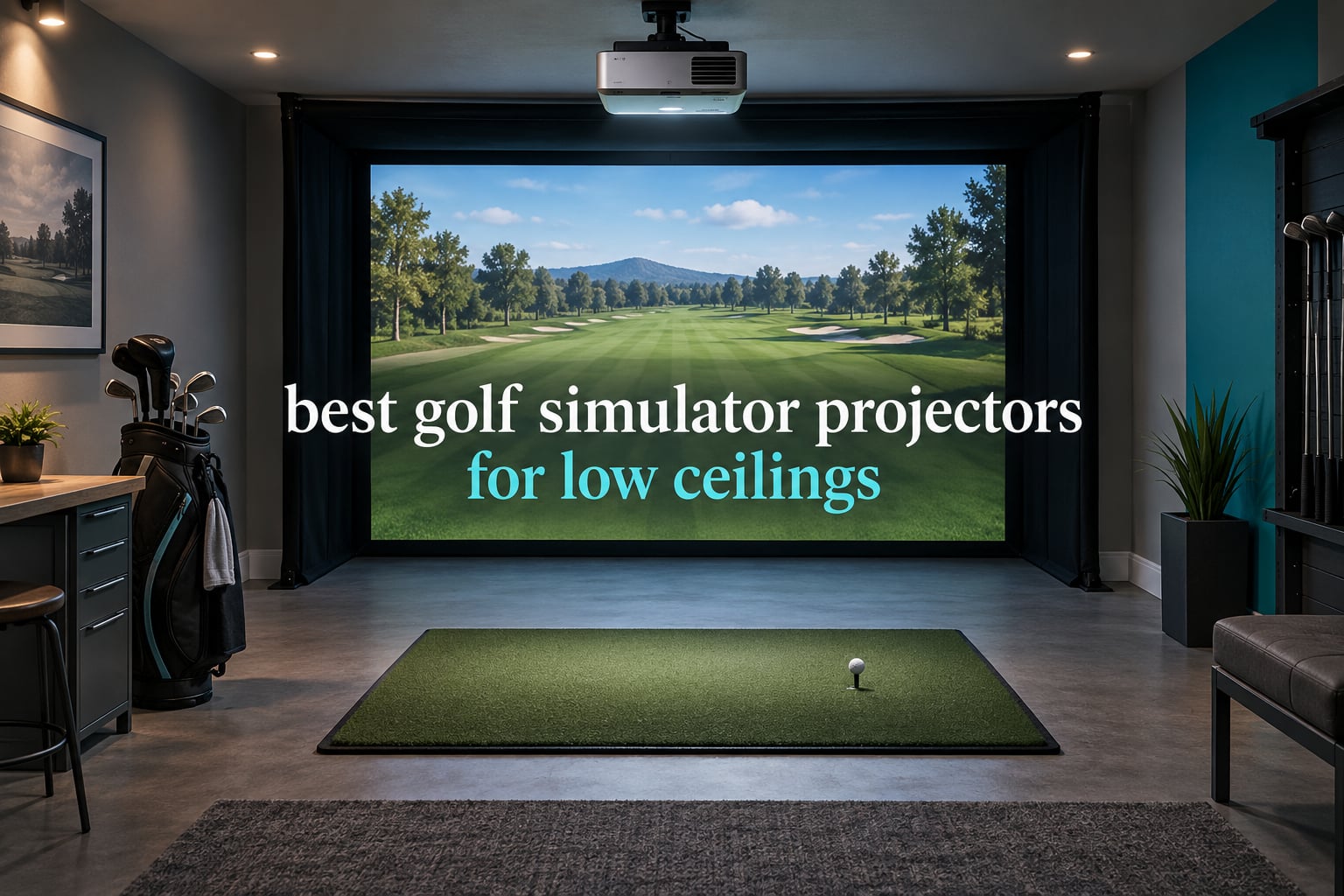
Ask any golf simulator builder what keeps them up at night and you will usually hear the same sentence: the ceiling is too low. Most garages top out at 8 feet. Most finished basements land somewhere between 8 and 9 feet. That single fact rules out the long throw projectors that fill an average living room, because a long throw lens needs 12 feet or more of depth and ends up parked behind the hitting position, inside your swing arc. The answer for anyone searching for the best golf simulator projector for low ceilings is a short throw or ultra short throw unit that can flood a 100 to 120 inch impact screen from four to seven feet back and still sit well above your swing arc.
We built this guide around that constraint rather than around brand loyalty. Every projector below was matched to a ceiling band, given a minimum ceiling verdict, and given an honest disqualifier for the buyer whose ceiling is lower. We also worked out the mount distance each throw ratio actually produces, because that number is what you measure in your own bay rather than a spec you take on faith.
Two disclosures before we start. Every specification here, from throw distance to ANSI lumens to laser life, comes from manufacturer-published data and should be re-checked on the listing before you buy. We have not physically tested these units side by side in our own simulator bays. And yes, we earn a commission if you buy through the links on this page, which is why the disqualifier lines are as blunt as they are.
One more practical note before the picks: if your ceiling is usable at all but hard to reach, our guide to projector lifts for ceilings covers the hardware that makes a high or awkward mount manageable, and drywall lifts cover the case where you are cutting a joist bay to drop the ceiling a foot.
Table of Contents
Top 3 Picks for Low-Ceiling Golf Simulator Projectors for October 2026


Best Golf Simulator Projectors for Low Ceilings in October 2026
| Product | Specifications | Action |
|---|---|---|
| BenQ TH671ST |
|
Check Latest Price |
| Optoma GT1090HDR |
|
Check Latest Price |
| Optoma GT2000HDR |
|
Check Latest Price |
 ViewSonic PS502W ViewSonic PS502W |
|
Check Latest Price |
 AWOL VISION LTV-3000 Pro AWOL VISION LTV-3000 Pro |
|
Check Latest Price |
 Hisense PL2 Hisense PL2 |
|
Check Latest Price |
 BenQ TK710STi BenQ TK710STi |
|
Check Latest Price |
 ViewSonic LX700-4K ViewSonic LX700-4K |
|
Check Latest Price |
 Optoma EH412ST Optoma EH412ST |
|
Check Latest Price |
 ViewSonic LS740HD ViewSonic LS740HD |
|
Check Latest Price |
Lens Shift and Vertical Offset: The Fix Most Buyers Miss
Vertical lens shift lets you move the image up or down without physically tilting the projector, and that single feature solves most low-ceiling installation problems. Without it, you either move the screen or you use digital keystone, which crops pixels and softens the picture.
Only one projector in this roundup has true vertical lens shift: the ViewSonic LX700-4K. Its offset is large enough that you can ceiling mount it low and still drop the image onto a screen hung at a comfortable height. The trade is that this offset throws the image noticeably high in normal use, so it needs deliberate mounting work rather than a casual tabletop drop.
Horizontal lens shift is the other underused feature. In an asymmetric bay where a centered mount is blocked by a joist, horizontal shift moves the image sideways without cropping. Ask about it directly, because few short throw models in the mainstream lineup include it.
1. BenQ TH671ST: The Most Proven Low-Ceiling Fit
BenQ TH671ST 3000 Lumens 1080p Short Throw Home Entertainment Projector
3000 ANSI lumens
Native 1920x1080 DLP
100 inch image from 5 feet
Lamp rated 10000 hours
Pros
- 3000 ANSI lumens holds up with room lights on
- 100 inch image from about 5 feet of depth
- Low input lag for console and PC play
- 92 percent Rec.709 color coverage
- Three year warranty
Cons
- Exposed lens scratches easily
- Lamp life drops under heavy daily use
- Fan noise audible in a silent room
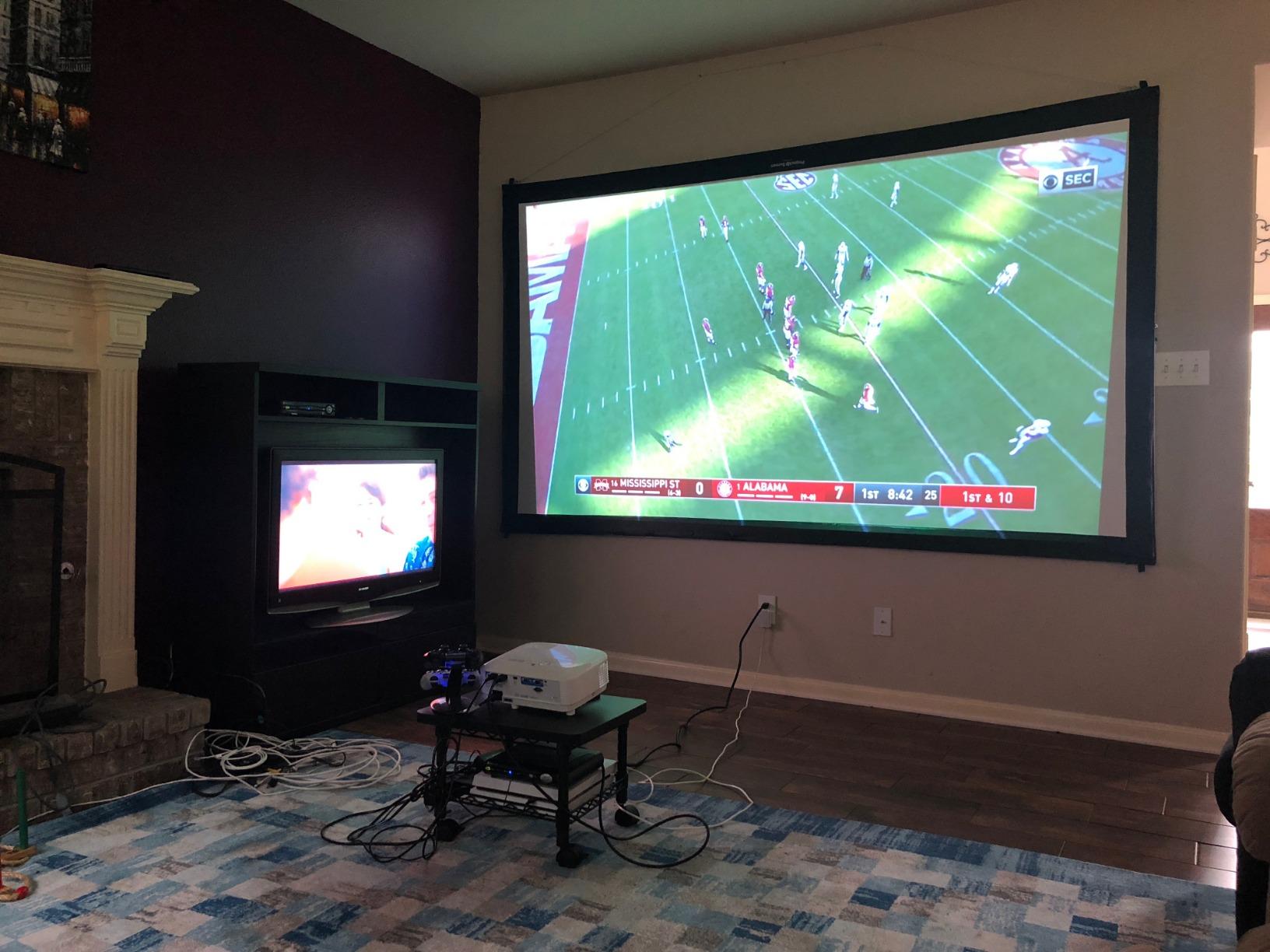
Start with the throw specification, because it is the whole argument. A 100 inch image from about 5 feet places the mount point just forward of the hitting area on a typical 16 by 9 impact screen, which keeps it inside a shallow bay. At 3000 ANSI lumens it holds a usable image with lights on, which is the difference between a sim you use in January and one you abandon.
This is the unit our reading turned up most often in actual sim builds, and it is also the model with the deepest owner history in this group. Long term owners consistently report reliability and brightness rather than excitement about new features. Several reviewers describe using it specifically for indoor golf, noting a sharp image and workable sound from the built in speaker.
The weak point is the lamp. A 10000 hour rating sounds generous until you measure it in a room that gets used most evenings, and lamp replacement puts a service interval back into a box you thought you had finished with. The lamp also runs warmer and louder than any laser here, which some builders notice in a quiet basement.
Manual focus is fiddly, and the lens is exposed, which matters more than it sounds when the unit is hanging inches from a ball flight at head height in a space people walk through. Plan the mount so the lens faces a wall, not the room.
Who this suits
A blacked-out or dim basement bay with an 8 to 9 foot ceiling and a 100 to 120 inch screen. It is our default recommendation because the throw geometry is forgiving, the owner history is long, and 3000 lumens covers most residential installs without drama.
Who should skip it
Anyone whose room cannot be dimmed, and anyone unwilling to own a lamp replacement cycle. Below about 7 feet of ceiling in a one-car bay you will also be trimming the screen size, and at that point the light output gets tight.
2. Optoma GT1090HDR: Brightest Proven Laser Fit
Optoma GT1090HDR Short Throw Laser Home Theater Projector | 4K HDR Input | Lamp-Free Reliable Operation 30,000 hours | Bright 4,200 lumens for Day and Night | Short Throw
4200 ANSI lumens
DuraCore laser rated 30000 hours
120 inch image from 4 ft 4 in
1080p panel with 4K input
Pros
- 4200 ANSI lumens works in a lit room
- 120 inch image from only 4 feet 4 inches
- No lamp or filter replacement
- 32dB operation in eco mode
- IPX6 dust resistant laser
Cons
- 1080p native panel despite 4K input
- Manual focus is extremely sensitive
- Text blurs in corners after image shift
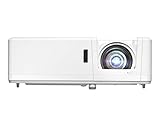
At 4 feet 4 inches of throw distance for a 120 inch image, this is the shortest mount among the short throw units in the roundup, and that is why it ranks so high for shallow ceilings. Golf sim owners report clear images on large impact screens from roughly 7 feet of lens-to-screen distance, which is a small fraction of a typical garage depth.
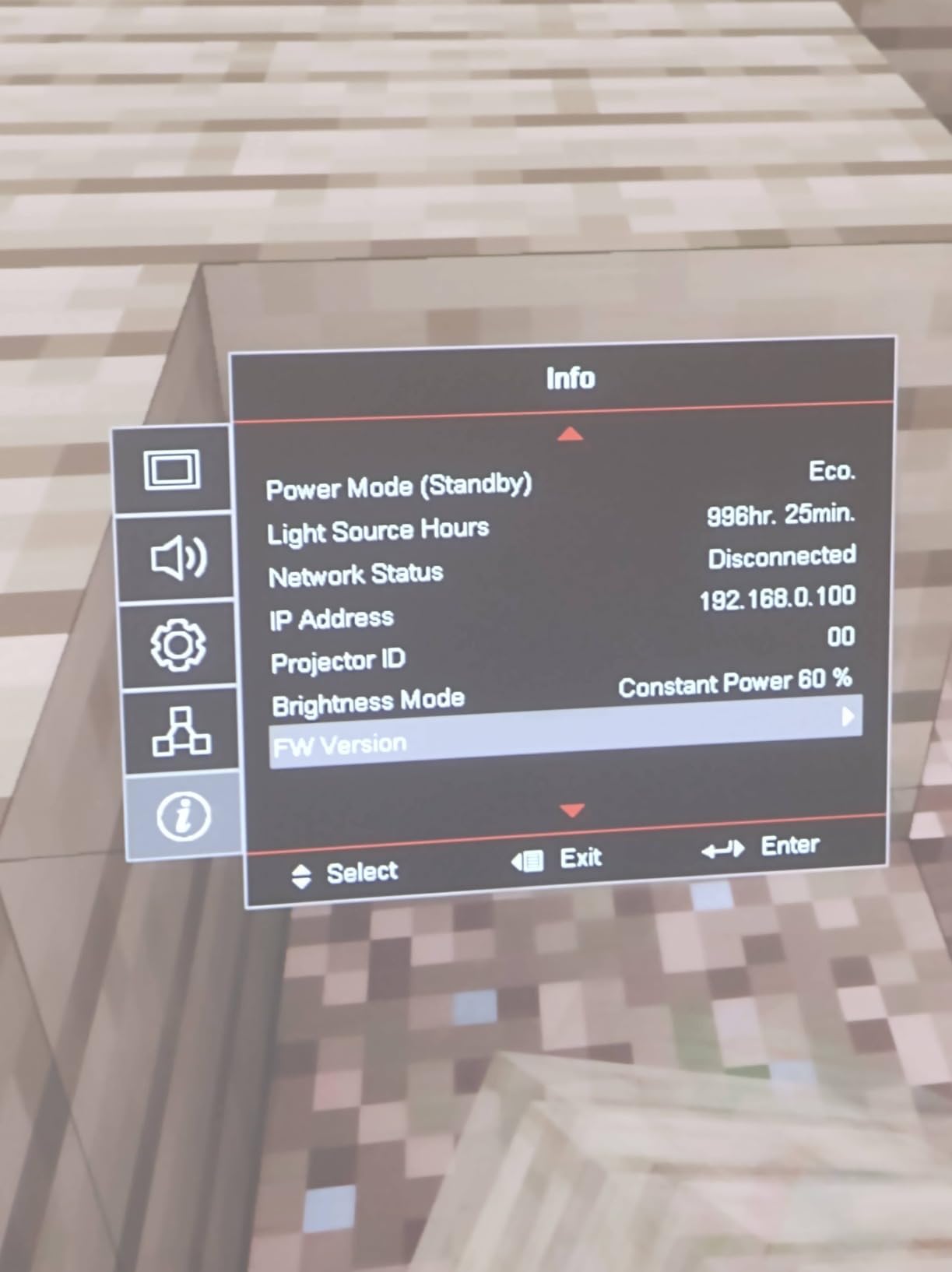
4200 ANSI lumens changes the conversation in a dim basement. It means you do not need a blackout build to see the fairway, and the DuraCore laser rated to 30000 hours removes bulb replacement from the ownership cycle entirely. Quiet operation in eco mode is a small thing until you are hitting balls next to it.
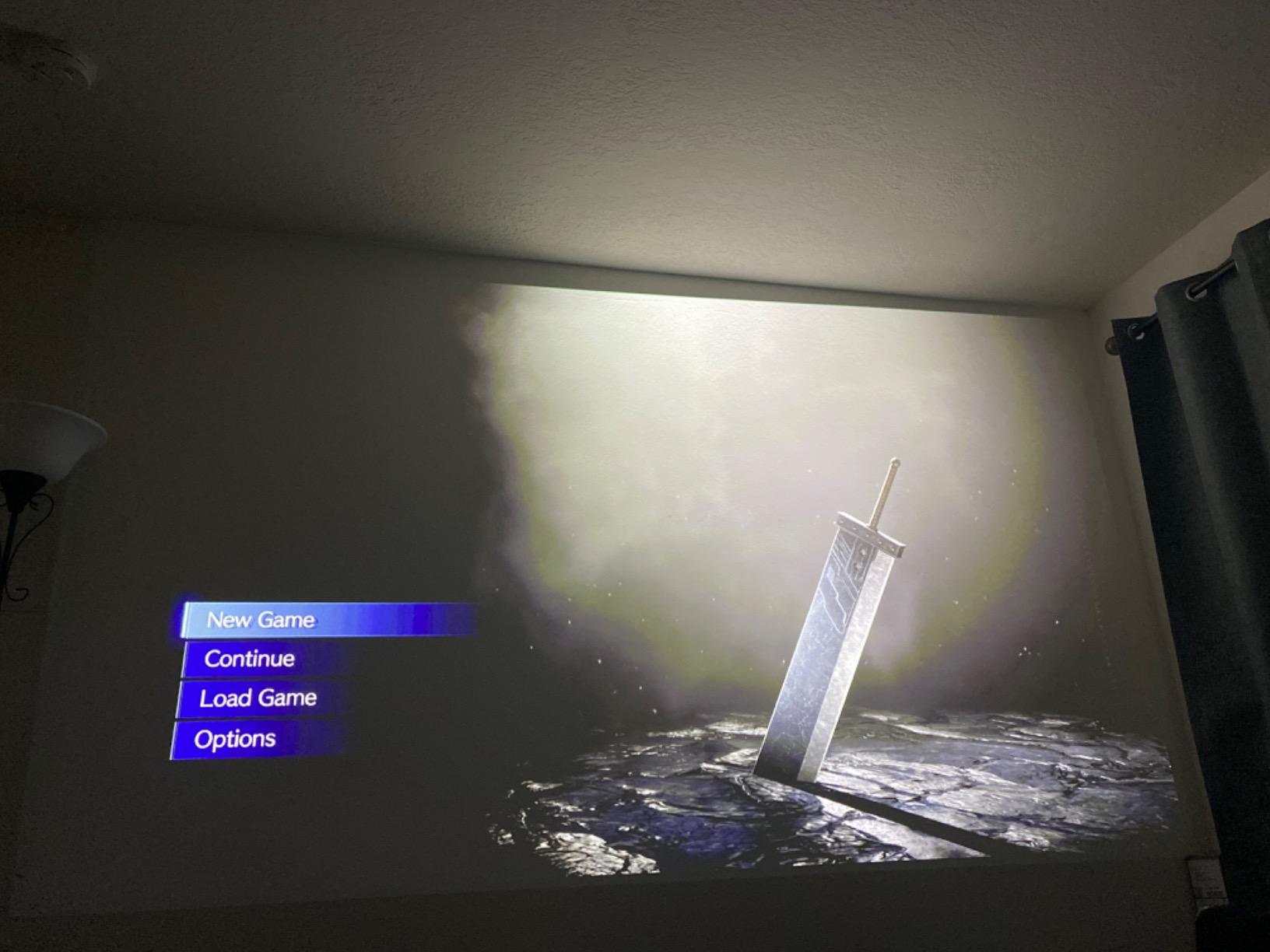
It is a 1080p panel that accepts 4K input, and we will say so plainly rather than let the marketing language blur it. On very large screens some owners notice a screen door effect, and the manual focus is described as extremely sensitive, which pairs badly with the slightly rippled impact screens that come with tensioned enclosures.
Dynamic Black mode adds perceived lag and washes out shadow detail, and out of the box red is oversaturated enough to need calibration. A minority of owners report signal drops and color wheel faults, so keep the warranty details handy.
Who this suits
Basements and garages where light control is imperfect and the ceiling is 8 feet or under. If you want one projector that covers both brightness and clearance, this is the strongest single answer here.
Who should skip it
Anyone who needs true native 4K, and anyone who will not spend 20 minutes on focus and geometry. If your impact screen is visibly rippled, that sensitivity will cost you the whole install.
3. Optoma GT2000HDR: Smallest Body for Obstructed Ceilings
Optoma GT2000HDR Ultra-Compact Short Throw Full HD Home Laser Projector
3500 ANSI lumens
Ultra compact chassis
1080p native laser
Ceiling and tabletop mounting
Pros
- Compact chassis fits where a full size unit will not
- 3500 lumens of laser brightness for a small room
- 98 watt power draw keeps heat low
- Ceiling and tabletop mounting supported
Cons
- 1080p native resolution
- External power brick adds another box to hide
- One star reviews hint at early unit failures
The body is the selling point. Reviewers of compact short throw units describe them as easier to position out of the swing path and less obtrusive overhead, and that description fits this projector well. When the ceiling is low, joists are in the way, or you are mounting inside a shallow cabinet, chassis size decides whether the install is possible at all.
You still get 3500 ANSI lumens from a laser rated to 30000 hours, which is a genuinely useful brightness level for a dim basement. The external power supply moves heat out of the chassis, and the unit is rated for both ceiling and tabletop mounting.
Its 4.1 average is among the lowest here, with about 12 percent one star reviews, so buyers should expect some early hardware and support friction rather than a clean bill of health. That is worth weighing against a lamp model of similar brightness.
The external power brick is another box to hide somewhere in a tight sim room, and the panel is 1080p. Neither is disqualifying. Both are annoyances you should plan for rather than discover.
Who this suits
A one-car garage bay with an obstructed ceiling where the mount point has to tuck close to the wall. If you are measuring clearance in inches rather than feet, compact sizing is the deciding factor.
Who should skip it
Buyers who want a track record of reliability before committing to a laser unit in a hard-to-reach mount. Reaching into a tight bay to service a failing unit is a miserable afternoon.
4. ViewSonic PS502W: Brightness Where the Budget Stops
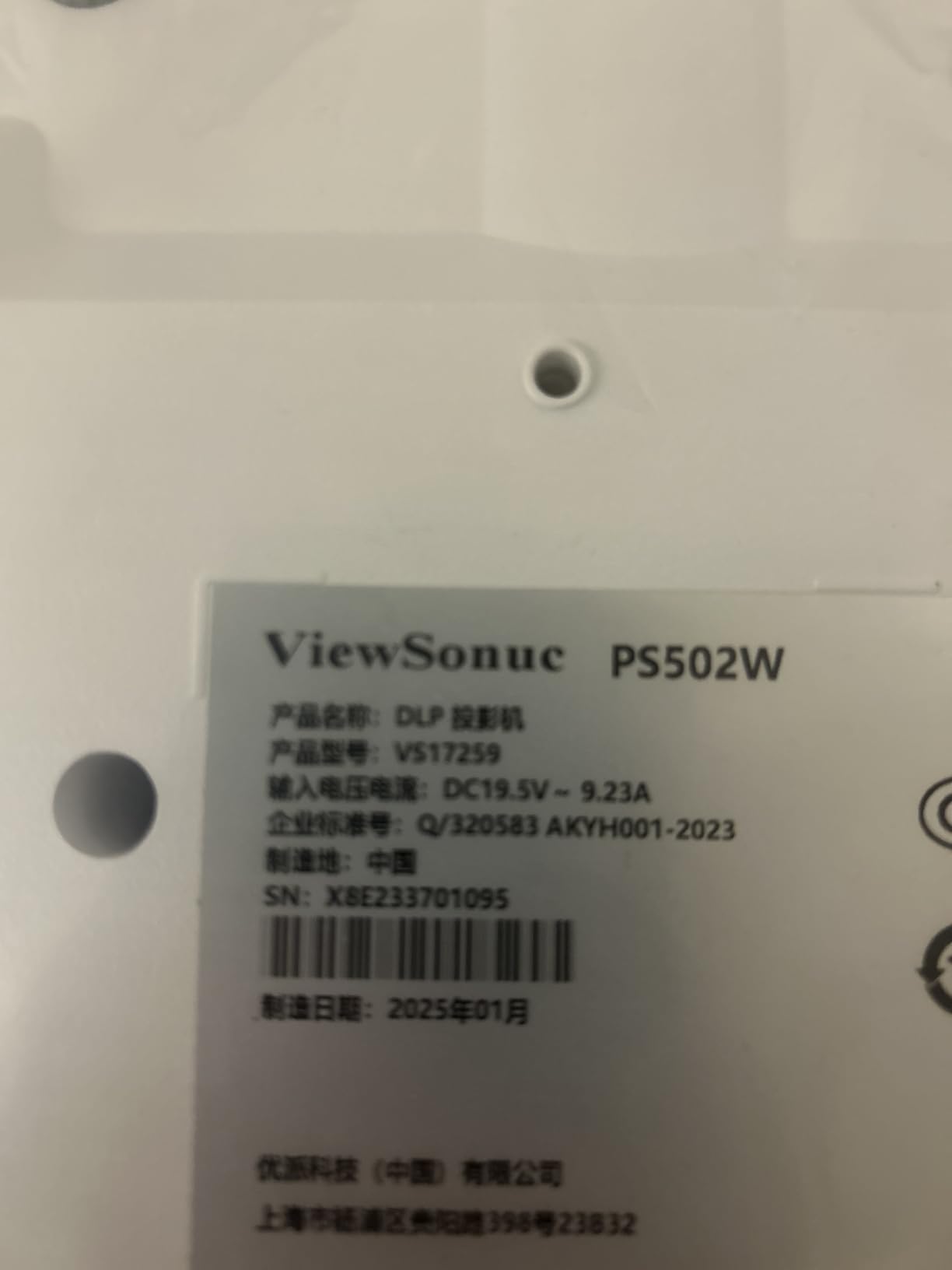
ViewSonic PS502W WXGA Short Throw Projector 4000 Lumens, Dual HDMI
4000 ANSI lumens
0.5 throw ratio
Native 1280x800 WXGA
4000 hour lamp life
Pros
- 4000 ANSI lumens for a bright room
- 0.5 ratio gives 100 inch from 4.5 feet
- Vertical auto keystone simplifies ceiling installs
- Three year parts and labor warranty
Cons
- WXGA is the lowest native resolution here
- 4000 hour lamp life is short
- Not a laser unit
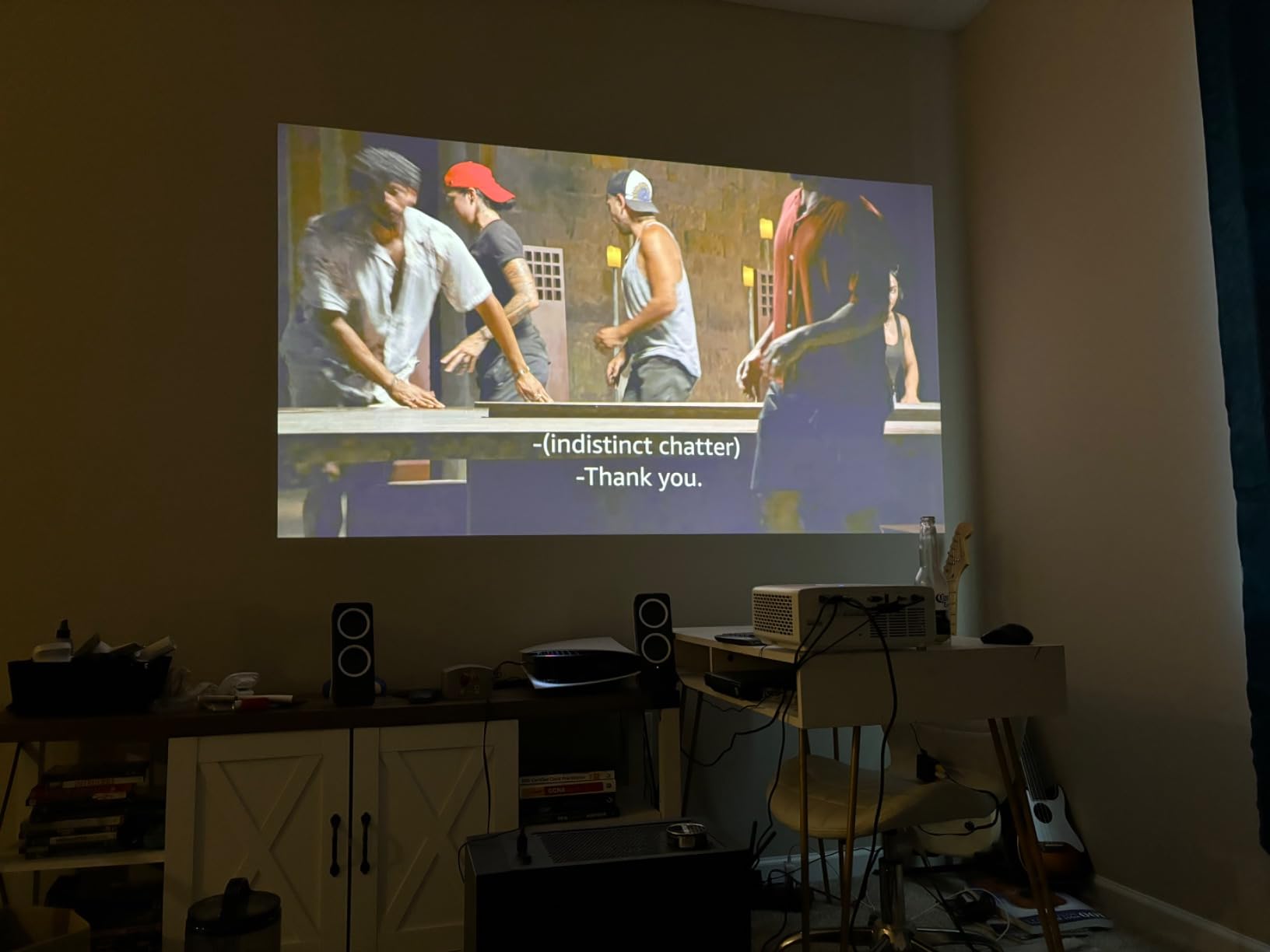
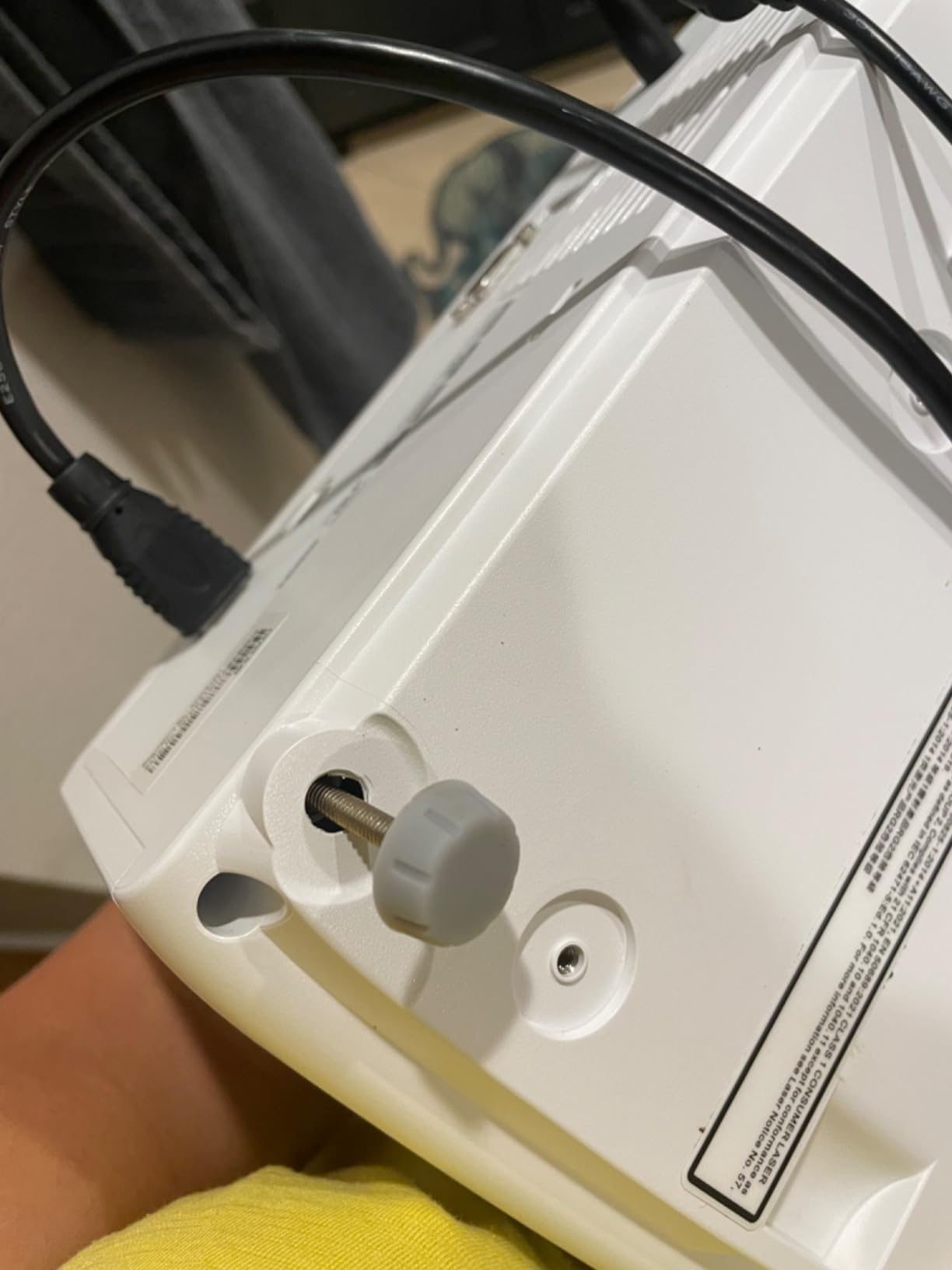
A 0.5 throw ratio that produces a 100 inch image from 4.5 feet is exactly the geometry a low-ceiling bay wants. At 4000 ANSI lumens this is among the brightest projectors in the roundup, and it reaches that figure without laser money. The vertical auto keystone makes ceiling installation painless, which matters more in a tight room where you cannot easily reach the lens to nudge it.
Reviewers treat it as a value short throw projector for small rooms, and satisfaction centers on brightness, tight throw and easy setup. The SuperColor processing gives it a wider gamut than the resolution would suggest.
Native 1280 by 800 is the lowest resolution here, and on a 120 inch screen from 10 to 12 feet back you will see it. It is also a lamp with a 4000 hour rating, which is the shortest light source life in this group by a wide margin.
That lamp life is the real cost of ownership decision. In a room used most evenings, replacement arrives sooner than most buyers expect, and the running cost difference against a laser is meaningful over years.
Who this suits
A first simulator build on a garage bay with an 8 foot ceiling, where brightness matters more than pixel count and the budget has a ceiling of its own. The 4.4 rating across 116 reviews suggests the trade lands well.
Who should skip it
Anyone building toward a 120 inch screen viewed from 10 feet or more, and anyone planning a decade of regular play. At that screen size, both the resolution and the lamp interval start to argue against it.
5. AWOL VISION LTV-3000 Pro: Tightest Fit in the Roundup
AWOL VISION LTV-3000 Pro 4K 3D Ultra Short Throw Triple Laser Projector, Dolby Vision & Atmos, HDR10+, 150″ UST Laser TV Home Theater Projector
0.25:1 ultra short throw
100 inch at 8.54 inches
Native 4K UHD triple laser
Dolby Vision and HDR10+
Pros
- 0.25:1 ratio fills a screen from inches away
- Native 4K with Dolby Vision and HDR10+
- Triple laser covers 107 percent BT.2020
- Built in center channel speaker
Cons
- Only 2000 lumens of normal output
- Needs a dark room or an ALR screen
- 28 pound chassis with a 23.6 inch depth
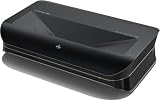
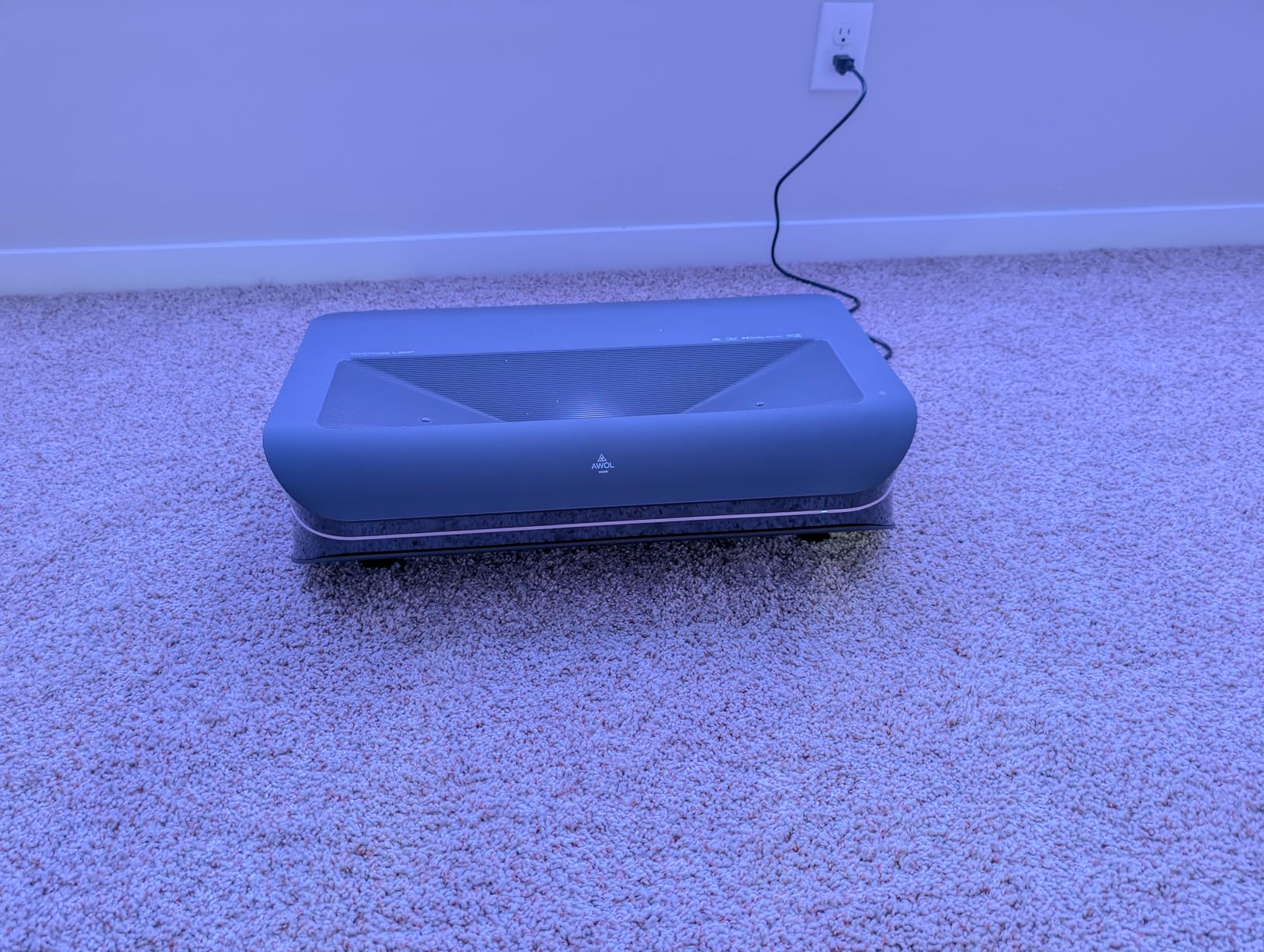
At a fixed 0.25:1 ratio, this unit puts a 100 inch image on the screen from 8.54 inches of lens distance. That is the kind of placement a low bay cannot get any other way: when the ceiling is so low that even a 4 foot throw mount will not clear the swing arc, an ultra short throw unit is the one category built for that clearance problem, and this model delivers native 4K with Dolby Vision from a single chassis.
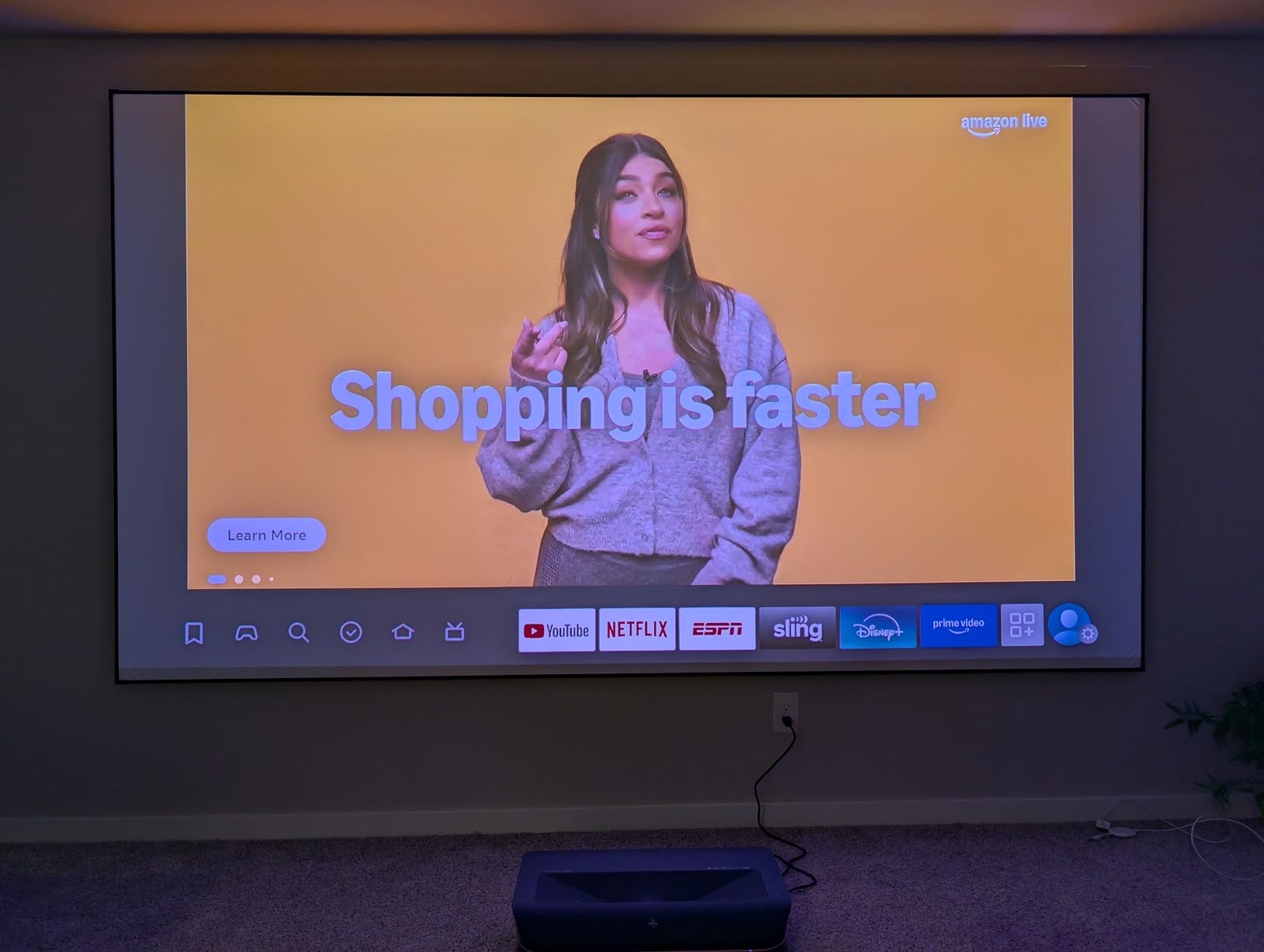
Color is the standout: triple laser with no color wheel covering 107 percent BT.2020 and 147 percent DCI-P3. Reviewers consistently praise the 4K sharpness and color volume, treating it as a television replacement rather than a gaming projector.
Brightness is the constraint. Normal output is 2000 lumens, the lowest here, and reviewers say the picture is at its best in a dark room, ideally with an ambient light rejecting screen. A UST laser sitting inches from a white impact screen in a lit garage will not deliver.
The chassis is 23.6 inches deep and 28 pounds, which means it needs a real alcove or cabinet rather than a shelf. Reviewers also flag it as a poor fit for a bright open bay without a high gain screen.
Who this suits
A shallow cabinet bay or a dedicated dark sim room where picture quality matters more than daylight tolerance. The 0.25 ratio also means the unit can sit behind furniture without blocking the image.
Who should skip it
Anyone with an open garage door and no blackout capability, and anyone who cannot give it 2 feet of physical depth. In a bright room this is the wrong tool and the price of the wrong tool is high.
6. Hisense PL2: Native 4K Ultra Short Throw for the Living Room Bay
Hisense PL2, Ultra Short Throw Home Theater Laser Projector, 80” – 150”, 4K UHD, 2,700 Lumens, 3000:1 Contrast, Dolby Vision & Atmos, 3D, Google TV, WIFI 6E
4K UHD native
Ultra short throw, 80 to 150 inch
2700 ANSI lumens
X-Fusion laser rated 25000 plus hours
Pros
- Near zero placement distance suits compact rooms
- Native 4K image without needing a screen
- Google TV interface is fast and responsive
- Laser light source with long rated life
Cons
- 2700 lumens leans dim
- Auto keystone workflow is clumsy
- Sensitive viewers may notice rainbow fringing
This is the pick for a multi-use room where the sim is not the only purpose. Owners upgrading from a television report a dramatic picture improvement and near television responsiveness, and an 80 to 150 inch image from a near zero placement distance means it works in a shallow bay where nothing else fits.
The X-Fusion laser is rated beyond 25000 hours, Dolby Vision and Atmos are supported, and Google TV with Wi-Fi 6E means no streaming dongle. Digital lens focus is a genuine convenience when the unit sits inches from a wall.
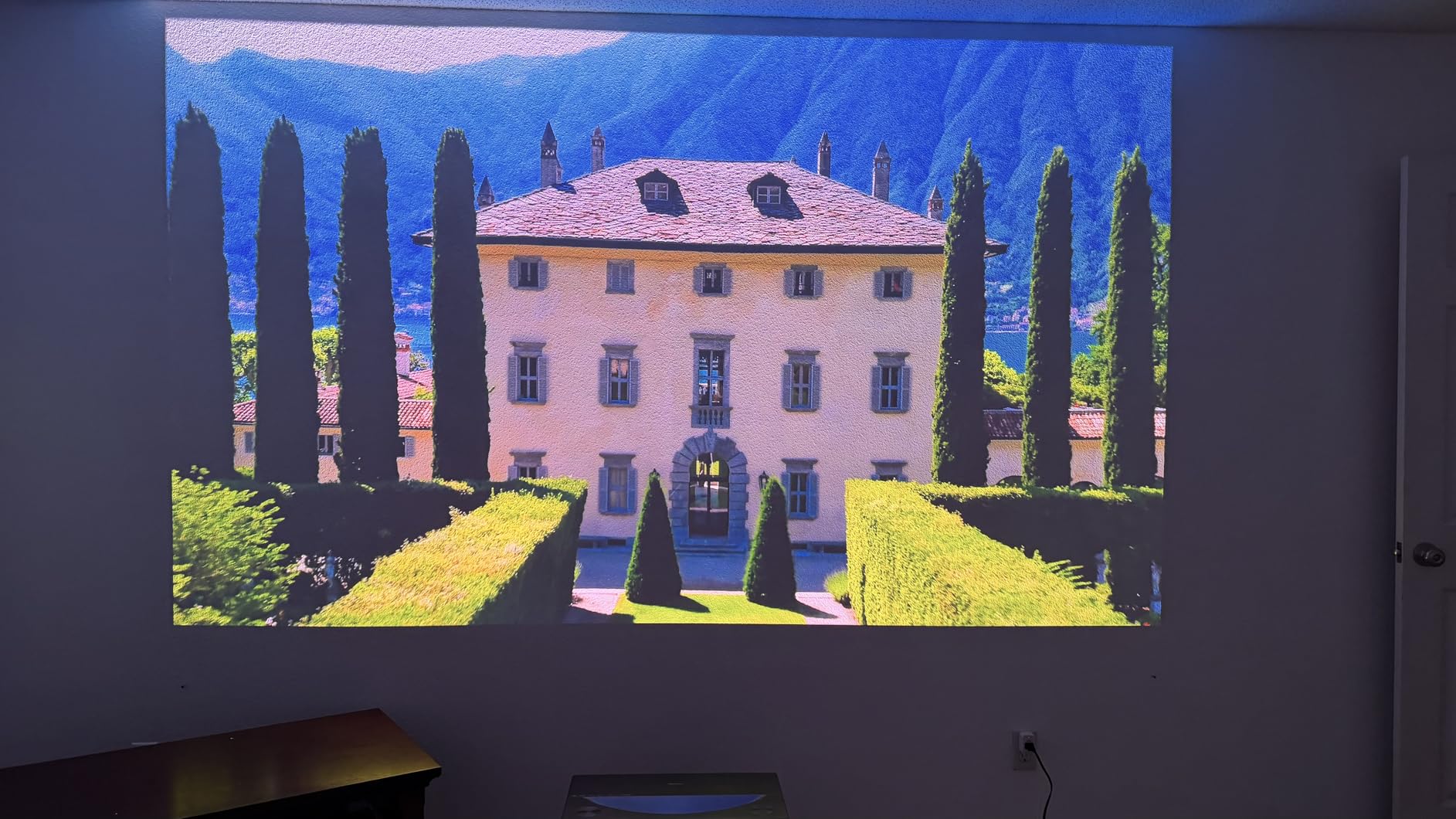
2700 ANSI lumens is on the dim side, and a high gain screen improves the result noticeably. Reviewers upgrading from 1080p speak about daylight and about a high gain screen in the same breath, which tells you where the limits are.
The auto keystone is poorly implemented, requiring a phone photo uploaded to a website, and some sensitive viewers notice a rainbow effect from the DLP chip. Plan to level it manually rather than trusting the automatic correction.
Who this suits
A finished basement or spare room with a low ceiling that also serves as a media room, where native 4K and a built in streaming platform matter as much as the golf image.
Who should skip it
Bright garage installs and anyone who cannot dim the room at all. At 2700 lumens on an absorptive impact screen, ambient light will flatten the greens faster than the resolution can rescue them.
7. BenQ TK710STi: Lowest-Lag Pick With Real Sim Owners
BenQ TK710STi 3200 Lumens 4K HDR Short Throw Home Entertainment Projector
3200 ANSI lumens
Native 3840x2160 4K UHD
4ms at 1080p and 240Hz
Laser rated 20000 hours
Pros
- 4ms response at 1080p and 240Hz
- Native 4K laser with 95 percent Rec.709
- Grid and keystone snap simplify ceiling alignment
- Laser life removes bulb replacement
Cons
- Needs a dark room
- Audible fan noise and one very loud startup report
- Only two HDMI ports and no optical audio out
Several dedicated golf sim builders cite this as their choice, including one running it ceiling mounted 9 feet from a 13 by 10 foot impact screen. That is exactly the geometry a low-ceiling bay needs: the model is rated for a 120 inch image at 8.4 feet, so the mount point sits forward of the hitting position rather than behind it.
4ms input lag at 1080p and 240Hz means software response is effectively immediate, and the grid plus keystone snap make ceiling alignment straightforward. The 600,000:1 contrast ratio and 95 percent Rec.709 coverage keep the greens and sky separated in a way that reads well on an impact screen.
The review base is small at 41, so the long term reliability picture is thinner here than for our top pick. Buyers who took the plunge report enthusiasm, but we would weight that accordingly.
It needs a dark room and is not suited to heavy sunlight or many lights on. Fan acoustics are the recurring complaint, and one owner reported very loud startup that cut out repeatedly. Port selection is also limited to two HDMI inputs with no optical audio out.
Who this suits
A blacked-out basement sim bay with an 8 to 9 foot ceiling where the owner plays serious virtual golf and console games on the same screen. The alignment tools save real time on a tight ceiling mount.
Who should skip it
Any room that will not go dark, and buyers who want a long owner track record before mounting a light source 8 feet above their hitting position.
8. ViewSonic LX700-4K: The Only Pick With Real Vertical Lens Shift
ViewSonic LX700-4K 4K UHD Laser Gaming Projector 3500 Lumens 240Hz Xbox
4K UHD native
3500 ANSI lumens laser
Vertical lens shift
Dedicated golf simulation mode
Pros
- Dedicated golf mode for greens and blues
- 1.3x optical zoom plus vertical lens shift
- Quiet fan and no warmup delay
- 4.2ms lag and 240Hz for console play
Cons
- Vertical offset throws the image noticeably high
- Weak mono speaker with little bass
- Only two HDMI ports and no built in apps
This is the one projector in the roundup with true vertical lens shift, and on a low ceiling that single feature is worth more than several other specifications on this list. It lets you mount the unit low and drop the image onto a screen hung at a comfortable height, without tilting the chassis and without digital keystone cropping your pixels.
It is also the only 4K laser unit here with a dedicated golf simulation mode that pushes greens and blues for more realistic imagery, and the 4.2ms latency at 240Hz handles current consoles cleanly. One owner measured roughly 40 percent lower power draw than a lamp projector they replaced.
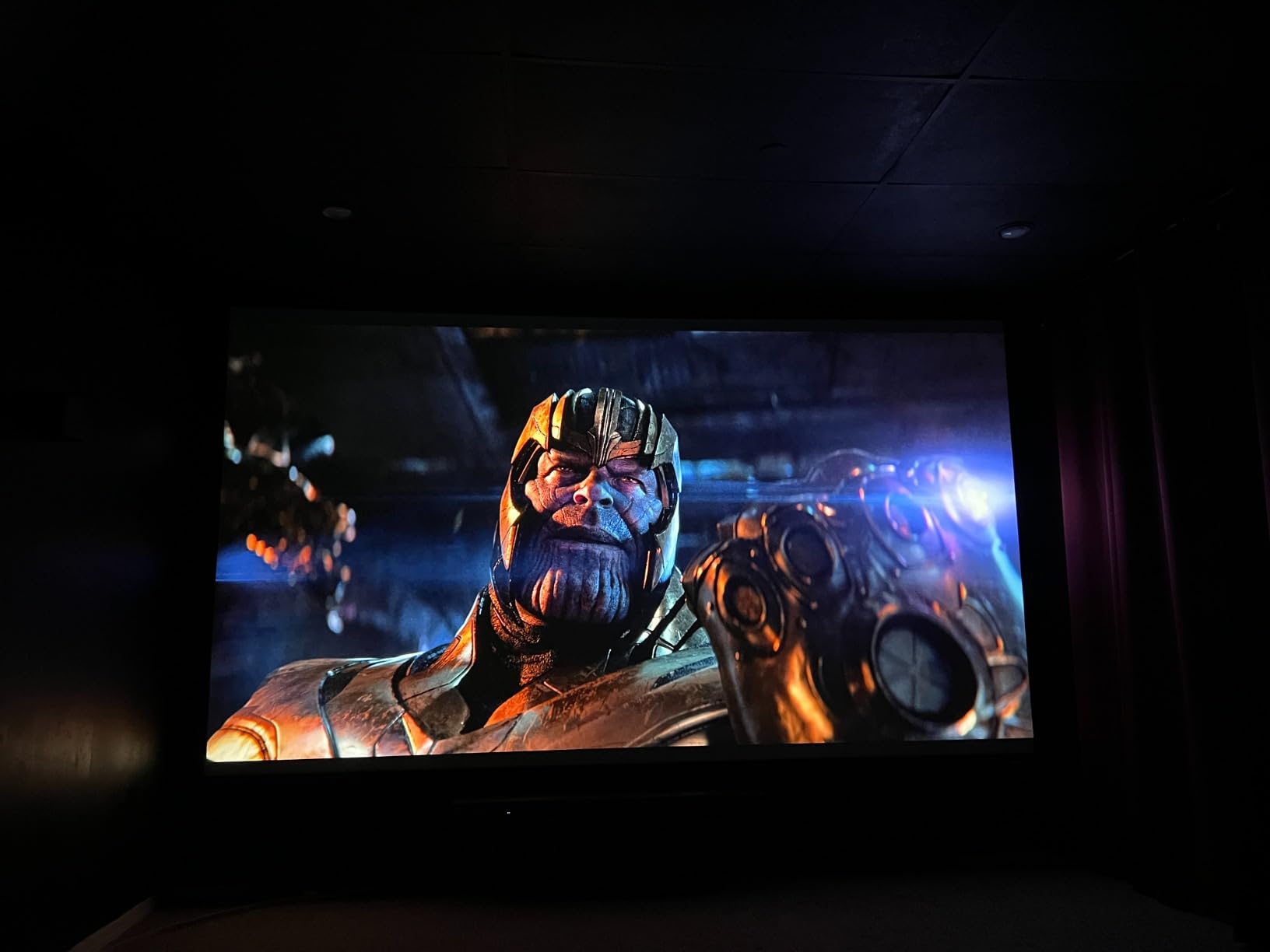
That same large vertical offset works against tabletop placement, because the image is thrown noticeably high in normal use and needs a mounting workaround to land correctly. Do not plan on setting this on a shelf behind the tee.
The built in mono speaker has little bass, and black level is a dark grey rather than true black, which softens contrast on an impact screen. The 4K panel is reached by interlacing 1080p class chips, so the gain over native 1080p is subtle at typical viewing distances.
Who this suits
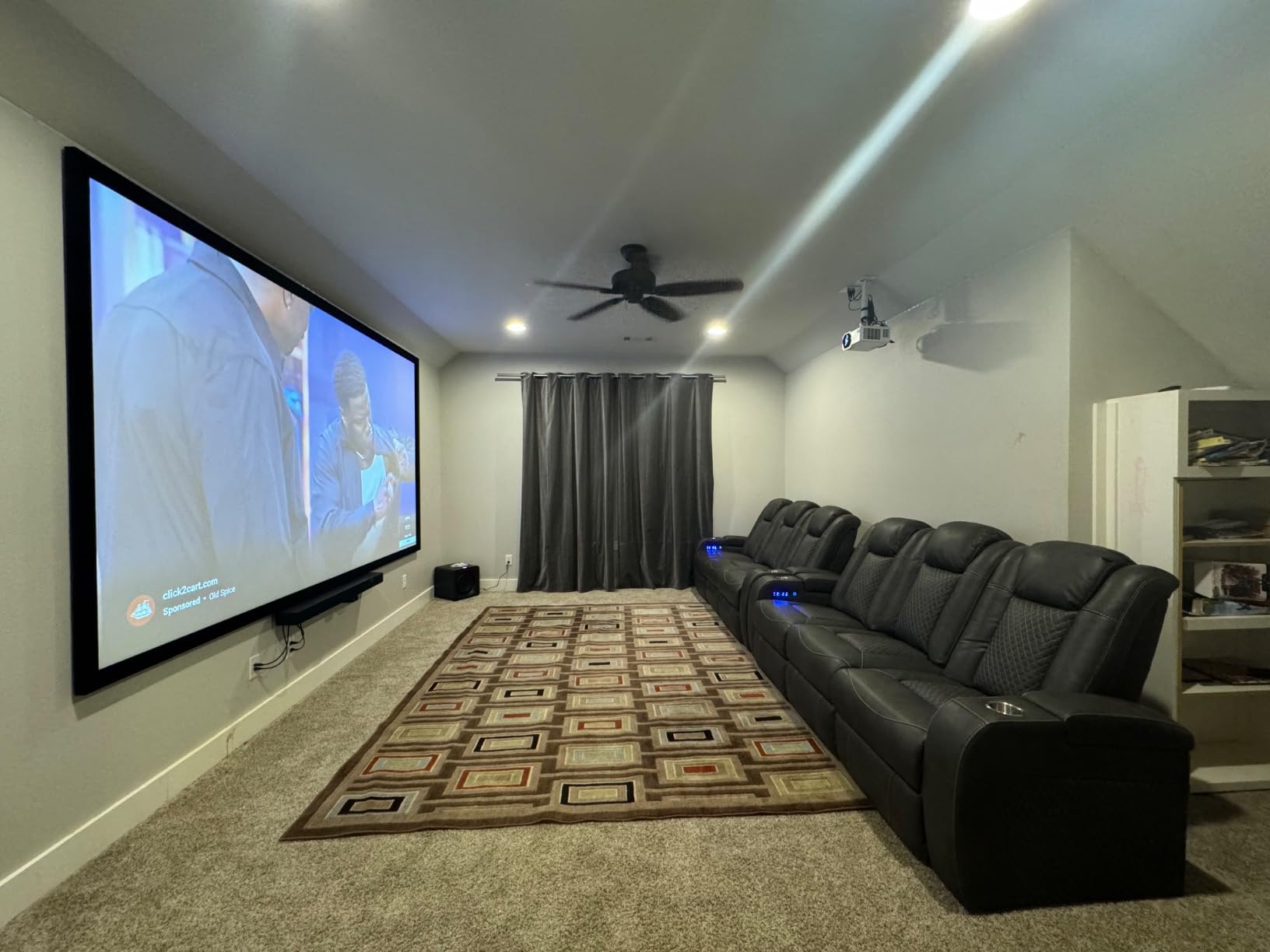
An asymmetric or unusually shaped bay where a centered ceiling mount is blocked by a joist or duct. Lens shift solves that geometry problem without giving up the image width you planned for.
Who should skip it
Buyers who want a true black level for dark night scenes, and anyone expecting streaming apps or serious built in audio. Plan on external speakers from day one.
9. Optoma EH412ST: Long-Lamp Brightness on a Lamp Budget
Optoma EH412ST Short Throw 1080P HDR Professional Projector | Super Bright 4000 Lumens | Business Presentations, Classrooms, or Meeting Rooms | 15,000 hour lamp life | Speaker Built In | Portable
0.5 to 1 short throw
4000 ANSI lumens
120 inch image from 4.5 feet
15000 hour lamp life
Pros
- Genuine 0.5 to 1 throw gives 120 inch from 4.5 feet
- 4000 lumens for well lit rooms
- 15000 hour lamp life is long for a lamp
- Extensive port selection
Cons
- 1080p native resolution only
- 10 watt speaker suits small rooms
- Eventual bulb replacement with a 90 day lamp warranty
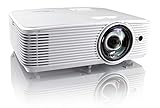
A 0.5 to 1 short throw lens putting a 120 inch image up from 4.5 feet is the right shape for a low ceiling, and the brightness figure of 4000 ANSI lumens means you are not fighting ambient light for every session. The room does not have to be perfectly dark to see the target line.
The 15000 hour lamp life is the longest light source rating among the lamps here, which softens the main objection to a lamp-based sim projector. Port selection is unusually thorough for the category, including VGA pass through, audio in and out, RS-232 and USB-A.
It is a professional classroom and small room projector rather than a dedicated golf unit, so there is no golf picture mode and the tuning is aimed at presentations. About 10 percent of its reviews are one star, so expect some early hardware friction.
The 10 watt built in speaker is adequate for a small room and nothing more, and the lamp carries a 90 day warranty. Plan to replace it eventually and budget for it rather than pretending it will not happen.
Who this suits
A garage bay with an 8 foot ceiling that doubles as a workspace or classroom, where the brightness and the long lamp life matter more than gaming features or color tuning.
Who should skip it
Pure gaming setups and buyers chasing color accuracy for turf and sky realism. The extra connectivity is genuinely useful, but it is office connectivity, not simulator connectivity.
10. ViewSonic LS740HD: Brightest Option for a Garage You Cannot Darken
ViewSonic LS740HD 1080P Laser Projector, 5500 Lumens, Full HD Home Theater
5500 ANSI lumens
Native 1080p Full HD
Laser rated 20000 hours
Dedicated golf simulation mode
Pros
- 5500 lumens is the brightest output here
- Four corner adjustment aligns to a skewed screen
- Laser life removes bulb replacement
- Quiet operation and instant power on
Cons
- No lens shift so placement is fixed
- 1.1 to 1.5 throw needs about 8.2 feet for 100 inch
- Some units reported an orange flashing glitch
If your room cannot be blacked out, brightness stops being a nice-to-have and becomes the deciding spec. At 5500 ANSI lumens this unit has the highest output in the roundup by a wide margin, and a specific group of golf sim builders singles it out for that brightness, backed by corner adjustment and a 20000 hour laser.
The four corner adjustment matters more than it sounds. Impact screens are frequently installed a little out of square, and corner keystone lets you square the image to the screen instead of squaring the screen to the projector. The unit also supports 360 degree and portrait projection, which widens your mounting options in a tight bay.
Here is the honest disqualifier. At a 1.1 to 1.5 throw ratio, a 100 inch image needs about 8.2 feet of lens-to-screen distance. In a shallow one-car garage with a low ceiling, that mount point can land right where you stand, and this projector has no lens shift to move the image out of the way.
Some owners have also reported a random orange flashing glitch, the built in speaker sounds muffled, and the menu system is basic with a fixed RS-232 baud rate. Verify placement math before anything else here.
Who this suits
A garage bay with 9 or 10 feet of depth, a ceiling high enough for an 8 foot mount, and light control you cannot improve. Brightness solves a problem no other pick on this list addresses.
Who should skip it
Shallow bays and any room under 9 feet of depth. The throw ratio is the wrong shape for the problem this article exists to solve, no matter how bright the picture is.
If You Cannot Ceiling-Mount: Floor, Shelf and Enclosure Mounting
Sometimes the ceiling is simply not usable, and no throw ratio solves it. A garage with door rails, ductwork and low-hanging joists falls into this category, as does any apartment or rental where drilling is not allowed. The realistic options are a protected floor mount behind the hitting position, a shelf mount, and a lens shift model mounted off-axis.
Floor mounting puts the projector at ground level behind the tee, which means ultra short throw is close to mandatory. Builders working this way historically recommend a unit around a 0.5 ratio with horizontal offset, because a conventional short throw on the floor will be in your feet or produce an image angled sharply upward.
A protected shelf or cabinet mount solves the same problem with less risk, since the unit is boxed in and vented from the front. Our guide to simulator cockpits and enclosures covers the kind of furniture-scale build that usually accompanies it.
The honest caveat for all floor-mounted approaches is alignment. A unit sitting at floor level next to the hitting mat projects upward at an angle, which stretches keystone geometry and softens the corners. If you can raise the mount by even 18 inches, do it.
How to Choose a Golf Simulator Projector for a Low Ceiling?
How we chose, and what we did not test
Every pick here was filtered on three criteria: throw ratio, ANSI lumen output, and physical chassis size. We mapped each unit to the ceiling band it can serve and gave it a minimum ceiling verdict and a disqualifier. All specifications are manufacturer-published and should be verified on the listing. We have not run hands-on comparison tests.
Brightness bands by room type
A blacked-out room needs 3000 ANSI lumens or more. A typical light-controlled basement sits in the 3500 to 4500 range. A bright garage with an open door wants 5000 or above. Impact screen material absorbs and diffuses light rather than reflecting it, so your lumen needs run higher than the same projector on a white wall.
1080p versus 4K in a golf bay
At 10 to 12 feet from a 100 inch screen, brightness and throw fit beat pixel count. Native 1080p with the correct mount distance produces a better practice image than a 4K unit placed badly. Choose 4K when your screen is 120 inches or larger and your source material warrants it.
Laser versus lamp
Laser units remove bulb replacement and run cooler and quieter, which matters in a small enclosed bay. Lamp units cost less up front and can be more than bright enough. Factor in replacement cost and access difficulty, because servicing a unit mounted inches above a hitting area is unpleasant work.
Measure before you order
Measure ceiling height, exact screen width in inches, and the distance from your planned hitting position to the screen. Multiply width by the throw ratio to get your mount distance, then confirm the mount clears your swing. Use a projection calculator from the manufacturer as a second check.
Frequently Asked Questions
What is the lowest ceiling height for a golf simulator?
Roughly 8 feet is the practical floor, and 9 to 10 feet is comfortable. Below 8 feet you are usually negotiating joists, ducts and garage door rails rather than a flat ceiling. Swing clearance, not projector size, is the binding constraint: stand in your planned hitting position and run a full slow-motion swing before you commit.
Can you swing a driver with a 9 foot ceiling?
Yes for most adult golfers, but the clearance is tight and depends on your height and setup. The safe test is to stand in the planned hitting position and take a full slow-motion swing under the planned mount point. If the club or your hands come within an inch of anything overhead, lower your screen rather than hoping.
Do I need a short throw projector for golf simulator?
In almost every low-ceiling room, yes. A long throw projector needs 12 feet or more of depth, which most garages cannot provide, and it places the unit behind or inside your swing arc. Short throw fills a 100 to 120 inch screen from 4 to 7 feet, keeping the mount point forward of the hitting position and reachable with a shallow ceiling drop.
How many lumens should a golf simulator projector be?
Aim for 3000 ANSI lumens or more in a blacked-out room, 3500 to 4500 in a typical light-controlled basement, and 5000 or above for a bright garage. Impact screen material absorbs and diffuses light rather than reflecting it, so your lumen requirement runs higher than the same projector on a painted wall.
Is 1080p enough for a golf simulator projector?
Yes in most rooms. At 10 to 12 feet from a 100 inch screen, brightness and correct throw fit matter more than pixel count. Native 1080p with the mount distance matched to your screen width produces a better practice image than a 4K projector mounted badly. Choose 4K when you are at 120 inches or larger.
Final Verdict
For most people searching for the best golf simulator projector for low ceilings, the BenQ TH671ST is the answer: a 0.5 ratio that fills a 100 inch image from about 5 feet, 3000 ANSI lumens, and the deepest owner history in the group. If your bay is bright or your ceiling is tighter than 8 feet, step up to the Optoma GT1090HDR for 4200 lumens and a 4 foot 4 inch mount distance, or drop to the Optoma GT2000HDR when the chassis is what actually fits.
Measure your ceiling, measure your screen width, and do the multiplication before you order. In 2026, the right answer is still the one whose throw ratio lands the mount point forward of your swing. Pick from the list, check the current specifications on the listing, and build it to the numbers rather than the marketing.