
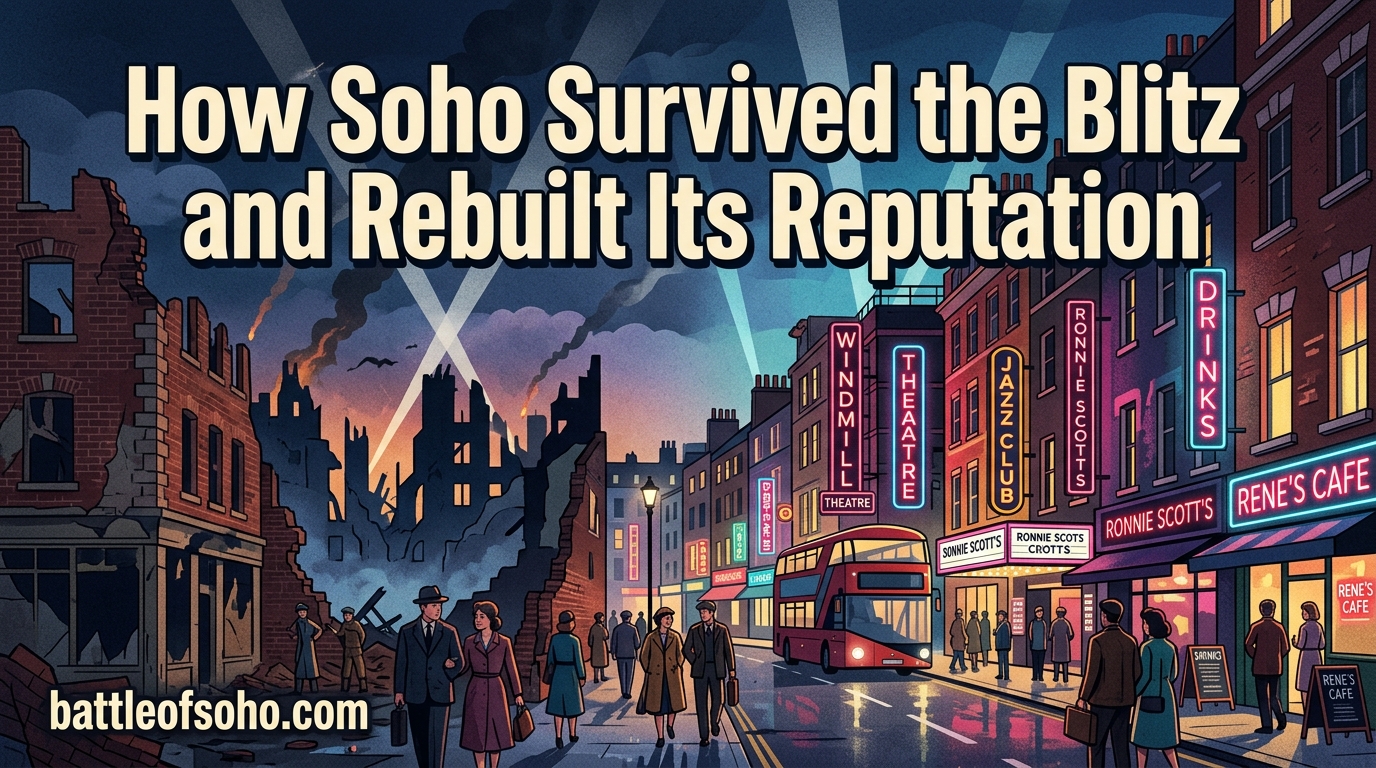
Walk through Soho today and you will find neon-lit streets packed with restaurants, pubs, music venues, and film production companies. It is hard to imagine that fewer than eighty years ago, those same streets were choked with smoke, rubble, and the screams of air raid sirens. The Soho Blitz experience is a story that most history books gloss over, buried beneath broader narratives about the London Blitz and the Docklands bombing campaigns.
The Blitz was a sustained German bombing campaign against Britain that ran from September 7, 1940 to May 11, 1941. Over those eight months, London bore the heaviest brunt, with the Luftwaffe bombing the city for 57 consecutive nights. While the East End and Docklands absorbed the most destruction, central London districts like Soho suffered their own share of devastation.
Soho occupies a unique place in the Blitz story. It sat right between the industrial Docklands to the east and the government buildings of Westminster to the west, putting it squarely in the flight path of bombers heading for high-value targets. Yet the story of how Soho survived the Blitz is about more than geography. It is about a community of restaurateurs, entertainers, market traders, and immigrant families who refused to let their neighborhood die.
In this article, we walk through what happened to Soho during the Blitz, how its residents endured night after night of bombing, which streets and buildings were hit, and how the district rebuilt itself into the cultural powerhouse it is in 2026. Whether you are researching family history, planning a London walking tour, or simply fascinated by wartime resilience, the Soho Blitz story deserves to be told.
Table of Contents
What Was the Blitz? Understanding the Bombing Campaign
The Blitz was a sustained aerial bombing campaign carried out by Nazi Germany’s Luftwaffe against the United Kingdom during World War II, lasting from September 7, 1940 to May 11, 1941. The word “Blitz” comes from the German “Blitzkrieg,” meaning lightning war, though the British campaign was anything but quick.
Before the Blitz began, the Luftwaffe had primarily targeted RAF airfields and military installations during the Battle of Britain. That changed on September 7, 1940, when Hitler shifted strategy and ordered attacks on London itself. The first major raid targeted the Docklands in East London, dropping hundreds of tons of high-explosive bombs and incendiary devices over a densely populated civilian area.
From that night onward, London was bombed for 56 out of the next 57 consecutive days and nights. The campaign eventually expanded to other British cities, including Coventry, Liverpool, Birmingham, Bristol, and Glasgow. But London remained the primary target throughout.
By the time the Blitz officially ended in May 1941, approximately 43,000 civilians had been killed across Britain and around 1.4 million people had been made homeless. London alone saw over a million houses damaged or destroyed. The campaign’s goal was to break British morale and force the government to negotiate peace. It failed on both counts.
Why Soho Was in the Crosshairs
Soho was not a primary target in the way the Docklands or Westminster were. The district had no major port facilities, no munitions factories, and no government ministries. But its location made it impossible to avoid.
Situated in the West End of London, Soho sits directly south of the Oxford Street shopping corridor and just north of the Charing Cross Road transport hub. Bombers flying up the Thames toward the Docklands would pass directly overhead. Those targeting the government buildings of Whitehall and Westminster would release their payload over the West End if they were off course, damaged by anti-aircraft fire, or simply looking for any target of opportunity before heading home.
The Luftwaffe’s bombing tactics relied heavily on incendiary devices designed to start fires that would guide subsequent waves of bombers to their targets. Once fires broke out in one part of central London, the glow on the horizon served as a beacon. Soho’s dense concentration of old timber-framed buildings, many dating back to the 18th century, made it particularly vulnerable to fire spreading from incendiary landings.
Additionally, Soho’s reputation as an entertainment district meant it was busier at night than many other parts of London. Restaurants, pubs, music halls, and theaters drew crowds even during the blackout. Those crowds made any bomb strike more likely to cause casualties, and the activity made the area harder to fully darken during blackout regulations.
The Night the Bombs Fell on Soho
The heaviest bombing of central London occurred during the first months of the Blitz, particularly September and October 1940. The night of October 14, 1940, was one of the worst for the Soho area, with multiple high-explosive bombs striking the district.
One of the most significant losses was St Anne’s Church on Dean Street, the parish church of Soho. The church’s distinctive tower, a familiar landmark for generations of Soho residents, was hit by an incendiary bomb. The resulting fire gutted the interior, though the tower itself survived and became a symbol of Soho’s endurance during the war years.
Berwick Street Market, a working-class market that had served Soho since the 19th century, also suffered bomb damage. The market stalls and surrounding shops on Berwick Street took direct hits on several occasions. Yet traders returned within days, setting up their stalls amid the rubble and broken glass. It became one of the most enduring images of the Soho Blitz spirit.
Wardour Street, then the heart of London’s film distribution industry, was hit multiple times. Film exchanges and offices that supplied cinemas across Britain were damaged or destroyed. Greek Street and Old Compton Street saw buildings collapse into the streets, blocking traffic and trapping residents in basements.
One of the most harrowing incidents occurred when a bomb struck a crowded public house on a Saturday night. Pubs were among the few places Londoners could gather during the Blitz, seeking companionship and normalcy amid the chaos. When a pub took a direct hit, the casualties were immediate and devastating.
The Underground stations that served Soho, including Tottenham Court Road and Oxford Circus, became makeshift shelters each night. Hundreds of people would queue for hours to secure a spot on the platform, bringing blankets, thermoses, and whatever they could carry. The Tube offered the best available protection from high-explosive bombs, though it was far from comfortable.
How Soho Survived the Blitz: Shelter and Spirit
Survival in wartime Soho depended on a combination of government-provided shelters, improvisation, and raw determination. The shelter systems available to Soho residents reflected the broader London experience but took on a distinct local flavor.
The London Underground was the most iconic shelter of the Blitz. By the second week of the campaign, thousands of Londoners were sleeping on station platforms each night. The government initially tried to discourage the practice, worried about health risks and the spread of disease. But the crowds kept coming, and authorities eventually accepted the reality, providing bunk beds, latrines, and even refreshment stalls at major stations.
For those who stayed above ground, the Anderson shelter was the most common option. Named after Sir John Anderson, the minister responsible for air raid precautions, these were corrugated steel domes buried partly in the ground and covered with earth. They were distributed free to households earning under a certain income threshold. In a dense urban district like Soho, few homes had gardens large enough to install one, making them more common in the outer suburbs.
The Morrison shelter, introduced in 1941, was designed for indoor use. It was essentially a steel cage that could serve as a dining table during the day and a protective shelter at night. Morrison shelters saved countless lives when ceilings collapsed during nearby explosions. They were particularly suited to the multi-occupancy dwellings and flats common in Soho.
But shelters alone do not explain how Soho survived the Blitz. The district’s entertainment culture played an equally important role. Soho’s pubs, cafes, and clubs stayed open whenever possible, offering a sense of normalcy that was psychologically important. The “business as usual” ethos became a point of pride. Restaurant owners served meals by candlelight during power cuts. Barbers cut hair in damaged shops with tarps covering blown-out windows.
The French House on Dean Street, a legendary Soho pub that served the Free French community during the war, became a gathering point for exiles, soldiers on leave, and locals seeking comfort. It survived the Blitz and remains a Soho institution to this day. Stories like these capture the spirit that kept the district alive through the worst months of bombing.
Soho Streets Damaged: Specific Locations from the Bomb Damage Maps
The London County Council Bomb Damage Maps, compiled during and after the war, provide a street-by-street record of where bombs fell across the capital. Each building was color-coded according to the severity of damage, from “general blast damage” in yellow to “destroyed” in black. These maps confirm what Soho residents lived through: the district was hit repeatedly and across a wide area.
Dean Street was among the hardest-hit streets in Soho. The aforementioned destruction of St Anne’s Church was the most visible loss, but numerous residential buildings and commercial premises along the street were also damaged. Dean Street housed a mix of working-class families and small businesses, and many were forced to relocate after their homes were rendered uninhabitable.
Old Compton Street, the main east-to-west artery through Soho, suffered damage to several blocks of buildings. The street was home to Italian and French immigrant communities, as well as a growing number of cafes and restaurants. Some families who lost their homes and businesses in the Blitz never returned to Soho, part of a wider displacement that reshaped the district’s demographic makeup after the war.
Berwick Street, with its famous street market, saw damage to the market infrastructure and the Victorian-era buildings lining the street. The market’s survival despite repeated bombing became a source of local pride. Photographs from the period show traders selling fruit and vegetables beside bomb craters and shattered shopfronts.
Wardour Street, the backbone of London’s film industry, lost several important buildings to fire and blast damage. The film distribution companies based there were forced to relocate operations or work from temporary premises. Despite the disruption, the industry adapted quickly, reflecting the broader resilience of Soho’s commercial community.
Greek Street and Frith Street, with their dense concentration of pubs, restaurants, and residential flats, also appear on the Bomb Damage Maps with multiple impact zones. The narrow street layout that gave Soho its character also made it harder for emergency services to navigate after bombing raids. Fire engines and ambulances frequently struggled to reach trapped residents through debris-filled streets.
The Imperial War Museum holds extensive photographic records of bomb damage in central London, including images of Soho streets in the immediate aftermath of raids. These images, along with the Bomb Damage Maps available through the London Metropolitan Archives, remain the most reliable resources for tracing specific locations affected by the Soho Blitz.
The Long Road Back: Post-War Soho Reconstruction
When the Blitz ended in May 1941, the bombing did not stop entirely. Smaller raids continued through 1942 and 1943, and the V-1 flying bomb and V-2 rocket campaigns of 1944 and 1945 brought a new wave of destruction to London. Soho experienced damage from these later attacks as well, complicating already difficult reconstruction plans.
After the war ended in 1945, London faced a housing crisis of staggering proportions. Over a million homes had been damaged or destroyed across the city. In Soho, the problem was acute because the district’s housing stock was already aging and overcrowded before the war. Bomb damage only worsened conditions that had been a concern for decades.
The government’s War Damage Commission provided compensation to property owners whose buildings had been destroyed or damaged. But the process was slow, and payments often fell short of actual rebuilding costs. Many Soho property owners had to take out additional loans or sell their land to developers to afford reconstruction.
The immediate post-war years saw a mix of repair and new construction in Soho. Where historic buildings could be saved, they were patched up and returned to use. Where damage was total, new buildings went up, often in the functional but uninspired style that characterized much of 1950s British architecture. Some bomb sites remained empty for years, used as temporary car parks or left as wasteland while arguments over development continued.
The 1950s brought a wave of change to Soho that went beyond simple rebuilding. The Festival of Britain in 1951 helped lift national spirits and encouraged investment in urban renewal. In Soho, this manifested as a new wave of cafes, coffee bars, and small restaurants that took advantage of cleared bomb sites. The district’s character began to shift from a rough working-class neighborhood toward the entertainment and dining destination it would become.
One of the most significant changes was the consolidation of Soho’s film and media industry. Companies that had been scattered by bomb damage began clustering together in new premises, creating the concentration of production companies, editing houses, and talent agencies that still defines the industry presence in Soho in 2026.
It is worth noting that reconstruction was not universally welcomed. Some residents felt that developers used bomb damage as an excuse to demolish affordable housing and replace it with more profitable commercial properties. Tensions between preservation and development have been a constant in Soho’s post-war history, and they continue to shape planning debates in the district.
Soho’s Cultural Rebirth: From Bomb Sites to Bright Lights
The transformation of Soho from a bomb-scarred neighborhood to a global entertainment destination did not happen overnight. It was a process that unfolded over two decades, driven by a combination of entrepreneurial energy, cultural shifts, and sheer determination.
The 1950s coffee bar phenomenon was one of the first signs of Soho’s rebirth. Inspired by Italian and French cafe culture, small espresso bars began opening on Old Compton Street, Frith Street, and Dean Street. These were not just places to drink coffee. They became meeting points for writers, artists, musicians, and the emerging youth culture that would define the 1960s. Many of them opened on sites that had been bomb-damaged just a few years earlier.
The music scene followed close behind. Skiffle and jazz clubs proliferated in Soho’s basements and back rooms during the late 1950s. The 2i’s Coffee Bar on Old Compton Street became legendary as the birthplace of British rock and roll, launching the careers of performers like Tommy Steele. None of this would have been possible if the district had not rebuilt its physical infrastructure after the Blitz.
The 1960s cemented Soho’s reputation as the cultural heart of London. The district became synonymous with fashion, music, film, and a certain bohemian excess. Carnaby Street, just south of Soho proper, became a global fashion destination. Recording studios and music publishers filled the side streets. The film industry expanded its footprint, and Soho became the undisputed center of British film post-production.
The sex industry, which had always existed in pockets of Soho, also expanded significantly in the post-war decades. This became a defining, if controversial, part of Soho’s identity through the 1970s and 1980s. It was not until the 1990s and 2000s that rising property values and changing social attitudes began to push these establishments out, making way for the upscale restaurants, media companies, and tech startups that dominate the area now.
Today, walking through Soho, you can still find traces of the Blitz if you know where to look. St Anne’s Church tower still stands on Dean Street, rebuilt and rededicated as a symbol of the community’s survival. Berwick Street Market still operates, though in a diminished form. The street grid remains largely unchanged, a physical link to the neighborhood that endured the bombing eight decades ago.
What makes Soho’s story remarkable is not just that it survived the Blitz. Many London districts did. What sets Soho apart is how it used that survival as a foundation for reinvention. The district did not simply rebuild what was there before. It transformed itself, using the cleared bomb sites and forced relocations as an opportunity to become something new. That willingness to adapt is what rebuilt Soho’s reputation and made it the cultural landmark it remains in 2026.
FAQs
How was London rebuilt after the Blitz?
London was rebuilt through a combination of government compensation through the War Damage Commission, private investment, and large-scale public housing projects. The process took over a decade, with some bomb sites remaining undeveloped into the 1950s and 1960s. Reconstruction prioritized housing and infrastructure, though many historic buildings were lost and replaced with functional modern structures.
How did people survive the Blitz?
People survived the Blitz through a combination of shelter systems and community resilience. The main options included London Underground stations (used by thousands each night), Anderson shelters (outdoor steel domes for homes with gardens), Morrison shelters (indoor steel cages), and public air raid shelters. Civil defense volunteers, fire watches, and an emphasis on maintaining normal routines also contributed to survival.
How long did it take for London to rebuild after the Blitz?
Rebuilding London after the Blitz took roughly 15 to 20 years for the most critical work, though some bomb sites remained undeveloped into the 1970s. The most intensive reconstruction occurred between 1945 and 1960. The Festival of Britain in 1951 marked a psychological turning point, signaling that recovery was well underway, but full physical and economic recovery extended well into the 1960s.
What part of London was bombed the most in WWII?
The East End and Docklands were bombed the most during WWII because they contained the port facilities, warehouses, and industrial infrastructure the Luftwaffe specifically targeted. The borough of Stepney (now part of Tower Hamlets) suffered some of the heaviest damage per square mile. However, central London districts including Soho, the City of London, and Westminster also experienced significant damage from bombs that missed primary targets or were dropped opportunistically.
Was Soho specifically targeted during the Blitz?
Soho was not a primary target during the Blitz. The Luftwaffe focused on Docklands, industrial areas, and government buildings. However, Soho’s location in central London put it directly in the flight path of bombers heading for those targets. Bombs that missed their intended targets, were released early by damaged aircraft, or were dropped on secondary targets of opportunity regularly struck Soho streets, causing significant damage to the district.
Did the Blitz make London richer?
The Blitz did not directly make London richer. It caused enormous economic damage, destroying over a million homes, thousands of businesses, and critical infrastructure. However, the post-war reconstruction process did accelerate modernization in some areas, as outdated buildings and infrastructure were replaced. Some historians argue the eventual rebuilding created opportunities for urban renewal, but the immediate economic impact was devastating and recovery took decades.
Conclusion: A District That Refused to Disappear
The story of how Soho survived the Blitz and rebuilt its reputation is, at its core, a story about community resilience. The district had no strategic military value, yet it absorbed bombs night after night simply because of where it sat on the map. Buildings fell, streets were blocked, families were displaced, and yet the neighborhood endured.
What happened after the bombing stopped is equally important. Soho did not just rebuild what was lost. It reinvented itself. The cleared bomb sites became the foundation for a new wave of cafes, clubs, restaurants, and creative businesses that transformed the district into the cultural destination it is known as in 2026. The Soho Blitz experience is not just a chapter of wartime history. It is the origin story of modern Soho.
If you want to explore this history for yourself, the Imperial War Museum holds extensive Blitz collections and is a short walk from Lambeth. The London Metropolitan Archives houses the Bomb Damage Maps where you can trace exactly which Soho streets were hit. And walking through Dean Street past the rebuilt St Anne’s Church tower, you can see with your own eyes the physical evidence of a community that refused to disappear.