
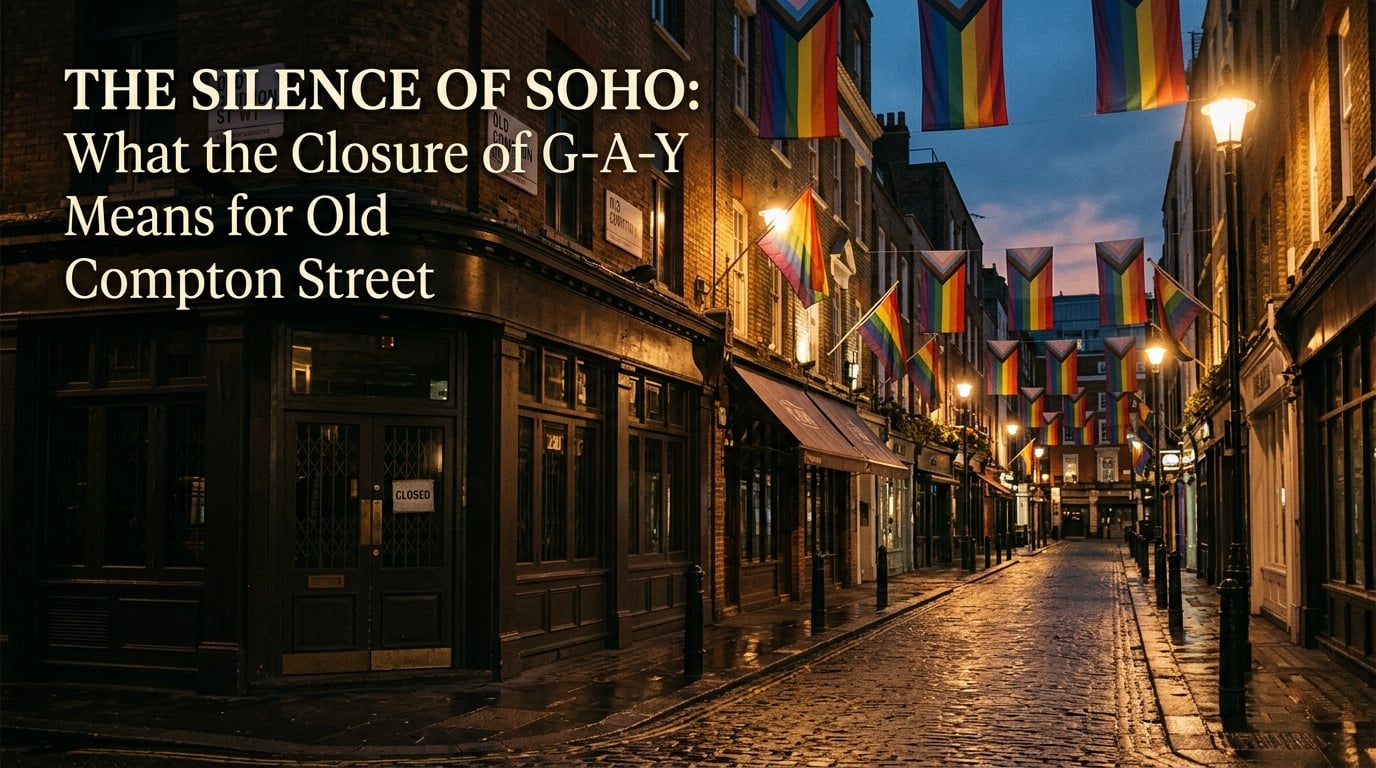
On 2 October 2025, Jeremy Joseph announced that G-A-Y Bar on Old Compton Street would close its doors for good. The news landed like a thunderclap across London’s LGBTQ+ community. For nearly 30 years, G-A-Y had been a fixture of Soho’s gay village — a place where a young Madonna once drew an overnight queue of fans singing in the streets, and where generations of queer Londoners found their footing on a dancefloor that felt like home.
The G-A-Y nightclub closure on Old Compton Street represents something bigger than one venue shutting down. Joseph himself said it plainly: the street had “lost its LGBT identity.” Rising rents, gentrification, noise complaints from new residents, and the crushing financial reality of running two major queer venues simultaneously had finally caught up with him.
In this article, we break down exactly what happened, why it matters, and what the future holds for Old Compton Street’s queer scene. We have pulled together the timeline, the financial pressures, the community reaction from Reddit and social media, and what comes next — including the new venue taking over the space.
Table of Contents
The Quick Answer: Key Facts About the G-A-Y Closure
If you are looking for the short version, here are the essential facts about what happened:
- When: G-A-Y Bar closed permanently in October 2025, with its final weekend described as the “last opening.”
- Who: Owner Jeremy Joseph, who also operates Heaven nightclub near Charing Cross, made the announcement via a lengthy Instagram post.
- Why: A combination of rising commercial rent (landlord ArchCo sought a massive increase for Heaven), the cost of living crisis, and Joseph’s belief that Old Compton Street had lost its LGBT identity.
- The trade-off: Joseph could not keep both G-A-Y Bar and Heaven financially viable. He chose to sacrifice the Soho bar to save the larger nightclub.
- What is replacing it: Coven, a new queer nightclub led by Matthew Jacobs Morgan, is taking over the site — offering a thread of continuity.
- Bigger context: G-A-Y Late at Goslett Yard also closed, and London has been losing LGBTQ+ venues at an accelerating rate.
What Happened: The G-A-Y Closure Announcement
The announcement came on 2 October 2025. Jeremy Joseph, the longtime owner of the G-A-Y brand, took to Instagram with a statement that immediately rippled across British media. The BBC, Time Out, Metro, and PinkNews all picked up the story within hours. Joseph’s core message was stark and emotional: Old Compton Street was no longer the place it had been.
In his statement, Joseph said that Soho’s most famous gay street had “lost its LGBT identity.” He pointed to years of financial pressure, the burden of running multiple venues, and the shifting character of the neighbourhood. This was not a sudden decision — he had been signalling distress for months. Earlier in 2025, G-A-Y Bar had been put on the market, a move that many in the community read as a warning sign.
Joseph also revealed the financial knot at the centre of the decision. ArchCo, the landlord for Heaven nightclub, had pushed through a major rent increase following arbitration. While Joseph described the new figure as “high but doable,” it left no room to sustain G-A-Y Bar simultaneously. He faced an impossible choice: keep both venues and risk losing everything, or sacrifice one to save the other.
The physical aftermath was visceral. Within weeks of the closure, photos surfaced on Reddit showing the interior being gutted. Glitterballs, Malibu bottles, years of memorabilia — all of it was being pulled out and tossed into a skip on the street. One Reddit user titled their post “End of an era in Old Compton Street,” capturing the grief many felt seeing a landmark dismantled piece by piece.
A Brief History of G-A-Y on Old Compton Street
To understand why this closure hit so hard, you need to know what G-A-Y meant to London. The brand traces its roots back to the mid-1990s, when Jeremy Joseph launched G-A-Y as a club night at the London Astoria on Charing Cross Road. It quickly became one of the UK’s most iconic LGBTQ+ club brands, drawing huge crowds and big-name performers.
The Astoria was demolished in 2009 to make way for Crossrail, forcing G-A-Y to relocate its flagship club night to Heaven nightclub — the legendary Charing Cross venue that Joseph would eventually come to own outright. But the G-A-Y Bar on Old Compton Street remained a separate, beloved institution. It was a bar rather than a club, a place where people could start their evening, meet friends, and feel the particular energy of Soho’s gay village.
The cultural moments embedded in those walls are extraordinary. Perhaps the most famous anecdote: Madonna performed at G-A-Y roughly 25 years ago. According to Time Out’s reporting, fans queued all night for the chance to get in, singing her songs in the street. That moment captured something essential about the venue — it was a place where pop culture and queer culture collided with pure, unfiltered joy.
G-A-Y was not just one venue. The brand included G-A-Y Bar on Old Compton Street, G-A-Y Late at Goslett Yard (which also closed, reportedly in 2024), and the Heaven nightclub operation near Charing Cross. By the time G-A-Y Bar shut its doors, G-A-Y Late was already gone. The closure of the Old Compton Street site effectively reduced the brand from a multi-venue empire to a single nightclub.
For three decades, G-A-Y was a constant in a neighbourhood that has changed dramatically. It survived the 2000s, weathered the 2008 financial crisis, and somehow held on through the COVID-19 pandemic with the help of Soho Estates, which waived rent during lockdown. But the pressures that followed proved too much.
Why G-A-Y Closed: Rent, Identity, and the Heaven Trade-Off
The closure was not caused by a single factor. It was the result of several pressures converging at once. Here is a breakdown of the key reasons:
- Rent and the ArchCo arbitration: ArchCo, the landlord for Heaven nightclub, took Joseph to arbitration over rent. The resulting increase was significant — described by Joseph as “high but doable.” But “doable” for one venue meant “impossible” for two. The rent hike on Heaven effectively forced Joseph to consolidate.
- The cost of living crisis: Running a central London gay bar in 2026 means facing astronomical overheads. Energy costs, staffing, insurance, and stock prices all surged in the post-pandemic years. Margins in hospitality were already thin; for a venue the size of G-A-Y Bar, the maths stopped working.
- Lost LGBT identity on Old Compton Street: This was Joseph’s most pointed argument. He said the street itself had changed — that it no longer felt like the proudly queer space it had been for decades. If the neighbourhood was losing its character, what was the point of fighting to keep a bar there?
- The impossible choice: Joseph could not sustain both G-A-Y Bar and Heaven. Heaven is the larger venue, the flagship club, and arguably the more financially significant operation. Sacrificing G-A-Y Bar to protect Heaven was a brutal but rational business decision.
- G-A-Y Late was already gone: With G-A-Y Late at Goslett Yard already closed, the brand had already been contracting. The Old Compton Street bar was the next domino.
It is worth noting that not all landlord relationships were adversarial. Joseph publicly credited Soho Estates — the major Soho landowner — for waiving rent during the COVID-19 pandemic. That act of goodwill kept G-A-Y alive through lockdown. But Soho Estates was the landlord for G-A-Y Bar, while ArchCo was the landlord for Heaven. The two situations played out very differently.
The arbitration process with ArchCo was particularly bruising. Commercial rent arbitration in the UK can result in dramatic increases if the landlord successfully argues that market rates have risen. For a nightlife venue operating on tight margins, a sudden rent jump can be fatal. Joseph’s description of the outcome as “high but doable” suggests he absorbed the hit for Heaven — but the cost was G-A-Y Bar.
The “Lost LGBT Identity” of Old Compton Street
Joseph’s claim that Old Compton Street had “lost its LGBT identity” struck a nerve. It was the most quoted line from his statement, and it tapped into a conversation that had been building for years. But what does that phrase actually mean in practice?
Old Compton Street has been the heart of London’s gay scene since at least the 1970s. For decades, it was the closest thing London had to a “gay village” — a stretch of pubs, bars, and clubs where queer people could feel safe, visible, and at home. The street had a particular energy: rainbow flags, late-night crowds, drag shows spilling onto pavements, and a sense of community that was genuinely rare.
That energy has been fading. Gentrification has transformed Soho over the past two decades. Luxury flats, corporate chain restaurants, and high-end retail have moved in. And with new residents came noise complaints — the kind of NIMBY pressure that makes running a nightlife venue increasingly difficult. Time Out’s coverage highlighted this tension, contrasting the historic queer energy of the street with modern complaints from people who had moved into a nightlife district and then objected to the nightlife.
Reddit users offered their own evidence. In one thread, a commenter noted that Old Compton Street bars were “mostly closed by 11:30pm” in recent years. That is a stunning shift for a street that once throbbed until the early hours. Licensing restrictions, noise abatement orders, and the simple economics of earlier closing times all contributed to a scene that felt diminished.
The contrast is painful when you look at the history. The same street where fans once queued all night to see Madonna, singing in the streets at 3am, had become a place where bars shut before midnight. Joseph was not exaggerating when he said the identity had changed. He was naming something the community had been feeling for years.
How the Community Reacted
What set this closure apart from other venue losses was the depth and visibility of community grief. This was not just a news story — it was a collective mourning, and it played out across social media in real time.
On Reddit’s r/london community, two major threads captured the public response. The first, titled “G-A-Y owner announces venue closure amid growing concern for queer spaces in SOHO,” drew hundreds of comments. The second, simply titled “End of an era in Old Compton Street,” showed photos of the venue being gutted — glitterballs and Malibu bottles going into a skip. That visual hit people hard. Seeing three decades of memorabilia thrown into a skip made the closure tangible in a way that a news headline could not.
The comments revealed several recurring themes. People described G-A-Y as the place where they first felt comfortable being openly queer. Others remembered specific nights — first dates, coming-out celebrations, nights out with friends who are no longer alive. The venue was not just a business. It was a repository of personal queer history.
There was also anger directed at the broader system. Commenters pointed to gentrification, corporate landlords, and a political climate that seemed indifferent to the loss of queer spaces. One thread on r/londonlgbt titled “What’s wrong with London’s gay bars?” had been running for months before the closure, cataloguing a pattern of venues struggling and shutting down across the city.
The community also asked practical questions: What will happen to queer spaces in Soho now? Are other gay bars on Old Compton Street at risk? Where do people go now? These are not rhetorical questions. They reflect genuine anxiety about whether Soho’s identity as a queer neighbourhood can survive the loss of its anchor venues.
The Bigger Picture: Gay Bar Closures Across London
G-A-Y’s closure did not happen in a vacuum. London has been losing LGBTQ+ venues at an alarming rate for years. According to data from LGBTQ+ nightlife advocacy groups, the capital has lost more than half of its queer venues over the past two decades. The trend accelerated after the pandemic, and G-A-Y is simply the most high-profile casualty so far.
Several structural factors are driving this pattern. Commercial rents in central London have soared, pricing out independent operators. The cost of living crisis has reduced discretionary spending on nightlife. Gentrification has brought new residents into areas that were historically queer spaces, leading to noise complaints and licensing battles. And the rise of dating apps has changed how queer people connect — reducing the social function of the gay bar for some, particularly younger generations.
But the dating app argument has limits. As Reddit discussions on r/londonlgbt have highlighted, queer spaces serve functions that apps cannot replicate. They provide community, safety, and a sense of belonging. They are where people meet friends, find chosen family, and experience the particular joy of being surrounded by other queer people in a physical space. Losing them erodes the social fabric of LGBTQ+ life.
The pattern is not unique to London. Manchester’s Canal Street, Brighton’s scene, and queer venues across the UK face similar pressures. But London’s situation is particularly acute because of the sheer cost of operating in zones 1 and 2. When a commercial landlord can earn more from a chain restaurant or a luxury retail tenant than a gay bar, the market logic is brutal and clear.
G-A-Y’s closure is therefore both a specific event and a symbol. It is the story of one venue and one owner making a difficult decision. But it is also the story of what happens when cities stop valuing the spaces that make minority communities visible and connected.
What Remains on Old Compton Street
With G-A-Y gone, the question everyone is asking is simple: what is left? Old Compton Street has not been completely emptied of queer venues, but the landscape is undeniably thinner than it was.
The most notable survivor is Comptons of Soho, often nicknamed “The Old Dame” of London’s gay scene. Comptons is one of the oldest gay pubs in the city, offering a more relaxed, traditional pub atmosphere compared to G-A-Y’s club-adjacent energy. It serves beer, shows live sports, and hosts DJ sets on weekends. For many in the community, Comptons represents the last true constant on the street.
Beyond Comptons, the picture is mixed. Several venues on and around Old Compton Street still cater to LGBTQ+ crowds, but many have shifted to become more mixed or have reduced their late-night offerings. The cumulative effect is a street that still has queer presence but lacks the density and energy that once defined it.
The concern among community members is whether the remaining venues can survive. If G-A-Y — a brand with name recognition, a loyal following, and 30 years of history — could not make the numbers work, what does that mean for smaller, independent operators? The financial pressures that killed G-A-Y are not going away. Rents will continue to rise. The cost of living crisis has not fully resolved. And NIMBY pressure on nightlife venues shows no sign of abating.
This is the anxiety that runs through every Reddit thread and social media discussion about the closure. It is not just about one bar. It is about whether Old Compton Street can remain a queer space at all.
What Comes Next: Coven and the Future of Queer Soho
There is a glimmer of continuity in this story. The G-A-Y Bar site on Old Compton Street is not being turned into a chain restaurant or luxury flats — at least not yet. It is being taken over by Coven, a new queer nightclub venture.
Coven is led by Matthew Jacobs Morgan, and early reports suggest it aims to carry the torch of queer nightlife on the site. While details remain sparse in mainstream coverage, the concept has generated cautious optimism in the community. The idea that the physical space where G-A-Y operated will remain a queer venue, rather than being lost to gentrification, is meaningful.
That said, Coven faces the same structural challenges that brought down G-A-Y. Rent, overheads, noise complaints, and the cost of running a nightlife venue in central London do not disappear because the name above the door has changed. The question is whether a new operation with fresh energy and potentially different business models can succeed where a 30-year institution could not.
For now, the community is watching with a mix of hope and trepidation. Coven represents the possibility that Old Compton Street’s queer identity is not entirely lost. But it also represents the fragility of that identity — one more closure away from disappearing entirely.
The broader future of queer Soho depends on factors beyond any single venue. It depends on whether landlords choose to support queer businesses, whether local planning policies protect nightlife, and whether the community continues to show up and use these spaces. G-A-Y’s closure is a warning. What happens next is still being written.
FAQs
Why did G-A-Y close on Old Compton Street?
G-A-Y Bar closed in October 2025 due to a combination of rising commercial rent, the cost of living crisis, and owner Jeremy Joseph’s belief that Old Compton Street had lost its LGBT identity. The landlord ArchCo increased Heaven nightclub’s rent through arbitration, and Joseph could not sustain both Heaven and G-A-Y Bar simultaneously. He chose to close the Soho bar to save the larger nightclub.
When did G-A-Y bar officially close?
G-A-Y Bar on Old Compton Street closed permanently in October 2025. Jeremy Joseph announced the closure on 2 October 2025 via Instagram, and the venue had its final weekend shortly after. The site was then gutted, with fixtures and memorabilia removed.
What is replacing G-A-Y bar in Soho?
Coven, a new queer nightclub led by Matthew Jacobs Morgan, is taking over the G-A-Y Bar site on Old Compton Street. The venue aims to continue the tradition of queer nightlife in the space, though it faces the same financial pressures that contributed to G-A-Y’s closure.
Is Heaven nightclub still open?
Yes, Heaven nightclub near Charing Cross is still open. Owner Jeremy Joseph closed G-A-Y Bar specifically so he could focus resources on keeping Heaven operational after ArchCo increased its rent through arbitration. Joseph described the new rent as high but manageable for a single venue.
Are there still gay bars on Old Compton Street?
Yes, there are still LGBTQ+ venues on Old Compton Street, though fewer than in previous years. Comptons of Soho, one of London’s oldest gay pubs, remains open and is the most prominent surviving queer venue on the street. However, the overall density of gay bars has decreased significantly.
Who owns G-A-Y and Heaven nightclub?
Jeremy Joseph owns both the G-A-Y brand and Heaven nightclub. He has operated G-A-Y since the mid-1990s, originally as a club night at the London Astoria before expanding to multiple venues including G-A-Y Bar on Old Compton Street, G-A-Y Late at Goslett Yard, and Heaven near Charing Cross.
Why are London gay bars closing down?
London gay bars are closing due to rising commercial rents, the cost of living crisis, gentrification bringing noise complaints from new residents, changing social habits including the rise of dating apps, and licensing pressures. London has lost more than half of its LGBTQ+ venues over the past two decades, with the trend accelerating after the COVID-19 pandemic.
Conclusion: What the G-A-Y Nightclub Closure Means for Old Compton Street
The G-A-Y nightclub closure on Old Compton Street is a watershed moment for London’s LGBTQ+ community. It marks the end of a 30-year institution, the contraction of a once-mighty venue brand, and the starkest evidence yet that Soho’s queer identity is under existential threat.
Jeremy Joseph’s decision was driven by forces that no single owner can resist: rising commercial rents, a brutal cost of living crisis, gentrification that has fundamentally changed the character of Old Compton Street, and the financial impossibility of sustaining multiple venues in parallel. His claim that the street had “lost its LGBT identity” was not hyperbole — it was a diagnosis confirmed by anyone who has watched the neighbourhood change over the past decade.
What happens next matters enormously. Coven’s arrival offers a thread of hope, but the structural pressures remain. Comptons and other surviving venues carry the weight of a community that is shrinking in physical presence even as it grows in visibility and rights. The question is whether Old Compton Street can remain a queer space — or whether it becomes just another gentrified London street with a rainbow history and nothing behind it.
For now, the glitterballs are in a skip and the Malibu bottles are gone. But the community that filled G-A-Y for 30 years is still here. Where they go next, and whether the spaces that welcome them can survive, will define the next chapter of queer Soho.