
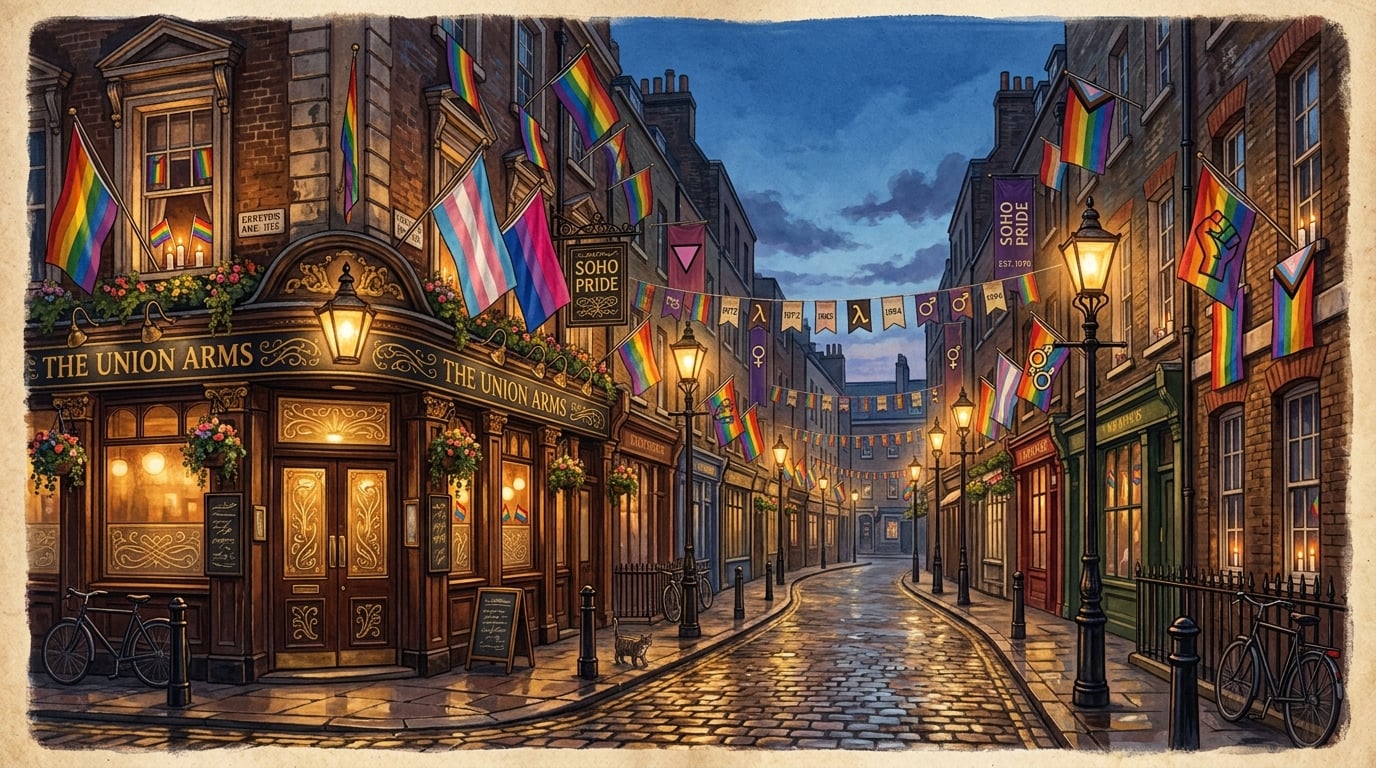
London’s gay village has one of the richest queer histories of any city in the world. From secret gatherings in 18th-century Molly Houses to the neon-lit storefronts of Old Compton Street, the story of how London’s gay village changed over the decades is one of resilience, defiance, and constant reinvention.
If you walk through Soho today, you might notice rainbow crossings and a handful of surviving gay bars. But beneath the surface lies nearly 300 years of struggle. LGBTQ+ people built community spaces here long before it was legal to do so. They fought police raids, survived the AIDS crisis, and created a cultural hub that influenced queer scenes worldwide.
In this guide, we trace how London’s gay village evolved across every major era. We cover the Molly Houses of the 1700s, Victorian crackdowns, the underground clubs of the early 1900s, the Stonewall era, Soho’s golden years, and the gentrification pressures reshaping queer London today. Whether you are a history enthusiast, a member of the LGBTQ+ community, or a visitor wanting to understand the significance of Old Compton Street, this decade-by-decade breakdown covers everything you need to know.
Table of Contents
The 1700s: Molly Houses and the Birth of Queer London
Queer life in London existed long before the term “gay village” was ever used. In the early 1700s, men who had sex with men gathered in secret venues known as Molly Houses. These were informal meeting places in private homes, taverns, and back rooms where people could socialize, cross-dress, and form relationships away from the judgment of society.
Soho and the surrounding areas of central London were central to this early queer underground. Mother Clap’s Molly House, which operated in the 1720s near what is now Holborn, became the most famous example. It was raided in 1726, leading to arrests and several executions. But the raid also proved something remarkable: a queer community existed in London, and it was large enough to fill an entire establishment.
The 1700s were brutal for LGBTQ+ people. Sodomy was a capital offence in England until 1861, punishable by death. Despite this, Molly Houses persisted throughout the century. They popped up in the streets around Covent Garden, the Strand, and the edges of Soho. These were the first queer spaces in London, even if nobody would have called them that at the time.
What is striking about this era is how organized the community already was. Molly Houses had their own traditions, slang, and social roles. Some had mock birth ceremonies and christenings. This was not a scattered underground of isolated individuals. It was a functioning subculture, and it laid the foundation for everything that came after.
The 1800s: Victorian Crackdown and Underground Survival
The Victorian era intensified the persecution of LGBTQ+ people in London. The Offences Against the Person Act of 1861 replaced the death penalty for sodomy with life imprisonment. Then, the Criminal Law Amendment Act of 1885 criminalized “gross indecency” between men, covering any sexual act, in public or private. This was the law under which Oscar Wilde was prosecuted and sentenced to two years of hard labor in 1895.
The Wilde trial sent shockwaves through London’s queer community. For years afterward, men who loved men lived in even greater fear. Public awareness of homosexuality surged, but not in a way that helped. It became a scandal, a punchline, and a crime all at once. The community was driven further underground.
Yet queer spaces survived. Through the 1800s, certain pubs, bathhouses, and cruising areas in central London remained known to those in the community. The area around Soho, with its mix of theaters, music halls, and cheap lodging houses, continued to attract people living outside conventional society. The neighborhood’s reputation for bohemian excess made it a natural refuge for those who could not exist openly elsewhere.
Female same-sex relationships were never explicitly criminalized in England, which meant that queer women’s spaces followed a different trajectory. They existed in less documented, more private forms. Literary salons, boarding houses, and theater circles served as meeting points. The history of lesbian and bisexual women in Victorian London is harder to trace, but it was there, woven into the fabric of the city’s cultural underground.
Early 1900s: The Cave of the Golden Calf and Hidden Worlds
The early 20th century brought new forms of queer expression to London. One of the most significant was the Cave of the Golden Calf, a nightclub that opened in 1912 on Heddon Street, just a short walk from Soho. It was not exclusively a gay venue, but it attracted a bohemian, sexually diverse crowd that included queer artists, writers, and performers. It was one of the first places in London where sexuality could be performed and celebrated openly, even if only within its walls.
The interwar period saw the rise of speakeasy-style bars and private members’ clubs where queer people could gather. These venues operated in a legal grey area. Homosexuality was still criminalized, and police raids were a constant threat. But the demand for these spaces was enormous, and supply followed.
One notable venue from this era was the Gateways Club, which opened in the 1930s and became London’s most famous lesbian club. Located in Chelsea, it ran for decades and was featured in the 1968 film “The Killing of Sister George.” The Gateways provided a rare, long-term safe space for queer women in a city that otherwise ignored their existence.
World War II disrupted and reshaped London’s queer scene in unexpected ways. The war brought millions of people together in close quarters, away from families and hometowns. For many queer people, wartime London was the first place they found others like themselves. The sense of impermanence and danger created an atmosphere where hidden desires could surface. After the war, many stayed in the city, helping seed the more visible queer communities of the 1950s and beyond.
The 1950s to 1960s: Wolfenden, Decriminalization, and the First Visible Spaces
The 1950s were a turning point for London’s LGBTQ+ community. In 1957, the Wolfenden Report recommended that homosexual acts between consenting adults in private should no longer be criminalized. It took another decade for Parliament to act on this recommendation, but the report marked a shift in public conversation. For the first time, a government-appointed body had acknowledged that criminalizing homosexuality was unjust.
The Sexual Offences Act of 1967 partially decriminalized homosexuality in England and Wales. It applied only to men over 21, and only to acts committed in private. It was a limited reform, riddled with contradictions, but it changed everything. For the first time, it was legal for gay men to exist as gay men in their own homes.
Decriminalization did not instantly create a gay village. But it opened the door. Throughout the late 1960s, a small number of bars and clubs in central London began to cater more openly to queer clientele. Soho was the natural location. Its density of nightlife, its distance from residential respectability, and its existing bohemian character made it the obvious place for a nascent gay scene to take root.
The Earl’s Court area also developed a gay reputation during this period. The Coleherne pub became a landmark, particularly for the leather and bear communities that would grow in the decades to follow. London’s queer geography was starting to take shape, even if it would be years before anyone talked about a “gay village.”
The 1970s: Gay Liberation and London’s First Pride
The 1970s transformed London’s queer scene more dramatically than any decade before. The Stonewall riots in New York in 1969 sparked a global movement. In London, the Gay Liberation Front formed in 1970, bringing a new energy of activism, visibility, and unapologetic pride to a community that had spent centuries hiding.
London’s first Pride march took place on July 1, 1972. About 2,000 people marched from Trafalgar Square to Hyde Park. It was a radical act. Participants risked their jobs, their families, and their safety simply by showing up. But they came anyway, and the march became an annual tradition that grew year after year.
This decade saw the first real clustering of gay businesses around Old Compton Street in Soho. The French House, a historic pub on Dean Street, had long been a haunt for artists and free thinkers, including queer figures like Francis Bacon. Now, specifically gay venues began opening nearby. The characterization of Soho as London’s gay village began here, in the pubs and bars that gave the community a visible, physical home.
In 1979, Heaven opened beneath the arches of Charing Cross Station. It was not in Soho proper, but it became the most famous gay nightclub in London and one of the most iconic in the world. Heaven showed that queer nightlife could operate on a grand, theatrical scale. It set a standard that every subsequent venue would be measured against.
The 1980s: AIDS Crisis and Community Resilience
The 1980s were the hardest decade in the history of London’s gay village. The AIDS epidemic arrived in the UK in the early 1980s and devastated the community. Young men fell ill, and the medical establishment struggled to understand or respond. Fear, stigma, and grief defined the era.
The British government launched the “Don’t Die of Ignorance” campaign in 1987, sending an information leaflet about HIV and AIDS to every household in the country. The campaign raised awareness but also intensified fear. The iceberg advert and ominous voiceover became cultural touchstones, but for the queer community, they reinforced a narrative of disease and death.
In 1988, Margaret Thatcher’s government passed Section 28, a law prohibiting local authorities from “promoting homosexuality.” It was a devastating blow. Schools could not mention same-sex relationships. Libraries pulled queer literature from shelves. Community groups lost funding. The law sent a clear message that LGBTQ+ people were not just different but dangerous.
Yet this was also a decade of fierce community organizing. Activist groups like ACT UP London and Stonewall (founded in 1989) fought back against ignorance and institutional neglect. Soho’s gay venues became more important than ever. They were not just places to socialize. They were places to share information about HIV prevention, to organize protests, to grieve together, and to find strength in numbers when the rest of society seemed hostile.
The gay village of the 1980s was defined by solidarity in the face of catastrophe. The community lost countless members, but it also forged bonds that would fuel the explosion of queer culture in the decade that followed.
The 1990s to 2000s: The Golden Era of Soho’s Gay Village
For many people, the 1990s and early 2000s represent the peak of Soho as a gay village. This was the era when Old Compton Street became internationally recognized as the heart of queer London. Rainbow flags hung from awnings. Gay bars, clubs, cafes, and shops lined the street. You could step out of one venue and into another, spending an entire night without leaving the neighborhood.
Comptons of Soho, one of the oldest surviving gay pubs in the area, became a cornerstone of the scene. The Village Soho opened its doors and became a hub for drag shows and cabaret. Molly Moggs offered a more traditional pub atmosphere with a fiercely loyal queer following. Madame Jojos hosted legendary drag nights and became synonymous with Soho nightlife.
G-A-Y, owned by Jeremy Joseph, started as a club night and grew into one of the biggest LGBTQ+ entertainment brands in the UK. The G-A-Y Bar and G-A-Y Late on Old Compton Street became institutions. They attracted pop stars for performances, drew crowds from across the country, and anchored the street’s identity as a queer destination.
The cultural impact of this era extended far beyond nightlife. Queer art, film, literature, and fashion flourished in and around Soho. The neighborhood became a symbol of what visibility and community could achieve when given space to grow. For a generation of LGBTQ+ people, Soho was proof that they existed, they mattered, and they could build a world of their own.
This golden era also saw the abolition of Section 28 in 2003, the equalization of the age of consent, and the introduction of civil partnerships in 2004. Legal progress and cultural visibility reinforced each other. London’s gay village was thriving, and it felt like the progress would never stop.
The 2010s: Gentrification, Development, and Venue Closures
The 2010s marked a turning point. The very success that made Soho’s gay village famous also made it a target. Property values soared. Developers circled. The infrastructure projects that modernized central London also tore through the queer spaces that had taken decades to build.
The construction of the Elizabeth Line (Crossrail) required the demolition of several buildings in the Soho and Tottenham Court Road area. The Astoria, a historic live music venue with strong LGBTQ+ ties, was torn down in 2009. The Ghetto, a small but beloved queer club near Charing Cross, was demolished to make way for the same project. First Out, a feminist and queer cafe near King’s Cross, closed in 2011. Each closure erased not just a business but a piece of community history.
Rising rents were the other major factor. As Soho became increasingly desirable to corporate tenants and chain businesses, independent gay venues struggled to survive. Landlords raised lease prices to levels that queer businesses could not meet. Some venues closed outright. Others were replaced by cocktail bars and restaurants that had no connection to the LGBTQ+ community.
This shift raised concerns about heteronormativity in Soho. Queer spaces that had once felt safe and exclusively community-oriented were increasingly filled with straight crowds who treated the area as a novelty or a tourist attraction. Regulars reported feeling like strangers in spaces they had considered home. The character of Old Compton Street was changing, and many in the community felt powerless to stop it.
Research from LGBTQ+ advocacy groups documented the decline. A 2017 study by UCL found that London had lost nearly 60% of its LGBTQ+ venues since 2006. The losses were felt across the city, but Soho’s concentration of historic venues made the impact particularly visible there. The gay village was not dying overnight, but it was eroding steadily.
How London’s Gay Village Changed Over the Decades: 2020s to Present
The changes that began in the 2010s accelerated in the 2020s. The most significant single event was the closure of G-A-Y Late in December 2023. Owner Jeremy Joseph cited a combination of factors, including attacks on customers and staff, rising costs, and increasingly hostile conditions. The loss sent shockwaves through the community. G-A-Y Late had been one of the last large-scale queer club venues on Old Compton Street, and its closure felt like an era ending.
Noise complaints from wealthy new residents have become a persistent issue. Soho, once a neighborhood defined by nightlife and entertainment, has seen an influx of luxury apartments. Residents who moved into the area knowingly surrounded by bars and clubs have filed noise complaints and pushed for curfews. This has restricted operating hours for venues that depend on late-night business to stay afloat.
The Village Soho also attracted controversy over its door policies. Multiple reports on Reddit and community forums described people being turned away for not appearing “gay enough.” These incidents highlighted a tension within the changing gay village. As straight visitors increasingly frequented queer venues, some establishments tried to preserve their LGBTQ+ character through selective entry. But the policies were inconsistent and sometimes discriminatory, alienating members of the very community they were meant to protect.
The broader question of how London’s gay village changed over the decades has no simple answer. Soho remains the historic heart of queer London, and Old Compton Street still draws visitors from around the world. But the density and vibrancy that defined the golden era are diminished. The village that exists today is a thinner, more commercial version of what it was at its peak.
That said, the story is not only one of decline. The pandemic years saw a wave of mutual aid and community solidarity. New venues have opened, and existing ones have adapted. Drag shows, queer performance nights, and community events continue to draw crowds. The community has not abandoned Soho. It is fighting for the space it built.
Soho vs Vauxhall vs Dalston: Where Queer London Is Now
As Soho has changed, queer London has decentralized. The gay village is no longer a single street. It is a network of neighborhoods, each with its own character and community. Three areas stand out as the primary hubs of contemporary queer nightlife.
Vauxhall, in south London, emerged as a major queer destination in the 2000s. Venues like Fire, Lightbox, and the Royal Vauxhall Tavern (RVT) created a nightlife cluster that offered something Soho could not: large warehouse-style spaces for after-hours clubbing. The RVT, which has operated since World War II, is one of London’s oldest surviving queer venues and holds Grade II listed status. Vauxhall’s scene tends to skew toward the clubbing and fetish communities, with a gritty, late-night energy.
Dalston, in east London, has become the home of a younger, more inclusive and intersectional queer scene. Venues like Dalston Superstore have built reputations on diverse programming that centers queer people of color, trans people, and women. The east London scene feels less commercial and more community-driven than Soho’s, which appeals to LGBTQ+ people who feel priced out or alienated by the West End.
Soho remains the most iconic and the most visited. Tourists, first-time visitors, and people looking for a centralized night out still gravitate to Old Compton Street. But locals who want a more community-focused experience increasingly look elsewhere. The gay village has become gay villages, spread across the city in ways that reflect how queer London itself has diversified.
Why This History Matters: Community, Memory, and Preservation
The history of how London’s gay village changed over the decades is not just a nostalgic exercise. It is a story about what happens when marginalized communities build something beautiful and then watch it threatened by the same economic forces that shape every desirable neighborhood. Each venue that closes erases a meeting place, a memory, and a piece of collective history.
Activist groups have taken up the cause of preserving queer spaces. Organizations like the Friends of the Joiners Arms, formed after the closure of a beloved gay pub in east London, have campaigned for legal protections for LGBTQ+ venues. Their efforts contributed to the adoption of the Agent of Change principle in planning policy, which places responsibility for noise mitigation on new developments rather than existing venues.
Community-owned and community-run spaces represent another strategy. The efforts to save venues through crowdfunding, cooperative ownership, and grassroots organizing show that the queer community is not passively accepting the loss of its spaces. The fight to preserve London’s queer geography is ongoing, and it draws directly on the same spirit of resistance that has defined LGBTQ+ history for centuries.
Frequently Asked Questions
What is the gayest neighborhood in London?
Soho, specifically Old Compton Street, has historically been London’s most famous gay neighborhood. In recent years, the queer scene has also expanded to Vauxhall, known for its large club venues and the Royal Vauxhall Tavern, and Dalston in east London, which hosts a younger and more intersectional scene. Soho remains the most recognized gay village, though the community is now spread across multiple areas.
What happened to gay Soho?
Gay Soho has been reshaped by rising rents, gentrification, and venue closures. Major losses include the Astoria and Ghetto, demolished for the Elizabeth Line, and G-A-Y Late, which closed in December 2023. Noise complaints from new residents have led to curfews. Many queer venues have been replaced by chain businesses. Soho still has LGBTQ+ bars and clubs, but the scene is smaller and more commercial than it was during its 1990s and 2000s peak.
Where do older gay men go in London?
Older gay men in London tend to favor traditional pub-style venues over large clubs. Comptons of Soho on Old Compton Street remains popular with an older demographic. The Quebec Hotel near Marble Arch has long catered to mature gay men. The Royal Vauxhall Tavern attracts a mixed-age crowd for its cabaret and performance nights. Many older community members also gather at daytime cafe events and social groups organized through LGBTQ+ community centers.
Which gay club has dark rooms in London?
Dark rooms in London gay clubs are typically found in the larger late-night venues in Vauxhall rather than in Soho. Venues in the Vauxhall arches cluster, such as those hosting fetish and leather events, have historically included dark room areas. The specific venues and their offerings change frequently, so it is best to check current listings on venue websites or community forums before visiting.
What is a dark room at a gay club?
A dark room is a dimly lit or unlit back room in a gay club or bar where patrons can engage in anonymous sexual activity. Dark rooms have been a feature of some queer nightlife venues for decades, particularly in leather and fetish-oriented spaces. They are entirely optional areas, and the main areas of the venue operate as normal social spaces. Not all gay venues have dark rooms, and their presence varies widely by venue type and location.
Conclusion
The story of how London’s gay village changed over the decades is, at its core, a story about a community that refused to disappear. From the Molly Houses of the 1700s to the golden era of Old Compton Street to the decentralized queer geography of today, LGBTQ+ Londoners have built, lost, and rebuilt their spaces across three centuries.
Soho may not be what it was at its peak, but the community that created it has not gone anywhere. It has spread to Vauxhall, Dalston, and beyond. It has organized to protect what remains and to create what comes next. The gay village of the future may look different from the one we remember, but it will still be standing.
If you want to support London’s queer spaces, the most powerful thing you can do is visit them. Spend your money at independent LGBTQ+ venues. Attend community events. Share their stories. Every pint bought, every ticket purchased, and every night out spent in a queer venue is a vote for the survival of this history. The gay village was built by the community, and it will be preserved by the community.