
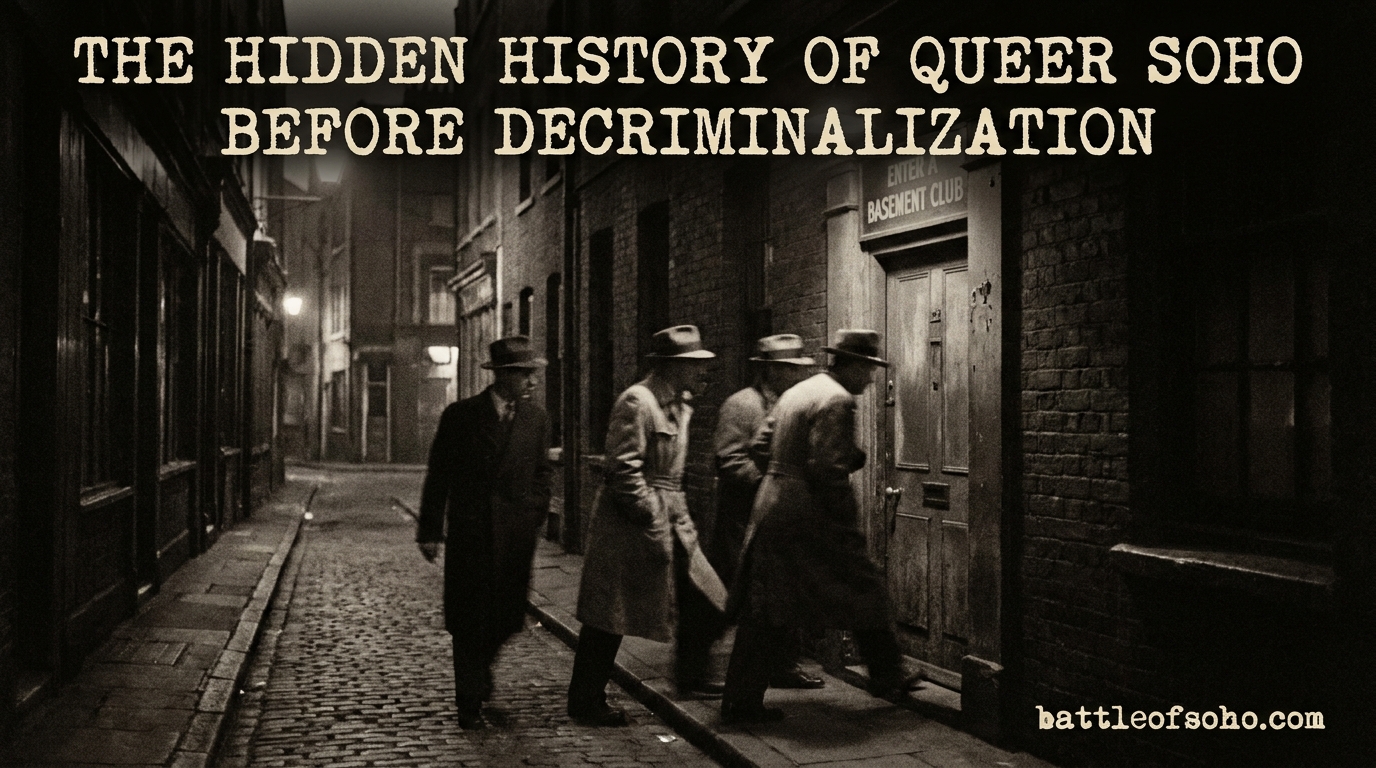
Picture Soho at midnight in 1934. Down a narrow side street off Endell Street, a discreet door opens to a basement club where men dance together under low-hanging lights. A password gets you in. The wrong knock brings the police. This was the reality of queer Soho history before decriminalization, a hidden world that thrived in plain sight for centuries before the law caught up with it.
For over 300 years before the Sexual Offences Act of 1967, LGBTQ+ people in London built a shadow culture in the streets, clubs, and coffee bars of Soho. They used coded language, secret signals, and underground networks to find each other in a city where their very existence was criminalized. The story of how they survived, organized, and built community is one of the most remarkable in London’s history.
In this article, I trace the hidden history of queer Soho before decriminalization, from the Molly houses of the 1700s through the infamous Caravan Club raid of 1934, the coffee bar culture of the 1950s, and the partial freedom brought by the 1967 Act. I also cover stories most accounts skip, including the women’s queer scene in Soho and the intersection of race and sexuality in the neighborhood’s jazz clubs.
Table of Contents
Soho’s Early Years: A Magnet for Outsiders (1600s-1800s)
Soho became a natural gathering place for people who lived outside mainstream society almost from the moment it was developed. In the late 1600s, the area was transforming from rural farmland into a dense urban neighborhood. It sat just outside the old City of London’s strict social controls, which made it attractive to immigrants, artists, sex workers, and anyone else who did not fit into respectable society.
The most accepted boundaries of Soho are generally marked by Shaftesbury Avenue, Regent Street, Oxford Street, and Charing Cross Road. Within this rectangle, a culture of tolerance and anonymity took root that existed almost nowhere else in Britain. People could lose themselves in Soho’s crowded streets, cheap lodgings, and late-opening establishments.
This geography mattered enormously for queer people. The City of London had watchmen, parish constables, and tight-knit communities where strangers were noticed. Soho, by contrast, was a neighborhood of transients. Its boarding houses, pubs, and entertainment venues provided cover for men seeking other men, even though such encounters carried the death penalty under the Buggery Act of 1533, which remained on the books in various forms for centuries.
By the 1700s, Soho and the surrounding West End had become the epicenter of an emerging queer underground. Men who today might identify as gay or bisexual found each other through a network of specific pubs, parks, and private homes. The most famous of these early meeting places were known as Molly houses.
The Molly House Era: When Soho’s Queer Underground Began
Molly houses were the first documented queer spaces in London, and several operated in and around Soho during the early 1700s. These were private homes or rooms above pubs where men could gather, socialize, and engage in relationships with each other. The most famous was run by Margaret Clap, known as Mother Clap, in Field Lane, Holborn, just a short walk from Soho’s borders.
At Mother Clap’s Molly house, men adopted feminine names and personas. They held mock births, performed ceremonies, and created a community that functioned almost like an alternative society. Some wore women’s clothing. Others simply enjoyed the freedom of being among people who understood them. These gatherings were not just about sex. They were about belonging.
The British state responded with brutal force. In 1726, a coordinated police raid targeted several Molly houses across London, including establishments connected to the Soho area. Mother Clap was arrested, convicted, and sentenced to stand in the pillory. She survived the experience, though many others did not. Several men from the raids were executed at Tyburn.
What the Molly house raids reveal is that queer community in central London was already organized and visible enough to alarm authorities more than two centuries before decriminalization. The raids did not destroy this community. They simply drove it deeper underground, into the streets and venues of Soho.
The term “Molly” itself became part of the coded language queer people used. A “Molly boy” referred to an effeminate man or a man who had sex with other men. This kind of coded vocabulary would evolve and expand over the centuries, helping queer people identify each other without drawing attention from outsiders.
Oscar Wilde and the Shadow Over Soho (1890s)
By the 1890s, Soho’s queer underground had become more sophisticated and more visible. Men who were part of this world knew which restaurants, bars, and Turkish baths were safe. Oscar Wilde, the most famous playwright in Britain at the time, moved through these spaces regularly, though his preferred haunts extended across the West End rather than being confined to Soho alone.
Wilde’s connection to the queer West End was well known in certain circles. He frequented the Cafe Royal on Regent Street, just on the edge of Soho, and his social circle included many men who were part of the same underground network. Soho’s bars and restaurants provided meeting places where men could socialize with a degree of plausible deniability.
The 1895 trial of Oscar Wilde changed everything. When Wilde was prosecuted under the Criminal Law Amendment Act of 1885 for “gross indecency,” the case sent shockwaves through every queer community in Britain. The specific law used against Wilde, Section 11, had been designed to criminalize any sexual act between men, regardless of whether it occurred in public or private. It was known colloquially as the “Blackmailer’s Charter” because it made queer men so vulnerable to extortion.
After Wilde’s conviction and sentencing to two years of hard labor, the queer spaces of Soho and the West End went quiet. Men who had been visible became invisible. Establishments that had turned a blind eye became hostile. The trial’s chilling effect cannot be overstated. For nearly two decades, public queer life in central London retreated deeper into the shadows.
The Cave of the Golden Calf (1912-1914): Soho’s First Modern Queer Club
The Cave of the Golden Calf opened in 1912 at 9 Heddon Street, just off Regent Street on Soho’s eastern edge. It was the brainchild of Frida Strindberg, the Austrian-born ex-wife of playwright August Strindberg. Her vision was to create a London version of the avant-garde cabarets she had experienced in Paris and Berlin, where artistic experimentation and sexual freedom mixed freely.
The club quickly became a sensation. Its interior was designed by Wyndham Lewis and included contributions from other future Vorticist artists. The space featured a golden calf sculpture, African-inspired decor, and an atmosphere of deliberate decadence. Patrons danced, drank, and socialized in a setting that felt unlike anything else in Edwardian London.
What made the Cave of the Golden Calf remarkable for queer history was its mixed clientele. The club attracted wealthy bohemians, artists, writers, and a significant number of gay men and lesbians who could socialize there with a degree of freedom they found almost nowhere else. The atmosphere was permissive, experimental, and deliberately transgressive.
The club closed in 1914, lasting barely two years. Financial problems, management disputes, and the outbreak of the First World War all contributed to its demise. But its legacy as one of the first spaces in modern London where queer people could gather openly in a commercial venue was enormous. It proved that such spaces could exist, even if only briefly, and it inspired imitators.
The Caravan Club and the Endell Street Raid (1934)
If the Cave of the Golden Calf showed what was possible, the Caravan Club showed how quickly it could all be destroyed. The Caravan was an underground club located in the basement of 81 Endell Street, in the heart of Soho. It was run by Jack Neave, a former strongman and circus performer who understood the appeal of a space where conventions could be suspended.
The Caravan operated as a private members club, which was a common legal workaround for venues that wanted to serve alcohol after hours or host activities that would not be permitted in licensed premises. Members paid a subscription and were given a password to gain entry. Inside, men could dance together, socialize, and enjoy a level of freedom that was extraordinary for 1930s Britain.
On 25 August 1934, the police raided the Caravan Club. The raid was part of a broader crackdown on queer venues in London during this period. Officers forced their way in and found what they described in court as scenes of men dancing together and behaving in ways they found morally repugnant. The police report described the venue as a “rendezvous for homosexual perverts,” language that reflected both the legal and cultural hostility of the time.
The trial that followed was sensational. Press coverage was extensive and often lurid. Jack Neave and several others were convicted and imprisoned. The Caravan Club was shut down permanently. But the raid’s impact went far beyond one venue. It sent a message that no queer space in London was truly safe from prosecution, a message that would shape queer Soho for decades.
The Caravan Club raid also highlighted how reliant queer spaces were on individual operators willing to take enormous risks. When those operators were prosecuted and imprisoned, the spaces disappeared. There was no institutional infrastructure to protect them, no legal framework that acknowledged the right of queer people to gather. Every club existed on borrowed time.
The Shim Sham Club: Jazz, Race, and Queer Soho
A story often missing from accounts of queer Soho is the role of Black jazz musicians and the intersection of race and sexuality in the neighborhood’s nightlife. The Shim Sham Club, which operated in Soho during the 1930s and 1940s, was one of several venues where the Black jazz scene and queer culture overlapped.
Black American and Caribbean musicians who came to London to play jazz often found themselves in a parallel underground. They faced racial discrimination in mainstream venues, and many ended up performing in and socializing at the same clubs that welcomed queer patrons. These spaces became sites of cultural intersection that most historical accounts overlook.
The Shim Sham and similar venues created an environment where people marginalized for different reasons found common ground. Queer men, Black musicians, sex workers, and bohemians shared space in a way that challenged the rigid social hierarchies of mid-century Britain. This intersectional history is essential to understanding what made queer Soho unique.
Unfortunately, the documentation of these spaces is sparse. Police records focused on queer activity rather than racial dynamics, and the people who frequented these clubs had every reason to avoid leaving written records. Reconstructing this history requires reading between the lines of court documents, press coverage, and the few surviving first-person accounts.
The Meat Rack: Soho’s Post-War Queer Geography
After the Second World War, queer Soho developed a distinct geography that regulars understood intimately. Central to this geography was an area known colloquially as the Meat Rack. The term referred to the stretch of Rupert Street and the surrounding alleys where men could find each other for casual encounters.
The Meat Rack was not a single venue. It was a stretch of public street that functioned as an outdoor meeting point. Men would walk slowly through this area, making eye contact, using subtle gestures and coded phrases to determine who was approachable. It was dangerous. Undercover police officers routinely patrolled these streets, and arrests for importuning were common.
The Meat Rack earned its name from the parade of men who would line the street, almost like cuts of meat on display. It was a grim nickname for a space that, for many men, was the only way to find community and companionship. The stakes were extraordinarily high. A single conversation with the wrong person could lead to arrest, public exposure, loss of employment, and imprisonment.
Despite these risks, the Meat Rack endured for decades. It represented the fundamental tension of pre-decriminalization queer life: the need for connection was so powerful that men were willing to risk everything for it. The Meat Rack was not glamorous. It was a survival strategy born of desperation and necessity.
Coffee Bar Culture: How Queer Soho Survived the 1950s
The 1950s brought a new kind of queer space to Soho: the coffee bar. After the war, Italian-style espresso bars opened across the neighborhood, and many of them became informal gathering places for queer men. Unlike pubs, coffee bars did not need alcohol licenses, which meant they could stay open late and attract a younger clientele.
These coffee bars occupied a gray area in the legal landscape. They were not private clubs, so they were technically public spaces. But their owners often turned a blind eye to the queer men who patronized them, as long as they behaved discreetly and bought drinks. Same-sex dancing was occasionally tolerated, and some venues became known as places where queer men could gather.
One first-person account from the period describes a Soho coffee bar where same-sex dancing was allowed and patrons stayed until 3am. The venue was not exclusively gay, which provided a layer of cover. Queer men could socialize there without the space being labeled a “homosexual venue,” at least until the police decided otherwise.
The coffee bar era also saw the emergence of a more organized queer community in Soho. Regulars at specific establishments got to know each other. Networks formed. Information about which spaces were safe and which were under surveillance spread through word of mouth. This informal intelligence network was essential for survival in a period when arrests for homosexual offences reached record numbers.
What happened to gay men in the 1950s was, in many ways, worse than in previous decades. Post-war moral conservatism, combined with aggressive policing, created an atmosphere of intense persecution. Between 1938 and 1955, annual convictions for homosexual offences in England and Wales more than doubled. Men were arrested, imprisoned, publicly named in newspapers, and driven to suicide. The coffee bars of Soho were a lifeline in this brutal environment.
Women in Queer Soho: The Hidden Half of the Story
Almost every account of queer Soho focuses exclusively on men. This is partly because the law itself was gendered. Sexual acts between women were never explicitly criminalized in Britain in the way that male homosexuality was. The oft-repeated story is that Queen Victoria refused to believe such acts were possible, so they were left out of the legislation. Whether or not this anecdote is true, the legal result was real: women who had sex with women were not subject to the same criminal statutes as men.
But the absence of specific criminalization did not mean acceptance. Women in same-sex relationships faced social ruin, loss of employment, family rejection, and forced psychiatric treatment. Their relationships were denied legal recognition. They were invisible in law not because they were tolerated, but because they were considered too shocking to even acknowledge.
In Soho, women found each other through different channels than men. Private salons, literary circles, and specific bars and clubs served as meeting points. Some women-only spaces existed within the broader queer Soho landscape, but they were even more hidden than their male counterparts. Documentation is extremely sparse, which is why this history remains largely untold.
The lack of police records for women’s spaces means historians must rely on diaries, letters, and oral histories, many of which have been lost or never created. What we do know is that women were present in queer Soho. They were not absent from this history. They were simply better hidden, by a society that refused to see them and by a legal system that pretended they did not exist.
The Wolfenden Report (1957): The Turning Point
The Wolfenden Report, published in September 1957, was the most significant official acknowledgment that the criminalization of homosexuality was unsustainable. The committee was chaired by Sir John Wolfenden, a university vice-chancellor. It was initially convened to examine both prostitution and homosexuality in Britain, reflecting a broader post-war anxiety about public morality.
The committee’s recommendation on homosexuality was striking. It concluded that homosexual behavior between consenting adults in private should no longer be a criminal offence. The report drew a distinction between sin and crime, arguing that the law should not regulate private morality. This was a radical position for 1957.
Public reaction was deeply divided. Some newspapers and politicians welcomed the recommendations. Others were horrified. The debate that followed lasted a full decade, during which thousands more men were prosecuted under the existing laws. The report did not immediately change anything. It simply opened a conversation that had been impossible to have before.
For queer people in Soho, the Wolfenden Report was a glimmer of hope after centuries of persecution. But the ten-year wait between the report and actual legislative change was filled with continued arrests, continued raids, and continued suffering. The law moved slowly, and real people paid the price for that delay every single day.
The Sexual Offences Act 1967: What It Did and Did Not Do
The Sexual Offences Act 1967 finally received Royal Assent on 21 July 1967. It partially decriminalized homosexual acts between men in England and Wales, but the word “partially” deserves emphasis. The Act was narrowly constructed and left most queer men outside its protections.
Under the 1967 Act, homosexual acts between two men were legal only if both men were over 21, both consented, and the acts took place in private. The age of consent for heterosexual acts was 16. This disparity was not closed until 2001, more than three decades later. The Act also did not apply to Scotland or Northern Ireland, where decriminalization came years later, in 1980 and 1982 respectively.
The definition of “private” was also restrictive. Acts that took place in a hotel room, or in any space where more than two people were present, could still be prosecuted. This meant that the communal spaces of queer Soho, the clubs and bars where community had been built, were still effectively criminalized. The Act legalized private acts between individuals. It did not legalize queer community.
For queer Soho, the 1967 Act was the beginning of a transformation, not the end of the story. Venues could operate more openly. Men could socialize with slightly less fear. But police raids continued, discrimination remained legal in employment and housing, and the threat of prosecution for acts outside the Act’s narrow provisions persisted. Full equality was still decades away.
The legacy of pre-1967 queer Soho lives on in the neighborhood’s identity as a center of LGBTQ+ life in London. The spaces may have changed, but the geography of queer community in Soho was established during those centuries of hidden existence. Every modern pride celebration in the area stands on ground that was once patrolled by police looking to arrest men for the crime of loving other men.
Timeline: Key Dates in Queer Soho History Before Decriminalization
1533 – The Buggery Act makes sexual acts between men punishable by death in England.
1726 – Police raids on London Molly houses, including Mother Clap’s establishment, lead to arrests and executions.
1885 – The Criminal Law Amendment Act introduces the offence of “gross indecency” between men, known as the Blackmailer’s Charter.
1895 – Oscar Wilde is prosecuted and convicted under Section 11 of the 1885 Act, sending shockwaves through queer London.
1912 – The Cave of the Golden Calf opens at 9 Heddon Street, offering a rare permissive space for queer patrons.
1914 – The Cave of the Golden Calf closes after less than two years of operation.
25 August 1934 – Police raid the Caravan Club at 81 Endell Street, Soho, leading to prosecutions and the club’s closure.
1930s-1940s – The Shim Sham Club and similar venues host intersectional spaces for queer patrons and Black jazz musicians.
1950s – Coffee bar culture emerges in Soho as a relative safe haven for queer men, while arrests for homosexual offences reach record levels.
September 1957 – The Wolfenden Report recommends decriminalizing private homosexual acts between consenting adults.
21 July 1967 – The Sexual Offences Act receives Royal Assent, partially decriminalizing homosexuality in England and Wales for men over 21.
1980 – Decriminalization extended to Scotland.
1982 – Decriminalization extended to Northern Ireland.
2001 – The age of consent for homosexual acts equalized at 16 across the UK.
How Queer People Found Each Other in Pre-1967 Soho
One of the most common questions about pre-decriminalization queer life is simply: how did people find each other? The answer involves a sophisticated system of coded language, visual signals, and trusted intermediaries that evolved over centuries.
Eye contact was the primary tool. A lingering look held a fraction too long could signal interest, though misreading these signals carried enormous risk. Specific phrases, often meaningless to outsiders, served as identification tests. The placement of a hand, the wearing of a green carnation (popularized by Oscar Wilde), or the use of particular slang could all function as signals.
Bartenders, club owners, and regulars at known venues served as informal gatekeepers. A newcomer might need an introduction from an existing member to gain access to private clubs. This system protected the community from police infiltration, though it was never foolproof. Undercover officers did penetrate these networks, with devastating consequences.
The postal system also played a role. Men corresponded with each other using coded language in letters, knowing that their mail might be intercepted. Some used false names or post office box addresses. These letters, when they survive, provide some of the most intimate documentation of pre-1967 queer life, though their coded nature makes them difficult to interpret today.
FAQs
When did Soho become a gay area?
Soho began attracting queer people as early as the 1600s due to its location outside the City of London’s strict social controls. By the 1700s, Molly houses in the broader Soho and West End area served as documented queer meeting places. Soho’s identity as a specifically gay neighborhood solidified in the 1930s with clubs like the Caravan, and became firmly established through the coffee bar culture of the 1950s.
What happened to gay men in the 1950s?
Gay men in 1950s Britain faced intense persecution. Annual convictions for homosexual offences more than doubled between 1938 and 1955. Men were arrested, publicly named in newspapers, imprisoned, and driven to suicide. Undercover police officers patrolled known cruising areas in Soho, including the Meat Rack on Rupert Street. The 1950s were one of the most dangerous decades to be a gay man in Britain, despite the relative safety of some Soho coffee bars.
What was the Cave of the Golden Calf in Soho?
The Cave of the Golden Calf was an avant-garde nightclub that opened at 9 Heddon Street in 1912. Founded by Frida Strindberg, it featured decor by Wyndham Lewis and became a rare permissive space where queer patrons could socialize alongside bohemian artists and writers. It closed in 1914 after less than two years but is considered one of the first modern queer-friendly commercial venues in London.
What was the Caravan Club raid of 1934?
On 25 August 1934, police raided the Caravan Club at 81 Endell Street in Soho, an underground venue where men danced together. The club’s owner Jack Neave and several patrons were arrested and prosecuted. Police described the venue as a rendezvous for homosexual perverts. The raid and subsequent trial received sensational press coverage and resulted in prison sentences, sending a chilling message to every queer venue in London.
When was homosexuality decriminalised in the UK?
Homosexuality was partially decriminalised in England and Wales on 21 July 1967 with the Sexual Offences Act, but only for men over 21 acting in private. Scotland followed in 1980 and Northern Ireland in 1982. The age of consent was not equalized at 16 until 2001. Full legal equality, including marriage, came even later.
Why is queer history not taught in schools?
Queer history is often excluded from mainstream education because the criminalization of homosexuality until 1967 meant that queer lives were deliberately hidden and undocumented. Primary sources are scarce because people destroyed letters and diaries to avoid prosecution. Additionally, educational curricula have traditionally focused on political and military history, marginalizing the stories of persecuted communities. Advocacy for inclusive history education continues to face resistance.
Why This History Still Matters
The hidden history of queer Soho before decriminalization is not just a story about the past. It is a story about how communities form under pressure, how people create meaning in the face of persecution, and how the geography of a neighborhood can be shaped by those who were never supposed to be there.
Understanding this history matters because it corrects a false narrative. The common story is that LGBTQ+ rights began with Stonewall in 1969 or with the Sexual Offences Act in 1967. But the truth is that queer community in London existed for centuries before either event. It was organized, resilient, and creative. It just had to hide.
This history also matters because it is still being erased. Queer venues in Soho continue to close as rents rise and the neighborhood gentrifies. The physical spaces where this history happened are disappearing. Without documentation and active remembrance, the stories of the people who built queer Soho could be lost again, this time not to prosecution but to forgetting.
The hidden history of queer Soho before decriminalization is a testament to the human drive for connection. Despite laws designed to destroy them, despite police raids and prison sentences and public humiliation, queer people in Soho found ways to build lives, relationships, and communities. That legacy deserves to be remembered, studied, and honored, not as a footnote, but as a central chapter in the story of London itself.