
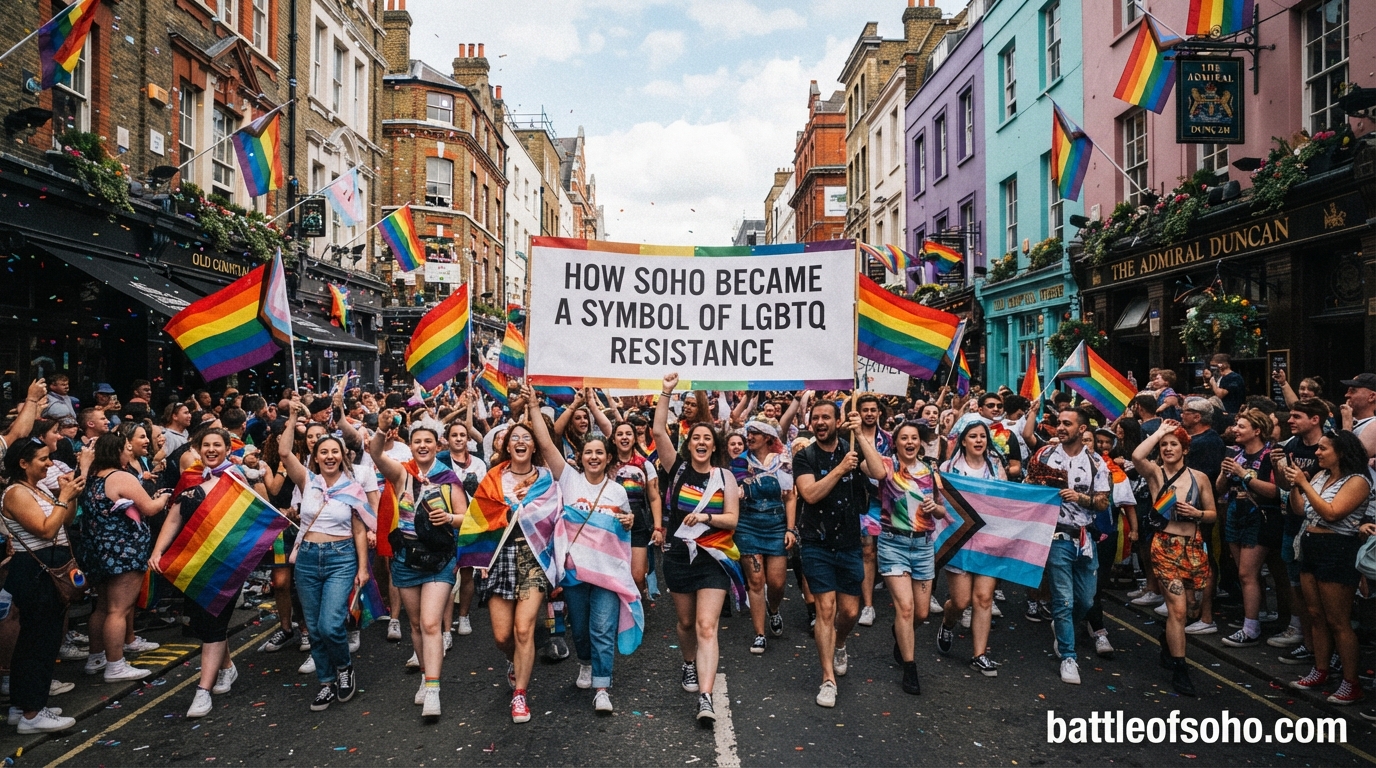
Soho, London, a compact grid of streets tucked between Oxford Street and Shaftesbury Avenue, has served as the beating heart of Britain’s LGBTQ community for over three centuries. When you ask how Soho became a symbol of LGBTQ resistance, you are really asking how a single neighborhood absorbed centuries of persecution, criminalization, violence, and erasure, and still emerged as the most visible queer district in the United Kingdom. The answer stretches from the molly houses of the 1700s through the nail bomb that shattered Old Compton Street in 1999, and onward into the gentrification battles of 2026.
I have spent years researching Soho’s queer history, walking its streets, talking to publicans, activists, and veteran club-goers who remember the neighborhood before it became a tourist destination. What follows is the most comprehensive account of how Soho became a symbol of LGBTQ resistance, told as a continuous narrative from its earliest underground gathering places to the modern fight for survival against rising rents and corporate redevelopment.
This story matters because Soho’s struggle is not just London’s story. It mirrors what queer communities face worldwide: the tension between visibility and safety, between celebration and political resistance, between owning a space and defending it from forces that want to sanitize or erase it. Understanding how Soho became a symbol of LGBTQ resistance means understanding the blueprint for queer survival itself.
Table of Contents
How Soho Became a Symbol of LGBTQ Resistance: A Quick Timeline
Soho became a symbol of LGBTQ resistance through a cumulative process spanning more than 300 years. Each era of persecution produced a corresponding wave of defiance, and each wave left physical and cultural markers on the neighborhood that the next generation could build upon. Here is the arc at a glance.
1700s: Molly houses operated secretly in Soho despite the death penalty for same-sex acts under the Buggery Act 1533. Men gathered, dressed in women’s clothing, performed mock births, and built community under constant threat of execution.
1800s: Cruising grounds around Soho Square and Rupert Street drew men seeking companionship. Oscar Wilde and other notable figures frequented the area. Police surveillance intensified, culminating in the Criminal Law Amendment Act 1885, which criminalized gross indecency between men.
1930s: Soho’s underground club scene exploded. The Caravan Club, the Shim Sham Club, and the Trocadero Long Bar offered spaces where queer people, Black jazz musicians, anti-fascist activists, and bohemians mingled freely until police raids shut them down.
1940s-1950s: Wartime blackouts and post-war ambiguity created room for discreet queer culture. Private drinking clubs like the Colony Room and the French House became havens for artists, writers, and queer identity to flourish behind closed doors.
1967: The Sexual Offences Act partially decriminalized homosexuality in England and Wales. The legal shift did not transform Soho overnight, but it opened the door for visible community formation.
1970s: The Gay Liberation Front emerged, Derek Jarman moved to the area in 1979, and Heaven nightclub opened, marking the beginning of Soho’s modern era as a visibly queer neighborhood centered on Old Compton Street.
1980s: Section 28, the AIDS crisis, and the founding of Stonewall UK turned Soho into the epicenter of political resistance. Consumerism and activism fused as queer businesses clustered along Old Compton Street.
1999: A neo-Nazi nail bomb exploded at the Admiral Duncan pub on Old Compton Street, killing three people and injuring 79. The community’s defiant response cemented Soho as a symbol of LGBTQ resistance.
2000s-present: Gentrification, rising rents, and venue closures have threatened Soho’s queer character. Each closure has sparked community resistance, proving that the spirit of defiance that defined the neighborhood remains alive.
Early Roots: Molly Houses and Cruising Grounds (1600s-1800s)
The story of how Soho became a symbol of LGBTQ resistance begins long before the word “gay” entered common use. In the late 1600s and early 1700s, Soho already had a reputation as a place where men sought other men for sex. The neighborhood’s narrow alleys, cheap lodgings, and proximity to the pleasure gardens of the West End made it a natural gathering point for people living outside the social mainstream.
Molly houses were the first organized queer spaces in Soho, and arguably in London. These were taverns, coffee houses, and private rooms where men who today might identify as gay, bisexual, or transgender gathered to socialize, dance, and express themselves in ways that the law expressly forbade. The Buggery Act 1533 made sodomy a capital offence punishable by death, and the Criminal Law Amendment Act of 1885 later expanded criminalization to virtually all sexual contact between men. Despite this, molly houses thrived in secret.
Inside a molly house, men adopted feminine names, wore women’s clothing, and performed elaborate rituals including mock births and christenings. These were not merely social gatherings. They were acts of community formation under conditions of extreme danger. The very act of gathering was resistance. To understand how Soho became a symbol of LGBTQ resistance, you have to start here, with people who risked everything simply to be in a room together.
The most famous molly house raid occurred in 1726 when Mother Clap’s establishment was raided by the Society for the Reformation of Manners. Several men were arrested, and three were executed at Tyburn. But the raids did not stop the gatherings. They simply pushed them deeper underground, and Soho remained the gravitational center for this clandestine world.
By the 18th and 19th centuries, cruising grounds around Soho Square, Rupert Street, and the adjacent arcades became well-known meeting spots. Men communicated through coded glances, specific walking patterns, and the secret language of Polari, a mix of Italian, Romani, and backslang that allowed queer people to identify each other without drawing attention from outsiders or police. Polari was not just a vocabulary. It was a survival tool, and Soho was its primary classroom.
Oscar Wilde’s connection to the West End and Soho’s cultural orbit brought the era’s most famous persecution into sharp focus. Wilde’s 1895 trial and imprisonment for gross indecency under the Criminal Law Amendment Act demonstrated exactly what the state could do to men who loved men. But Wilde’s case also galvanized a growing sense of injustice that would fuel queer organizing for decades to come. Soho, with its dense network of theaters, pubs, and boarding houses, sat at the center of this cultural earthquake.
What makes this early period so foundational to understanding how Soho became a symbol of LGBTQ resistance is the pattern it established. Persecution drove the community underground, but it also forged bonds, created shared language, and concentrated queer life in a specific geographic area. That concentration would prove decisive in every era that followed.
The 1930s Club Scene: Resistance on the Dance Floor
The 1930s marked a turning point in Soho’s queer history. The neighborhood’s underground club scene exploded with energy, creativity, and political significance in ways that no previous era had seen. These were not just places to drink and dance. They were spaces where queer identity, racial integration, and anti-fascist politics intersected on the dance floor.
The Cave of the Golden Calf, which opened in 1912 on Heddon Street just north of Soho, is often cited as a precursor to the modern nightclub. It featured avant-garde decor, live music, and a deliberately bohemian clientele that included openly queer patrons. Though it closed before the 1930s began, it established the template for the clubs that followed: defiantly modern, artistically daring, and welcoming to people the mainstream rejected.
The Caravan Club, which operated in the basement of 81 Endell Street in the mid-1930s, was one of the most explicitly queer venues of the era. It was described in court records as a gathering place for “sexual perverts,” a charge its patrons would have recognized as both dangerous and, in its own twisted way, an acknowledgment that they had been found. The Caravan was raided by police in 1934, and the subsequent trial produced sensational newspaper coverage that revealed the existence of an organized queer social world in the heart of London.
The Shim Sham Club deserves particular attention because it represents an intersection of queer history, Black British history, and anti-fascist politics that most accounts of Soho completely overlook. Named after the Shim Sham tap dance routine, the club drew Black jazz musicians, queer performers, political radicals, and anti-fascist activists into the same room. In an era when Oswald Mosley’s British Union of Fascists were marching through London’s East End, the Shim Sham Club’s very existence was a political statement. Integrated dancing, queer expression, and jazz music were all acts of resistance against the rising tide of fascism.
This is one of the most underexplored chapters in how Soho became a symbol of LGBTQ resistance. The Black queer history of the neighborhood runs deep, from the jazz clubs of the 1930s through the drag balls and club nights of later decades. Yet it remains largely absent from mainstream accounts. The Shim Sham Club proves that Soho’s resistance was never single-issue. It was intersectional before the word existed.
The Trocadero Long Bar on Shaftesbury Avenue was another key venue of this era. Its enormous, marble-topped bar attracted a mixed crowd that included queer men who used the space for meeting and socializing. The sheer size and public nature of the venue meant that queer presence in the area was visible even to people who never set foot inside a private club. Soho was becoming known as a place where queer people existed, and that visibility, dangerous as it was, was itself a form of resistance.
Police raids shut down most of these clubs by the late 1930s, but the damage was done. The idea that Soho was a place where queer people could find each other had taken root. The war that followed would create new conditions for that community to grow.
Wartime and Post-War: Underground Queer Culture
World War II transformed London, and it transformed Soho. The blackout conditions that covered the city during the Blitz created accidental privacy. In the darkness, queer people could meet, socialize, and form relationships with a degree of freedom that the daylight had never allowed. The chaos of war disrupted policing patterns, and the general atmosphere of impermanence and mortality led many people to live more authentically, even if only in stolen moments.
Soho’s private drinking clubs became the anchors of post-war queer culture. The Colony Room, a members-only bar at 41 Dean Street that opened in 1948, became legendary as a gathering place for artists, writers, and queer bohemians. Its proprietor, Muriel Belcher, was openly lesbian, and the club operated as a space where sexuality could be discussed and performed with a freedom impossible in licensed pubs subject to police oversight. Francis Bacon was a regular. Lucian Freud drank there. The intellectual and artistic ferment of the Colony Room fed directly into a broader cultural acceptance of queer presence in the neighborhood.
The French House on Dean Street served a similar function. Known for its French wine, its no-lager policy, and its eclectic clientele, the French House was a place where queer writers, artists, and thinkers could gather without the pretense of straightness. Charles de Gaulle allegedly wrote his wartime speeches there. Dylan Thomas drank there. And queer Londoners made it their own.
York Minster, universally known as “The French,” was another essential venue. Its cramped interior and location on Dean Street placed it at the heart of Soho’s queer social network. These were not gay bars in the modern sense. They were spaces where queer identity could exist without being the explicit focus, and that subtlety was its own form of survival.
Polari, the secret language that had been part of queer culture for generations, continued to evolve and spread through these Soho venues. Words like “naff” (bad or undesirable), “otta” (to know), and “blag” (to steal or bluff) entered the Polari vocabulary through Soho’s theatrical and circus connections. The language served as both a passport and a shield. If you could speak Polari, you belonged. If you could not, the conversation seamlessly shifted back to English before you noticed anything unusual.
The post-war period also saw the emergence of more explicitly queer venues. The Gateways Club, located just south of Soho in Chelsea but culturally part of the same ecosystem, was the most famous lesbian bar in London. Although not physically in Soho, it drew from the same community of queer women who socialized, worked, and organized in the Soho area. The interconnectedness of these venues created a network of safe spaces that made London’s queer community increasingly resilient.
By the late 1950s and early 1960s, pressure for legal reform was building. The Wolfenden Report of 1957 recommended that homosexuality be decriminalized, and the campaign that followed drew heavily on the networks and relationships that had been built in Soho’s clubs and bars. The neighborhood was not just a place to socialize. It was an organizing hub.
The 1970s Turning Point: Gay Liberation Front
The Sexual Offences Act 1967 partially decriminalized homosexuality in England and Wales for men over 21 acting in private. It was a limited reform that left most queer people still criminalized, but it created the legal breathing room necessary for a more visible, organized community to emerge. Soho was where that community took shape.
The Gay Liberation Front, founded in London in 1970, was inspired by the Stonewall uprising in New York the previous year. The GLF was radical, confrontational, and unapologetic. Its members rejected the polite, assimilationist approach of earlier organizations like the Homosexual Law Reform Society. They wanted liberation, not tolerance. And they saw Soho as a natural base of operations.
GLF meetings drew hundreds of people, and the organization’s presence in central London helped shift the center of queer gravity toward Soho. The group organized the first Pride march in London in 1972, and while that march started in Trafalgar Square, the after-parties and celebrations inevitably flowed into Soho’s pubs and streets. The neighborhood became the physical and emotional destination for a newly militant queer community.
Mark W. Turner, the academic whose work on Soho’s queer history is widely cited, argued that when the filmmaker and artist Derek Jarman moved to a flat above Meard Street in 1979, it marked a symbolic turning point. Jarman was already a major cultural figure, openly gay at a time when openness carried real risks. His presence in Soho, along with his artistic circle of friends and collaborators, drew other queer artists, filmmakers, and writers into the neighborhood.
Jarman’s Soho was not just a residence. It was a salon, a studio, and a statement. He hosted friends like Tilda Swinton, Peter Tully, and other figures who would shape British art and fashion for decades. The creative energy that Jarman and his circle brought to Soho was inseparable from the neighborhood’s queer identity. To be queer and creative in late-1970s London was to spend time in Soho.
The opening of Heaven nightclub in 1979 under the railway arches at Charing Cross, just steps from Soho’s southern edge, was the commercial counterpart to Jarman’s cultural influence. Heaven was, at the time, the largest gay club in Europe. Its scale, its sound system, and its unapologetic visibility marked a new era. Queer people no longer needed to hide in basement molly houses or private members’ clubs. They could dance in a massive, purpose-built venue on a Friday night and walk through Soho afterward without shame.
Heaven’s opening also marked the beginning of Soho’s transformation into a destination rather than just a local gathering place. Queer people traveled from across London and beyond to experience the neighborhood’s nightlife. This influx of people and money created the conditions for the 1980s boom that would make Old Compton Street the recognized center of London’s LGBTQ scene.
The 1980s: Political Resistance and the AIDS Crisis
If the 1970s were about liberation, the 1980s were about survival. The decade brought two devastating forces to bear on Soho’s queer community simultaneously: the AIDS crisis and Section 28. How Soho responded to these dual threats is central to understanding how it became a symbol of LGBTQ resistance.
Section 28, also known as Clause 28, was introduced as an amendment to the Local Government Act 1988. It stated that local authorities “shall not intentionally promote homosexuality or publish material for the promotion of homosexuality” and that schools could not “promote the teaching… of the acceptability of homosexuality as a pretended family relationship.” The law was a direct attack on queer visibility, and it galvanized a generation of activists.
Soho was at the center of the resistance. The neighborhood’s pubs, clubs, and bookshops became organizing hubs where activists planned protests, distributed information, and raised funds. Gay’s the Word, the LGBTQ bookshop on Marchmont Street in Bloomsbury (just north of Soho and culturally part of the same community), was itself raided by Customs and Excise in 1984, with its stock seized and its directors prosecuted. The charges were eventually dropped, but the raid demonstrated exactly what the state thought of queer literature and queer spaces. The community’s response, including fundraising concerts and readings in Soho venues, showed what the community thought of the state.
Stonewall UK was founded in 1989 by a small group including Ian McKellen, Michael Cashman, and Lisa Power, specifically in response to Section 28. The charity’s name referenced the Stonewall uprising in New York, and its mission was to fight for legal equality through lobbying and political action. McKellen, already a celebrated actor, came out publicly on BBC Radio 3 in 1988 during a debate about Section 28. His decision to be openly gay in defiance of the law was a powerful act of resistance, and his profile helped bring mainstream attention to the cause.
The AIDS crisis hit Soho with devastating force. The neighborhood’s bars and clubs lost staff, patrons, and performers to HIV-related illnesses. The grief was compounded by government indifference and media hostility. But the community’s response was extraordinary. Organizations like Switchboard (formerly the Lesbian and Gay Switchboard) operated helplines and support services. Volunteers staffed clinics, organized food deliveries for people too ill to cook, and held memorial events in Soho venues.
The academic Frank Mort, whose work on consumer culture and sexuality in London is widely cited, argued that the 1980s saw a fusion of consumerism and activism in Soho. Queer businesses clustered along Old Compton Street, creating a visible commercial strip that served as both an economic engine and a political statement. Comptons, the gay pub on Old Compton Street, became a fixture. The Village Group of bars expanded its presence. The very act of spending money in a queer-owned business became a form of resistance in an era when the government was trying to make queer people invisible.
Valentine’s Day 1993 saw the “Queer Street” festival transform Old Compton Street into a celebration of LGBTQ culture. The event combined party and protest, drawing thousands of people into the streets and demonstrating that Soho’s queer community was not merely surviving but thriving. The festival’s organizers understood something that politicians did not: visibility was the most powerful weapon against erasure.
By the end of the 1980s, Soho had been tested by the worst crises imaginable and had emerged more united, more visible, and more defiant than before. The neighborhood was no longer just a place where queer people gathered. It was a political territory, claimed and defended through years of struggle.
1999: The Admiral Duncan Bombing
On the evening of Friday, April 30, 1999, a neo-Nazi named David Copeland planted a nail bomb in a holdall bag at the Admiral Duncan pub on Old Compton Street. The bomb exploded at 6:37 PM, killing three people: Andrea Dykes, who was pregnant, her friend Nick Moore, and John Light. Seventy-nine people were injured, many severely. The blast tore through the crowded pub, turning a relaxed Friday evening into a scene of devastation.
Copeland’s attack was the third in a series of bombings targeting London’s minority communities. He had previously bombed Brixton, a predominantly Black neighborhood, and Brick Lane, home to London’s Bangladeshi community. The Admiral Duncan was his final target, chosen specifically because it was a gay pub in the heart of Soho. His stated aim was to stir up racial and homophobic tension and destabilize society. Instead, his attack achieved the opposite: it unified the community in defiance.
The response was immediate and powerful. Within hours, hundreds of people gathered outside the Admiral Duncan, laying flowers, lighting candles, and standing in silence. The crowd included local residents, queer people from across London, and allies who had no personal connection to Soho but felt compelled to show solidarity. The vigil lasted days, and the makeshift memorial on Old Compton Street became a pilgrimage site.
In the weeks that followed, the community organized public demonstrations of defiance. Pride marches that year took on a heavier, more urgent tone. The bombing had transformed Soho from a neighborhood known for nightlife into a neighborhood known for resilience. As Wolf and Badger noted in their account of Soho’s queer history, the Admiral Duncan attack “cemented Soho’s queer legacy not just as a party hub, but as a symbol of resilience and resistance.”
The bombing also forced a broader reckoning. Politicians who had previously ignored or actively opposed LGBTQ rights suddenly had to confront the reality of homophobic violence. The attack became a reference point in debates about hate crime legislation, policing, and community safety. It also reinforced the importance of physical queer spaces. If the Admiral Duncan could be attacked, it was precisely because it was visible, known, and significant. The attack proved that Soho mattered, both to the community it served and to those who wished to destroy it.
The Admiral Duncan reopened and continues to operate today. Its survival is itself an act of resistance. Every drink ordered at its bar, every conversation held in its booths, is a continuation of the community’s refusal to be intimidated. When we talk about how Soho became a symbol of LGBTQ resistance, the Admiral Duncan bombing is the event that made the symbol undeniable.
Modern Soho: Gentrification and Ongoing Resistance
The challenges facing Soho in the 21st century are different from those of previous eras but no less existential. Rising rents, corporate redevelopment, and the financial pressures of running independent nightlife venues have led to a wave of closures that threatens the neighborhood’s queer character. The resistance of the modern era is not against police raids or nail bombs. It is against economic forces that, if left unchecked, could erase everything that makes Soho significant.
The closure of Madame Jojo’s in 2014 was a watershed moment. The venue, known for its drag nights, cabaret performances, and decades of queer history, had its license revoked by Westminster City Council after a violent incident involving security staff. The closure sparked outrage and protest from the LGBTQ community, who saw it as part of a pattern of institutional hostility toward queer nightlife. Campaigners argued that the response was disproportionate and that the loss of Madame Jojo’s would leave a hole in Soho’s cultural fabric that no chain bar or restaurant could fill.
The construction of the Elizabeth Line (Crossrail), which opened in 2026, brought massive infrastructure changes to the Soho area. Construction works disrupted businesses for years, and the new transit connections have accelerated gentrification by making the area even more attractive to corporate tenants. Community groups have fought to ensure that the benefits of development do not come at the cost of erasing the neighborhood’s queer identity, but the pressure is relentless.
G-A-Y Bar on Old Compton Street, part of the G-A-Y brand that also operates Heaven, remains one of the most visible queer venues in Soho. Its survival, alongside institutions like Comptons, the Admiral Duncan, and Halfway II Heaven, represents the ongoing struggle to maintain queer-owned space in one of the most expensive real estate markets in the world. Each venue that closes is not just a business failure. It is a loss of community infrastructure that took decades to build.
Soho Pride and other community events continue to draw crowds to the neighborhood, asserting queer presence in the face of demographic and economic change. These events are celebrations, but they are also demonstrations of persistence. They say: we are still here, this is still our neighborhood, and we will not be priced out or pushed aside.
The fight over Soho’s future is not just about bars and clubs. It is about whether queer communities can maintain physical spaces in city centers as those centers become increasingly corporatized and homogenized. The question of how Soho became a symbol of LGBTQ resistance is also the question of whether that resistance can continue in an era when the threats are structural rather than violent, economic rather than legislative.
Queer Women’s Spaces in Soho: A History of Their Own
Any account of how Soho became a symbol of LGBTQ resistance would be incomplete without acknowledging the history of queer women’s spaces in the neighborhood. The dominant narrative of Soho’s queer history tends to focus on male venues, male activism, and male cultural production. But queer women built their own spaces, their own networks, and their own traditions of resistance in and around Soho, often with fewer resources and less visibility than their male counterparts.
The Candy Bar, which operated on Carlisle Street for years before its closure, was one of the most prominent lesbian bars in Soho. It provided a dedicated space for queer women to socialize without the male gaze or the assumption of heterosexuality that dominated most venues. Its loss was felt deeply by the community, as it left a gap that has never been fully filled.
She Bar, another queer women’s venue in Soho, faced similar pressures. The economics of running a niche venue in one of London’s most expensive neighborhoods are brutal, and queer women’s spaces have historically operated with smaller customer bases and less investment capital than venues targeting gay men. Their closures represent not just business failures but the erosion of spaces where queer women could build community on their own terms.
The Gateways Club, while technically located in Chelsea, functioned as part of the same cultural ecosystem as Soho’s queer venues. Its appearance in the 1968 film “The Killing of Sister George” brought lesbian life to the screen for the first time in British cinema, albeit in a controversial and sensationalized way. The club’s connection to Soho’s nightlife scene meant that queer women moved fluidly between neighborhoods, creating a wider network of safe spaces than any single venue could provide.
Understanding the full story of how Soho became a symbol of LGBTQ resistance means recognizing that this history was never monolithic. Different communities within the LGBTQ umbrella faced different pressures, built different spaces, and practiced different forms of resistance. Queer women’s contributions to Soho’s legacy deserve the same recognition and preservation as those of their male counterparts.
Black Queer History in Soho: An Underexplored Legacy
Black queer history in Soho is one of the richest and most underexplored chapters in the story of how the neighborhood became a symbol of LGBTQ resistance. From the jazz clubs of the 1930s to the drag balls and club nights of the late 20th century, Black queer people have been central to Soho’s cultural life, even as their contributions have been systematically overlooked by historians, journalists, and heritage organizations.
The Shim Sham Club, discussed earlier, is the most striking example. In the 1930s, this venue brought together Black jazz musicians, queer performers, and anti-fascist activists in a space that challenged every norm of British society. Integrated dancing between people of different races was itself a radical act. Queer expression in a mixed-race space was even more so. The Shim Sham Club was not just a nightclub. It was a living argument against the racial and sexual hierarchies of its time.
Black drag performers have been a fixture of Soho’s nightlife for decades, bringing aesthetics, music, and performance traditions that shaped the neighborhood’s creative identity. The influence of Black ballroom culture, originating in the African American and Latino LGBTQ communities of New York, reached London’s queer scene and found a home in Soho’s clubs. These cultural exchanges enriched the entire community, even when the specific contributions of Black queer people went uncredited.
The gap in the historical record is itself a form of erasure. When accounts of Soho’s queer history focus exclusively on white figures like Oscar Wilde, Derek Jarman, and Ian McKellen, they tell an incomplete story. The full history of how Soho became a symbol of LGBTQ resistance includes the unnamed Black queer people who danced at the Shim Sham Club, the drag performers who lit up Soho’s stages, and the Black LGBTQ activists who organized, protested, and built community in a neighborhood that was not always welcoming to them.
Recognizing this history is not just about correcting the record. It is about understanding that resistance has always been intersectional. The forces that criminalized homosexuality, enforced racial segregation, and policed gender expression were interconnected. The communities that resisted those forces were, and are, interconnected too. Soho’s legacy as a symbol of LGBTQ resistance belongs to everyone who fought for it, and that fight was never single-race, single-gender, or single-issue.
Key Venues That Shaped Soho’s Queer Legacy
The story of how Soho became a symbol of LGBTQ resistance is, in many ways, the story of specific buildings. These venues were not just businesses. They were institutions where identity was formed, politics were debated, love was found, and resistance was practiced. Understanding Soho means knowing these places and what they meant to the community.
The Admiral Duncan on Old Compton Street remains the most symbolically charged venue in Soho. Surviving the 1999 nail bomb attack, the pub stands as a living memorial to the three people killed and a testament to the community’s refusal to be intimidated. Its continued operation is an act of defiance.
Heaven, located under the railway arches at Charing Cross, has been a cornerstone of London’s gay nightlife since 1979. As one of the largest gay clubs in Europe, it has hosted countless community events, political fundraisers, and cultural moments. Its scale and visibility helped normalize queer nightlife as a mainstream cultural force.
Comptons on Old Compton Street is one of the oldest surviving gay pubs in Soho. Its unpretentious atmosphere and loyal regulars represent the community infrastructure that has sustained queer life in the neighborhood through decades of change. It is the kind of place where regulars know each other’s names, where new visitors feel welcomed, and where the history of the neighborhood is carried in conversation.
Gay’s the Word, located just north of Soho on Marchmont Street, is the UK’s oldest LGBTQ bookshop. Founded in 1979, it has survived a Customs and Excise raid, the rise of online retail, and decades of political hostility to remain a vital community resource. The bookshop is a reminder that resistance is intellectual as well as physical, and that queer literature is itself a form of activism.
Madame Jojo’s, though now closed, remains a legend in Soho’s queer history. Its drag nights, cabaret shows, and legendary status as a space where performance and politics met made it irreplaceable. Its closure is mourned as a loss that the community has never fully recovered from.
The Colony Room and The French House, both on Dean Street, represent the post-war era of Soho’s queer culture, when private clubs provided the spaces where artists, writers, and bohemians could express themselves freely. Their legacy lives on in the creative energy that continues to define the neighborhood.
These venues, and many others, form the physical infrastructure of Soho’s queer resistance. Each one that closes removes a piece of that infrastructure. Each one that survives carries forward the legacy of everyone who ever walked through its doors.
The Legal Framework: From Persecution to Equality
Understanding how Soho became a symbol of LGBTQ resistance requires understanding the legal context in which that resistance took place. The history of LGBTQ law in Britain is a history of persecution, partial reform, and ongoing struggle. Each legal milestone shaped what was possible in Soho and how the community could organize.
The Buggery Act 1533 made sodomy a capital offence, punishable by death. This law, and its successors, defined the legal framework for queer life in Britain for nearly 400 years. The death penalty for sodomy was not formally abolished until 1861, though executions had become rare by the early 1800s. The threat, however, hung over every queer gathering for centuries.
The Criminal Law Amendment Act 1885 expanded criminalization beyond sodomy to include “gross indecency” between men, a catch-all term that effectively criminalized all sexual contact between men, public or private. This was the law under which Oscar Wilde was prosecuted and imprisoned in 1895.
The Sexual Offences Act 1967 partially decriminalized homosexuality in England and Wales for men over 21 acting in private. Scotland and Northern Ireland did not follow until 1980 and 1982 respectively. The age of consent was not equalized until 2001, after a protracted political battle.
Section 28 (1988-2003) prohibited local authorities and schools from “promoting” homosexuality. It was repealed in Scotland in 2000 and in England and Wales in 2003, but its chilling effect on LGBTQ education and services lasted far longer.
The Equality Act 2010 consolidated and strengthened protections against discrimination on the basis of sexual orientation and gender reassignment. It represents the most comprehensive legal framework for LGBTQ equality in British history, though activists continue to push for reforms, particularly around transgender rights.
Each of these legal milestones played out in the streets, pubs, and clubs of Soho. The neighborhood was where the laws were felt, resisted, and eventually overturned. The legal history and the local history are inseparable.
FAQs
Is Soho, London queer?
Yes, Soho is the most well-known LGBTQ district in London. Old Compton Street serves as its recognizable hub, lined with gay bars, clubs, and queer-owned businesses. Soho has been a center of queer life for over 300 years, from the molly houses of the 1700s to the modern venues that continue to operate today.
Why did gay Soho close?
Gay Soho has not closed entirely, but many iconic venues have shut down due to rising rents, gentrification, corporate redevelopment, and the financial pressures of running independent nightlife businesses. Venues like Madame Jojo’s, the Candy Bar, and She Bar have been lost. Community groups and Soho Pride continue to fight for the survival of remaining queer spaces.
When did Soho become a gay area?
Soho has had a queer presence since at least the 1600s, when molly houses operated secretly in the area. However, it became a visibly gay neighborhood in the late 1970s and 1980s, after the Sexual Offences Act 1967 partially decriminalized homosexuality and the Gay Liberation Front began organizing. Derek Jarman’s move to Soho in 1979 and the opening of Heaven nightclub the same year are widely cited as key turning points.
Where do older gay men go in London?
Older gay men in London gravitate toward traditional pubs rather than nightclubs. Comptons on Old Compton Street and the Royal Vauxhall Tavern in Vauxhall are popular choices. The Admiral Duncan and Halfway II Heaven in Soho also attract older crowds. These venues offer a more relaxed atmosphere compared to the high-energy clubs that dominate the younger queer scene.
Conclusion: The Legacy of Resistance
How Soho became a symbol of LGBTQ resistance is a story that spans centuries, connecting the men who gathered in molly houses under threat of execution to the drag performers who lit up stages in the 1980s, to the activists who fought Section 28 and won, to the community members who rebuilt after the Admiral Duncan bombing, to the campaigners who today fight to save queer venues from the forces of gentrification. Each generation inherited the resistance of the one before it and passed it forward, building layer upon layer of meaning, memory, and defiance into the streets of this small London neighborhood.
Soho’s significance goes beyond its borders. It is a model for how marginalized communities can claim physical space, build institutions, and defend them against erasure. The neighborhood demonstrates that visibility is not just about being seen. It is about being present, being counted, and refusing to disappear. Every pub that opens its doors, every Pride flag hung from a window, every drag show performed on a Soho stage is a continuation of a struggle that began with people who risked their lives simply to gather together.
The fight is not over. Rising rents, venue closures, and the erosion of queer-owned space threaten the very character that makes Soho significant. But if the history of how Soho became a symbol of LGBTQ resistance teaches anything, it is that this community has survived worse. The molly house patrons survived the gallows. The 1930s club-goers survived the police raids. The 1980s activists survived Section 28 and AIDS. The 1999 community survived the Admiral Duncan bombing. Soho’s LGBTQ community will survive whatever comes next, because resistance is not just what they do. It is who they are.
If you want to understand this history, walk Old Compton Street. Visit the Admiral Duncan. Browse the shelves at Gay’s the Word. Talk to the regulars at Comptons. The story of how Soho became a symbol of LGBTQ resistance is written in the bricks and pavement of the neighborhood itself, and it is still being written every day by the people who refuse to let it disappear.