
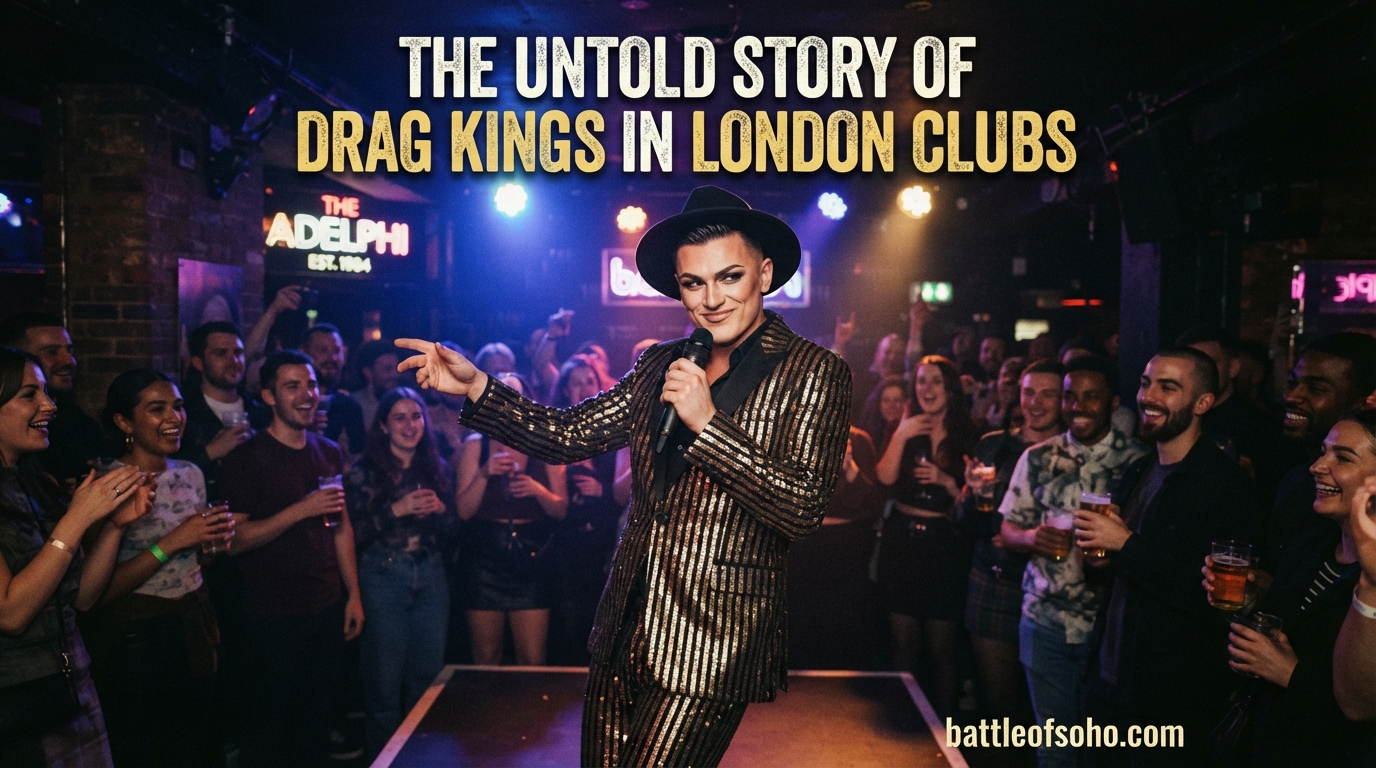
Walk into any London drag show in 2026 and you will almost certainly see drag queens. Sequins, wigs, lip-sync anthems, death drops. What you will rarely see, however, is a drag king. The performer in a sharp suit, pencilled beard, and slicked-back hair, channeling masculinity as a performance art, is a ghost haunting the very venues that should celebrate them. The story of drag kings in London clubs is one of the richest and most overlooked chapters in queer performance history.
Drag kings are performers, typically women or non-binary people, who adopt masculine personas through costume, makeup, and stage presence, blending comedy, music, and political commentary to subvert gender norms. They have existed for centuries, longer than the term itself. And London, arguably more than any other city, is where the drag king tradition was born.
Yet the mainstream cultural conversation about drag has left drag kings almost entirely behind. When was the last time you saw a drag king on television? When did a mainstream publication run a feature on the London drag king scene? The erasure is so thorough that many people do not even know what a drag king is, let alone that the tradition stretches back to Shakespeare’s England.
This is the untold story of drag kings in London clubs. It spans breeches roles on the Elizabethan stage, the dazzling male impersonators of Victorian music halls, the queer undergrounds of Harlem and Soho, and the modern performers fighting for space on the very stages their ancestors built. It is a story about visibility, about who gets remembered and who gets forgotten, and about why the most subversive form of drag remains the least seen.
Table of Contents
The Forgotten Roots: From Shakespeare to the Stage
Long before the term “drag king” existed, the practice of performers adopting the opposite gender on stage was woven into English theatrical tradition. The story begins not in a nightclub but in the playhouses of Elizabethan England, where gender performance was not just accepted but structurally required.
In Shakespeare’s time, women were legally barred from the stage. All female roles were played by young men or boys. This meant that characters like Portia in The Merchant of Venice, Rosalind in As You Like It, and Viola in Twelfth Night involved a male actor playing a woman who then disguises herself as a man. These were layers upon layers of gender subversion, performed openly to audiences who understood the game.
When King Charles II restored the monarchy in 1660 and lifted the ban on female actors, something fascinating happened. Rather than abandoning cross-gender performance, the theatre doubled down. The new permission for women to appear on stage birthed what became known as breeches roles, theatrical parts written specifically for actresses to wear male clothing, typically tight-fitting breeches that revealed the shape of their legs.
These breeches roles were enormously popular. They gave audiences a sanctioned space to gaze upon women in masculine attire, but they also gave performers a taste of the freedom that came with adopting a male persona. For the first time in English history, women were being celebrated, not punished, for performing masculinity on a public stage. The seeds of the drag king tradition had been planted.
It is worth noting that breeches roles were not exactly radical by modern standards. They were written by men, staged by men, and designed to be titillating rather than liberating. But they created a framework. They established the convention that a woman wearing men’s clothing on stage could command an audience’s attention, admiration, and even desire. That framework would prove unstoppable.
London’s Male Impersonator Golden Age
If the breeches roles of the Restoration were the seed, the Victorian and Edwardian music hall era was the full flowering. London in the late 1800s and early 1900s was the global capital of male impersonation, a form of entertainment so popular that its biggest stars were among the highest-paid performers in the country.
The music halls of London were rowdy, working-class entertainment venues, a far cry from the polite theatres of the West End. They served cheap beer, loud songs, and variety acts ranging from acrobats to comedians. And among the most beloved performers on those stages were women dressed as men.
Vesta Tilley: The Reluctant Drag King Superstar
The undisputed queen of the male impersonators was Vesta Tilley, born Matilda Alice Powles in 1864 in Worcester. Tilley began performing at the age of three and was wearing male drag on stage by the time she was six. By her teens, she was a London sensation.
Tilley’s act was extraordinary for its craft and specificity. She did not simply put on a suit. She created distinct male characters, each meticulously realised. She played the dashing young soldier, the smug aristocratic dandy in top hat and tails, the cheeky office boy, the pompous cleric. Each character had its own walk, posture, facial expression, and comic timing. Audiences did not just tolerate her masculinity. They adored it.
At the height of her fame, Tilley was earning the equivalent of tens of thousands of pounds per week in today’s money. She performed for royalty. She was so convincing as a man on stage that some first-time audience members genuinely did not realise they were watching a woman until the big reveal at the end of the act.
What made Tilley fascinating, and what places her firmly in the pre-history of the drag king, was the deliberateness of her gender play. Off stage, she presented as a conventional feminine woman. On stage, she was a man, fully, convincingly, and with enormous affection for the characters she created. She did not mock men. She channelled them, celebrating and gently satirising male behaviour with the kind of loving attention that defines the best drag performance.
Annie Hindle: The One Who Lived It
If Vesta Tilley was the polished professional, Annie Hindle was the pioneer who blurred the lines between performance and identity. Born in 1847, Hindle was one of the first male impersonators to achieve fame in America, but her story resonates across the Atlantic because it reveals how queer these performances could be.
Hindle performed in a style similar to Tilley’s, singing comic songs in male costume and adopting a swaggering masculine stage presence. But Hindle’s life off stage was where things got interesting. She lived for years in male clothing, went by male names in her private life, and in 1886, she married her dresser, Annie Ryan, in a ceremony performed by a minister who believed Hindle was a man. The marriage was discovered and briefly scandalised the press, but Hindle continued performing.
Hindle’s story is a reminder that the male impersonator tradition was not simply a novelty act. For some performers, the stage persona and the private identity were deeply intertwined. The question of whether we would today call Hindle a drag king, a trans man, or something else entirely is unanswerable and, in many ways, beside the point. What matters is that the tradition of female-assigned performers living in masculine drag has deep roots, roots that go far beyond entertainment.
The Music Hall Legacy
Tilley and Hindle were the most famous, but they were far from alone. Performers like Ella Shields (who created the iconic song “I’m a Lonely Little Petunia in an Onion Patch” while dressed as a tramp), Hetty King, Florence Foy, and Ella Wesner all built careers on male impersonation in the late Victorian and Edwardian periods. London’s music halls were packed with women performing masculinity, and audiences could not get enough.
This golden age did not last. The rise of cinema and radio in the early 20th century gutted the music hall circuit, and changing tastes pushed male impersonation toward novelty and nostalgia. But the tradition had been established. London had proven, over several decades, that a woman in a suit could be the biggest star in the room. That proof would carry forward.
Blues, Harlem, and the Queer Underground
While London’s music halls were the most visible home of male impersonation, a parallel and deeply queer tradition was developing across the Atlantic. The Blues era of the 1920s and 1930s, centered in Harlem, produced a wave of performers whose gender nonconformity went far beyond the stage.
Gladys Bentley was perhaps the most striking figure of this era. A blues singer and pianist who headlined at Harlem’s Clam House (later renamed Mona’s), Bentley performed in a white tuxedo and top hat, her masculine presentation unmistakable. She was openly queer at a time when such openness carried enormous risk. She sang bawdy, suggestive lyrics, flirted openly with women in the audience, and became one of the most talked-about entertainers in New York.
Bentley was part of a broader Harlem Renaissance culture in which gender nonconformity was, if not fully accepted, at least present and visible. Blues singers like Ma Rainey and Bessie Smith sang about queer desire with surprising directness. Prohibition-era rent parties and speakeasies hosted drag balls where performers of all genders competed for prizes and prestige.
The Harlem Renaissance was not geographically disconnected from London. The transatlantic cultural exchange between Black American performers and British audiences was robust, particularly in the 1920s and 1930s. Jazz, blues, and the associated performance styles crossed the ocean regularly. The influence of Harlem’s queer underground on London’s emerging cabaret and club scene was real, even if it is rarely documented.
The Jewel Box Revue
In the 1940s and 1950s, the Jewel Box Revue emerged as the first integrated drag show in America. It featured both male and female impersonators performing together, and it toured extensively, including international dates. The Revue was co-founded and emceed by Storme DeLarverie, a performer whose significance to drag history, and to queer history more broadly, can hardly be overstated.
The Jewel Box Revue model, a variety show featuring drag kings and drag queens together on the same bill, would later echo through London’s drag king nights. The idea that drag kings and queens should share the stage, that one should not exist without the other, is a principle that the Revue embodied decades before it became a talking point in modern drag discourse.
Storme DeLarverie and the Stonewall Connection
No account of drag king history would be complete without Storme DeLarverie. Born in 1920 to an African American mother and a Puerto Rican father, DeLarverie was a butch lesbian, a drag king, a singer, and, according to multiple eyewitness accounts, the person whose scuffle with police on the night of June 28, 1969 helped ignite the Stonewall uprising.
DeLarverie had toured with the Jewel Box Revue as its only male impersonator, performing alongside two dozen drag queens. Her act involved singing, sharp tailored suits, and a commanding stage presence that audiences found magnetic. She was, by all accounts, the kind of performer who could silence a room just by walking into it.
The Stonewall connection matters for the London story because it established, in the most dramatic possible way, that drag kings were at the forefront of queer resistance. The modern LGBTQ rights movement, which would reshape nightlife and culture in cities across the world including London, was born in part through the actions of a drag king.
DeLarverie spent the rest of her life as a self-appointed guardian of the queer community in New York’s West Village, patrolling the streets and protecting younger LGBTQ people from violence. She worked as a bouncer at lesbian bars, performed at benefits, and remained a presence in the community until her death in 2014. She rarely spoke publicly about Stonewall, but those who knew her understood that her commitment to protecting queer lives was not theoretical. It was bone-deep.
The connection between DeLarverie’s legacy and the London drag king scene is one of lineage. The performers who would later create drag king nights in London’s queer venues were part of a tradition that included Stonewall, that included the Jewel Box Revue, that included the unapologetic gender nonconformity of Gladys Bentley and the subversive charm of Vesta Tilley. This was not a fringe movement. This was the spine of queer performance.
Drag Kings Arrive in London Clubs
For all this history, the modern drag king scene in London is surprisingly young. The term “drag king” itself did not enter common usage until the 1990s, and it took even longer for dedicated drag king nights to establish themselves in London venues. But when they did arrive, they arrived with force.
boibox: The Legendary Drag King Night
For many Londoners, the name boibox is synonymous with the city’s drag king history. boibox was a regular drag king night that ran in various London venues, building a loyal following of fans who came specifically to see masculine drag performance. It was one of the few spaces in the city where drag kings were not the opener or the novelty act but the main event.
The significance of boibox cannot be overstated for those who attended. As one Reddit user, MarchIcy1138, recalled: “Pre-covid I really enjoyed going to the few drag king shows around London (boibox, one I forget the name of at the RVT etc).” The mention is casual, almost throwaway, but it speaks volumes. These nights were not just entertainment. They were cultural touchstones, the kind of events that people remember by name years later.
boibox did not just showcase established performers. It functioned as an incubator for new talent, giving drag kings a stage to develop their personas, test their material, and build the kind of stage confidence that only comes from performing regularly in front of an audience that came specifically to see you.
Kings of Clubs at the Royal Vauxhall Tavern
The Royal Vauxhall Tavern, or RVT as it is universally known, is one of London’s oldest and most storied LGBTQ venues. Opened as a music hall in the 1890s, it has been a gay pub since at least the 1940s and has hosted legendary drag performers for decades. Among its many nights was Kings of Clubs, a drag king event that gave masculine performers a home at one of the most iconic queer venues in the country.
Having a regular drag king night at the RVT was significant. The venue’s history as a performance space stretches back to the music hall era that birthed Vesta Tilley. There is a poetic continuity in the fact that the same building that once hosted Victorian-era variety entertainment was, over a century later, hosting performers who were carrying the male impersonation tradition into the 21st century.
The RVT has always been a venue where queer performance could be experimental, political, and unfiltered. Drag kings at the RVT were not asked to tone down their act or make it more palatable for a mainstream audience. They could be raw, confrontational, funny, and strange. That freedom is what made the venue special, and it is what made the drag king nights that passed through it so memorable.
The Pre-COVID Scene vs Today
The COVID-19 pandemic hit London’s nightlife harder than almost any other sector. Queer venues, already under pressure from rising rents and redevelopment, faced closure after closure. Drag king nights, which were already operating on thin margins with smaller audiences than drag queen events, were particularly vulnerable.
The Reddit community has been vocal about what was lost. Users mourn the disappearance of regular drag king shows, noting that boibox and the RVT nights have either vanished or become infrequent. The few shows that do still happen are harder to find, often promoted through word of mouth or niche social media accounts rather than mainstream listings.
This is not just a logistical problem. It is a cultural one. When drag king nights disappear, the pipeline of new talent dries up. Performers who might have developed their craft on a regular stage never get the chance. Audiences who might have discovered drag king performance never encounter it. The erasure becomes self-reinforcing, and the scene shrinks further.
That said, the scene is not dead. Drag kings continue to perform at venues across London, often as part of mixed bills or special events. The energy is still there. The talent is still there. What is missing is the infrastructure, the regular, reliable nights that give performers a home base and audiences a dependable place to find them.
Why Drag Kings Were Erased
The question of why drag kings remain invisible in mainstream drag culture is one that the community itself grapples with constantly. The answer is not simple. It involves media bias, commercial pressures, internal community dynamics, and a cultural blind spot so pervasive that most people do not even notice it.
The RuPaul’s Drag Race Effect
There is no way to discuss the erasure of drag kings without talking about RuPaul’s Drag Race. Since its launch in 2009, the show has become the dominant cultural force in drag worldwide. It has launched careers, filled arenas, and dragged (pun intended) the art form into mainstream visibility. But that visibility has been almost exclusively for drag queens.
Drag Race has never featured a drag king as a regular competitor. The show’s format, aesthetic, and judging criteria are built around the drag queen performance tradition: lip-syncing, fashion runways, female illusion. This is not a criticism so much as an observation. The show defined what “drag” means to a generation of viewers, and that definition did not include drag kings.
The ripple effects are enormous. When the general public thinks of drag, they think of Drag Race. When venues book drag acts, they book Drag Race alumni or performers in that mold. When media outlets cover drag, they cover drag queens. The entire commercial ecosystem of drag in 2026 is built around the queen-centric model that Drag Race established, and drag kings are left outside it.
Internal Prejudice Within the Drag Community
Some of the most painful testimony about drag king erasure comes from within the drag community itself. Reddit discussions on forums like r/Dragula have highlighted what users describe as prejudice from some drag queens toward drag kings. The complaints range from dismissive attitudes about the effort drag kings put into their looks, to gatekeeping about what counts as “real” drag, to booking practices that consistently favour queens.
As one Reddit user put it, drag queens “tend to suck up all the oxygen in a room” at shows, leaving little space for kings to shine. Others have described being made to feel that drag king performance is inherently less polished or less valuable than drag queen work. These are not universal sentiments. Many drag queens are fierce allies of drag kings and actively champion their work. But the pattern is real enough that community members discuss it regularly.
This internal tension has historical parallels. Even in the Jewel Box Revue era, the balance between male and female impersonators was not always equal. The difference today is that the scale has tipped so dramatically toward queens that kings are fighting for scraps of stage time rather than sharing a bill.
Structural and Commercial Barriers
Beyond media and community dynamics, there are structural reasons why drag kings struggle for visibility. Here is what the landscape looks like in 2026:
1. Venue economics. Drag queen shows, particularly those with Drag Race connections, reliably fill rooms. Drag king shows draw smaller crowds. Venue bookers, operating on tight margins, gravitate toward the guaranteed draw. This creates a cycle where drag kings get fewer bookings, build smaller audiences, and become even harder to book.
2. Media representation. Mainstream publications covering London drag almost exclusively feature queens. When Time Out, Metro, or lifestyle blogs round up the “best drag shows in London,” drag king events are rarely mentioned. This absence is not malicious. It is simply the result of editors and writers who do not know the drag king scene exists.
3. Audience unfamiliarity. Because drag kings are rarely seen in mainstream media, general audiences often do not know what to expect from a drag king performance. This creates a barrier to entry. A person who has watched Drag Race for years feels they understand drag queens. They have no framework for understanding drag kings, and without that framework, they may not seek out king shows.
4. The visibility paradox. Drag kings need platforms to gain visibility, but platforms will not book drag kings until they have visibility. This catch-22 is the defining challenge of the modern drag king scene. Breaking it requires conscious effort from venues, promoters, media, and audiences.
Where to See Drag Kings in London Today
Despite the challenges, drag kings are still performing in London. You just have to know where to look. Here are the venues that have historically hosted, or currently host, drag king performances in the city.
Royal Vauxhall Tavern (RVT): The grand dame of London queer venues. While regular drag king nights have become less frequent here since the pandemic, the RVT still hosts mixed bills and special events that include drag kings. Check their current programming.
The Glory: Located in Haggerston, The Glory is one of London’s most important drag venues. It has historically been more inclusive of diverse drag forms, including drag kings, than many of its peers. Their bingo nights and variety shows sometimes feature drag king performers.
Dalston Superstore: This Dalston staple has long been a hub for experimental and queer performance. Drag kings have appeared on its bills alongside queens, though dedicated king nights are rare. Follow their social media for the most current line-ups.
Bethnal Green Working Mens Club: This unassuming East London venue has a history of hosting queer alternative events, including drag performances that push boundaries. It has been a space where drag kings have been welcomed and featured.
The Admiral Duncan: Situated in the heart of Soho, this historic pub hosts regular drag shows. While the programming leans heavily toward drag queens, special events and mixed bills sometimes include drag king performers.
The most reliable way to find drag king shows in London in 2026 is not through mainstream listings but through social media. Follow individual drag king performers on Instagram, search for drag king collectives, and join London LGBTQ community groups on Facebook and Reddit. The community is small but active, and word travels fast when a drag king night is announced.
Community members consistently offer the same advice: support local drag kings. Go to their shows. Bring friends. Tip generously. The scene survives on audience support, and every person who discovers and celebrates drag king performance helps ensure the tradition continues.
Drag Kings vs Drag Queens: Understanding the Difference
Understanding why drag kings matter requires understanding how they differ from drag queens. The two traditions share a root, the subversion of gender through performance, but they have developed along different paths and face different challenges.
Performance style: Drag queens typically perform exaggerated femininity, often through lip-syncing, dance, comedy, and fashion. Drag kings perform exaggerated or subverted masculinity, which can involve singing, character comedy, stripping, political satire, or any combination. The performance vocabulary is different, and neither is inherently more difficult or more valuable than the other.
Historical trajectory: Drag queen performance has roots in queer nightlife, drag balls, and the ballroom culture of communities of colour. Drag king performance traces back to theatrical breeches roles, Victorian male impersonation, and butch lesbian performance traditions. Both are rich histories, but they are rarely given equal weight in mainstream accounts of drag.
Cultural reception: Drag queens, post-Drag Race, are mainstream celebrities. They host television shows, walk red carpets, and fill arenas. Drag kings remain largely unknown outside queer community spaces. This disparity is not a reflection of talent or artistic merit. It is a reflection of which form of gender subversion the mainstream has decided to embrace and which it has chosen to ignore.
Understanding these differences is not about creating division. It is about recognising that drag is a broad tradition with multiple branches, and that every branch deserves to be seen, celebrated, and given a stage.
FAQs
Can a straight man be a drag king?
Drag kings are typically women or non-binary people who perform masculinity, but the identity is not strictly limited by gender. In practice, anyone can explore masculine drag performance regardless of their gender identity or sexual orientation. However, the drag king tradition is rooted in the experiences of female-assigned and non-binary performers, and that context matters. A straight cisgender man performing masculine drag would be a different kind of act, closer to character comedy than the gender-subversive tradition of drag king performance.
Why are drag kings not as popular as drag queens?
Drag kings remain less visible than drag queens for several reasons. RuPaul’s Drag Race has dominated mainstream drag culture since 2009 and features only drag queens, creating a public perception that drag is exclusively a queen art form. Venue economics favour acts with larger guaranteed audiences, and media coverage follows suit. Internal prejudice within parts of the drag community has also contributed to fewer booking opportunities and less stage time for drag kings.
Who is the most famous drag king?
The most historically famous drag king-adjacent performers include Vesta Tilley, the Victorian male impersonator who was one of the highest-paid entertainers of her era, and Storme DeLarverie, the Jewel Box Revue star who played a role in the Stonewall uprising. In more modern times, performers like Murray Hill, Landon Cider, and Adam All have achieved significant recognition, though none have reached the mainstream celebrity status of top drag queens.
Where can I see drag king shows in London?
Drag king performances in London can be found at venues including the Royal Vauxhall Tavern, The Glory in Haggerston, Dalston Superstore, and Bethnal Green Working Mens Club. Dedicated drag king nights have become less frequent since the COVID-19 pandemic, so the most reliable way to find current shows is by following individual performers and London LGBTQ community accounts on social media.
What is the difference between a drag king and a drag queen?
A drag queen is typically a male-assigned performer who adopts an exaggerated feminine persona through costume, makeup, and performance. A drag king is typically a female-assigned or non-binary performer who adopts an exaggerated or subverted masculine persona. Both traditions use gender performance as a form of entertainment, comedy, and social commentary, but they emerge from different historical roots and face different levels of mainstream visibility.
The Future of Drag Kings in London
The untold story of drag kings in London clubs is, at its heart, a story about what a culture chooses to remember and what it allows to fade. London gave the world Vesta Tilley, Annie Hindle, and a music hall tradition that made male impersonation one of the most popular forms of entertainment in the country. London’s queer venues later became homes for a new generation of drag kings who carried that tradition forward. The history is rich, the talent is real, and the tradition is alive, even if it is fighting for every inch of stage space.
The future of drag kings in London depends on the same things it has always depended on: stages willing to book them, audiences willing to show up, and a culture willing to expand its definition of what drag can be. The performers are out there. They are sharpening their beards, pressing their suits, and writing acts that subvert gender with the same craft and conviction that Tilley brought to the music hall stage over a century ago. They just need to be seen.
If there is one thing to take away from the story of drag kings in London clubs, it is this: drag has never been just one thing. It has always been a broad, messy, glorious tradition of gender subversion, and it has always included performers of every gender expression. The erasure of drag kings from the mainstream narrative is not a reflection of their importance. It is a reflection of how narrow that narrative has become. The more we widen it, the richer the story gets.