
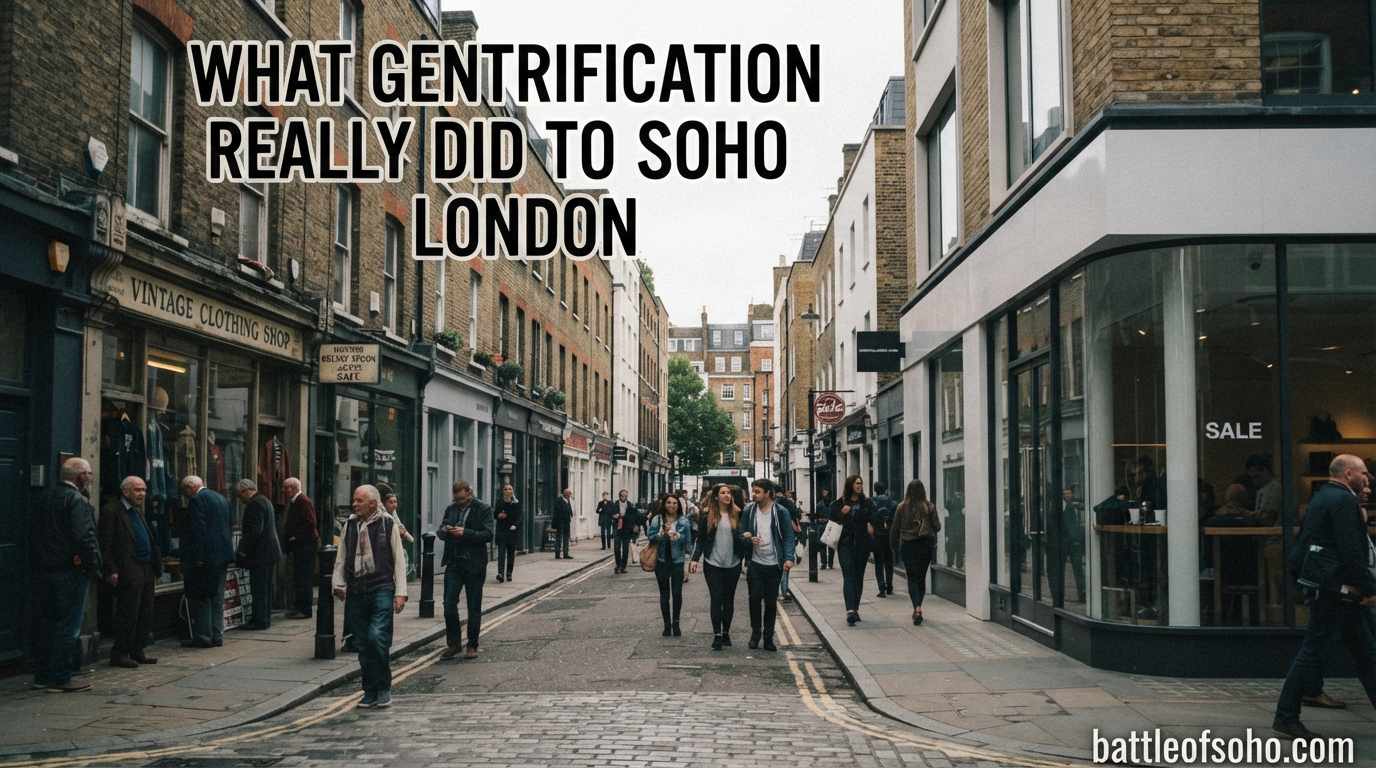
Walk through Soho on a Saturday night in 2026 and you will find something that would have been unthinkable two decades ago. The longest queues snake outside cocktail bars serving fifteen-pound martinis to hen parties from the Home Counties. The doorways that once sheltered sex workers now frame delivery riders waiting for Uber Eats pickups. Neon signs for global fast-fashion brands glow where independent record shops once stood.
For centuries, Soho was London’s great exception. It was the square mile where respectability went to die and reinvention went to live. Immigrants, artists, sex workers, queer people, musicians, drinkers, and dreamers all carved out space in a neighborhood that asked no questions and demanded no credentials. Understanding what gentrification did to Soho London means understanding what was lost when those communities were priced out, rezoned, and rebranded.
This article traces that transformation from the ground up. We examine the historical waves that made Soho what it was, the specific economic forces that dismantled it, the venue closures that became cultural flashpoints, and the community resistance that continues today. Whether you remember Soho from the 1980s or are encountering its story for the first time, what follows is an attempt to separate the myth from the measurable reality.
Has Soho been gentrified? Yes, profoundly, over the course of more than four decades. The process was not a single event but a sustained campaign of economic pressure, planning policy, and cultural erasure that transformed one of the world’s most distinctive neighborhoods into something far more ordinary. What gentrification really did to Soho London is not a simple story of decline or progress. It is a story about who a city belongs to, what culture gets preserved, and what happens when the most diverse square mile in London becomes just another post code for luxury development.
Table of Contents
Soho Before Gentrification: A Brief History of London’s Outsider Capital
Soho was never respectable, and that was exactly the point. The area bounded roughly by Oxford Street to the north, Charing Cross Road to the east, Leicester Square to the south, and Regent Street to the west began its life as royal hunting ground in the sixteenth century. The name itself reportedly comes from a hunting cry, shouted by riders chasing game through what was then open countryside on the edge of London.
By the eighteenth century, the area had become a neighborhood of immigrants, artisans, and people who did not fit anywhere else. The aristocracy moved west to Mayfair and Belgravia, leaving Soho to those who could not afford to follow. This pattern, wealthy interests abandoning an area and leaving it to marginalized communities, would repeat throughout Soho’s history with bitter irony when those same interests returned centuries later to reclaim it.
French Huguenots fleeing religious persecution arrived first, giving Soho its enduring French character. The French House on Dean Street, still standing today, served as a meeting point for Charles de Gaulle and the Free French during World War II. The French Protestant Church on Soho Square served the community from 1893. In the nineteenth century, Italian immigrants and Eastern European Jews followed. Karl Marx lived at 28 Dean Street, where he wrote and pondered revolution while his family struggled with poverty in cramped rooms above what is now a trendy restaurant.
This diversity was not a marketing slogan. It was the lived reality of a neighborhood where people came because rent was cheap, questions were not asked, and community formed around shared marginality rather than shared respectability. Soho absorbed wave after wave of newcomers and gave them space to exist. The Italian community around Little Clarendon Street, the Jewish community around Brewer Street, the French community around Soho Square, all overlapped and intermingled in a way that created something genuinely unique in London.
By the twentieth century, Soho had layered on new identities. It became London’s red light district, with strip clubs, peep shows, and sex shops concentrated around Walker’s Court and Rupert Street. Paul Raymond built an empire of adult entertainment there, opening the Raymond Revuebar in 1958 and eventually controlling much of the property in the area. It became a haven for the LGBTQ+ community decades before legalization, with gay bars, clubs, and cruising spots providing a fragile but real safety net for people who had none elsewhere.
It was also the beating heart of British music and bohemian culture. The Marquee Club hosted the Rolling Stones, Jimi Hendrix, and David Bowie. The 2i’s Coffee Bar on Old Compton Street is widely credited as the birthplace of British rock and roll, where Tommy Hicks was discovered and became Tommy Steele, Britain’s first rock and roll star. The 100 Club, originally a jazz venue called the Feldman Swing Club, hosted legends from Glenn Miller to the Sex Pistols. Ronnie Scott’s Jazz Club opened in 1959 and remains one of the world’s most respected jazz venues, a rare survivor.
The Colony Room, a private drinking club run by the fearsome Muriel Belcher, counted Francis Bacon, Lucian Freud, Jeffrey Bernard, and the entire Soho literati among its regulars. It was the kind of place where a world-famous painter might be found arguing with a Soho drunk at three in the afternoon, and where social hierarchy was replaced by the simple question of whether you were interesting enough to be tolerated. Soho was where culture happened before it was safe enough for the rest of London to notice.
When Did Soho Become Gentrified?
Soho’s gentrification did not happen in a single moment. It arrived in waves, each one stripping away a layer of the neighborhood’s character and replacing it with something more marketable. Historians and urban geographers generally identify three distinct phases of gentrification in Soho, each driven by different economic and political forces.
The first wave began in the late 1970s and accelerated through the 1980s. As London’s financial sector boomed, the Big Bang of 1986 deregulated the City and created new wealth that needed somewhere to spend it. Young professionals began moving into previously unfashionable central London areas. Property developers noticed Soho’s central location and began buying up commercial buildings. The first wave of chain restaurants and corporate bars appeared on Old Compton Street and Greek Street. The Groucho Club opened in 1985, signaling the arrival of a new clientele that valued exclusivity over accessibility.
This first wave was relatively contained. Soho in the late 1980s was still recognizably itself, still grubby, still queer, still cheap enough for artists and outsiders to survive. But the foundations were being laid. Property values were rising. The narrative was shifting. What had been dismissed as sleaze was being rebranded as character, and character was becoming a selling point for developers who had previously ignored the area.
The second wave hit in the late 1990s and early 2000s. The rise of Soho as a media and advertising hub, with companies like Saatchi and Saatchi establishing offices in the area, brought white-collar workers who wanted coffee shops, delis, and clean streets. Westminster Council’s licensing policies became stricter, making it harder for late-night venues to operate. Independent bookshops like Compendium on Camden High Street and Silver Moon on Charing Cross Road closed. First Out, one of London’s oldest queer bookshops and cafes, shut its doors on St Giles High Street in 2004.
The Astoria, one of London’s most legendary live music venues, was demolished in 2009 to make way for the Crossrail construction site. The demolition was part of a broader pattern of cultural infrastructure being sacrificed for development. Multiple venues closed or were threatened with closure during this period, including the Astoria 2, the Metro, and the Shadow Lounge.
The third wave, and the most transformative, began around 2014 and continues through 2026. This wave is defined by hyper-commercialization. Independent businesses closed at an accelerating rate. Luxury apartment developments replaced affordable housing. The Elizabeth Line, formerly Crossrail, finally opened in 2022 with Tottenham Court Road and Bond Street stations serving Soho, driving property values even higher. As one Reddit user on r/london put it, Soho now has “the longest queues outside tapas bars, not nightclubs.”
This third wave is qualitatively different from the previous two. The first wave added new elements alongside the old. The second wave eroded the edges. The third wave is completing the transformation, leaving only fragments of what Soho was. When Madame Jojo’s closed in 2014, something broke in the collective understanding of what Soho was for. The question shifted from whether Soho was changing to whether there was anything left to save.
So when did Soho become gentrified? The honest answer is that gentrification was a process spanning more than four decades, but the cultural tipping point arrived with the closure of Madame Jojo’s in 2014. That single event crystallized what many had been saying for years: the Soho they knew was being erased, one venue at a time.
A Timeline of Key Gentrification Events in Soho
No competitor provides a comprehensive chronological record of Soho’s transformation. This timeline fills that gap, documenting the specific events that reshaped the neighborhood from its mid-century peak through 2026. Each entry represents a moment where the balance shifted a little further from what Soho was toward what it was becoming.
- 1958 – Paul Raymond opens the Raymond Revuebar, establishing Soho as the center of London’s adult entertainment industry.
- 1959 – Ronnie Scott’s Jazz Club opens on Gerrard Street, beginning Soho’s decades-long role as a center of live music.
- 1964 – The Marquee Club on Wardour Street hosts the Rolling Stones, cementing Soho’s place in British rock history.
- 1976 – The punk movement peaks at the Marquee Club and 100 Club, with the Sex Pistols playing legendary gigs that define an era.
- 1981 – The Blitz Club nights at 69 Dean Street launch the New Romantic movement, with regulars including Boy George and Steve Strange.
- 1985 – The Groucho Club opens, bringing a new type of media-elite clientele to Soho and signaling the shift toward exclusivity.
- 1986 – The Big Bang deregulates London’s financial sector, flooding central London with new wealth that begins reshaping Soho’s property market.
- 1995 – Soho House opens as a private members’ club for the creative industries, further embedding exclusivity in the area.
- 2004 – First Out, one of London’s oldest queer bookshops and cafes, closes its doors on St Giles High Street.
- 2006 – The Astoria and neighbouring venues face demolition orders to make way for Crossrail construction, despite massive public opposition.
- 2008 – The economic recession briefly slows development pressure on Soho but does not reverse the underlying trends.
- 2009 – The Astoria is demolished. The site remains a construction zone for over a decade.
- 2014 – Madame Jojo’s, one of Soho’s most iconic LGBTQ+ and cabaret venues, has its license revoked after a violent incident. The closure is widely seen as the final nail in old Soho’s coffin.
- 2015 – The Save Soho campaign launches, bringing together residents, performers, and cultural figures to advocate for preservation of Soho’s creative spaces.
- 2016 – The Ghetto, a small queer club near Tottenham Court Road, closes permanently after years of rent pressure.
- 2017 – A University of Cambridge study documents that London lost approximately 50 percent of its LGBTQ+ venues between 2006 and 2017, with Soho bearing a disproportionate share.
- 2017 – The announcement of Crossrail delays extends construction disruption to Soho businesses for years longer than planned.
- 2019 – The Curzon Soho cinema faces threats of demolition for a Crossrail station expansion, prompting a high-profile campaign that successfully delays the plans.
- 2022 – The Elizabeth Line opens at Tottenham Court Road and Bond Street, immediately driving up commercial rents in the surrounding area.
- 2023 – G-A-Y Late announces its closure, citing unsustainable rent increases. The venue was one of the last large LGBTQ+ club spaces in Soho.
- 2024 – Molly Moggs, a historic gay pub on Old Compton Street, faces closure threats. Community campaigns rally to preserve it.
- 2025 – Heaven nightclub, one of the most famous gay clubs in the world, is granted historic venue status by Westminster Council, offering a rare piece of protective good news.
- 2026 – Independent businesses continue to report rent increases of 30 to 50 percent on lease renewals, according to local business associations.
How Venue Closures Changed Soho Forever
You cannot tell the story of what gentrification did to Soho London without telling the story of its venues. Each closure was not just the loss of a business. It was the removal of a gathering place, a safe space, and a piece of cultural infrastructure that existed nowhere else. The cumulative effect of these closures was the dismantling of an ecosystem that had taken decades to build.
Venues in Soho operated as an interconnected network. People would start at one bar, move to a club, end up at a late-night cafe. Each venue fed the others. When one closed, the whole network weakened. This is why the impact of individual closures was greater than the loss of any single business. Here are the closures that mattered most.
Madame Jojo’s: The Final Straw
Madame Jojo’s opened in the 1960s on Walkers Court as a drag and cabaret venue. For decades it was one of the most celebrated queer performance spaces in London, hosting everything from underground drag nights to mainstream club events. The venue’s famous mirrored interior and legendary sound system made it a destination for performers and clubbers from across the country. The Guardian called its 2014 closure the moment that “feels like the nail in the coffin” of old Soho.
The immediate cause was a violent incident outside the venue that led Westminster Council to revoke its license. But many in the community saw the decision as part of a broader pattern. Madame Jojo’s occupied a building on a street that property developers had been eyeing for years. The severity of the punishment, a total license revocation for an incident that other venues might have survived with a warning, struck many as disproportionate. The venue never reopened, and the building was later redeveloped.
The closure of Madame Jojo’s was not just the loss of a club. It was the loss of a specific type of space that had all but disappeared from London. It was a venue that hosted working-class queer performers, drag artists of color, and underground music nights that had no other home. When it closed, those communities lost their stage.
G-A-Y Late: The End of an Era
G-A-Y Late was one of the largest LGBTQ+ club spaces in central London. Located near Tottenham Court Road station, it served a predominantly young, queer clientele who relied on its affordable entry prices and late hours. The venue was known for its pop music policy, celebrity appearances, and the kind of unpretentious, joyous atmosphere that has become increasingly rare in central London nightlife. When the venue announced its closure in 2023, citing rent increases that had become unsustainable, the response was one of grief and anger.
The closure left a vacuum. Reddit users on r/london reported that younger LGBTQ+ people were increasingly traveling to Dalston, Vauxhall, and Clapham for nightlife, areas that are geographically and culturally distant from Soho’s historic queer heartland. The community that once gathered on Old Compton Street now fragments across the city. For young queer people coming to London for the first time, there is no longer a single neighborhood where they can expect to find their community.
The Astoria: Killed by Crossrail
The Astoria was not exclusively a queer venue, but its demolition in 2009 for the Crossrail project removed one of central London’s most important mid-size live music spaces. The venue hosted everyone from Nirvana to the Arctic Monkeys, and its smaller sibling venue, the Astoria 2, served as a critical space for emerging bands. Their loss, along with the neighbouring G-A-Y Late’s predecessor venue, was a direct consequence of infrastructure planning that prioritized transit development over cultural preservation.
The campaign to save the Astoria was one of the largest cultural preservation efforts in London’s recent history. Thousands of people signed petitions, held demonstrations, and lobbied politicians. None of it was enough. The venues were demolished and the site became a construction zone for over a decade, serving as a daily reminder to anyone walking down Charing Cross Road of what had been sacrificed for a train line.
The irony is bitter. The Crossrail project, later renamed the Elizabeth Line, was supposed to benefit London. Instead, for Soho’s cultural ecosystem, it accelerated the very displacement that has hollowed out the area. Independent venues that had survived the construction disruption were then hit with post-opening rent hikes that finished what Crossrail started.
Molly Moggs and the Death of the Gay Pub
Molly Moggs on Old Compton Street is one of the oldest surviving gay pubs in Soho. When it faced closure threats in 2024, community campaigners mobilized to save it. The pub represents something the clubs cannot: a daytime, low-cost, intergenerational queer space where people meet for a pint rather than a night out. It is where older gay men gather in the afternoon, where someone new to the city might have their first conversation with another queer person, where community forms quietly rather than on a dance floor.
The threat to Molly Moggs illustrates that gentrification in Soho does not only target nightlife. It targets every type of queer infrastructure, from bookshops to pubs to cafes, replacing them with venues that serve a very different demographic. When the pub that hosted your first date becomes a cocktail bar for bankers, the message is clear: you are no longer the customer Soho is interested in serving.
The Raymond Revuebar and the End of Soho Sleaze
The Raymond Revuebar, opened by Paul Raymond in 1958, was for decades the most famous strip club in London. Its neon sign became a Soho landmark. Raymond’s empire extended to property ownership across the area, making him one of the most powerful figures in Soho’s twentieth-century history. The Revuebar closed in 2004 and the building was later converted into an art gallery and events space, a transformation that perfectly encapsulates the shift from Soho’s sex industry past to its cultural-commercial present.
The loss of the Revuebar was not just the loss of a strip club. It was the erasure of a piece of Soho’s identity that, whatever your feelings about the sex industry, was undeniably part of what made the area distinctive. The replacement, an art gallery, sounds like an upgrade until you realize that Soho now has dozens of art galleries and zero historic strip clubs. The balance that once made the area interesting has been replaced by a monoculture of respectability.
The Impact on Soho’s LGBTQ+ Community
The displacement of Soho’s LGBTQ+ community is the most documented and most painful consequence of gentrification. For decades, Soho functioned as a safe haven at a time when homosexuality was criminalized, then pathologized, then tolerated only conditionally. Gay bars were not just places to drink. They were places to exist without fear, to find community, to meet a partner, to be visible in a world that demanded invisibility.
The importance of physical queer spaces cannot be overstated. Before dating apps, before social media, before legal equality, the gay bar was the infrastructure of LGBTQ+ life. It was where you learned you were not alone. Soho concentrated dozens of these spaces within walking distance of each other, creating a density of queer community that existed nowhere else in Britain. The loss of that concentration is not just a matter of nostalgia. It is the loss of a social support system that took generations to build.
Academic research published in the journal Sociological Research Online describes what happened to Soho as “hegemonic gentrification,” a process that works to “actively and knowingly sanitize the city.” The authors argue that Soho’s transformation was not accidental or gradual but deliberate, driven by forces that saw queer culture and working-class diversity as obstacles to be cleared rather than assets to be protected. The term “hegemonic” is important here. It suggests not just change but domination, the replacement of one culture by another that claims to be superior.
The numbers tell part of the story. A 2017 study by the University of Cambridge documented that London lost approximately 50 percent of its LGBTQ+ venues between 2006 and 2017. Soho bore a disproportionate share of those losses. When G-A-Y Late closed in 2023, it removed one of the last large queer club spaces from the area entirely. The trend has not reversed in the years since.
But the impact goes beyond statistics. Forum discussions on Reddit reveal the human cost. Long-time Soho residents describe watching their local pub turn into a venue catering to straight men on stag nights. Community members report increased harassment and hate crimes in what were once reliably safe spaces. One Reddit user wrote about being physically attacked near Old Compton Street in an incident that would have been unthinkable in the Soho of the 1990s. Others describe the experience of visiting Old Compton Street and finding it indistinguishable from any other central London street full of generic bars and chain restaurants.
The community has adapted, but adaptation often means leaving. Younger LGBTQ+ Londoners now gather in Dalston Superstore, Royal Vauxhall Tavern, and venues scattered across south and east London. The geographic scattering has real consequences. It fragments community bonds that once concentrated in a single neighborhood and makes spontaneous connection harder. As one forum contributor noted, the question of where to find the queer community in London no longer has an easy answer. There is no single neighborhood that serves the function Soho once did.
The shift has a generational dimension. Older LGBTQ+ Londoners who came of age in Soho feel a sense of loss that younger people, who never knew that Soho, may not fully share. But younger queer people are also losing something. They are growing up in a city where the physical infrastructure of LGBTQ+ community is thinner than it has been in fifty years. Dating apps and online communities offer connection, but they do not replace the experience of being surrounded by your people in physical space.
One positive development arrived in 2025 when Heaven nightclub was granted historic gay venue status by Westminster Council. This designation, the first of its kind, offers a degree of protection that other venues never had. It means that any future planning application affecting Heaven must take into account its cultural significance. Whether it represents a turning point or a single reprieve remains to be seen, but it is at least an acknowledgment that what was lost mattered.
The Decline of Soho’s Red Light District
Soho’s identity as a red light district was always contested. Sex workers, feminists, religious groups, and politicians argued for decades about whether the area’s sex industry was exploitation, empowerment, or something more complicated. What is not contested is that gentrification systematically dismantled it, and that the communities most affected had the least say in the process.
The English Collective of Prostitutes, a grassroots organization that has operated from Soho for decades, documented the displacement of sex workers from walk-up flats in the area through police raids, licensing changes, and property redevelopment. Their zines and reports provide one of the few first-hand records of what gentrification meant for a community that rarely gets to tell its own story. They describe women being evicted from flats they had worked in for decades, police operations that used trafficking concerns as a pretext for clearing buildings, and a planning system that treated sex workers as an obstacle to development rather than as members of the community.
The novelist Fiona Mozley, writing about Soho for Bookclubs.com, drew parallels between modern displacement and medieval land grabs. She described how the sex workers who made Soho infamous were among the first to be pushed out when property values rose. Their flats were converted into luxury apartments and offices. The infrastructure that supported them, from late-night cafes to cheap accommodation, disappeared. The women who worked in Soho’s sex industry were not consulted about the future of their neighborhood. They were simply removed.
The displacement of sex workers from Soho raises uncomfortable questions about who gets to claim urban space. The dominant narrative portrays the clearance of Soho’s sex industry as a victory for public decency. But the English Collective of Prostitutes and other advocacy organizations argue that it was simply a different form of exploitation, one that replaced the economic agency of sex workers with the economic interests of property developers. The women who lost their workplaces were not liberated. They were displaced to less safe, less visible, and less regulated environments.
Is Soho still a red light district in 2026? The honest answer is barely. A handful of walk-ups and adult shops remain, but the area’s sex industry exists in fragments compared to its peak. What replaced it is not liberation but a different kind of commercial space, one that serves corporate clients and tourists rather than the communities that once defined the area. The neon signs that once advertised peep shows now advertise pop-up experiences and branded cocktail lounges.
Economic Forces: Rent Hikes, Property Developers, and the Elizabeth Line
The cultural changes in Soho were driven by economic forces that are measurable and specific. Understanding them requires looking at the numbers, which no competitor currently provides in any systematic way. Gentrification is not a mysterious cultural tide. It is a set of economic processes driven by identifiable actors making identifiable decisions.
Commercial rent in Soho has increased dramatically over the past two decades. While precise figures vary by street and property type, local business associations report that lease renewals in 2026 routinely come with rent increases of 30 to 50 percent compared to the previous term. For independent businesses operating on thin margins, these increases are fatal. The businesses that survive are overwhelmingly chains and corporate operators that can absorb the cost or pass it on to customers. This creates a filtering effect where the only businesses that can afford to operate in Soho are those that serve a high-spending clientele.
Property developers have played a central role. The Sage Journals study on hegemonic gentrification in Soho documented how planning applications for luxury flats, boutique hotels, and corporate office space consistently received approval from Westminster Council while applications for cultural venues and affordable housing faced barriers. The Council’s own planning policies, while nominally committed to preserving Soho’s character, have in practice favored development that increases property tax revenue. The result is a built environment that increasingly serves commercial interests rather than community needs.
The pattern is familiar to anyone who studies urban development. A neighborhood develops a distinctive character because it is cheap enough for unconventional businesses to operate. That character becomes attractive to wealthier residents and visitors. Property values rise. The businesses that created the character can no longer afford the rent. The character is replaced by a generic commercial landscape that lacks any of the distinctiveness that attracted people in the first place. In Soho, this cycle played out over four decades.
The Elizabeth Line, which opened in 2022 after years of delay, had an immediate and measurable impact. The new rail link made Soho more accessible than ever, with Tottenham Court Road station handling an estimated 200,000 passengers per day. That accessibility drove up commercial rents in the surrounding area, accelerating the closure of businesses that could not compete. Independent venues that had survived the construction disruption were then hit with post-opening rent hikes that finished what Crossrail started. The line that was supposed to benefit London became, for Soho’s cultural ecosystem, the final blow.
The impact of the Elizabeth Line was compounded by the years of construction disruption that preceded it. Businesses near the construction sites endured noise, dust, blocked pavements, and reduced foot traffic for over a decade. Many did not survive. Those that did survive faced the further insult of rent increases once the line opened, as if the years of disruption were not payment enough for the inconvenience.
Westminster Council’s specific policy decisions have also contributed. Stricter licensing enforcement targeted late-night venues, noise complaints were pursued more aggressively, and the cumulative effect was an operating environment that became inhospitable to the kinds of businesses that once defined Soho. Multiple Reddit threads on r/london cite these decisions as evidence that the Council actively facilitated gentrification rather than merely allowing it. The Council’s commitment to preserving Soho’s character, expressed in planning documents and policy statements, has not been matched by the actual decisions made by its planning committees.
Soho Then vs Now: How the District Has Changed
The transformation of Soho is most visible in direct comparison. Here is what the neighborhood looked like in the 1980s compared to what it looks like in 2026. These comparisons are drawn from historical accounts, academic research, and first-hand reports from people who knew both versions of the area.
Demographics: In the 1980s, Soho was home to working-class residents, immigrants, artists, sex workers, and queer people who lived, worked, and socialized in the area. Social housing existed alongside private rentals, creating a genuinely mixed community. In 2026, the residential population skews toward affluent professionals in luxury flats, with long-term working-class residents largely displaced. Social housing remains but in shrinking quantities, and the gap between those who can afford to live in Soho and those who work there has never been wider.
Venues: The 1980s Soho had dozens of independent gay bars, live music venues, strip clubs, peep shows, record shops, bookshops, and cheap cafes. Old Compton Street was lined with gay venues that catered to every taste and budget. In 2026 Soho has a handful of surviving queer venues, numerous chain restaurants and cocktail bars, corporate retail, and boutique hotels. The diversity of venue types has been replaced by a monoculture of corporate hospitality.
Character: The old Soho was described as seedy, dangerous, exciting, egalitarian, and authentic. It was a place where a famous artist and a Soho drunk could end up at the same bar. The current Soho is described as sanitized, expensive, corporate, and homogeneous. As one Reddit user summarized it, “Soho went from being where you went to misbehave to being where you went to overpay for a burger.” The area is safer and cleaner, but what it gained in respectability it lost in character.
Cost: A pint in a Soho pub in the mid-1980s cost roughly one pound, affordable on a working-class wage. The same pint in 2026 routinely costs seven to nine pounds, with cocktails starting at twelve to fifteen pounds. The cost of doing business has risen even more sharply, which is why the businesses that defined Soho largely cannot afford to be there anymore. A venue that paid ten thousand pounds a month in rent in 2000 might face demands of thirty thousand or more in 2026, with no corresponding increase in revenue.
Ownership: In the 1980s, many Soho businesses were independently owned by people who lived in or near the area. Property ownership was fragmented, with numerous small landlords. In 2026, much of Soho’s commercial property is controlled by large property companies and institutional investors. Decisions about what businesses can operate are made by people who have no connection to the area beyond its balance sheet.
How Does Soho Compare to Other Gentrified London Areas?
Soho is not the only London neighborhood transformed by gentrification, but its case is distinctive. Understanding what gentrification did to Soho London benefits from comparison with other areas that experienced similar processes. Each neighborhood has its own story, but the patterns echo each other in instructive ways.
Hackney, particularly areas like Dalston and London Fields, experienced gentrification roughly a decade after Soho’s third wave. The process was similar: working-class and immigrant communities were priced out, independent venues closed, and chain businesses moved in. But Hackney’s gentrification followed a different sequence. It began with artists moving into cheap industrial spaces, then media professionals attracted by the artistic vibe, then property developers attracted by the new residents. The same pattern that transformed Soho transformed Hackney, just later.
Peckham followed a similar trajectory, with the added dimension of racial politics. The area’s Black British community was displaced by rising rents and property development, raising the same questions about who a neighborhood belongs to that Soho’s story raises. Brixton, Shoreditch, and Spitalfields all tell versions of the same story. What makes Soho different is the specific cultural infrastructure that was lost. Other neighborhoods lost affordable housing and working-class communities. Soho lost those things too, but it also lost a concentration of queer culture and sex industry infrastructure that existed nowhere else in Britain.
What is the most gentrified area in London? The answer depends on your metric. If you measure by property price increases, areas like Shoreditch and Hackney Wick have seen the steepest rises. If you measure by loss of cultural infrastructure, Soho stands out for the irreplaceability of what was lost. A closed gay bar in Hackney might reopen in Dalston. The concentration of queer venues that existed in Soho cannot be recreated anywhere, because it depended on a specific historical moment and a specific geographic density that no longer exists.
Community Resistance and Activism
Gentrification in Soho has not gone unchallenged. Community resistance has taken many forms over the decades, and it continues through 2026. Understanding what gentrification did to Soho London means also understanding how people fought back, what they achieved, and where they fell short.
The Save Soho campaign, launched in response to the wave of venue closures in the mid-2010s, brought together residents, performers, business owners, and cultural figures to advocate for the preservation of Soho’s creative and queer spaces. The campaign achieved limited successes, including raising awareness of the issue in national media and pressuring Westminster Council to adopt some protective policies for existing venues. But the structural forces driving closures, rising rents and development pressure, proved stronger than any campaign could overcome.
The English Collective of Prostitutes has been fighting the displacement of sex workers from Soho for decades. Their work includes direct support for women facing eviction, legal advocacy, public education, and documentation of police harassment. They argue that the destruction of Soho’s red light district was not about protecting women but about clearing space for more profitable development. Their campaigns have sometimes achieved temporary reprieves for individual women and flats, but the overall trend has been one of steady loss.
The campaign to save the Curzon Soho cinema from demolition in 2019 demonstrated that community resistance can sometimes work. When Transport for London proposed demolishing the cinema as part of the Crossrail station expansion at Tottenham Court Road, a public campaign featuring filmmakers, actors, and local residents successfully pressured the Mayor’s office to reconsider. The cinema was saved, at least for now. This victory showed that when communities organize effectively and mobilize public opinion, they can influence planning decisions. But such victories are exceptions.
Reddit discussions reveal that everyday Londoners also resist in smaller ways. Users share lists of surviving independent businesses to support. Community members organize pub crawls that deliberately avoid corporate chains. Local historians document what has been lost through photography, oral history, and archival work. These individual acts do not stop gentrification, but they preserve knowledge and keep the memory of what Soho was alive for future generations.
Not everyone agrees that resistance is the right response. Some argue that change is inevitable and that nostalgia for old Soho overlooks genuine problems, including exploitation, crime, and poor living conditions. This debate plays out constantly on London forums, with some users defending gentrification as progress and others mourning it as cultural destruction. The most thoughtful contributors acknowledge that the truth lies somewhere in between, and that the loss of Soho’s diversity is a real cost even if some changes brought benefits. It is possible to acknowledge that old Soho had problems while also recognizing that what replaced it lost something irreplaceable.
Is Soho Still Worth Visiting in 2026?
The answer depends on what you are looking for. If you want chain restaurants, expensive cocktails, and a nightlife scene that feels more like a corporate entertainment district than a cultural quarter, Soho in 2026 delivers all of that with efficiency. The area is cleaner, safer, and more accessible than it has ever been. For many visitors, that is enough.
If you want what made Soho famous, you have to look harder. A handful of independent venues survive. The French House on Dean Street still serves its storied patrons, maintaining its policy of serving only half pints and refusing to stock spirits. The Coach and Horses maintains its character as one of Soho’s last genuinely old-school pubs, with its famous no-music policy and its clientele of regulars who remember when Soho was different. The Curzon Soho continues to screen art-house cinema despite repeated threats to its existence. Ronnie Scott’s remains one of the world’s great jazz clubs. Heaven, now protected by its historic venue status, remains a landmark for queer nightlife. The 100 Club, founded in 1942, still hosts live music on Oxford Street.
But these survivors exist as exceptions in a landscape that has fundamentally changed. Walking through Soho in 2026, it takes effort to find the traces of what made the area matter. The queer culture, the immigrant history, the artistic energy, the willingness to be different, all of it exists in fragments rather than in the concentrated, walkable ecosystem that once defined the neighborhood.
For visitors interested in London’s cultural history, Soho remains essential. The layers of the past are still visible if you know where to look, from the blue plaque marking Karl Marx’s residence to the restored neon signs on Walker’s Court. For visitors looking for the Soho of legend, much of that place now exists only in books, photographs, and the memories of those who were there. The question is whether the fragments that remain can sustain enough cultural life to seed a revival, or whether they are simply the last relics of a neighborhood that has already ended.
FAQs
When did Soho become gentrified?
Soho’s gentrification occurred in waves beginning in the late 1970s, with the most transformative period starting around 2014 and continuing through the present. The cultural tipping point is widely considered to be the 2014 closure of Madame Jojo’s.
Is Soho in London still a red light district?
Barely. A handful of walk-up flats and adult shops remain, but Soho’s sex industry exists in fragments compared to its peak in the mid-twentieth century. Gentrification, police raids, and property redevelopment systematically dismantled the area’s red light infrastructure.
What happened to Madame Jojo’s?
Madame Jojo’s had its license revoked by Westminster Council in 2014 following a violent incident outside the venue. The iconic drag and cabaret space never reopened and the building was later redeveloped. Its closure is widely seen as the moment old Soho ended.
What happened to G-A-Y Late?
G-A-Y Late announced its closure in 2023, citing unsustainable rent increases. It was one of the last large LGBTQ+ club spaces in Soho, and its loss left a significant gap in central London’s queer nightlife infrastructure.
Is Soho still LGBTQ+ friendly?
Soho retains some LGBTQ+ venues, including Heaven, which was granted historic venue status in 2025. However, the queer community has largely dispersed to Dalston, Vauxhall, and other areas following years of venue closures and rising costs in Soho.
What is the most gentrified area in London?
Soho is among the most culturally transformed areas, but Hackney, Peckham, Shoreditch, and Brixton have also experienced severe gentrification. Each area lost working-class and minority communities to rising rents and property development, though the specific dynamics differ.
Why is Soho House not cool anymore?
Soho House, a private members club founded in 1995, symbolized the shift from bohemian accessibility to corporate exclusivity in Soho. As it expanded globally and catered to a wealthier, more mainstream membership, it lost the countercultural credibility that made it notable in the first place.
Can Soho’s gentrification be reversed?
Full reversal is unlikely given the scale of property development and the loss of cultural infrastructure. However, protective policies like historic venue status, community land trusts, and rent regulation could preserve what remains and slow further displacement.
Conclusion: What Gentrification Really Did to Soho London
What gentrification really did to Soho London was replace a uniquely diverse, culturally rich, and historically significant neighborhood with a cleaner, safer, and more expensive version of everywhere else. It displaced the communities that made Soho matter, from queer people to sex workers to immigrants to artists to working-class residents. It erased venues that existed nowhere else and replaced them with businesses that could exist anywhere. The square mile that once served as a refuge for everyone London had no room for became a destination for people who could afford to be anywhere.
The forces behind this transformation, rising rents, property development, council policy, and infrastructure projects like the Elizabeth Line, were not natural or inevitable. They were the result of specific decisions made by specific people and institutions. Property developers chose to invest in luxury flats over affordable housing. Westminster Council chose to approve those developments while enforcing licensing policies that targeted independent venues. Transport planners chose to prioritize the Elizabeth Line over the cultural infrastructure that stood in its path. Understanding that these were choices is the first step toward ensuring that what happened to Soho does not have to happen everywhere else.
Soho is not gone entirely. Fragments of its old character survive in the pubs, clubs, and shops that held on against the tide. Ronnie Scott’s still hosts world-class jazz. The French House still serves half pints to the same kinds of characters it always has. Heaven still stands, now with a degree of legal protection its peers never enjoyed. The community that defined the area did not disappear. It scattered, to Dalston, to Vauxhall, to the corners of the internet, and to the memories of those who were there.
Whether those fragments can be preserved, and whether that community can rebuild, depends on choices that are being made right now in council chambers, planning offices, and community meetings across London. The story of what gentrification did to Soho is not over. It is still being written, in 2026 and beyond. The question for anyone who cares about what cities are for is whether we learn from what was lost, or whether we simply watch it happen again in the next neighborhood that dares to be different.