
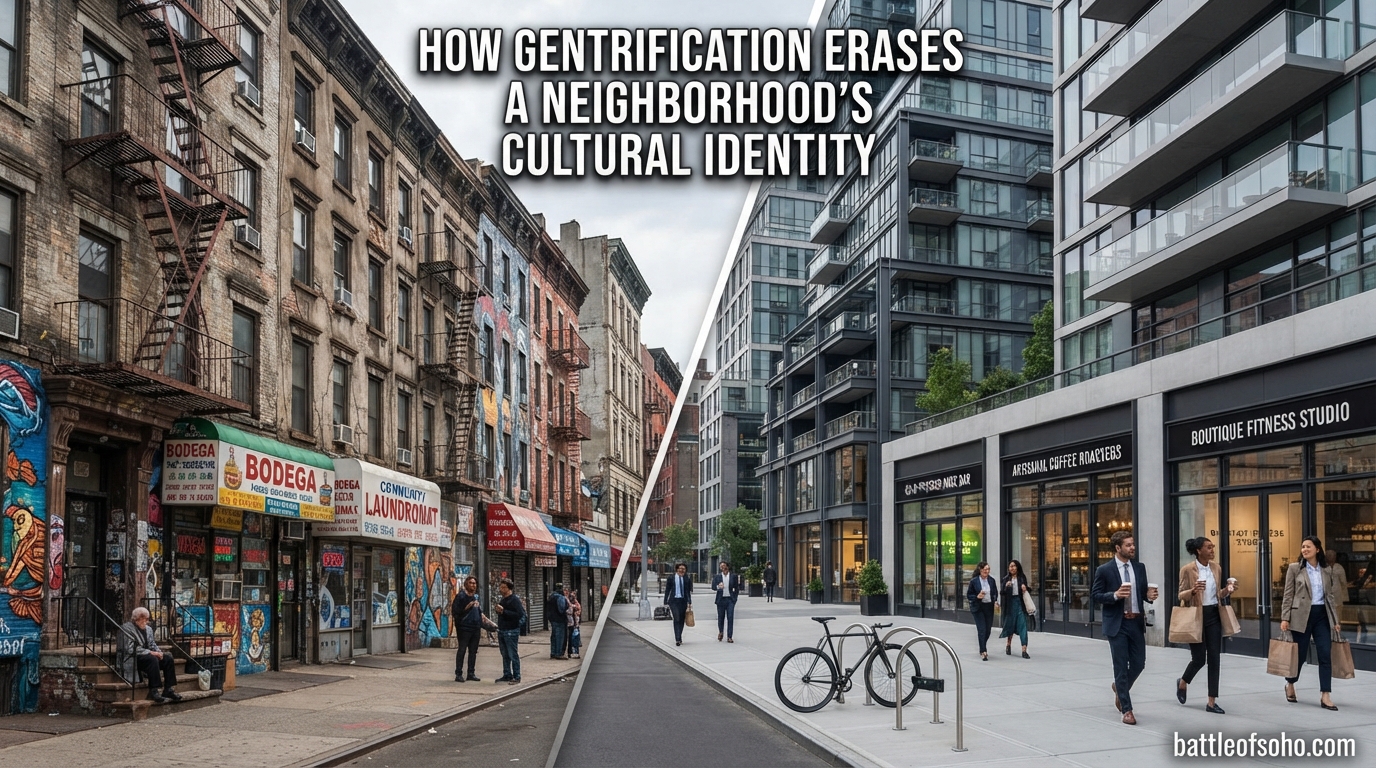
Walk down a street you grew up on twenty years ago, and something feels wrong. The bodega where your grandmother bought groceries every Saturday morning is now an artisanal coffee shop selling seven-dollar lattes. The family-owned barber who cut three generations of hair has been replaced by a sleek salon with exposed brick. The murals painted by local artists, the sound of music from front porches, the corner market with hand-painted signage, all gone.
This is how gentrification erases a neighborhood’s cultural identity. Not in one dramatic moment, but slowly, block by block, business by business, family by family. By the time the transformation feels complete, the people who built the community’s character are often nowhere to be found.
Gentrification is a process of neighborhood change where higher-income and higher-educated residents move into historically marginalized neighborhoods, housing costs rise rapidly, and physical and cultural transformation displaces original residents and erases their cultural identity. Over the past fifty years, approximately 15% of urban neighborhoods in the United States have shown signs of gentrification, according to research from the National Community Reinvestment Coalition (NCRC). The cultural consequences of this shift run far deeper than rising rents.
In this article, we explore exactly how gentrification strips neighborhoods of their cultural identity. We break down the mechanisms of cultural erasure, examine real-world case studies from Washington DC to Brooklyn, and look at what communities are doing to fight back. Whether you live in a gentrifying area, work in urban planning, or simply care about the soul of cities, understanding this process is the first step toward protecting it.
Table of Contents
What Is Gentrification and Why Does Cultural Identity Matter?
Gentrification refers to the transformation of a working-class or low-income neighborhood when middle- and upper-middle-class residents, investors, and businesses move in. Property values climb. Rents spike. New construction replaces old buildings. And gradually, the demographic makeup of the area shifts from its original residents to wealthier, often whiter newcomers.
The term itself was coined in 1964 by British sociologist Ruth Glass, who observed that working-class quarters in London were being invaded by the middle classes. The process has only accelerated since then, spreading to cities across the globe.
But gentrification is not just about economics. It is deeply cultural. A neighborhood’s cultural identity is the fabric of shared traditions, language, food, art, music, religious practices, and social customs that long-time residents have woven together over generations. It lives in the family-owned restaurant that has served the same recipes for forty years. It exists in the church choir that practices every Wednesday evening. It echoes through street festivals, block parties, and the everyday interactions between neighbors who know each other by name.
Sociologists often point to rent gap theory to explain why gentrification happens. The theory, developed by geographer Neil Smith in 1979, suggests that investors target neighborhoods where the actual ground rent (what the land currently earns) is significantly lower than the potential ground rent (what the land could earn if redeveloped). When that gap is wide enough, capital flows in. The neighborhood becomes what investors call an “opportunity,” and what residents call home becomes a target.
Once that process begins, cultural identity becomes vulnerable. The people who carry that culture, the businesses that express it, and the institutions that sustain it all face displacement. And when those elements disappear, the neighborhood does not just change. It loses something that cannot be rebuilt with luxury condominiums and craft breweries.
How Gentrification Erases a Neighborhood’s Cultural Identity: The Core Mechanisms
Cultural erasure through gentrification does not happen through a single action. It operates through multiple interconnected mechanisms, each one chipping away at the community’s identity until little remains. Understanding these mechanisms is essential for anyone who wants to grasp why gentrification cultural identity loss goes far beyond individual families being priced out.
1. Direct Residential Displacement
The most visible mechanism is direct displacement. As property values rise, landlords raise rents, sometimes dramatically and sometimes overnight. Long-time renters find themselves unable to afford the homes they have lived in for decades. Homeowners face climbing property taxes that can force them to sell.
When residents leave, they take their culture with them. A neighborhood is not just a collection of buildings. It is the people who live there, their daily routines, their relationships, and their way of life. Remove the people, and you remove the culture.
Research shows that between 2000 and 2013, thousands of low-income households were displaced from gentrifying neighborhoods across major US cities. In many cases, these residents relocated to suburban areas or poorer neighborhoods far from their original community networks.
2. Indirect Displacement and Cultural Pressure
Not all displacement is direct. Indirect displacement, sometimes called cultural displacement, happens when residents feel pressured to leave even if they technically could afford to stay. The neighborhood around them has changed so dramatically that it no longer feels like home.
Imagine walking down your street and no longer recognizing a single face. The shops you relied on are gone. The language you hear has changed. The community events that brought neighbors together have stopped because the new residents complained about the noise. You still live there physically, but culturally, you have already been displaced.
This phenomenon is well-documented in urban sociology. Residents report feeling invisible, unwelcome, and culturally disconnected in their own neighborhoods. Some choose to leave voluntarily, not because of rent increases, but because the social and cultural environment that made the neighborhood worth living in has vanished.
3. Social Capital Erosion
Social capital refers to the networks of relationships, trust, and mutual support that exist within a community. In long-established neighborhoods, social capital is built over generations. Neighbors look out for each other. People borrow tools, share meals, watch each other’s children. There are informal support systems that no government program can replicate.
Gentrification dismantles these networks. As original residents leave, the web of relationships that held the community together weakens. New residents, who often see the neighborhood as a bedroom community rather than the center of their social lives, do not replace that social capital. The result is a neighborhood that has more people but less community.
Sociologists have found that social capital erosion has measurable effects on health, safety, and wellbeing. Communities with strong social networks have lower crime rates, better health outcomes, and greater resilience in times of crisis. When gentrification erodes those networks, the entire community suffers, including the newcomers who do not realize what has been lost.
4. Business Displacement and Commercial Erasure
Local businesses are cultural anchors. The family-owned grocery store, the barbershop that served as an unofficial community center, the restaurant that cooked the food of the neighborhood’s heritage, these places do more than sell goods and services. They are gathering spaces. They are cultural institutions.
When commercial rents rise, these businesses are often the first casualties. They cannot compete with chain stores or high-end retailers who can afford premium leases. One Reddit user described watching the corner bodega where their grandmother shopped for thirty years become an artisanal coffee shop. That single transformation encapsulates an entire process of cultural erasure.
The replacement businesses rarely serve the same community. Artisanal shops, boutique fitness studios, and high-end restaurants cater to the new demographic. They are culturally blank spaces, disconnected from the neighborhood’s history. The commercial landscape becomes a visible record of who has been pushed out and who has moved in.
5. Institutional and Religious Displacement
Churches, mosques, temples, community centers, and cultural organizations are often the backbone of neighborhood identity. They host celebrations, provide social services, preserve traditions, and connect generations. When their congregations and memberships shrink because members have been displaced, these institutions face existential threats.
Houses of worship may close their doors. Community organizations may lose funding and relevance. Cultural festivals may be cancelled because the organizing community has scattered. Even when institutions survive, they often struggle to maintain their cultural mission in a neighborhood that no longer reflects their constituency.
Real-World Case Studies: Cultural Erasure in Action
The mechanisms described above are not abstract theories. They are playing out in neighborhoods across the country right now. Examining specific communities reveals the human reality behind the statistics.
U Street and Shaw, Washington DC
Washington DC’s U Street corridor, once known as “Black Broadway,” is one of the most frequently cited examples of gentrification and Black cultural displacement. In the mid-20th century, this neighborhood was the cultural heart of Black DC. Jazz clubs, Black-owned businesses, and vibrant street life defined the area. Duke Ellington grew up there.
Today, U Street looks dramatically different. The jazz clubs have largely been replaced by wine bars and upscale restaurants. The Black population in the broader Shaw area plummeted as white residents moved in. According to NCRC research, DC experienced some of the most intense gentrification of any US city between 2000 and 2013. Long-time residents describe walking through the neighborhood and feeling like tourists in the place where they grew up.
The cultural infrastructure that defined Black Broadway did not just fade. It was actively replaced. Historical markers exist, but they often feel like tombstones for a culture that has been displaced rather than celebrations of a living, breathing community.
Bedford-Stuyvesant, Brooklyn
Bedford-Stuyvesant, or Bed-Stuy, has been one of the most significant Black neighborhoods in New York City for generations. It was immortalized in literature, music, and film as a center of Black culture and community life. But the numbers tell a stark story of demographic transformation.
Between 2010 and 2020, Bed-Stuy lost approximately 22,000 Black residents while its white population grew by roughly 30,000. That is not incremental change. That is a fundamental remaking of the neighborhood’s cultural identity within a single decade.
Walk through Bed-Stuy today and you will see the visual markers of this shift. Historic brownstones have been renovated and sold at prices that exclude the original community. New businesses cater to a different clientele. The stoop culture that once defined the neighborhood, where neighbors gathered on front steps to socialize, is fading as the people who practiced it move away.
East Austin, Texas
East Austin was historically the city’s Latino and Black neighborhood, a legacy of segregationist zoning laws that concentrated communities of color east of Interstate 35. For decades, East Austin built a rich cultural identity through family-owned Mexican restaurants, Black churches, music venues, and community organizations.
The construction of newer housing, combined with Austin’s booming tech economy, triggered rapid gentrification. Property values in East Austin skyrocketed. Families who had owned homes for generations faced property tax bills they could no longer afford. Latino and Black businesses closed. The community that gave East Austin its character was steadily pushed to the suburbs, far from the cultural institutions and social networks they had built.
Chinatown Neighborhoods Nationwide
Chinatowns across American cities face a particularly complex form of cultural erasure. These neighborhoods are simultaneously residential communities, commercial hubs, cultural centers, and tourist destinations. Gentrification threatens all four functions.
In one widely shared account, Mrs. Chen, a long-time Chinatown resident, described new residents calling the police to complain about noise from traditional lion dance performances. Lion dances, which have been part of Chinese cultural celebrations for centuries, were treated as a nuisance by newcomers who had chosen to move into a Chinese neighborhood.
This captures the essential paradox of gentrification-driven cultural erasure. Newcomers are often attracted to a neighborhood precisely because of its cultural character. But once they arrive, that character can become an inconvenience to them. The result is pressure to sanitize and conform the culture to new preferences, stripping it of its authenticity.
The Psychological and Social Toll on Displaced Communities
The cultural erasure caused by gentrification is not just a matter of changing storefronts and demographics. It takes a profound psychological toll on the people who experience it. Understanding this dimension is critical to grasping why gentrification cultural identity loss matters on a human level.
Loss of Belonging and Rootlessness
Place-based identity is a powerful psychological force. People do not just live in neighborhoods. They identify with them. Their sense of self is tied to the streets they walked as children, the parks where they played, the corner store where the owner knew their name.
When that environment is erased, residents experience a form of grief. Psychologists have documented what they call “solastalgia,” a term originally coined to describe the distress caused by environmental change in one’s home. Applied to gentrification, solastalgia captures the pain of watching your neighborhood transform into something unrecognizable while you are still standing in it.
Displaced residents often describe feeling rootless. Even after relocating, they carry a sense of loss that does not fully heal. The new neighborhood does not have the memories, the relationships, or the cultural resonance of the old one.
Community Trauma
Gentrification does not just affect individuals. It traumatizes communities. When a neighborhood loses its cultural anchors, the collective identity that held people together fractures. The shared history, the mutual support networks, the sense of being part of something larger than yourself, all of these are damaged.
Mental health professionals who work in gentrifying communities report high rates of anxiety, depression, and stress among long-time residents. Some of this is economic, driven by housing insecurity and financial pressure. But a significant portion is cultural and social. People are grieving a way of life that is disappearing.
Intergenerational Impact
Perhaps the most insidious aspect of gentrification-driven cultural erasure is its intergenerational dimension. When a community is dispersed, children lose access to the cultural knowledge that would have been transmitted through daily life. They do not learn the traditions, the language, the recipes, or the history in the same organic way.
Grandparents who once taught grandchildren about their heritage through shared neighborhood experiences now live miles away. Cultural knowledge that was passed down through proximity and daily practice must now be deliberately taught, if it is taught at all. Over time, this creates gaps in cultural continuity that may never be repaired.
Cultural Disconnect and Isolation
For residents who remain in gentrifying neighborhoods, the experience can be deeply isolating. They live among people who do not share their history, their cultural references, or their values. Casual conversations become harder because the common ground has eroded.
This isolation compounds the other psychological effects. Residents who feel culturally disconnected in their own neighborhood are more likely to experience depression and anxiety. They are less likely to participate in community activities, which further weakens the social fabric.
The Commodification of Culture and Visual Identity Erasure
One of the most complex dimensions of gentrification-driven cultural erasure is what happens to the culture itself. It does not simply disappear. In many cases, it gets commodified, packaged, and sold back to the very people who replaced the community that created it.
When Culture Becomes a Product
Gentrifying neighborhoods often market their cultural character as a selling point. Real estate listings boast about “vibrant” communities, “authentic” neighborhoods, and “rich cultural heritage.” New businesses adopt aesthetic elements of the displaced culture, using ethnic motifs in their branding or serving “elevated” versions of traditional foods.
This is commodification. The cultural identity that original residents lived and breathed becomes a marketing tool. The neighborhood’s heritage is strip-mined for profit, stripped of its context, and sold as a lifestyle amenity to newcomers who want the flavor without the history.
The result is a hollow version of culture. The visual aesthetics remain, or are recreated, but the people, stories, and traditions behind them are gone. It is cultural taxidermy. The neighborhood looks alive but the soul has been removed.
Visual Identity Erasure: Signage, Storefronts, and Streetscapes
One of the most immediate and visible signs of gentrification is the transformation of commercial streetscapes. Hand-painted signs in Spanish, Chinese, or Korean are replaced by minimalist typography in English. Family-owned storefronts with decades of character give way to identically designed chain stores and boutiques.
Forum users frequently cite this visual erasure as one of the most painful aspects of gentrification. The physical environment of a neighborhood, its signage, its building styles, its street layout, is a record of its history. When every visible trace of the original community is replaced, the message is clear: you no longer belong here.
Cultural Events Under Pressure
Cultural events, festivals, religious celebrations, block parties, and street performances, are the living expression of neighborhood identity. But in gentrifying areas, these events frequently come under pressure from new residents.
Newcomers complain about noise, parking disruptions, and street closures. They call authorities about music they find unfamiliar. They treat traditions that have been practiced for decades as nuisances. Event organizers face increasing costs for permits and insurance. Some festivals are scaled back. Others disappear entirely.
When a neighborhood loses its cultural events, it loses its heartbeat. These gatherings are where community identity is performed, reinforced, and transmitted. Without them, the neighborhood becomes just another collection of buildings.
Can Communities Fight Back? Preservation Strategies and Resistance
While the forces driving gentrification can feel overwhelming, communities are not powerless. Across the country, residents, organizers, and policymakers are developing strategies to preserve neighborhood cultural identity and resist displacement. These approaches range from grassroots organizing to formal policy interventions.
Community Land Trusts
Community land trusts (CLTs) are nonprofit organizations that acquire and hold land for the benefit of the community. By removing land from the speculative market, CLTs can keep housing affordable and prevent the displacement that drives cultural erasure.
The CLT model has been successfully implemented in cities like Burlington, Vermont, and Atlanta, Georgia. Residents collectively own the land beneath their homes, ensuring that rising property values benefit the community rather than displacing it. For neighborhoods facing gentrification, CLTs offer a structural defense against the economic forces that drive cultural erasure.
Cultural District Designations
Many cities have created formal cultural district designations that provide protections and resources for historically significant neighborhoods. These designations can include rent stabilization for legacy businesses, protections for cultural institutions, and funding for community events.
San Francisco’s Cultural Heritage Districts and Los Angeles’s Historic Cultural Neighborhoods are examples of policy frameworks designed to preserve community identity in the face of development pressure. While not a complete solution, these designations give communities a legal foundation for defending their cultural presence.
Anti-Displacement Zoning and Policy
Zoning policy is one of the most powerful tools for shaping neighborhood change. Anti-displacement zoning strategies include inclusionary zoning (requiring affordable units in new developments), rent stabilization laws, and limits on speculative property purchases.
Cities like Portland, Oregon, have experimented with anti-displacement zoning in neighborhoods identified as vulnerable to gentrification. The goal is to allow some development while protecting the residents and businesses that give the neighborhood its cultural identity.
Supporting Legacy Businesses
Some cities have established legacy business registries and grant programs that provide financial support to long-standing local businesses. These programs recognize that family-owned shops, restaurants, and services are cultural institutions, not just commercial enterprises.
San Francisco’s Legacy Business Registry, for example, provides grants and technical assistance to businesses that have operated in the city for twenty or more years. By helping these businesses survive rising rents and changing markets, the program preserves the commercial fabric that gives neighborhoods their character.
How New Residents Can Be Allies
Not everyone who moves into a changing neighborhood intends harm. Many newcomers genuinely appreciate the cultural character of their new community. The question is how to be a good neighbor without contributing to cultural erasure.
Allyship starts with listening. New residents can learn about the neighborhood’s history, support existing local businesses rather than new ones, attend cultural events and respect their traditions, and advocate for policies that protect long-time residents from displacement. The key is to integrate into the existing community rather than expecting the community to adapt to you.
Being an ally also means recognizing when your presence is part of the problem. If the coffee shop you frequent opened in the space of a displaced family business, acknowledge that. If your landlord raised rents to attract higher-income tenants, understand your role in that dynamic. Self-awareness is the foundation of responsible community membership.
FAQs
How does gentrification erase culture?
Gentrification erases culture by displacing the residents, businesses, and institutions that carry a neighborhood’s cultural identity. Rising rents force out long-time families, commercial landlords replace legacy businesses with upscale shops, and new residents often disrupt cultural events and traditions. The physical and social fabric that gave the neighborhood its character is systematically dismantled, leaving behind a sanitized version of the community stripped of its original people and meaning.
How does gentrification help communities?
Gentrification can bring some benefits, including increased investment in infrastructure, improved public services, new business development, and higher property values for homeowners. Some argue it can reduce crime and increase tax revenue for city services. However, these benefits frequently flow to newcomers and investors rather than original residents, who often face displacement and cultural erasure. The improvements come at a steep social and cultural cost that disproportionately affects low-income communities and communities of color.
How does gentrification affect diversity?
Gentrification often reduces neighborhood diversity rather than increasing it. While newcomers may bring different backgrounds, the displacement of original residents typically results in racial and economic homogenization. Studies show that gentrifying neighborhoods frequently transition from diverse, low-income communities of color to predominantly white, affluent areas. The apparent diversity of a gentrifying neighborhood is often temporary, lasting only until displacement is complete and the original community has been fully replaced.
What is gentrification of culture?
Gentrification of culture refers to the process by which a neighborhood’s original cultural identity is erased, commodified, or replaced during gentrification. This includes the loss of cultural landmarks and traditions, the displacement of culturally significant businesses and institutions, and the appropriation of cultural elements by new businesses and residents. It often results in a sanitized, marketable version of the original culture that serves newcomers while the community that created it has been pushed out.
Conclusion
Understanding how gentrification erases a neighborhood’s cultural identity means recognizing that displacement is not just about housing. It is about the systematic removal of people, businesses, institutions, and traditions that give a community its soul. The mechanisms are well-documented. Direct and indirect displacement push residents out. Social capital erosion weakens community bonds. Business and institutional displacement remove cultural anchors. And commodification turns living culture into a marketing asset.
The case studies from U Street, Bed-Stuy, East Austin, and Chinatowns across the country show that this process is not hypothetical. It is happening right now, in real neighborhoods, to real people. The psychological toll, the loss of belonging, the intergenerational trauma, and the cultural disconnection are consequences that no amount of new construction can repair.
But communities are fighting back. Through land trusts, cultural district designations, anti-displacement policy, legacy business programs, and the active allyship of responsible new residents, neighborhoods can defend their cultural identity. The question is not whether gentrification will continue to transform cities. It will. The question is whether we will allow it to erase the communities that make those cities worth living in.
If you care about gentrification and cultural identity, the most important thing you can do is pay attention. Listen to long-time residents. Support local businesses. Show up to community meetings. Advocate for policies that protect vulnerable neighborhoods. Culture is not preserved by accident. It is preserved by people who value it enough to defend it.