
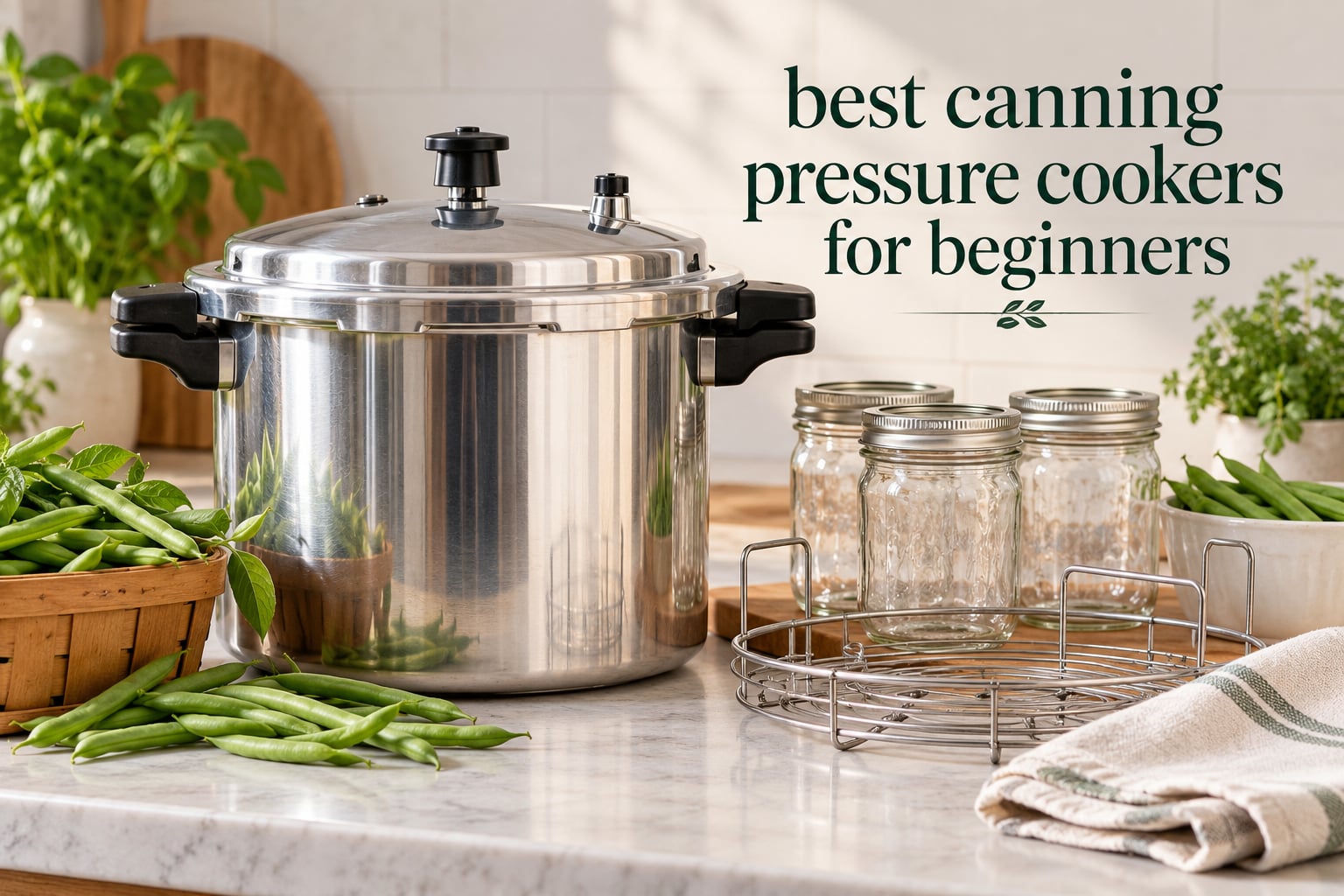
The first question a new canner asks is not which brand to buy. It is whether they need a pressure canner at all, and the honest answer is that you only need one if you plan to put low-acid foods into jars for shelf storage. Vegetables, beans, meats, poultry, seafood, soups and stews all require sustained pressure of 10 to 15 PSI for processing times that regularly run past an hour. Jam, pickles, most fruit and acidified tomatoes do not, and a simple boiling-water canner handles those.
That distinction matters more than any spec sheet, because the two vessels look similar and are not interchangeable. A pressure cooker is built to cook food fast and is usually not tested to hold canning pressure for a full cycle. A pressure canner is a heavy, tall, certified vessel with a wide mouth, a rack, and a sealing system that can hold pressure steadily for the whole process. The National Center for Home Food Preservation and Cooperative Extension services are consistent on this point: for low-acid foods, use a canner that is tested and listed for pressure canning. Multi-cookers such as the Instant Pot fall into the first group, not the second.
We went through the eight canners below with the questions a first-timer actually asks: how many jars fit, what has to be monitored, what wears out, and will it fit on the cooktop you own. Everything in this guide of the best canning pressure cookers for beginners comes from manufacturer specifications and from what owners report after real batches. If you want the everyday cooking side of the equation first, our guide to the [best pressure cookers for home cooks](https://battleofsoho.com/best-pressure-cookers-for-home-cooks/) covers the units that live on the counter rather than on the stove.
Two things to set up front, since they change what you should buy. The first is altitude: above 1,000 feet, low-acid processing times lengthen, and a canner with a genuine dial gauge or an altitude-capable electric control makes a real difference. The second is batch size, because a canner that is too small turns a garden surplus into three evenings of babysitting. We size each pick against real jar counts rather than marketing quart figures.
Table of Contents
Top 3 Best Canning Pressure Cookers for Beginners in 2026

Presto 01781 23-Quart Pressure Canner
- 26 half-pint
- 20 pint or 7 quart capacity
- Deluxe dial gauge reads the full pressure range
- Includes canning rack and 76-page recipe book
- 12-year limited warranty

All American 915 Pressure Canner
- Metal-to-metal seal
- no gasket to replace
- About 10 pint or 7 quart jars per load
- Audible weighted regulator you can hear
T-Fal 22-Quart Pressure Canner
- Built-in lid weight with 3 PSI settings
- 24 half-pints
- 18 pints or 7 quarts per load
- Two canning racks included
- Step-by-step canning guide in the box
Best Canning Pressure Cookers Compared Side by Side in October
| Product | Specifications | Action |
|---|---|---|
| Presto 01781 23-Quart Pressure Canner |
|
Check Latest Price |
| All American 915 15.5-Quart Pressure Canner |
|
Check Latest Price |
| T-Fal 22-Quart Pressure Canner |
|
Check Latest Price |
 NESCO NPC-9 Electric Pressure Canner NESCO NPC-9 Electric Pressure Canner |
|
Check Latest Price |
 Presto 02152 17-Quart Digital Canner Presto 02152 17-Quart Digital Canner |
|
Check Latest Price |
 Granite Ware 20-Quart Pressure Canner Granite Ware 20-Quart Pressure Canner |
|
Check Latest Price |
 Presto 01755 16-Quart Pressure Canner Presto 01755 16-Quart Pressure Canner |
|
Check Latest Price |
 All American 910 10.5-Quart Pressure Cooker/Canner All American 910 10.5-Quart Pressure Cooker/Canner |
|
Check Latest Price |
1. Presto 01781 23-Quart Pressure Canner and Cooker – Best Overall
Presto 01781 23-Quart Pressure Canner and Cooker
21.8 liter capacity
26 half-pint, 20 pint or 7 quart jars
12 pounds empty
12-year limited warranty
Pros
- Largest jar capacity in this group
- Weighted gauge with a deluxe dial for altitude reads
- Heats fast and evenly on gas and smooth-top ranges
- Rack and 76-page recipe book included
- Works as a boiling-water canner too
Cons
- Manual heat adjustment to hold steady pressure
- Aluminum body reacts with highly acidic foods
- Bulky footprint for small cabinets
This is the canner we come back to for most beginners, and the reason is capacity rather than gadgetry. The manufacturer lists 26 half-pints, 20 pints or 7 quarts per load, which means a serious weeknight of tomato sauce or a basket of green beans finishes in one run instead of three. At 12 pounds empty it is also the second-lightest unit in this roundup, which matters when you are lifting it full of glass.
Pressure control is a weighted regulator on the lid paired with a deluxe dial gauge that registers the full processing range. In practice you watch the gauge, not the regulator, and you turn the burner up or down to keep the needle steady. That is the part that takes a season to learn, and it is also the part that tells you honestly that pressure is happening.
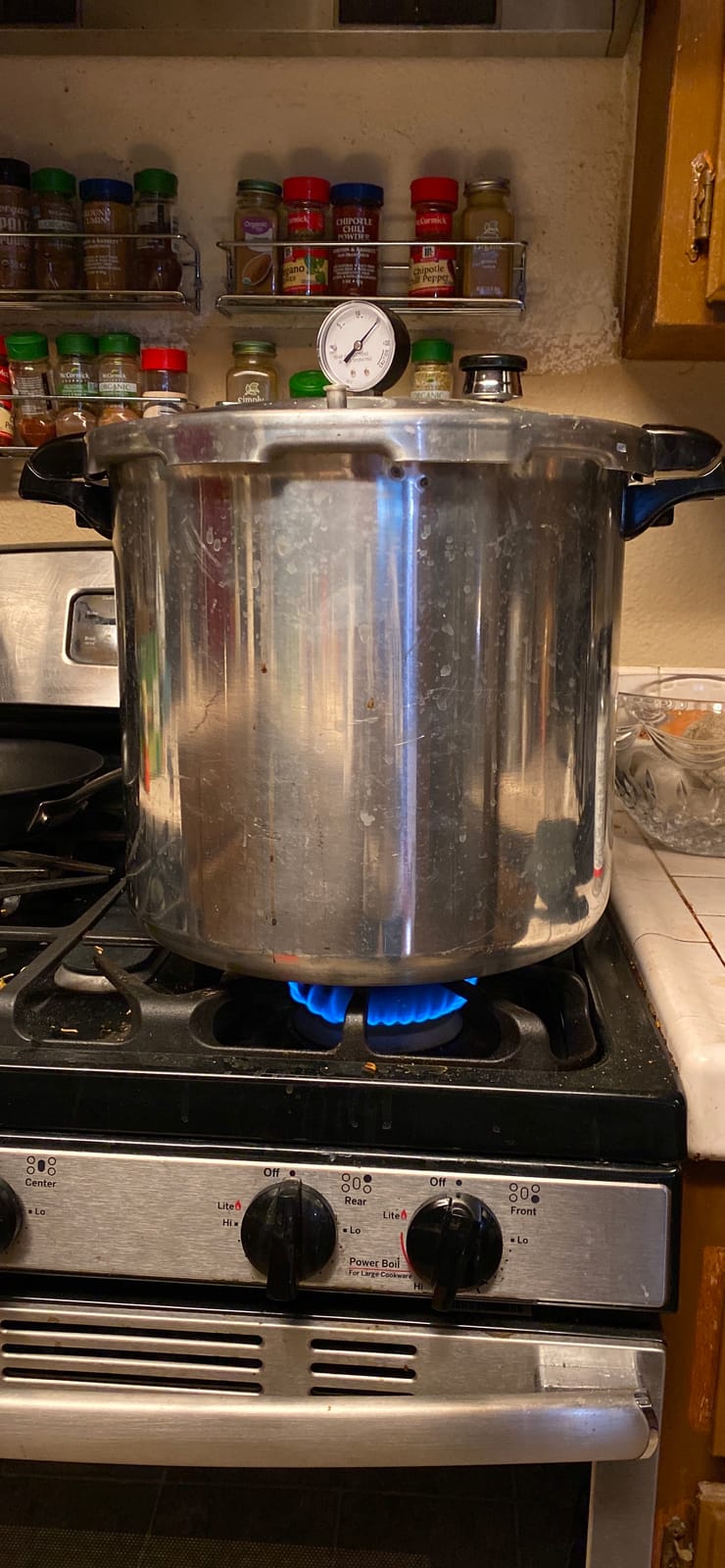
The deluxe gauge is the sleeper feature here. It is one of only a few stovetop canners in this group that can actually show you a reading you can use for altitude adjustments, and reviewers repeatedly single it out for exactly that. A canner in the Rockies or anywhere above 1,000 feet needs longer processing, and a gauge that registers more than a single weight gives you a way to verify that the extra time is being spent at the right pressure.
Two things to know before you commit. The aluminum body will discolor over years of use and should stay away from highly acidic or vinegar-heavy batches, and the 23-quart footprint is genuinely large, so measure your cabinet before you order. The 12-year limited warranty is the longest in this group and the least visible advantage, because you will not think about it until it matters.
How many jars fit, and what does that mean for a first season
Twenty pints or seven quarts per load is the number that changes planning. A family of four going through a summer garden can finish a full basket of beans in a single afternoon, and the leftover capacity is what absorbs the surprise surplus that always shows up in August. The canning rack in the box keeps jars off the bottom of the pot so nothing sits in a pocket of cooler water.
Because the interior is sized for both pints and quarts, you are not locked into one jar size for the life of the canner. Wide-mouth pints also fit, which matters if that is the lid inventory you already own.
What it is like to use for a full processing cycle
You fill the pot with a couple of inches of water, load the rack, set the weight, and leave the vent open for a timed release before the weight goes on. From there it is heat management: raise the flame until the dial settles at the processing pressure, then nudge the burner whenever it drifts. The first batch is a learning run and it is normal for pressure to take a while to build.
After processing, the cool-down is not optional. Let the canner sit undisturbed until it is fully depressurized and cool enough to open, because thermal shock and a stuck gasket are both avoidable. Owners who rush this stage are the ones who end up with a warped pot or a jar that did not seal.
2. All American 915 15.5-Quart Pressure Cooker/Canner – Top Rated
All American 1930: 15.5qt Pressure Cooker/Canner (The 915) – Exclusive Metal-to-Metal Sealing System – Easy to Open & Close – Suitable for Gas, Electric, or Flat Top Stoves – Made in the USA
14.67 liter capacity
About 10 pint or 7 quart jars
18 pounds empty
Made in the USA
Pros
- No gasket
- nothing consumable to replace
- Audible steady jiggle you can hear from another room
- Built-in gauge needs no annual calibration
- Made in USA with detailed manual cookbook
- Works on gas
- electric and flat-top stoves
Cons
- Heavy when loaded
- so load it on the stove
- Lid can stick at zero pressure if opened slowly
- Aluminum body reacts with acidic foods
- Higher cost than most stovetop canners
The All American 915 is the one we recommend to people who describe themselves as gasket-phobic, and the reason is structural rather than cosmetic. Its sealing system is metal to metal, so there is no rubber ring anywhere in the pressure path. That removes the single most common failure point in stovetop canners, and the same gauge and clamping knobs carry across the whole model range, so parts and service stay available for decades.
Capacity is about 10 pint jars or 7 quarts per load, which is a solid mid-size batch and enough for a first season without turning into a lifting problem. At 18 pounds empty it is the second-heaviest unit here, and that weight is concentrated in the pot itself rather than spread through a tall body, so it feels more stable on a burner than the number suggests.
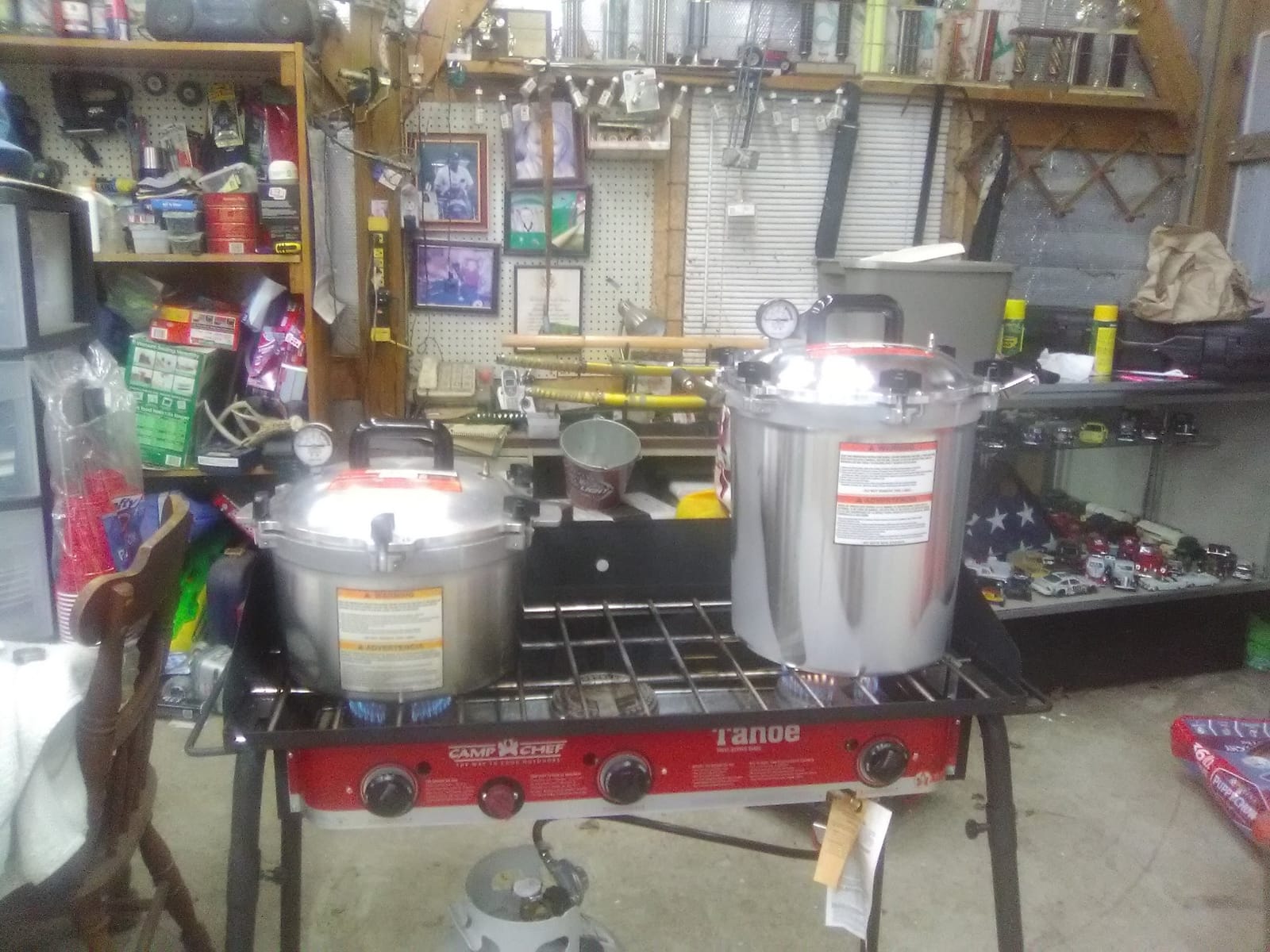
The regulator is a precision-machined weight, and the gauge is a reference rather than the control. That inversion is the whole design idea: you set the weight and the canner holds pressure by physics, and the audible jiggle tells you it is working without you standing over a dial. Experienced canners describe this exact canner as a buy-it-for-life tool, and the enthusiasm in owner reviews tracks the same thing, that there is no consumable part to forget.
Two habits will keep it happy. Remove the lid promptly once pressure reaches zero, because the vacuum of cooling metal can lock the seal and a light film of oil on the sealing rim prevents it. And keep acidic or vinegar-based food out of the aluminum body, where it will discolor and can taste off over time.
How the gauge-free control changes your routine
There is no dial to interpret once the weight is set, so the only active task during a batch is keeping the flame steady enough that the jiggle continues. That is a meaningful reduction in cognitive load for a first-timer, and it is the reason this canner shows up so often in beginner advice threads despite its higher cost.
It also removes an annual chore. Canners with a dial reading sometimes get people asking whether the gauge needs periodic testing, and this design sidesteps that question entirely. Fewer things to check means fewer reasons to skip a batch.
When the 915 is the wrong pick
It is the wrong pick if your budget is tight, because you are paying a premium for a seal that will never need replacing. If your garden output is small, roughly four quarts of food per batch is more than a typical household eats in a week. And if you plan to can a lot of tomato sauce or vinegar-based recipes, the aluminum body is a poor fit regardless of how good the seal is.
3. T-Fal 22-Quart Aluminum Pressure Canner – Best Value
T-fal 22-Quart Aluminum Pressure Canner, 3 PSI Settings, Home Canning, Includes Racks & Canning Guide, Large Capacity, Pressure & Water Bath Canning for Vegetables, Meats, Seafood & Fruits, Silver
22 quart capacity
24 half-pints, 18 pints or 7 quarts
14.8 pounds empty
Gas and electric coil compatible
Pros
- Built-in adjustable lid weight removes dial math
- Large 24 half-pint or 18 pint capacity
- Two canning racks and a guide included
- Reports of simple
- confidence-inspiring operation
- Adjustable weight offers three PSI settings
Cons
- Lid gasket sometimes needs cleaning to stop small leaks
- Pressure indicator button is recessed and hard to read
- Very large and heavy when full
- Aluminum discolors after acidic or high-heat use
The T-Fal is the pick for a beginner who wants a big canner and does not want to think about gauge readings. The adjustable weight is built into the lid with three PSI settings, so you choose a pressure and turn the burner until it holds. Owner reviews describe the first batch as confidence-inspiring, which is the phrase that matters most for a canner bought by someone who has never processed a low-acid jar.
Capacity is generous for the class: 24 half-pints, 16 wide-mouth pints, 18 pints or 7 quarts. The wide-mouth pint option is worth noting, because wide-mouth jars are awkward to grip inside a tall pot and this one is dimensioned to handle them.
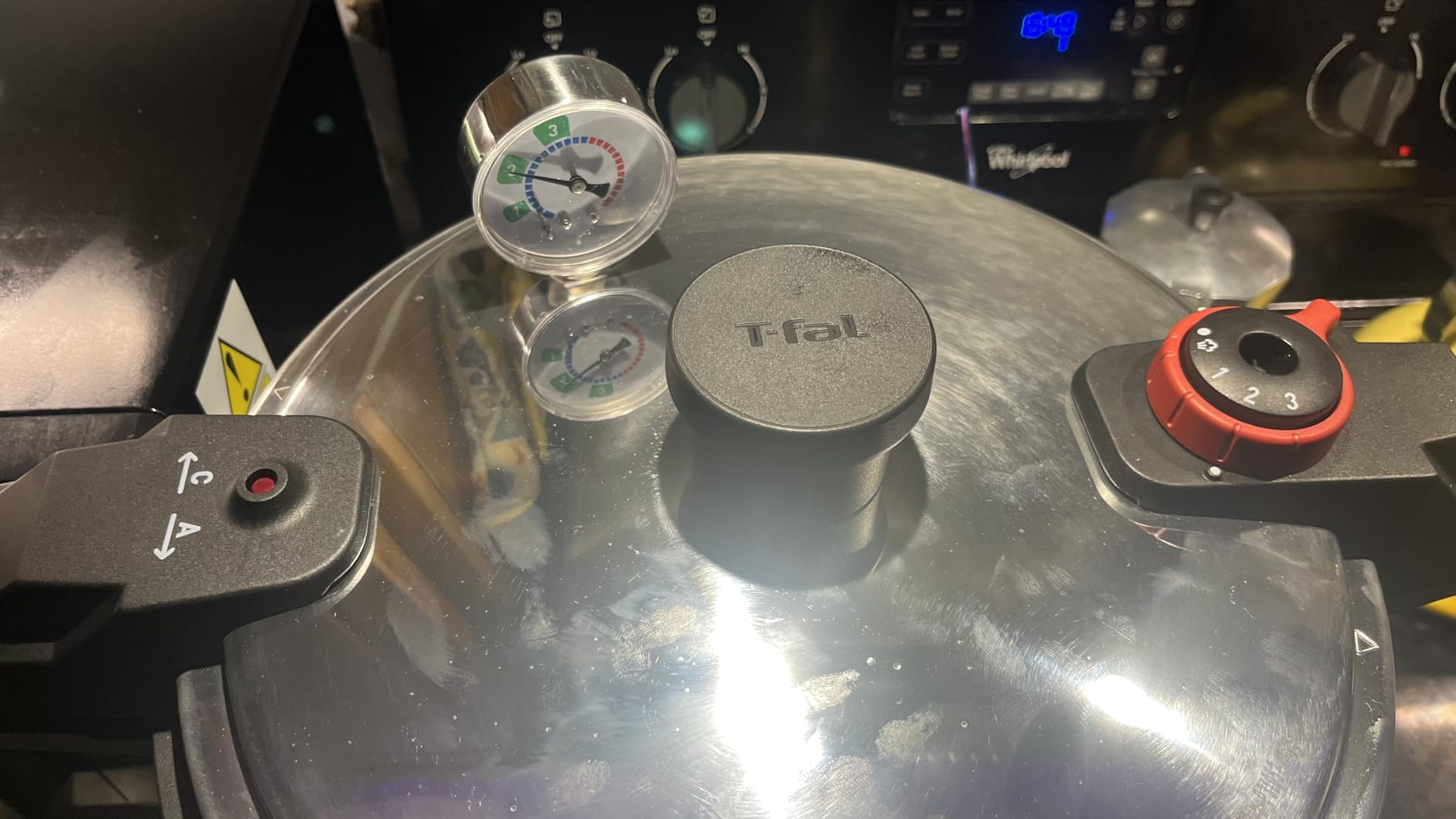
Two racks and a step-by-step canning guide are included in the box, which removes the most common first-season purchase mistakes. Owners cite the guide as a genuine aid rather than filler, particularly for the venting stage, which is the step beginners most often rush.
The honest weakness is the gasket. Reviews report that the lid ring occasionally needs cleaning or re-seating to stop a small steam leak, and that is a maintenance item you will think about every few years. The recessed pressure indicator button is also genuinely hard to see pop up, so find it once before you need it and you will not lose time mid-batch.
What the three PSI settings do for a first batch
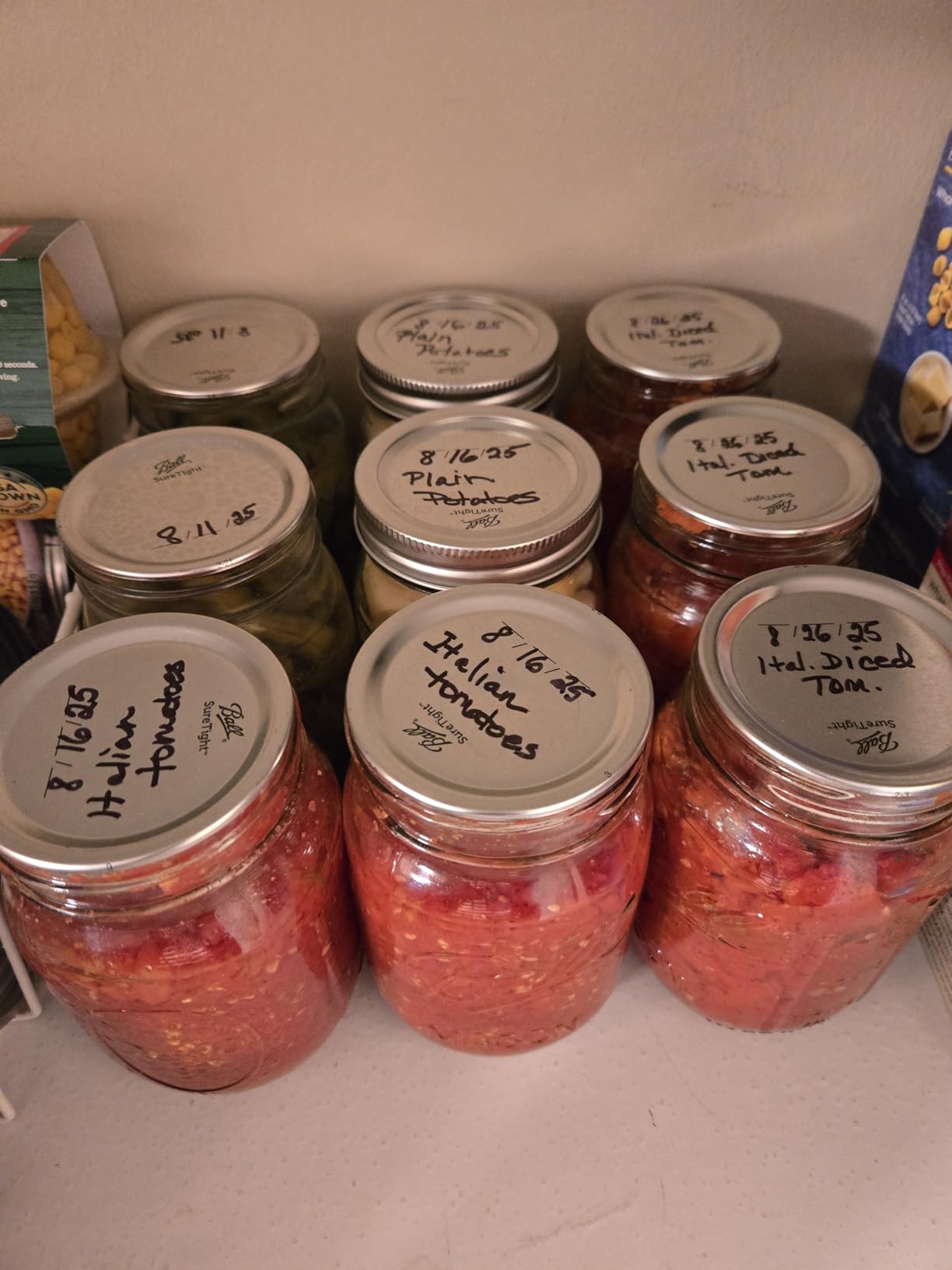
Most home pressure canning happens at 10 or 15 PSI depending on the food, so a weight with three positions covers the range you will actually need without a separate part. For a beginner, that is the whole point: the decision is made once, before the burner goes on, instead of continuously during processing.
The manual can read as dated on a first pass, and the layout is not as clear as newer digital documentation. Set aside twenty minutes with it before your first batch rather than during one.
Who should buy something else instead
Skip it if you have limited counter or cabinet space, since the 22-quart body is among the largest here at nearly 20 inches deep. Skip it if you can a lot of highly acidic food, because bare aluminum stains with tomatoes and vinegar. And if you want a unit you never have to service, the gasket on this model is the trade you are making for the low cost.
4. NESCO NPC-9 Smart Electric Pressure Canner – Best for First-Timers
NESCO NPC‑9 Smart Electric Pressure Canner and Cooker for Home Food Preservation, 9.5‑Quart Stainless Steel with Digital Controls
9.5-quart stainless inner pot
About 4 quart or 5 pint jars
Digital controls, 1000 watts
Stainless steel body
Pros
- Electric operation removes stove guesswork
- Digital programs and timer give repeatable cycles
- Also pressure cooks
- steams and water-baths
- Removable nonstick pot and condensation catcher
- Standard and high-altitude limiting valves included
- Does not heat the kitchen
Cons
- Small batch size limits output per run
- Wide-mouth pints are awkward to lift out
- Instructions are wordy on first read
- Beeps at plug-in and timer changes
This is the canner we suggest to anyone whose main objection to pressure canning is losing control of the stove. Nothing here is manual. The digital display runs a programmed canning cycle with a processing timer, and the unit handles heat, venting and altitude on its own, so there is no flame to babysit and no weight to judge.
There is a persistent claim online that no electric pressure canner is tested safe, and it circulates in canning forums without a citation. The way to resolve it is not to argue but to check: the National Center for Home Food Preservation and USDA guidance both point at whether a specific unit is listed and tested for pressure canning, and manufacturers publish that testing. Verify the listing for the model you are considering rather than accepting a forum consensus either way.
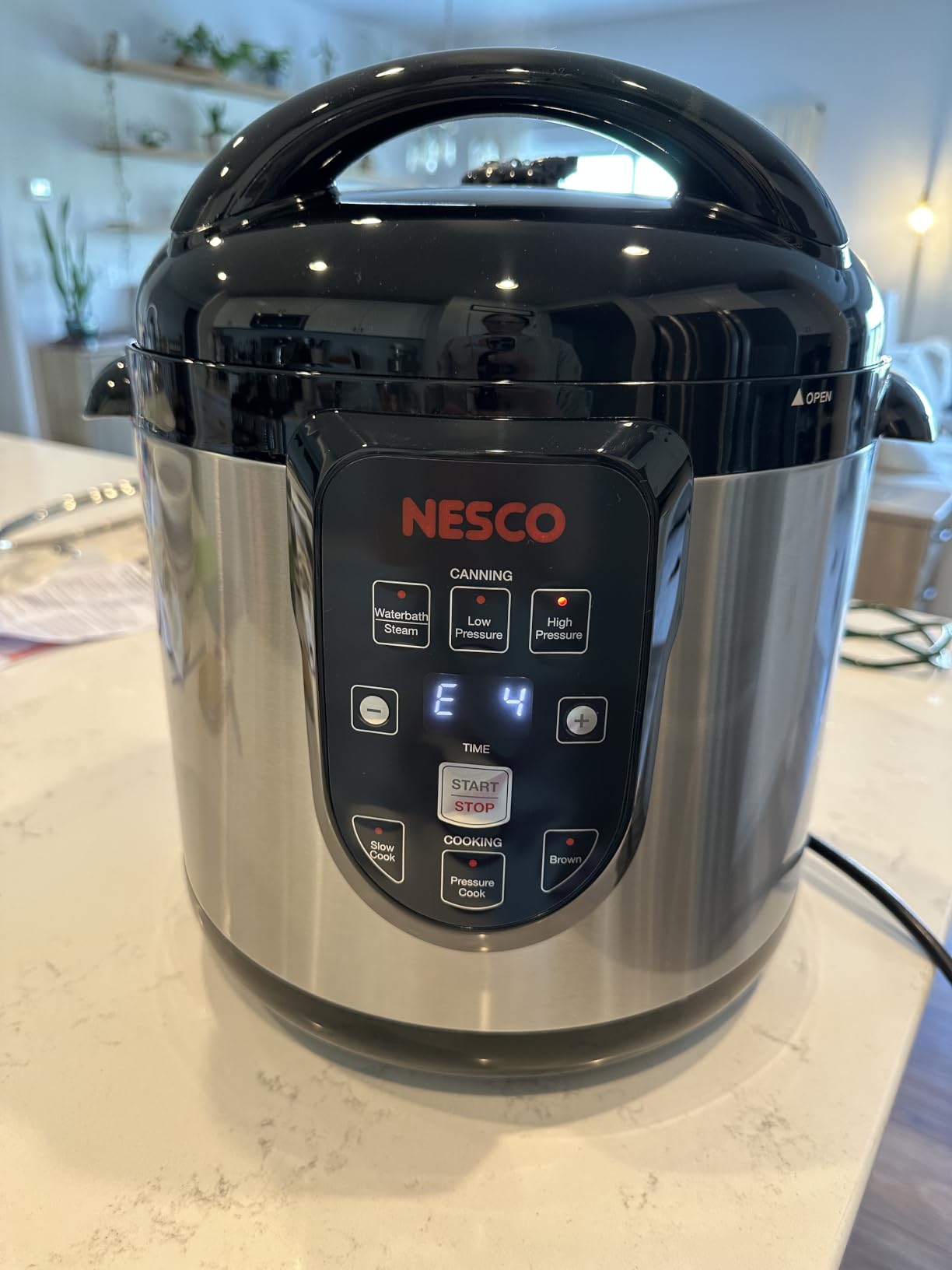
The trade is batch size. The manufacturer puts capacity at roughly 4 quart jars or 5 pint jars, which is a real constraint if you are trying to put up a whole garden in a weekend. A garden surplus of 30 pint jars is eight runs on this machine and one or two on a 22-quart stovetop canner.
In exchange you get a stainless body, a removable nonstick inner pot, canning and steam racks, a condensation catcher, and both standard and high-altitude limiting valves in the box. It is also a slow cooker, steamer and water-bath canner, which makes it the one unit here that earns its counter space outside of a canning season.
Is an electric canner right for a small household
If you are one or two people, or you are testing whether you like canning at all, the batch size is a feature. Four quarts is roughly a week of beans for a couple, and you are not committing an entire evening to a load you cannot eat. For a family of four putting up 200 jars a year, it is the wrong shape entirely.
The stainless interior is also easier to keep clean than bare aluminum, and it does not discolor with acidic batches, which makes it the electric option for a tomato-heavy gardener.
What trips people up on this unit
The manual is wordy and the modes overlap, so read it before the first batch rather than during one. Wide-mouth pint jars are hard to grip and lift out of the deep inner pot, and the audible beeps at plug-in and timer changes startle people who did not expect them. None of these are safety issues, but all of them cause a slightly jarring first session.
5. Presto 02152 17-Quart Digital Pressure Canner – Best for Kitchens Without a Gas Burner
Presto 02152 17-Quart Digital Pressure Canner
17 quart capacity
Extra-tall interior fits quart jars
24.3 pounds empty
Sensor-controlled temperature
Pros
- Automated cycle removes heat management
- Sensor holds safe canning temperature at altitude
- LED display walks through each step
- Extra-tall chamber sized for quart jars
- Stainless interior is easier to maintain
- Handles pressure and boiling-water canning
Cons
- Heavy 24.3-pound body before jars and water
- Tall 18-inch body needs counter clearance
- Less hands-on than a stovetop canner
The Presto Digital takes the automation idea further than the NESCO in one specific way: it holds canning temperature by sensor rather than running a fixed time, and it compensates for altitude without a manual adjustment. If you live above 1,000 feet, that is the feature that makes the difference between a safe batch and a long one.
The control knob selects the canning method and processing time, and the LED display walks through each step. There is no dial reading and no burner to steer, so a first batch is closer to following a sequence on a screen than to managing heat with a flame.
Capacity is 17 quarts in an extra-tall interior dimensioned to accept quart jars, and there is also a 12-quart version in the range for smaller kitchens. The stainless interior is easier to keep clean than bare aluminum and will not take on the discoloration that shows up after a few seasons of acidic batches.
Size is the real cost. At 24.3 pounds before you add water and glass, and 18 inches tall, this is the largest physical unit in the roundup. You need genuine counter clearance and a cabinet that will accept the height, and loading is a two-person job when the load is full.
How automation changes altitude processing
Below 1,000 feet, an automatic cycle mostly saves you attention. Above it, the sensor is doing real work, because low-acid processing times lengthen and a canner that just runs a fixed clock at sea-level pressure is not doing the safer thing. This unit is built to adjust rather than assume.
If you are not above 1,000 feet and do not mind a hands-on process, this automation is not worth paying for on its own. A weighted-gauge stovetop canner will get you to the same safe result with more involvement.
Where the manual approach still wins
Some canners learn faster with visible cause and effect, and a knob-and-flame process teaches you what pressure actually feels like. This unit removes that feedback on purpose. It also works as a boiling-water canner, but if fruit and jam are most of what you want to put up, a dedicated water-bath setup is the simpler purchase.
6. Granite Ware 20-Quart Pressure Canner/Cooker/Steamer – Best for a Rust-Resistant Body
Granite Ware Pressure Canner/Cooker/Steamer, 20-Quart
20 quart capacity
Three-piece regulator at 5, 10 and 15 psi
10.5 pounds empty
Hard-anodized aluminum
Pros
- Hard-anodized body resists rust and staining
- Adjustable three-piece regulator
- 20-quart capacity for real batches
- Lightest 20-quart body in this group
- Doubles as pressure cooker and steamer
Cons
- Manual heat adjustment throughout
- Smaller base of owner feedback than the leaders
- Gasket and regulator are wear parts
The reason to look at this one is the surface. The body is heavy-gauge hard-anodized aluminum, which resists rust and staining noticeably better than bare aluminum, and that matters over a decade of tomato season, if you are someone who would rather not scrub discoloration off a pot every year.
Pressure control is a three-piece adjustable regulator calibrated at 5, 10 and 15 PSI, controlled manually. That is the least automated approach in the roundup, and it is the one most like the classic Presto design, which has been canning for decades with the same philosophy.
At 10.5 pounds empty, this is the lightest 20-quart unit in the group, and a 20-quart capacity gives you a meaningful batch. The canner also works as a pressure cooker and steamer, so the off-season use case is there if you want it.
The honest limitation is the size of the owner base. Review volume is far lower than the Presto and All American units in this roundup, which means less long-term feedback to draw on when something goes wrong. Owners in that smaller group tend to rely on the manual rather than the gauge and treat the gasket and regulator as consumable wear parts.
Is a hard-anodized body worth choosing over bare aluminum
For a canner that will be wet, hot and acidic on a regular basis, the anodized surface is the difference between a pot that looks fine and one that darkens unevenly. It does not make the canner safer, and it does not change pressure performance, but it removes a source of ongoing annoyance.
It also does not solve the two real maintenance items. The gasket and the regulator are still wear parts that need periodic replacement, so this is not a no-maintenance canner in the way the metal-to-metal designs are.
Who should pass on it
Pass if you want the deepest pool of long-term owner experience available, Pass if you want automation, since every adjustment is manual. And pass if you are canning for a household rather than a garden, because 20 quarts may be more than you will use.
7. Presto 01755 16-Quart Aluminum Pressure Canner – Best for Small Kitchens
Presto 01755 16-Quart Aluminum Pressure Canner and Cooker
16 quart capacity
10.5 pounds empty
Weighted regulator with cover lock
1 year limited warranty
Pros
- Compact 16-quart body stores easily
- Light at 10.5 pounds empty
- Fast
- even warp-resistant aluminum
- Works as a pressure canner and cooker
- Cover lock and air vent show pressure release clearly
Cons
- Manual weighted pressure control takes practice
- Aluminum discolors and should avoid acidic foods
- Product detail is sparse so research beforehand
- Lid gasket is a wear item
For a first canner in a small kitchen, size is the deciding factor and this is the one that wins it. At 16 quarts and 10.5 pounds empty, it is the smallest genuinely capable Presto canner, and it stores in a cabinet where a 23-quart unit simply will not go.
The design is the classic Presto weighted-gauge arrangement with a cover lock and air vent, which gives visible confirmation of pressure release before the weight goes on. The aluminum is warp-resistant and heats quickly, and the whole unit also pressure cooks, so it earns its space outside canning season.
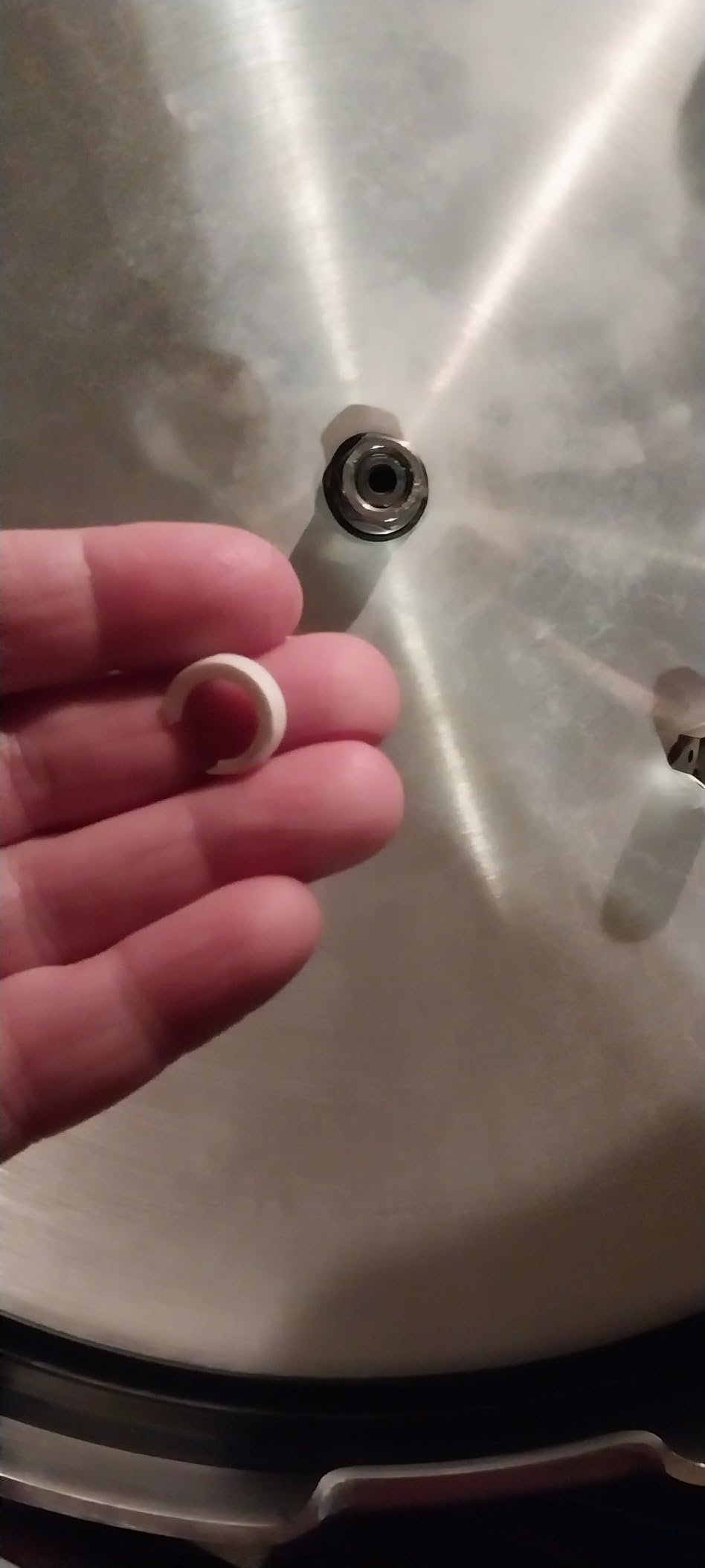
What you give up is batch size. A 16-quart canner handles a respectable load but roughly a third fewer jars than the 22 and 23-quart units, so a big garden surplus means more evenings. Owner reviews treat this as a dependable long-serving workhorse rather than a compromise, which is a fair read for a household that cans for itself rather than for a market.
Two practical notes. The product detail available at purchase is sparser than for newer models, so read the manual before the first batch. And the lid gasket is a wear item that will eventually need replacing, which is the recurring cost that separates a Presto from a metal-to-metal canner.
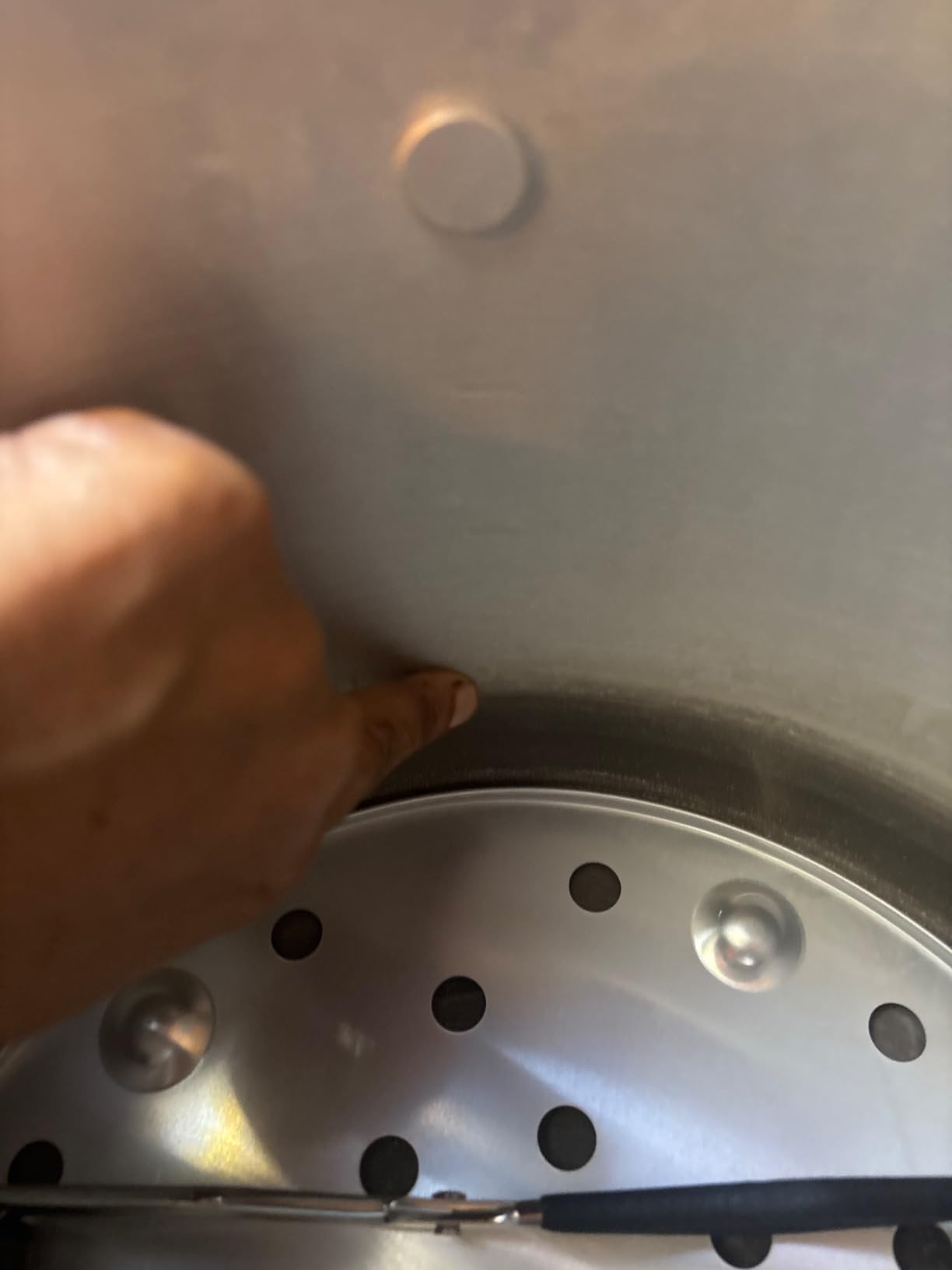
Is 16 quarts too small to be worth buying
For one or two people, 16 quarts is closer to right than oversized. A load of beans or greens that a 23-quart canner processes in one pass can take a full afternoon here, and a large canner mostly means more food than you can eat before it goes past peak. Undersized is worse, though, if you are processing soups and stocks where a bigger pot means fewer batches of liquid.
Because it is the lightest unit in the roundup at 10.5 pounds empty, this is also the easiest to lift full, and lifting full glass is the injury that actually sends people to urgent care.
What the weighted gauge asks of you
Pressure is held by a weighted regulator, so the only active job is keeping the flame steady and watching for the weight to rock. The vent-and-lock sequence has to be timed rather than eyeballed, and that is the step beginners most often rush.
The aluminum body is the other constraint. Keep tomatoes and vinegar-based recipes out of it, and accept some discoloration as a sign the canner is being used. If you can mostly fruit, pickles or jam, this is more than you need and our water-bath reasoning below applies instead.
8. All American 910 10.5-Quart Pressure Cooker/Canner – Best for Gasket-Free Canning
All American 1930: 10.5qt Pressure Cooker/Canner (The 910) – Exclusive Metal-to-Metal Sealing System – Easy to Open & Close – Suitable for Gas, Electric, or Flat Top Stoves – Made in the USA
9.94 liter capacity
About 7 pint or 4 quart jars
14.8 pounds empty
Made in the USA
Pros
- Metal-to-metal seal
- nothing consumable
- Gasket-free design removes the top failure point
- Audible weighted regulator
- Highest owner ratings in the group
- Compact body fits more kitchens
- US-made with readily available parts
Cons
- Heavy when loaded
- load and unload on the stove
- Lid can stick at zero pressure if opened slowly
- Aluminum reacts with acidic or vinegar foods
- Higher cost than entry-level canners
The 910 is the same gasket-free design as the 915 in a smaller body, and it carries the same gauge, weight and clamping knobs. That shared hardware is the argument for buying from this brand at all: parts, service and manual design stay consistent across the range, which is what makes a canner viable as a decades-long tool rather than a kitchen appliance.
Capacity is about 7 pint jars or 4 quarts. At 10.25 inches square and 11.75 inches tall it is the most compact unit in this roundup, and it is the practical choice for a small kitchen where a 22-quart body would dominate the counter.
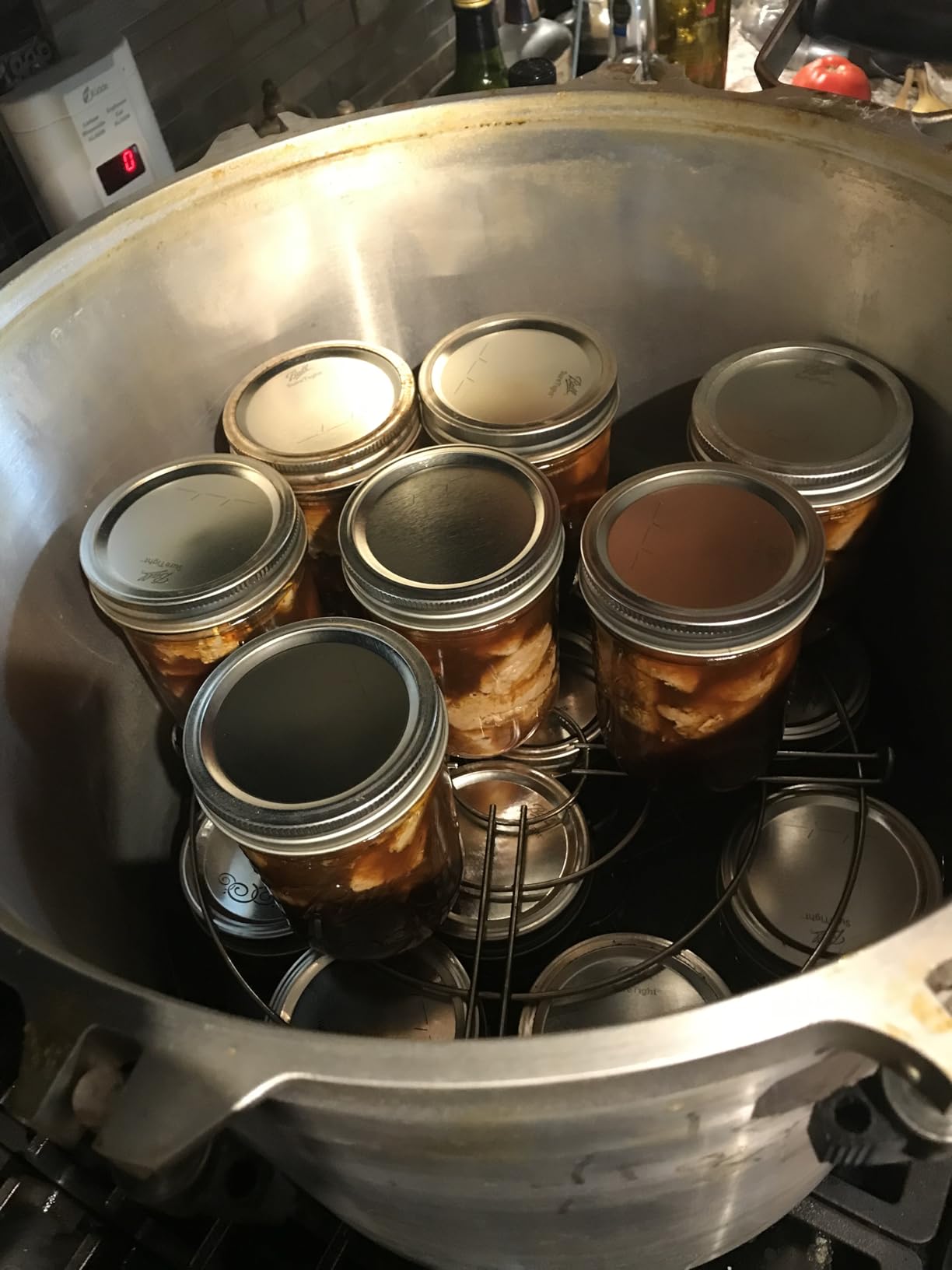
Owner ratings here are among the highest in the group, and the language in those reviews is telling, with experienced canners describing it as built like a tank. The audible weighted regulator gives a clear, repeatable signal without watching a gauge, and the detailed printed manual doubles as both a pressure-cooking and canning cookbook, which matters more than it sounds when you are learning process times alone at home.
It also pressure cooks for 15 or more people, so for anyone who wants a serious cooking pot and a canner in one footprint, the two functions share the same metal-to-metal body rather than a gasket-seated insert.
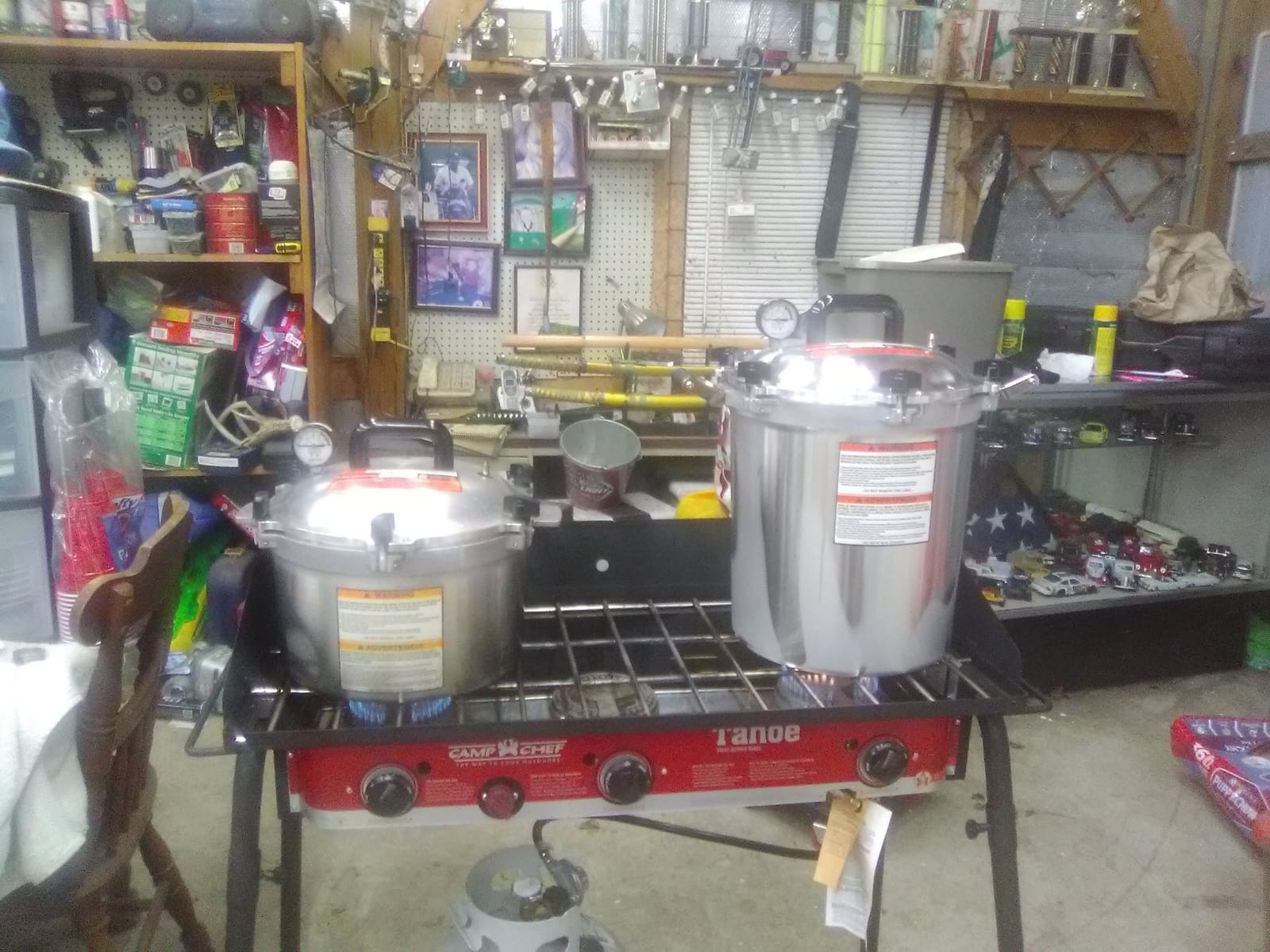
How small is too small for pressure canning
Four quarts is a real batch, and for one or two people it is often a full week of beans or a couple of sessions of stock. The limiting factor is not capacity so much as surface area, since a smaller canner takes proportionally longer to come up to pressure and releases it more slowly afterward. Plan your cool-down time into the evening rather than assuming it is instant.
Below about four quarts the jar options get awkward, so this is about the floor for pressure canning rather than a step below it. For boiling-water canning of fruit, the smaller size is perfectly reasonable.
Who should buy the larger 915 instead
Buy the 15.5-quart 915 if you are a family putting up a season of food, roughly double the output per load for the same design philosophy. The 910 is the right pick when the constraint is kitchen space or when the canner is a second unit alongside a larger one, since the identical parts and sealing system mean you can move between them without relearning anything.
Keep acidic and vinegar-based recipes out of the aluminum either way, and lift the lid promptly at zero pressure so the seal does not lock.
Do You Actually Need a Pressure Canner? Water Bath vs Pressure
You need a pressure canner only for low-acid foods, and if your list does not include any of those, skip this purchase entirely. A boiling-water canner is cheaper, smaller, faster and far easier to learn on, and it is the right tool for the majority of what a first-time canner wants to make.
High-acid foods, which means most fruit, pickles, relishes and properly acidified tomatoes, are safe to process in boiling water because the acidity itself prevents the growth of Clostridium botulinum. Low-acid foods, which means vegetables, beans, legumes, meat, poultry, seafood, soups, stocks and stews, need 10 to 15 PSI sustained long enough to destroy the spores. That distinction is the single most important thing to understand before buying anything.
Some people preserve both in a season, and there is no rule against owning a canner and a water-bath pot side by side. Several of the units in this roundup, including the Presto 01781, the Presto Digital and the NESCO NPC-9, double as boiling-water canners, which collapses the decision into a single purchase. If you are processing at a scale beyond jars, a separate look at [retort systems for canning](https://battleofsoho.com/best-retort-systems-for-canning/) is worth it, though that is a different commitment.
One thing never to do is use a standard pressure cooker or a multi-cooker for low-acid canning. These vessels are not built or tested to hold canning pressure for a full processing cycle, and the risk is botulism in a sealed jar, which is the one outcome where being wrong is genuinely dangerous.
Electric vs Stovetop Pressure Canners: Which One Should You Buy?
Choose electric if your main worry is control, if you do not want a heavy vessel on a glass cooktop, or if you live at altitude and want the canner to handle the adjustment. Choose stovetop if you want lower upfront cost, larger batches, and a process you control by hand.
The comparison comes down to capacity and attention. Stovetop canners in this roundup run from 4 to 7 quarts per load and beyond, while the electric units here are smaller and automatic. A stovetop batch needs a steady flame and a vent routine; an electric cycle needs a countertop outlet and patience through a programmed sequence.
About the electric safety debate: claims that no electric pressure canner is tested safe circulate in forums without citation, and the resolution is to verify the listing for the specific model rather than accept either side of the argument. There is also a kitchen-comfort factor that gets overlooked, since a stovetop boiling-water canner heats a room on a summer afternoon, while the electric units run cooler.
For a large garden or a household that cans 200 jars a year, stovetop capacity wins and the answer is straightforward. For one or two people testing the hobby, an electric unit’s smaller batch is a feature rather than a limitation.
Dial Gauge vs Weighted Gauge: The Simplest Choice for Beginners
For a beginner, a weighted gauge is simpler, because it holds pressure by its own weight and there is nothing to calibrate or interpret. A dial gauge shows you the pressure reading and lets you adjust for altitude, which is more precise and more useful above 1,000 feet.
The two often appear together. The Presto 01781 is a weighted-gauge canner with a deluxe dial that reads the full processing range, so you get the simplicity of the weight plus a way to verify what is happening. That combination is why it is our overall pick.
Electric units replace the gauge entirely with a temperature sensor and a programmed cycle, which is the least hands-on option and also the one that handles altitude automatically. The trade for all of these is that you give up direct feedback in exchange for not having to manage anything.
One point of confusion worth clearing up: a canner with a single 10 PSI weight is still a genuine weighted-gauge pressure canner. The number of settings changes flexibility, not legitimacy. What matters is that the canner is listed and tested for pressure canning at the pressure your recipe requires.
What to Look for When Buying a Pressure Canner
Start with the certification, because a real canner and a lookalike pressure cooker can be nearly impossible to tell apart from a photo. The canner should be listed for pressure canning by a recognized testing body, and the manual should say so plainly. This is the single factor separating a safe purchase from a risky one.
Second, look at the seal. A gasket-seated lid is cheaper and easier to find parts for, but it is a consumable that will need replacing. A metal-to-metal seal costs more up front and has no wear part in the pressure path, which is the argument enthusiasts make for buying one of those units and keeping it indefinitely.
Third, check capacity against your real output rather than the marketing quart figure, and look for the actual jar count per load. A 20-quart canner that holds four quarts of food means more batches than a 16-quart unit that holds seven. Fourth, confirm cooktop compatibility, since glass tops and induction put real limits on what a heavy aluminum pot can sit on.
Fifth, weigh it. A loaded canner with glass jars is the heaviest thing in most kitchens, and a unit you dread lifting gets used less. Sixth, check that replacement parts and gaskets are still sold, because a canner you cannot service in ten years is a canner you replace. Seventh, look at altitude handling, which matters above 1,000 feet and is often not mentioned in the product copy.
Eighth, and this is the one beginners miss: confirm the canner doubles as a boiling-water canner if you plan to do fruit or pickles. If it does not, you are buying a second vessel later.
What Size Pressure Canner Do You Need?
Match the canner to your household and your garden, not to the biggest number available. A 10.5 to 16-quart canner suits one or two people, roughly 4 to 7 pints and 4 quarts per load. A 20 to 23-quart canner suits a family of four or a serious garden, and holds 18 to 20 pints or 7 quarts.
The failure mode for beginners is a canner that is too small, because it turns a single afternoon of work into three evenings of monitoring. The opposite failure is a canner so large that a full load of glass is genuinely unsafe to lift, and we have seen that conversation repeated constantly in beginner threads.
For a glass cooktop or an induction hob, the weight question is the first filter. Heavier canners with wide flat bases distribute heat more evenly and reduce the warping risk that comes from uneven heating. Electric units sidestep the problem entirely.
What Else You Need for Your First Canning Season
The canner is the easy part. You also need standard mouth Mason jars and two-piece lids in the sizes your recipes call for, a canning rack if one did not come with your unit, a jar lifter, a funnel, headspace measures, a bubble remover and a clean damp cloth for the sealing surface.
For tested recipes, use the Ball Blue Book of Preserving and treat the National Center for Home Food Preservation as the reference when a recipe is not in it. Untested recipes in forums and social posts are the most common source of failed seals and, more seriously, of unsafe low-acid processes.
Keep extra lids on hand, since a single dinged or bent lid ruins a jar, and never reuse a lid that did not seal cleanly. Our guide to the [best canning kits for home preserving](https://battleofsoho.com/best-canning-kits-for-home-preserving/) covers the full starter list if you would rather buy it in one order.
Budget for a gasket replacement every few years if you buy a gasket-sealed canner, and for spare canning racks. Neither is expensive, but both are easier to have on a shelf than to order mid-season.
Buying a Used Pressure Canner: A Vetting Checklist
Second-hand canners are common at flea markets and yard sales, and the savings are real, but the checklist is not optional. If you cannot inspect a unit properly, the risk is not worth the money.
Check the pot body for warping, dents or a rim that sits unevenly on a flat surface, since a warped canner heats unpredictably. Inspect the sealing surface for pitting or corrosion, and look for the safety release plug, which must be present and intact. Confirm the gauge, if the canner has one, was not dropped, and that the weight and vent are the correct parts for that model rather than a substitute.
The most important check is documentation. Look for a model number you can research, because parts and manuals differ across generations, and a canner you cannot identify is a canner you cannot service. If a manual is not available, find the model number before you buy and download the correct one afterward.
Once home, run the canner empty with water through a full cycle before you trust it with food. If it does not come up to pressure, holds it, or vents cleanly, stop and find out why. A warped pot and insufficient water are the two causes that appear most often in beginner accounts of canners that misbehaved.
Frequently Asked Questions
What is the best pressure canner for a beginner?
The Presto 01781 23-Quart is our top pick for a first canner because it holds 26 half-pints, 20 pints or 7 quarts per load, weighs 12 pounds empty, and pairs a weighted regulator with a deluxe dial gauge that reads the full pressure range. A smaller kitchen is better served by the 16-quart Presto 01755, and anyone who refuses to maintain gaskets should look at the metal-to-metal All American models.
Is there a pressure canner that doesn’t require a gasket?
Yes. The All American 915 and 910 both use a metal-to-metal sealing system with no rubber gasket anywhere in the pressure path, so there is no seal to replace on a maintenance schedule. The trade is a higher upfront cost and an aluminum body that should stay away from acidic or vinegar-based foods. The 915 holds about 10 pint or 7 quart jars, and the 910 holds about 7 pint or 4 quart jars.
Can any pressure cooker be used as a canner?
No. Only a vessel that is listed and tested for pressure canning should be used for low-acid foods. Standard pressure cookers and multi-cookers are built to cook food quickly, not to hold 10 to 15 PSI for a full 60 to 90 minute processing cycle, and using the wrong vessel risks botulism in a sealed jar. Check the National Center for Home Food Preservation and Cooperative Extension guidance, and confirm the specific model is approved for pressure canning.
What size pressure canner do I need?
One or two people are well served by a 10.5 to 16-quart canner holding roughly 4 to 7 pints or about 4 quarts per load. A family of four or a large garden needs a 20 to 23-quart unit that holds 18 to 20 pints or 7 quarts. Electric models here are the exception, with the NESCO NPC-9 holding about 4 quart or 5 pint jars per cycle.
Is an electric pressure canner better than a stovetop one?
Electric is better for repeatability, altitude handling and avoiding a heavy pot on a glass cooktop, and the Presto 02152 and NESCO NPC-9 both run programmed cycles with temperature sensing. Stovetop models hold larger batches, cost less, and let you control heat directly. Electric units trade batch size for automation, so a large garden is better served by a stovetop canner.
The Bottom Line: Which Pressure Canner Should You Buy First?
Start by deciding whether you need one at all. If your list is jam, pickles and fruit, buy a water-bath canner instead and save yourself the learning curve. If vegetables, beans, meat or soups are on the menu, the Presto 01781 23-Quart is the canner we recommend most often, because it pairs the largest jar capacity in this roundup with a genuine dial reading and the longest warranty, at 12 pounds it is still one of the lighter units to lift.
Buy the All American 915 or 910 if you want a metal-to-metal seal and never think about a gasket again, the Presto 01755 if cabinet space is the constraint, the NESCO NPC-9 or Presto 02152 if you want the canner to run itself and you live at altitude, and the T-Fal 22-Quart if you want maximum capacity with a built-in adjustable weight. Whatever you choose, verify the pressure canning listing before your first batch, use tested recipes, and give the cool-down the time it needs.
Whichever one you start with, the best canning pressure cookers for beginners are the ones you will still be using in ten years, so buy for capacity you can lift and parts you can still source. That is the same shortlist we would hand a friend in 2026, and it has not changed much in years.