
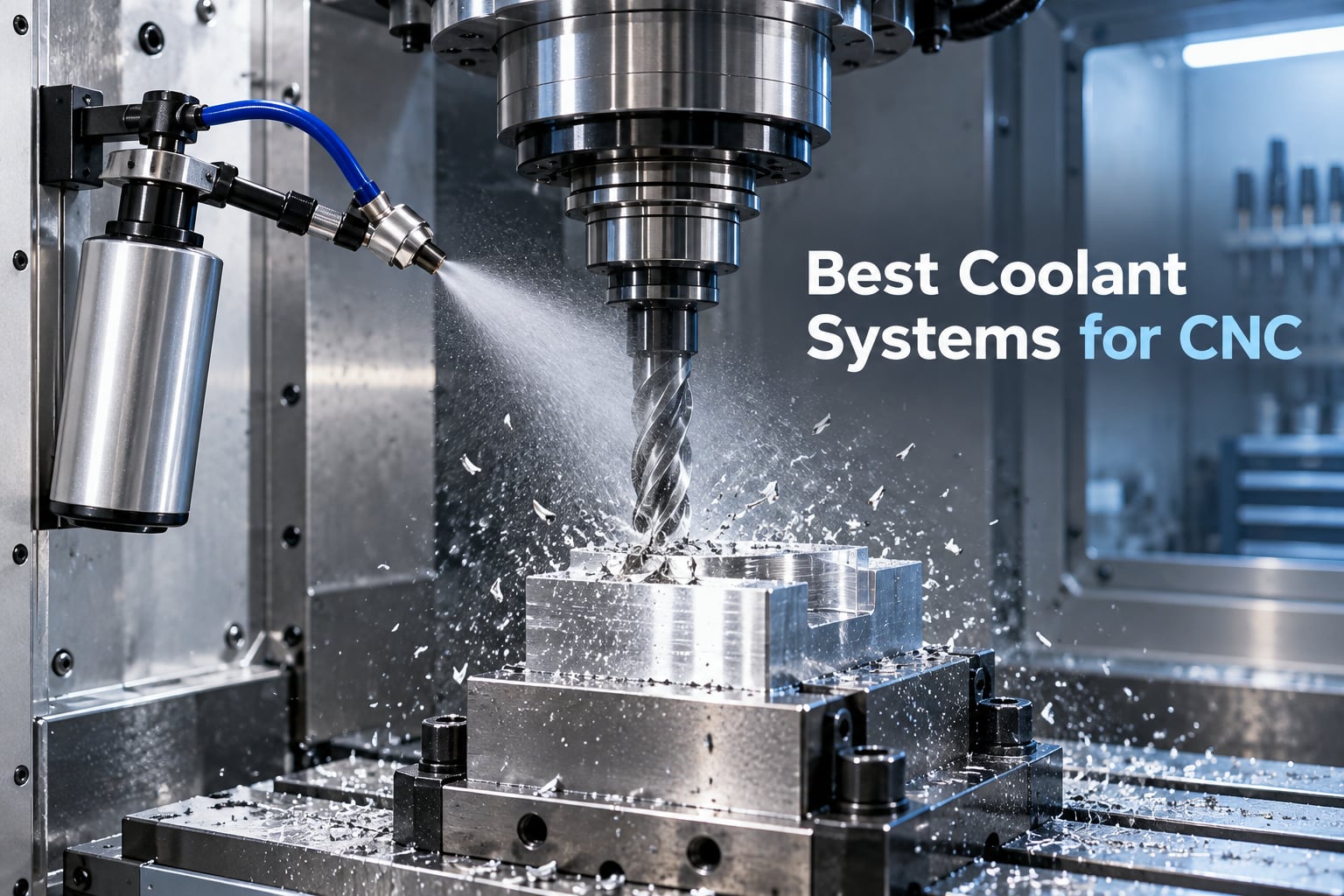
Most pages answering this question are not answering it at all. They explain coolant fluid chemistry while the thing you actually click Buy on is a coolant system: a pump, tank, air line or high-pressure plumbing, nozzle, and filtration that decides whether fluid reaches the cutting edge at all.
We spent weeks sorting through the market for the best coolant systems for CNC machines, and the honest answer is that the systems divide into three distinct families. Air-driven mist systems handle aluminum, light cutting, and small machines. Pumped tank systems handle lathes, drill presses, and shop floors where a mist bottle is not enough. Through-spindle and high-pressure systems are a factory-scale upgrade that most retrofits cannot support. Which family you need is decided by your material mix and your machine’s plumbing, not by a headline pressure number.
Below is a ranked list of ten real systems, the pressure bands machinists actually use, and a straight answer for who should skip each one. If you are outfitting a whole shop rather than one machine, our [coolant exchange machine roundup](https://battleofsoho.com/best-coolant-exchange-machines-for-shops/) covers the sump side of the same decision.
One warning before we start, because it is the most common mistake we see. Mist systems need fluid made for misting. Putting an ordinary flood coolant or straight water into a mist pump produces a shower, not a lubricating atom. CNCZone regulars make this point constantly, and it saves people the whole system.
Table of Contents
Top 3 Picks for the Best Coolant Systems for CNC in September

OriGlam Sealed Mist Spray System
- Sealed mist line resists kinks
- Adjustable air and mist volume
- Cools lubricates and blows chips
- 5-7 KGF/CM2 air pressure

BACHIN Gooseneck Mist System
- Flexible gooseneck with brass nozzle
- Integrated oil-water separator
- Works with water coolant or oil
- Universal machine fit
CNZG PNEU Aluminum Mister
- Aluminum body with no moving parts
- Separate air and liquid valves
- 1/4 inch air inlet and 4 mm pickup
- Magnetic base included
All 10 Best Coolant Systems for CNC in 2026
Everything below is an air-driven mist system except the last entry, which is a pumped tank cooler. Pressure is the real separator between them, and the price gap is bigger than most people expect.
| Product | Specifications | Action |
|---|---|---|
| OriGlam Sealed Mist Spray System |
|
Check Latest Price |
| BACHIN Gooseneck Mist Lubrication Kit |
|
Check Latest Price |
 Eldwviz 8mm Air Pipe Mist Spray Eldwviz 8mm Air Pipe Mist Spray |
|
Check Latest Price |
 OriGlam All-In-One Mist Sprayer OriGlam All-In-One Mist Sprayer |
|
Check Latest Price |
 ChgImposs Mist Kit with Check Valve ChgImposs Mist Kit with Check Valve |
|
Check Latest Price |
 Walfront Magnetic Base Mist System Walfront Magnetic Base Mist System |
|
Check Latest Price |
| CNZG PNEU Compact Aluminum Mister |
|
Check Latest Price |
 ChgImposs 1.5m Mist Assembly ChgImposs 1.5m Mist Assembly |
|
Check Latest Price |
 QWORK CNC Mist Spray System QWORK CNC Mist Spray System |
|
Check Latest Price |
 Vertex 3-Gallon Coolant Pump Kit Vertex 3-Gallon Coolant Pump Kit |
|
Check Latest Price |
What a CNC Coolant System Actually Does
A coolant system has exactly three jobs, and every spec on every listing exists to serve one of them. It removes heat from the cutting edge, it provides lubricity so the edge does not rub and weld to the workpiece, and it clears chips out of the cut. If a system does not deliver fluid to the cutting edge, it is an air blower with a bottle attached.
Those three jobs break into three delivery methods, and this is the single clearest way to sort the market. Flood systems wash the cut with bulk fluid from a tank. Mist and MQL systems atomize a small amount of oil into an air stream and aim it with a nozzle. Through-spindle and high-pressure systems force fluid through the tool itself, often at up to 1,000 PSI, to break chips at the point of cut and reach heat that flood cannot.
The pressure ladder matters, and machinists quote it constantly. Flood systems sit somewhere around 50 to 150 PSI. Mid-pressure systems run 250 to 300 PSI. Factory high-pressure systems reach 1,000 PSI. One machinist on Practical Machinist calls 250 PSI the absolute minimum for a job that needs real coolant pressure, and HomeShopMachinist posters describe anywhere from 300 to 1,000 PSI as the practical band.
What that buys you is chip breaking. Shops report tool life figures in the two-to-three-times range when high pressure is added, though that is a shop result rather than a universal law. The more defensible claim is that higher pressure gets fluid under the cutting edge where a flood nozzle physically cannot aim.
Flood vs Mist: The Mess and Cleanliness Trade-Off
Flood and mist are not competing on capability so much as on mess. Flood moves bulk liquid, so it soaks the enclosure, carries swarf into the ball screw ways, pools on the floor, and makes noise. Mist moves very little fluid, so the machine stays dry and the shop stays quiet, but the fluid that does land evaporates and hangs in the air as an oil aerosol.
Mess is the complaint that dominates every machinist forum thread on this topic, and it is why shops drift toward MQL. It is also why MQL has a hard boundary. HMN Tool puts it plainly: MQL works well for semi-finishing, but for heavy roughing or interrupted cuts flood coolant remains superior for heat dissipation and chip evacuation. Mist lubricates an edge. Flood pushes heat and chips away.
Two metrics decide a mist purchase more than any pressure figure. The first is sump life. CNCZone users report that a single gallon of proper mist fluid lasts for years of hobby use. The second is odor. A r/Machinists user on QualiChem XTREME CUT 250C praises it specifically because it does not stink at all, ever, and the sump lasts a very long time.
Noise gets mentioned for a reason people rarely admit. A pump and tank running next to a machine is a constant hum that a quiet mist system simply does not produce, and in a small shop that changes how willing people are to keep coolant running.
What Is Not a CNC Coolant System
Shopping results for this keyword surface PC liquid cooling units, including a computer water-cooling system that appears alongside real mist kits. A PC loop circulates coolant to a CPU block. It has a radiator, a pump, and a reservoir, and none of those parts put fluid on a cutting tool. Buying one for a mill is a wasted afternoon.
A spindle water-glycol loop is the same trap in a different outfit. It circulates chilled fluid through a closed loop inside the spindle to control thermal growth, and it is valuable, but it never touches the workpiece. If your problem is heat leaving the tool, that loop is not the answer.
Our [CNC plasma table guide](https://battleofsoho.com/best-cnc-plasma-tables-for-metal/) covers a different shop upgrade, but the same rule applies: the peripheral has to solve the problem you actually have.
1. OriGlam Sealed Mist Spray System – The Most Proven Mist Setup on the Market
OriGlam Mist Coolant Lubrication Spray System for Metal Cutting Engraving Cooling Sprayer Machine for Air Pipe CNC Lathe Milling Drill
Fully sealed mist line
Adjustable air and mist volume
5-7 KGF/CM2 air
180 g body
Pros
- Sealed air line resists leaks when bent
- Adjustable airflow and mist volume
- Doubles as a chip blower for cleaner work
- Works with plain unpressurized liquid
- Highest review count in the group
Cons
- Needs an external compressor at 5-7 KGF/CM2
- Mist consistency depends on reservoir height
This is the system we kept coming back to. The headline is not a clever feature, it is the review count. Just over a thousand reviews at a 4.5 average with a 74 percent five-star share is a much larger body of field evidence than anything else in this roundup, and for a cheap air-driven device that matters more than a spec sheet.
The design is genuinely good. Air is sealed inside the pipe rather than pushed through a joint, so the line does not leak at the contact surface when you bend it to reach a tool. That sounds minor until you have routed a mist line around a lathe ways and watched it weep coolant onto the enclosure.
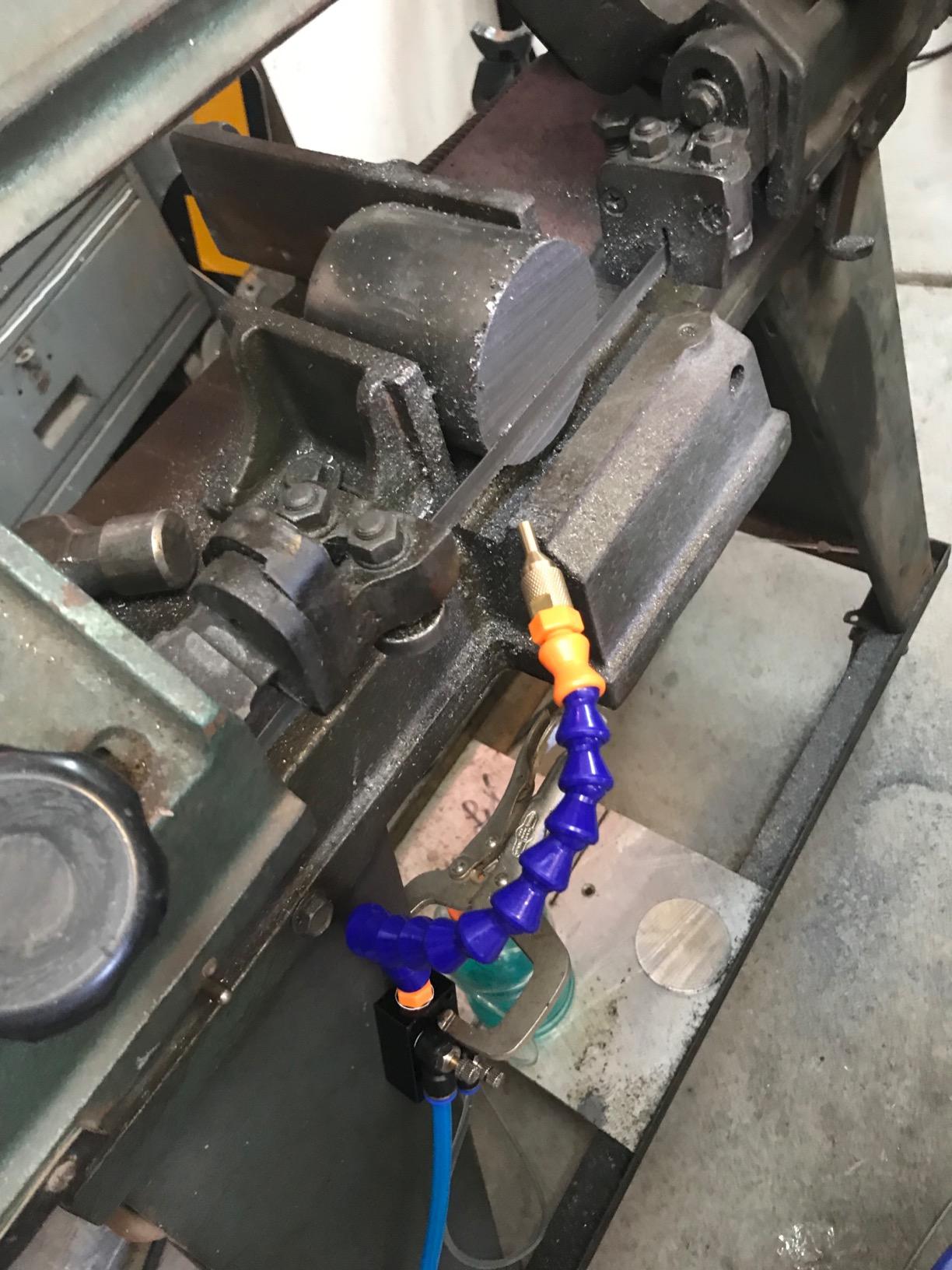
What it actually does at the cut is three jobs in one body. It cools, it lubricates, and it blows the chips away, which means you can see your work instead of fishing for it in a chip cloud. Airflow and mist volume are both adjustable, and the 180 g body is light enough to reposition with one hand.
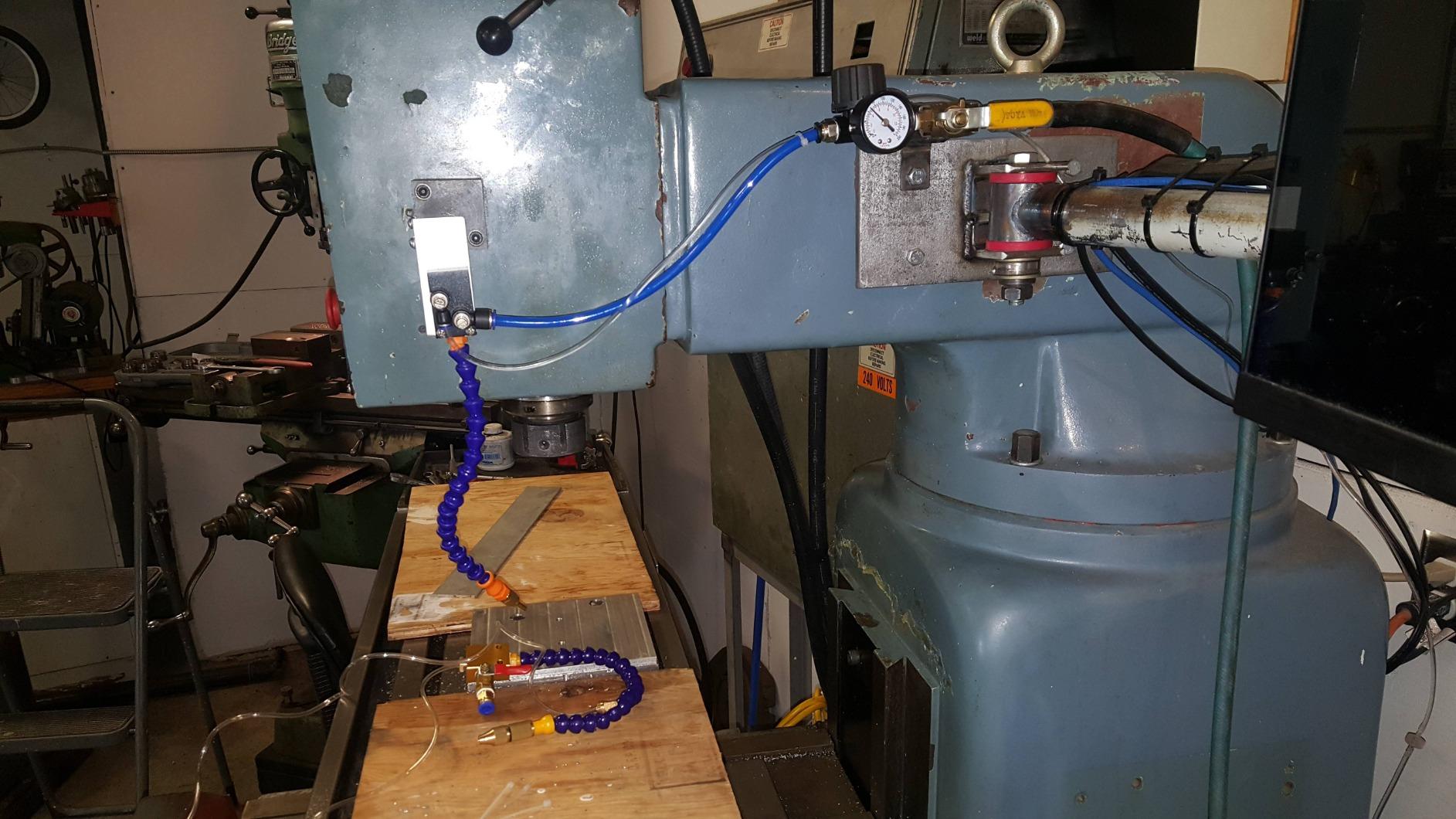
Setup advice from owners is consistent and worth repeating. Swap the supplied fitting for a standard quick-connect, mount the reservoir at roughly nozzle height so suction is reliable, and add a small regulator if your compressor will not hold pressure. Mist quality degrades fast when the fluid source sits well below the nozzle.
Who this suits
If you are cutting aluminum, mild steel, or doing engraving and general milling on a small CNC, this is the lowest-risk way to add coolant. The chip-blowing function alone earns its place on small work where you need to see the cut. It also runs on unpressurized liquid, so a plain bottle works.
Who should skip it
Skip it if you do not already have a compressor delivering 5 to 7 KGF/CM2 at the machine, because the unit is air-driven and the compressor is not included. Also skip it for deep-hole drilling or interrupted roughing in tough alloys, where you need flood volume rather than a lubricating atom.
2. BACHIN Gooseneck Mist Lubrication Kit – Best Reach and Best Fluid Flexibility
BACHIN Mist Coolant Lubrication System, Flexible Hose Oil-Water Separator Spray Unit, Adjustable Mist Nozzle for Drill Press, Lathe, CNC, Milling Machine, Metal Cutting Cooling Tool
Flexible gooseneck hose
Brass adjustable nozzle
Integrated oil-water separator
0.19 kg
Pros
- Gooseneck reaches awkward tool positions
- Brass nozzle gives fine mist control
- Oil-water separator resists clogging
- No complex plumbing required
- Accepts water-based coolant cutting oil or alcohol
Cons
- Compressor and reservoir sold separately
- Metal and brass parts add weight
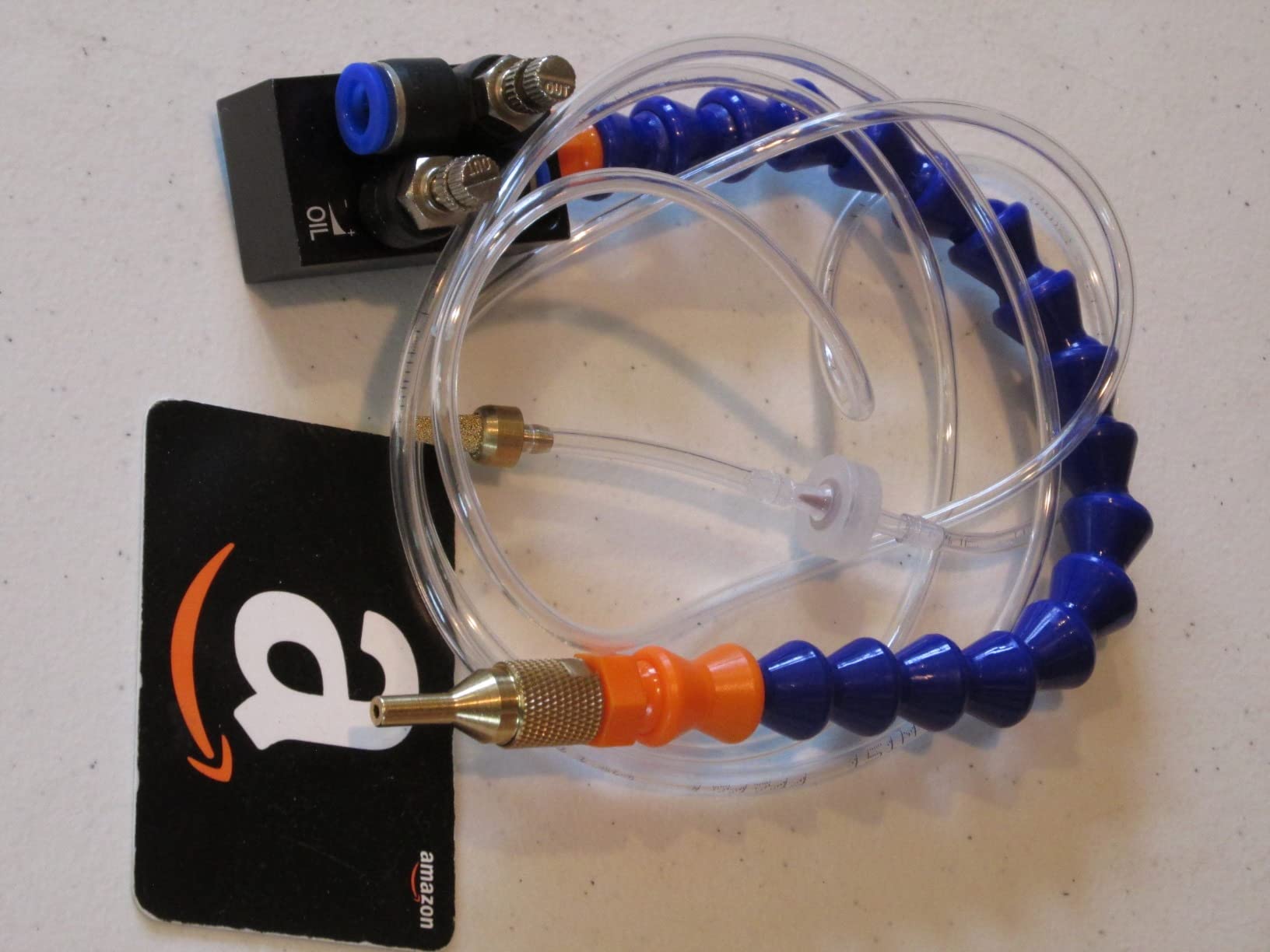
The gooseneck is what separates this from the bottle-style misters. On a lathe or a vertical mill, the difference between a nozzle that reaches under the turret and one that points vaguely at it is the difference between coolant at the cut and coolant on the swarf. Buyers single this out first in reviews.
The integrated oil-water separator is the second thing worth understanding. It sits in the air path and keeps the airflow and fluid delivery stable, which is why the mist does not sputter and why the nozzle is less prone to clogging after a few hours of running.
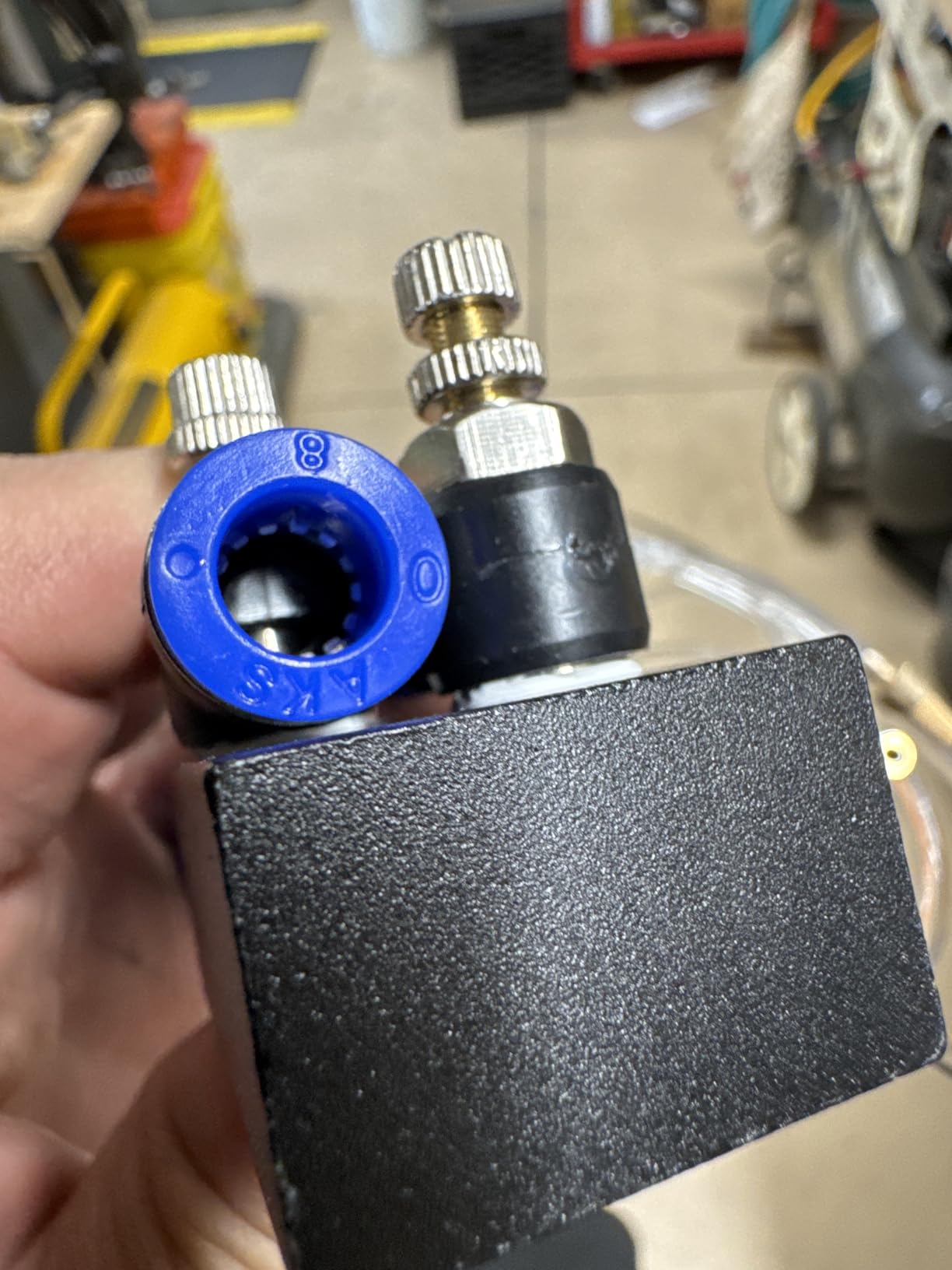
Fluid flexibility is the quiet advantage here. It runs on water-based coolant, cutting oil, or alcohol, so you are not locked into a proprietary mist fluid. Some users run it with the coolant port blocked and use it purely as a directed air blast when compressor capacity is limited, which is a legitimate trick for dry cleanup work.
At 345 reviews and a 4.4 average with a 70 percent five-star share, the feedback is mature and consistent. The recurring setup advice is the same as on every unit in this class: connect to a compressor, mix your fluid in a reservoir, and keep that reservoir near the level of the mister.
Who this suits
This is our pick for anyone whose cuts are hard to reach, which in practice means most CNC lathes and older manual lathes with a retrofit mist line. The brass nozzle also gives finer mist control than plastic-bodied units when you are chasing a specific finish on aluminum parts.
Who should skip it
Skip it if weight matters. At 0.19 kg with metal and brass components, this is a mounted system rather than something you will pick up and move constantly. It also will not substitute for flood in heavy roughing.
3. Eldwviz 8mm Air Pipe Mist Spray – Best Brass Hardware on a Small Budget
Eldwviz Mist Coolant Lubrication Spray System For 8mm Air Pipe CNC Lathe Milling Drill 1
Rotatable adjustable nozzle
Brass metal and plastic body
8 mm air line hookup
0.11 kg
Pros
- Brass and metal hardware at a budget tier
- Rotatable nozzle with adjustable mist
- Blows chips clear of the cut
- Handles carbide tooling and stone
- Quick-connect retrofit is easy
Cons
- Needs a regulator and fittings to install
- Mist weakens if reservoir sits low
- Some arrived with a blocked pickup
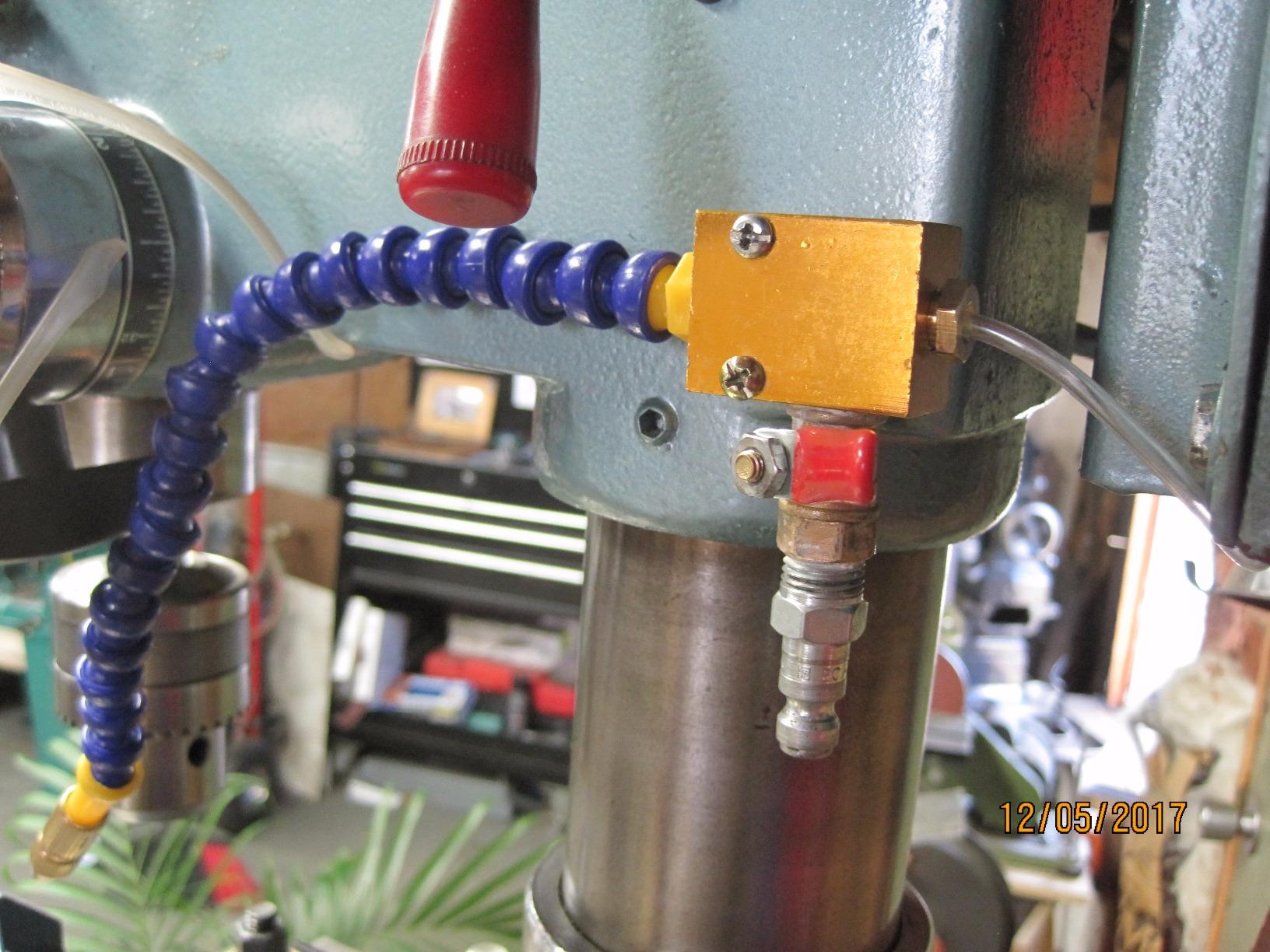
This unit is interesting because it puts brass and metal where cheaper misters put plastic. The nozzle assembly is rotatable and both atomizing air and coolant output are adjustable, so you can dial in a mist that coats the flute instead of fogging the whole chamber.
Owner feedback is practical and honest. Most people replace the 8 mm fitting with a standard male quick-connect, add a regulator, and mount the reservoir near nozzle height. Once those three things are done, reviewers report it performs like far more expensive models. One buyer used plain water, another used heavily diluted soluble oil, both successfully.
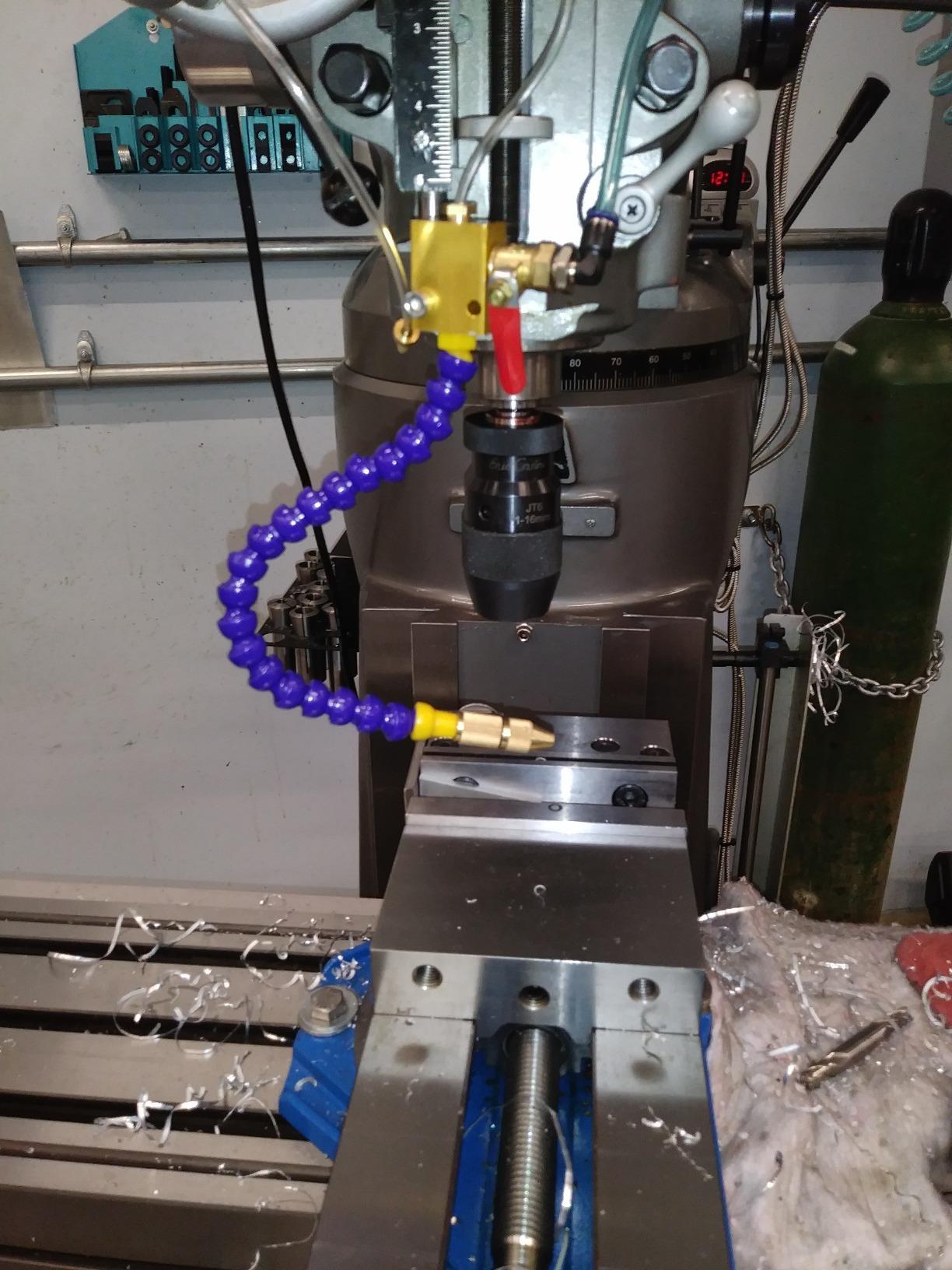
At 0.11 kg it is the lightest body in the group, which matters if you are hand-positioning the mist over a small workpiece. The listed maximum pressure figure of 99.56 psi refers to the air line handling, not a fluid delivery rating, so do not read it as a coolant system pressure spec.
The honest weakness is quality control at the budget tier. At least one buyer received a unit whose brass pickup piece had no through-hole and whose hose leaked air at the fitting. That is a manufacturing inconsistency rather than a design flaw, but it is the kind of thing that costs you an afternoon.
Who this suits
A hobby machinist or small shop that wants durable metal hardware without moving up a tier, and works on carbide tooling or engraving where a fine, tight mist matters. The rotatable nozzle also helps on multi-axis work where the cut moves around the part.
Who should skip it
Skip it if you are not prepared to add a regulator, tubing, and push fittings, because the install is not turnkey. Anyone with a hard water supply or a need for filtration should also look elsewhere; this is a minimal system with no filtration stage.
4. OriGlam All-In-One Mist Sprayer – The Cheapest Way to Add Any Lubrication at All
OriGlam Mist Coolant Mist Lubrication, Spray System Unit Used for CNC Lathe Milling Drill Machine
Cooling lubrication and chip blowing
Rotatable spray head
150 g body
14.76 x 5.51 x 7.09 in
Pros
- Lowest entry point in the roundup
- Three functions in one body
- Rotatable spray head is easy to reposition
- Standard mounting hardware included
Cons
- Basic rather than precision fit
- Mist quality and durability trail the higher-rated units
We include this one because the honest question for a lot of readers is whether adding coolant to a manual mill or small CNC is worth doing at all. At this tier, the answer is yes, because the downside is a few dollars and the upside is a visible difference in finish on aluminum.
The body combines cooling, lubrication, and chip blowing in a single unit with a rotatable spray head, so you can aim it without moving the whole body. It is listed for lathe, milling, grinding, drilling, boring, and tapping work, which covers most of what a small shop does.
Reviewers are realistic about what they get. At a 4.2 average with a 60 percent five-star share, the praise centers on price and the combined function, while the lower reviews describe a more basic nozzle and mounting system than the brass-and-hose competitors here. That is an accurate description of the class.
Be aware of what you are not buying. There is no check valve, no built-in filter, and no separate air and mist control. You get a working mister, not a tunable one.
Who this suits
Anyone who barely uses their machine and wants coolant available without committing to sump maintenance or a tank. It suits light aluminum work, drilling, and tapping on manual or small CNC equipment where chip visibility matters.
Who should skip it
Skip it if you plan to run it all day. The durability reports on this body are thinner than on the metal-hose units, and the single-knob adjustment will frustrate anyone chasing repeatable finishes across multiple setups.
5. ChgImposs Mist Kit with Check Valve – Best Metal Hardware and Filtration
ChgImposs Mist Coolant Lubrication Spray System with Check Valve & Metal Nozzle, 1.5m Flexible Tube Cooling Kit for CNC Lathe Milling Drill Engraving Machine
Check valve and built-in filter
Separate air and mist knobs
Metal pipe plus 1.5 m tube
320 g
Pros
- Only system here with a check valve and filter
- Independent air and mist controls
- Metal parts resist heat and corrosion
- Good reach from the 1.5 m tube
Cons
- Heaviest body in the group at 320 g
- Requires coolant under 68 cSt viscosity
- Demands 5-7 kgf/cm2 air
This is the only system in the roundup with two features that matter more than they sound: an integrated check valve that prevents backflow, and a built-in filter that keeps the spray clean. Both exist because heat and cutting fluid eventually attack cheap plastic internals, and both extend service life in a way the bottle-style units cannot match.
Control is genuinely better here too. Airflow and mist output have independent adjustment knobs, so you can change the air pattern without disturbing your fluid setting. Reviewers cite that as the reason the control feels better than simpler budget bodies.
The hardware is metal where it counts. A 420 mm flexible metal pipe plus a 1.5 m tube with an anti-rust metal nozzle gives you the reach and the heat tolerance that plastic tubing cannot. The listed requirement is air at 5 to 7 kgf/cm2 with coolant viscosity below 68 cSt.
At 4.4 stars across 70 reviews, the feedback is positive but thin. The consensus is that paying roughly twice what the plastic bodies cost is fair given the metal hardware and the valve.
Who this suits
Shops running a lot of cutting hours on one machine, or anyone whose previous misters died from heat and backflow. It suits lathes and mills where the unit is mounted permanently rather than repositioned constantly.
Who should skip it
Skip it if you need to hand-carry the mist to different setups. At 320 g it is the heaviest body here. Also check your fluid first: anything thicker than 68 cSt will not atomize properly through this nozzle.
6. Walfront Magnetic Base Mist System – Best Magnetic Mounting and Fast Repositioning
Adjustable Mist Coolant Spray System with Magnetic Base and 8mm Air Hose for CNC Lathe Milling Drill, Industrial-grade Threaded Nozzle and Precision Lubrication Control
Magnetic base positioning
Acetal copolymer body
Fits 8 mm air pipes
6.3 oz
Pros
- Magnetic base repositions in seconds
- Acetal body tolerates oil coolant
- Buyers compare flow favourably to costlier misters
- Compact and light
Cons
- Needs high airflow that can blow chips too far
- Some units leak air from the body section
- One variant has unusable flow control
The magnetic base is the point of this one. When you change a setup, you peel the mist off the machine and move it to a new position in seconds instead of unbolting a bracket. For a machine doing mixed work across a table, that convenience is worth more than another nozzle refinement.
The body is an acetal copolymer rated to handle oil coolant and cutting fluids day in and out, which is the correct material choice for something sitting inches from a splash zone. Buyers compare its flow favourably to misters costing several times more.
Now the honest part. At the airflow needed to atomize properly, this unit throws chips ten to fourteen feet. That is great for clearing a cut and poor for a shop where chips land in the coolant bottle. One reviewer also reports air leaking from the blue body section until the system is disconnected, and another found the flow control unusable for heavy spray.
Its claimed saving of up to 80 percent coolant versus flood cooling is a manufacturer figure, not an independent measurement, so treat it as directional. The general savings claim appears across this entire class of product for the same reason.
Who this suits
Mixed-work machines where you switch jobs and materials often, and shops that care about fast setup over fine mist adjustment. It works well on lathes with an exposed tool line and on small mills with a flat casting surface to mount against.
Who should skip it
Skip it in a confined enclosure or anywhere chips flying fourteen feet becomes a problem. If you need precise low-volume mist, the single-knob control will not give it to you. Check the flow controls before committing.
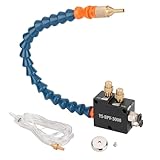
7. CNZG PNEU Compact Aluminum Mister – Best for Tight Machine Spaces
CNZG PNEU 1/4″ CNC Coolant Mister for Milling Machine Mist Spray System
Aluminum body with no moving parts
1/4 inch air inlet
4 mm oil pickup
Magnetic base and 1.5 m hose
Pros
- Compact body fits tight machine spaces
- Separate air and liquid valves
- No internal moving parts
- Magnetic base stronger than name-brand rivals
Cons
- 5/32 inch oil hose needs adapters
- Suction tube is short
- Mounting holes sit on the sides
This is the newest and most thoughtfully built system here. The body is machined aluminum with no moving parts inside, and reviewers make a point of saying they returned a name-brand mist unit and kept this one instead. The 4.5 average is on 40 reviews, so read that as strong early signal rather than proven longevity.
Two details matter for real installs. The air inlet is a 1/4 inch quick-connect, which is far more likely to match your shop air directly than an 8 mm push fitting. The oil pickup is a 4 mm line, which is genuinely too small for a typical US setup and will need adapters.
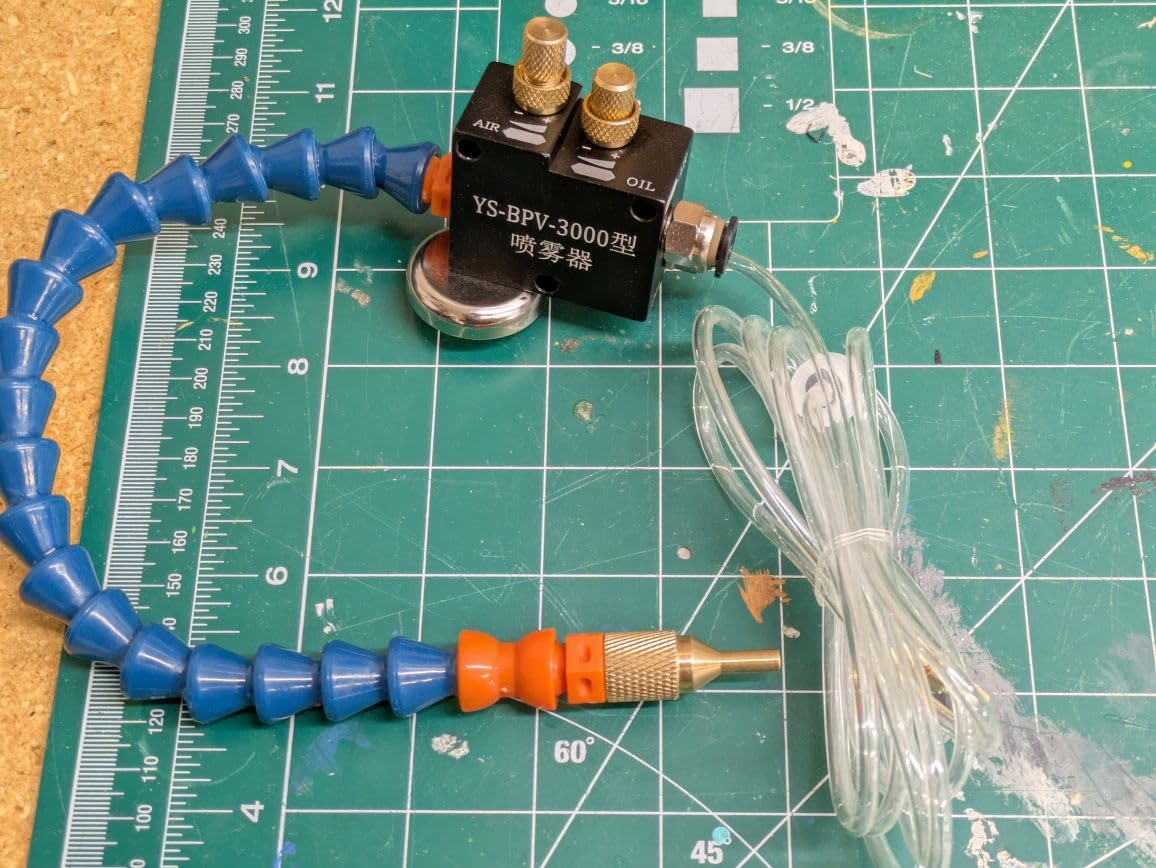
Independent air and liquid valves give the best control in this class, and one buyer put the extra fittings needed to adapt it to their shop at roughly fifteen dollars in parts. The included kit covers the mister, a magnetic base, and 1.5 m of 2.5 mm hose, so the adapter is the only thing you add.
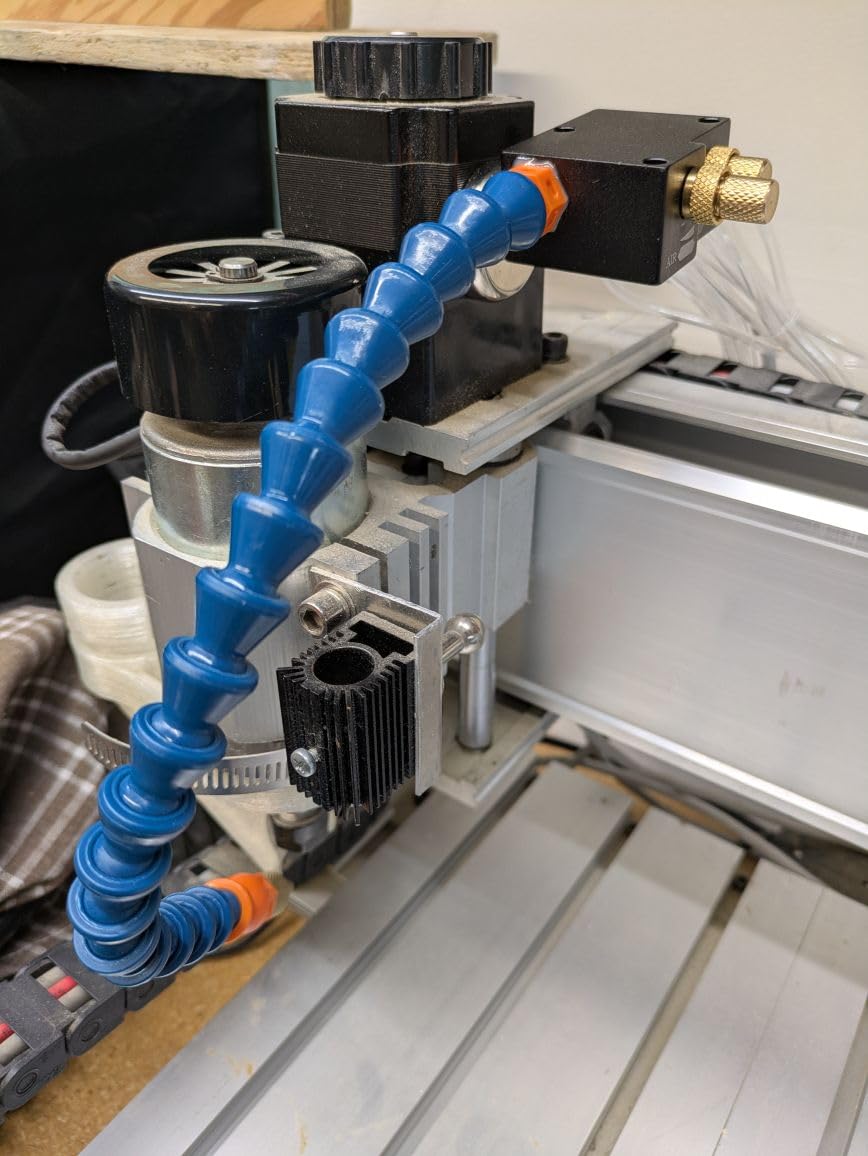
The clear tubing that runs into the coolant bottle is light enough to float, so weight it or route it so it stays down. The magnet mounting holes are on the sides rather than centered, which is awkward if your casting face is narrow.
Who this suits
Machining centers and Swiss-type cells where envelope space is genuinely tight, and anyone with 1/4 inch shop air who wants clean, repeatable mist control. It suits grinding, tapping, sawing, and router work as well as milling and turning.
Who should skip it
Skip it if you run 8 mm air lines already, because you will be adapting down rather than connecting. It is also a poor fit if your mist sits far from the machine, since the short suction tube limits how far below the nozzle your reservoir can sit.
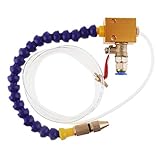
8. ChgImposs 1.5m Mist Assembly – Best for Long Reach and Non-Metal Work
ChgImposs Mist Coolant Lubrication Spray System, Engraving Machine Metal Cutting Fluid Cooling Sprayer with Quick Insertion Diameter 8mm Air Pipe for CNC Lathe/Milling/Drill Machine
1.5 m assembly with 350 mm tube
8 mm quick insertion
0.18 kg
5-7 KGF/CM2
Pros
- Long 1.5 m assembly gives real reach
- Easy to mount and aim
- Handles granite and tile as well as metal
- Low weight
Cons
- Needs sustained airflow
- Some units will not lift cutting oil mixed 5:1
- Weakest five-star share in the group
The 1.5 m overall length with a 350 mm cooling tube is the distinguishing number here. It means the mist can be mounted well away from the machine and still put fluid at the cut, which matters on a lathe with a long bed or a fixture that occupies the usual nozzle position.
Owners also report success well outside metalworking. One buyer wet-cut a granite countertop with a diamond blade using this assembly, and the same all-in-one cooling, lubrication, and chip-blowing design does that job. For shops that occasionally cut stone, tile, or ceramics, that versatility is real.
Airflow is where this one earns its complaints. One owner ran a 50 liter compressor dry after five or six minutes and now blocks the coolant port and uses the unit purely as an air blast. Another found it would not lift cutting oil mixed five-to-one with water, and a couple of international buyers report it simply does not perform as described.
Its 54 percent five-star share is the widest spread of any product here, so treat the design as capable and the quality control as inconsistent. The claimed coolant saving of up to 80 percent is a manufacturer figure.
Who this suits
Shops working in stone, tile, or composite alongside metal, and anyone who needs the mist nozzle physically far from the air compressor or the machine enclosure. It suits lathe, mill, drill, and tapping work where aiming is awkward.
Who should skip it
Skip it if your compressor is small or intermittent. The sustained airflow demand is the single most reported complaint, and mist that fades mid-cut is worse than no mist because you learn not to trust it. Dense cutting oil will not lift reliably either.
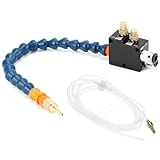
9. QWORK CNC Mist Spray System – Best Straightforward Setup for New Builds
QWORK Mist Coolant Lubrication Spray System for CNC, Lathe, Milling & Drill Machines – Enhanced Metal Cutting & Engraving Efficiency
Adjustable air flow and mist volume
5-7 KGF/CM2 air
9.2 oz
7.44 x 5.67 x 1.22 in
Pros
- Adjustable air and mist for repeatable setups
- Works with any jug or bottle
- No liquid pressure supply required
- Chip-blowing action keeps the cut visible
Cons
- Thin review history at 25 ratings
- Newer listing with less field data
- Modest body with no check valve
If you are setting up a machine for the first time and want the shortest path from unbox to cutting, this is the straightforward option. Air flow and spray mist volume are both adjustable, and the system runs on any unpressurized liquid, so a jug, a bottle, or a cutting oil can will work.
The gas-assisted chip removal is the part we noticed most in practice. Blowing the swarf off the cut keeps the work area visible and cuts cleanup, which is exactly the complaint shops raise when they abandon coolant entirely.
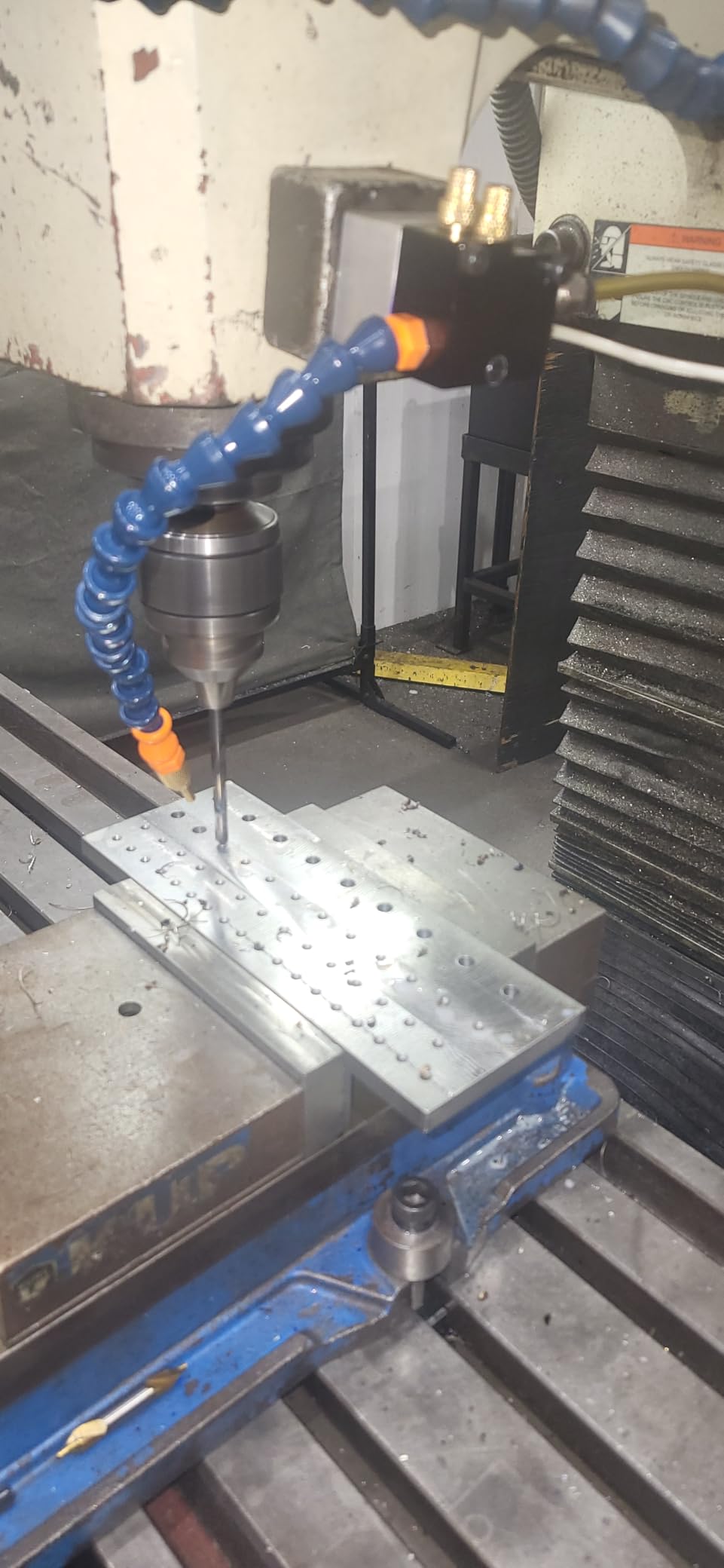
Be clear-eyed about the evidence. This is a recent listing, and 25 reviews at 4.5 with a 66 percent five-star share and no one-star feedback at all is exactly the pattern a young product shows. It means long-term seal and durability performance is not yet documented.
The claimed saving of over 80 percent coolant versus traditional water cooling is a manufacturer claim, stated the same way across this entire category. The physical logic is sound, since atomized oil uses far less volume than a flood wash, but we did not find independent measurement for it.
Who this suits
New machine builds, students, and small shops that want a mist system working the same afternoon it arrives. It suits CNC lathes, mills, and drill machines for engraving, metal cutting, and general cooling duties.
Who should skip it
Skip it if you cannot accept a thin field history and need a unit with a decade of service data. Anyone running heavy stainless or titanium work should also step up to a system with more robust hardware rather than a general-purpose sprayer.
10. Vertex 3-Gallon Coolant Pump Kit – the One Real Flood-Style Cooler Here
VERTEX 3012-8110 3-Gallon Coolant Pump Kit – 110V 1/8 HP Portable Machine Tool Cooling System for Milling, Drilling, Lathe – Compact 3-Gallon Tank, Above-Ground Design, Easy Coolant Circulation Device
3 gallon closed reservoir
110V 1/8 HP motor
15.5 x 10.5 x 13 in housing
18.7 lb
Pros
- True tank-and-circulation cooling
- A closed reservoir limits splashing and evaporation
- Above-ground design is easy to refill and clean
- Compact footprint moves easily around a shop
Cons
- Much higher cost than the mist systems
- 1/8 HP motor is light duty for heavy work
- Needs floor or bench space beside the machine
This is the odd one out and it earns its place. Every other product here atomizes oil with shop air; this one pumps bulk fluid from a 3-gallon tank, which is genuinely a different category of answer to the same question. If you want flood-style cooling without rebuilding a machine, this is the unit to look at.
The closed reservoir is the useful design decision. Limiting splashing and evaporation is how you avoid the odor complaints that push shops back off coolant, and the above-ground layout means refilling, cleaning, and inspection do not require pulling a tank out from under a machine.
It is rated 110V corded with a 1/8 HP motor, in a 15.5 by 10.5 by 13 inch housing weighing 18.7 lb. There is a larger tank version in the same range if your run time between refills is too short.
Its 4.0 average with a 58 percent five-star share and a 9 percent one-star share is the lowest rating in the roundup, and the reviews explain why. Users who match it to their workload like the steady circulation. Users who put it on heavy continuous work find the 1/8 HP motor is the limit, and the cost sits far above everything else here.
Who this suits
Mills, drill presses, lathes, grinders, and tapping machines in small workshops and light production, where you want a coolant reservoir you can top up and clean yourself. It suits users with little interest in mist fluid and fixturing.
Who should skip it
Skip it if you need to cool chips out of a deep or interrupted cut. A 1/8 HP pump is not a high-pressure system and will not substitute for one. It is also the wrong answer for a shop that wants a near-dry machine, since flood means puddles, noise, and cleanup.
How to Size a Coolant System for Your Machine
Size by material and tool diameter before you size by pressure. Flood systems live around 50 to 150 PSI and are correct for aluminum, mild steel, cast iron, and general milling. Somewhere around 250 to 300 PSI is the practical minimum machinists cite for real chip-breaking duty, and 1,000 PSI is reserved for gundrilling and tough alloys where a tool has to survive inside the cut.
Tool diameter sets the flow question more than the pump question. Small-diameter drills and gundrills need pressure delivered inside the tool, which is a through-spindle requirement no mist system can meet. Larger cutters on a flood system need volume at the nozzle, not pressure, and a bigger reservoir.
Reservoir size follows from run time. A 3-gallon tank covers short benchtop work. Shops cutting all day want recirculation, filtration, and chip management, which means moving up to a proper packaged system rather than any unit in this roundup.
Two rules cover most materials. Aluminum and plastics want low viscosity, low pressure, and good chip evacuation, which is a mist or light flood job. Stainless, Inconel, and titanium want heat removal first and chip breaking second, which pushes you toward flood volume or genuine high pressure.
Verify seller claims before you buy. Check whether a quoted pressure figure is the fluid delivery rating or just the air supply, whether a pump is rated for continuous duty or intermittent use, and whether a filter rating in microns is finer than your nozzle orifice, since filtration below nozzle size is wasted money.
Installation and Retrofit Checklist
Start with air. Every mist system in this roundup needs 5 to 7 KGF/CM2 at the nozzle, and several owners report their compressor running out of head. A small shop compressor will drive some of these for a few minutes before the mist fades, which is the single most common installation failure.
Get the reservoir height right. Mounting the fluid source near nozzle height is the most repeated setup note across reviews of these products. When it sits well below, suction drops and the mist goes weak or intermittent, and people misread that as a bad unit.
Check your fitting standard before you order. Units that quote 8 mm air lines need adapters for typical US shop air, and one buyer priced that adaptation at roughly fifteen dollars in parts. Buying the right quick-connect up front avoids the frustration.
Controller support decides whether you can automate. A Masso forum poster notes that the Masso control only supports M07 for mist and M08 for flood. If your control lacks those codes, budget for a manual solenoid switch or a relay wired to a spare output rather than assuming the mist will trigger with the program.
Finally, know what your machine can physically accept. Mist units clamp on externally and are safe on almost anything. Through-spindle and high-pressure systems are not a retrofit in any casual sense, since they need a pressurized path through the spindle, compatible seals, tank coatings, and electrical capacity, and the same machine builder’s system should be assumed to require a new machine instead. If you are planning a full retrofit, our [CNC router and spindle cooling guide](https://battleofsoho.com/best-cnc-routers-for-woodworking/) covers the closed-loop side of that decision.
Maintenance: Foam, Odor, Concentration and Filtration
Foaming usually means one of three things: the wrong fluid, hard water, or a contaminated sump. Running ordinary flood coolant in a mist pump causes it, and so does mixing with tap water that carries a heavy mineral load. If you see foam, suspect the fluid before you suspect the hardware.
Odor is a sump-life problem. Bacteria grow in warm, oil-rich, low-circulation fluid, and the smell arrives long before the fluid fails visibly. Shops that report the best odor control are the ones topping up rather than topping off, skimming tramp oil off the surface, and replacing fluid on a schedule instead of waiting for it.
Run concentration and pH like process variables, not like guesswork. A refractometer tells you concentration in seconds. For water-based fluids, published guidance puts the target pH band at 8.5 to 9.5, and going outside that range explains both corrosion complaints and bacterial odor. RO or DI water is preferred where hard water leaves film and scum, though tap water is workable in genuinely soft areas.
Here is a workable cadence. Daily, skim tramp oil and top up the level. Weekly, check concentration and pH, and clear chips out of the pickup and filter. Monthly, replace the filter element, inspect the mist nozzles and hoses for softening, and clean the reservoir. Quarterly, replace the fluid outright rather than letting it run indefinitely.
On mist systems specifically, add one rule from CNCZone users: use a coolant made for misting. A dedicated mist fluid atomizes cleanly, lubricates the edge, and lasts far longer in the bottle, which is why one gallon reportedly lasts years of hobby use in the right setup.
Frequently Asked Questions
What is the best coolant for CNC machines?
The best coolant system depends on machine and material rather than on a single winner. Air-driven mist systems are the right answer for aluminum, engraving, and small CNC machines. Pumped tank systems suit lathes and drill presses needing bulk cooling. Through-spindle and high-pressure systems are required for gundrilling, stainless, Inconel, and titanium. Match the system type to the material mix and your machine’s plumbing, not to a headline PSI number.
What’s the difference between flood and mist coolant?
Flood delivers bulk fluid from a tank to wash the cut, which gives strong heat removal and chip evacuation but soaks the enclosure. Mist atomizes a small amount of oil into an air stream, which lubricates the cutting edge with far less mess and almost no noise. MQL works well for semi-finishing, while heavy roughing and interrupted cuts still favor flood.
What is the best high pressure coolant pump for CNC machines?
Shop-floor high pressure means a pumped system that delivers fluid at the cutting edge rather than atomizing oil with air. Practical machinists put the useful band at 250 to 1,000 PSI, with 250 PSI as an absolute minimum and 1,000 PSI reserved for gundrilling and tough alloys. Genuine high pressure is normally a factory or major retrofit option, not a benchtop add-on.
What is the best coolant to use in aluminum machining?
Aluminum wants a low-viscosity, high-lubricity fluid that wets the cutting edge and moves chips away fast, and it is where mist and MQL excel. Machinists choose mist systems for aluminum specifically because the low volume keeps swarf from welding to the tool and leaves the machine dry and quiet. Use a fluid made for misting in a mist pump, never ordinary flood coolant.
What pH should CNC coolant be?
Published guidance for water-based machining fluids puts the target pH band at 8.5 to 9.5. Staying inside that range limits both corrosion of aluminum components and the bacterial growth that causes sump odor. Check pH and concentration together on a schedule, and treat out-of-range fluid as a problem to correct rather than a machine fault to troubleshoot.
Can I use tap water for mixing coolant, or do I need RO/DI?
RO or DI water is preferred when your tap water is hard, because minerals cause film, scum, foaming, and concentration readings that drift. Tap water is workable in genuinely soft areas. Whatever you use, mixing fresh fluid into a dirty sump rather than replacing the sump is the most common cause of foaming and odor complaints.
Conclusion: Which Coolant System Fits Your Shop
The best coolant systems for CNC machining are not the highest-pressure ones, they are the ones that put the right amount of the right fluid at the cutting edge on the machine you already own. For most hobby and small shop work on aluminum, the OriGlam sealed mist system is where we started, because its thousand-plus reviews make it the least risky purchase in the category.
Buy the BACHIN gooseneck kit if reach is your problem. Buy the ChgImposs metal kit if you run hours and want a check valve and filter. Buy the CNZG PNEU mister if your machine envelope is tight and you have 1/4 inch air. Buy the Vertex tank if you want bulk cooling on a lathe or drill press and do not want to fuss with mist fluid. And if you are running stainless, Inconel, or gundrilling, no unit on this page is the answer, because that job needs through-spindle pressure your machine either has or does not have.
Whichever you choose, the forum consensus we kept coming back to is simpler than any spec sheet: buy fluid made for your delivery method, keep the reservoir high, and judge the system on odor and sump life before you judge it on pressure. If you are still comparing machine-side options, our [CNC sign router comparison](https://battleofsoho.com/best-cnc-sign-routers-for-shops/) covers a different class of shop equipment in the same format.
Specs and product options for this roundup were last verified in September 2026.