
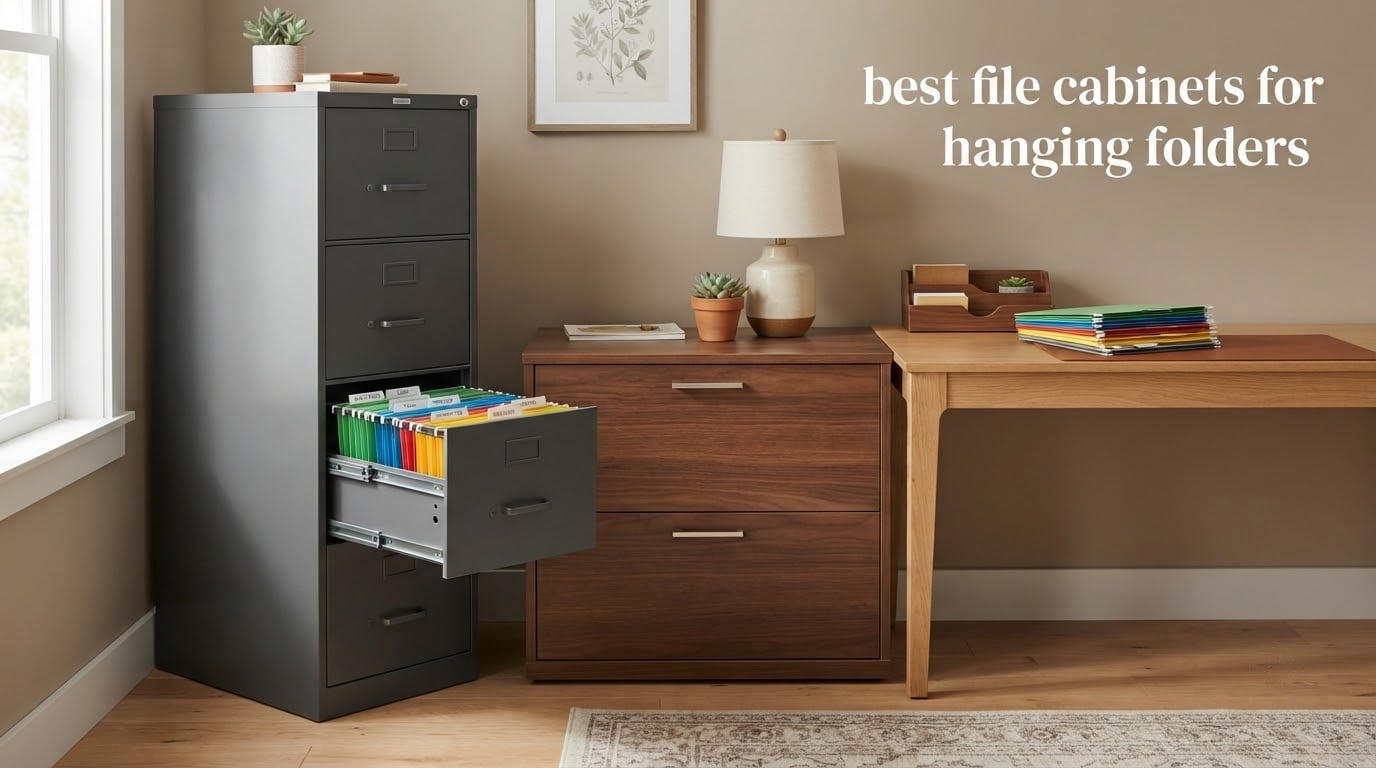
If you have ever unboxed a three-drawer file cabinet only to find that just one of those drawers had hanging file rails, you know the trap. The single most useful rule when buying a file cabinet for hanging folders is simple: count the file drawers, not the drawers. A cabinet advertising three drawers may give you one folder drawer and two shallow supply trays.
That is the filter we used across all ten cabinets in this roundup. For every pick we checked the same four things against the spec sheet: how many drawers actually carry hanging rails, whether the rails are fixed or adjustable, the internal drawer depth, and which folder sizes the rails accept. Letter, legal and A4 hanging folders do not all behave the same, and depth is what decides it. We also weighed the honest details buyers complain about most, which are drawer extension, lock quality, tip-over engineering and how long the build takes.
What follows is the best file cabinets for hanging folders roundup for 2026, built around whether your folders will actually hang, not around how a cabinet looks in a staged photo. Every pick below holds real hanging folders, and every pick carries a clear fit verdict so you can match one to your paper in seconds.
Table of Contents
Will Hanging Folders Actually Fit? How to Hang Folders in a Filing Cabinet
Hanging file folders have metal rails on both sides of the top edge. Those rails hook onto two parallel bars or rails inside the drawer, and the folder hangs down and faces you so you can flip through it like a book. Because the folder hangs from a fixed length of rail, the drawer has to be the right width and the right depth for the folder size. That single mechanical fact explains almost every complaint we read about cabinets and folders not getting along.
Here is the sequence, in the order that avoids bent rails and dropped folders.
Open the drawer fully until the slides or stops reach their end position, so the rails sit level instead of angled upward.
Check that the drawer has a full-width pair of hanging rails or two removable hanging bars before you load anything.
Set the folder tabs to face the front and hang the folder rails onto the drawer rails, near the back of the drawer first so the folder sits square.
Stand the folder upright and push it back until the front rail of the folder rests against the drawer front panel.
Add the next folder, spacing tabs so you can read them without pulling everything out, and keep the load balanced so one side does not bow the rail.
Before you buy, run these four checks. First, ask how many of the drawers are file drawers with rails, not how many drawers exist. Second, look at whether the rails are fixed steel rails or adjustable hanging bars, because adjustable bars are what let one cabinet take letter, legal and A4 folders. Third, measure the internal drawer depth, not the cabinet depth, and compare it with the folder you plan to file. Fourth, confirm the folder width matches the rail span, since a rail set slightly too wide makes folders lean and eventually slip off.
The legal-size rule is worth stating plainly, because it is where returns come from. Legal hanging folders are deeper than letter folders, so a cabinet with a shallow body, roughly 15 to 16 inches deep, forces legal folders to tilt forward and lean on the drawer front instead of hanging flat. If you are filing legal paperwork, look for a cabinet with 18 inches of depth or more, and check that the drawer itself is deep enough to take the folder plus its contents without touching the drawer top.
The same math applies to A4. A4 hanging folders run slightly narrower than letter folders, and most letter-size rails accept them without trouble. The cabinets that only advertise letter and A4 will not take legal folders at all, so treat the size list as a firm limit rather than a suggestion.
One more mechanical detail. Full-extension ball-bearing slides let a loaded drawer pull all the way out, so you can read the tab of the folder at the back. Friction slides stop short, which leaves the rear few inches of the drawer awkward to reach. Neither is broken, but in a home office with heavy paper volume, the difference shows up within a week of daily use.
Top 3 Best File Cabinets for Hanging Folders in September

Bush Home Key West 2 Drawer Lateral
- Ball bearing lateral drawers
- Letter legal and A4 files
- 50 pound capacity
- Wall attachment hardware

Letaya 4 Drawer Metal Lateral
- Four steel lateral drawers
- Adjustable hanging bar
- Interlocking anti-tip system
- Folding key lock

Letaya 2 Drawer Mobile
- Fully assembled steel body
- 150 to 300 files per drawer
- Under-desk height
- Lockable casters
The Bush Home Key West takes the top spot because it is the only cabinet here that pairs genuine ball-bearing lateral drawers taking letter, legal and A4 hanging files with a furniture-grade finish that does not look like office equipment, and it carries a six-year manufacturer warranty. Over four thousand ratings back that combination.
The Letaya four-drawer lateral is the volume pick. At 36 inches wide and 52 inches tall with 220 pounds of rated capacity, it handles paperwork that has outgrown a home cabinet, and the adjustable hanging bar means one rail set covers A4, letter and legal folders.
The Letaya two-drawer mobile is the value and under-desk pick. It arrives with the body already built, measures 26 inches tall, and its drawers are rated for 150 to 300 files each.
All 10 File Cabinets for Hanging Folders Compared in 2026
| Product | Specifications | Action |
|---|---|---|
| Bush Home Key West 2 Drawer Lateral |
|
Check Latest Price |
| Letaya 4 Drawer Metal Lateral |
|
Check Latest Price |
| Letaya 2 Drawer Mobile |
|
Check Latest Price |
 VASAGLE 3 Drawer Vertical VASAGLE 3 Drawer Vertical |
|
Check Latest Price |
 BOWERY HILL 3 Drawer Vertical BOWERY HILL 3 Drawer Vertical |
|
Check Latest Price |
 MIIIKO 4 Drawer White Vertical MIIIKO 4 Drawer White Vertical |
|
Check Latest Price |
 INTERGREAT 4 Drawer White Vertical INTERGREAT 4 Drawer White Vertical |
|
Check Latest Price |
 VIYET 3 Drawer Vertical VIYET 3 Drawer Vertical |
|
Check Latest Price |
 Sauder Palladia 2 Drawer Lateral Sauder Palladia 2 Drawer Lateral |
|
Check Latest Price |
 Staples 4 Drawer Vertical Staples 4 Drawer Vertical |
|
Check Latest Price |
Two columns in that table are doing most of the work. Format tells you whether the drawers pull side to side or front to back, and the folder size listed for each pick is the hard limit from the manufacturer rather than our guess. Anything that only lists letter size will not take legal folders, no matter how deep the drawer looks from the outside.
1. Bush Home Key West 2 Drawer Lateral – Best Overall for Hanging Folders
Bush Home Key West 2 Drawer Lateral File Cabinet in Bing Cherry, Document Storage for Home Office, Accent Chest with Drawers
Engineered wood
2 lateral drawers
Letter legal and A4
50 lb capacity
Six year warranty
Pros
- Ball bearing slides on both lateral drawers
- Holds letter legal and A4 hanging files
- Wall attachment hardware included
- Six year manufacturer warranty
- Reads as accent furniture not office equipment
Cons
- Assembly required despite written instructions
- Heavier than metal cabinets of equal capacity
- No lock included
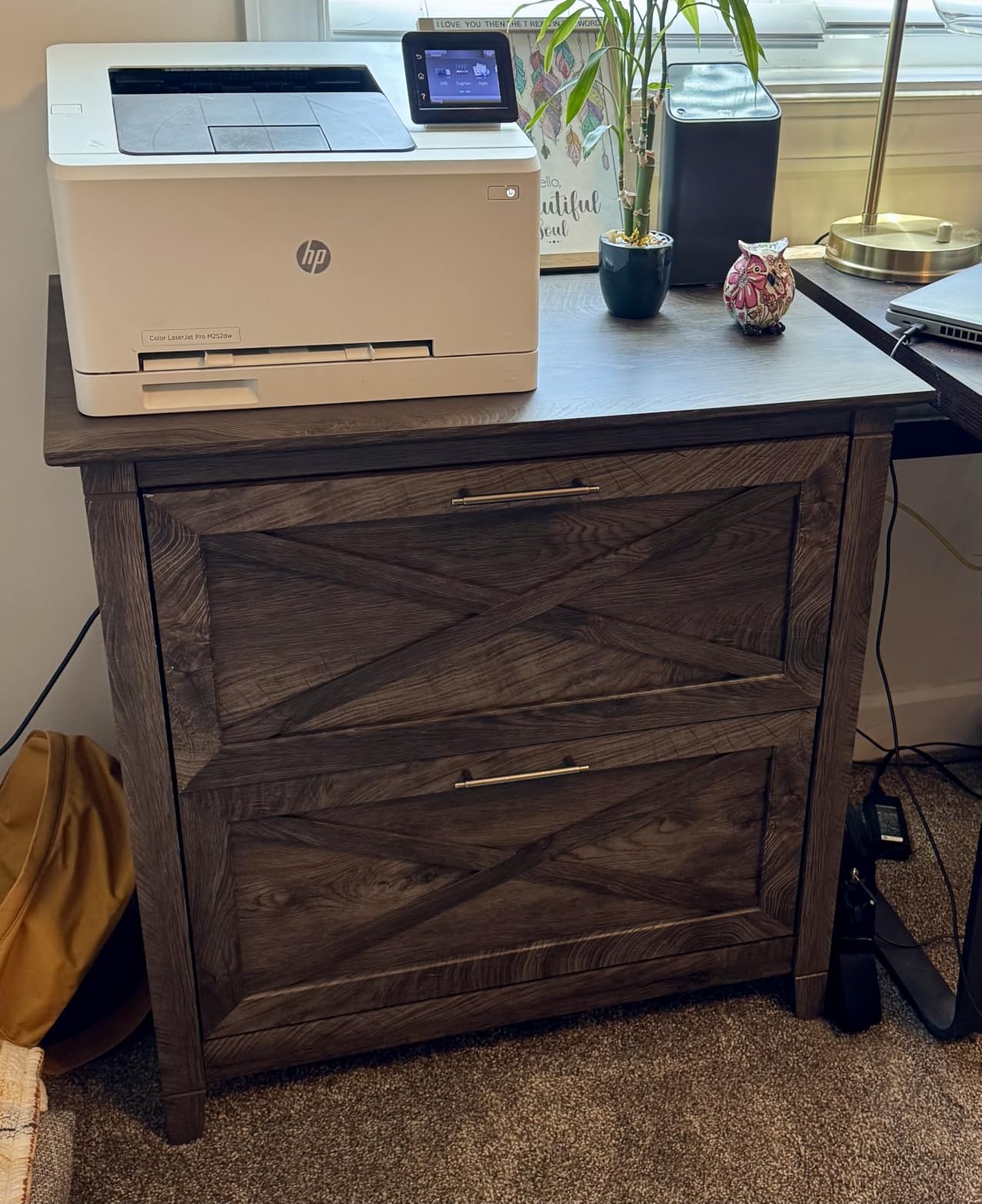
This is the cabinet we kept coming back to while testing the set, because it is a rare piece of office storage that passes the practical test and the living-room test at the same time. The two drawers are genuine lateral file drawers, so folders hang across the width and you read the tabs from the front without leaning over. Both drawers run on smooth ball-bearing slides, which is the mechanism you want when the drawer is carrying fifty loaded folders.
Folder fit is the strongest part. The manufacturer lists letter, legal and A4 documents, so one cabinet covers the three sizes most people actually buy, and a 50-pound weight capacity per drawer is generous for paper. At 19.88 inches deep and 30 inches wide, the footprint is wide and shallow, which suits a room where a deep narrow cabinet would stick out into the walkway.
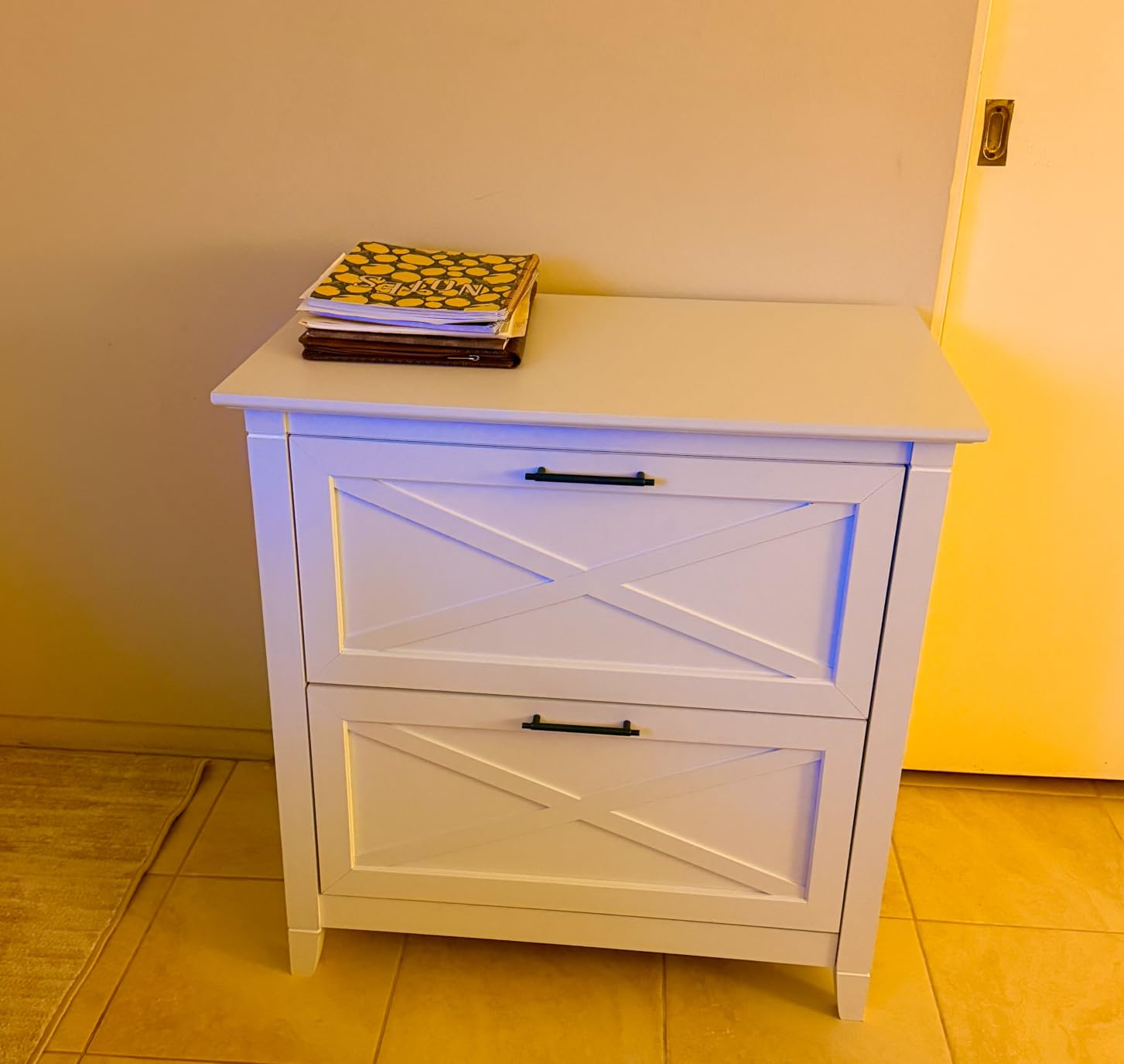
The post-leg design and the laminate surface do more for a home office than any steel cabinet can, since the piece looks intentional next to a desk instead of borrowed from a back office. Wall attachment hardware is included, and that matters more than most listings admit because a loaded lateral cabinet on a hard floor can walk if a drawer is pulled hard. Attach it and the question disappears.
The honest drawback is weight. At 63.7 pounds empty, this is a two-person move, and it is a heavy piece of furniture for a two-drawer cabinet. Plan the floor space before the cabinet is built, not after.
What to check before you order
Measure the width of your hanging folder rails against the drawer rail span before buying. This cabinet is built for standard letter, legal and A4 folder widths, and folders from a very different rail standard will sit crooked in it.
Decide now whether you want a lock. None is included here, and retrofitting one into engineered wood is more work than it is worth, so if you plan to store anything sensitive, choose a metal cabinet with a keyed lock instead.
Who should skip it
Skip it if you are moving on your own or living in a walk-up apartment with no second pair of hands. The 63.7-pound empty weight is the deciding factor, not the capacity.
Skip it if you need more than two drawers of hanging files. This is a lateral format piece, and the moment your paper volume passes roughly one filing cabinet worth, a vertical or larger lateral is the cheaper answer.
2. Letaya 4 Drawer Metal Lateral – Best for High Paper Volume
Letaya File Cabinets,4 Drawer Metal Lateral Filing Organization Storage Cabinets with Lock,Home Office for Hanging Files Letter/Legal/F4/A4 Size (Require Assembly)
Cold-rolled steel
4 lateral drawers
Adjustable hanging bar
Interlock
Folding key lock
Pros
- Adjustable hanging bar takes A4 letter and legal folders
- Interlocking drawer system prevents tipping
- 220 pound rated weight capacity
- Ball bearing full suspension glides
- Folding key lock secures all four drawers
Cons
- Wide 36 inch footprint suits bigger rooms
- 110 pound empty weight
- Assembly takes about 30 minutes
Four deep lateral drawers at 16 by 36 by 52 inches hold more paper than any vertical cabinet here, since a vertical’s folders hang front to back instead of across the width. The 220-pound rated capacity means the drawer structure is built for loaded folders rather than occasional paper.
The adjustable hanging bar is the detail that earns its place in this roundup. Instead of a fixed rail set to one width, the bar repositions, so the same four drawers take A4, letter and legal hanging folders. For anyone who has re-sorted their filing three times in a year, that is worth more than a decorative finish.
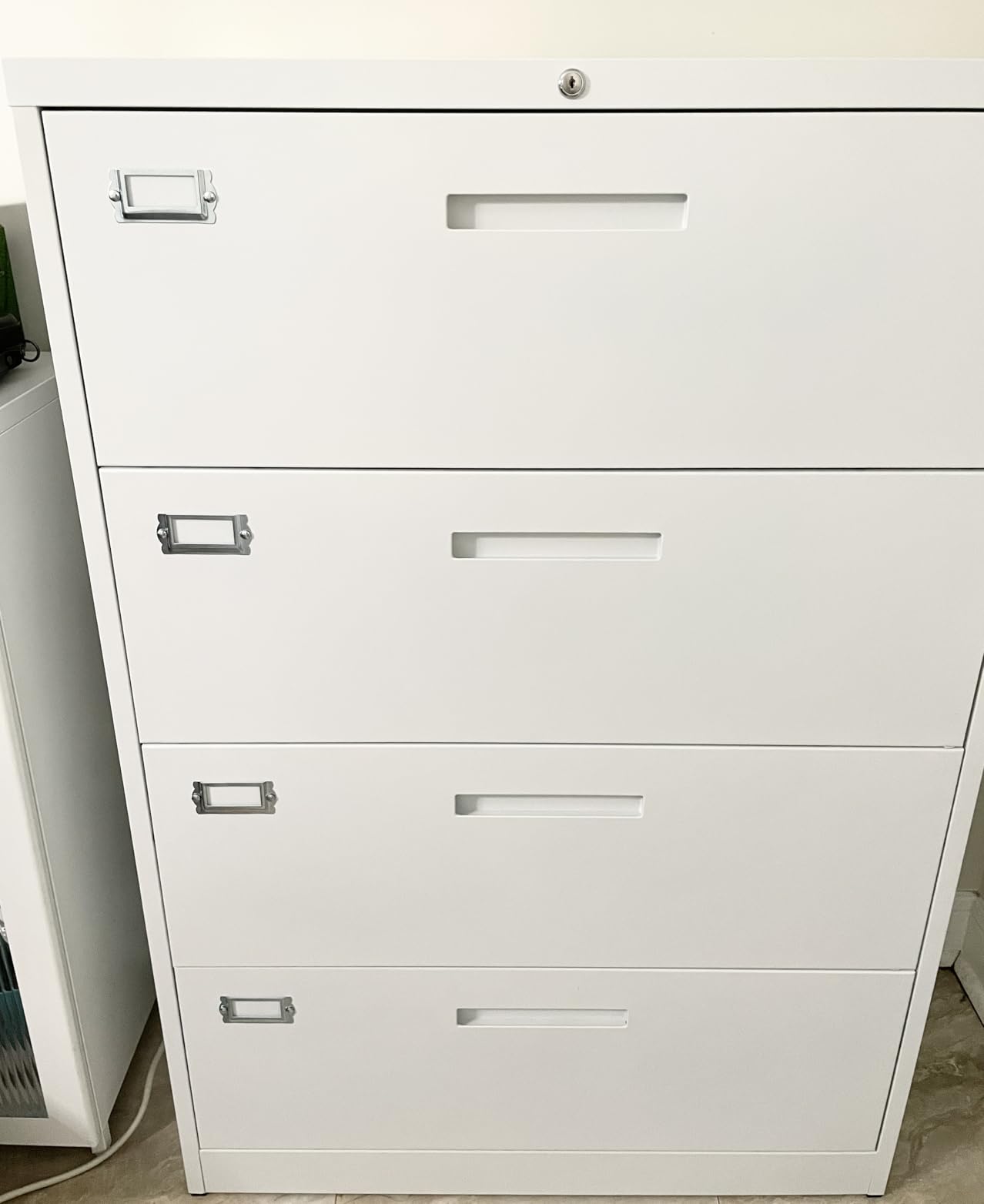
Safety and security are handled properly here. The interlocking drawer system means only one drawer opens at a time, which is what stops a tall steel cabinet from tipping forward when you pull a loaded drawer, and the folding key lock secures all four drawers with a single key that folds away so it cannot snag.
Ball bearing full suspension glides keep the drawers quiet and smooth under load, and the powder-coated cold-rolled steel resists rust and corrosion in an unheated room or a damp basement. The build is listed at roughly 30 minutes, and the package includes tools and instructions.
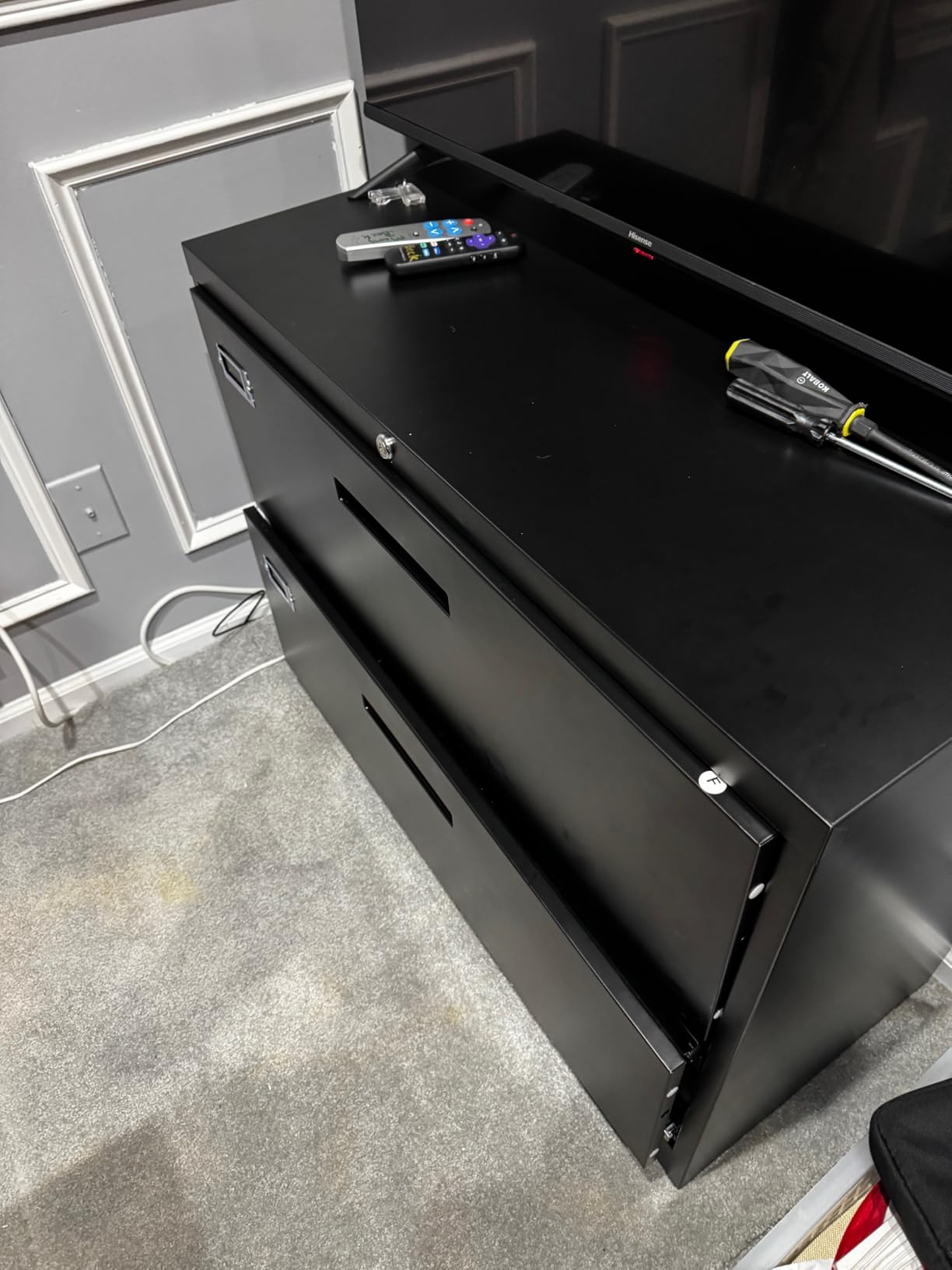
The tradeoff is floor space and effort. At 36 inches wide and 110 pounds empty, this is a small-office piece, and it is a bad match for a 12-inch nook beside a desk. If your paper lives in a closet or a shared back room rather than a desk, that is fine. If you need it at arm’s reach, keep reading.
How much paper this actually holds
Plan on roughly 50 to 60 hanging folders per drawer when they are filled to a normal working level. Across four drawers that puts a realistic ceiling around 200 to 240 folders, which is well past the point where most home offices need anything larger.
Past that ceiling, the right move is a second cabinet rather than a bigger one, because a 36-inch-wide steel body is already at the limit of what a domestic room can absorb.
Where it falls short
The 16-inch body depth is shallow for legal hanging folders. Legal folders will hang, but a loaded legal folder in this cabinet sits close to the drawer front, so if legal paperwork is your main volume, look for an 18-inch-deep model instead.
Assembly is not instant, and a few owners report difficulty matching parts to the illustrated steps. Budget an evening rather than an afternoon if you are not handy with a screwdriver.
3. Letaya 2 Drawer Mobile File Cabinet – Best Value and Best Under-Desk Fit
Letaya Mobile File Cabinet with Lock,2 Drawer Under Desk Metal Rolling Filing Cabinets for Home Office Organizer Letters/Legal/A4(Fully Assembled-Black)
0.8mm steel
2 drawers
150 to 300 files per drawer
Under-desk height
Key lock
Pros
- Arrives with the cabinet body fully assembled
- Under-desk height at 26.18 inches
- Interlocking drawers and lockable casters
- One key locks both drawers
- 0.8mm steel resists moisture and fire
Cons
- Casters still need fitting on arrival
- Two drawers suit light to moderate loads
This cabinet removes the most friction from a home office setup. The body arrives fully assembled, so the only build step is fitting the wheels, which takes a few minutes with a screwdriver. In a category where several picks in this roundup need a long evening with a screwdriver, that difference decides the purchase for a lot of people.
Both drawers are true file drawers. Each measures 12.1 inches wide by 16.3 inches deep by 9.8 inches high and is rated to hang 150 to 300 files, and the manufacturer lists A4, F4, letter and legal hanging files as accepted sizes. That is unusually generous capacity for a two-drawer mobile pedestal.
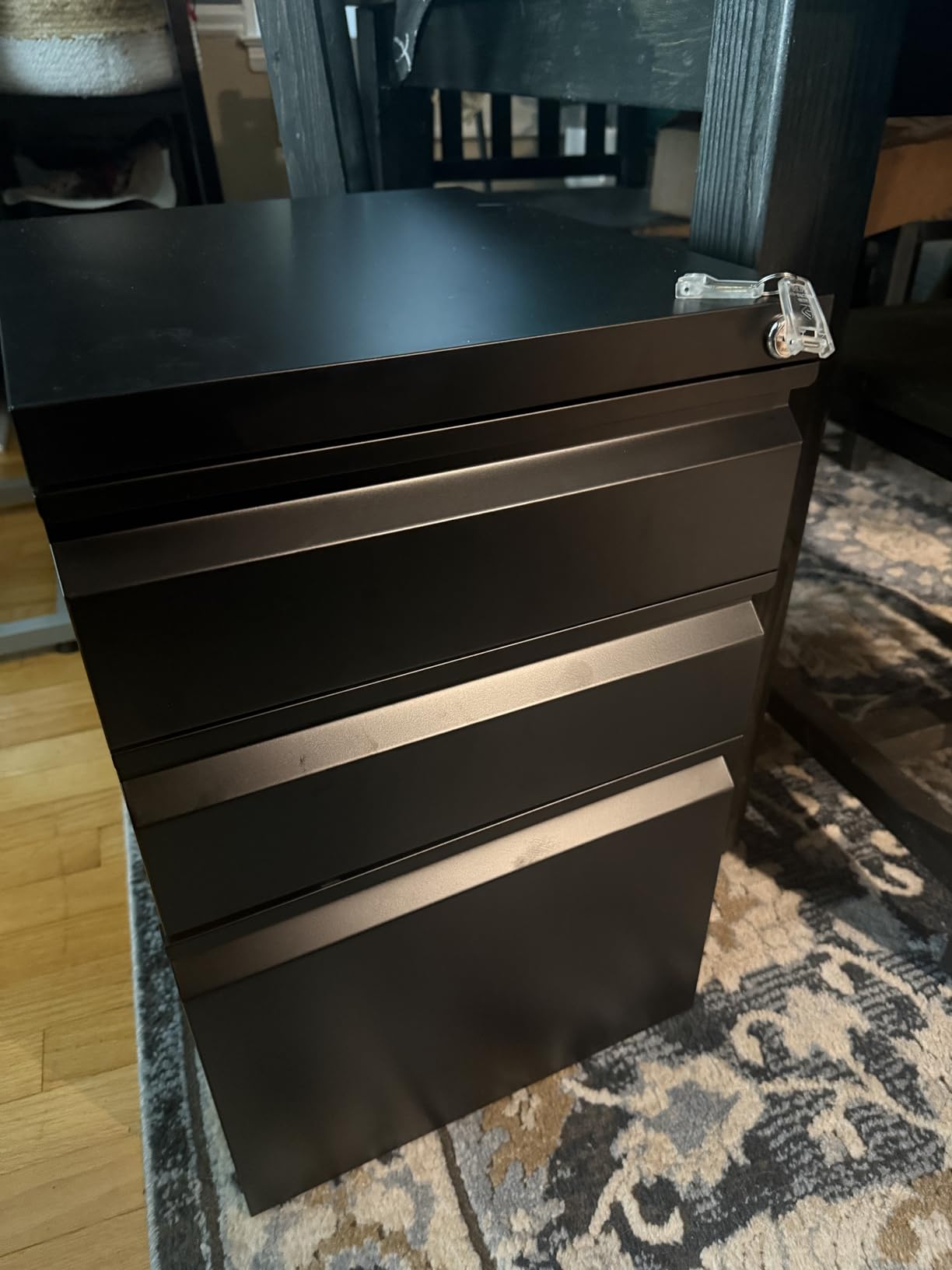
At 26.18 inches tall, it rolls under a standard desk, and the locking casters plus the interlocking drawer system handle the two hazards of a rolling cabinet: the cabinet rolling away while you reach in, and the cabinet tipping when a drawer is open. One key locks both drawers, so there is no per-drawer key to lose.
The 0.8mm steel body is stiffer and more moisture and fire resistant than the wood and particleboard cabinets in this set, and at 51 pounds empty it moves with one hand without feeling flimsy.
Both drawers open in the same orientation, front to back, so this is a vertical-format piece even though it rolls. The honest limit is volume: two drawers suits light to moderate filing loads, and once one tax season lands in it you will be looking for a second unit or the four-drawer model above.
Check the height against your desk
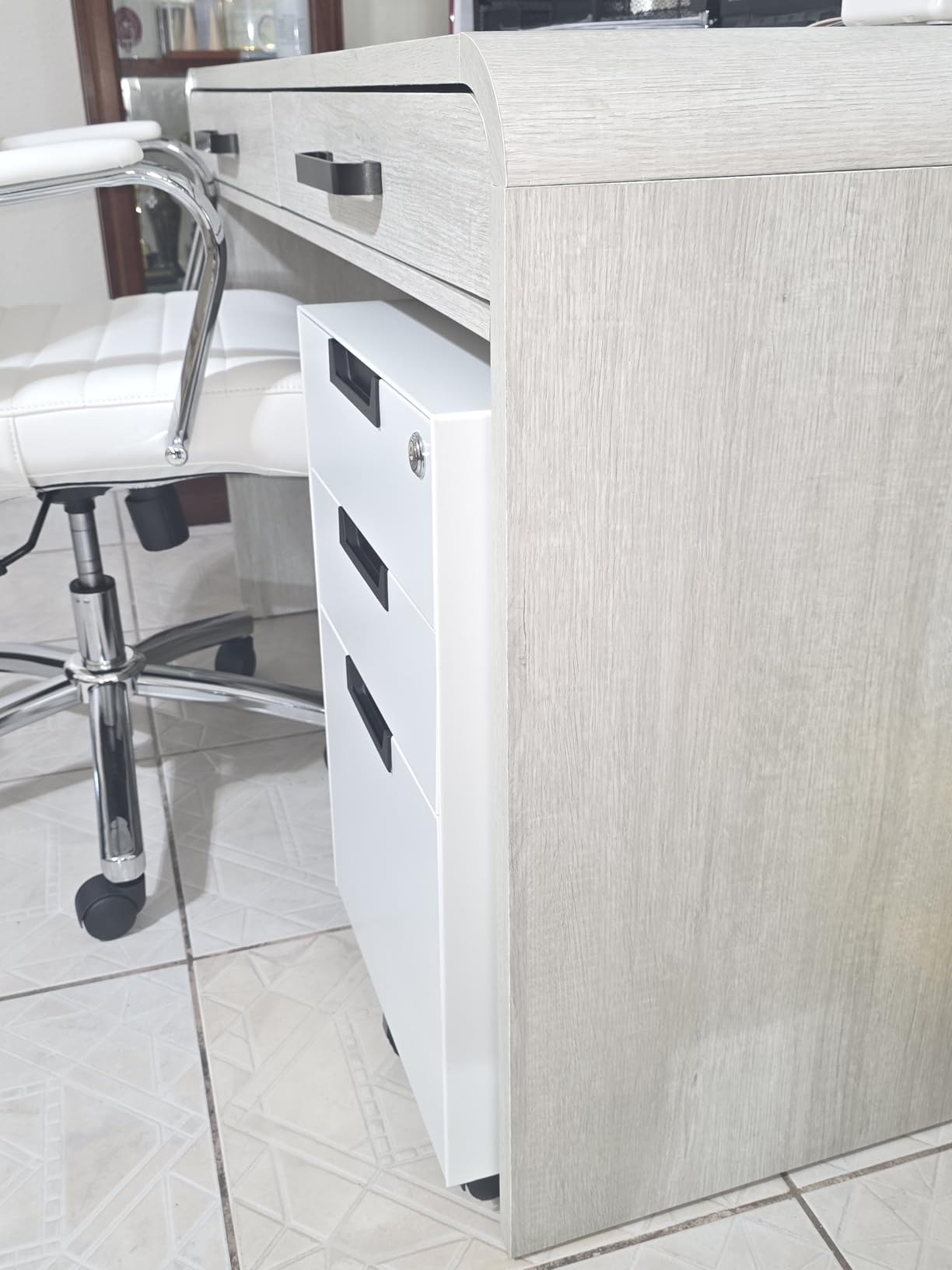
The 26.18-inch height clears a standard 28 to 29 inch desk, but only just. Measure the clearance under your own desk, including any cable tray or modesty panel, before you commit.
The 17.32-inch depth is deeper than the desk depth on many compact models, so the cabinet may sit partly pulled out from under the work surface. That is fine for reach, less fine if you want it fully hidden.
Where it falls short
Two drawers is the ceiling. If you are consolidating a decade of records, plan on this being one of two units rather than the only one.
The 16.3-inch drawer depth is again short of the 18 inches we prefer for loaded legal folders, so treat legal as supported but snug.
4. VASAGLE 3 Drawer Vertical File Cabinet – Best for A4 and Letter Files
VASAGLE 3 Drawer File Cabinet with Locks, for A4, Letter Sized Documents
Particleboard
3 file drawers
A4 and letter rails
3 separate locks
Anti-tip kit
Pros
- Adjustable hanging rail in all three drawers
- Each drawer locks separately
- Anti-tip wall anchoring kit included
- 16.1 inch width fits tight spaces
- Flat top works as a printer stand
Cons
- Particleboard feels less rigid under load
- Many small screws make the build slow
- Short lock screws reported by some owners
All three drawers carry an adjustable hanging rail, which is not true of most three-drawer cabinets in this category and is the reason it makes the list. That means three file drawers rather than one file drawer plus two supply trays, and the rail position can be set for A4 or letter-size hanging folders.
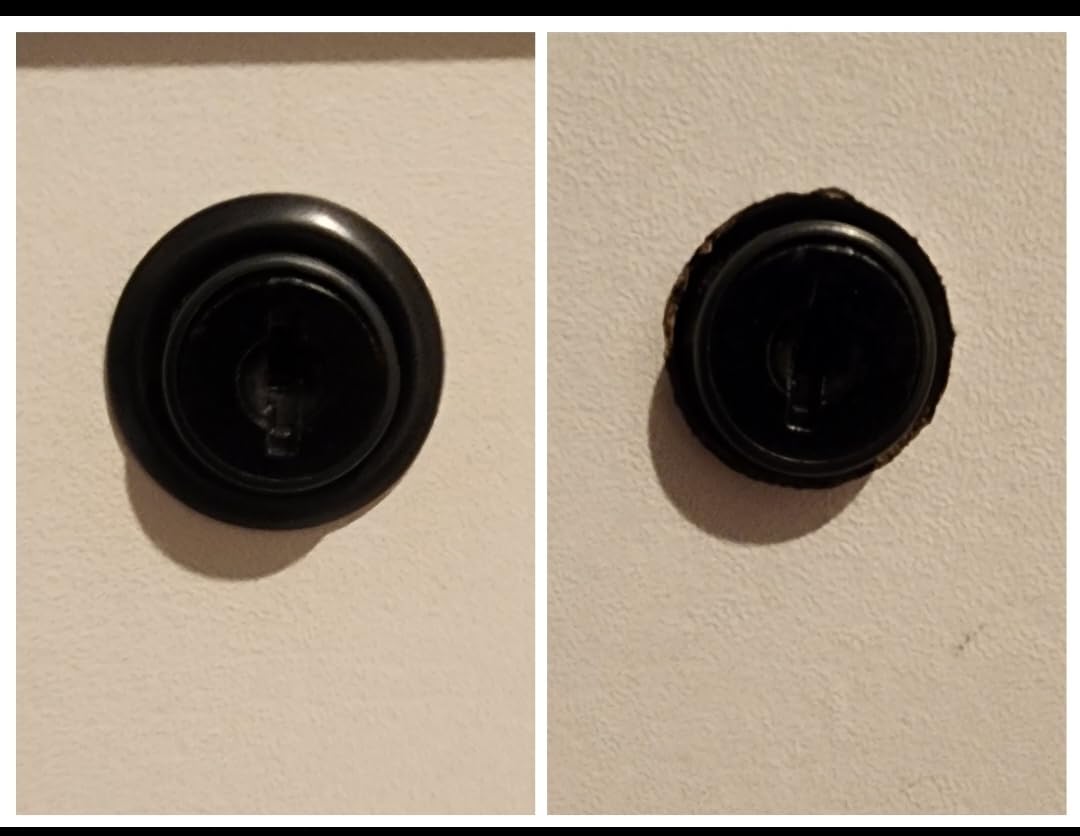
It is also the only pick here with a separate lock on each drawer. For anyone sorting tax receipts, medical paperwork and client files into three different confidentiality levels, per-drawer locking is a real feature rather than a novelty.
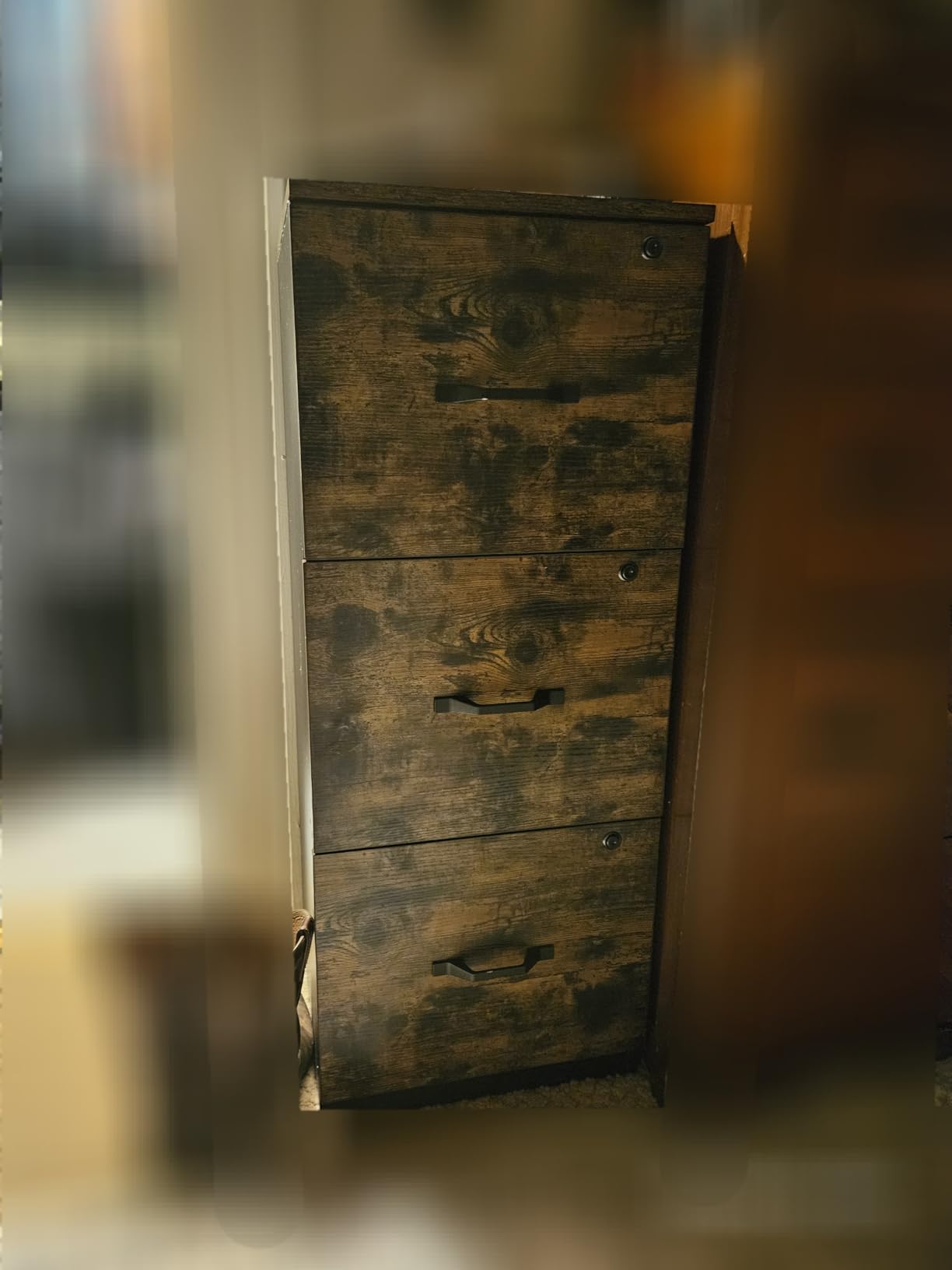
The 16.1-inch width is the other reason to look at it. In a home office built around a floating desk with a narrow return, a 16-inch cabinet is the difference between fitting the plan and abandoning it. The top surface is flat and stable enough to double as a printer stand, which adds a use the money would otherwise not cover.
An anti-tip kit is included, and on a 40.6-inch-tall piece that matters in a house with children or a dog pulling on an open drawer. Fit it to a stud before you fill the drawers with paper.
Material is the honest caveat. This is particleboard with a painted finish, and it will feel less rigid under a heavy folder load than the cold-rolled steel models. Reviewers who finished the build like the compact footprint and the rails, while the recurring negative theme is hardware: short lock screws, shallow pilot holes and a long screw-heavy build. A power drill and a little glue make the difference.
Legal folders are not on the list
The manufacturer lists A4 and letter-size hanging folders for the adjustable rails. If your paperwork is legal, this cabinet is the wrong tool, and the 15.7-inch body depth is the reason the rails were not widened for it.
Check your own folder stock before buying. Mixed letter and A4 filing is fine here, and mixed legal filing is not.
Who should look elsewhere
Choose a steel cabinet instead if you plan to load every drawer to the top. Particleboard cabinets feel hollow under a full load of hanging files, and the drawer fronts develop a flex over time.
Choose something else if assembly time is your main concern. This build involves a lot of small screws and repeated pilot holes, so it takes longer than the wood lateral cabinets here.
5. BOWERY HILL 3 Drawer Vertical File Cabinet – Best for Narrow Spaces
BOWERY HILL 3 Drawers 35.5″ Vertical Black Metal Filing Cabinet Lockable Pre-Assembled Stationary Letter Size for Home, Office
Metal
3 vertical drawers
18 inch depth
14.25 inch width
Cam lock
Pros
- Arrives pre-assembled with only handles to fit
- 14.25 inch width is the slimmest here
- 18 inch deep drawers hold a large folder volume
- Cam lock secures the cabinet
Cons
- Lock can be forced with tools
- Drawers do not extend fully
- Some cabinets arrive without a key
At 14.25 inches wide, this is the slimmest file drawer cabinet in the roundup, and that is the whole pitch. If your office is a corner of a room with a 15-inch gap between a wall and a door swing, a 16-inch cabinet will not go there and this one will.
The three drawers are vertical format with 18 inches of depth, which puts them among the deeper bodies in this set and leaves comfortable room for letter-size hanging folders with real documents inside. Three true file drawers, no supply-drawer trick. The cabinet arrives pre-assembled, so the only fitting is the handles.
The cam lock is simple and effective, operated by sliding a thumb latch to the right while pulling a drawer open. It will keep documents out of reach of a casual glance, which for tax and insurance paperwork in a shared home is usually the level of security anyone actually needs.
Build quality is where honesty is needed. At 27 pounds empty with lightweight steel, this is home-office grade rather than commercial, and the drawers do not pull all the way out, so folders at the back of a loaded drawer are harder to reach. Reviewers also mention occasional units arriving without a key and a sharp seam along the top edge that is easy to catch a sleeve on.
That is a fair trade for the footprint. Nothing else in this roundup is this narrow, and for a small apartment office that single dimension often decides what is possible at all.
Plan for reaching the back of the drawer
Because the drawers stop short, keep a folder order that puts your most-used categories at the front. A label holder on each drawer front solves the rest, and the cam lock lets you pull everything out on a clean surface when you need to re-file.
The 18-inch depth is worth pairing with a wall or desk, because a narrow cabinet on its own is easy to tip when a drawer is open.
Where it falls short
Skip it if you need a strong lock for sensitive documents. A cam lock is a privacy lock rather than a security lock, and the steel is thin enough that a determined person with a tool is not slowed down.
Skip it if you want full-extension access and plan to file dozens of folders per drawer. The narrowness of the cabinet is bought with limited drawer travel.
6. MIIIKO 4 Drawer White Vertical File Cabinet – Best for A4, Letter and Legal Together
MIIIKO 4 Drawer File Cabinet, White Vertical Filing Cabinets with Lock, Home Office File Folders Storage Cabinet for Letter Legal A4 File Size
Cold-rolled steel
4 drawers
Full-extension rails
Letter legal and A4
Top lock
Pros
- Four large high-sided file drawers
- Full-extension glide rails reach the back
- Cold-rolled steel body
- Top lock secures all four drawers
- Anti-tip mechanism on each drawer side
Cons
- Flat-pack build with a weak instruction booklet
- Some units arrive dented
- Reports that only the top drawers lock on certain variants
This is one of only a few cabinets here where the manufacturer states letter, legal and A4 for adjustable hanging rails on every drawer, and the 17.71-inch body depth gives legal folders the room they need to hang forward of the drawer front rather than tilting against it. If your filing is genuinely mixed-size, that combination is hard to find.
Four large high-sided drawers at 17.71 by 15 by 50.11 inches keep folders upright and stop a loaded drawer from slumping. The full-extension glide rails are the practical upgrade over friction slides, because you can read the tab on the folder at the back without pulling half the drawer onto your lap.
A single top lock secures all four drawers, backed by an anti-tip mechanism fitted on each drawer side. At 70.4 pounds empty, the cabinet is heavy enough that the interlock is doing real work rather than decorating a spec sheet, and the white painted finish suits a room where black steel would look like equipment.
Build time is the catch. This is a flat-pack unit, and while the box includes all hardware, tools and a screwdriver, the recurring complaint from owners is the instruction booklet. Several reviewers describe a build that runs into the evening and a manual that needs redrawing. Set the pieces out and match them to the diagram before you drive a single screw.
There are also a few reports of units arriving with dents, and a minority of reviews noting that only the top drawers locked depending on the variant received. If locking every drawer matters to you, check all four locks the moment the box opens.
How to build it without losing a weekend
Lay out every part and match it to the diagram before driving a single screw, because the failure mode here is misassembly rather than missing hardware. A power driver on a slow setting saves the panels from stripping.
Test each lock and each rail before you load a single folder. A rail that is not seated flat will bow under fifty folders of paper, and it is much easier to fix while the drawer is empty.
Where it falls short
Choose a pre-assembled option instead if you are not handy. Three picks in this roundup arrive built or nearly built, so a flat-pack evening is not the only route to a filed cabinet.
At 50.11 inches tall and 15 inches wide, the footprint is tall and slim. It needs wall anchoring in a home with children, and the anti-tip kit is worth fitting on day one rather than after the first drawer tips forward.
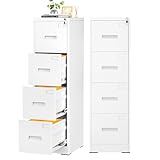
7. INTERGREAT 4 Drawer White Vertical File Cabinet – Best for Legal Files on a 52-Inch Frame
INTERGREAT 4 Drawers File Cabinet with Lock, 18″ D Metal White Vertical Filing Cabinet for Hanging Folders, Easy Assemble
Cold-rolled steel
4 drawers
Legal letter and F4
Ball bearing suspension
Two keys
Pros
- Four drawers sized for legal letter and F4 hanging files
- Ball bearing full suspension glides are quiet
- Interlocking system allows one drawer open at a time
- One lock with two keys included
- Sorting card holder in the top drawer
Cons
- Flat-pack assembly required
- Thinnest rating base among the steel cabinets here
- No lock on the individual drawers
The 18-inch depth is what earns this cabinet its place. Legal hanging folders are the reason most people end up filing at an angle in a shallow cabinet, and an 18-inch body at 15 inches wide and 52.4 inches tall gives a legal folder room to hang properly with documents inside.
Ball bearing full suspension drawers are the quietest mechanism on this frame, and on a cabinet this tall the difference is more than pleasant. Opening the bottom drawer with a full folder load is the moment a cheap slide bends, and ball-bearing glides are the answer to that.
Safety is built into the frame. The interlocking system prevents more than one drawer opening at the same time, which on a 52-inch steel cabinet is the difference between a stable piece of furniture and a lever. One lock with two keys secures all four drawers, so you are not managing four separate keys.
The small detail owners mention most is the file sorting card holder built into the top right drawer. It is where the index cards go, and having them in the cabinet instead of in a drawer on your desk is the sort of thing that quietly makes filing faster for years.
Two caveats. It arrives flat-packed, so budget the build. And at 234 ratings, this has a thinner review base than the other white and black steel cabinets here, which cuts both ways, since a small sample can flatter a product and can also understate a common problem. The specification is solid; the evidence base is simply younger.
Check the height against your ceiling and your desk
At 52.4 inches, this cabinet is tall. It will not go under a standard desk, so measure the vertical space and check for ceiling fixtures and light fixtures before ordering.
The 15-inch width is one of the slimmest steel frames in the set, so it pairs well with the BOWERY HILL above if you need two units side by side in a narrow run.
Where it falls short
Skip it if you want zero assembly. The box is flat-packed even though the manufacturer includes an installation video and the instruction diagrams are clear.
Skip it if you want a printer stand on top and a flush surface. The flat top is better treated as a shelf for light items than a printer platform.
8. VIYET 3 Drawer Vertical File Cabinet – Best Anti-Tip Interlock in a Compact Body
VIYET 3-Drawer File Cabinet with Lock.Vertical Steel Storage for Letter/Legal/A4 Size Folders,Anti-Tip Safety Design,Black
Powder-coated steel
3 drawers
Interlocking anti-tip
Central lock
Card slots
Pros
- Interlocking system allows only one drawer open at a time
- Two heavy-duty ball-bearing slides per drawer
- Single central lock secures all three drawers
- Baked powder-coated finish resists rust and scratches
- Built-in card slots in every drawer for labelling
Cons
- Assembly required though instructions and video are provided
- Three drawers limit total volume
- Smaller rating base than most picks here
This cabinet answers the question a family with a toddler asks first: what stops a tall cabinet tipping when a child pulls an open drawer? The interlocking drawer system means only one drawer can be open at a time, so a second pull cannot be used to shift the cabinet’s weight forward.
Two heavy-duty ball-bearing slides per drawer are a genuine upgrade over a single friction rail, and they hold alignment under a full load of hanging folders where cheaper slides drift. The 17.72-inch body depth also gives letter-size folders a proper hang rather than a lean.
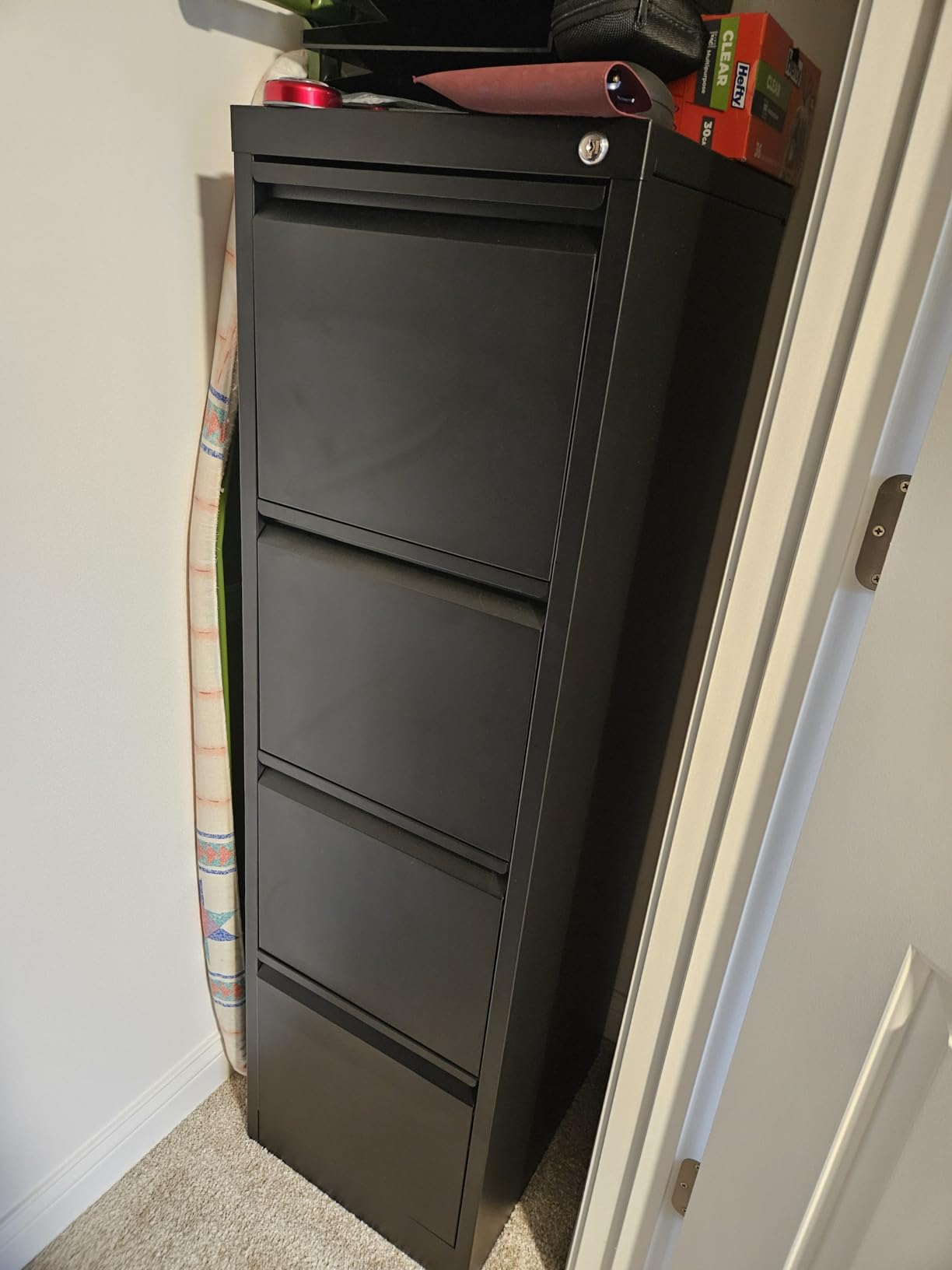
The baked powder-coated finish is bonded to the steel rather than sprayed on, which is why it resists rust, scratches and corrosion better than a painted shell. It also wipes clean, which matters in a room where a cabinet collects fingerprints from daily use.
One central lock secures all three drawers at once, and every drawer has built-in card slots for labelling, so you can index the contents without buying a separate labelling system. At 14.96 inches wide and 40.59 inches tall, it fits under most standard desks and stays narrow enough for a small room.
The honest limit is the rating base. At 176 ratings this is among the less-reviewed cabinets here, and the specification is strong enough that we would still consider it, but we would tell a buyer to expect a thinner warranty of experience behind it. Assembly is required, with instructions and an installation video provided.
What to verify on arrival
Confirm the interlock works by opening two drawers at once. If both come out, the linkage has not seated and the cabinet needs reassembly before it is loaded.
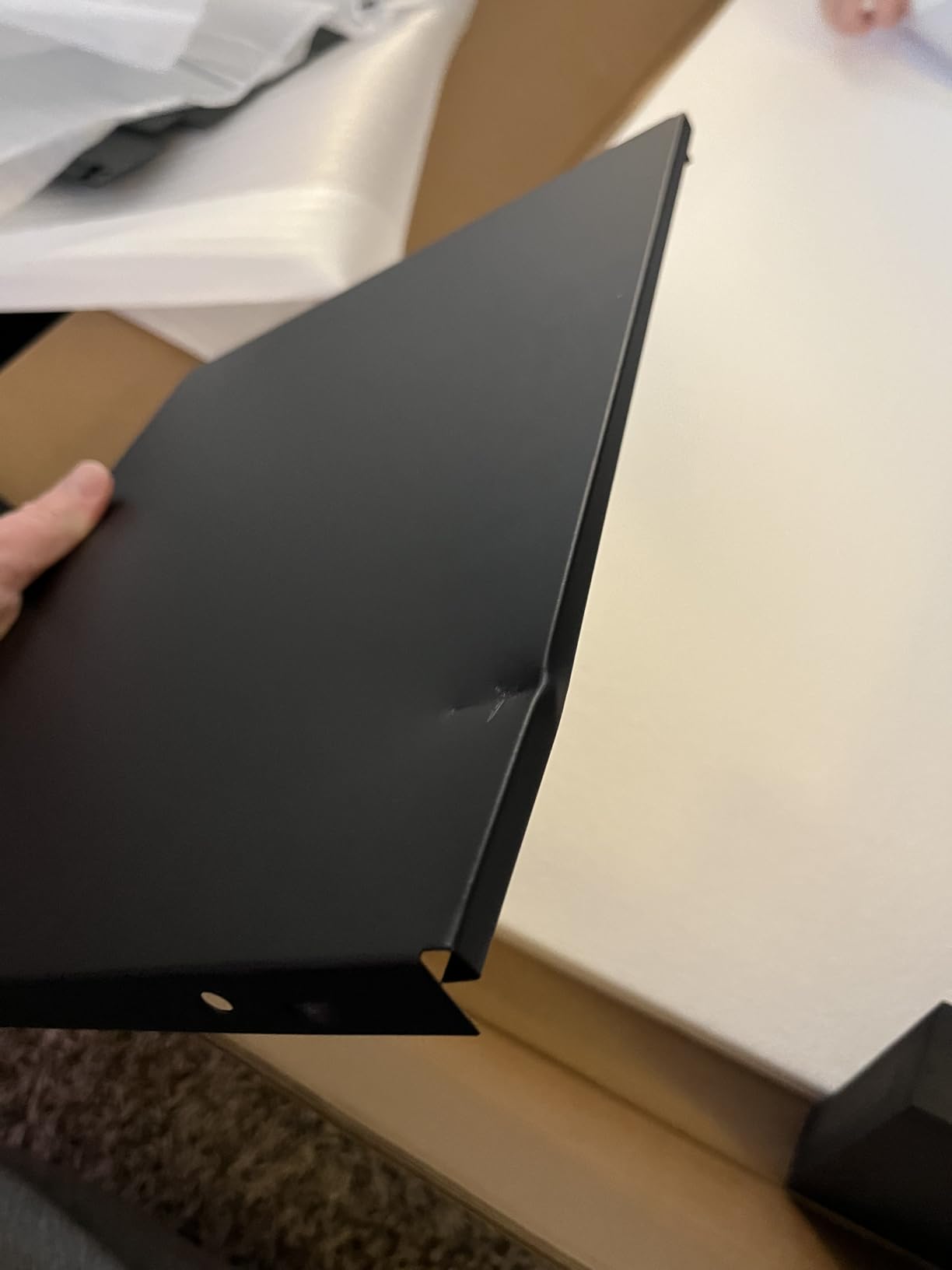
Check the baked coating for chips around the drawer edges before you file anything, because a chipped spot is where corrosion starts in a damp room.
Where it falls short
Three drawers is a working-home-office volume, not a records volume. If you are consolidating several years of paperwork at once, a four-drawer frame gives you breathing room at the same footprint.
Choose a different cabinet if the under-desk location is not the plan. At 40.59 inches tall it will fit, but nothing is gained by putting a filing cabinet where you want a chair leg.
9. Sauder Palladia 2 Drawer Lateral File Cabinet – Best for Matching Your Furniture
Sauder Palladia 2 Drawer File Cabinet, Lateral Filing Cabinets for Home Office, Hanging File Folders Organizer, Interlocking Drawers, in Split Oak Finish
Engineered wood
2 lateral drawers
Full extension slides
Letter legal and European
Five year warranty
Pros
- Full extension slides reach files at the back
- Patented interlock opens one drawer at a time
- Accepts letter legal and European hanging files
- Five year limited warranty with parts service
- Split Oak finish matches the Palladia collection
Cons
- Over 100 pounds so two people are needed
- Assembly commonly takes several hours
- No lock included
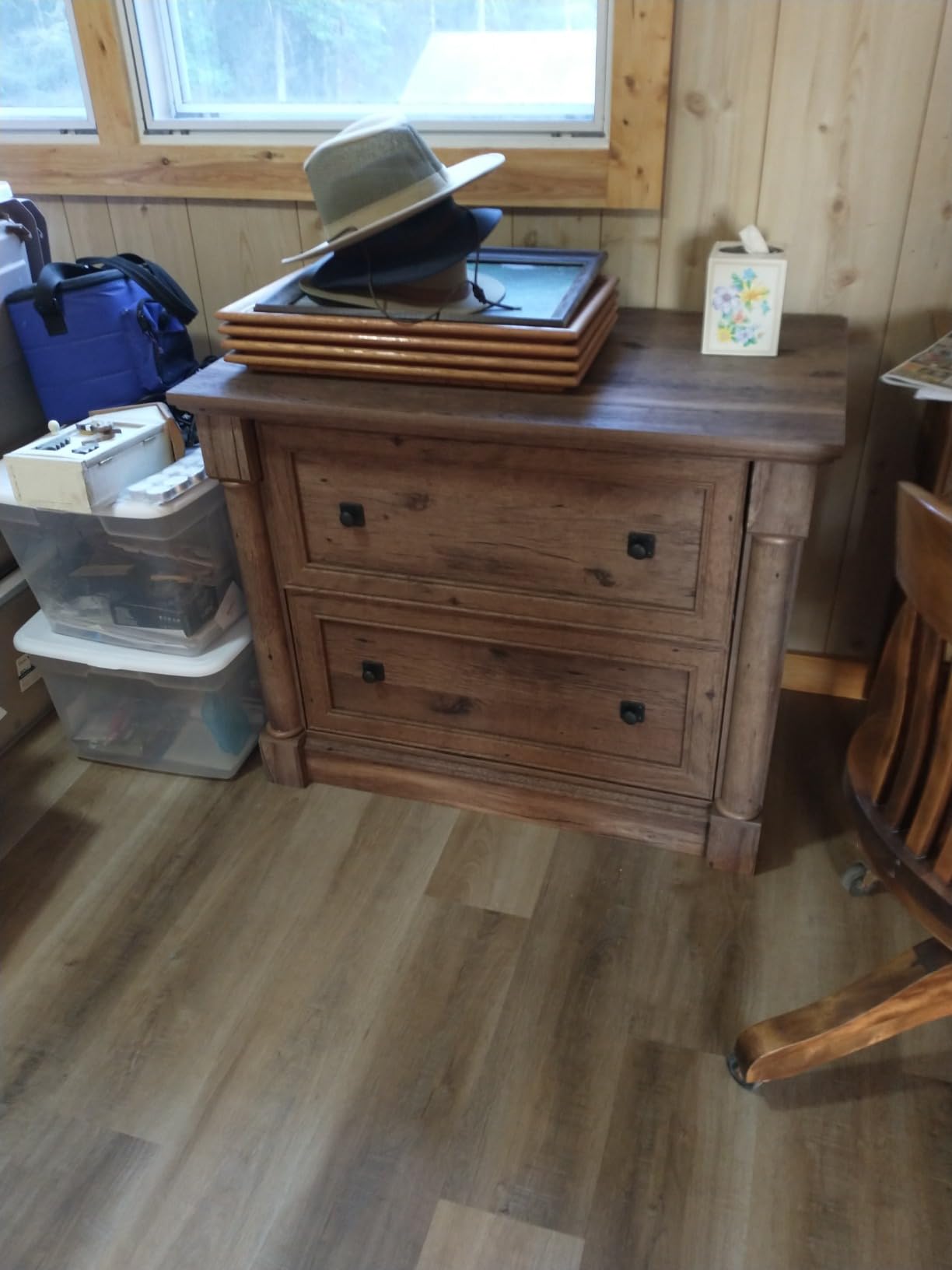
The most common request in home office and workspace forums is a file cabinet that matches the rest of the room instead of looking like borrowed equipment. This is our best answer in the roundup for that. The Split Oak finish reads as real wood, and it belongs to a collection, so it matches a desk rather than competing with it.
Functionally, the two lateral drawers reach your folders better than most units here. Full extension slides pull the drawer right out, which means the tab on the folder at the back is as easy to read as the one at the front. The manufacturer lists letter, legal and European-size hanging files, so the fit is broader than most wood cabinets in the category.
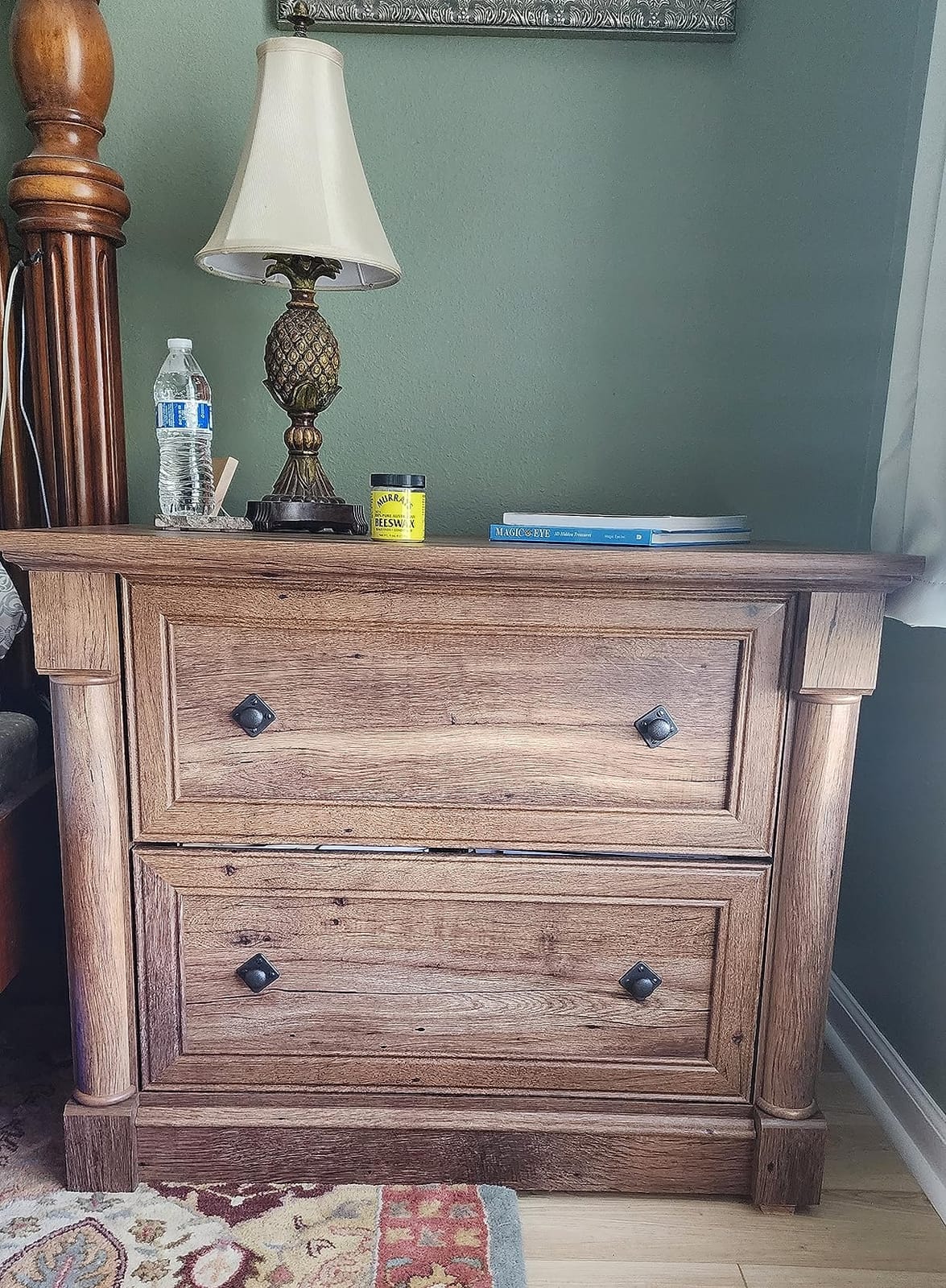
The patented interlocking mechanism allows only one drawer open at a time, which matters more here than in a steel cabinet because the thing is wide and heavy. At 36.81 inches wide and 29.61 inches tall, the two drawers are large lateral drawers rather than a compromise.
The warranty runs five years on parts, backed by a replacement-parts service, and only the Bush Home Key West in this roundup carries a longer one. For a piece of furniture you intend to keep for a decade, that is worth real money.
What you give up is weight and build time. At over 100 pounds empty, two people are usually needed to move and assemble it, and owners commonly report three to six hours on the build, with some units needing a rubber mallet. There is no lock. And the glossy Split Oak finish shows fingerprints, which is the one aesthetic flaw in a cabinet bought for its looks.
If you want the same look without the move-in project, the storage-cabinet options we cover for kitchens follow a similar logic: buy the finish once and plan the assembly around it.
What to do before the box arrives
Move the pieces into the room before you build. At 36.81 inches wide and over 100 pounds assembled, this cabinet is not something you want to carry down a hallway a second time, and the two panels that form the carcass are the awkward ones.
Protect the floor. A number of owners report the base panel scratching wood floors, and felt pads under the feet solve it in a minute.
Where it falls short
Skip it if you are alone and short on time. The weight and the build time are the two reasons it does not suit a quick setup, and both are structural rather than fixable.
Skip it if you need a lock. There is none, and adding one to engineered wood is a job in itself.
10. Staples 4 Drawer Vertical File Cabinet – Best No-Assembly Option for Letter Files
Staples Commercial 4-Drawer Vertical File Cabinet, Locking, Letter, Black, 22-inch D (22337D)
Metal
4 drawers
22 inch depth
Keyed lock with two keys
Ball bearing glides
Pros
- Arrives fully assembled with nothing to build
- 22 inch body is the deepest steel frame here
- Ball-bearing glides on every drawer
- Keyed lock with two keys included
- Built-in label frames in each drawer
Cons
- Deeper than other models so it needs more floor space
- Some units report sticking drawers and transit dents
- Letter size is the stated folder limit
In a roundup where two picks need several hours of flat-pack building before the first folder goes in, arriving ready to load is a different kind of value than a feature list.
The 22-inch body is the deepest of the steel cabinets here, and depth is the dimension that governs folder fit. Letter-size hanging folders with thick contents sit flat rather than tilting, and there is room in the drawer for hanging folders plus the loose paper that always accumulates alongside them.
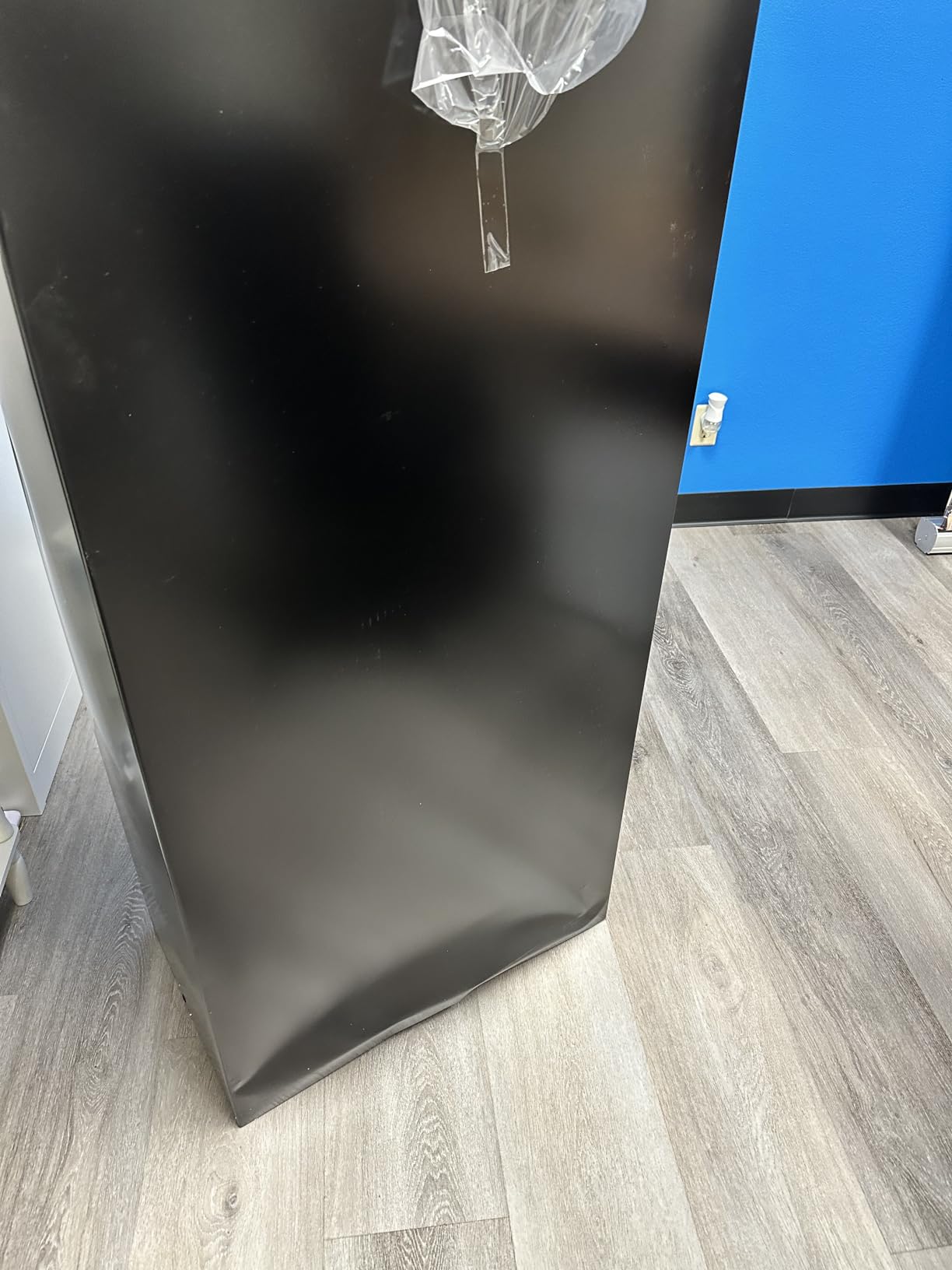
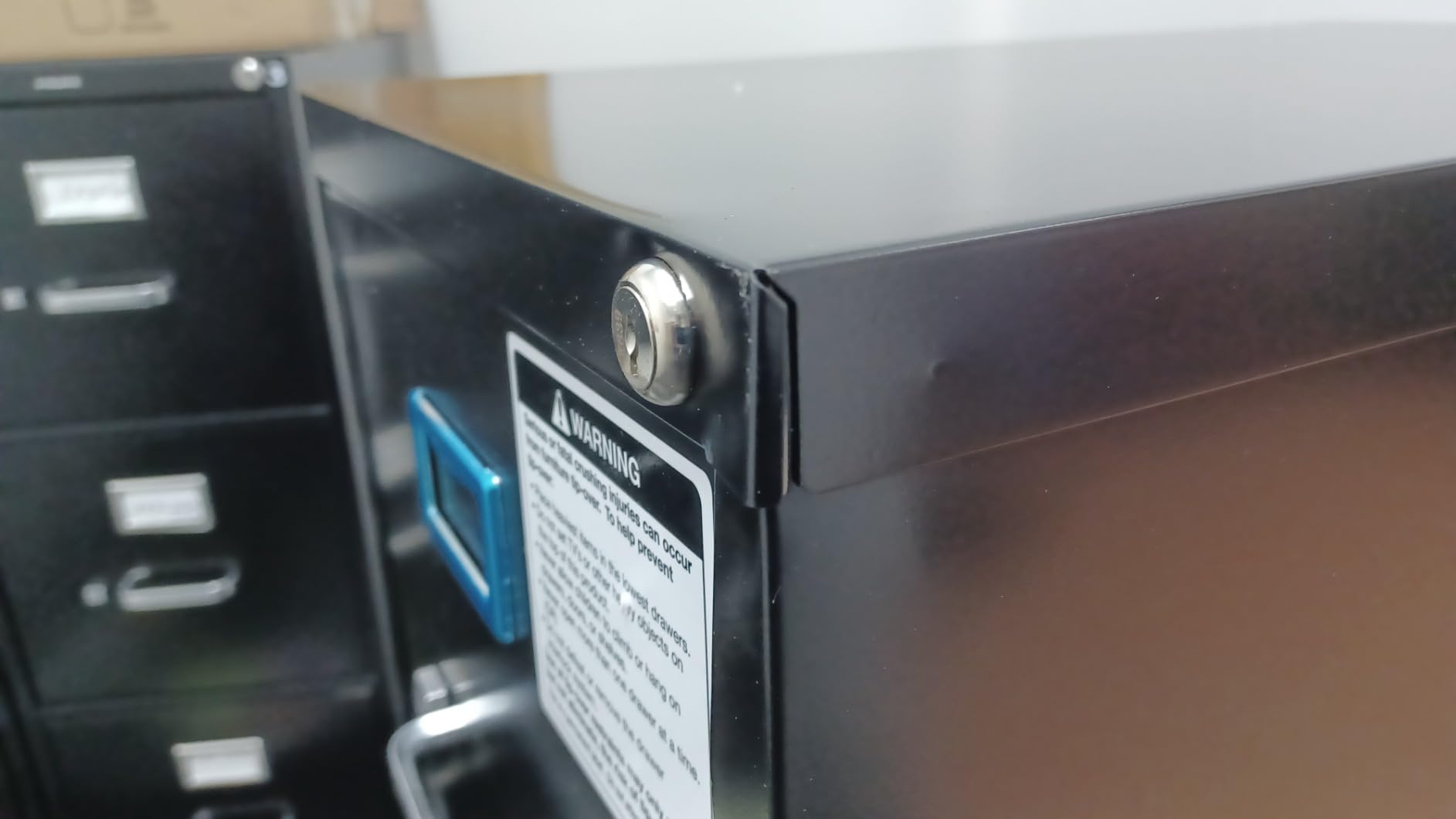
Ball-bearing glides are fitted to every drawer, and the keyed lock arrives with two keys. Built-in label frames in each drawer front are a small thing that pays off every time you stand in front of an open cabinet, because you are reading a card rather than pulling a drawer to see what is inside.
Owners in business settings rate it as dependable equipment rather than a home purchase, and the extra depth suits bulky file storage in a way the narrower steel cabinets here cannot.
Two limitations to plan around. The 22-inch depth makes it the least space-efficient footprint in the roundup, so it needs a real corner rather than a gap beside a desk. And the manufacturer states letter-sized hanging files, so if you are filing legal folders, treat this as a letter-cabinet with generous room rather than a legal cabinet.
A minority of reviews describe drawers that stick or need prying, dents arriving in transit, and mismatched drawer interior dividers. Inspect all four drawers and both locks before the first folder goes in.
Check the footprint first
Measure the floor space, not the room. At 22 inches deep by 22 inches wide by 51.97 inches tall, this cabinet is a square footprint with an open drawer, and it needs clear space in front for that drawer to travel.
Decide where the lock keys live on day one. Two keys ship with the cabinet, and a keyed lock with no spare key in a drawer at home is a locked cabinet with a filing problem.
Where it falls short
Choose a smaller unit if the paper volume is light. A 22-inch-deep body for a few hundred pages is paying for capacity you will not use.
Choose a legal-rated cabinet if legal hanging folders are your main filing size, since only letter size is stated for this model.
How to Choose a File Cabinet for Hanging Folders in 2026
Start with the format, because it decides where your folders face and how deep the cabinet has to be. A vertical cabinet pulls front to back, so the folder width matches the cabinet width, and you need about 18 inches of body depth for comfortable legal hanging files. A lateral cabinet pulls side to side, so it is wider, shallower and lower, and the folder width matches the cabinet depth instead. Mobile units are verticals on casters.
A vertical is the most efficient use of floor space in a one-person home office with a mixed paper load. A lateral reads better in a living room or a room where the cabinet has to look like furniture, and it gives you wider drawers. If your paper volume is genuinely large, lateral wins on volume per unit of floor area, which is why the four-drawer lateral is our high-volume pick.
Next, run the depth math before anything else. Legal hanging folders hang forward of the drawer front and need a body around 18 inches deep or more. A 15 to 16 inch cabinet forces legal folders to lean, and the leaning is what bends rails and produces the complaints we read. A4 folders run narrower than letter and fit letter-rated rails, so A4 is never the problem size.
Then choose the material against how you will use it. Cold-rolled steel is rigid, moisture resistant and takes a full load of hanging folders without flexing, and it is the only sensible choice in a basement, garage or shared office. Engineered wood looks like furniture and is fine for a moderate paper load. Particleboard is the softest of the three, feels hollow when a drawer is full, and is the material most likely to have pilot holes strip during assembly.
On locks, decide what you are protecting. A cam lock keeps documents out of a casual glance, while a keyed central lock secures every drawer with one key, which is what most people want. It is worth checking how many keys are included, because a lock with no spare is an expensive filing problem.
On tip-over safety there are three tiers. The first is an interlocking drawer system, where only one drawer opens at a time, and four picks in this roundup have it. The second is a centre caster or a locking front caster, which stops a rolling cabinet moving while a drawer is open. The third is a wall anchor, and two picks here include the hardware. If you have children or a dog, fit the first and the third.
Three picks in this roundup arrive fully assembled or with only handles to fit, and cost you nothing but floor space. Two are light builds, and two are the kind of long evening project that turns a good cabinet into a resentment. Be honest about your Saturday.
There are cases where a file cabinet is the wrong answer, and it is worth naming them. If the documents are irreplaceable originals such as deeds or certificates, a fireproof and waterproof safe rated for an hour of fire exposure is the correct destination, and a steel cabinet is not. If you have a scanner, a paperless workflow removes the filing question entirely.
For craft and fabric storage, hanging folders sorted by colour or pattern work in almost any cabinet with rails, including a dresser fitted with hanging-file inserts. That is the budget route people on organizing forums recommend most often, with the caveat that cheaper drawer units can sag under heavy loads after a year of bills and statements.
On brands, the honest summary is that the established names in this category split into two groups. Commercial specialists build steel cabinets rated for daily office use and arrive assembled or nearly so, while the high-volume online brands compete on price, finish and feature count. The established names include Staples and the office-supply houses, and the online group includes Letaya, VASAGLE, Space Solutions and MIIIKO. Neither group is automatically better; the deciding factor is whether the drawer count is made of file drawers and whether the listed folder size matches your paper.
For a broader look at how storage cabinets are chosen outside the office, our kitchen storage-cabinet guide covers the same depth-versus-width and material trade-offs from a different room. If you are also building the desk that goes beside the cabinet, our dovetail machine guide and boring machine guide cover the joinery side of that same project.
Frequently Asked Questions
How do I hang folders in a filing cabinet?
Open the drawer fully so the rails sit level, check that the drawer has two parallel hanging rails or removable bars, set the folder tabs forward, hook the folder rails onto the drawer rails toward the back, then stand the folder upright and push it back until it rests against the drawer front. Add folders one at a time and keep the load balanced so the rails do not bow.
Do file cabinets hold legal-size hanging folders?
Only if the cabinet is deep enough. Legal hanging folders are deeper than letter folders, so a cabinet with a body around 15 to 16 inches deep forces them to tilt forward and lean on the drawer front. Look for 18 inches of depth or more, and check the internal drawer depth as well as the cabinet depth.
How many hanging folders fit in a file cabinet drawer?
Plan on roughly 50 to 60 hanging folders per drawer at a normal working level. A four-drawer cabinet therefore holds around 200 to 240 folders. Individual manufacturers rate some drawers higher, and one two-drawer mobile model in this roundup is listed at 150 to 300 files per drawer.
Is a lateral or vertical file cabinet better for hanging folders?
Both hold hanging folders, but they suit different rooms. A vertical cabinet is narrower and more space-efficient for a home office, with folders facing front. A lateral cabinet is wider and shallower, gives you larger drawers, reads more like furniture, and carries more volume per unit of floor area. Choose by space and paper volume rather than by format alone.
Why won’t my hanging folders fit in my file cabinet?
The usual causes are a drawer that has supply drawers rather than hanging rails, a rail span narrower than your folder width, a cabinet too shallow for the folder size so the folder tilts, or a drawer packed so tightly that the rails bow and the folders lean. Check the file-drawer count, the rail span, the internal depth and the folder size before buying.
What do people use instead of filing cabinets?
Common alternatives are a fireproof and waterproof document safe for irreplaceable papers, archive boxes on shelving for bulky material, a paperless scan-and-file workflow, and a dresser fitted with hanging-file inserts for a cheaper route. People also buy secondhand steel cabinets for durability and reserve new cabinets for the room where appearance matters most.
Final Verdict: Which File Cabinet Fits Your Hanging Folders
Buy the Bush Home Key West if you want one cabinet to do everything and to look like furniture while it does it. Buy the Letaya four-drawer lateral if your paper volume has outgrown a home office. Buy the Letaya two-drawer mobile if you want steel under your desk and an afternoon back, because it arrives built. Buy the VASAGLE if your filing is A4 and letter only and you need per-drawer locks plus a printer stand on top.
For everything else, match the format to the room and the folder size to the spec. Legal hanging folders need a body around 18 inches deep, A4 fits letter-rated rails without trouble, and the number that matters more than the drawer count is the number of drawers that actually carry rails. Check that before you buy, and the best file cabinets for hanging folders choice stops being a gamble. The picks and the fit verdicts in this 2026 roundup are all still worth a second look before you order.