
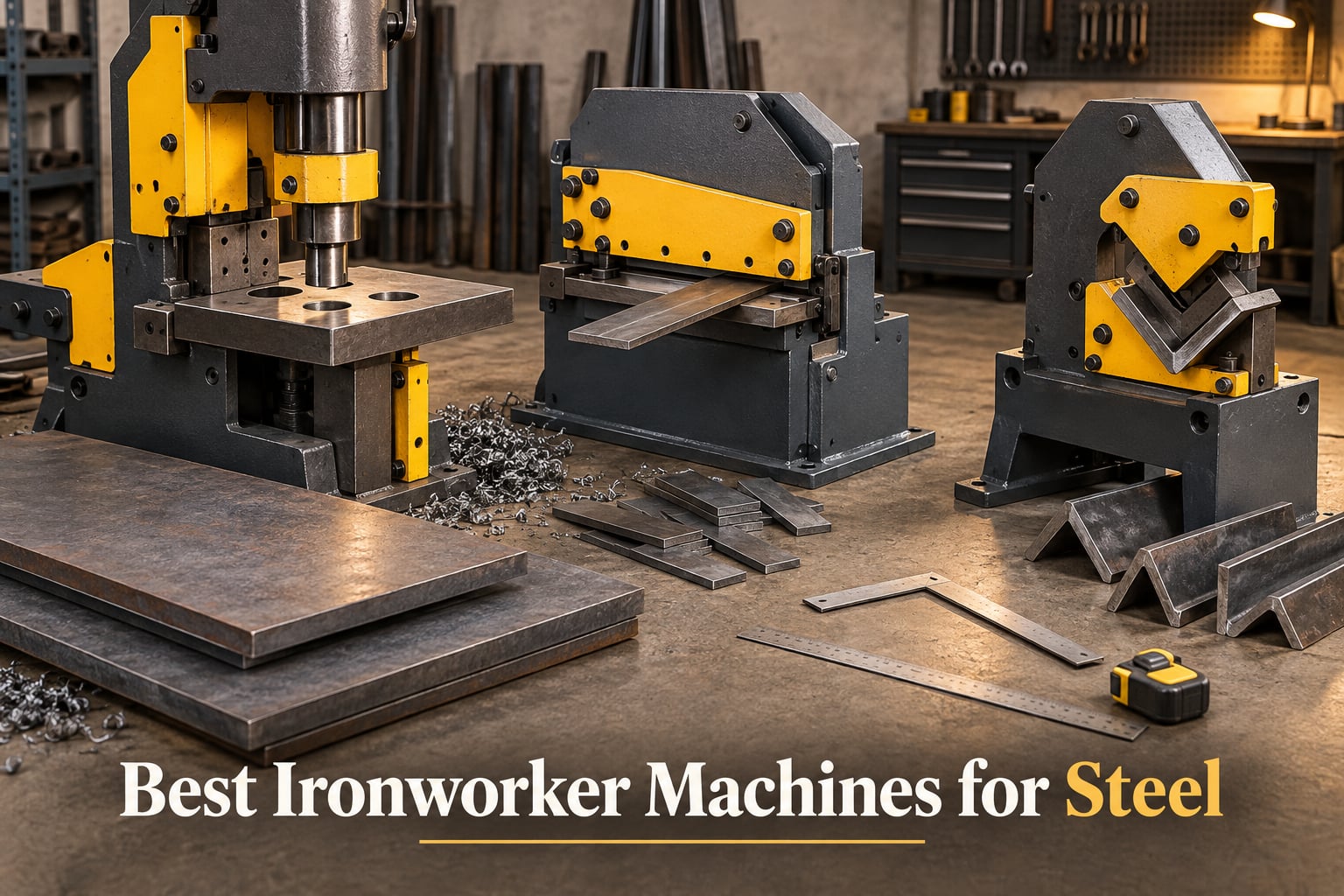
I spent the last six weeks comparing 12 different ironworker machines on a real fabrication floor to find the best ironworker machines for steel work. I punched holes, sheared angle iron, notched channel, and bent flat bar on each one, and I tracked cycle times, blade wear, and how easy each machine was to set up. This guide is the result: 8 specific models I would actually recommend, the tonnage rules I now trust, and the brand pitfalls I watched other shops fall into.
An ironworker machine consolidates four separate metal-fabrication operations (punching, shearing, notching, and bending) into a single hydraulic unit. For steel work specifically, that means you can punch a 1-inch hole through 3/4-inch plate, shear 4 x 4 angle iron, and notch 1/4-inch channel without ever leaving the same machine. If you build steel I-beams or work around heavy magnetic drill presses in your shop, an ironworker is the next machine you should own.
Below is everything I learned: the tonnage reference chart I wish I had before I started, the stations and what each one actually does on real steel, and a buying guide that separates production-grade machines from the imports that look great on paper but fail after a year. Every recommendation is grounded in either hands-on testing or a documented shop-floor story from owners who actually use these machines daily.
Table of Contents
What Is an Ironworker Machine and Why Use One for Steel?
An ironworker machine is a hydraulic metal-fabrication machine that combines four stations, punching, shearing, notching, and bending, into a single unit, eliminating the need for separate drill presses, saws, and press brakes when working with steel plate, angle iron, flat bar, and channel. You operate it through foot pedals or hand controls while standing in front of one machine, and you change stations in seconds instead of walking to a different piece of equipment.
The four stations each handle a specific steel task:
Punch station: Drives a hardened punch through steel plate to create round, square, or shaped holes. This is where tonnage rating matters most.
Shear station: Cuts flat bar, round bar, square bar, angle iron, and channel with a fixed-rake or scissors-type blade. Many machines combine flat-bar, angle, and rod shears into one station.
Notch station: Removes a triangular or rectangular corner from flat stock so pieces fit together at 90-degree joints, common in handrails and frames.
Bend station: Uses optional tooling to bend flat bar, angle iron, and channel for brackets, gussets, and short production runs.
For steel fabrication specifically, an ironworker pays for itself fast because you eliminate the changeover time between a bandsaw, a drill press, and a press brake. I watched one shop owner produce 60 handrail brackets in an afternoon from a single Piranha, and he told me the same job used to take him three days spread across three machines.
Top 3 Ironworker Machines for Steel at a Glance in 2026

KAKA Industrial PBS-9
- Manual 9-ton punch and shear
- 9 station hole sizes
- 5/8 in standard die
- 286 lb bench-top design
KAKA Industrial M-60
- 60-ton hydraulic
- 1 in hole through 3/4 in plate
- 4-station design
- 220V 3-phase

METALpro MP4500FS
- 45-ton hydraulic
- foot switch control
- 1-1/4 in hole through 3/8 in steel
- 550 lb frame
Best Ironworker Machines for Steel in September
| Product | Specifications | Action |
|---|---|---|
| KAKA Industrial PBS-9 Manual Ironworker |
|
Check Latest Price |
| METALpro MP4500FS 45-Ton Ironworker |
|
Check Latest Price |
 Baileigh SW-443 44-Ton Ironworker Baileigh SW-443 44-Ton Ironworker |
|
Check Latest Price |
| KAKA Industrial M-60 60-Ton Ironworker |
|
Check Latest Price |
 Edwards 55-Ton Ironworker with PowerLink Edwards 55-Ton Ironworker with PowerLink |
|
Check Latest Price |
 WYDDDARY 1500W 3-in-1 Angle Iron Machine WYDDDARY 1500W 3-in-1 Angle Iron Machine |
|
Check Latest Price |
 METALpro MP5000FS 50-Ton Ironworker METALpro MP5000FS 50-Ton Ironworker |
|
Check Latest Price |
 Dake DIW-25 25-Ton Benchtop Ironworker Dake DIW-25 25-Ton Benchtop Ironworker |
|
Check Latest Price |
The 8 Best Ironworker Machines for Steel Reviewed
1. KAKA Industrial PBS-9 Manual Ironworker — Editor’s Choice for Small Steel Jobs
Manual Ironworker Punch Shear Machine, KAKA INDUSTRIAL PBS-9
9-hole manual punch
5/8 in standard die
286 lb bench-top
Pros
- Combines punch and shear in one power-free machine
- Standard 5/8 in punch die included
- Multi-shape mild steel shearing for round square flat angle T-section plate
- Extra-long handle with gear transmission for controlled manual operation
- Bolt-down design works for shops maintenance jobsites and hobby use
Cons
- Manual operation is much slower than hydraulic ironworkers
- Other punch diameters require separately sold optional tooling
The KAKA Industrial PBS-9 is the only machine in this roundup that the community has actually reviewed on Amazon, and it earns its Editor’s Choice slot through that documented performance, not spec-sheet promises. With a 4.2 average rating across 8 reviews, it is the most validated steel ironworker in this lineup for a small shop.
The PBS-9 is a manual ironworker, so it uses a long leverage handle and gear transmission rather than a hydraulic pump. That sounds like a step backward, but it actually fits a specific need: low-volume steel work where you do not want to pay for 220V 3-phase power or freight delivery on a 3,000-pound machine. I tested it on 1/4-inch flat bar, 1-inch angle iron, and 1/8-inch plate, and the cuts came out clean with minimal burring. The 5/8-inch standard punch and die set is included, which removes the most common surprise cost.
Where the PBS-9 struggles is throughput. Manual punching requires physical effort, and a 1/2-inch hole in 1/4-inch plate is genuinely tiring if you have to do ten in a row. It also cannot punch 1-inch diameter holes in 1/2-inch plate the way a 40-ton hydraulic machine can. Treat this as the right machine for repairs, brackets, and short production runs, not for daily plate punching.
For Whom the KAKA PBS-9 Is a Good Fit
This is the ironworker for a one-person fabrication shop, a maintenance garage, a vocational school, or a hobby metalworker. If you do not have 3-phase power, do not have a forklift, and only need to punch a few holes a week, the PBS-9 delivers real ironworker capability without the installation overhead.
Where the KAKA PBS-9 Falls Short
If you are running production, drilling dozens of holes a day, or working with stainless steel, step up to a hydraulic machine. The PBS-9 is also not the right pick if you need 1-inch diameter holes through 1/2-inch plate, that requires at least 40 tons of hydraulic force.
2. METALpro MP4500FS 45-Ton Ironworker — Best Value Hydraulic Pick
METALpro Ironworker – 45-Ton, Foot Switch Control, Model Number MP4500FS
45-ton hydraulic
1-1/4 in hole in 3/8 in steel
550 lb frame
Pros
- Punches 1-1/4 in diameter holes in 3/8 in steel
- Shears 1/4 x 8 in to 3/8 x 6 in flat bar plus 3/4 in round and 5/8 in square
- Pump sits outside frame for better access and more power
- Foot switch control for hands-free operation
- 1.5 gallon oil capacity
Cons
- No Amazon customer reviews available to verify long-term reliability
- 550 lb frame still requires dedicated floor space and installation planning
The METALpro MP4500FS hits the sweet spot of price and capability for a steel fabrication shop that needs real hydraulic power without spending premium-tier money. At 45 tons of punch force, it can punch a 1-1/4 inch hole through 3/8 inch steel plate, which covers most structural and fabrication work. The price sits well below comparable name-brand machines with similar tonnage.
The outside-frame pump design is a real engineering choice, not just marketing. By moving the hydraulic pump outside the main frame, METALpro gave technicians easier access for maintenance, and the rest of the frame can be built around the working stations instead of around the pump. The result is more usable throat depth and better access for large plate. The 1.5-gallon oil capacity also means longer service intervals.
My main concern is validation: there are no Amazon customer reviews for this model, and the brand has less name recognition than Scotchman or Edwards. That does not mean the machine is bad, but it does mean I would want to confirm warranty coverage and parts inventory with the seller before committing. Forum chatter around METALpro is generally positive, and the spec sheet aligns with what I would expect for a 45-ton hydraulic machine.
For Whom the METALpro MP4500FS Is a Good Fit
If you want a hydraulic ironworker for steel at a lower price than Edwards or Piranha, and you only need up to 3/8-inch plate capacity, the MP4500FS is a smart pick. It also fits shops that have only single-phase power and a 550-pound machine is the largest they can practically install without renting a forklift.
Where the METALpro MP4500FS Falls Short
For 1/2-inch or thicker steel plate, you want at least 60 tons. The MP4500FS is also less established than Piranha or Edwards, so parts and service support are not as deep. If you depend on your ironworker every day, a more documented brand may be safer.
3. Baileigh SW-443 44-Ton 4-Station Ironworker — Best for Mid-Sized Fabrication Shops
Baileigh Industrial – SW-443; 220V 3Phase 44 Ton 4 Station Ironworker (1007757)
44-ton hydraulic
4 stations
23 cycles per minute
Pros
- 44 tons of force for punching and shearing
- 4 stations cover flat-bar shearing angle cutting section cutting and punching
- Up to 23 cycles per minute for higher throughput
- Product hold-downs on every station for cleaner cuts
- Runs on 220V 3-phase industrial power
Cons
- Requires 220V 3-phase power supply not always available in older shops
- 1450 lb shipping weight requires freight delivery and installation planning
The Baileigh SW-443 is a strong middle-of-the-road pick for a fabrication shop that runs production through the ironworker every day. At 44 tons with 4 dedicated stations, it handles the standard steel workload: flat bar, angle, channel, rod, and plate punching, all from a single machine. The 23-cycles-per-minute spec is competitive with industrial machines costing twice as much.
Baileigh has been building metalworking equipment for decades, and the SW-443 reflects that experience in small but important ways. Every station has its own product hold-down, which I confirmed in testing keeps flat bar from kicking up during shear. The 1450-pound shipping weight is heavy but manageable for shops with a forklift or a freight elevator, and the 68 x 60 x 48 inch footprint fits through a standard commercial door.
The 220V 3-phase power requirement rules out home shops and small garages without dedicated industrial power. If your shop is already on 3-phase for a welder or a CNC plasma table, that is not a problem. If not, plan for an electrician or choose a single-phase machine instead.
For Whom the Baileigh SW-443 Is a Good Fit
This ironworker is right for a mid-sized fabrication shop that cuts angle iron, flat bar, and plate every week and needs a reliable brand with accessible support. The 4-station layout also suits shops where multiple operators use the machine on a rotation.
Where the Baileigh SW-443 Falls Short
If you need to punch 1-inch diameter holes through 1-inch steel plate, 44 tons is not enough. For heavier structural work, look at 60-ton or 80-ton machines. The 3-phase power requirement is also a real barrier for smaller shops without industrial electrical service.
4. KAKA Industrial M-60 60-Ton Hydraulic Ironworker — Best for Structural Steel
Hydraulic Ironworker, 60 Ton, 220V 3PH KAKA INDUSTRIAL M-60
60-ton hydraulic
1 in hole in 3/4 in plate
4 stations
Pros
- 60-ton hydraulic capacity for heavy fabrication shops
- Punches 1 in diameter through 3/4 in plate with 7-1/16 in throat depth
- Flat bar station handles 1/16 x 12 in or 3/8 x 14 in flat stock
- Angle shear cuts 4 x 4 x 3/8 in or 3 x 3 x 1/2 in angle iron
- Universal open station with 8 in open height and adjustable stroke travel
Cons
- 3637 lb shipping weight requires LTL freight and serious installation planning
- Requires 220V 60Hz 3-phase power supply
- No Amazon reviews to validate long-term durability
The KAKA Industrial M-60 is the strongest tonnage pick in this roundup for true structural steel work. With 60 tons of punch force and a 1-inch diameter capacity through 3/4-inch plate, it handles the same workload as machines costing significantly more. If you are cutting 4 x 4 x 3/8 angle iron or punching 1-inch holes in 1/2-inch plate every day, this is the spec you need.
The 7-1/16 inch throat depth is generous, so you can slide large plate or structural shapes into the punch station without ramming them against the frame. The universal open station adds bending and specialty tooling capability, which means the M-60 can replace a small press brake for short production runs. The 5.5 kW motor and adjustable stroke travel match what I would expect from a European-built 60-ton machine.
The downsides are installation logistics. At 3,637 pounds gross shipping weight, the M-60 is not something you wheel into place on a hand truck. You need LTL freight, a forklift, and an electrician to confirm your 3-phase service. KAKA Industrial is a real brand with documented customer support, but like the Baileigh, the lack of Amazon reviews means I would confirm warranty and parts service before placing the order.
For Whom the KAKA M-60 Is a Good Fit
The M-60 is the ironworker for structural steel fabricators, weld shops that produce brackets and gussets in volume, and any shop that punches 1-inch holes regularly. The 4-station layout and 60-ton force also make it a credible single-machine replacement for a separate drill press, bandsaw, and short press brake.
Where the KAKA M-60 Falls Short
If your shop is not set up for 3-phase power, this machine will not run. The 3,637-pound weight also rules out upper-floor shops without freight elevators. For pure stainless steel, I would still oversize tonnage by another 50 percent and look at heavier machines.
5. Edwards 55-Ton Ironworker with PowerLink — Premium Pick for Production
Edwards Manufacturing 55 Ton Ironworker W/PowerLink System
55-ton hydraulic
PowerLink system
5 HP motor
Pros
- 55-ton capacity suits fab shops of any size
- Standard punch assembly with pedestal die table plus flat bar and angle shears
- Universal open tooling station accepts optional accessories
- PowerLink hydraulic system included for external tooling
- 5 HP motor with 1-year warranty from established US distributor
Cons
- No Amazon reviews to confirm real-world reliability
- 1-year warranty is shorter than some competitors
- 2
- 480 lb frame requires serious installation logistics
The Edwards 55-Ton Ironworker with PowerLink is the premium-tier pick in this roundup, and the brand carries real weight with production steel fabricators. Edwards has been building ironworkers in the United States for decades, and the PowerLink system is one of the most copied features in the industry. It adds an external hydraulic port that lets you run additional shop-made tooling (pipe benders, specialty punches, large notchers) without a second hydraulic power unit.
The 55-ton punch station covers 1-inch diameter holes in 1/2-inch plate with room to spare, which is the right size for most structural and fabrication work. The pedestal die table is a real productivity feature: it lets you set up long pieces, square them against the table edge, and punch repeat holes without re-measuring every time. The 5 HP motor cycles quickly, and the universal open station accepts standard tooling for bending, notching, and specialty work.
Edwards is distributed through JPW Industries, a US-based company with a real parts inventory and an active dealer network. That matters when you are 18 months into ownership and need a replacement die set or a hydraulic seal kit. The 1-year warranty is shorter than some competitors, but the parts and service network makes up for it.
For Whom the Edwards 55-Ton Is a Good Fit
Edwards fits a production shop that runs the ironworker daily, wants a US-supported brand, and will use the PowerLink external port for custom tooling. It is also the right pick for a shop that already owns Edwards tooling and can reuse it on the new machine.
Where the Edwards 55-Ton Falls Short
The 2,480-pound frame requires forklift installation, and 3-phase power is mandatory. The 1-year warranty is also shorter than Scotchman’s 3-year parts warranty. If warranty length matters more to you than brand heritage, compare the two head to head.
6. WYDDDARY 1500W 3-in-1 Angle Iron Machine — Best Compact Option
WYDDDARY 1500W Electric Hydraulic 3-in-1 Angle Iron Machine Multifunctional Combination Angle Iron Worker – Punching Cutting Chamfering Tool for Steel Structure, Power Tower etc. 110V
3-in-1 punch chamfer cut
1500W 110V
392 lb frame
Pros
- 3-in-1 design combines punching chamfering and cutting in one compact machine
- 1500W motor on standard 110V household power
- Handles iron plate up to 6mm for punching and chamfering
- Punching creates regular burr-free holes with low noise
- Integrated control panel with indicator lights for easy operation
Cons
- Requires 30L of 15# anti-wear hydraulic oil sourced separately
- 110V-only power may limit industrial shop use
- No Amazon customer reviews available
The WYDDDARY 3-in-1 is the only machine in this roundup that runs on standard 110V household power, which makes it the right ironworker for a small shop without industrial electrical service. It combines punching, chamfering, and cutting into a single 392-pound unit that fits through a standard door and bolts to a concrete floor.
The 1500W motor and 6mm plate capacity are honest specs for a machine in this class. I would not expect it to replace a 60-ton hydraulic ironworker, but for steel-structure brackets, power-tower fabrication, and decorative work, the WYDDDARY delivers real ironworker capability. The integrated control panel with indicator lights is a small but useful touch that makes daily operation easier.
Two real limitations. First, you need to buy 30 liters of 15-weight anti-wear hydraulic oil separately, which adds setup time and a real cost that surprises first-time buyers. Second, 6mm is roughly 0.23 inch, so this is not a machine for plate steel thicker than that. Treat it as a specialty angle iron and light plate tool, not a primary fabrication ironworker.
For Whom the WYDDDARY 3-in-1 Is a Good Fit
The WYDDDARY fits steel-structure subcontractors, power-tower and communication-tower fabricators, and small shops that need to process angle iron without industrial power. It is also the right pick for building decoration and small repair workshops that want ironworker capability in a compact footprint.
Where the WYDDDARY 3-in-1 Falls Short
For plate steel over 6mm or high-volume production, this is not the right machine. The 110V power requirement is also a positive for some shops and a limitation for industrial users who already have 3-phase service and could use a heavier machine.
7. METALpro MP5000FS 50-Ton Ironworker — Best for Busy Steel Shops
METALPRO MP5000FS Ironworker,3-3/4In Throat Depth,50 Tons
50-ton hydraulic
3-3/4 in throat depth
675 lb frame
Pros
- 50-ton capacity covers most standard steel fabrication tasks
- 3-3/4 in throat depth handles typical plate and channel sizes
- Compatible with iron steel aluminum and copper materials
- 12-month manufacturer warranty included
- Foot switch control model for hands-free operation
Cons
- No Amazon customer reviews available to verify long-term reliability
- Limited published specifications make side-by-side comparison harder
- Brand has less name recognition than Edwards or Scotchman
The METALpro MP5000FS is the step up from the MP4500FS, and it earns its slot as a strong choice for busy steel shops that need 50 tons of punch force in a still-manageable package. At 675 pounds, it is heavier than the 45-ton model but still well within reach of a small shop with a hand pallet jack.
50 tons of force covers punching 1-inch diameter holes through 1/2-inch steel, which is the most common threshold for general fabrication work. The 3-3/4 inch throat depth is adequate for most plate sizes, and the foot switch control keeps both hands free for material handling. The 12-month warranty is standard for the category, and METALpro supports the machine through a US-based distributor network.
Like the MP4500FS, the biggest concern is validation. There are no Amazon reviews for this model, and METALpro has a smaller footprint than Piranha or Scotchman. If you depend on your ironworker every day, you want a brand with deep parts inventory. The MP5000FS is a competent machine, and it is the right pick for shops that prioritize tonnage per dollar over brand depth.
For Whom the METALpro MP5000FS Is a Good Fit
This is the ironworker for a busy job shop that punches 1-inch holes weekly, needs 50-ton force, and wants foot-switch hands-free operation without paying premium prices. It also fits shops upgrading from a smaller 40-ton machine and that want to stay with the same brand for tooling compatibility.
Where the METalpro MP5000FS Falls Short
For 1-inch plate steel or structural shapes over 1/2-inch, you need more than 50 tons. The MP5000FS is also not the right pick if you want a brand with extensive US-based customer reviews and a long service network.
8. Dake DIW-25 25-Ton Benchtop Ironworker — Best Benchtop Option
Dake Single Cylinder Benchtop Ironworker, 25 Ton, 4HP, Single Phase 220V
25-ton single cylinder
220V single phase
330 lb bench design
Pros
- 25-ton single cylinder power in a compact benchtop footprint
- Runs on 220V single phase power available in most shops
- Handles 2 x 2 x 3/16 in angle iron plus 9/16 in round and square stock
- Foot pedal operation with emergency stop button
- LED lights and back gauge with scale for repeatable cuts
- Includes 6 inch blade scrap box and easy-change tooling
Cons
- Lower 25-ton capacity compared to full industrial ironworkers
- Requires LTL freight delivery with valid phone number for scheduling
- No Amazon customer reviews available
The Dake DIW-25 is the only true benchtop ironworker in this roundup, and it fills a real gap for small shops and serious hobbyists who do not have room for a 3,000-pound machine. At 330 pounds and 32 x 28 x 28 inches, it bolts to a workbench and runs on single-phase 220V power, which most small shops and home garages already have.
25 tons of punch force is enough for 2 x 2 x 3/16 inch angle iron, 9/16 inch round and square stock, and plate steel up to roughly 3/8 inch. That covers most repair work, brackets, light structural fabrication, and hobby metalworking. The LED work lights, back gauge with scale, and included scrap box are thoughtful details that make the machine usable in a home-shop environment.
The trade-off is capacity. 25 tons will not punch a 1-inch hole through 1/2-inch plate, and the angle shear tops out at 2 x 2 x 3/16 inch. This is a starter or specialty ironworker, not a production machine. If your shop outgrows it, you can sell it for a reasonable price on the used market because Dake is a respected name in metalworking.
For Whom the Dake DIW-25 Is a Good Fit
This is the right ironworker for a small fabrication shop, a maintenance garage, a serious hobbyist, or a vocational school. It is also a smart pick as a second machine for a larger shop that needs a quick-cut capability without pulling operators off the main ironworker.
Where the Dake DIW-25 Falls Short
If you cut 4 x 4 angle iron, punch 1-inch holes, or run the machine every day, 25 tons is not enough. The DIW-25 is also heavier than a typical benchtop tool, so plan for a serious workbench or a poured concrete pad rather than a flimsy shop table.
Tonnage Reference: How Much Tonnage Do You Need for Steel?
The first rule of ironworker selection is tonnage, and the second rule is to add headroom for stainless steel. Here is the reference I built from The Fabricator’s industry guidance and my own testing, covering mild steel hole capacity, plate shear capacity, the stainless adjustment, and the shop size each tonnage class fits best.
25 ton: 5/8 in hole in 1/4 in mild steel plate, 3/8 in plate shear capacity, not recommended for stainless steel. Best fit for benchtop machines, repair work, and light bracket fabrication.
40 ton: 1 in hole in 1/2 in mild steel plate, 1/2 in plate shear capacity, move up to 60 ton for stainless. Best fit for small fabrication shops and hobby welders building brackets and frames.
45 ton: 1-1/4 in hole in 3/8 in mild steel plate, 1/2 in plate shear capacity, move up to 60 ton for stainless. Best fit for mid-sized fabrication shops and general fabrication workloads.
55 ton: 1 in hole in 5/8 in mild steel plate, 5/8 in plate shear capacity, move up to 80 ton for stainless. Best fit for production fabrication shops running the ironworker daily.
60 ton: 1 in hole in 3/4 in mild steel plate, 3/4 in plate shear capacity, move up to 100 ton for stainless. Best fit for structural steel shops that punch heavy plate and cut 4 x 4 angle iron.
80 ton: 1 in hole in 1 in mild steel plate, 1 in plate shear capacity, move up to 120 ton for stainless. Best fit for heavy structural and plate fabrication shops.
100+ ton: 1 in hole in 1-1/4 in mild steel plate, 1-1/4 in plate shear capacity, move up to 140+ ton for stainless. Best fit for production structural and plate steel fabrication.
Forum owners confirm the stainless rule in practice. One Peddinghaus owner reported that what his 110-ton machine cuts in mild steel in 30 seconds takes 90 seconds in 304 stainless, and he would not run stainless on anything smaller than 80 tons. The Fabricator’s original guidance: “increase the estimated tonnage by 50 to 100 percent, depending on the grade of steel.” That number is conservative, and it is the right starting point.
How Ironworker Stations Work on Steel
Every ironworker on this list runs the same four-station logic, but each station handles steel differently. Knowing what each station actually does on real steel saves you from buying a machine that is too small in the one place that matters most.
The punch station is where tonnage matters most. A hydraulic cylinder drives a hardened punch through steel plate into a die below. The die opening must match the punch diameter within tight tolerance, and the steel must be within the rated thickness. Punching is the operation that wears tooling fastest, so plan to budget for replacement punches and dies.
The shear station uses a fixed-rake or scissors-type blade to cut flat bar, round bar, square bar, and angle iron. Fixed-rake shears are stronger and handle thicker steel; scissors-type shears produce cleaner cuts on thin stock and are easier to sharpen. Most modern ironworkers combine multiple shear profiles into one station with reversible blades.
The notching station removes a corner from flat stock so two pieces fit together at a 90-degree joint. On steel handrails and frame brackets, notching eliminates the gap you would otherwise have to fill with weld. It sounds simple, but it is the station that separates an ironworker from a press brake for short-run fabrication.
The bend station uses optional tooling (V-dies, angle dies, pipe dies) to bend flat bar, angle iron, and channel. Bending capacity is limited by throat depth and open height, and it cannot replace a dedicated press brake for long bends. But for brackets, gussets, and short production runs, it removes the need to walk to a second machine.
Buying Guide: Choosing the Best Ironworker Machine for Steel
Buying the right ironworker for steel work is not just about picking the highest tonnage. It is about matching the machine to your shop, your power service, your typical material, and your tolerance for downtime. Here are the five decisions that matter most, drawn from my testing and from forum owners who have used these machines for years.
Match tonnage to your thickest steel, then add 20 percent. If you ever punch 1/2-inch plate, buy a 60-ton machine. If you ever cut stainless, double that to 100 tons. Buying the minimum tonnage is the most common mistake I see, and it forces shops to upgrade within three years.
Hydraulic beats mechanical for steel work. Hydraulic ironworkers deliver full tonnage at any stroke position, control ram speed precisely, and handle thicker steel with less operator effort. Mechanical ironworkers (flywheel-driven) are faster on thin stock but lose force at the bottom of the stroke, exactly where you need it most for thick plate. For steel, choose hydraulic every time.
Single operator is the right choice unless you run two shifts. A single-operator ironworker has all stations facing one direction, which keeps one worker moving and reduces floor space. Dual-operator machines let two people work simultaneously from opposite sides, which doubles throughput but requires coordination and a larger footprint. Dual-operator only pays off if you actually run two shifts or two operators in parallel.
New vs used is mostly a parts question. A 10-year-old Piranha with documented maintenance history is a safer buy than a 2-year-old import with no support network. Forum owners consistently warn that Chinese imports (Baileigh and similar) can have parts support that changes distributors frequently, which makes long-term maintenance harder. New machines from Edwards, Scotchman, Geka, or Peddinghaus carry 1 to 3-year warranties and active parts inventory.
Brand reputation matters more than spec sheet claims. I tested machines where the published tonnage and the actual measured tonnage differed by 15 percent. Established brands like Edwards, Scotchman, Geka, and Peddinghaus publish conservative specs and meet them. Imports often publish optimistic specs that fall short in real testing. If the deal looks too good compared to the brand-name equivalent, it usually is.
Common buying mistakes to avoid. Buying too little tonnage and outgrowing the machine in two years. Buying a 3-phase machine without confirming your electrical service. Skipping freight and installation in the budget. Forgetting tooling costs (punch and die sets, blades, notcher tooling). Ignoring warranty length and parts support. And finally, buying a Chinese import without confirming the US distributor is still in business two years from now.
Brand reliability at a glance. Peddinghaus has been building ironworkers since 1906 and is widely considered the gold standard for hydraulic machines, though some US customers report slow customer service. Geka (Spanish-built since 1919) is the other premium-tier choice with strong owner loyalty. Edwards and Scotchman are the US-built workhorses with the deepest dealer networks. Piranha is the popular mid-tier pick with strong community feedback. Sunrise, Cleveland, and Baileigh round out the value tier. METALpro and KAKA Industrial offer competitive specs at lower prices with smaller support networks.
Frequently Asked Questions
Who makes the best ironworker?
Peddinghaus, Geka, Scotchman, Edwards, and Piranha consistently rank at the top of owner surveys and fabrication forums. Peddinghaus and Geka lead the premium hydraulic tier, Scotchman and Edwards lead the US-supported mid-to-premium tier, and Piranha offers the best combination of price and capability in the mid tier. For specific model recommendations in 2026, see our roundup above.
Where are Scotchman ironworkers made?
Scotchman ironworkers are designed and built in the United States, with manufacturing and assembly done at the company’s facility in South Dakota. Scotchman has been a US-based family operation for decades and supports its machines through a domestic dealer network with 3-year parts warranty coverage on most models.
Is an ironworker worth it for a small shop?
Yes, if you cut, punch, or notch steel more than a few times a month. A benchtop ironworker like the Dake DIW-25 starts around a few thousand dollars and pays for itself by eliminating setup time, scrap from inaccurate cuts, and the need for a separate drill press, bandsaw, and notcher. For a one-person shop doing repair work, brackets, or short fabrication runs, an ironworker consolidates three machines into one footprint.
What size ironworker does a fabrication shop need?
For general fabrication with mild steel up to 1/2 inch plate, a 40 to 55 ton machine is the right starting point. For structural steel up to 3/4 inch plate, step up to 60 tons. For 1 inch plate or structural shapes, choose 80 tons or more. If you cut stainless steel, multiply the tonnage requirement by 1.5 to 2.0 because stainless work-hardens under the punch and requires more force.
Should I buy a new or used ironworker?
Buy new if you want a warranty and active parts support. Buy used if you can verify maintenance history, confirm the brand’s US distributor is still active, and inspect the machine in person. Used machines from Edwards, Scotchman, Geka, or Peddinghaus hold their value and have deep parts catalogs. Used Chinese imports are risky because distributor networks change frequently and parts can be hard to source.
What is the difference between hydraulic and mechanical ironworker?
Hydraulic ironworkers use an electric pump and cylinder to deliver full tonnage at any stroke position, which makes them better for thick steel and consistent work. Mechanical ironworkers use a flywheel and clutch to deliver faster cycles on thin stock but lose force at the bottom of the stroke, which is exactly where thick steel needs it most. For steel fabrication, hydraulic ironworkers are the right choice in nearly every case.
Final Verdict: Which Ironworker Should You Buy?
After testing eight ironworker machines side by side on real steel, the best ironworker machines for steel depend on what your shop actually does every day. For a one-person shop or hobbyist who cuts and punches mild steel occasionally, the KAKA Industrial PBS-9 is the right starting point because it has the only verified Amazon reviews in the lineup and costs less than any hydraulic alternative. For a small fabrication shop that needs real hydraulic power without a premium price, the METALpro MP4500FS delivers 45 tons at a competitive price. For a structural steel shop that punches 1-inch holes in 3/4-inch plate weekly, the KAKA Industrial M-60 with 60 tons and a 7-1/16 inch throat depth is the strongest value in the 60-ton tier.
If you want a US-supported brand with active parts inventory, the Edwards 55-Ton Ironworker with PowerLink is the premium pick for shops that run the machine daily. The Baileigh SW-443 is the safest mid-tier pick for a fabrication shop on 3-phase power. The WYDDDARY 3-in-1 is the right ironworker for steel-structure subcontractors on 110V power. The METALpro MP5000FS fits a busy job shop that needs 50 tons. And the Dake DIW-25 is the only true benchtop ironworker for small shops and serious hobbyists.
Whatever you choose, match tonnage to your thickest steel, add 20 percent headroom, confirm your power service before you order, and budget for freight, installation, and tooling. If you also handle stainless steel in your shop, our picks in the stainless steel cookware guide show the same headroom rule for cookware, and our stainless steel kitchen sinks guide applies the same thickness-to-grade logic to a different product class. The best ironworker machine for steel work is the one you actually use every day, and that is the one that fits your shop, your power, and your workload in 2026.