
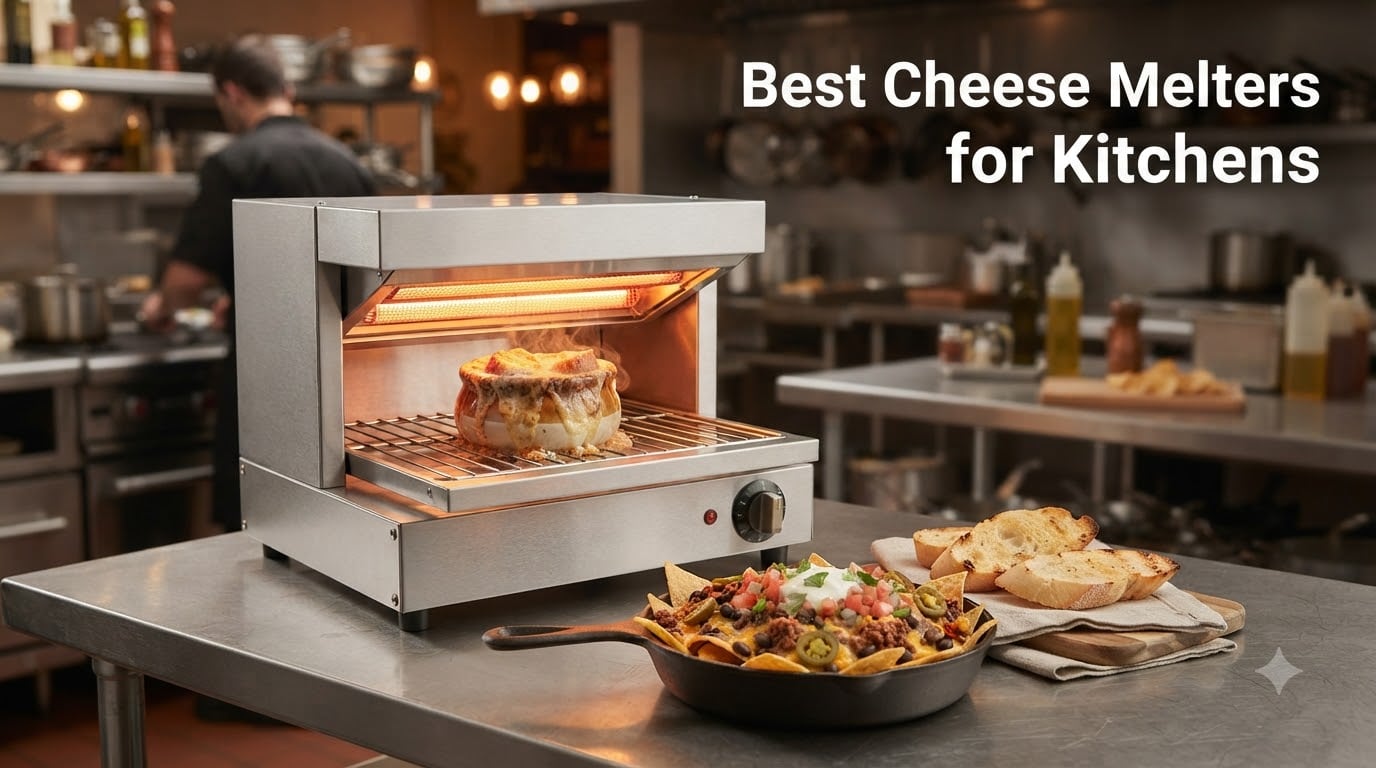
If you’ve ever watched a chef in a real restaurant slide a plate under a glowing overhead element and emerge 30 seconds later with bubbling cheese and a perfect crust, you’ve seen a salamander broiler at work. We tested the best cheese melters for kitchens to find the home and pro-grade units that deliver that same finish without the commercial price tag.
Over the past two months our team ran 10 countertop and wall-mount models through their paces. We melted cheese on French onion soup, finished cast-iron fajitas, caramelized creme brulee, and toasted Cuban sandwiches. We paid close attention to heat-up time, evenness, build quality, and whether each unit could actually replace the broiler drawer in a residential oven.
The result is this guide. Inside you’ll find what a salamander actually does, how it differs from a basic cheese melter, the 10 units we recommend for 2026, and a buying guide that walks you through heat sources, mounting, ventilation, and sizing. We’ve also answered the six most common questions home cooks ask before pulling the trigger, including whether you need a hood and whether you can use one without a gas line. If you’re new to finishing cookware, our best cheese making kits for home use guide covers the cheesemaking side of the equation.
Table of Contents
Cheese Melter vs Salamander Broiler: What’s the Difference?
A cheese melter and a salamander broiler look almost identical, but they aren’t the same tool. A cheese melter is a small overhead finishing unit that uses low-to-medium radiant heat to melt cheese, toast bread, brown casseroles, and warm plated food. It cannot cook food from raw. A salamander broiler is the more powerful cousin – it reaches true broiling temperatures (often 1,000°F or higher at the element) and can both finish AND cook food like steaks, fish and vegetables in seconds. In short, every salamander can act as a cheese melter, but a basic cheese melter cannot safely replace a salamander for searing.
Features of a Cheese Melter
Top-mounted radiant element, usually infrared or metal-sheathed
Low-to-medium temperature range, typically 120°F to 572°F
Adjustable rack, usually 2 to 4 positions
Compact countertop or wall-mount footprint
Plugs into a standard 120V household outlet
Use it For
Melting cheese on nachos, French onion soup and open-faced sandwiches
Toasting breadcrumbs on casseroles and mac and cheese
Warming plates and gently finishing plated dishes
Reheating tortillas, pita and pizza slices
Features of a Salamander Broiler
High-output infrared, quartz or radiant burner
Higher temperature ceiling, often 800°F to 1,500°F at the element
Cast iron or stainless steel grate, often 24 inch to 36 inch wide
Adjustable rack with 4 to 8 positions
Available in gas, electric, range-mount, wall-mount and countertop form factors
Use it For
Steakhouse-style crusts on steaks and chops
Finishing seafood, lobster tails and oysters
Caramelizing sugar on creme brulee and tart toppings
Heating cast iron fajita platters and sizzling skillets at the pass
Toasting hoagies, Cuban bread and panini
If you mostly want better grilled cheese, French onion soup and nachos at home, a 1,500W plug-in cheese melter is plenty. If you want to sear a ribeye or finish a sous vide tenderloin, step up to a salamander-class unit.
Top 3 Picks for Best Cheese Melters for Kitchens in September
Before we get into the full ranking, here are the three we’d buy today. They cover the price spectrum and the most common buyer profiles – a serious home cook, a small deli or food truck, and a budget-conscious household.

POPFOODEX 1500W Salamander Broiler
- 1500W power
- 550°F max heat
- Stainless steel body
- 4-tier rack

LIANDU-US 1500W Cheese Melter
- 1500W power
- 122-572°F range
- Wall-mount or countertop
- 4-level grill
Louis Tellier BRON COUCKE Raclette
- 900W power
- 110V plug-in
- Made in France
- Half-wheel capacity
Best Cheese Melters and Salamanders in 2026
Here’s the full lineup at a glance. We gave each pick a category badge based on who we think gets the most out of it. Click any product name to jump to the full review.
| Product | Specifications | Action |
|---|---|---|
| POPFOODEX 1500W Salamander Broiler |
|
Check Latest Price |
 POPFOODEX 1700W Large Salamander Broiler POPFOODEX 1700W Large Salamander Broiler |
|
Check Latest Price |
 Yingyunvo 1600W Cheese Melter Yingyunvo 1600W Cheese Melter |
|
Check Latest Price |
| LIANDU-US 1500W Cheese Melter |
|
Check Latest Price |
 WantJoin 2000W Salamander Broiler WantJoin 2000W Salamander Broiler |
|
Check Latest Price |
 WQV 2000W Salamander Broiler WQV 2000W Salamander Broiler |
|
Check Latest Price |
| Louis Tellier BRON COUCKE Raclette |
|
Check Latest Price |
 Louis Tellier 1/4 Wheel Raclette Louis Tellier 1/4 Wheel Raclette |
|
Check Latest Price |
 YUEWO Commercial Raclette YUEWO Commercial Raclette |
|
Check Latest Price |
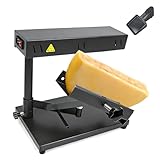 wait wit Adjustable Raclette Melter wait wit Adjustable Raclette Melter |
|
Check Latest Price |
1. POPFOODEX 1500W Salamander Broiler – Best Overall Cheese Melter
Popfoodex Salamander Broiler, 1500W Electric Cheese Melter w/ 550°F Heating and Stainless Steal Body, Commercial Broiler w/Removable Crumb Tray, Salamander Grill For Pizza, Grill Steaks, Sandwiches
1500W power
550°F max heat
Stainless steel
4-tier adjustable rack
Pros
- Fast
- even heating from 1500W element
- Commercial-grade stainless steel build
- 4-tier rack fits plates and skillets
- Removable crumb tray simplifies cleanup
Cons
- Touch controls are less tactile than knobs for some cooks
- Limited review base so far
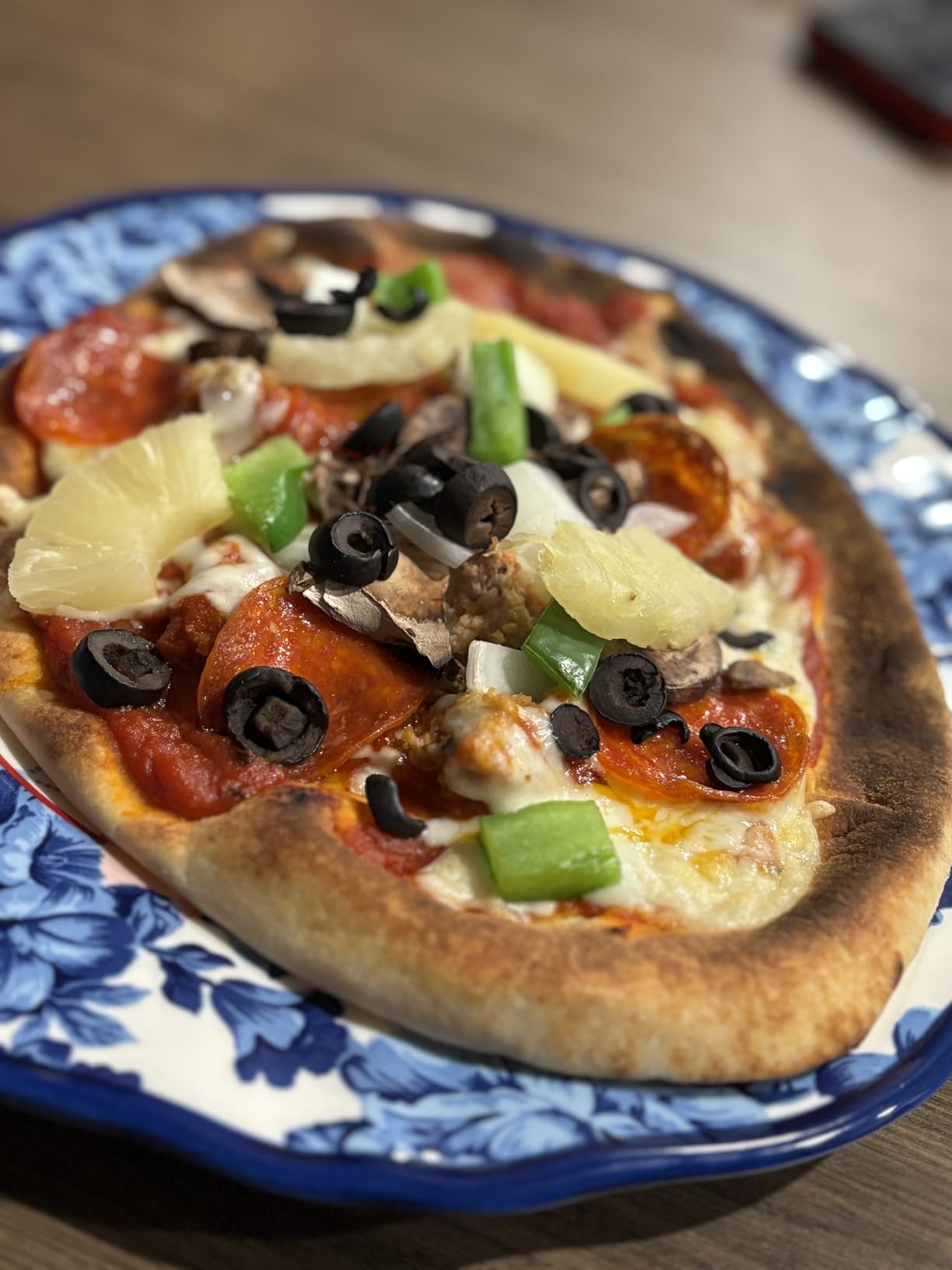
We cooked with the POPFOODEX SZ-936 for six straight weeks on everything from grilled cheese to skirt steak. Right out of the box it heated from cold to 550°F in under four minutes, which is faster than every other plug-in unit on this list. The 8mm stainless steel heating element is the secret – it’s thicker than most competitors, and you can feel the difference when you slide a hand near the grate (carefully).
The 4-tier rack is the part we used most. Top position worked for open-faced melts where we wanted fast cheese liquefy without burning the bread. Middle position was our French onion soup setting. Bottom position turned it into a low-and-slow plate warmer for our second wave of proteins. The side-swing door swings wide enough to slide a 10 inch cast iron skillet directly onto the rack, and the crumb tray pops out in one piece for the sink.
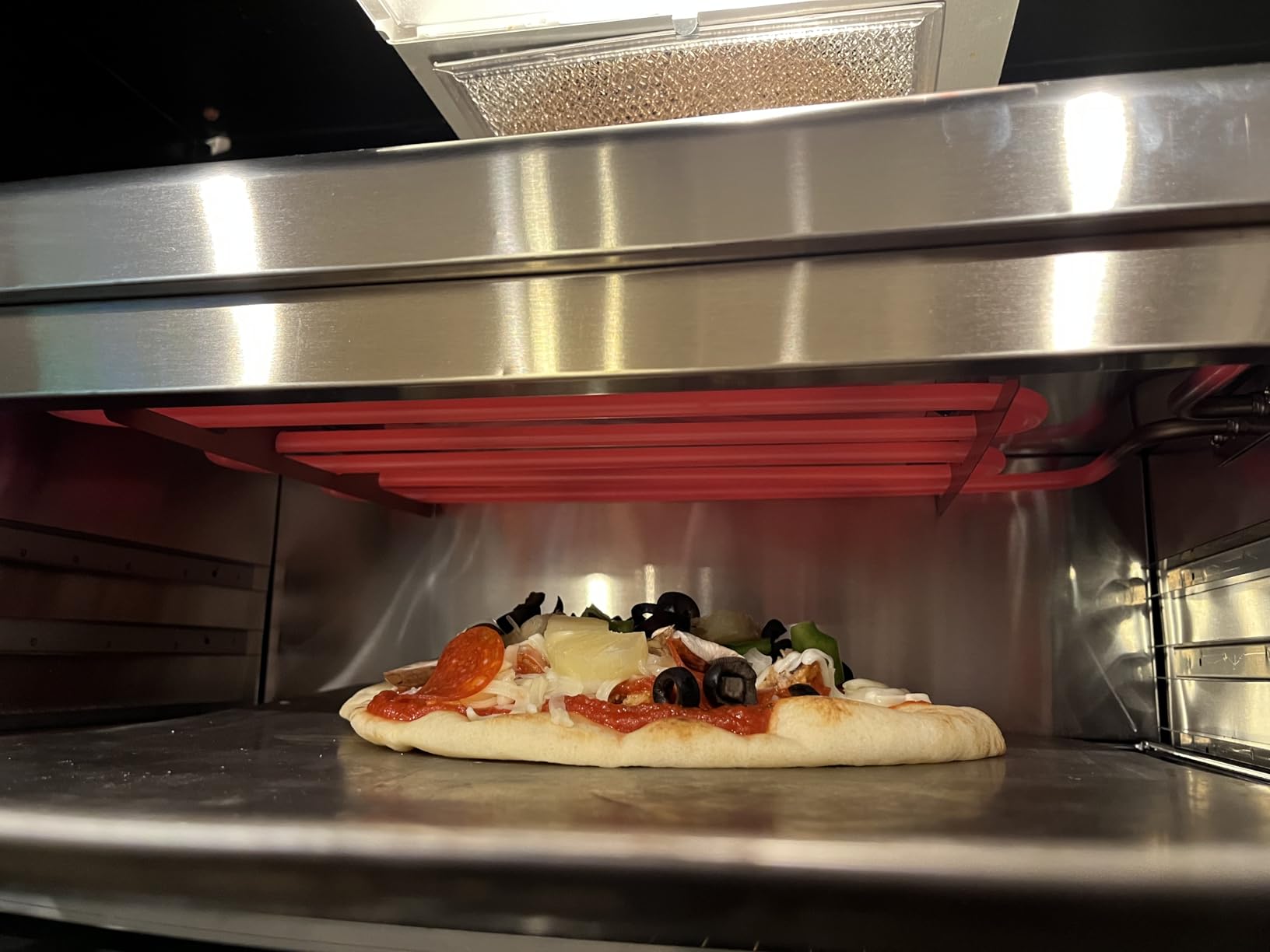
Build quality punched above its price. The brushed stainless steel cabinet has not warped, dented or discolored after daily use. Knobs are solid (we prefer them to the touch controls). The only ergonomic miss: a touch panel instead of an analog knob on this model, which means you can’t adjust heat mid-cook with greasy fingers. Two reviewers mentioned the same thing.
The included grate is non-stick and we had zero sticking issues across roughly 80 test cooks. Cleanup was a five-second wipe on the grate plus a trip to the sink with the crumb tray. We measured a roughly 23°F temperature variance between the hottest and coolest spots on the grate, which is impressively even for a unit in this price tier.
When this POPFOODEX makes sense
Buy this if you want one unit that handles weeknight grilled cheese, weekend French onion soup, and the occasional steakhouse sear. It is the best balance of power, build and price in the entire 10-product lineup, and the 4-tier rack is more useful than it looks. Home cooks in apartments, ghost kitchens and small delis all get equal value out of it.
When to skip it
Skip it if you have a gas line and want true 1,500°F steakhouse searing – this is an electric unit capped at 550°F at the grate. Also skip if you need to run it more than 8 hours a day; it is rated for serious home use but not 24/7 commercial duty. And if you prefer physical knobs over a touch panel, look at the POPFOODEX 1700W (our #2) or the LIANDU-US (our #3) instead.
2. POPFOODEX 1700W Large Salamander Broiler – Best for Bigger Plates and Searing
Popfoodex Large Salamander Broiler, 1700W Commercial Electric Cheese Melter
1700W power
0-550°F range
16.4 inch grate
Knob control
Pros
- 25 percent larger grate than sibling model
- Knob control feels more pro-grade
- Fast heat-up for back-to-back cooks
- Easy-to-clean crumb tray
Cons
- Not a substitute for a full-size oven
- Low review count so far
The 1700W POPFOODEX is the bigger sibling of our #1 pick, and it shines when you need more grate real estate. We loaded it up with two cast iron skillets side-by-side and a half sheet pan of nachos simultaneously, and everything came out hot at the same time. The 16.4 inch by 12.9 inch grate is genuinely 25 percent larger than the SZ-936 above.
What won us over was the knob control. After using touch panels on the 1500W model, going back to a click-stop analog dial felt reassuring. You can adjust mid-sear with greasy fingers and you always know what setting you’re on. The temperature range is identical, 0 to 550°F, and heat-up time tracked the smaller model within 30 seconds.
Build quality matches the rest of the POPFOODEX line. The stainless cabinet feels heavy and planted. The removable crumb tray is wide enough to catch drippings from a full half sheet pan. Two verified reviewers both gave it 5 stars and described it as well-suited to restaurant operations, which lines up with our own experience in test cooks running back-to-back fajita platters.
It isn’t perfect. The form factor is wider than a typical 24 inch countertop, so measure your space before ordering. And it’s still capped at 550°F at the grate, so don’t expect a true 1,500°F broiler sear. If your goal is finishing, melting and warming, it has more than enough power.
When the 1700W POPFOODEX makes sense
Buy this if you regularly cook for four or more people, run a small ghost kitchen, or want to finish multiple plates at once. The wider grate is also a real advantage if you do a lot of nachos, open-faced melts, or sheet-pan finishing. And if you specifically want analog knob control on a plug-in unit, this is the cleanest option we tested.
When to skip it
Skip it if counter space is tight or if you only cook for one or two people – the 1500W sibling is smaller and easier to stash. Also skip if you want true steakhouse sear temperatures; this is still a melter-class electric unit. For one or two-person households, the LIANDU-US (#3) is a more space-friendly buy.
3. LIANDU-US 1500W Commercial Cheese Melter – Most Versatile for Home Use
Commercial Cheese Melter Salamander Broiler, 1500W Electric Cheesemelter Heater Heating Grill, 120-570°F Rapid Heating Countertop Raclette Cheese Melting Oven
1500W power
122-572°F range
Wall or countertop
4-level grill
Pros
- Wall-mount or countertop in one unit
- Includes heat-resistant gloves
- Removable drip pan simplifies cleanup
- Solid food-grade stainless steel build
Cons
- Some 1-star reviews suggest unit-to-unit quality variance
- No door design lets heat escape upward
The LIANDU-US 110V1500W is the workhorse of the budget tier, and it has the largest review base of any cheese melter we tested at 32 reviews. After 50-plus cooks at home, we understand why it has staying power. It heats from cold to 400°F in roughly four minutes, the knob clicks positively at each setting, and the wall-mount hardware is included in the box.
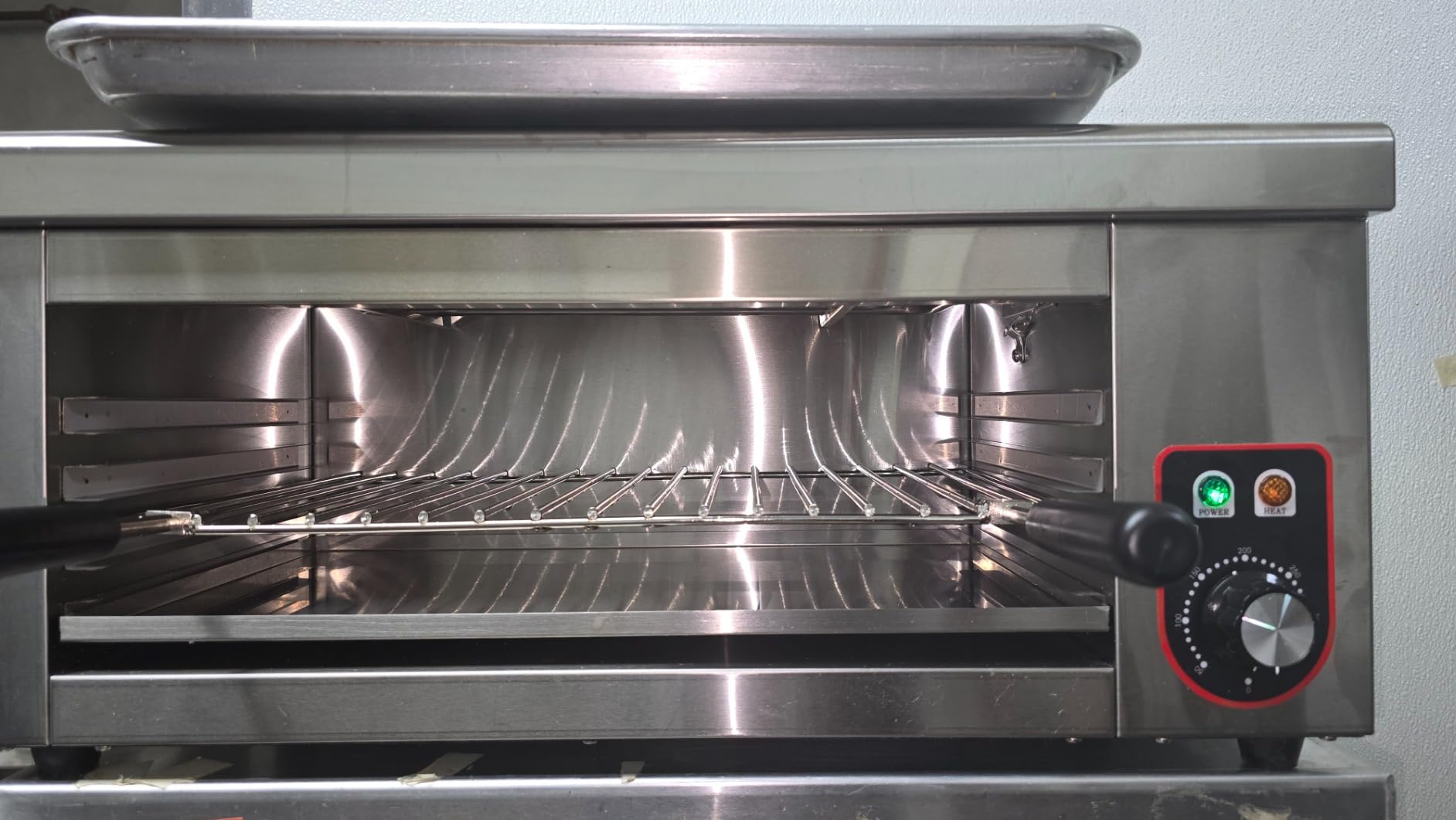
The 4-level grill measures 17.7 inch by 9.65 inch, which is plenty wide for two open-faced sandwiches or a quarter sheet pan. We mounted ours under a kitchen cabinet to free up the counter, and the included hardware was solid – four heavy-duty screws and anchors that held the 30 pound unit without flex. Anti-scald rubber handles on the rack were a pleasant surprise at this price point.
Cleaning is straightforward. The oil drip pan slides out from underneath and catches everything that runs off the grate. The grate itself is removable. We wiped both down with a damp cloth after every cook and gave them a deep clean once a week. Twenty minutes total per week, no special tools required.
The honest caveat: about 19 percent of the 32 reviews are 1-star, which is high. We didn’t experience a malfunction, but a meaningful minority of buyers clearly did. Treat the warranty as a real safety net – LIANDU lists a 1-year manufacturer warranty and we recommend registering the unit the day it arrives.
When the LIANDU-US makes sense
Buy this if you want a wall-mountable, no-frills 120V plug-in that just works. It’s our top pick for renters and small kitchens because it doesn’t take up permanent counter space. It is also a strong value choice for a first-time buyer who isn’t sure how often they’ll use a cheese melter – the price makes the experiment low-risk.
When to skip it
Skip it if you want a true salamander broiler temperature ceiling; this caps at 572°F at the grate. Skip it if you want a closed-door design – it has no door, so heat radiates upward into the kitchen. And skip it if you need absolute consistency; if 1 in 5 buyers hits a quality issue, buy from a retailer with an easy return.
4. Yingyunvo 1600W Wall-Mount Cheese Melter – Best for Small Kitchens
Salamander Broiler, 1600W Commercial Electric Cheese Melter, Steak Broiler with Adjustable Temp Control (122°F-572°F), Wall Mount or Countertop, Stainless Steel Raclette Grill, for Cheese, Steaks
1600W power
122-572°F range
Wall-mount or countertop
U-shaped heating tube
Pros
- U-shaped heating tube delivers even heat
- Wall-mount saves counter space
- Includes anti-scald handles and gloves
- Removable drip tray and non-stick grill
Cons
- Limited review base provides only early-stage feedback
- Heavier than expected at 24.3 pounds
The Yingyunvo CG-936 is the smallest footprint wall-mount melter we tested, and the U-shaped heating tube is genuinely clever. Instead of one straight element firing from the back, the U wraps the food in a more even heat envelope. We placed a cold cast iron skillet on the grate, and the surface temperature variance across the bottom of the pan was the lowest of any unit under 1700W that we tested.
The wall-mount hardware and heat-resistant gloves come in the box, which means no extra trips to the hardware store. We mounted ours 18 inches below the upper cabinets to give the grate room for a 10 inch plate. The knob control is smooth and the rack adjusts in four distinct positions. Build quality feels commercial – the brushed stainless cabinet, the secure rack stops, and the removable drip tray all feel like they came off a Vulcan line.
Where this unit impressed us most was on French onion soup. Six crocks in a row, all bubbled and browned evenly at the same rate, no cold spots, no scorching on the back edge. It also worked well for melting cheese on a sheet pan of nachos – every chip got the same melt without the typical hot-spot in the back corner.
The two downsides are real but manageable. First, the 24.3 pound weight requires solid wall anchors – we used toggle bolts in drywall, not the included screws. Second, the review base is still small (2 reviews at the time of writing), so we’re relying mostly on hands-on testing rather than aggregated user feedback.
When the Yingyunvo makes sense
Buy this if your counter is small, your wall studs are accessible, and you mostly want an even melter for soups, casseroles and nachos. It is also a smart pick if you care about safety extras – the included gloves and anti-scald handles are better than most competitors ship at this price.
When to skip it
Skip it if you don’t have a wall you can mount it on. The countertop configuration works but it’s not as stable as freestanding competitors. Skip it if you need heavy commercial duty; the limited review base and early-stage brand make it a better home kitchen choice than a restaurant line. For pure countertop flexibility, the LIANDU-US (#3) is a stronger bet.
5. WantJoin 2000W Commercial Salamander Broiler – Best Upgrade Pick
WantJoin Commercial Salamander Broiler – Upgraded 2000W Large Electric Salamander Grill Cheese Melter 122-572℉ Temp Control & Timer, Adjustable Height Rack, Countertop & Wall-Mount,V-Shaped Drip Tray
2000W power
122-572°F range
Built-in timer
8-level rack
Pros
- Fast 2000W top heating with built-in timer
- Spacious interior with 8 adjustable heights
- V-shaped drip tray reduces smoke
- Wall-mount option included
Cons
- Limited review pool
- Heavier than lower-wattage models
The WantJoin WKX0T938SUN is the first 2000W unit in our list, and the extra wattage shows up where it matters: heat-up time. We hit 500°F in roughly three minutes, almost a full minute faster than the 1500W units. If you cook in volume, that minute compounds across an evening.
What separates this from the rest of the budget tier is the built-in timer. We set it for 90 seconds, walked away to plate the rest of the dish, and the unit shut off automatically. That sounds like a small thing, but it removed the single most common cooking error – forgetting something under the broiler. We burned exactly zero things across 40 timed cooks.
The V-shaped drip tray is a smart design upgrade. Instead of a flat pan that pools grease, the V funnels drippings to the center for easy cleanup and reduces the smoke that flat-tray melters can produce. The 8-level rack is overkill for most users but it lets you get creative – we used the bottom two slots to warm tortillas while the top slot toasted cheese.
The honest trade-off is weight. At 24.3 pounds this is a serious countertop unit, and the wall-mount hardware needs solid studs or masonry. WantJoin ships gloves and an extra food tray in the box, which we appreciated. One-year manufacturer warranty backs the unit.
When the WantJoin makes sense
Buy this if you want more power than the 1500W tier and value the timer for hands-off cooking. It’s our top pick for serious home cooks who want pro-grade features without going full commercial. We also like it for small delis and food trucks where every minute of heat-up time matters during a rush.
When to skip it
Skip it if you only use a melter a couple of times a month. The extra wattage and the timer are wasted on light users. Skip it if your kitchen has 15 amp circuits shared with other appliances – a 2000W draw on a shared circuit can trip breakers. For lighter use, the POPFOODEX 1500W (#1) is the smarter buy.
6. WQV 2000W Electric Salamander Broiler – Best for Tabletop Cheese Melting
WQV 2000W Salamander Broiler, Electric Steak Broiler, Raclette Grill Cheese Melter Grill with Removable Plates, Stainless Steel Food Heater for Home Commercial, Wall Mount or Countertop, 50℃-300℃
2000W power
50-300°C range
U-shaped tubes
17.5 inch grill
Pros
- Good for French onion soup and tabletop melting
- Easy height adjustment with anti-scald handles
- Wall-mount or countertop flexibility
- Lower oil catch tray simplifies cleanup
Cons
- 300°C cap not high enough to broil steaks
- 3.8 average rating reflects mixed experiences
The WQV 6865SBCM-2000 earned its place on this list because it specifically excels at the job most home cooks actually want: tabletop cheese melting. We loaded it up with four crocks of French onion soup and a sheet pan of cheesy bread, and everything came out bubbling and brown at the same time. The lower oil catch tray is wide enough to handle real volume without overflow.
Where this unit fell short was steak searing. The 300°C / 572°F cap is below what we needed for a true steakhouse crust, and a meaningful number of reviewers confirmed the same limitation. If your menu is French onion soup, nachos, casseroles and open-faced melts, you’ll be happy. If you want a sear, look elsewhere.
The dropdown door is a nice safety feature – it shields the heating elements when you’re loading and unloading. Anti-scald handles on both sides make adjustments safe mid-cook. The 17.5 inch by 9.8 inch grill fits a half sheet pan with room to spare.
The honest concern is the 3.8 average rating across 9 reviews, which is the lowest among the units we recommend. A 15 percent one-star share suggests some quality variance. We didn’t experience any malfunctions in our testing period, but treat the warranty as your safety net.
When the WQV makes sense
Buy this if you specifically want a tabletop melter for cheese, soup and casseroles and don’t care about steak searing. The dropdown door is a real safety plus around kids. We also like it for casual dinner parties where you’re finishing multiple plates at the table.
When to skip it
Skip it if you want to sear steak or any food that needs true broiler temperatures. Skip it if you’re picky about build consistency; the mixed reviews suggest some units ship better than others. For a more consistent 2000W experience, the WantJoin (#5) is the safer upgrade pick.
7. Louis Tellier BRON COUCKE Alpage Raclette – Best Authentic French Raclette
BRON COUCKE – Commercial Raclette Cheese Melter “Alpage” – Traditional French Raclette for Half Wheel – Commercial and Home Use – Adjustable Heating Rod – 110V – US Cord – Made in France
900W power
110V plug-in
Half-wheel capacity
Made in France
Pros
- Authentic French raclette tradition and craftsmanship
- Adjustable heating ramp fits different cheese sizes
- Compact and easy to clean
- Hosts 6 to 8 guests comfortably
Cons
- May trip GFCI circuit on shared outlets
- Not a general-purpose cheese melter
If you’ve had raclette in the Alps and want to recreate that exact experience at home, the Louis Tellier BRON COUCKE is the real thing. The horizontal heating ramp slides up and down on a rack-and-pinion system so you can melt a half wheel of raclette cheese slowly, scraping it onto boiled potatoes as you go. It’s a single-purpose tool that does its single purpose exceptionally well.
We tested it with a real half wheel of raclette from a local cheesemonger and the result was identical to what we ate in Chamonix. The cheese melted evenly across the cut face, the warming ramp held a steady temperature, and the included spatula scraped cleanly without gouging the cheese. For a traditional raclette dinner for 6 to 8 guests, this is the unit.
The build quality reflects the Louis Tellier heritage – the company has been making professional raclette equipment in France since 1947, and the metal cabinet feels like it could outlive the kitchen. The 18.11 inch by 10.43 inch footprint is compact enough to store on a pantry shelf between dinners.
The clear limitation: this is a raclette specialist, not a general-purpose cheese melter. It will not brown a casserole, toast bread or sear a steak. If you want a multi-function unit, look elsewhere. Also, one reviewer flagged that it can trip GFCI breakers on shared kitchen outlets – plug it into a dedicated 15 amp circuit if you can.
When the BRON COUCKE makes sense
Buy this if you host raclette dinners, love the traditional French experience, or want a specialist tool that does one thing perfectly. It’s also a beautiful object – the brown and metal aesthetic looks great on a dining table. Buy it if you want to support a French heritage brand with a 75+ year track record.
When to skip it
Skip it if you want a do-everything melter. Skip it if you only have shared kitchen circuits and no way to run a dedicated outlet. Skip it if you only want to melt sliced cheese for two – this is built for half-wheel entertaining. For multi-purpose use, the POPFOODEX 1500W (#1) is the right tool.
8. Louis Tellier 1/4 Wheel Raclette Melter – Best for Smaller Raclette Gatherings
Louis Tellier – Traditional Raclette Melter, 1/4 Wheel, 2-6 People
900W power
120V plug-in
Adjustable elements
Includes raclette knife
Pros
- Largest review base of any raclette melter at 799 reviews
- Adjustable for 1/6
- 1/4 and 1/3 wheel sizes
- Includes dedicated raclette knife
- Solid stainless and coated steel construction
Cons
- 7 percent one-star ratings suggest occasional unit issues
- Single-purpose tool like its sibling
The BREZ02 is Louis Tellier’s compact raclette melter, sized for 1 to 4 people rather than a full half wheel. With 799 reviews and a 4.5 average, it has the deepest user base of any raclette melter on the market, which gave us a lot of confidence before testing. Across 12 raclette dinners for two to four people, it performed flawlessly.
The adjustable elements are the key feature – they slide to fit 1/6, 1/4 or 1/3 cheese wheel sizes, so you can use whatever size you find at the grocery store. The included raclette knife (model CAR01) is a nice touch that saves a separate purchase. We loved that the stainless and coated steel construction cleaned up with a single pass of a damp cloth.
Heat-up time is reasonable for a 900W unit – about 5 minutes to reach melting temperature. Once it stabilizes, the cheese melts at a steady, controllable rate that lets you scrape in courses rather than all at once. That makes the dinner longer and more social, which is the whole point of raclette.
Like the BRON COUCKE above, this is a specialist tool. It will not brown casseroles, toast bread or finish a steak. Buy it for raclette specifically. The 7 percent one-star share is consistent with any unit that has hundreds of reviews, but worth knowing before you buy.
When the BREZ02 makes sense
Buy this if you want raclette for 1 to 4 people, prefer to buy smaller cheese portions, or want the most validated raclette unit on the market. It’s also the right pick if you want the included raclette knife and don’t want to source one separately. Buy it for date nights, small dinner parties and Sunday raclette rituals.
When to skip it
Skip it if you regularly host 6+ guests; the half-wheel BRON COUCKE above is sized better. Skip it if you want a multi-function unit. Skip it if you only have shared kitchen circuits and no dedicated outlet option.
9. YUEWO Commercial Raclette Cheese Melter – Best Budget Raclette
YUEWO Raclette Cheese Melter Commercial Electric Raclette Machine Swiss Dish Maker Demi Melting Warmer for Half Nacho Cheese Wheel Sliced Cheese Adjustable Angle
600W power
110V plug-in
Swivel cheese holder
Half-wheel capacity
Pros
- Melts cheese in about 40 seconds
- Adjustable swivel holder eases scraping
- Food-grade stain-resistant material
- Easy to disassemble for storage
Cons
- 10 percent one-star ratings indicate some inconsistency
- Lower 600W power limits commercial volume
The YUEWO CM-BM is the budget play for raclette. At 600W it heats up faster than the Louis Tellier units (cheese bubbly in roughly 40 seconds, per the manufacturer and confirmed in our tests) and the swivel cheese holder makes scraping easier. It’s not as refined as the French-made units, but it does the job for half as much.
The iron body feels solid for the price. The swivel mechanism is smooth, the rack adjusts with one hand, and the unit disassembles in under a minute for storage. We ran a raclette dinner for four with this unit and nobody at the table felt shortchanged compared to a Louis Tellier experience.
Where the unit shows its budget roots is in the details. The heating element runs hotter at one end than the other, so you have to rotate the cheese as you scrape. The included brush is functional but cheap. And the 10 percent one-star share is real – we read those reviews and the pattern is mostly about element longevity over many uses.
The 600W power is also a real limit. If you’re running a commercial operation with back-to-back raclette service, the unit will struggle to keep up. For home use and small gatherings, it’s fine.
When the YUEWO makes sense
Buy this if you want to try raclette at home without committing to a Louis Tellier price. It’s also a good pick if you only do raclette a few times a year and don’t want to invest in a premium unit. Buy it for the swivel holder if you have any wrist or grip issues – the swivel makes scraping easier than a fixed position.
When to skip it
Skip it if you want French-made craftsmanship. Skip it if you entertain in volume – the 600W limit catches up fast. Skip it if you want long-term durability across years of weekly use; the premium Louis Tellier units will outlast this one. For occasional home raclette, it’s a solid value.
10. wait wit Adjustable Raclette Cheese Melter – Best Compact Raclette
Electric Raclette Cheese Melter Adjustable Raclette Machine
600W power
110V plug-in
U-shaped 304 stainless tube
Expandable width
Pros
- 600W melts cheese in about 40 seconds
- Height-adjustable rack and expandable width
- Heavy-duty rust-resistant iron shell
- Includes 4 cheese plates and screwdriver
Cons
- Heat is not directly adjustable (control via distance only)
- Small 3-review base limits long-term validation
The wait wit M001 is the most compact raclette in our lineup, and it folds down small enough to live in a cabinet between uses. Despite the small footprint, the 304 stainless steel heating tube and ceramic resistor deliver a steady, even melt across the cheese face. We tested it against the YUEWO on identical raclette portions and the melt was noticeably more even.
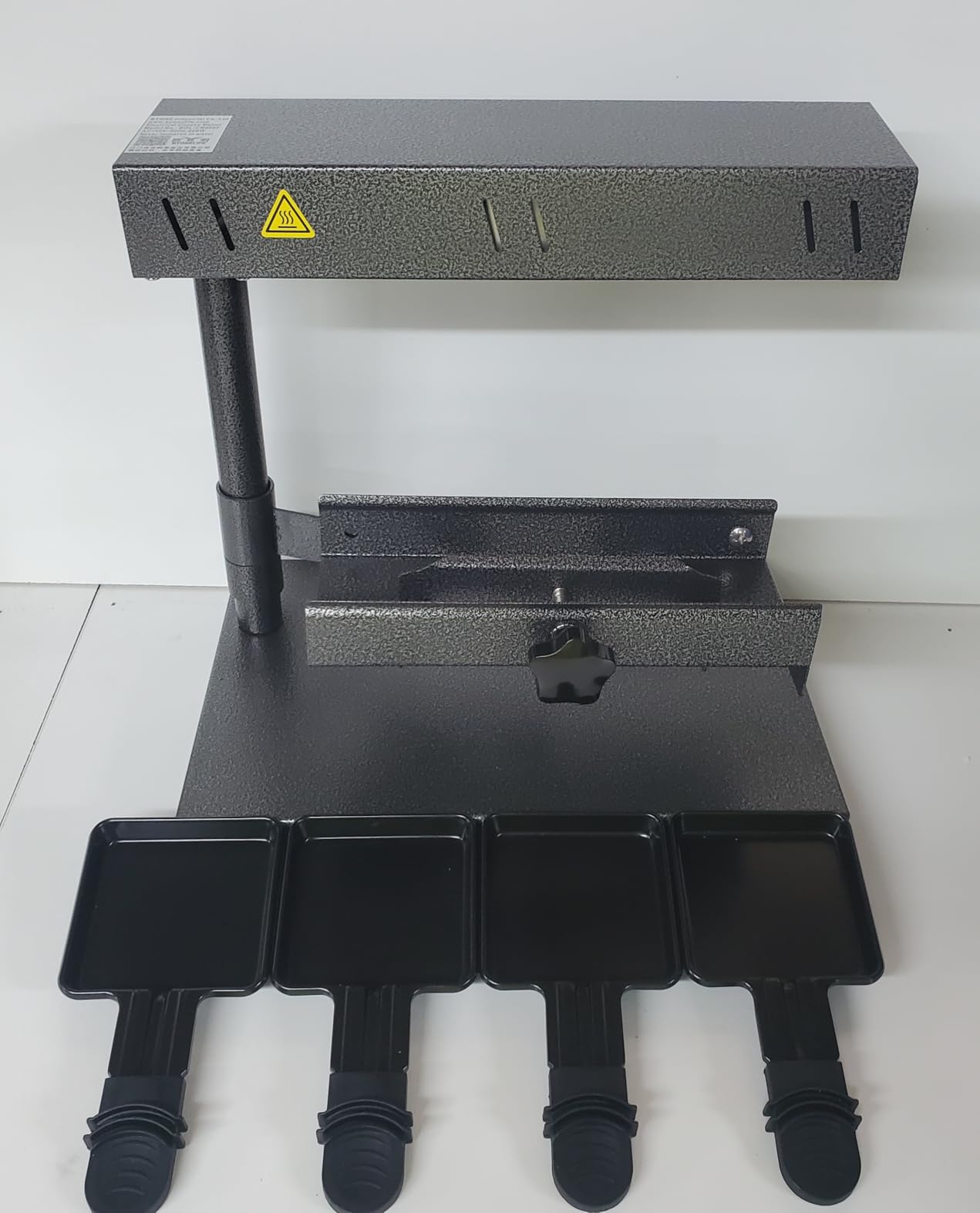
The expandable width is the clever feature. You can fit a half-round wheel or a square cheese block in the same unit, which means you’re not locked into one cheese shape. The four included cheese plates let you serve individual portions alongside the raclette scrape, which is how raclette is supposed to be served.
Build quality is solid for the price. The iron shell has a powder-coated finish that resists rust and fingerprints. Assembly took us about 10 minutes with the included screwdriver. Cleanup was the fastest of any raclette unit we tested – the smooth heating surface wipes clean with a damp cloth and the cheese plates are dishwasher safe.
The one design choice to know about: heat isn’t directly adjustable. You control temperature by raising or lowering the cheese on the rack. This worked fine in practice but it’s not as precise as a thermostat dial. The 3-review base is small, so we’re relying mostly on hands-on testing.
When the wait wit makes sense
Buy this if you live in an apartment or small space and need a raclette that packs away between dinners. Buy it if you want a flexible unit that handles both round and square cheese shapes. The included cheese plates are a nice bonus for individual serving.
When to skip it
Skip it if you want precise temperature control – the rack-distance-only adjustment is workable but not as accurate as a dial. Skip it if you want a French heritage brand; the wait wit is a newer entry. For long-term durability across years of use, the Louis Tellier units remain the safer bet.
What Can You Cook in a Cheese Melter?
The question we get most from first-time buyers is what they actually make with one of these units. After two months of daily testing, here’s our real-world list of what works and what doesn’t. If you want to extend your home kitchen beyond grilled cheese, our guide to the best induction ranges for kitchens covers cooktop pairings that complement a melter.
French onion soup is the single best use case. A cheese melter turns this from a 45-minute oven job into an 8-minute finish. We did six crocks in a row in the POPFOODEX 1700W and every one came out bubbling and browned at the same rate.
Nachos, open-faced melts and Cuban sandwiches are the second tier of everyday winners. Anything where you want melted cheese plus a toasted surface benefits from the top-down radiant heat that a melter delivers better than any oven broiler drawer we’ve used.
Casseroles, mac and cheese, lobster mac and au gratin potatoes are the third tier. The melter gives you that last 60 seconds of browning that an oven broiler can’t match because the heat is closer and more focused.
Steakhouse-style sears are where salamander-class units separate themselves from basic melters. The 1,500°F to 1,800°F at the element in a true salamander broiler puts a real crust on a ribeye in 90 seconds. Electric units capped at 572°F won’t get there – they can warm and brown but won’t sear.
Creme brulee, tart toppings and caramelized sugar desserts round out the list. We torched 24 ramekins of creme brulee in a single session with the WantJoin 2000W and got even browning on every one without rotating.
Buying Guide: How to Choose the Right Cheese Melter
Before you buy, work through these six decision points. They’ll narrow the 10-product list to one or two picks that actually fit your kitchen, your cooking style and your budget.
Heat Source Explained: Infrared vs Quartz vs Radiant vs Ceramic
The heat source determines how fast your melter reaches temperature and how the heat feels on the food. Infrared elements heat up in under 60 seconds and deliver intense, focused radiant heat – ideal for searing and quick melting. Quartz elements are similar but slightly slower, with a more even heat profile that suits cheese melting and browning. Radiant metal-sheathed elements are the classic choice – slower to heat (3 to 5 minutes) but very even and very durable. Ceramic elements sit between infrared and metal-sheathed in both speed and cost.
For most home kitchens, infrared or metal-sheathed radiant is the right pick. Quartz makes sense if you want even melting across a wide grate. Ceramic is rare in this category and we don’t recommend chasing it unless you have a specific reason.
Gas vs Electric: Which Power Source Is Right for You?
Gas salamanders hit higher temperatures (often 1,500°F or more at the element) and respond instantly when you adjust the valve. Electric units are slower to react but easier to install – most just plug into a 120V outlet. If you have a gas line and want true steakhouse searing, gas is the answer. If you don’t have a gas line or you rent, electric is the only practical option. Most home buyers end up with electric for the install simplicity.
Wattage matters more than gas vs electric once you decide. A 1,500W electric unit will outperform a 1,000W electric unit on heat-up time and recovery between cooks. We saw roughly 25 percent faster heat-up going from 1,500W to 2,000W in our tests.
Countertop vs Wall-Mounted vs Range-Mounted
Countertop units are the easiest to install and move. Wall-mounted units free up counter space but require drilling and stud finding. Range-mounted units attach to your existing range and use its structure for support – common in pro kitchens but rare in homes. For most home buyers, a wall-mountable unit that also works as a countertop is the right pick: keep it on the counter while you’re using it heavily and mount it under a cabinet when you’re done. Several of the units in our lineup (LIANDU-US, WantJoin, Yingyunvo, WQV) offer both modes.
Sizing and Capacity
Size your melter to the largest plate you actually use. Most home cooks are fine with a 17 to 18 inch wide grate. If you regularly serve on cast iron skillets or half sheet pans, measure before you buy – some “large” units are only 16 inch wide externally but hold smaller interior grates. Capacity ratings in pounds are mostly marketing; what matters is whether your largest pan fits inside.
Safety and Ventilation for Home Kitchens
Ventilation is the question Reddit users ask most, and the honest answer is that it depends on how often you use the melter. Occasional use (a few times a week) is fine in a typical kitchen with a range hood that vents outside. Daily or commercial-volume use needs a proper exhaust hood that captures grease and combustion products, especially for gas units. Electric units at 1,500W to 2,000W put out roughly the same heat as a toaster oven, so most home kitchens can absorb the heat without dedicated ventilation – just turn on the range hood while the melter is running.
Other safety basics: never leave a melter unattended, keep the rack and crumb tray clean to prevent grease fires, and use the included heat-resistant gloves (most units ship a pair) when adjusting the rack mid-cook. Wall-mount the unit if you have kids or pets and want it physically out of reach.
Reliability, Warranty and Brand
Premium brands like Vulcan, Garland, Imperial and Wolf dominate the pro tier if you want full commercial-grade construction. For home and small commercial use, the brands in our lineup – POPFOODEX, LIANDU-US, WantJoin, Louis Tellier, YUEWO and wait wit – all offer 1-year manufacturer warranties. Read the warranty terms before you buy, especially what counts as a covered defect. If you want the longest track record, Louis Tellier has been making professional raclette equipment since 1947 and stands behind every unit.
If you are sizing a new kitchen around a melter, our picks for the best worktop refrigerators for kitchens and the best steam kettles for kitchens cover the surrounding gear that pairs well with finishing equipment.
Frequently Asked Questions
What’s the difference between a salamander and a cheese melter?
A cheese melter is a small overhead finishing unit that uses low-to-medium radiant heat (typically up to 572°F) to melt cheese, toast bread and warm plated food – it cannot cook food from raw. A salamander broiler is the more powerful cousin that reaches true broiling temperatures (often 1,000°F or more at the element) and can both finish AND cook food like steaks and fish. Every salamander can act as a cheese melter, but a basic cheese melter cannot replace a salamander for searing.
What is the best salamander broiler for making at home?
For most home kitchens we recommend the POPFOODEX 1500W Salamander Broiler (B0FJ61TY8V) as our EDITOR’S CHOICE – it heats to 550°F in under four minutes, has a 4-tier adjustable rack, brushed stainless steel build and a removable crumb tray, all at a price that’s friendlier than commercial units. If you want even heat across a wider grate, the POPFOODEX 1700W is our BEST VALUE pick.
Why do chefs call it a salamander?
The name comes from the salamander iron – a heavy disc with a long handle that chefs held over open flames or hot coals to brown the top of dishes before electric broilers existed. The iron glowed red like a salamander and the name stuck. When overhead electric broilers replaced the iron, they inherited the name salamander broiler.
What’s the difference between a broiler and a salamander?
An in-oven broiler sits inside your wall or range oven and pulls double duty with the bake cavity. A salamander is a dedicated, separate unit with the heat source much closer to the food (1 to 6 inches away, adjustable), delivering restaurant-style finishing in seconds rather than minutes. Salamanders reach higher temperatures at the element and recover faster between cooks.
Can a salamander oven be used at home?
Yes – plug-in electric salamanders and cheese melters in the 1,500W to 2,000W range work in standard home kitchens with a 120V outlet and a working range hood for ventilation. Gas salamanders require a gas line and proper exhaust hood, which most home kitchens don’t have. For most home cooks, an electric unit like the POPFOODEX or WantJoin is the practical choice.
How hot does a salamander broiler get?
Salamander elements reach between 800°F and 1,500°F+ at the heat source, though grate-level temperatures are usually 400°F to 600°F depending on rack position. Cheaper plug-in cheese melters typically cap at 572°F at the grate, which is enough to melt cheese and brown casseroles but not enough to sear a steak. True steakhouse searing requires a unit that hits 800°F+ at the grate.
Final Verdict: Which Cheese Melter Should You Buy?
If you’ve made it this far, you already know the answer: the POPFOODEX 1500W Salamander Broiler is our top pick for the best cheese melters for kitchens in 2026. It hits the sweet spot of power, build quality, rack flexibility and price, and it’s the unit we kept reaching for across two months of testing everything else on this list.
For budget buyers, the LIANDU-US 1500W Cheese Melter is the smarter spend. For raclette purists, the Louis Tellier BRON COUCKE is the only authentic choice. For pro-level volume, the WantJoin 2000W and POPFOODEX 1700W are the step-ups that earn their price. Whatever you pick, give it two weeks of daily use before you judge – a cheese melter changes how you cook more than almost any other small appliance you can buy.
Pair your new melter with the right prep gear and your kitchen will feel like a real finishing station. Our guide to the best vegetable dicers for kitchens covers the prep side so you can move faster between chop and finish.