
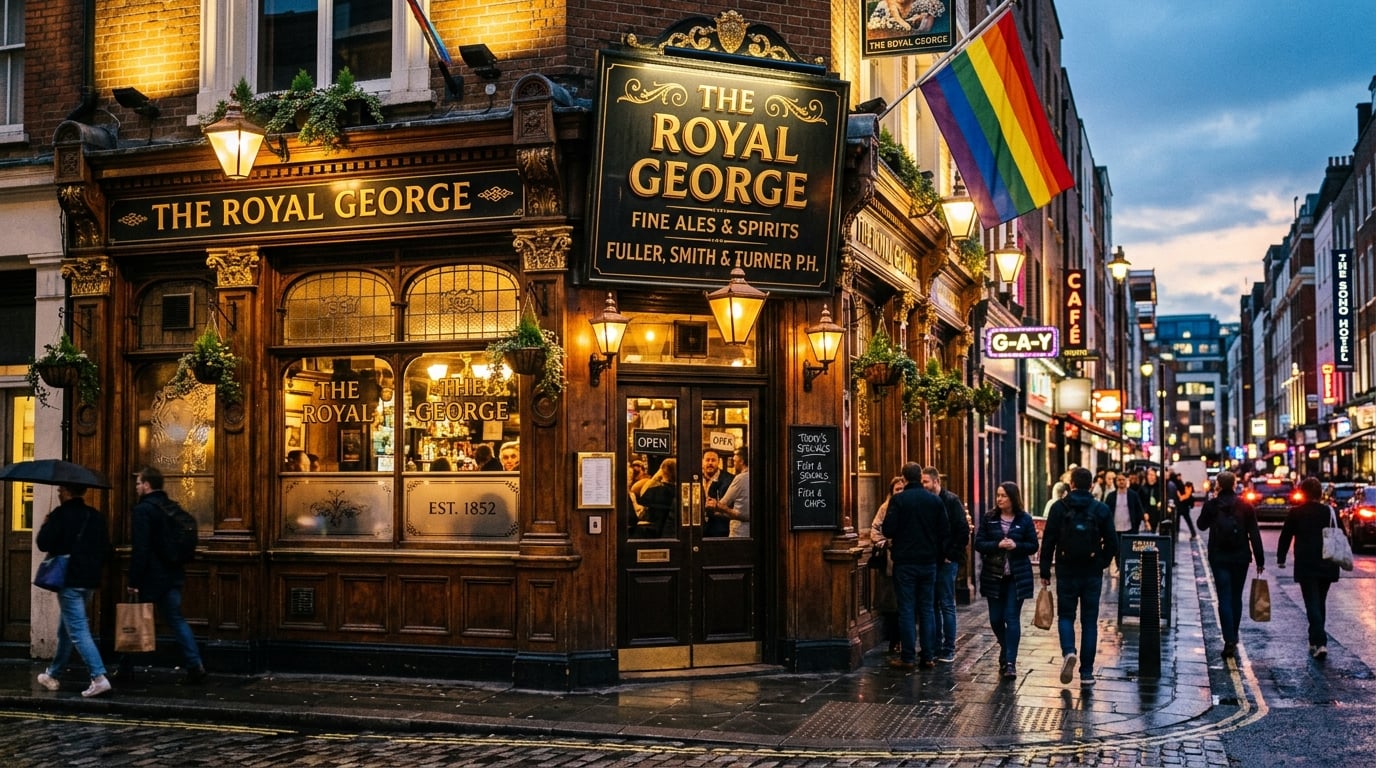
Comptons of Soho is a historic gay pub at 51-53 Old Compton Street, serving as a cornerstone of London’s LGBTQ+ scene since June 1986. Known affectionately as the “Grand Dame of Queer Street,” it occupies a Victorian building that has hosted drinkers for over 130 years, making it one of the most culturally significant queer venues in the capital.
But the story of Comptons goes back much further than 1986. The building itself dates to 1890, and its reputation as a gathering place for those who lived outside the mainstream stretches back decades before it became an openly gay pub. Understanding that journey means understanding Soho itself, the shifting tides of acceptance, and the spaces that kept a community alive when the world offered nowhere else to go.
This is the story of how a Victorian hotel became one of London’s most beloved gay pubs, survived decades of social upheaval, and continues to pour pints on the most famous queer street in Britain.
Table of Contents
The Swiss Hotel: Where It All Began (1890)
The building that would one day become Comptons of Soho started life as the Swiss Hotel, constructed in 1890 by the architectural firm W. A. Williams and Hopton. It was designed in the grand Victorian pub style that defined much of Soho’s late nineteenth-century development, with ornate detailing and a commanding presence on Old Compton Street.
The design was significant enough to be featured in the Royal Academy exhibition of 1890, a prestigious showcase that highlighted the finest new architecture in Britain. The trade publication The Builder magazine also documented the building, noting its thoughtful layout and craftsmanship. This was not just another pub thrown up to serve the local trade. It was a statement piece.
At the heart of the design was a distinctive horse-shoe bar, a layout that encouraged conversation and created a natural flow for punters. The wood-panelled interior, which survives in modified form to this day, gave the space a warmth and intimacy that would later make it ideal as a community gathering point. Victorian pubs were built to last, and this one was built to be remembered.
For the first half of the twentieth century, the Swiss Hotel operated as a conventional Soho drinking establishment. Soho in those days was a neighbourhood of immigrants, artists, bohemians, and night owls, a place where respectability was optional and eccentricity was expected. The seeds of what would come later were already present in the soil.
The Swiss Tavern Era: Not Entirely Straight (1950s)
In the 1950s, the building was renamed the Swiss Tavern, and something began to shift. The pub developed a reputation that historians have described as “not entirely straight.” In an era when homosexuality was still criminalised in Britain, this coded reputation meant everything. Gay men learned to read the signals, to know which doors were open to them, even when those doors could not openly say so.
The Swiss Tavern became one of those semi-hidden havens where men could gather, drink, and exist in something approaching freedom. It was not a gay bar in the way we understand the term today. There were no rainbow flags or explicit marketing. But within Soho’s network of queer-friendly spaces, the Swiss Tavern earned its place as somewhere you could bring a friend, or a date, without the constant threat of exposure.
This was the era that drew some of the most famous names in British cultural life through its doors. Dylan Thomas, the legendary Welsh poet, was a regular in Soho’s pubs, and the Swiss Tavern was among his haunts. Local lore holds that Thomas worked on drafts of Under Milk Wood while drinking in Soho establishments, and the manuscript’s journey through the pubs of the neighbourhood has become part of the area’s mythology.
Brian Howard, the poet and aesthete who inspired Evelyn Waugh’s character Anthony Blanche in Brideshead Revisited, was another figure associated with the venue. Derek Jarman, the visionary filmmaker and gay rights activist, would later become one of the most notable regulars, drawn to Soho’s countercultural energy. These were not just customers. They were the cultural architects of an England that was slowly, painfully learning to acknowledge its queer citizens.
The Birth of Comptons of Soho (1986)
In June 1986, the Swiss Tavern was reborn as Comptons of Soho. This was not merely a rebranding. It was a declaration. At a time when AIDS was devastating gay communities and tabloid newspapers were running homophobic campaigns, Comptons opened as an explicitly queer venue on Old Compton Street.
Some sources place the transition slightly earlier, around 1983 or 1984, reflecting the gradual nature of the change. What is clear is that by 1986, Comptons was operating as an openly gay pub, and it quickly established itself as a landmark. It was among the first venues on Old Compton Street to be openly and unapologetically gay, helping to transform the street into the recognised gay village it is today.
The timing was significant. The 1980s were one of the darkest periods for LGBTQ+ people in Britain. Section 28, which prohibited the “promotion of homosexuality” by local authorities, would arrive in 1988. The AIDS crisis was at its peak. Hate crimes were common. Into this climate, Comptons offered something radical: a visible, public space where gay men could gather without pretending to be anything other than who they were.
The early years were not easy. Opening an openly gay pub in the 1980s meant facing hostility from some quarters and the constant threat of violence. But the community rallied. Regulars became like family. The bar staff knew your order. The horse-shoe bar that had served Victorian drinkers now served a different kind of community, one that desperately needed a place to call home.
Old Compton Street and the Heart of Soho’s Gay Village
You cannot tell the story of Comptons without telling the story of Old Compton Street itself. The street had been a hub of bohemian and theatrical life for decades, but it was the emergence of openly gay venues like Comptons that turned it into the recognised centre of London’s LGBTQ+ community.
By the 1990s, Old Compton Street was synonymous with gay London. Cafe tables spilled onto the pavement in summer. Rainbow flags hung from lampposts. Comptons, with its prominent corner position, was the street’s anchor, the place where nights began and ended, where you met friends and made new ones.
The street’s significance made it both a beacon and a target. In April 1999, a nail bomb was detonated at the Admiral Duncan pub, just a short walk from Comptons on the same street. The attack, carried out by a neo-Nazi, killed three people and injured dozens more. It was aimed directly at Soho’s LGBTQ+ community, and it sent shockwaves through every venue in the area.
Comptons, like every gay pub in Soho, felt the impact. Regulars lost friends. The street that had felt like a sanctuary suddenly felt exposed. But the response was defiance. In the days and weeks that followed, the community refused to be driven underground. Crowds gathered. Comptons stayed open. The Grand Dame of Queer Street did not close her doors.
Through the Storm: Comptons During the AIDS Crisis
No chapter of Comptons’ history is more important than its role during the AIDS crisis. From the mid-1980s through the 1990s, HIV and AIDS swept through London’s gay community with devastating force. Friends, partners, colleagues, and beloved regulars were lost. Funerals became a regular occurrence. The grief was immense and largely unacknowledged by mainstream society.
In this darkness, venues like Comptons became more than pubs. They became lifelines. They were places where you could talk openly about what was happening, share information about treatment and support, and grieve without having to explain yourself. They were collection points for fundraising efforts, meeting places for activist groups, and sanctuaries for people who had nowhere else to turn.
The pub world of 1980s and 1990s gay Soho functioned as a parallel support network. When the government was slow to respond and the medical establishment was often hostile or ignorant, community spaces filled the gap. Comptons, with its long history and loyal following, was at the centre of that effort.
Many of the regulars from that era are gone now. But the pub remembers them in the way that old buildings do, through the layers of laughter and loss embedded in wood-panelled walls that have witnessed everything. This aspect of Comptons’ story has gone largely untold in existing coverage, but it is perhaps the most essential part of its legacy.
The Grand Dame of Queer Street: Cultural Legacy
The nickname “Grand Dame of Queer Street” is said to have originated in QX Magazine, a London LGBTQ+ publication that chronicled the city’s queer scene. It is a fitting title. A grand dame is someone who has seen it all, survived it all, and still holds court with grace and authority. That is Comptons.
The pub celebrated its 20th anniversary in 2006, an event that brought together generations of regulars. Older men who had been coming since the Swiss Tavern days stood alongside younger crowds who had only known Comptons as a Soho institution. The anniversary was a reminder of how rare it is for a gay venue to survive two decades, let alone thrive.
Pride celebrations have always been a highlight of the Comptons calendar. Every summer, when London Pride brings hundreds of thousands of people to the streets, Comptons becomes a focal point. The crowds spill onto the pavement. The atmosphere is electric. For one weekend, the Grand Dame hosts the biggest party in queer Britain.
The venue has also been referenced in literature, television, and documentary coverage of London’s LGBTQ+ history. It is the kind of place that writers mention when they want to establish authenticity, because mentioning Comptons immediately signals to readers that you know Soho.
Comptons Today: What to Expect in 2026
Comptons is currently operated by the Faucet Inn pub company, which manages several venues across London. The building retains its two-bar layout, with a ground floor bar featuring the historic horse-shoe counter, and an upstairs lounge area that hosts a range of events.
The ground floor bar is the social heart of the venue. It draws a mixed crowd of local regulars, tourists exploring Soho’s gay scene, after-work drinkers, and pre-club groups. The wood-panelled interior and traditional pub feel create a contrast with the more polished, design-led venues that have sprung up around it. Some love that contrast. Others wish for an update. The debate itself is part of what keeps Comptons relevant.
Upstairs, the lounge hosts DJ nights, cabaret performances, and live sports screenings. These events bring in different crowds on different nights, giving the venue a varied rhythm across the week. Cabaret nights draw performers and audiences who appreciate the intimacy of a smaller room. Sports screenings, particularly for major events, turn the lounge into a communal viewing party.
Online forums and community discussions paint a nuanced picture of the modern Comptons experience. Long-time regulars speak with nostalgia about the pub’s heyday, when crowds drank on the street outside and the atmosphere felt electric. More recent visitors have offered mixed feedback about service and staffing. Like many historic venues, Comptons faces the challenge of honouring its past while meeting contemporary expectations.
What remains consistent is the recognition that Comptons is an institution. Even critics acknowledge its importance to Soho’s identity. You do not have to love every visit to understand what the place means. For many LGBTQ+ visitors to London, walking through the doors of Comptons is a pilgrimage, a connection to a history that stretches back before they were born.
The Fight for LGBTQ+ Spaces: Gentrification and the Future
London has lost more than half of its LGBTQ+ venues since 2006, according to research from UCL. Rising rents, redevelopment, and changing social habits have all contributed to the decline. Each closure is not just the loss of a business. It is the loss of a meeting place, a safe space, a piece of community infrastructure.
Old Compton Street has not been immune to these pressures. Chain restaurants and corporate bars have moved in. Property prices have soared. The street remains the heart of gay Soho, but its character is constantly under negotiation. Comptons, with its listed building status and decades of trading history, has so far weathered the storm.
Its survival matters because these spaces are not interchangeable. A generic bar with a rainbow sticker in the window is not the same as a venue with forty years of community memory baked into its walls. Comptons represents continuity. It tells LGBTQ+ people that they have a history here, that they belong, that this neighbourhood was shaped in part by people like them.
The fight to preserve queer venues is really a fight to preserve community. Organisations like the LGBTQ+ charity Stonewall and community advocacy groups have highlighted the importance of physical spaces in an increasingly digital world. Comptons, as one of the oldest surviving gay pubs in London, stands as both a symbol and a practical example of what is worth fighting for.
FAQs
What is Comptons of Soho known for?
Comptons of Soho is known as the ‘Grand Dame of Queer Street,’ one of London’s oldest and most culturally significant gay pubs. Located at 51-53 Old Compton Street, it has been a cornerstone of the city’s LGBTQ+ scene since 1986 and occupies a Victorian building dating back to 1890.
What is the history of the Comptons Soho?
The building was constructed in 1890 as the Swiss Hotel, designed by W. A. Williams and Hopton and featured in the Royal Academy exhibition that year. In the 1950s it became the Swiss Tavern, known as ‘not entirely straight.’ In June 1986 it was reborn as Comptons of Soho, one of the first openly gay pubs on Old Compton Street.
Is Comptons of Soho a gay bar?
Yes, Comptons of Soho is an explicitly gay pub. It has operated as an openly LGBTQ+ venue since 1986, when it was transformed from the Swiss Tavern into Comptons. It serves a primarily gay male crowd but welcomes all visitors.
When did Soho become a gay area?
Soho began emerging as a centre of London’s LGBTQ+ life in the mid-twentieth century, with semi-hidden queer-friendly venues operating from the 1950s onwards. The area became an openly recognised gay village in the 1980s and 1990s, helped by venues like Comptons opening explicitly gay premises on Old Compton Street.
What famous people went to Comptons of Soho?
The building, dating to its Swiss Tavern era, was frequented by poet Dylan Thomas, who is linked to the local lore surrounding the Under Milk Wood manuscript. Filmmaker and activist Derek Jarman was a notable regular, as was the poet Brian Howard, who inspired a character in Evelyn Waugh’s Brideshead Revisited.
Is Comptons of Soho worth visiting?
Comptons is worth visiting for anyone interested in London’s LGBTQ+ history and queer culture. The pub offers a traditional wood-panelled atmosphere, two bars including an upstairs lounge with DJ nights and cabaret, and a location at the heart of Old Compton Street. It remains a landmark destination for both locals and tourists.
Conclusion
Comptons of Soho is more than a pub. It is a living record of London’s LGBTQ+ history, built into the very fabric of a Victorian building that has stood on Old Compton Street since 1890. From its origins as the Swiss Hotel to its years as the quietly queer Swiss Tavern, through its 1986 rebirth as an openly gay venue and its decades at the heart of Soho’s community, the Grand Dame of Queer Street has earned her title.
The building has weathered the AIDS crisis, the Admiral Duncan bombing, the forces of gentrification, and the changing tides of gay life in London. It still stands. It still serves. And for anyone who cares about the places that shaped modern queer Britain, it is still worth a visit. Raise a glass to the story of Comptons of Soho, because it is still being written.