
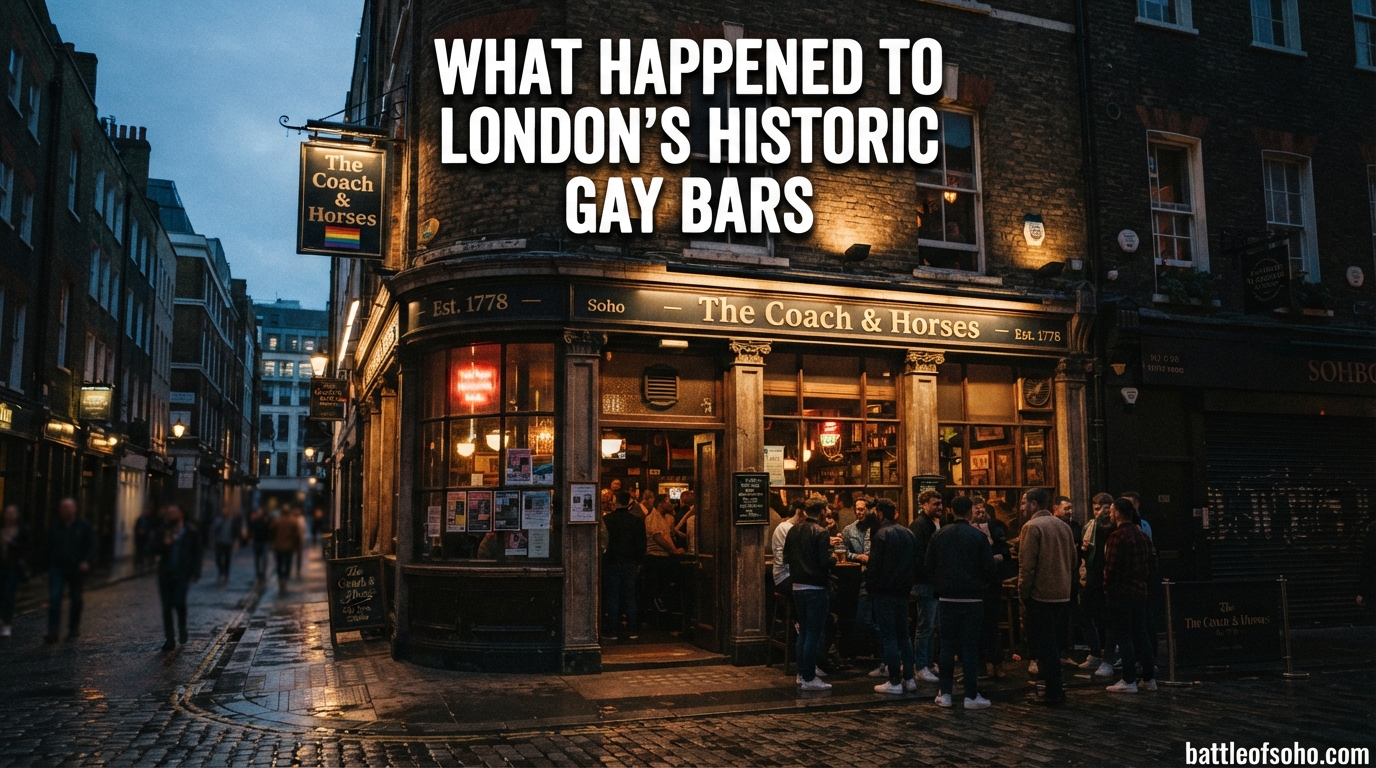
London’s historic gay bars declined dramatically over the past two decades due to a combination of soaring commercial rents, aggressive gentrification of Soho and Vauxhall, property redevelopment, and shifting social habits including dating apps and mainstream venue integration. Research from UCL’s Urban Laboratory found that London lost over half its LGBTQ+ venues between 2006 and 2017, dropping from 125 to fewer than 50. Iconic spaces like the G-A-Y bar, The Black Cap, and the Joiners Arms closed under pressure from developers, rising costs, and changing nightlife economics. The closures represent not just a loss of businesses but the erosion of community safe spaces that shaped queer identity in the capital for generations.
If you have walked through Soho in 2026 and felt something was missing, you are not imagining it. The streets that once buzzed with queer life, drag performances, and late-night camaraderie have grown noticeably quieter. Venues that operated for decades as sanctuaries for LGBTQ+ Londoners have vanished, replaced by chain restaurants, luxury flats, and corporate retail spaces.
Our team has spent months tracing the history of London’s gay bar scene, speaking with venue regulars, studying closure records, and examining the economic forces behind the decline. What we found is a story of resilience, loss, and a community fighting to hold on to spaces that once defined what it meant to be queer in London.
Understanding what happened to London’s historic gay bars means understanding how a city treats its most vulnerable communities when property values soar. It is a story about more than nightlife. It is about identity, belonging, and the physical spaces where marginalized people built lives when the rest of the world told them they did not matter.
Table of Contents
Before Liberation: London’s Underground Gay Bars Before 1967
Long before homosexuality was decriminalised in England and Wales, London had a thriving but deeply hidden queer nightlife. These were not the proud, neon-lit venues of Soho’s later golden age. They were whispered-about rooms behind unmarked doors, where men gathered knowing that discovery meant arrest, public ruin, or worse.
The Victorian and Edwardian eras saw periodic crackdowns on what authorities called “gross indecency.” Venues like the Cafe Royal on Regent Street became known as places where queer men might spot each other, though never openly. Polari, the secret slang language used by marginalized communities including queer men, circus performers, and sex workers, allowed people to communicate without alerting outsiders. A simple phrase like “vada the bona eek” meant “look at the beautiful face,” and it could signal recognition across a crowded room without raising suspicion.
Raids were a constant threat. The police treated gay gathering spaces as dens of criminality rather than communities of people seeking connection. Men caught in raids faced public exposure, loss of employment, and imprisonment. Despite these risks, queer Londoners continued to gather, creating networks of pubs, private clubs, and underground parties that sustained community through decades of persecution.
Post-war London saw a slow loosening of social attitudes, but queer venues still operated in a legal grey zone. The Wolfenden Report of 1957 recommended decriminalising homosexuality, but it took a full decade for Parliament to act. In those intervening years, venues like the Salisbury on St Martin’s Lane became known as gathering spots, operating under constant surveillance and the ever-present threat of a police raid.
The 1967 Decriminalisation and What It Changed
The Sexual Offences Act 1967 partially decriminalised homosexuality in England and Wales for men over 21 acting in private. It was a landmark moment, but it did not transform London’s gay bar scene overnight. The law was limited, exclusionary, and left many people still vulnerable to prosecution. Men under 21, members of the armed forces, and anyone behaving “in public” remained criminalised.
What the Act did change was the atmosphere of possibility. Venue owners who had operated in the shadows began to feel a cautious optimism. Pubs and clubs that had quietly served queer clientele started to acknowledge their role more openly. The decriminalisation did not create London’s gay bars, but it allowed them to breathe. Over the following decade, establishments that had been whispered about became destinations, and a new generation of venue owners began investing in spaces designed specifically for LGBTQ+ customers.
The earliest openly gay venues still faced discrimination, licensing battles, and harassment. But the legal shift created the foundation for what would become Soho’s legendary queer district. Without the 1967 Act, the golden age of London’s gay scene could not have happened.
Soho’s Golden Age: 1970s to 1990s
By the 1980s, Soho had established itself as the beating heart of London’s gay scene. Old Compton Street became the symbolic centre, lined with pubs, bars, and clubs that served a community hungry for visible, joyful spaces. This was the era that defined what London gay bars meant to a generation.
The Admiral Duncan, a pub on Old Compton Street, became one of the most famous gay venues in the country. Comptons of Soho, still standing today, drew crowds with its traditional pub atmosphere mixed with a proudly queer clientele. The Village, G-A-Y, and dozens of smaller venues created a dense ecosystem where you could bar-hop all night without leaving a few square blocks.
What made Soho special was not just the concentration of venues. It was the sense of community. These bars were where people came out, met partners, found chosen families, and organised politically. During the AIDS crisis of the 1980s and 1990s, Soho’s gay bars became centres of mutual aid, grief, and activism. They hosted fundraisers, distributed information, and provided spaces where people could process trauma together.
Earl’s Court had its own thriving scene during this period, sometimes called London’s other gay village. Venues like The Coleherne and The South Yorkshire attracted a different crowd, often more working-class and leather-orientated. The diversity of scenes across different neighbourhoods gave London one of the richest queer nightlife landscapes in the world.
By the late 1990s, Soho was at its peak. G-A-Y, founded by Jeremy Joseph, had grown from a single club night into a multimedia brand. Venues were packed every night of the week. The sense that queer people had claimed a piece of London as their own felt permanent and unshakeable.
What Happened to London’s Historic Gay Bars: The Decline Begins
The story of decline did not happen overnight, and no single factor caused it. Instead, a combination of economic, social, and cultural forces converged to hollow out the scene that had taken decades to build. Understanding what happened to London’s historic gay bars requires looking at each of these forces.
Rising commercial rents were the first and most devastating pressure. As Soho became desirable to mainstream businesses, landlords realised they could charge premium rates for prime locations. A gay bar that had paid a modest rent for decades suddenly faced renewal terms that doubled or tripled their costs. Many venues operated on thin margins, relying on loyal regulars rather than high-spending corporate clients. When rents spiked, there was no financial cushion to absorb the shock.
Gentrification transformed Soho from a bohemian, slightly gritty neighbourhood into a premium retail and residential district. The character that had made it attractive to queer venues, its tolerance of the unconventional and its relatively affordable commercial spaces, was exactly what developers wanted to erase. Luxury apartments, upscale restaurants, and corporate offices replaced the independent venues that had given the area its soul.
Property development deals proved fatal for many venues. Some bars sat in buildings owned by developers with long-term plans for demolition and rebuilding. Even when a venue was profitable, a landlord who wanted to redevelop the site could simply refuse to renew a lease. The Joiners Arms in Hackney closed in 2015 when its building was sold for redevelopment, despite fierce community opposition. The Royal Vauxhall Tavern fought a similar battle, eventually securing its future as an asset of community value, but only after years of campaigning.
Here is a timeline of some of the most significant closures that reshaped London’s gay bar landscape:
- 2008 – The Black Cap in Camden, a legendary cabaret venue, faced its first major closure battle.
- 2014 – The Joiners Arms in Hackney closed after the building was sold to developers.
- 2015 – The Black Cap closed its doors after 50 years, despite protests and campaigns.
- 2016 – The Madame Jojo’s in Soho closed following a licensing review.
- 2017 – UCL Urban Laboratory research revealed London had lost over 50% of its LGBTQ+ venues in a decade.
- 2024 – G-A-Y Late closed, with owner Jeremy Joseph citing accessibility issues, safety concerns, and building works.
- 2026 – Community groups continue reporting further losses and venue pressures across the capital.
Each closure represented more than a business shutting down. Regulars lost their social anchors. Drag performers lost stages. Older LGBTQ+ people lost the only spaces where they felt truly comfortable. The cumulative effect was the fragmentation of a community that had once been geographically concentrated and culturally cohesive.
Vauxhall’s Rise and the Shift South
As Soho became increasingly commercialised and expensive, Vauxhall emerged in the early 2000s as London’s alternative gay district. The area had industrial spaces, lower rents, and a growing cluster of venues that offered something different from Soho’s pub-and-bar model. Vauxhall was about clubs, late nights, and a harder-partying scene.
Venues like the Royal Vauxhall Tavern, Duckie, and later the Eagle created a distinctly different atmosphere. The RVT, as it is universally known, has hosted cabaret, drag, and queer performance since the 1940s, making it one of the oldest continuously operating queer venues in the world. Duckie, a Saturday night institution, blended pub culture with avant-garde performance art.
The shift south reflected broader changes in how queer people socialised. Soho’s traditional pub model appealed to an older generation, while younger LGBTQ+ people gravitated toward club culture and larger events. Vauxhall filled that gap, but it too faced pressure. The construction of the American Embassy nearby, the redevelopment of the Vauxhall area, and rising property values began threatening venues that had seemed secure.
Crossrail construction and ongoing infrastructure projects disrupted several venues, with building works making access difficult and deterring customers. The Royal Vauxhall Tavern’s battle against redevelopment became a flashpoint for community activism, demonstrating that no venue was truly safe from property market pressures.
The Numbers Behind the Closures
The most comprehensive research into London’s LGBTQ+ venue closures comes from UCL Urban Laboratory, which has been tracking the data for years. Their findings paint a stark picture of decline that goes far beyond anecdotal impressions of a quieter Soho.
In 2006, London had approximately 125 LGBTQ+ venues. By 2017, that number had fallen to fewer than 50, representing a loss of over 50% in just over a decade. The rate of closure accelerated in the 2010s, with an average of several venues shutting each year. Some years were particularly brutal, with clusters of closures hitting specific neighbourhoods.
The losses were not evenly distributed. Soho and Earl’s Court suffered the heaviest losses proportionally. Earl’s Court, once home to a distinct gay village, saw its scene virtually disappear entirely. Venues like The Coleherne and The South Yorkshire closed, and nothing comparable replaced them. Soho retained more venues but lost much of its density and character.
Compared to other nightlife sectors, LGBTQ+ venues closed at a disproportionately high rate. General pubs and bars also faced challenges from the 2008 financial crash, changing drinking habits, and the smoking ban. But queer venues had additional vulnerabilities: smaller customer bases, dependence on specific neighbourhoods, and the reluctance of some mainstream lenders and investors to back LGBTQ+ businesses.
The research also revealed that losses continued even as awareness grew. Community campaigns, media coverage, and political promises to protect queer spaces did not reverse the trend. Each year brought new closures, and the remaining venues operated under constant threat.
Why Are Gay Bars Closing: The Real Reasons
Beyond the headline causes of rent and gentrification, several interrelated factors have driven the decline of London’s gay bars. Our research into forum discussions, community testimony, and venue owner statements reveals a more nuanced picture than simple economics.
Dating apps reduced footfall. The rise of Grindr, Tinder, and other dating platforms changed how queer people meet. Where gay bars once served as the primary way to connect with potential partners, apps made it possible to meet without leaving home. This was particularly significant for younger LGBTQ+ people and those outside central London. Venue owners across multiple forums reported noticeable drops in weeknight attendance correlating with the growth of app culture.
Mainstream venues became more accepting. As social attitudes shifted, many LGBTQ+ people felt comfortable socialising in mixed or straight venues. The need for dedicated safe spaces did not disappear, but the urgency diminished for some. This integration was a sign of progress, but it had an unintended consequence: gay bars lost customers to venues that did not carry the same overhead or community mission.
Safety and accessibility challenges mounted. Venue owners like Jeremy Joseph of G-A-Y cited specific operational pressures that made running queer spaces untenable. Accessibility issues, safety concerns from aggressive behaviour outside venues, and relentless building works surrounding properties all contributed. Joseph’s decision to close G-A-Y Late was met with an outpouring of grief on Reddit’s r/london community, where users described “growing concern for queer nightlife” and lamented the loss of another institution.
Generational shifts in socialising. Younger LGBTQ+ people socialise differently than previous generations. They are more likely to attend pop-up events, warehouse parties, and queer collectives that operate outside the traditional bar model. These ephemeral spaces offer flexibility and lower overheads, but they do not provide the permanent, visible presence that traditional gay bars offered. The result is a nightlife landscape that is vibrant in moments but lacks the persistent community infrastructure of earlier decades.
Business model pressures. Many gay bars were small businesses with limited financial reserves. They depended on consistent weekly trade, and any disruption could be catastrophic. Rising minimum wages, increased licensing fees, insurance costs, and utility bills all squeezed margins. When a landlord demanded a rent increase, there was often no room to absorb it.
London’s Surviving LGBTQ+ Venues Today
Despite the losses, London still has LGBTQ+ venues, and some are thriving. The surviving spaces are a mix of historic institutions and newer establishments that have found ways to adapt to the challenging landscape. Supporting these venues is how the community ensures queer spaces survive into the future.
Comptons of Soho remains open on Old Compton Street, continuing a tradition that spans decades. The Admiral Duncan, also on Old Compton Street, survived both the 1999 nail bombing and decades of commercial pressure. The Royal Vauxhall Tavern continues to host cabaret and drag, buoyed by its status as an asset of community value. The Glory in Hackney has become a hub for drag and performance, carrying forward the spirit of venues that have closed.
A new wave of queer spaces has emerged in unexpected locations. Zodiac Bar in Soho offers karaoke and drag in a modern setting. Venues outside the traditional gay ghettos, in areas like Hackney, Peckham, and Bethnal Green, have created alternative scenes. These spaces often operate as part-time queer nights rather than dedicated gay bars, reflecting the shift toward event-based socialising.
Community-led initiatives have also stepped into the gap. Organisations like LGBTQ+ nightlife advocacy groups, queer collective nights, and fundraising campaigns for threatened venues have mobilised to protect what remains. The campaign to save the Royal Vauxhall Tavern demonstrated that organised community action can make a difference, even against powerful development interests.
Where Do Older LGBTQ+ Londoners Go Now?
One of the most overlooked impacts of gay bar closures is on older LGBTQ+ people. For generations who came of age when being openly queer carried enormous risk, dedicated gay spaces were lifelines. The loss of traditional pub environments has left many older gay men and lesbians wondering where they belong in the modern scene.
Forum discussions on Reddit and Facebook reveal genuine anxiety about this question. Users describe feeling unwelcome in younger, louder, club-oriented venues. Accessibility issues, including stairs, lack of seating, and loud music, make many spaces difficult for older patrons. The traditional pub model, with its sit-down atmosphere and conversation-friendly environment, suited an older demographic that newer venues often do not serve.
The closure of venues like The Black Cap, which had an older, regular clientele, removed spaces where generations mixed. Older patrons worry that without these bridging venues, younger LGBTQ+ people lose connection to their community’s history, and older people lose their social networks.
FAQs
Why did G-A-Y bar London close?
G-A-Y Late closed in 2024 when owner Jeremy Joseph cited multiple pressures including accessibility issues, safety concerns from surrounding area activity, and consistent building works that disrupted operations. Joseph stated these external pressures made the venue unsustainable despite strong customer support.
How many gay bars has London lost?
According to UCL Urban Laboratory research, London lost over 50% of its LGBTQ+ venues between 2006 and 2017, dropping from approximately 125 venues to fewer than 50. Closures have continued since, with community groups tracking ongoing losses each year.
What is the oldest gay bar in London?
The Royal Vauxhall Tavern claims to be one of the oldest continuously operating queer venues in the world, hosting LGBTQ+ entertainment since the 1940s. Comptons of Soho, established in its current form in the 1980s, is among the oldest surviving gay pubs in Soho.
Is London’s gay scene dying?
London’s traditional gay bar scene has contracted significantly, but queer nightlife persists in new forms. While dedicated gay pubs have declined, pop-up events, queer collectives, and alternative venues continue. The scene is changing rather than disappearing entirely, though the loss of permanent community spaces remains a serious concern.
What caused the decline of gay nightlife in London?
The decline stems from multiple factors: soaring commercial rents, gentrification of Soho and Vauxhall, property redevelopment, the rise of dating apps reducing bar visits, greater social acceptance allowing LGBTQ+ people to use mainstream venues, and generational shifts toward event-based socialising over traditional pub culture.
Which London gay bars are still open?
Surviving venues include Comptons of Soho, The Admiral Duncan, The Royal Vauxhall Tavern, The Glory in Hackney, and Zodiac Bar in Soho. Newer spaces and queer nights operate across Hackney, Peckham, and other areas, though the overall number of dedicated LGBTQ+ venues remains far below its peak.
The Future of London’s Queer Nightlife
What happened to London’s historic gay bars is a story of loss, but it is not only a story of loss. It is also about a community that continues to adapt, organise, and create spaces despite enormous pressure. The venues that survive do so because of loyal patronage and visible community support. The Royal Vauxhall Tavern stands today because hundreds of people campaigned to protect it.
The future of London’s LGBTQ+ nightlife will likely look different from its past. Traditional gay bars may continue to decline, but queer events, collectives, and community-organised spaces are filling gaps. The challenge is ensuring these new models provide the same permanence, visibility, and accessibility that dedicated venues once offered.
If we want to understand what happened to London’s historic gay bars, we have to recognise that their loss was not inevitable. It resulted from specific policy choices, property market dynamics, and community priorities. Changing those outcomes means changing how cities value spaces that serve marginalised communities. It means showing up, spending money at surviving venues, and supporting campaigns that protect queer heritage.
The next time you walk down Old Compton Street, look at the venues that remain. Each one is a survivor. Each one carries decades of history, community, and resistance. Whether they survive another decade depends on whether the community that needs them shows up to keep them alive.